Department of Civil Engineering & MBA, Loyola Institute of Technology, Chennai, Tamilnadu, India
Self Cured Flyash Brick by Forming
Geopolymer
R.K.Logeshwaran1, A.Aravindhan2, L.Subbaraj3
UG Student, Department of Civil Engineering, Karpaga Vinayaga College of Engineering and Technology,
Madurantakam, India12
Head of Department, Department of Civil Engineering, Karpaga Vinayaga College of Engineering and Technology,
Madurantakam, India3
ABSTRACT: A brick is building material used to make walls, pavement and other elements in construction industry.
Fly ash brick technology is a process of converting the industrial waste materials into quality bricks. The advantages of using flyash brick is the brick carries good compressive strength and better thermal insulation than other fire clay bricks. One of the important ingredient of flyash brick is GGBFS. Because it act as a binding material and increase the strength of brick. However due to increased use of brick in almost all type of construction work leads to the demand of river sand. Here the use of manufactured sand compensate the demands and also increases the compressive strength. In this study an attempt has to be made to replace the river sand with the manufactured sand and copper slag in 70%,75%,80% and 20%,25%,30%. In this study flyash brick is self cured by forming geopolymer with the addition of alkaline solution.
KEYWORDS: Flyash, GGBFS, Copper slag, M sand, Alkaline solution, geo polymer.
I. INTRODUCTION
Flyash brick is a building material, specifically masonry unit consists of class F flyash in major quantity and GGBS. Flyash is useful by product from the thermal power station and it has the considerable pozzolanic activity. During the formation of coal, clay is entrapped through natural process. During the combustion, carbon is burnt leaving the incombustible clay particles as ash. This national resource has been gainfully utilized and act as a supplement to the common burnt clay brick leading to the conservation of natural resource and preventing the environment.
Fly ash brick are generally made by adding various raw materials like GGBS, copper slag and M sand in various proportion and then moulded into bricks and subjected to different curing cycles at room temperature. Copper slag is used to control the water absorption capacity and increases the strength. A number of studies are going in india as well as abroad to study the impact of use of these pozzolanic materials. The flyash brick is a chemically bonded brick. These bricks are suitable for use in construction industry just common as the conventional brick. Flyash when react with alkaline solution it forms a geopolymer act as a bonding agent and increases the strength of brick.
1.1 OBJECTIVES:
To manufacture the eco friendly self cured flyash brick
To increase the compressive strength of brick
Department of Civil Engineering & MBA, Loyola Institute of Technology, Chennai, Tamilnadu, India
To reduce the usage of water
II.MATERIALS USED
The materials used in the study are explained below
BINDER
Fly ash ( class F )
Ground granulated blast furnace slag
AGGREGATE
Copper slag
Manufactured sand
LIQUID FOR CURING
Alkaline solution
III.MATERIAL PROPERTIES
3.1 CLASS F FLYASH
Class F flyash is designated in ASTM C 618 and originates from anthracite and bituminous coal. It consists mainly of alumina and silica and has a higher LOI than class F flyash. Class F flyash has lower calcium content than class C flyash. The class F flyash is pozzolanic in nature and contain less than 20% lime. The class F flyash contains about 70% pozzolanic compounds(silica oxide, alumina oxide and iron oxide). To attain pozzolanic property the class F flyash needs cementing agent such as Portland cement when reacted with water it produces a cementitious compound. Adding sodium silicate to the class F flyash forms a geopolymer.
PARAMETERS FLY ASH
Bulk density(gm/cc) 0.9-1.3
Specific gravity 1.6-2.6
Plasticity Lower or non plastic
Shrinkage limit(vol Higher
stability)
Department of Civil Engineering & MBA, Loyola Institute of Technology, Chennai, Tamilnadu, India
3.2 GGBFS(Ground granulated blast furnace slag)
Ground granulated blast furnace slag is obtained by quenching molten iron slag(a by-product of iron and steel making)from a blast furnace in water or steam, to produce a glassy, granular product that is then dried and ground into a fine powder
S.NO CHARACTERISTICS PERCENTAGE
1 Fineness(m2/kg) 412
2 Particle size(cumulative %) 94.25/100
3 Insoluble residue 0.23
4 Moisture content 0.14
3.3 M SAND
The M sand is free from elongated and flaky particles since it is shaped cubically using VSI shaping machine. The cubically shaped particles give high strength and long life. Original M sand is manufactured strictly adhering to IS 383 (1970) zone II grading. Perfect grading and cubical shape of M sand provide 25-30% more strength for masonry works compared to crusher dust. Original M sand has two grades for concreting and plastering.
3.4 COPPER SLAG
Copper slag is a by-product of copper extraction by smelting, impurities become slag which floats on the molten metal. Slag that is quenched in water produce angular granules which are disposed of as waste. The granulated slag(<3 mm size fraction) has both insulating and drainage properties which are used to avoid ground frost in winter which in turn prevents pavement cracks. The properties of copper slag is explained below
S.NO COMPOSITION % By MASS
1 Fe2O3 55-60
2 Fe3O4 <10
3 SiO2 27-33
4 CaO 1-3.5
5 S 0.2-1.5
6 Cu <1
7 Al2O3 <3
8 Specific gravity 4.12
9 Bulk density(g/cc) 2.31
10 Fineness modulus 3.4
3.5 ALKALINE SOLUTION
The alkaline solution used for the experimental investigation are discussed below
Department of Civil Engineering & MBA, Loyola Institute of Technology, Chennai, Tamilnadu, India
Specification of sodium hydroxide flakes
MAXIMUM LIMITS OF IMPURITIES 96%
Carbonate 2%
Chloride 0.1%
Phosphate 0.001%
Silicate 0.02%
Sulphate 0.01%
Arsenic 0.001%
Iron 0.005%
Lead 0.001%
Zinc 0.02%
Specifications of sodium silicate liquid
S.NO CHARACTERISTICS SPECIFICATION
1 Na2O 15.5%+- 1
2 Na2O:SiO2 Ratio 1:2.2+-0.1 to 1:2.4+-0.1
3 Colour White liquid
4 Total solids 50%+-2%
IV. EXPERIMENTAL PROGRAMME
4.1 MATERIALS AND PROCUREMENT
The materials used in the project work and the source is given below
S.NO MATERIALS SOURCE
1 Fly ash ( class F) Balaji RMC plant, madurantakam.
2 GGBFS Astra chemicals, Chennai.
3 Copper slag Star trace private limited, Chennai.
4 M sand KVCET, madurantakam.
5 NaOH Micro fine chemicals, Chennai.
6 Na2SiO3 Super chemicals, Chennai.
4.2 PREPARATION OF ALKALINE SOLUTION
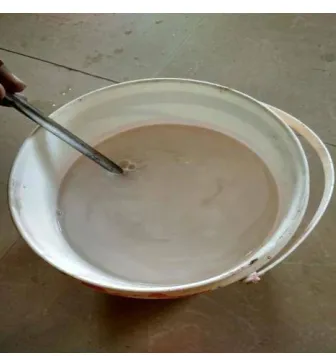
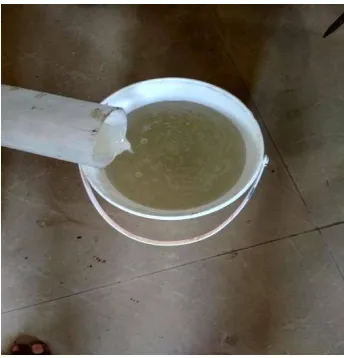
Dissolved water is used to make the alkaline solution to avoid the mineral interference. The alkaline solution is to be prepared 24 hours in advance before use. The sodium hydroxide to be used is in pellet form and sodium silicate in gel form. The mass of NaOH varies depends on the concentration of solution in terms of its molarity. For example if the concentration is 6M, the mass of NaOH is 240gms, where 40 is the molecular weight of NaOH.
Department of Civil Engineering & MBA, Loyola Institute of Technology, Chennai, Tamilnadu, India
component. The solution is normally soapy in nature and even a single drop of solution fall on the skin it may cause a skin irritation. Hence proper care should to be taken while handling the solution.
Fig 4.2(a)Adding sodium hydroxide to
dissolved H2O
Fig 4.2(c) Alkaline solution
CALULATION FOR MAKING ONE BRICK
The dimension of the brick is 23cmX11cmX7cm Volume of the brick is = 1.771X10⁻³m3
Mass of the brick if 3.5 Kg
Department of Civil Engineering & MBA, Loyola Institute of Technology, Chennai, Tamilnadu, India
Fluid to binder ratio = 0.3
Mass of aggregate for one brick = 2166.34 gms in various proportion.
Fig 4.2(b) Adding sodium silicate
4.3 CASTING OF BRICK:
The materials like flyash, GGBS, copper slag and M sand is mixed in dry condition and it is kept for kneading of about 3 to 4 mins. After this the alkaline solution is added to the dry mix and mix well upto its consistency. The mixture is allowed to fall into the mould and the mixture is compacted in three layers. Each layer 25 number of blows has to be given with the help of rammer. And finally the brick is demoulded and kept for self curing.
Department of Civil Engineering & MBA, Loyola Institute of Technology, Chennai, Tamilnadu, India
Fig 4.3(c) After demoulding
V. TEST FOR COMPRESSIVE STRENGTH
The compressive strength test is conducted to find the load bearing capacity of material. The compressive strength test is done by CTM for 3, 7, 14 and 28 days of self curing.
Fig 5 Test for compressive strength
5.1 RESULTS FOR COMPRESSIVE STRENGTH
TABLE 5.1 SHOWS THE COMPRESSIVE STRENGTH FOR 3RD AND 7TH DAYS.
S
S. A PERCENTAGE 3rd DAY 7TH DAY
NO M
P
L MSAND:COPPER LOAD COMPRESSIVE LOAD COMPRESSIVE
E FLYASH:GGBS SLAG IN STRENGTH IN STRENGTH
(KN) (N/mm2) (KN) (N/mm2)
1 S1 70:30 70:30 630 24 684 27.04
2 S2 70:30 75:25 848 33.5 950 37.5
Department of Civil Engineering & MBA, Loyola Institute of Technology, Chennai, Tamilnadu, India
TABLE 5.2 SHOWS THE COMPRESSIVE STRENGTH FOR 14TH AND 28TH DAYS.
S
S. A PERCENTAGE 14TH DAY 28TH DAY
NO M
P MSAND:COPPER LOAD COMPRESSIVE LOAD COMPRESSIVE
L FLYASH:GGBS SLAG IN STRENGTH IN STRENGTH
E
(KN) (N/mm2) (KN) (N/mm2)
1 S1 70:30 70:30 820 32.4 1088 43.04
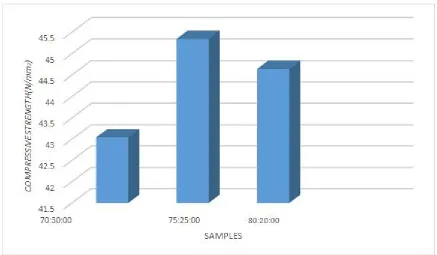
2 S2 70:30 75:25 996 39.4 1147 45.34
3 S3 70:30 80:20 860 34 1129 44.64
The proportion of flyash:GGBS = 70:30 gives better compressive strength compared to other proportions.
Department of Civil Engineering & MBA, Loyola Institute of Technology, Chennai, Tamilnadu, India
Line graph 5.4 shows the analysis of compressive strength at 3rd, 7th, 14th and 28th days.
50 45 )2 40 st re n g th (N /m m 35 30 25 C o m p re ss iv e 20 15 10 5 0
3rd day 7th day 14th day 28th day
SAMPLES
70:30:00 75:25:00 80:20:00
VI. CONCLUSION
Usage of river sand is avoided leads to the conservation of natural resources.
As per codal provision the minimum compressive strength for any class of flyash brick should not be less than 3.5
N/mm2 . The maximum compressive strength obtained for the flyash and GGBS percentages of 70 and 30 and for
the M sand and copper slag percentages of 75 and 25.
The maximum compressive strength obtained is 45.34 N/mm2.
REFERENCES
1. International journal on “Utilization of ground granulated blast furnace and pulverized fuel ash” by Venkatalakshmi yarlagadda and Beulah M.
2. International journal on “Development of coal ash-GGBS based geopolymer bricks” by bennet jose mathew. 3. International journal on “Effect of vermiculite, quarry dust and steel slag in self cured fly ash bricks” by PG Guruvelu and Dr. T suresh babu.