Excited lepton baryogenesis
Dmitry Zhuridov1,a
1Institute of Physics, University of Silesia, Uniwersytecka 4, 40-007, Katowice, Poland
Abstract.The excited leptons that share the quantum numbers with the Standard Model leptons but have larger masses are widespread in many promising new physics theories. A subclass of excited leptons that at low ener-gies interact with the SM fermions dominantly through the effective coupling to lepton and fermion-antifermion pair can be referred as leptomesons. I introduce possible generation of the baryon asymmetry of the universe using these new particles. The discussed baryogenesis mechanisms do not contradict to the small neutrino masses and the proton stability, and can be interesting for the collider experiments.
1 Introduction
In spite of the present success of the Standard Model (SM) several observations indicate its possible nonfundamen-tality: large number of the SM fermions, their arbitrary masses and mixings, fractional electric charge of quarks, etc. Among the diversity of new physics models the the-ories of compositeness [1–8] try to solve these problems by introducing a substructure of the SM particles, which subcomponents are commonly referred as preons [1]. The composite models may include in the particle content ra-dial, orbital, topological, structural, and other excitations of the ground state particles, e.g., anexcited leptonthat shares leptonic quantum number with one of the existing leptons, has larger mass and no color charge.
Besides the outlined issues on the particles and their interactions that come from the laboratory studies, an-other opened questions (including the dark matter prob-lem) arise from the astrophysical observations of the uni-verse around us. In particular, our uniuni-verse appears to be populated exclusively with baryonic matter rather than antimatter [9]. However this baryon asymmetry can not be explained within the Big Bang cosmology and the SM. Possible scenarios of dynamical generation of the baryon asymmetry during the evolution of the universe from a hot early matter-antimatter symmetric stage are referred as the baryogenesis (BG) mechanisms [10, 11], and include new physics.
In the next section we discuss one example of the com-posite models in question. The interactions and the mass bounds for the excited leptons are outlined in section 3, and the new BG scenarios that involve these particles are discussed in section 4. Finally, we conclude in section 5.
ae-mail: [email protected]
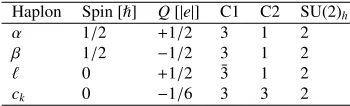
Table 1.The haplon quantum numbers
Haplon Spin [] Q[|e|] C1 C2 SU(2)h
α 1/2 +1/2 3 1 2
β 1/2 −1/2 3 1 2
0 +1/2 ¯3 1 2
ck 0 −1/6 3 3 2
2 Composite model example
Consider the haplon models [7, 12], which are similar to the earlier models with wakems and chroms [4, 13, 14], and are based on the symmetry SU(3)c×U(1)em×SU(N)h, where the new haplon group SU(N)h has the confine-ment scale of the order of 0.3 TeV, and denotes, e.g., SU(2)L×SU(2)R. These models contain the two categories of preons (haplons): the fermionsα+1/2 and β−1/2, and the scalars+1/2andc−1/6
k , wherek=r, g,b(“red, green, blue”). Their quantum number assignment is given in Ta-ble 1, whereQis the electric charge, C1 is the choice for the SU(3)crepresentations in Ref. [7]1and C2 is an alter-native choice [12]. Then the haplon pairs can compose the SM particles asν=(α¯),e−=(β¯),u=(αc¯k),d=(βc¯k),
W−=( ¯αβ),W3 =( ¯αα−ββ¯ )/√2,. . . , and the new parti-cles, e.g., a scalar leptoquarkS+2/3=(c¯k), and the neutral scalarsS0
=(¯) andS0c=(ckc¯k).W3mixes with the pho-tonγsimilarly to the mixing betweenγandρ0-meson.H scalar can be a p-wave excitation of theZ, and the second and third generations can be dynamical excitations. Notice thatS+2/3,S0candS0states (if their masses are small) may contribute to the low-energy observables, e.g., so-called, XYZ states [16].2
1Notice that C1 assignment does not provide a spin-charge separa-tion [15].
2Notice that the SM results can be reproduced in some composite models, at least at the tree level, due to the complementarity between Higgs phase and confining phase [17, 18].
However, new questions arise: Where does this pe-culiar haplon picture come from? Can it, in turn, re-sult from a substructure of haplons? Consider the two scalar “prepreons”3π
kand ¯πk, which are SU(3) triplets and have the electric charges of−1/6 and+1/6, respectively. Then the set of haplons with their electric and C2 color charges can be reproduced by the triples of “prepreons” ( ¯πr¯π¯g¯π¯b¯ → {α, },πrπgπb → {β,¯}, ¯π¯iπjπl → ck), while additional mechanism of spin generation is required. One can think of possible relation of spin to a circular color currents similarly to some discussions in the context of the condensed matter [20] and gravity [21] theories, taking into account that the distribution of matter in a composite state can be imagined (in particular, in the SU(3) Yang-Mills theory) in terms of the wave functions or probabil-ity distributions for the effective subcomponents of a finite size [22–25]. Then a “spinning” and “nonspinning” states of the same preon (e.g.,αand) may form a supersym-metric multiplet.
Notice that the possibility of multihaplon states such as (βc¯k¯ck), (αβ¯ ¯ckβ¯ck), etc., gets more points from recent discoveries of the multiquark hadrons [26].
3 Excited leptons
The excited lepton states defined in the introduction can be particularly important if their masses are smaller than the leptoquark and leptogluon masses, which can be natural due to the absence of the color charge. The contact inter-actions among the SM fermionsfand the excited fermions
f∗can be generically written as [9]
LCI=
g2 ∗ 2Λ2
α,β=L,R
ηαβ( ¯fαγμfα)( ¯fβγμfβ)
+η
αβ( ¯fαγμfα)( ¯fβ∗γμfβ∗)+η˜αβ( ¯fα∗γμfα∗)( ¯fβ∗γμfβ∗)
+η
αβ( ¯fαγμfα)( ¯fβ∗γμfβ)+H.c.+. . ., (1)
whereΛis the contact interaction scale,g2
∗=4π, and the new parameter values are usually taken of|ηj| ≤1.
Assuming nearly maximal couplings of|ηj| 1 and the excited fermion masses ofMf∗Λ, the present lower bounds forΛ/|ηj|ratios are of the order of few TeV [9]. However, if Eq. (1) expresses a “residue” effective inter-actions between the composites (with respect to the funda-mental interactions among their subcomponents) then|ηj| couplings can be small, and even the case ofMf∗ Λ< 1 TeV is not excluded for|ηj| 1 andΛ/|ηj|>>Mf∗.
A particular type of excited leptons that at low ener-gies interact with the SM fermions dominantly through the contact terms we refer asleptomesons(LM).4The rel-evant contact terms (withη couplings) can be realized, e.g., through the leptoquark exchange.
3For supersymmetric models with “prepreons” see, e.g., Ref. [19]. 4Notice that the same term “leptomeson” was used in the literature for the bound states of colored excitations ofe+ande−[27].
4 Baryogenesis
Possible BG and the dark matter generation by a scalar 4-haplon state was considered in Ref. [12]. In this pro-ceedings we discuss if fermionic LM states can provide a successful BG [28]. Similarly to the sterile neutrinoνR case, depending on the LM properties, deviation from ther-mal equilibrium can occur at either production or freeze-out and decay (compare to the BG viaνRoscillations [29] and the usual leptogenesis [30], respectively). In both sce-narios one should replace the Yukawa interactions ofνR by the contact interactions of LMs, which may result in promising effects.
4.1 BG from LM oscillations
Once created in the early universe neutral long-lived LMs oscillate and interact with ordinary matter. These pro-cesses do not violate the total lepton numberLtot(for Dirac LMs). However the oscillations violateCPand therefore do not conserve individual lepton numbersLi for LMs. Hence the initial state with all zero lepton numbers evolves into a state withLtot=
L0+iLi=0 butLi0, whereL0 is the lepton number of other particles.
At temperaturesT Λthe LMs communicate their lepton asymmetry to neutrinosν and charged leptons through the effective interactions, e.g.,B-conserving (and
L-conserving for Dirac LMs) vector couplings
ψ,f,f
α,β=L,R
⎡ ⎢⎢⎢⎢⎢ ⎢⎣
αβ f fψ Λ2 ( ¯fαγ
μ
fα)( ¯ψβγμNβ)
+˜
αβ f fψ Λ2 ( ¯ψαγ
μ
fα)( ¯ fβγμNα)
⎤ ⎥⎥⎥⎥⎥
⎥⎦+H.c., (2)
whereψ=, ν(=e, μ, τ), the constants(∼)=4πηcan be real,fandfdenote either quarks or leptons such that
Qfα+Qfαc+Qψβ=0, andNis the neutral LM flavor state related to the mass eigenstatesNiasNα=ni=1U
α iNi. Suppose that LMs of at least one typeNi remain in thermal equilibrium till the electroweak symmetry break-ing timetEWat which sphalerons become ineffective, and those of at least one other typeNjcome out-of-equilibrium bytEW. Hence the lepton number of former (later) affects (has no effect on) the BG. In result, the final baryon asym-metry aftertEWis nonzero. At the timettEWall LMs decay into the leptons and the quarks (hadrons). For this reason they do not contribute to the dark matter in the uni-verse, and do not destroy the Big Bang nucleosynthesis.
The system ofntypes of singlet LMs of a given mo-mentum k(t) ∝ T(t) that interact with the primordial plasma can be described by then×ndensity matrixρ(t). In a simplified picture it satisfies the kinetic equation [29]
idρ
dt =[ ˆH, ρ]− i
2{Γ, ρ}+
i
2{Γ
p,1−ρ}, (3)
whereΓ(Γp) is the destruction (production) rate, and the effective Hamiltonian can be written as
ˆ
H=V(t)+U Mˆ
2
2k(t)U
×
N1
q
qc ×
N1 Nj q, q q qc × N1 q Nj
q, q qc
Figure 1.Feynman diagrams for the discussed contributions to the CP asymmetry, where the line direction shows eitherLorBflow, “×” represents a Majorana mass insertion, and the black bulb represents a subprocess (e.g., a leptoquark exchange).
where ˆM2=diag(M2
1, . . . ,Mn2) with the massesMiofNi, andVis a real potential.
One of the main features of the discussed BG from LMs is that the 4-particle interaction cross section that contributes to the destruction rate is proportional to the total energy of the processsinstead of the inverse propor-tionality that takes place in the BG fromνR oscillations. Indeed, this cross section can be written as
σ(a+b→c+d)= C 4π||
2 s
Λ4 ∝s, (5) wherea,b,candddenote the four interacting particles (f,
f,ψandN), andC=O(1) is the constant that includes the color factor in the case of the interaction with quarks. In result, the interaction rate that equilibrates LMs,
Γ∝ ||2T5
Λ4, (6)
is suppressed by (T/Λ)4with respect to the Higgs medi-ated interaction rate in usual BG viaνRoscillations.
The conditions that LMs of typeNiremain in thermal equilibrium tilltEW, whileNjdo not, can be written as
Γi(TEW)>H(TEW), Γj(TEW)<H(TEW), (7) whereH(T) is the Hubble expansion rate. Due to the sup-pression factor of (TEW/Λ)4the successful BG can be re-alized with the relatively large couplings||with respect to the sterile neutrino Yukawas ofY∼10−7in the BG via
νRoscillations [29]. In particular, forΛ10 and 30 TeV we have||10−4and 10−3, respectively. Hence the con-sidered BG scenario can be relevant for the LHC and next colliders without unnatural hierarchy of the couplings.
4.2 BG from LM decays
Suppose that the neutral LMs are Majorana particles (N =Nc). Consider their out-of-equilibrium,CP- andL -violating decays in the early universe. The relevant inter-actions can be written as
αR f fψ Λ2 ( ¯fαγ
μ
fα)( ¯ψRγμNR)+ S
f fψ Λ2 ( ¯fRf
L)( ¯ψLNR)
+
T f fψ Λ2 ( ¯fσ
μν
f)( ¯ψLσμνNR)+H.c. (8)
To be more specific in the following we consider the term λi
Λ2( ¯qαγ μ
qα)( ¯RγμNiR), (9)
whereλi = qqαRURi is a complex parameter. Consider the interference of tree and one-loop diagrams5shown in Fig. 1. The finalCPasymmetry that is produced in decays of the lightest LMsN1
ε1= 1
Γ1
[Γ(N1→Rqαqcα)−Γ(N1→Rcqcαqα)],(10)
can be non-zero if Im[(λ†λ)2
1j]0. Using the width [33],
Γ1 =
[Γ(N1→Rqαqcα)+ Γ(N1→Rcqcαqα)]
1
128π3(λ †λ)
11M 5 1
Λ4, (11)
the condition for the decay parameterK≡Γ1/H(M1)>3 (strong washout regime) translates into the limit of
(λ†λ)114×10−7×
Λ 10 TeV 4 × 1 TeV M1 3 . (12)
The final baryon asymmetry can be written as
nB−nB¯
s =
−28
79
×nL−nL¯
s =
−28
79
×ε1κ
g∗, (13)
wherenB (nL) is the baryon (lepton) number density, s is the entropy density,−28/79 is the sphaleron lepton-to-baryon factor, andκ≤1 is the washout coefficient that can be determined by solving the set of Boltzmann equations. The observed baryon asymmetry of the universe of [9]
ηB=nB−nB¯
nγ =7.04×
nB−nB¯
s 6×10
−10, (14)
wherenγis the photon number density, can be produced, e.g., forK∼100 with the degeneracy factor of
μ≡ M2−M1
M1
10−6
M
1 1 TeV
, (15)
which enters the resonantCPasymmetry of
εi∼Im{[(λ†λ)i j]2} (λ†λ)ii(λ†λ)j j
Γj
Mj
MiMj
M2 i −M2j
∼μ−1Γ1
M1
. (16)
Notice that the discussed effective LM-quark-quark-lepton vertex can be realized, e.g., through the exchange
5Same two-loop self-energy graph as in Fig. 1 (right) was discussed in the resonant BG scenarios of Refs. [31, 32], where the baryon asymmetry is directly produced in the three-body decays of the sterile neutrinos. Al-though these mechanisms involveB-violating interactions ofqqqνRtype,
they do not lead to fast proton decay due to the large values ofνRmass
×
νL νLc
Ni q, qc
Figure 2.The discussed contribution to the neutrino masses (line direction showsLflow).
×
νL νLc
N
qL qR
×
×
LQ
LQ
qL
qR
φ
φ
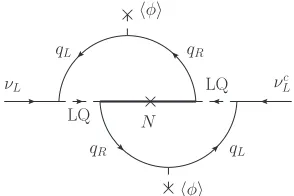
Figure 3.Leptoquark (LQ) contribution to the neutrino masses.
of the SU(2)Lsinglet scalar leptoquarkS0RwithY=1/3. Relevant interaction terms can be written as
−Lint = (gi jd¯cRNiR+fju¯cRR)S0jR+H.c. (17) Then the above expressions are valid with the replace-ments ofλ → gf∗ andΛ → MS0R. The relevant to the successful BG values of the new couplings of|g| ∼ |f| ∼ 0.01−0.1, can be interesting for the collider searches.
4.3 Neutrino masses
For Majorana LMs the effective terms of
S f fν
Λ2 f¯RfLν¯LNR+
T f fν Λ2 f¯σ
μν
fν¯LσμνNR+H.c. (18)
can generate the two-loop contributions to the observable light neutrino massesmν that is illustrated for f = qin
Fig. 2, and for a particular model with the leptoquarks in Fig. 3. A simple estimate of this contribution is
mν∼
i (UR
i) 2
(16π2)2
M3 im2q
Λ4 , (19)
wheremqis the quark mass. Hence the present bound of
mν2 eV [34] can be easily satisfied.
5 Conclusion
The two new testable baryogenesis scenarios in the mod-els with excited leptons are introduced, which do not con-tradict to the observable neutrino masses. First, the BG from LM oscillationsmay take place for relatively light and long-lived LMs, which do not all decay beforetEW. Second,the BG from LM decayscan be realized if all LMs decay beforetEW. A particular models based on the former (later) BG proposal require detailed study of the neutrino
potential (of the Boltzmann equations) to be verified in the future experiments. In both scenarios the baryon number is violated only by the sphaleron processes that does not affect the proton stability. Due to the relatively low tem-peratures of the discussed BG mechanisms, an analog of the gravitino problem [35, 36] does not exist there.
Acknowledgements
The author thanks Marek Zrałek, Henryk Czy˙z, Bhupal Dev and Yue Zhang for useful discussions. This work was supported in part by the Polish National Science Cen-tre, grant number DEC-2012/07/B/ST2/03867. The author used JaxoDraw [37] to draw the Feynman diagrams.
References
[1] J. C. Pati and A. Salam, Phys. Rev. D10, 275 (1974) [Erratum-ibid. D11, 703 (1975)].
[2] H. Terazawa, K. Akama and Y. Chikashige, Phys. Rev. D15, 480 (1977).
[3] M. A. Shupe, Phys. Lett. B86, 87 (1979). [4] H. Terazawa, Phys. Rev. D22, 184 (1980). [5] E. J. Squires, Phys. Lett. B94, 54 (1980).
[6] H. Harari and N. Seiberg, Phys. Lett. B 98, 269 (1981).
[7] H. Fritzsch and G. Mandelbaum, Phys. Lett. B102, 319 (1981).
[8] R. Barbieri, R. N. Mohapatra and A. Masiero, Phys. Lett. B 105, 369 (1981) [Erratum-ibid. B 107, 455 (1981)].
[9] C. Patrignaniet al. (Particle Data Group), Chin. Phys. C40, 100001 (2016).
[10] A. D. Dolgov, Phys. Rept.222, 309 (1992). [11] M. Dine and A. Kusenko, Rev. Mod. Phys.76, 1
(2003)
[12] H. Fritzsch and J. Sola, Adv. High Energy Phys. 2014, 361587 (2014).
[13] H. Terazawa, Conf. Proc. C840719, 63 (1984). [14] H. Terazawa, J. Mod. Phys.5, 205 (2014). [15] C. Xiong, arXiv:1606.01883 [hep-ph].
[16] Q.-p. Ji [BESIII Collaboration], Nucl. Part. Phys. Proc.270-272, 127 (2016).
[17] G. ’t Hooft, “Topological aspects of quantum chro-modynamics,” in From the Planck Length to the Hubble Radius, ed. A. Zichichi (World Scientific, Singapore, 2000), 216–236 [arXiv: hep-th/9812204].
[18] X. Calmet and H. Fritzsch, Phys. Lett. B496, 161 (2000).
[19] J. C. Pati and A. Salam, Nucl. Phys. B214, 109 (1983).
[20] C.-P. Chuu, M.-C. Chang and Q. Niu, Solid State Commun.150, 533 (2010).
[21] A. Burinskii, Phys. Lett. B754, 99 (2016). [22] S. D. Glazek, Few Body Syst.52, 367 (2012). [23] M. Gómez-Rocha and S. D. Głazek, Phys. Rev. D92,
[24] S. D. Glazek and P. Kubiczek, Few Body Syst.57, 425 (2016).
[25] S. D. Glazek and A. P. Trawinski, arXiv:1612.06211 [hep-ph].
[26] R. Aaijet al.[LHCb Collaboration], Phys. Rev. Lett. 115, 072001 (2015).
[27] M. Pitkänen and P. Mähönen, Int. J. Theor. Phys.31, 229 (1992).
[28] D. Zhuridov, Phys. Rev. D94, 035007 (2016). [29] E. K. Akhmedov, V. A. Rubakov and A. Y. Smirnov,
Phys. Rev. Lett.81, 1359 (1998).
[30] M. Fukugita and T. Yanagida, Phys. Lett. B.174, 45 (1986).
[31] P. S. B. Dev and R. N. Mohapatra, Phys. Rev. D92, 016007 (2015).
[32] H. Davoudiasl and Y. Zhang, Phys. Rev. D 92, 016005 (2015).
[33] O. Cakir, C. Leroy, R. R. Mehdiyev and A. Belyaev, Eur. Phys. J. C32, 1 (2004).
[34] V. N. Aseevet al.[Troitsk Collaboration], Phys. Rev. D84, 112003 (2011).
[35] M. Yu. Khlopov and A. D. Linde, Phys. Lett. B138, 265-268 (1984).
[36] F. Balestra,et al., Sov. J. Nucl. Phys.39, 626-631 (1984).