Article
1
Changes in sitting time and sitting fragmentation
2
after a workplace sedentary behaviour intervention
3
Jasmin Hutchinson 1*, Samuel Headley 2, Tracey Matthews 3, Greg Spicer 4, Kristen Dempsey 5,
4
Sarah Wooley 6, and Xanne Janssen 7
5
1 Department of Exercise Science and Sport Studies, Springfield College; [email protected]
6
2 Department of Exercise Science and Sport Studies, Springfield College; [email protected]
7
3 School of Health, Physical Education and Recreation Springfield College;
8
9
4 Department of Exercise Science and Sport Studies, Springfield College; [email protected]
10
5 Cardiac rehab/non-invasive cardiology, Newton-Wellesley Hospital; [email protected]
11
6 Department of Exercise Science and Sport Studies, Springfield College; [email protected]
12
7 University of Strathclyde, School of Psychological Science and Health; [email protected]
13
14
15
16
* Correspondence: [email protected]; Tel.: +001-413-748-3601
17
18
Abstract: Prolonged sedentary behaviour (SB) has shown to be detrimental to health. Nevertheless,
19
population levels of SB are high and interventions to decrease SB are needed. This study aimed to
20
explore the effect of an individualized consultation intervention aimed at reducing SB and
21
increasing breaks in SB among college employees. A pre-experimental study design was used.
22
Participants (n=36) were recruited at a college in Massachusetts, USA. SB was measured over 7
23
consecutive days using an activPAL3 accelerometer. Following baseline measures, all participants
24
received an individualized SB consultation which focused on limiting bouts of SB >30 minutes,
25
participants also received weekly follow-up e-mails. Post-intervention measures were taken after 16
26
weeks. Primary outcome variables were sedentary minutes/day and SB bouts >30 minutes.
27
Differences between baseline and follow-up were analyzed using paired t-tests. The intervention
28
did not change daily sedentary time (-0.48%; p>0.05). The number of sedentary bouts >30 minutes
29
decreased significantly by 0.52 bouts/day (p=0.015). In this study a consultation based SB
30
intervention was successful in reducing number of bouts >30 minutes of SB. However, daily
31
sedentary time did not reduce significantly. These results indicate that consultation-based
32
interventions may be effective if focused on a specific component of SB.
33
Keywords: Sitting time; Occupational; Sedentary fragmentation; Objective measurement
34
35
36
1. Introduction
37
Over the last decade sedentary behaviour (SB) has emerged as an important risk factor for poor
38
health. Recent systematic reviews have linked high levels of SB to many negative health outcomes
39
such as cardiovascular disease, type 2 diabetes, certain types of cancer and all-cause mortality,
40
independent of physical activity [1-5]. Nevertheless, adults in the United States spend between 7.5
41
and 8.5 hours per day sedentary [6]. In addition, evidence has shown that office workers are among
42
the most sedentary in the population, spending 82% of their working day seated [7]. The workplace
43
has been recognized as an important setting for the implementation of strategies to promote
44
physical activity and reduce SB [8]. The workplace also presents opportunities to build upon the
45
rapidly growing practice of mobile health (or mHealth) to harness the potential of technology to
46
help improve the health and wellbeing of all individuals [9].
47
It has been shown that workplace SB interventions can be an effective way to reduce sedentary time
48
and increase breaks in sedentary behaviour [10]. However, most of these interventions have
49
targeted the environment, for example implementing sit-stand desks or active workstations [11, 12].
50
While these interventions may be effective, the question is whether these interventions are
51
affordable and feasible to implement on a larger scale. A more affordable strategy, which is able to
52
reach many people at once, is the use of digital applications to prompt employees to stand up at
53
regular intervals [13]. However, these interventions often lack an informative component, thereby
54
failing to increase participant’s knowledge as to why they should be reducing their sedentary
55
behaviour. There is also a need to assess longer-term effects of such interventions. Another
cost-56
effective workplace intervention recommended by the World Health Organization is behavioural
57
counseling [14].
58
Previous research in physical activity has shown that including concepts such as personalized
goal-59
setting and information prompts are important concepts to implement in behaviour change
60
interventions [15]. In addition, individualized consultation approaches have shown to be an
61
effective way to target these concepts and result in successful behaviour change in physical activity
62
and dietary studies [15]. However, relatively few studies have implemented individualized
63
consultation based upon current patterns of behaviour. An exception is a small pilot study by
64
Fitzsimons et al. (2013) in which community dwelling older adults (mean age = 68 ±6 years)
65
received an individualized SB consultation incorporating feedback from an activPAL activity
66
monitor. Objectively measured daily time spent sitting/lying was reduced by 2.2% or 25 min per 24
67
h over 2 weeks. The intervention also significantly increased total time spent stepping by 13
68
min/day [16]. To the best of our knowledge, no study has taken an individualized approach to SB
69
behavioural counseling in the workplace. Therefore, this study aimed to explore the feasibility and
70
effectiveness of an individualized behavioural consultation aimed at reducing SB and increasing
71
breaks in sedentary time in college workers.
72
2. Materials and Methods
73
2.1 Study design
74
This study aimed to test the feasibility and pilot the effectiveness of a consultation based SB
75
intervention in the workplace. The study was conducted as a pre-experimental (one group pretest–
76
posttest) study design. Participants were enrolled in the study between September-December 2016
77
and follow-up data were collected in February-May 2017. The study was reviewed and approved by
78
the Institutional Review Board of the College and data were only collected on individuals who gave
79
their informed consent to participate.
80
81
2.2 Participants
83
Participants were recruited from Springfield College in Massachusetts, USA. All employees received
84
a recruitment email about the study during the beginning of the fall semester (i.e., September 2016).
85
To be eligible to participate, participants had to be at least 18 years old and classified as full-time
86
employees at the institution. Figure 1 shows the number of participants who were screened for
87
eligibility, received the intervention, attended follow-up testing, and were included in the final
88
analysis.
89
90
Figure 1. CONSORT flow diagram showing the flow of participants through each stage of the study
91
92
Assessed for eligibility (n=65)
Excluded (n=7)
Not meeting inclusion criteria
(n=1)
Included in the study (n=58)
Received allocated intervention (n=55)
Did not receive allocated intervention (n=3, no
show)
Analysed (n=36)
Excluded from analysis (n=10, missing diary Analysis
Follow-Up Enrollment
Measurements taken at follow-up (n=46)
Lost to follow-up (n=9) Declined to participate (n=4)
Scheduling difficulties (n=3)
Change in health status (n=1)
Change in employment status
2.3 Procedures
93
During the first visit, participants provided informed consent and completed a brief demographic
94
questionnaire. Height and weight were taken following standardized methods and participants were
95
fitted with an activPAL3 monitor. The monitor was attached directly to the midline anterior aspect
96
of the participants’ right thigh, mid-way between the hip and the knee in the correct orientation as
97
outlined by the manufacturer’s instructions. A nitral sleeve was used for waterproofing, and the
98
monitor was secured to the thigh using Tegaderm dressing. Participants wore the ActivPal3 monitor
99
continuously 24-hours per day for seven consecutive days, after which the device was returned to
100
the laboratory. During the 7-day wear period, participants were asked to record in a diary their bed
101
(i.e., “lights out”) and wake times as well as the times they were at work each day.
102
103
A second visit was scheduled for one week after the ActivPal3 monitor was returned, this was done
104
in order to allow time for data processing. During this visit, participants met in small groups of 2-5
105
to participate in an individualized SB consultation, as outlined below. A third and final visit was
106
scheduled 16-weeks following the behavioural intervention, at which time post-intervention physical
107
measures were taken and participants were asked to wear the activPAL3 for another seven
108
consecutive days.
109
2.4 Intervention
110
Phase One: The behaviour change intervention consisted of one 45-min face-to-face consultation
111
session conducted by a member of the research team, and a series of weekly follow-up emails
112
delivered over the ensuing 16 weeks. The theoretical underpinning of the intervention was Lewin's
113
force field theory. Lewin (1947) put forward the idea, that behavioural status quo represents an
114
equilibrium between forces favoring change (i.e. driving forces) and barriers to change (i.e.
115
restraining forces) [17]. For a goal-directed activity to be successfully implemented, the magnitude of
116
the driving force needs to match the magnitude of the restraining force [18].
117
118
The behavioural intervention sought to increase driving forces for change and reduce restraining
119
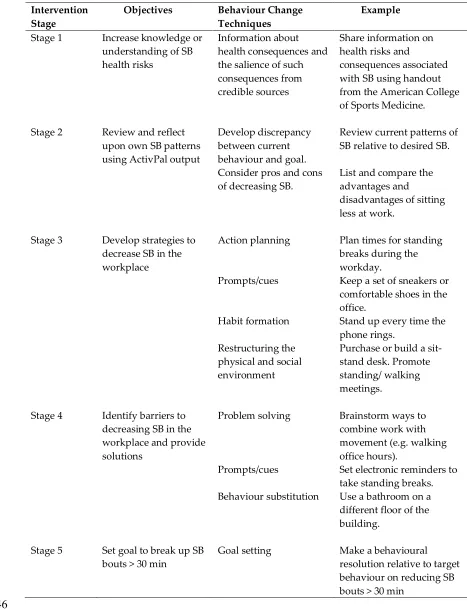
forces. The behavioural intervention was delivered in five stages. The first stage focused on increasing
120
participant’s knowledge of SB and the health effects of SB. During the second stage participants
121
identified specific driving forces toward decreasing SB (the “why” of behaviour change). Participants
122
also reviewed and reflected upon their current SB patterns based on their personal ActivPAL data.
123
Using a printout of the 7-day report (see Figure 1 for example) participants were able to identify the
124
most sedentary periods of their work day and map these time periods to specific work tasks and
125
behaviours. Stage 3 focused on finding feasible ways to reduce SB throughout the working day; this
126
was achieved through brainstorming and facilitated group discussion. In the fourth stage potential
127
barriers to change (i.e. restraining factors) were identified and solutions were sought, again through
128
a process of self-reflection and group discussion. In the final stage additional behavioural strategies
129
were offered (if not self-identified by the group) and participants created feasible goals to reduce
130
their SB at work, specifically to break up bouts of SB greater than 30 min. Table 1 details the
131
intervention in terms of specific behaviour change techniques, to allow for coding using the
132
Behaviour Change Technique Taxonomy [19].
133
134
Phase 2: Following the behavioural consultation the intervention group received weekly e-mail
135
prompts/reminders to break up prolonged bouts of sitting at work. Emails were sent every Monday
136
morning during work hours. Content of the emails varied between short simple messages, graphical
137
illustrations, information sharing (e.g. links to relevant content, or “did you know..?” statements)and
138
specific tips on how to reduce or interrupt workplace sitting. Emails were designed to target both
139
affective and cognitive attitudes [20] toward SB and included a combination of both gain-framed and
140
loss-framed message content [21]. Full content of the weekly emails can be requested from the first
141
author.
142
Table 1. Behavioural Intervention
144
145
Intervention Stage
Objectives Behaviour Change
Techniques
Example
Stage 1 Increase knowledge or understanding of SB health risks
Information about health consequences and the salience of such consequences from credible sources
Share information on health risks and
consequences associated with SB using handout from the American College of Sports Medicine.
Stage 2 Review and reflect upon own SB patterns using ActivPal output
Develop discrepancy between current behaviour and goal. Consider pros and cons of decreasing SB.
Review current patterns of SB relative to desired SB.
List and compare the advantages and
disadvantages of sitting less at work.
Stage 3 Develop strategies to decrease SB in the workplace
Action planning Plan times for standing breaks during the workday.
Prompts/cues Keep a set of sneakers or comfortable shoes in the office.
Habit formation Stand up every time the phone rings.
Restructuring the physical and social environment
Purchase or build a sit-stand desk. Promote standing/ walking meetings.
Stage 4 Identify barriers to decreasing SB in the workplace and provide solutions
Problem solving Brainstorm ways to combine work with movement (e.g. walking office hours).
Prompts/cues Set electronic reminders to take standing breaks. Behaviour substitution Use a bathroom on a
different floor of the building.
Stage 5 Set goal to break up SB bouts > 30 min
Goal setting Make a behavioural resolution relative to target behaviour on reducing SB bouts > 30 min
146
2.5 Outcome measures and statistical analysis
147
Sedentary behaviour was measured using an ActivPAL3 accelerometer. The ActivPAL3 classifies a
148
reliable measure of SB in adults [22]. Data were analysed using the event files from the activPAL3
150
and a personalized macro (available upon request from XJ). Primary outcome measures were the
151
average percentage of time spent sitting or lying per day/working day and the average number of
152
bouts per day/working day lasting more than 30 minutes. Secondary outcomes were the average
153
percentage of time spent standing and stepping per day/working day and the average number of
154
bouts lasting 10-19.99 minutes and 20-29.99 minutes per day/ working day.
155
Paired t-tests were used to compare time spent sitting/lying, standing and stepping and number of
156
bouts lasting 10-10.99 minutes, 20-29.99 minutes and >30 minutes between baseline and follow-up.
157
Sedentary, standing and stepping time was expressed in percentages in the analysis to control for
158
differences in waking time. A p-value of <0.05 was considered statistically significant. All statistical
159
analyses were conducted in SPSS version 25.
160
3. Results
161
Thirty-six participants (7 men, 29 women; mean age, 51.1 ± 11.1 years; mean BMI, 29.2 ± 7.6 kg/m2)
162
provided informed consent and took part in the intervention. All participants provided at least 5 days
163
of valid activPAL data for both baseline and follow-up measures. At baseline, participants spent an
164
average of 9.4 hours per day sedentary with no significant difference between females and males
165
during the waking day (p=0.563). See Table 2.
166
Table 2. Participant data at baseline
167
Female Male Total
Sedentary time (hr/day) 9.5 (1.4) 9.1 (1.7) 9.4 (1.5) Standing time (hr/day) 4.5 (1.2) 4.2 (1.6) 4.5 (1.3) Stepping time (hr/day) 1.9 (0.6) 2.2 (0.3) 1.9 (0.5) Sedentary time (hr/working day) 4.6 (1.4) 4.1 (1.9) 4.5 (1.5) Standing time (hr/working day) 2.4 (0.9) 2.5 (1.5) 2.5 (1.1) Stepping time (hr/day) 1.0 (0.6) 1.1 (0.5) 1.0 (0.5)
168
3.1 Whole day sedentary behaviour
169
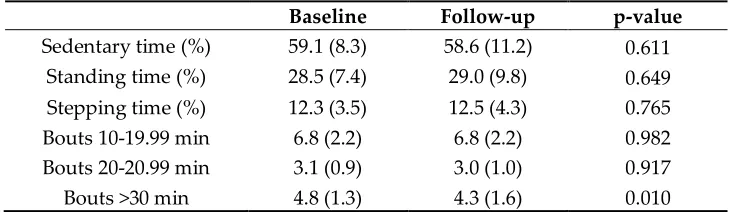
Intervention results are displayed in Table 3. Briefly, participants spent an average of 59.1% (SD 8.3)
170
of their waking day sedentary at baseline (9.4 ± 1.5 hr/day) and this decreased to 58.6% (SD 11.2) at
171
follow up (9.1 ± 2.1 hr/day; p=0.611). At baseline participants accumulated 4.8 bouts of SB greater
172
than 30 minutes per day (SD 1.3), this decreased significantly to 4.3 bouts per day (SD 1.6) at
follow-173
up (p= 0.010).
174
Table 3. Intervention outcomes whole day
175
Baseline Follow-up p-value
Sedentary time (%) 59.1 (8.3) 58.6 (11.2) 0.611 Standing time (%) 28.5 (7.4) 29.0 (9.8) 0.649 Stepping time (%) 12.3 (3.5) 12.5 (4.3) 0.765
Bouts 10-19.99 min 6.8 (2.2) 6.8 (2.2) 0.982
Bouts 20-20.99 min 3.1 (0.9) 3.0 (1.0) 0.917
Bouts >30 min 4.8 (1.3) 4.3 (1.6) 0.010
176
3.2 Working day sedentary behaviour
178
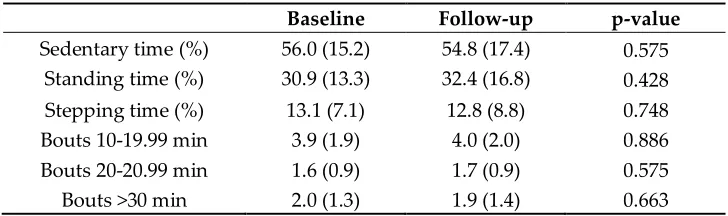
Intervention results during the working day are displayed in Table 4. No significant changes between
179
baseline and follow-up were found in any of the outcomes. Participants spent an average of 56.0%
180
(SD 15.2) of their working day sedentary at baseline (4.5 ± 1.5 hr/day) and 54.8% (SD 17.4) at follow
181
up (4.4 ± 1.8 hr/day; p=0.575). At baseline participants accumulated 2.0 SB bouts greater than 30
182
minutes per working day (SD 1.3), and at follow-up this was 1.9 bouts per working day (SD 1.4) at
183
follow-up (p= 0.663).
184
Table 4. Intervention outcomes working day
185
Baseline Follow-up p-value
Sedentary time (%) 56.0 (15.2) 54.8 (17.4) 0.575 Standing time (%) 30.9 (13.3) 32.4 (16.8) 0.428 Stepping time (%) 13.1 (7.1) 12.8 (8.8) 0.748
Bouts 10-19.99 min 3.9 (1.9) 4.0 (2.0) 0.886
Bouts 20-20.99 min 1.6 (0.9) 1.7 (0.9) 0.575
Bouts >30 min 2.0 (1.3) 1.9 (1.4) 0.663
186
4. Discussion
187
An individualized behavioural intervention aimed at reducing SB and increasing breaks in SB
188
among college employees resulted in a significant decrease in bouts of SB greater than 30 min
189
during the whole day, but not specifically the workday. This is an important finding given the fact
190
that engaging in prolonged periods of unbroken sedentary behaviour is associated with poor health
191
outcomes [23]. The fact that SB bouts were reduced across the whole day, but not specifically the
192
workday is somewhat surprising given that the behavioural intervention was targeted specifically
193
toward SB at work. One possible explanation for this is that participants had more control over
194
their environment and activities outside of work. Therefore, it is possible that the message of the
195
intervention was received, but was harder to put into place within the confines of the working
196
environment. A multi-level intervention, to include environmental restructuring, policy change,
197
and addressing social norms (e.g., walking/standing meetings) may be required to impact on
198
employees' workplace behaviour.
199
The individualized behavioural intervention did not impact daily sedentary time. This is not
200
entirely unexpected, as the focus of the intervention was breaking up prolonged (> 30-min) bouts of
201
SB. Evans et al. (2012) reported similar results, with no significant decrease in overall SB but a
202
significant reduction of SB >30 minutes (1.1 bout/day) in participants who received an educational
203
and email prompts intervention compared to those who only received the educational content [24].
204
Extending the consultation time, or providing a second consultation, may have allowed for time to
205
focus on decreasing total SB, however we did not want to place a greater burden on participants’
206
time. The study was also designed to focus on a single behaviour, as participants can feel
207
overwhelmed when asked to change multiple behaviours simultaneously [25].
208
Previous studies focusing on reducing SB in the workplace have shown conflicting results. A recent
209
systematic review highlighted studies which implemented environmental changes (e.g. sit-stand
210
desks) noted significant reductions in SB during the working day [26]. However, as mentioned
211
previously, the adoption of these interventions in real life is questionable due to high cost and
212
resources required. When focusing on interventions similar to the present study, which only
213
included educational/behavioural components (e.g. provide information on consequences of
214
behaviour to the individual; goal setting; use prompts/cues) results were inconclusive. However, all
215
CI: −22.9, −8.2)) which is slightly higher than the mean reduction in the current study which was
217
only about 6 min during the working day. One reason for this could be the relatively low level of SB
218
participants in the current study exhibited. For example, Evans et al. (2012) reported their
219
participants spent 78% of their working day seated compared to 56% in the current sample [24].
220
Important strengths of this study include the within subject design and the length of time (16
221
weeks) between the face-to-face intervention and follow-up testing. Also, the detailed objective
222
measurement of multiple features of SB with a validated device designed to differentiate sitting and
223
standing behaviours. The major limitations of this study are the lack of a control group, and a small
224
(n=36) and relatively homogeneous sample. The lack of a suitable control intervention means that
225
our pre-experimental study sheds no light on whether other interventions would result in similar
226
changes. Future controlled trials are warranted which also seek to confirm the current results in
227
larger, more diverse groups. A larger sample size would also present the opportunity to determine
228
whether the observed effects might be moderated by participant characteristics (e.g., age, BMI,
229
occupational role). Finally, it is worth considering that the use of the activPAL device may have
230
resulted in some reactivity (i.e. change in behaviour) of participants due to awareness of being
231
monitored. However, several studies have shown no evidence of reactivity to wearable technology
232
such as accelerometers and pedometers [27, 28].
233
5. Conclusions
234
In this feasibility and pilot study, a consultation based SB intervention was successful in reducing
235
number of bouts greater than 30 minutes of SB during the whole day but not the working day.
236
Overall daily sedentary time was not significantly reduced. These results indicate that consultation
237
based interventions may be effective if goal setting is focused on a specific component of SB (e.g.
238
reducing 30-minute bouts, including 10-minute active breaks every hour). This study did not
239
include a control group and the results of the study should be confirmed by more structured
240
randomized controlled trials.
241
242
Acknowledgments: The authors would like to acknowledge the wonderful assistance that we received from the
243
administrators, faculty, and staff at the College for participating in this study. We would also like to thank
244
Brendan O’Neil, Anna Platz, Patricia Rousseau and Bassey Apkan for their assistance with the intervention. This
245
study was supported by funds from the Academic Affairs Division of XXX College and from the Department of
246
XXX at XXX College.
247
Author Contributions: J.H., S.H. and T.M. conceived and designed the experiments; J.H. developed and
248
implemented the behavioural intervention, G.S. K.D. and S.W. were responsible for data collection and the
249
organization of the study ; X.J. and T.M. analyzed the data; X.J created the analysis macro; J.H. and X.J wrote the
250
paper, all authors provided feedback on the draft manuscript and approved the final version.
251
Conflicts of Interest: The authors declare no conflict of interest. The founding sponsors had no role in the design
252
of the study; in the collection, analyses, or interpretation of data; in the writing of the manuscript, and in the
253
decision to publish the results.
254
References
257
1. Benatti, F.B.; Larsen, S.A.; Kofoed, K.; Nielsen ST.; Harder-Lauridsen, N.M.; Lyngbaek, M.P.; Eriksen, D.;
258
Karstoft, K.; Krogh-Madsen, R.; Pedersen, B.K.; Ried-Larsen, M. Intermittent Standing but not a moderate
259
exercise bout reduces postprandial glycemia. Med Sci Sports Exerc. 2017, 49, 2305-2314, DOI:
260
10.1249/MSS.0000000000001354.
261
2. Chastin, S.F.; Palarea-Albaladejo, J.; Dontje, M.L.; Skelton, D.A.. Combined effects of time spent in physical
262
activity, sedentary behaviors and sleep on obesity and cardio-metabolic health markers: a novel
263
compositional data analysis approach. PLoS One. 2015, 10, e0139984, DOI: 10.1371/journal.pone.0139984.
264
3. Katzmarzyk P.T.; Church T.S.; Craig C.L; Bouchard C. Sitting time and mortality from all causes,
265
cardiovascular disease, and cancer. Med Sci Sports Exerc. 2009; 41, 998–1005. DOI:
266
10.1249/MSS.0b013e3181930355.
267
4. Lyden, K.; Keadle, S. K.; Staudenmayer, J.; Braun, B.; Freedson, P. S. Discrete features of sedentary behavior
268
impact cardiometabolic risk factors. Med Sci Sport Exerc. 2015, 47, 1079–1086, DOI:
269
10.1249/MSS.0000000000000499.
270
5. Wennberg, P.; et al., 2016. Acute effects of breaking up prolonged sitting on fatigue and cognition: A pilot
271
study. BMJ Open. 2016, 6, e009630, DOI: 10.1136/bmjopen-2015-009630
272
6. Matthews, C.E.; Chen, K.Y.; Freedson, P.S.; Buchowski, M.S.; Beech, B.M.; Pate, R.R; Troiano, R.P. Amount
273
of time spent in sedentary behaviors in the United States, 2003–2004. Am J Epidemiol. 2008, 167, 875-881. DOI:
274
10.1093/aje/kwm390
275
7. Parry, S., & Straker, L. (2013). The contribution of office work to sedentary behaviour associated risk. BMC
276
Public Health, 2013, 13, 296. DOI: 10.1186/1471-2458-13-296
277
8. Castillo-Retamal, M.; Hinckson, E.A. Measuring physical activity and sedentary behaviour at work: a
278
review. Work. 2011, 404, 345-357, DOI: 10.3233/WOR-2011-1246.
279
9. Labrique A.B.; Vasudevan L.; Kochi E.; Fabricant R.; Mehl G. mHealth innovations as health system
280
strengthening tools: 12 common applications and a visual framework. Glob Health Sci Pract. 2013, 1, 160-71,
281
DOI: 10.9745/GHSP-D-13-00031.
282
10. Healy, G.N et al. Reducing sitting time in office workers: short-term efficacy of a multicomponent
283
intervention. Prev Med. 2013; 57, 43-48. DOI: 10.1016/j.ypmed.2013.04.004
284
11. Alkhajah, T. A., Reeves, M. M., Eakin, E. G., Winkler, E. A., Owen, N., & Healy, G. N. Sit–stand workstations:
285
a pilot intervention to reduce office sitting time. Am J Prev Med. 2012, 43, 298-303. DOI:
286
10.1016/j.amepre.2012.05.027.
287
12. John, D., Thompson, D. L., Raynor, H., Bielak, K., Rider, B., & Bassett, D. R. (2011). Treadmill workstations:
288
a worksite physical activity intervention in overweight and obese office workers. J Phys Act Health. 2011, 8,
289
1034-1043. DOI:
290
13. Urda, J.L.; Lynn, J.S.; Gorman, A.; Larouere, B. Effects of a minimal workplace intervention to reduce
291
sedentary behaviors and improve perceived wellness in middle-aged women office workers. J Phys Act
292
Health. 2016, 13, 838-844. DOI: 10.1123/jpah.2015-0385.
293
14. World Health Organization. Tackling NCDs: ‘Best buys’ and other recommended interventions for the
294
prevention and control of noncommunicable disease. 2017.
295
15. Greaves, C.J.; Sheppard, K.E.; Abraham, C.; Hardeman, W.; Roden, M.; Evans, P. H.; Schwarz, P. Systematic
296
review of reviews of intervention components associated with increased effectiveness in dietary and
297
physical activity interventions. BMC public health. 2011, 11, 119. DOI: 10.1186/1471-2458-11-119.
298
16. Fitzsimons; C.F., Kirk, A.; Baker, G.; Michie, F.; Kane, C.; Mutrie, N. Using an individualised consultation
299
and activPAL™ feedback to reduce sedentary time in older Scottish adults: results of a feasibility and pilot
300
study. Prev Med. 2013, 57, 718-720. DOI: 10.1016/j.ypmed.2013.07.017
301
17. Lewin, K. (1947). Frontiers in group dynamics: I. Concept, method and reality in social sciences; social
302
equilibria and social change. Hum Relat. 1947, 1, 5-41, DOI: 10.1177/001872674700100103.
303
18. Kruglanski, A.W.; Bélanger, J.J.; Chen, X.; Köpetz, C.; Pierro, A.; Mannetti, L. The energetics of motivated
304
cognition: a force-field analysis. Psychol Rev. 2012, 119, 1-20, DOI: 10.1037/a0025488.
305
19. Michie, S.; Richardson, M.; Johnston, M.; Abraham, C.; Francis, J.; Hardeman, W.; Eccles, M.P.; Cane, J.;
306
Wood, C.E. The behavior change technique taxonomy (v1) of 93 hierarchically clustered techniques:
307
building an international consensus for the reporting of behavior change interventions. Ann Behav Med.
308
20. Conner, M.; Rhodes, R. E.; Morris, B.; McEachan, R.; Lawton, R. Changing exercise through targeting
310
affective or cognitive attitudes. Psychol Health. 2011, 26, 133-149, DOI: 10.1080/08870446.2011.531570.
311
21. O'Keefe, D.J.; Jensen, J.D. The relative persuasiveness of gain-framed loss-framed messages for encouraging
312
disease prevention behaviors: A meta-analytic review. J Health Commun. 2007, 12, 623-644, DOI:
313
10.1111/j.1460-2466.2009.01417.x.
314
22. Lyden, K.; Kozey-Keadle S.L.; Staudenmayer, J.W.; Freedson, P.S. Validity of two wearable monitors to
315
estimate breaks from sedentary time. Med Sci Sports Exerc. 2012, 44, 2243-52. DOI:
316
10.1249/MSS.0b013e318260c477.
317
23. Healy G.N.; Matthews C.E.; Dunstan D.W.; Winkler E.A.; Owen N. Sedentary time and cardio-metabolic
318
biomarkers in US adults: NHANES 2003–06. Eur Heart J. 2011, 32, 590–597. DOI: 10.1093/eurheartj/ehq451.
319
24. Evans, R.E.; Fawole, H.O.; Sheriff, S.A.; Dall, P.M.; Grant, P.M.; & Ryan, C.G. Point-of-choice prompts to
320
reduce sitting time at work: a randomized trial. Am J Prev Med. 2012, 43, 293-297.
321
25. Spring, B.; Doran, N.; Pagoto, S.; Schneider, K.; Pingitore, R.; Hedeker, D. Randomized controlled trial for
322
behavioral smoking and weight control treatment: Effect of concurrent versus sequential intervention. J
323
Consult Clin Psychol. 2004, 72, 785–796. DOI: 10.1037/0022-006X.72.5.785.
324
26. Chu, A.H.Y.; Ng, S.H.; Tan, C.S.; Win, A.M.; Koh, D.; Müller-Riemenschneider, F. A systematic review and
325
meta-analysis of workplace intervention strategies to reduce sedentary time in white-collar workers. Obes
326
Rev. 2016, 17, 467-481. DOI: 0.1111/obr.12388
327
27. Behrens, T.K.; Dinger, M.K. Motion sensor reactivity in physically active young adults. Res Q Exerc Sport.
328
2007, 78, 1-8.
329
28. Davis, R.E.; Loprinzi, P.D. (2016). Examination of accelerometer reactivity among a population sample of
330
children, adolescents, and adults. J Phys Act Health. 2016, 13, 1325-1332. DOI: 10.1123/jpah.2015-0703