ISSN 2348 – 7968
Demonstration of a Bidirectional WDM-PON with 10 Gb/s
Downstream DQPSK and 5 Gb/s Upstream Re-modulated OOK
Data Based on Reflective Semiconductor Optical Amplifier
Amritpal Singh( Student), Kulwinder Singh ( Associate professor) Department of Electronics and Communication, Punjabi University, Patiala, India
Abstract
We propose a bidirectional wavelength division multiplexing passive optical network (WDM-PON) based on a reflective semiconductor optical amplifier (RSOA) by employing a differential quadrature phase shift keying (DQPSK) signal for down-link and an on-off keying (OOK) re-modulated signal for up-link over 45km SMF colorless WDM-PON without dispersion compensation was demonstrated for both 10 Gbit/s DQPSK downstream signal and 5 Gbit/s OOK upstream signals. We investigate the impact of injection power to the RSOA on upstream data including BER performance for both downlink and uplink with the variation of transmission distance. It is observed that the proposed scheme is as good as those in case of continuous wave light injected RSOA. So, the simulation result is to meet the data rate and cost-efficient of the optical links simultaneously in tomorrow’s WDM-PON access networks. Keyword: WDM-PON, RSOA, DQPSK, OOK.
1. Introduction
For optical access networks, wavelength-division-multiplexing passive optical networks (WDM-PON) are considered as a promising solution for the next-generation of FTTx because of its almost-unlimited bandwidth, security, and protocol transparency. But this requires expensive wavelength specified optical sources so that it hasn’t been largely deployed. For this reason, an access network architecture utilizing a centralized light source at central office (CO) and with data re-modulation using the downstream wavelength received at the optical network unit (ONU) is an attractive solution for low-cost implementation of the upstream transmitter as it requires no wavelength management and needs no expensive wavelength specified light source[1,2].
Recently, several schemes have been proposed based on semiconductor optical amplifier (SOA), and reflective semiconductor optical amplifier (RSOA) because it can reuse the downstream signal received at the ONU for upstream transmission. The downstream signal is amplified and re-modulated with upstream signal by the RSOA and sent back to the CO. Thus, this technique does not require any additional broadband light sources at the CO and can provide sufficient power budgets for the upstream signals. Some schemes have been proposed based on RSOA with
on-off keying (OOK) modulation as downstream signal [2]-[4]. However, those schemes required high injection power and sacrificed the extinction ratio (ER) of the downstream data to reduce the crosstalk to the upstream signal. the application of the difference quadrature phase-shift keying (DQPSK) in the high-speed long-distance optical transmission system has become a new research hotspot. Com-pared with the modulation mode OOK and DPSK, the DQPSK has the following advantages: larger dispersion tolerance, PMD tolerance and nonlinearity tolerance, high spectrum efficiency [6]-[7], receiving sensitivity of approx. 3 dB, narrower spectrum width and strong crosstalk-resistant capability. Owing to these advantages, the DQPSK modulation mode is widely used in the DWDM system.
In this paper, we proposed a bidirectional WDM-PON architecture using differential phase shift keying (DQPSK) signal for downstream and using OOK signal re-modulated by RSOA for upstream data. For downstream transmission, the use of DQPSK itself poses a number of advantages over the traditional OOK modulation format. For example, an optical phase modulator with a single LiNbO3 crystal
usually costs less than a Mach–Zehnder intensity modulator. In addition, the constant-intensity nature of the DPSK modulation format could keep high ER and present higher tolerance to fiber nonlinear impairment and chromatic dispersion, thus improving the system power budget. DPSK balanced detection also enables 3 dB receiver-sensitivity enhancement. We have demonstrated Low-penalty upstream data re-modulation and transmission at 5 Gb/s using RSOA to re-modulate a 10 Gb/s downstream optical DQPSK wavelength.
2. System Architecture
single-ISSN 2348 – 7968
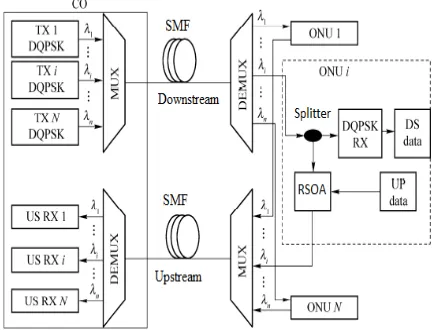
mode fiber (SMF). The DQPSK signals are de-multiplexed by de-multiplexer (DEMUX) where various wavelength lights are sent to different ONU. At the ONU, using optical splitter, portion of the DQPSK signal is fed to a DQPSK balanced receiver. For up-link, the other portion of the downstream DQPSK signal from the splitter is re-modulated using 5 Gb/s upstream data by RSOA in the ONU. The re-modulated OOK signals sent back to CO with another MUX and re-pass through the bidirectional SMF. Since the upstream signals are sent back to DEMUX along SMF and then de-multiplexed. A PIN receiver is used to receive the upstream signal in the CO.
Fig. 1The proposedArchitecture of WDM-PON employing DQPSK downstream and OOK re-modulated upstream signals (DS/US:
downstream/upstream)
3. Simulation Setup
The schematic diagram of the proposed a single bidirectional WDM-PON system as shown in Fig. 2. Inthe whole system with 4-DQPSK signal transmitters, the wavelength is from 1526 nm to 1556 nm with 100 GHz channel spacing and the laser power used in DQPSK transmitter is 0dBm. A continuous wave light beam from laser at 1530 nm was fed to LiNbO3 Mach-Zehnder
Modulator which works in conventional modulator mode using 10 Gb/s NRZ 231 – 1 pseudorandom bit stream (PRBS) was fed to pre-coder it was splitter into two signal so the signal bit rate of each beam is 5Gbit/s. These two signal pass through the series to LiNO3 Mach-Zehnder
Modulator and they also goes through an optical phase shift and to generate downstream DQPSK signal from the central office. Normally, a differential pre-coder was necessary for transmission. The generated downstream DQPSK signal was multiplexed by a multiplexer with eight channels before they transmitted over a 45km bidirectional feeder single-mode fiber. The parameter used in the simulation program as shown in table. 1. The erbium
doped fiber amplifier (EDFA) is used for compensating the linear loss. A bidirectional MUX/DEMUX with eight channels was used to de-multiplex the downstream signals and send them to different ONU. In the ONU, a optical splitter divided downstream optical signal into two parts .One part of the downstream data was demodulated by a delay interferometer (DI) and detected by a balanced detector and another part of the optical signal was re-modulated by an RSOA modulator using 5 Gb/s 231 – 1 pseudorandom bit stream (PRBS) data at input and output coupling loss was 3dB and input and output facet reflectivity was 5×10⁻⁵ and 0.99. The OOK signal re-modulated by this RSOA modulator was used for upstream signal, which was hen transmitted over the 45km bidirectional SMF and sent to the bidirectional MUX/DEMUX with eight channels. The upstream signals from each ONU were multiplexed and transmitted over the 45km bidirectional SMF, and sent back to the central office (CO). An optical circulator was used to separate the reflected upstream signal from the downstream signal. After DEMUX, the upstream data re-modulated by RSOA was detected by PIN photo detector and was fed into an Error Detector for BER measurement.
Table 1.The parameter used in the simulation program
Parameter Value
Optical transmitter (CW laser) Laser power input 0, 10 dBm
Wavelength 1530 nm
Laser line width 10 MHz Optical link
Length 45 km
Fiber loss 0.2dB/km
Fiber dispersion constant 16.75ps/nm/km Optical receiver (PIN Photo detector )
Responsivity 0A/W
Dark current 10 nA
RSOA
ISSN 2348 – 7968
Fig. 2 Schematic diagram of a single channel bidirectional WDM system.
4. Result and Discussion
Fig. 3. Optical spectrum of (a) DQPSK and (b) re-modulated RSOA at frequency 1530nm.
The Fig. 3 showed that the optical spectrum of DQPSK and re-modulated by RSOA at frequency 1530 nm with 0dBm injected power. The received eye diagrams of upstream signal were measured at central office. Firstly, we used OOK signal re-modulated by RSOA with 0dBm CW light injection as upstream signal. The received eye diagram of the upstream signal was shown in Fig. 4(a). We could see that the eye was clear and opened completely. And then, the proposed scheme of using differential quadrature phase shift keying (DQPSK) signal for downstream and using OOK signal re-modulated by the RSOA for upstream was grasped. The injection power of the RSOA was 0dBm at the ONU. Fig. 4(b) showed the received eye diagram. The eye diagram was similar with the scheme of using upstream signal re-modulated by RSOA with 0dBm CW light injection. It also showed a clear eye opening, though it was a little thicker when it compare with the received eye diagram of upstream signal re-modulated by RSOA with 0dBm CW light injection. This could be attributed to the effect of phase to intensity conversion during RSOA injection.
Fig. 4. Measured eye diagrams of upstream signal (a) re-modulated by RSOA with 0dBm CW light injection and (b) re-modulated by RSOA
with 0dBm DQPSK modulated-light injection.
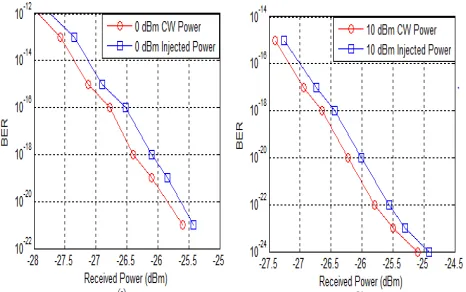
Fig.5 (a) and (b) shows the BER curves of the upstream signals measured at the CO, while varying the optical power incident on the RSOA from 0dBm to 10dBm. When we set the optical power of the seed light incident on the RSOA to be 0dBm, the receiver sensitivity at BER 10-9 was measured to be -27.92dBm. It should be noted that the power penalty from the CW light was only 0.19 dB. As we increased the optical power incident on the RSOA, the receiver sensitivity was also increased due to the increased OSNR. The performance of the re-modulated scheme using DQPSK downstream signal was very close to that of CW injection.
Fig. 5 (a) and (b). BER curve obtained at various optical powers incident on the RSOA.
ISSN 2348 – 7968
ONU, large eye-opening of DQPSK demodulation is obtained.
Fig. 6. BER vs Received curve of DQPSK is obtained at frequency 1530 nm.
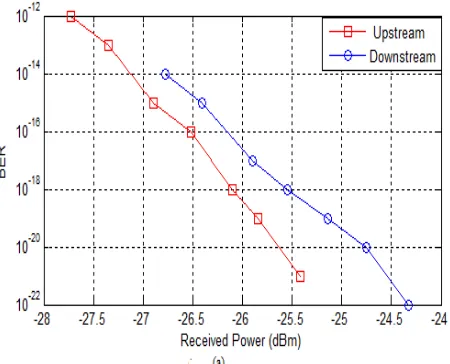
Fig. 7(a) shows the BER versus received power curves for downlink and uplink at frequency 1530 nm with input power 0dBm injected on the downstream DQPSK. it is noted from the figure that the BER for uplink goes down slowly when decreasing the received power from -25.42 to -27.73 and same as downlink also goes down slowly when decreasing the received power from -24.33 to -27.26.Fig 7(b) shows the variation of received power and BER against transmission distance. The results have been taken at the 16 channel. It is observed that as the transmission distance increases the BER deteriorated due to non-linear characteristics of fiber.
Fig. 7(a). BER vs Received power curves of downlink and upstream at input power 0dBm.
Fig. 7(a) BER vs Transmission Distance (in kms)
.
5. Conclusion
In this paper, We have proposed a bidirectional WDM-PON using 10Gb/s DPSK signal for down-link and a 5Gb/s OOK signal for up-link with a RSOA for re-modulation of a down-link signal over 45 km SMF. The performance of the re-modulated scheme using DPSK downstream signal was very close to that of CW injection and the optical bandwidth of 30 nm authorizes more than 32 users with 100 GHz spacing. We also investigated the impacts of the injection power to the RSOA on upstream data. We have observed the proposed scheme, low-penalty upstream and downstream transmission can be achieved simultaneously. Results show that this scheme is to meet the data rate and cost-efficient of the optical links simultaneously in tomorrow’s WDM-PON access networks.
References
[1] Jinnan Zhang et al.: “A Novel Bidirectional RSOA Based WDM-PON with Downstream DPSK and
Upstream Re-Modulated OOK Data”, in Proc. IEEE ICTON,2009.
[2] S. Y. Cheung et al.: “Demonstration of an ONU for WDM access Network with Downstream BPSK and Upstream Re-modulated OOK Data Using Injection-Locked FP Laser”, in Proc. ECOC’01, pp. 358-359,2001.
[3] H. Takesue, T. Sugie: “Wavelength channel data rewrite using saturated SOA modulator for WDM networks with centralized light sources”, J. of Light. Tech., vol. 21, no. 11, pp. 2546-2556, Nov. 2003. [4] W. R. Lee et al.: “Bidirectional WDM-pon based on
gain-saturated reflective semiconductor optical Amplifiers”, Photo. Tech., vol. 17, no. 11, pp. 2460-
ISSN 2348 – 7968
[5] X. Yu, T.B. Gibbon, I.T. Monroy, “Bidirectional radio-over-fiber system with phase-modulation downlink and rf oscillator-free uplink using a reflective SOA”,IEEE Photon. Technol. Lett. 20 (December (24) (2008).
[6] Li Li,Jijun Zhang et al.: “Analysis modulation format of DQPSK in WDM-PON” system,Optik 123
2050-2055 (2012).
[7] K.-P. Ho, “The effect of interferometer phase error on direct-detection DPSK and DQPSK signals,” IEEE Photon. Technol. Lett., vol. 16, no. 1, pp. 308–310, Jan. 2004.
[8] Zhihui Cao,Xue Chen et al.:”10 Gb/s Transmission in MDM-PON System Utilizing 1.2 GHz and FBG Equalizer”,ICOCN,China, , in Proc.IEEE ,2013. [9] Tae‐Young Kim, et al, “Reflective SOA‐Based
Bidirectional WDM‐PON Sharing Optical Source for Up/Downlink Data and Broadcasting Transmission,” IEEE Photonics Technology Letters, Vol. 18, No. 22, 2350‐2352 (2006).
[10] S. Y. Kim, E. S. Son, S. B. Jun, and Y. C. Chung, “Effects of downstream modulation formats on the performance of bidirectional WDM-PON using RSOA,” in Proc. OFC/NFOEC 2007, March 2007. [11] I. Papagiannakis, M. Omella, et.al. ”Investigation of
10-Gb/s RSOA Based Upstream Transmission in
WDM-PONs Utilizing Optical Filtering and
Electronic Equalization,” IEEE PTL, vol. 20, pp. 2168-2170, 2008.
[12] Q. Guo, A. V. Tran, and C. J. Chae, ”10-Gb/s WDM-PON based on lowbandwidth RSOA using partial response equalization,” IEEE PTL, vol. 23, pp. 1442-1444, 2011.
[13] H. Kim, ”10-Gbps upstream transmission for WDM-PON using RSOA and delay interferometer,” in Proc. OFC/NFOEC, paper OMP8 (2011).
[14] X. Chris, L. Xiang, L.F. Mollenauer, “Comparison of return-to-zero differential phase-shift keying and ON-OFF keying in Long–Haul dispersion managed transmission”,IEEE Photon. Technol. Lett. 15 (4) (2003) 617–619.
[15] Y.K. Lize, “DPSK, DQPSK and Coherent Receivers for 40G and 100G Systems”, AOE2008, p. SuA1. [16] Pierpaolo Boffi et al., “20 Gb/s Differential
Quardrature Phase Shift Keying Transmission Over
2000 Km in 64-Channel WDM System.”Opt.