Second Order Nonlinearities of Some Classes of
Cubic Boolean Functions Based on Secondary
Constructions
Deep Singh
Department of Mathematics, Indian Institute of Technology Roorkee
Roorkee 247 667, India.
Abstract-The higher order nonlinearity of a Boolean function is a cryptographic criterion, which play a role against attacks on stream and block ciphers. Also it play a role in coding theory, since it is related to the covering radii of Reed-Muller codes. In this paper, we study the lower bounds of second-order nonlinearities of a class of cubic Boolean functions of the form
with and ∈ ′ and some classes of cubic Boolean functions based on secondary construction. Whose lower bounds on second order nonlinearities improved upon previous existing general results.
Index Terms-Cryptography, derivative of Boolean functions, second-order nonlinearity, partial spreads.
I
.I
NTRODUCTIONBoolean functions play an important role in cryptography. The Boolean functions used in streams ciphers must have high order nonlinearity profile. Any function from to is called a Boolean function on n-variables, where 0, 1 be the prime field of characteristic 2 and is extension field of degree n over . The set of all n-variable Boolean functions is denoted by . The Algebraic Normal Form (ANF) of the Boolean function is given as
Where is a monomial and ∈ . The algebraic degree of f, denoted by deg (f) and is the maximum degree of monomial for which µ 0. The Hamming distance, , between , ∈ is the size of set ∈
∶ ⊕ 0.
The trace function : → is defined by
∑ . For given any , ∈ , is an inner
product of and . Let is the set of all affine Boolean functions on - variables. Nonlinearity of ∈ is defined as
∈ , . The Walsh transform of ∈ at
∈ is defined as:
∑ ∈ . 1
The multiset : ∈ is said to be the Walsh spectrum of . Following is the relationship between nonlinearity and Walsh spectrum of ∈ is
2 1
2 ∈ | |
By Parseval's identity
∑ ∈ 2
It can be shown that | | 2 ⁄ , which implies that
2 2 ⁄
Definition 1:
Suppose is an even integer. A function ∈ is said to be a bent function if and only if
2 2 ⁄ (i.e., 2 ⁄ , 2 ⁄ for all
∈ .
Bent functions first time introduced by Rothous [10]. For odd 9 the tight upper bound of nonlinearities of Boolean functions is not known.
Definition 2: The derivative of ∈ with respect to ∈ denoted by is defined as
for all ∈ .
The higher order derivatives are defined as follows. Definition 3: Let V be a -dimensional subspace of generated by i.e. V = < >. The r-th order derivative of ∈ with respect to V,
2
( )
n a aa F
f x
μ
x
∈
= ⊕
i a i n i
a
x
x
=
∏
=11, 2, ... ,r
denoted by or , , … , is defined by
, , … , for all ∈ . .
It is noted that the -th order derivative of f depends only on the choice of the -dimensional subspace V and independent of the choice of the basis of V.
Definition 4: Let ∈ for every non-negative integer r smaller than n, we denote by the r-th order nonlinearity of , which is the minimum Hamming distance of from all variable Boolean functions of algebraic degree at most .
The set of all Boolean function of n variables of degree at most is said to be the Reed-Muller code , , of length 2 and of order . The sequence of values n , for ranging from 1 to 1, is said to be the nonlinearity profile of Thefirst order nonlinearity of a Boolean function on n variables can be computed byusing fast Walsh transform in time o(n2n). Unlike first-order nonlinearity there is no efficient algorithm to compute second-order nonlinearities for
11. Most efficient algorithm due to Fourquet and Tavernier [6] works for 11 and up to 13 for some special functions. Thus, identifying classes containing Boolean functions with “good” nonlinearity profile is an important problem. There is no efficient algorithm to compute rth-order(for 2) nonlinearity of a Boolean function. Carlet [3, 4] for the first time did the systematic study of higher ordernonlinearity and nonlinearity profile of Boolean functions. He developed a recursive approach to compute the lower bounds on rth-order nonlinearities of a function f using the ( 1)th order nonlinearities of the derivatives of the f. He also obtained of the lower bounds of the second-order nonlinearities of several classes of functions, Welch function and the inverse function being among of them. We also refer to results due to Carlet-Mesnager [5] and Sun-Wu [12]. The best known asymptotic upper bound on is obtained by Carlet and Mesnager [5], which is
In [5] Carlet efficiently lower bounded the nonlinearity profile of Dillon type bent functions. Using Carlet's approach Gangopadhyay, Sarkar and Telang [7], Gode and Gangopadhyay [8], Sun and Wu [12] obtained the lower bounds of the second-order nonlinearities of several classes of Boolean functions. In this paper, we consider a class of cubic Boolean functions of the form with 3 and ∈ . A lower bound of second-order nonlinearities of these functions is obtained and compared with the lower bounds of second-order nonlinearities obtained for functions belonging to some other classes of functions which are recently studied.
II
.P
RELIMINARIESA. Quadratic Boolean function
Suppose ∈ is a quadratic function. The binary form associated with is defined by
, 0 .
The kernel of , is subspace of defined by
∈ : , 0 ∀ ∈ .
Lemma 1. ([1], Proposition 1): Let V be a vector space over a field of characteristic 2 and : → be a quadratic form, then the dimension of and the dimension of the kernel of Q have the same parity.
Lemma 2. ([1], Lemma 1): Let be any quadratic Boolean function. The kernel, is the subspace of consisting of those ∈ such that the derivative is constant. That is,
∈ ∶ .
If is a quadratic Boolean function and , is the quadratic form associated with it, then the Walsh Spectrum of depends only on the dimension, k, of the kernel of , [1, 9]. The weight distribution of the Walsh spectrum of f is:
Number of
0
22
k n+ 22
k n+−
k nn
−
−2
2
2 2 ) 0 ( 12
)
1
(
2
− − − −+
−
k n f k n 2 2 ) 0 ( 12
)
1
(
2
− − − −−
−
k n f k nB. Recursive lower Bounds of Higher-Order Nonlinearities Following are some results proved by Carlet [4]. Proposition 1. ([4], Proposition 2):Let ∈ and r be a positive integer smaller than n then we have
∈
In terms of higher order derivatives,
1 15 2 2 2
( ) 2 .(1 2) .2 ( ).
2
n
n r r
r
1
2 , .. ∈ . .
For every non-negative integer . In particular, for r = 2,
∈
Proposition 2. ([4], Proposition 3): Let ∈ and be a positive integer smaller than , then we have
2 2 2 ∑ ∈
Corollary 1. [[4], Corollary 2]: Let ∈ and be a positive integer smaller than . Assume that, for some non-negative integers and , we have 2
2 for every nonzero ∈ . Then
2 2 1 2
2 √ 2
Carlet remarked that in general, the lower bound given by the Proposition 2 is potentially stronger than that given in Proposition 1 [4].
In this paper, we study the lower bounds of second-order nonlinearities of a class of cubic Boolean functions of the form with 3 and ∈ and some classes of cubic Boolean functions based on secondary construction. Whose lower bounds on second order nonlinearities improved upon some previous existing general results. The derivative of any cubic Boolean function has algebraic degree at most 2 and the Walsh spectrum of a quadratic Boolean function [1] is completely characterized by the dimension of the kernel of the bilinear form associated with it.
III
.S
ECOND ORDER NONLINEARITY OF A CLASS OF CUBIC BOOLEAN FUNCTIONS OF THE PARTICULAR TYPETheorem 1. Suppose ∈ such that ∀ ∈ , with 3 and ∈ ′ . Then
2 2 .
Proof: f(x) = with 3 and ∈ ′ ,
the first order derivative f w. r. t. 0, ∈ is
Where is an affine Boolean function. Let ∈ such that , then
s
is constant if and only if
0
Since ∈ and 3 , therefore,
0
. .,
0
. .,
⁄ 1, 0
∈ .
Thus, for any non zero ∈ , number of ways in which can be chosen so that is constant are 2 (including the case 0). Hence by Lemma 2 we have, the dimension, of the kernel associated with is r i.e., . Thus the Walsh transform of at any point ∈ is
2 2 .
Therefore nonlinearity of is
2 2 1
Using Proposition 1 we have
2 2
Therefore we have a scope to get the better bounds using Corollary 1. Comparing (1) and Corollary 1, we have
1, , then by Corollary 1,
2 1
2 2 1 2 2
2 2
2 2 2
IV
.S
ECOND ORDER NONLINEARITIES OF A SOME CLASSES OF CUBIC BOOLEAN FUNCTIONS BASED ON SECONDARY CONSTRUCTIONLemma 3: Let , 1 ,
∈ be a Boolean function defined on , 1 then the dimension of the kernel of the bilinear form associated to
, is 1 where is the dimension of the kernel of the
bilinear form associated to , , here
∈ , ∈ and be a cubic Boolean function.
Proof: The function can be written as ,
. Consider a 2-dimensional subspace generated by two vectors , and , . The second order derivative of at is as follows:
, , , ,
=constant + (3) Clearly , , is quadratic hence by Lemma 2 the
kernel,
, , ∈ : , ,
= , ∈ : , , (4)
Also it is given that the kernel, is of dimension . Thus in (4) has 2 distinct values. Corresponding to each value of , can be chosen in 2 ways. Therefore, the total number of ways in which , can be chosen so that , , is constant is
2 . 2 2 . Hence , contains exactly 2 elements.
Theorem 2: Let is even and 1 and be integer such that or , define a function defined on as , 1 , then second order nonlinearity of is given by
2 2 2 2
Proof: , 1
Comparing this equation to Lemma 3, when 1 we get , it is given in [3] that the dimension , , of the kernel, , is 3 i.e., 3 for all a∈ . Hence by Lemma 3, the dimension, , , of the kernel, , is 4 i.e., , 4, for all (a, b)∈ , 0, . Hence the Walsh transform for all , μ ∈ is:
, , μ 2 , Thus the nonlinearity of , is:
, 2 , ∈ | , , μ |
2 2 ,
2 2 By using Proposition 2 we get:
2 2 2 2 2 2 2
2 2 2 2 .
Theorem 3: Suppose , 1
, then second order nonlinearity of the function defined on 7-variable is:
24
Proof: Clearly is cubic function. It is proved in [11] that the dimension of the kernel is 2 where ,
. By lemma 3 we get that the dimension, , , of the kernel, , is 3, i.e., 1, 3. Hence the Walsh transform for all , μ ∈ is :
, , μ 2 ,
Thus the nonlinearity of , is:
, 2 , ∈ | , , μ |
= 2 2 48
By using Proposition 1 we get: 24.
Theorem 4: Let , 1
, then second order nonlinearity of the function defined on 7-variables is:
28
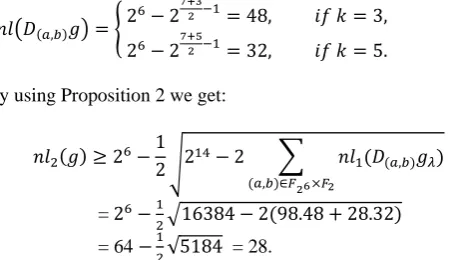
Proof: Clearly is cubic function. It is proved in [11 ] that the dimension of the kernel is 2 at 49 points and 4 at 14 points in , where , . Hence by Lemma 5, the dimension, , , of the kernel, , is 3 at 98 points and 5 at 28 points in . Therefore,
,
2 2 48, 3,
2 2 32, 5.
By using Proposition 2 we get:
2 1
2 2 2 ,
, ∈
= 2 16384 2 98.48 28.32 = 64 √5184 = 28.
Theorem 5: Define Boolean function : → as follows , 1 , where
, ∈ and l is a positive integer such that , 1 1 then for 4, second order nonlinearity of is:
2 2 2 2 , ≡ 1 2,
2 2 2 2 , ≡ 0 2.
Proof: Here the function is cubic, let
the dimension of the kernel associated with is . It is proved in [8] that for all nonzero ∈ is 4 if is even else 3. Hence Lemma 5 gives us for all
∈ , the dimension, , , of the kernel, , is 5 i.e., , 5 if is even else , 4. Thus for μ, ∈
, μ, 2 ,
i.e., , μ, 2 , ≡
2 , ≡
Therefore nonlinearity of , for all , ∈
except 0 and .
,
2 1
22 , ≡ 0 2
2 1
22 , ≡ 1 2
• For even, Proposition 2 gives
2 2 2 2 2 2 2
i.e., 2 2 2 2
• For odd, Proposition 2 gives
2 1
2 2 2 2 2 2 2
2 2 2 2 .
V.
C
OMPARISONS:In Table 1, (2 and 3) we give the numerical comparison between the bound obtained in Theorem 1(Theorem 3 and 5) and the general bound obtained by Carlet [4] and some other known bounds. it is clear that for ∈ 3, 6, 9 the bounds obtained by Theorem 1 are very close to maximum known bounds. Also the bounds on second order nonlinearities obtained in Theorem 3 and 5 are more efficient.
TABLE 1
COMPARISON OF THE VALUES OF LOWER BOUNDS OF SECOND ORDER NONLINEARITIES WITH SOME OTHER KNOWN BOUNDS
n, r with n=3r
Lower bounds obtained in Theorem 1
Gode et al. [8] bounds
Carlet’s General bounds [4]
*Hmax [6]
3, 1 2 -- 2 1
6, 2 16 10 10 18 9, 3 166 128 75 196
12,
4 1536 1024 600 1760
15,
5 13488 10592 4799 -- 18,
*Hmax used for maximum known Hamming distance.
TABLE2
COMPARISON OF THE VALUES OF LOWER BOUNDS OF SECOND ORDER NONLINEARITIES OBTAINED BY THEOREM 3 AND 5
(FOR ODD n) WITH SOME OTHER KNOWN BOUNDS
n
Lower bounds obtained
in Theorem
3 and 5
Gode et al. [8] bounds
Carlet’s General bounds
[4]
*Hmax [6]
6 10 10 10 18
8 64 64 38 84
10 331 331 150 400
12 1536 1536 600 1760
TABLE 3
COMPARISON OF THE VALUES OF LOWER BOUNDS OF SECOND ORDER NONLINEARITIES OBTAINED BY THEOREM 5(FOR EVEN
n) WITH SOME OTHER KNOWN BOUNDS
n
Lower bounds obtained in Theorem 3 and 5
Carlet’s General bounds
[4]
* Hmax[6]
7 19 19 40
9 128 75 196
11 661 300 848
13 3071 1200 ---
VI. C
ONCLUSIONSIn this paper we presented several classes of cubic Boolean functions which shows good behaviour with respect to second order nonlinearities and obtained efficient lower bounds on the second order nonlinearities of the class of cubic Boolean functions. The functions which are used in cipher systems are required to have good nonlinearity profile.
A
CKNOWLEDGMENTThe author would like to thank ‘‘NBHM (DAE)", India, for providing financial support. The author also wishes to thank to Mr. B. K. Singh for his helpful suggestions.
R
EFERENCES[1] A. Canteaut, P. Charpin and G. M. Kyureghyan, “A new class of
monomial bent functions,” Finite Fields and their Applications, 14, 2008,
pp. 221-241.
[2] C. Carlet, “The complexity of Boolean functions from cryptographic
view point,” Proc. Dagstuhl Seminar Complexity of Boolean Functions,
2006, pp. 15.
[3] C. Carlet, “Recursive lower bounds on the nonlinearity profile of
Boolean functions and their applications,” IEEE Trans. Inform. Theory
54 (3), 2008, pp. 1262-1272.
[4] C. Carlet and S. Mesnager, “Improving the upper bounds on the covering
radii of binary Reed-Muller codes,” IEEE Trans. Inform. Theory, vol. 53
(1), 2007, pp. 162-173.
[5] C. Carlet, “On the nonlinearity profile of the Dillon function,” Available: http://eprint.iacr.org/2009/577.pdf.
[6] R. Fourquet and C. Tavernier, “An improved list decoding algorithm for
the second-order Reed Muller codes and its applications,” Designs Codes
and Cryptography, 49, 2008, pp. 323-340.
[7] S. Gangopadhyay, S. Sarkar and R. Telang, “On the lower bounds of the
second-order nonlinearities of some Boolean functions”, Information
Sciences, 180, 2010, pp.266-273.
[8] R. Gode, S. Gangopadhyay, “On second order nonlinearities of cubic
monomial Boolean functions,”
Available: http://eprint.iacr.org/2009/502.pdf.
[9] O. S. Rothaus, “On bent functions,”Journal of Combinatorial Theory,
Series A, 20, 1976, pp. 300-305.
[10] G. Sun and C. Wu, “The lower bounds on the second order nonlinearity
of three classes of Boolean functions with high nonlinearity,”
Information Sciences, 179 (3), 2009, pp. 267-278.
[11] R. Telang and S. Gangopadhyay, On higher-order nonlinearity of