Western University Western University
Scholarship@Western
Scholarship@Western
Electronic Thesis and Dissertation Repository
9-21-2015 12:00 AM
Probabilistic Reasoning in Cosmology
Probabilistic Reasoning in Cosmology
Yann Benétreau-Dupin
The University of Western Ontario Supervisor
Professor Chris Smeenk
The University of Western Ontario Graduate Program in Philosophy
A thesis submitted in partial fulfillment of the requirements for the degree in Doctor of Philosophy
© Yann Benétreau-Dupin 2015
Follow this and additional works at: https://ir.lib.uwo.ca/etd
Part of the Cosmology, Relativity, and Gravity Commons, Epistemology Commons, Philosophy of Science Commons, Probability Commons, and the Statistical Methodology Commons
Recommended Citation Recommended Citation
Benétreau-Dupin, Yann, "Probabilistic Reasoning in Cosmology" (2015). Electronic Thesis and Dissertation Repository. 3337.
https://ir.lib.uwo.ca/etd/3337
This Dissertation/Thesis is brought to you for free and open access by Scholarship@Western. It has been accepted for inclusion in Electronic Thesis and Dissertation Repository by an authorized administrator of
by
Yann Ben´
etreau-Dupin
Graduate Program in Philosophy
A thesis submitted in partial fulfillment
of the requirements for the degree of
Doctor of Philosophy
The School of Graduate and Postdoctoral Studies
The University of Western Ontario
London, Ontario, Canada
c
Abstract
Cosmology raises novel philosophical questions regarding the use of probabilities in in-ference. This work aims at identifying and assessing lines of arguments and problematic principles in probabilistic reasoning in cosmology.
The first, second, and third papers deal with the intersection of two distinct problems: accounting for selection effects, and representing ignorance or indifference in probabilistic inferences. These two problems meet in the cosmology literature when anthropic consid-erations are used to predict cosmological parameters by conditionalizing the distribution of, e.g., the cosmological constant on the number of observers it allows for. However, uni-form probability distributions usually appealed to in such arguments are an inadequate representation of indifference, and lead to unfounded predictions. It has been argued that this inability to represent ignorance is a fundamental flaw of any inductive framework using additive measures. In the first paper, I examine how imprecise probabilities fare as an inductive framework and avoid such unwarranted inferences. In the second paper, I detail how this framework allows us to successfully avoid the conclusions of Doomsday arguments in a way no Bayesian approach that represents credal states by single credence functions could.
There are in the cosmology literature several kinds of arguments referring to self-locating uncertainty. In the multiverse framework, different “pocket-universes” may have different fundamental physical parameters. We don’t know if we are typical observers and if we can safely assume that the physical laws we draw from our observations hold elsewhere. The third paper examines the validity of the appeal to the “Sleeping Beauty problem” and assesses the nature and role of typicality assumptions often endorsed to handle such questions.
A more general issue for the use of probabilities in cosmology concerns the inadequacy of Bayesian and statistical model selection criteria in the absence of well-motivated mea-sures for different cosmological models. The criteria for model selection commonly used tend to focus on optimizing the number of free parameters, but they can select physi-cally implausible models. The fourth paper examines the possibility for Bayesian model selection to circumvent the lack of well-motivated priors.
Keywords: Cosmology, Cosmological Constant Problem, Measure Problem in Cos-mology, Probability, Bayesian Confirmation Theory, Induction, Imprecise Probablities, Indifference, Ignorance, Doomsday Argument, Anthropic Reasoning, Self-Locating Be-liefs, Sleeping Beauty Problem, Copernican Principle, Typicality, Bayesian Model Se-lection, Bayesian Information Criterion, Akaike Information Criterion, Ockham’s Razor, Simplicity, Parsimony, Unification
A project like this one couldn’t have been carried out without the help of many. My research was supported through the Ontario Trillium Scholarship.
I first want to express my sincere gratitude to my supervisor, Chris Smeenk, for his encouragement and intellectual guidance. His mentorship was essential throughout the lengthy process of defining a research project and carrying it to completion. I would like to thank my advisory committee, Wayne Myrvold and Carl Hoefer, for their many enlightening and challenging comments. I owe an immense debt of gratitude to
John Norton for his scholarship and for allowing me to come to Pittsburgh. The expert advice of Jim Joyce, Bill Harper, and Rob Corless, all members of my
thesis committee, will lead me to pursue and widen my research in the future.
A great many other people helped me at various stages of my writing, as teachers, interlocutors, or friends: Melissa, Craig, Molly, Mike, Andy, Josh, Fred, Guillaume, and many others at Western; Nora and Mike at Pitt; Mike Hicks, Casey, Chip, Al Wilson, Erik Curiel, Teddy Seidenfeld, Seamus Bradley, and many conference audience members.
Contents
Abstract ii
Acknowledgements iii
List of Figures vi
List of Appendices vii
1 Introduction 1
1.1 Preliminary Remarks . . . 1
1.1.1 Cosmology as a Science . . . 1
1.1.2 Probabilistic Arguments in Cosmology . . . 5
1.1.3 A Caveat about Cosmological Measures . . . 7
1.1.4 Broader Epistemological Issues . . . 8
1.2 Outline of the Thesis . . . 15
1.2.1 The Bayesian Who Knew Too Much . . . 17
1.2.2 Blurring Out Cosmic Puzzles . . . 19
1.2.3 Lost in the Multiverse . . . 22
1.2.4 Simplicity and Unification in Cosmological Model Selection . . . . 25
Bibliography . . . 27
2 The Bayesian Who Knew Too Much 31 2.1 Introduction: Bayesian Reasoning and Ignorance . . . 31
2.2 A Bayesian Failure? . . . 34
2.2.1 Neutral vs. Disconfirming . . . 34
2.2.2 A Non-Bayesian Notion of Neutral Support? . . . 35
2.3 A Bayesian Notion of Neutral Support . . . 37
2.3.1 Bayesian Credences Need Not Have Sharp Values . . . 37
2.3.2 Neutral Support with Imprecise Credences . . . 39
2.3.3 Norton’s Objections . . . 44
2.4 Dissolving Cosmic Confusions . . . 49
2.5 Conclusion . . . 52
Bibliography . . . 53
3 Blurring Out Cosmic Puzzles 55 3.1 Introduction . . . 55
3.1.3 The Problem: Ex Nihilo Nihil Fit . . . 59
3.2 Typicality, Indifference, Neutrality . . . 60
3.2.1 How Crucial to Those Arguments Is the Assumption of Typicality? 60 3.2.2 A Neutral Principle of Indifference? . . . 62
3.3 Dissolving the Puzzles with Imprecise Credence . . . 63
3.3.1 Imprecise Credence . . . 63
3.3.2 Blurring Out Gott’s Doomsday Argument: Apocalypse Not Now . 65 3.3.3 Blurring Out Anthropic Predictions . . . 66
3.4 Conclusion . . . 68
Bibliography . . . 69
4 Lost in the Multiverse 71 4.1 Introduction . . . 71
4.2 Self-Locating Beliefs and Observation Bias . . . 74
4.2.1 The Sleeping Beauty Problem as a Problem about Observation Bias 74 4.2.2 Beauty’s Bets in a Rigged Game . . . 77
4.3 Self-Locating Uncertainty and Typicality in Cosmology . . . 78
4.3.1 Typicality Assumptions . . . 78
4.3.2 Confusions about the Sleeping Beauty Problem . . . 85
4.3.3 Anthropic Reasoning . . . 88
4.3.4 Testing the Copernican Principle . . . 96
4.4 Conclusion . . . 101
4.A Appendix A: Beauty’s Credence and Betting Behavior . . . 103
4.B Appendix B: Bets and Credence with Many Possible Self-Locations . . . 106
Bibliography . . . 107
5 Simplicity and Unification in Cosmological Model Selection 110 5.1 Introduction . . . 110
5.2 Simplicity and Model Selection . . . 114
5.2.1 Why Simplicity Might Matter . . . 114
5.2.2 Why It Doesn’t, and What Model Selection Criteria Require . . . 119
5.3 Limitations of Model Selection Criteria in Cosmology . . . 128
5.4 Measuring Consilience Rather Than Predictive Accuracy or Fit . . . 135
5.5 Conclusions . . . 141
Bibliography . . . 144
6 Concluding Remarks 147 Bibliography . . . 152
A Copyright Permissions 153
B Curriculum Vitæ 158
List of Figures
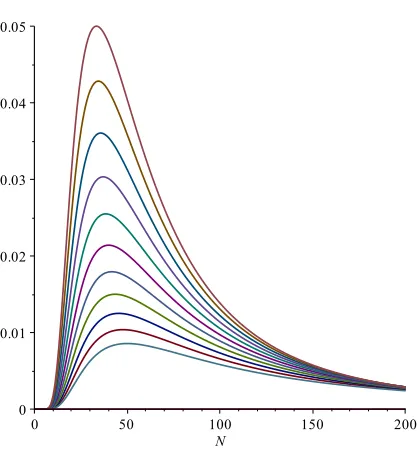
3.1 Posterior probability distributions for N conditional on r, obtained for r = 100 and assuming different likelihood distributions for r conditional on N (i.e., with different assumptions as to our relative place in humanity’s timeline), which each peaks at
dif-ferent valuesτ =Nr. The lowermost curve corresponds to a likelihood distribution that
peaks atτ→0, i.e., if we assumeN → ∞. . . 62 4.1 Illustration of the driftδz overδt, from (Uzan, 2010,§1.2.4) . . . 100 5.1 Different polynomial curves of different orders (from 1, linear, to 6). The higher the
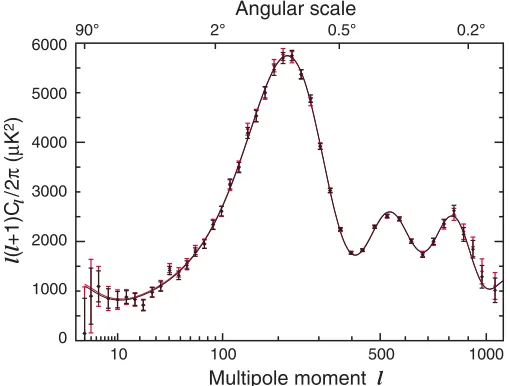
order, the better the curve fits the data; only the 6th-order curve fits all the data points.116 5.2 Two estimates (in red and in black) of the WMAP angular power spectrum of the
Cosmic Microwave Background radiation. The continuous lines are the best-fitting
models from inflationary cosmology for each estimate. Source: NASA/WMAP. . . . 135
Copyright Permissions . . . 153 Curriculum Vitæ . . . 158
Chapter 1
Introduction
1.1
Preliminary Remarks
Probabilistic arguments are a crucial but problematic ingredient of contemporary
cosmol-ogy. They have been used, e.g., to make predictions regarding the values of fundamental
constants by the theory of eternal inflation. Cosmology raises novel philosophical
ques-tions regarding, for instance, the status of arguments from fine-tuning, the explanatory
strength of appeal to typicality for a unique system, the role of self-locating uncertainty,
and the probative value of anthropic considerations. These problems are receiving
in-creasing attention among cosmologists, and only recently have philosophers turned to
these topics. All of these problems are connected in the sense that they involve
as-signments of probability, and as a consequence they need to be addressed together as
problems regarding the role and nature of probabilities in cosmology. My research in this
regard aims at identifying and assessing lines of arguments and problematic principles in
probabilistic reasoning in cosmology.
1.1.1
Cosmology as a Science
Speaking of probabilities in cosmology may seem to be problematic in the same way
that cosmology as a science seems problematic: there is only one universe, and as a
consequence one can wonder whether it makes sense to speak of laws of the universe,
and how to justify probability values when we cannot measure frequencies. The scientific
character of cosmology is not a topic I address in any of the chapters in this work.
However, it bears saying a few preliminary remarks about this issue, so as to explain in
what way I see cosmology as an interesting context for the kind of broader questions I
touch on.
The universe as a whole is a peculiar object, comprising all the physical world,
self-contained, and unique. Skepticism as to the possibility to establish a science of the
universe considered as a whole usually rests on several lines of argument, including:
- the difficulty to define its object; see, e.g., Roberto Torretti’s argument in (Torretti,
2000) that cosmology lacks a satisfying theoretical framework because of the
in-compatibility between general relativity and quantum mechanics (even the account
of the Cosmological Microwave Background radiation requires both theories),
- the difficulty to test our models (particularly because we only have access to a very
small portion of the universe) and the role of fundamental and apparently a priori
assumptions (such as the Copernican principle),
- the legitimacy to extrapolate local laws to the totality of the universe,
- the possibility that there be a physical science—i.e., a science aimed at discovering
physical laws—of a unique object.
All this leads many to question the scientific character of cosmology, or even the mere
possibility that there can be a science of the universe (at least a nomothetic science of
the universe). The following concern, indeed, is almost commonplace:
It is very questionable whether the study of any phenomenon that is not
repeatable can call itself a science at all. It would be sad however to abandon
the whole fascinating area to the priesthood. But if we are going to lend
1.1. Preliminary Remarks 3
its claims with a great circumspection and listen to its proponents with even
greater scepticism than is usually necessary. (Disney, 2000, 1126)
This criticism echoes claims made by, e.g., Munitz (1952, 1962, 36) or Ellis (2007),
according to which the uniqueness of its object sets cosmology apart from all other
physical disciplines, and prevents it from seeking physical laws. Ellis formulated the
argument behind such a claim as follows:
Thesis 1 The universe itself cannot be subjected to physical experimentation. (. . . )
Thesis 2 The universe cannot be observationally compared with other universes. (. . . )
Thesis 3 (consequence of 1 & 2) The concept of ‘Laws of Physics’ that apply to one object only is questionable. We cannot scientifically establish ‘laws of the universe’
that might apply to the class of all such objects, for we cannot test any such proposed
law except in terms of being consistent with one object (the observed universe).
(Ellis, 2007, 1216–1217, emphasis mine)
On such an account, if the uniqueness of the universe may preclude the scientific
character of cosmology, it is because our usual distinctions between laws (necessary) and
initial conditions (contingent) don’t apply in cosmology, since the initial conditions of the
universe are unchangeable, given only once and for all. This problem, Ellis acknowledged,
is not specific to cosmology, which he likens to historical or geographical sciences whose
aim is to describe an object and its evolution, rather than to find out its laws.
The issue of the uniqueness of the universe as a primary challenge to the scientific
character of cosmology can illustrate how relevant cosmology can be to philosophy, and
philosophy to cosmology. Indeed, if what is at stake is the possibility of cosmology
as a branch of physics, then addressing this philosophical issue matters to cosmology.
On the other hand, if what is at stake is the nature of a physical law and whether it
presumes a distinction between the contingent and the necessary in the physical facts,
Yet it has been argued that asking whether the uniqueness of the universe poses a
challenge to the scientific character of cosmology rests on a flawed conception of what
it means to be a physical law. Ellis’s or Munitz’s conception of physical laws usually
implies that laws need to apply to multiple instances of a phenomenon given to us
com-pletely (and not in part) and to a set of objects that have the same underlying behavior.
Cosmological models are usually based on Einstein field equations (EFE), which express,
at the largest scale, a relationship between the universe’s spatial curvature, its density,
and its distribution of matter. EFE are of the following form:
Rµν−
1
2gµν =− 8πG
c4 Tµν+ Λgµν
where Rµν and R are, respectively, the Ricci tensor and Ricci scalar, gµν is the metric
tensor,Gis Newton’s constant,Tµν is the stress-energy tensor, and Λ is the cosmological
constant. Now, as argued in (Smeenk, 2008, 2013, 626), if EFE are taken to be
cosmo-logical laws, then every sub-region of a solution of an EFE is also a solution to the same
equation. Thus, we could identify a multiplicity of instances to which the global law
applies. Therefore, Munitz’s and Ellis’s claim that cosmology cannot aim at finding laws
of the universe because such laws cannot apply to a multiplicity of instances fails for the
EFE.
Moreover, the requirement of a distinction between law and instance is problematic
insofar as it considers that events or phenomena are instances of a law. However, “[t]he
motion of Mars is not an “instance” of Newton’s laws; rather, the motion of Mars is
well approximated by an equation derived from Newton’s laws along with a number of
other assumptions.” (Smeenk, 2013, 626) The idea that the phenomena can constitute
“instances” of laws rests on the idea that physical laws can completely capture the
phe-nomena, which comes to seeing laws and phenomena as both having the same empirical
1.1. Preliminary Remarks 5
conditions are given, they enable us to give a description that accurately represents the
phenomena, and allow further refinements.
The uniqueness of the universe does represent an empirical and conceptual challenge
to its scientific study, but not an impossibility in principle. More generally, because of the
nature of its object of study, cosmologyexacerbates difficulties that are common to many
physical domains. Likewise, many of the problems and conclusions of the four papers
in this dissertation are not specific to cosmology, but they are particularly relevant to
cosmology.
1.1.2
Probabilistic Arguments in Cosmology
Probabilistic arguments in cosmology are used for confirming cosmological models, for
making predictions about the value of physical parameters, and even for motivating
re-search programs. For instance, three chapters in this dissertation especially deal with
probabilistic arguments that appeal to anthropic considerations in order to solve the
cos-mological constant problem (see below§§1.2.1, 2). Likewise, probabilistic arguments are
at the basis—explicitly or not—of fine-tuning claims that motivate theories of the initial
state of the universe. The cosmological standard model, which gives us a description of
global properties of the universe, leads to singularities when extrapolated backward in
time. Moreover, it leads to an extremely fine-tuned “initial state” of the universe. Hot
big bang cosmology in effect requires that the early universe be highly homogeneous in
spite of the fact that separated regions were causally disconnected, and it requires that
the global topology of the early universe be extremely close to flatness. Some see this
fine-tuning as a problem, and refer to these two requirements as the “horizon problem”
and the “flatness problem”, respectively. Alan Guth, most notably, argued that such
fine-tuning cries out for an explanation, and he proposed in (Guth, 1981) that a stage
of exponential expansion in the early universe (right after recombination, around 10−35s
Whether or not inflation does solve the problems it claims to solve,1 the view that
there are problems to be solved rests on an argument from fine-tuning, which implies a
probabilistic judgment. In other words, appealing to the initial flatness and homogeneity
of the early universe to motivate inflation rests on a claim—often made very explicitly
in the literature—that such initial conditions are extremely improbable or extremely
unlikely, and therefore implausible and unphysical. One might wonderon what measure
such a state is improbable (see below§1.1.3), but it is usually understood that however we
choose that measure, the “initial states” selected by compatibility with observations must
be extremely close to the maximally symmetric Friedman-Lemaˆıtre-Robertson-Walker
(FLRW) models,2 and therefore, presumably, an extremely small subset of the space of
solutions of EFE.
On the other hand, one can wonder why we should expect the initial state not to
be special. Furthermore, as argued in, e.g., (Feynman, 1967; Penrose, 1979),
considera-tions from statistical mechanics would lead us to expect that the initial state should be
extremely improbable. This line of reasoning dates back from the work of Ludwig
Boltz-mann and the search for a justification for time’s arrow. On a BoltzBoltz-mannian account of
statistical mechanics and the approach to equilibrium, a system’s entropy is as likely to
increase toward the future (and time’s arrow to flow in the right direction) as it is likely
to increase toward the past, unless we can show or posit that it was lower in the past.
According to David Albert, all posits of a “uniform-over-the-present-macrocondition
dis-tribution” used in some Boltzmannian accounts are thus “bound to fail—unless they
concern nothing less than the entirety of the universe at nothing later than its
begin-ning.” (Albert, 2000, 82,85)
Eventually, the status of this account of time’s arrow may decide whether or not
a rationale for inflationary cosmology—but also, eternal inflation and predictions in the
1See (Smeenk, 2014; McCoy, 2015) for discussions.
2Friedman-Lemaˆıtre-Robertson-Walker models are solutions to EFE that are spatially isotropic and
1.1. Preliminary Remarks 7
multiverse—based on probabilistic judgments is warranted. But until then, it places such
probabilistic arguments in cosmology at the forefront of both cosmology and debates in
the philosophy of physics.
1.1.3
A Caveat about Cosmological Measures
Fine-tuning arguments in cosmology regarding the initial state of the universe or its global
properties, as well as anthropic predictions, imply an appropriate probability measure
over some parameter of interest. They imply that such a measure can exist, and that
it can be well-defined and well-behaved. In all the papers in this dissertation, I take
for granted that it makes sense to speak of a probability distribution over the space of
solutions to EFE with respect to, e.g., the value of the cosmological constant (especially
when I discuss anthropic arguments in Chapters 2, 3, and 4) or the set of values of
different such parameters in a cosmological model (in paper 5).
There are, however, good reasons to doubt that such an assumption is tenable.
Schiffrin and Wald (2012); Curiel (2015) assessed the technical and conceptual
diffi-culties of defining the kind of measure used in such cosmological arguments. In
partic-ular, the families of spacetimes we work with and with which we carry out probabilistic
reasoning are spaces of Lorentzian metrics on differential manifolds, which tend to be
infinite-dimensional. However, “any translation-invariant measure on any reasonably
well-behaved infinite-dimensional space assigns infinite measure to all open sets, unless
the measure is the trivial measure,” i.e., the one that assigns measure zero to every
measurable set. (Curiel, 2015, § 3)
However, even if we restrict our family of models to finite-dimensional FLRW
space-times with a scalar field, as with, e.g., the Gibbons-Hawking-Stewart measure, µGHS,3
serious difficulties remain as to the physical interpretation of such measures. As Schiffrin
and Wald (2012) recalled, a measure like µGHS is constructed from a Hamiltonian
mulation of general relativity, which in statistical and Hamiltonian mechanics usually
provides a canonical (Liouville) measure. But the requirements for assigning a Liouville
measure to such a space, Schiffrin and Wald argued, face important difficulties. Even in
this restricted space of solutions to EFE, the total measure of phase space is infinite,
be-cause the phase space of general relativity is noncompact. As a consequence, any proper
subset of phase space is of measure (or probability) zero. One could use “regularization
procedures” that roughly work as follows (see Schiffrin and Wald, 2012, § IV): if we
want to assign a probability p(X) to a property X within the space Γ, and if both X
and Γ\X are of infinite measure, a regularization procedure approximates p(X) by a
nested sequence of finite-measure subsets {Γn} with ∪nΓn = Γ, and by defining p(X)
as p(X) = lim
n→∞
µGHS(X∩Γn)
µGHS(Γn)
. However, the result will depend on what is, arguably, an
arbitrary choice of partition of Γ.4
However, even if there is no ambiguous way to define a probability based on the
GHS measure, the physical significance of that measure is itself problematic. Indeed, as
Schiffrin and Wald argued, arguments for a Liouville measure based on the dynamical
evolution of the system of interest (here, the universe) do not apply when: “the system
is not ergodic, (. . . ) one has not waited a time much greater than the equilibrium time
after the system was prepared,” or when “the system has a time-dependent Hamiltonian
that is varying on a time scale that is small or comparable to the equilibration time.”
(Schiffrin and Wald, 2012,§III) But in cosmology none of these conditions obtains, which
precludes statistical equilibration.
1.1.4
Broader Epistemological Issues
The remarks we just saw in § 1.1.3 constitute a serious challenge to a legitimate and
physically meaningful use of measures in cosmology (at least when those are defined over
4Schiffrin and Wald (2012) give as an example (Gibbons and Turok, 2008) and (Carroll and Tam,
1.1. Preliminary Remarks 9
the space of solutions to EFE). As a consequence, they question the validity of many of
the probabilistic arguments the papers in this dissertation touch on. Nevertheless, the
relevance of this dissertation’s conclusions is rooted in broader discussions. But, like the
issue of the lawlikeness of cosmological laws previously illustrated, cosmology will elicit
concept-clarification more forcefully than many other disciplines. Indeed, in cosmology,
[p]resuppositions (regarding causality or time-order, for example) are made
explicit; implications (such as the rejection of simultaneity at a distance) are
explored. Consistency is tested. Relations between the most general
prin-ciples of the theory and the conceptual framework within which the basic
observations have to be situated, are worked out. (. . . ) [T]his sort of
concep-tual analysis is akin to that which elsewhere defines the work of philosophy.
(McMullin, 1981, 182)
Thus I hope to show in this dissertation that not only can philosophy be relevant to
cosmology, but also cosmology to philosophy. Indeed, all these papers are concerned
with the question of justifying probabilistic arguments based on pre-empirical notions
(such as indifference, typicality, or simplicity), which are of broad philosophical interest
and whose scope goes beyond cosmology.
The first two papers (i.e., Chapters 2 and 3) deal with the question of how to represent
our credences, and, in particular, how to represent ignorance and indifference (see also
below §§ 1.2.1, 1.2.2). A common criticism against a subjective interpretation of
prob-ability (i.e., the view that probabilities should be construed as representing an agent’s
degree of belief) claims that it is psychologically unrealistic to assign to our credence
a precise numerical value (see, e.g., Kyburg, 1978). Moreover, for those who conceive
of probabilities in terms of betting behavior, it would be more realistic to deal with an
interval of betting prices (bounded by a selling price and a buying price), rather than a
A bigger problem with the demand that our credences be represented by a precise
value of a probability distribution is that this artificially precise value will artificially
support unwarranted conclusions. This becomes clear when we want to represent our
complete ignorance or indifference about, e.g., the likely value of some physical parameter.
A common probabilistic interpretation of the principle of indifference recommends that
we assign the same precise probability value to each event about which we are equally
indifferent. In Chapter 3, I will discuss the contentious Doomsday argument, an argument
yielding a prediction about the end date for humanity based only on the knowledge of
how long it has existed and the assumption that we are typical members of this reference
class (see below § 1.2.2). Similar arguments lead to notoriously arbitrary conclusions: if
for instance, I am told that a factory makes dice whose side length is equally likely to be
anywhere between 1cm and 2cm, I would not obtain the same probability distribution
about what this factory produces if I am indifferent about these dice’s side length or
if I am indifferent about these dice’s volume (van Fraassen, 1989). Thus one can see
that it is possible, with this probabilistic interpretation of the principle of indifference,
to obtain, as Fisher (1922, 325) wrote, “a vitally important piece of knowledge (. . . ) out
of complete ignorance” and arbitrary choices. For that reason, some have argued that a
more accurate representation of our credences should be, in fact, less precise:
As sophisticated Bayesians like Isaac Levi (1980), Richard Jeffrey (1983),
Mark Kaplan (1998), have long recognized, the proper response to
symmet-rically ambiguous or incomplete evidence is not to assign probabilities
sym-metrically, but to refrain from assigning precise probabilities at all. (. . . )
Imprecise credences have a clear epistemological motivation: they are the
proper response to unspecific evidence” (Joyce, 2005, 171).5
Objections to imprecise probabilities assert that they contradict general principles of
conditionalization. Indeed, in some circumstances, updating our credence after obtaining
1.1. Preliminary Remarks 11
new information results, somewhat counter-intuitively, in a less precise posterior credence;
this is known as the “problem of dilation”.6 This issue has occupied a large part of
the discussion about imprecise probabilities, and it led some to wonder, for instance,
whether this reveals a more general problem with Bayesian updating, or if we ought
to restrict the domain of reasonable credal states to those that preclude dilation (see
Bradley, 2015, § 3.1 for a survey). But some contend that dilation is in fact a problem
for conditionalization, or that it is even a bug of imprecise Bayesianism; they simply
argue that “[t]he dilation-vulnerable parts of your prior conditional beliefs simply indicate
cases where there is evidence of unknown value to be learned.”7 (Bradley and Steele,
2014b, 1301–2) Another objection to imprecise probabilities centers around possible,
problematic consequences in decision making with imprecise probabilities. Adam Elga
(2010), for instance, proposed a sequence of bets which, under certain circumstances,
cannot result in the greatest possible gain, and which can even lead to a sure loss, if an
agent’s credences are allowed to be imprecise.8 It is debatable that Elga’s is in fact an
objection strong enough to support the claim that credences should be precise. It has
been argued indeed, e.g., in (Sahlin and Weirich, 2014), that there are decision making
rules for imprecise probabilities that don’t result in a sure loss.9 Moreover, as argued in
(Bradley and Steele, 2014a), even if there weren’t such decision making rules, it would
not be reasonable to reject imprecise probabilities as a whole on the grounds that they
make some bad decisions merelypermissible.
6Roger White (2010), for instance, made the claim that dilation violates the reflection principle,
according to which an agent ought to have now a certain credence in a given proposition if she is certain she will have it at a later time (see van Fraassen, 1984). Jim Joyce, however, argued that this claim is incorrect: “Reflection does not tell you to have imprecise beliefs now if you know that you will have imprecise beliefs in the future. Rather, it says that your current credence for [a given hypothesis] should coincide with your current expectation of your future credence for [that hypothesis].” (Joyce, 2010, 303–304)
7This is arguably a deflationary view of the problem of dilation, but, according to these authors, it
is the consensus view in statistics.
8In other words, he offered a variant of a diachronic “dutch book” argument.
9Namely, maximizing minimum expected utility. I will briefly discuss several possible decision making
I will show in Chapter 3, on the other hand, that the conclusion of the Doomsday
argument cannot be avoided by any Bayesian approach that represents credal states by
single credence functions. I will show how imprecise probabilities allows one to avoid
getting, as Fisher wrote, “a vitally important piece of knowledge (. . . ) out of complete
ignorance” (already cited above). Therefore, pace Elga, I will argue that, under certain
circumstances, not only that our credenceshould be imprecise, but also, more specifically,
that it should be represented by a set of probability distributions.
In addition to addressing the question of how we should represent credences, the
papers in this dissertation raise the issue of whether ignorance or indifference should
drive our inferences and predictions. In the arguments I will discuss, indifference claims
can be made about physical events, but they can also be made about ourselves, viz.,
about our location as observers. Assumptions about the typicality of our location as
observers made in cosmology (see §§ 1.2.3, 4) are sometimes taken as examples to assert
the relevance of self-locating beliefs (see, e.g., Titelbaum, 2013). Such claims are part of
a large literature that centers around the Sleeping Beauty problem (Elga, 2000; Lewis,
2001; Titelbaum, 2008) or other such thought experiments (such as in Elga, 2004), and
which falls within a larger discussion on how to handle indexicals.10 According to Ofra
Magidor, much of the works on this topic share the view—which she calls “the myth
of the de se”—that indexical propositions and, among them, self-locating propositions,
require a special handling in epistemology and in confirmation:
There is a special class of propositional (or “propositional-like”) attitudes.
These are self-locating or de se attitudes, ones that are typically expressed
using indexical expressions such as “I” and “now” (. . . ). Moreover, such
attitudes pose a special challenge for our account of propositional attitudes.
In other words, assume one starts with what might otherwise be considered
an adequate account for standard (non de se) attitudes. Once we take on
1.1. Preliminary Remarks 13
boardde se attitudes, this account ought to be fundamentally amended (. . . ).
(Magidor, 2014, 1)
Such calls to modify our non-indexical propositional attitudes by taking into account
indexical elements were made explicitly in the context of cosmology. Nick Bostrom, most
notably, argued that, because cosmological theories imply that, in a spatially infinite
universe, any possible observation will almost certainly be made, they cannot “have any
observational consequenceat all” (Bostrom, 2002b, 608) unless we adopt “a methodology
for evidence with a de se component.” (op. cit., 621). Here is his claim in a nutshell:
we must be careful about how we construe the evidence. We know not only
that such-and-such observations are made (which I shall show is impotent as
a basis for evaluating Big World theories): we also know that such-and-such
observations are madeby us. This indexical de se component of our evidence
turns out to be crucial to cosmology, and recognizing this is the first step to
the solution I shall propose.
The second step is to formulate a new methodological principle that describes
the probabilistic evidential bearing of (partly) indexical information on
non-indexical hypotheses. (Bostrom, 2002b, 608–609, original emphasis)
Such claims imply that there are two, presumably distinct kinds of uncertainty:
un-certainty “about what the world is like,” and unun-certainty “about one’s own spatial or
temporal location in the world” (Elga, 2000, 143). These two kinds of uncertainty are
about what Magidor called non-indexical and, respectivelly, indexical propositional
at-titudes. Adam Elga (2000) formulated the Sleeping Beauty problem in order to show
why our account of non-indexical propositional attitudes needs to be amended; he then
argued for assumptions and methods specifically adapted to handle with self-locating
un-certainty in order to solve that problem (introduced below in§§1.2.3, 4.2.1). If Elga and
a methodology with a de se component) can help to place a priori constraints on our
credence about the physical world, which could be especially relevant in cosmology.
Relatedly, invoking simplicity in theory choice and model selection aims at providing
us with another a priori guiding principle. As we will see below in §§ 1.2.4, 5, this
epistemological inclination is sometimes justified—at least in the science literature—by
an appeal to Ockham’s razor. Simplicity is usually considered to be “a standard criterion
for evaluating the adequacy of a theory” (Kuhn, 1977, 357) or for model selection, but as
Kuhn argued, theoretical simplicity can take on different meanings: a theory can afford
us more easily computable problem-solving methods, it can constitute a more unifying
explanation to more phenomena, or it can be more ontologically parsimonious. As Kuhn
argued,
[s]implicity, however, favored Copernicus, but only when evaluated in a quite
special way. If, on the one hand, the two systems were compared in terms of
the actual computational labor required to predict the position of a planet
at a particular time, then they proved substantially equivalent. Such
com-putations were what astronomers did, and Copernicus’s system offered them
no labor-saving techniques; in that sense it was not simpler than Ptolemy’s.
If, on the other hand, one asked about the amount of mathematical
appara-tus required to explain, not the detailed quantitative motions of the planets,
but merely their gross qualitative features—limited elongation, retrograde
motion and the like—then, as every schoolchild knows, Copernicus required
only one circle per planet, Ptolemy two. In that sense the Copernican theory
was the simpler, a fact vitally important to the choices made by both Kepler
and Galileo and thus essential to the ultimate triumph of Copernicanism.
But that sense of simplicity was not the only one available, nor even the one
most natural to professional astronomers, men [sic] whose task was the actual
1.2. Outline of the Thesis 15
Yet according to the same Kuhn, “Copernicus, too, was forced to use minor epicycles and
eccentrics. His full system was little if any less cumbersome than Ptolemy’s had been.
Both employed over thirty circles; there was little to choose between them in economy.”
(Kuhn, 1959, 169) One can then wonder what sense of simplicity we ought to adopt, and
on what grounds.
In this dissertation, I will give a generally critical assessment on the issue of simplicity
as well as about other pre-empirical notions and their role in inference and confirmation.
I discuss, particularly in Chapter 2 (see also § 1.2.1), claims that are very critical of
probabilistic reasoning in general, in part because, as we saw, the formal requirements
of a probability distribution—such as additivity—place too strong a constraint on the
representation of our credences. One might draw similarly critical conclusions from the
limitations of statistical and Bayesian analysis in model selection which I point out in
Chapter 5 (see also § 1.2.4). However, in these two papers, while I will acknowledge
limitations and inadequacies in the use of probabilities in induction, I will show how this
same inductive framework offers us a way out of these difficulties, and what legitimate
role probabilistic reasoning can play in cosmology.
1.2
Outline of the Thesis
Chapters one, two, and three will deal with the intersection of two distinct problems: the
problem of accounting for selection effects and the problem of representing ignorance or
indifference in probabilistic inferences. These two problems meet in different places in
the cosmology literature. A first case is that of anthropic reasoning used to predict
cos-mological parameters such as the coscos-mological constant. In the absence of fundamental
theories to explain, e.g., the value of the vacuum energy density ρV, it has been argued
that we should conditionalize the probability of different values of ρV on the number of
cos-mological constant, such arguments appeal to a uniform prior probability distribution in
order to represent our lack of knowledge and in order to obtain a prediction. The
predic-tion thus obtained, however, reflects the inadequacy of uniform probability distribupredic-tions
as representations of indifference. John Norton (2010) has argued that this inadequate
uniform probability distribution, which turns indifference into improbability, is a
funda-mental flaw of probabilistic inference or in general any inductive framework using additive
measures. Norton’s criticism is a serious challenge to Bayesianism. In chapter one, I will
examine how imprecise probabilities (whereby credences are represented by a family of
probability distributions) fare as an inductive framework and avoids such unwarranted
in-ferences. In particular, I will ask whether they can meet Norton’s criteria for a candidate
for representation of neutral support. In chapter two, I will detail how this framework
allows us to successfully address Doomsday arguments in a way no Bayesian approach
that represents credal states by single credence functions could.
Questions about the role of our place as observers arise in other parts of cosmology.
We may be uncertain about how representative or typical our observations are, depending
on whether we find ourselves in a typical region of our universe. We may also be uncertain
about our location as observers if we know that there may be copies of ourselves, i.e., other
observers having experiences identical to our own. Or we may also have an uncertainty
about our location as observers if in the multiverse different “universes” (or “pocket
universes”) are possible and which would be compatible with the data we have. Such
worries are sometimes discussed as questions about self-locating uncertainty, handled by
endorsing a kind of Copernican Principle, i.e., by simply assuming that we are “typical
observers”. Some arguments used to justify such assumptions closely resemble solutions
to puzzles of self-locating beliefs well known to philosophers, such as the Sleeping Beauty
problem. Chapter three will investigate whether and to what extent such self-locating
uncertainty is distinct from our uncertainty about what the world is like in such a way
1.2. Outline of the Thesis 17
The problems raised in the first three chapters join more general criticisms about the
role of probabilistic inference in cosmology. A more general issue concerns the inadequacy
of Bayesian model selection criteria in the absence of well-motivated measures for
differ-ent cosmological models. Bayesian model selection extends inferences about parameter
estimation to the space of models (Trotta, 2012). Information criteria commonly used for
model selection (such as the Akaike Information Criterion or the Bayesian Information
Criterion) tend to optimize the number of free parameters. But indiscriminate
appli-cations of what is taken to be Ockham’s razor can select physically implausible models
(Efstathiou, 2008). The last chapter will examine the possibility for Bayesian model
selection to circumvent the lack of well-motivated priors. In particular, I will evaluate
to what extent the virtue of unification as a criterion for model selection—defended by
Myrvold (2003)—overcomes the limitations of usual Bayesian information criteria.
1.2.1
The Bayesian Who Knew Too Much
Ongoing work by cosmologists (see e.g., Carr, 2007) purports to explain an allegedly
surprising coincidence—the fact that physics has produced a universe capable of hosting
life. Indeed, if the value of some physical constants, left indeterminate by our current
theories, were only slightly different, life wouldn’t be possible. These authors claim that
this state of affairs corresponds to a low-probability fine-tuning of cosmic parameters. In
such works, and apparently in accordance with Bayesian analysis, a theory that increases
the odds of what these authors consider to be a surprising cosmic arrangement should be
favored over those which don’t. The initial low probability values that motivate the need
for an explanation, however, is meant to represent our ignorance or indifference about
what value of a parameter we should expect.
Steven Weinberg (1987) resorted to a similar kind of confirmation when he appealed
to anthropic constraints (i.e., constraints related to the possibility for life to exist) in
ρV), left indeterminate by existing theories. Anthropic considerations provide bounds on
ρV, which can be neither too large (because then galaxies couldn’t form) nor too small
(because then observers wouldn’t have time to arise before the universe recollapses).
However, the anthropically-allowed range is quite large, and, in the absence of further
theories, it leaves us with many equipossible values forρV. Furthermore, by
conditionaliz-ing on the number of observers each value ofρV allows for, the initial uniform distribution
is turned into a prediction. Later observations of the cosmological constant have been
taken to vindicate this reasoning (see, e.g., Weinberg, 2007).
However, it is debatable whether a precise probability distribution over admissible
values of some physical parameters or their ratios can reasonably reflect a reasonable
prior credal state. Moreover, it is questionable that the conditions for life (e.g., the
particular value of certain physical constants) should be assigned a low rather than a
neutral probability value, if these parameters are left indeterminate by our theories.
John Norton has argued that Bayesianism cannot handle ignorance adequately due to
its inability to distinguish between neutral and disconfirming evidence. He argued that,
in anthropic reasoning as in other cases, this inability allows one to draw unwarranted
conclusions from alack of knowledge. Because it stems from the requirement of additivity,
it is, on Norton’s account, the sign of a fundamental flaw of Bayesian calculus. In several
works, Norton (2007, 2008, 2010) has introduced criteria for a candidate for representation
of neutral evidential support.
Joyce (2010) defended a version of Bayesianism without sharp credences. An
im-precise probability—or a ‘representor’ following (van Fraassen, 1990)—consisting of a
family of credal functions can be thought of as representing the credal state of a single
agent composed of several members who don’t necessarily agree with each other (e.g., a
jury or a committee). Representing a credal state by means of a family of credal
func-tions allows one to give a probabilistic representation of ignorance that 1) distinguishes
1.2. Outline of the Thesis 19
models the non-informativeness of priors corresponding to a credal state of ignorance
or indifference. This analysis allows us to see that, contrary to Norton’s claim, it isn’t
necessarily Bayesian reasoning, but rather an inadequate application of it that may be
at the origin of confusions in such instances of anthropic reasoning.
We can see to what extent imprecise probabilities fulfill Norton’s proposal, and
whether or not the latter should be amended. In particular, we can see that, if adopted,
the imprecise model generally agrees with Norton’s representation of neutral support but
demands that his criterion of self-duality be reformulated. The dual of a measure of
be-lief is a measure of disbebe-lief, and for Norton a representation of indifference or ignorance
must be self-dual. Because of the requirement of additivity, no measure can be self-dual.
Applied to the imprecise model, a credal set C representing ignorance is self-dual if it
contains probability functions ci and their duals c0i such that ∀ci ∈ C, c0i is such that
∀α, ci(α) = c0i(¬α) and ci(¬α) = c0i(α). It is clear that we cannot have such a set since
the dual of a probability function cannot be a probability function. But I will argue that
we need not impose such a strong constraint on credal sets.
Depending on what decision-making criterion with imprecise probabilities one chooses,
it is possible to construct a representation of indifference by means of credal sets that meet
all or almost all of Norton’s criteria, and it can do so without compromising Bayesianism
altogether. It only requires that we demand neither that credences be sharp nor that
a unique representation be applicable to all cases of ignorance or indifference (i.e., that
self-duality be abandoned).
1.2.2
Blurring Out Cosmic Puzzles
The previous section briefly introduced anthropic reasoning as an example of
probabilis-tic reasoning that allows one to draw unwarranted conclusions from a lack of knowledge.
The Doomsday argument is another example of such puzzles of probabilistic
the end date for humanity based only on the knowledge of the time elapsed since
human-ity’s advent. Both puzzles make ‘cosmic’ predictions based on typicality assumptions: by
conditionalizing on the number of observers allowed for by a given value of the
cosmolog-ical constant, anthropic reasoning assumes that we are typcosmolog-ical observers; Doomsday-type
arguments assume that our observation time is taken at random among all of
human-ity’s. Thus, the Doomsday argument and anthropic reasoning share a similar structure:
1) a uniform prior probability distribution reflects an initial state of ignorance or
indif-ference, and 2) an appeal to typicality or mediocrity is used to make a prediction. This
is puzzling: these two assumptions of indifference and typicality are meant to express
neutrality, and yet from them alone we seem to be getting a lot of information. But
assuming neutrality alone shouldn’t allow us to learn anything! One way of formulating
both of these arguments (anthropic reasoning and the Doomsday argument) makes them
a straightforward application of Bayesianism, yet the conclusion is so absurd as to cast
doubt on Bayesianism itself.
Much of the philosophical discussion around these arguments has focused on the
validity of the typicality assumption. For instance, Nick Bostrom (2002a) offered a
challenge to what he calls the Self-Sampling Assumption (SSA), according to which “one
should reason as if one were a random sample from the set of all observers in one’s
reference class.” In order to avoid the consequence of the Doomsday argument, Bostrom
suggested to adopt what he calls the Self-Indicating Assumption (SIA): “Given the fact
that you exist, you should (other things equal) favor hypotheses according to which
many observers exist over hypotheses on which few observers exist.” But this arguably
ad hoc solution leads to the unpalatable consequence that a preference for a cosmological
scenario over another can be established entirely a priori. Relatedly, Radford Neal (2006)
argued that conditionalizing on non-indexical information (i.e., all the information at the
disposal of the agent formulating the argument, including all their memories), reproduces
1.2. Outline of the Thesis 21
However, these solutions to an assumption of typicality cannot satisfactorily avoid the
conclusions of all versions of the Doomsday argument. A version put forth by Richard
Gott (1994) which starts from an assumption about our birth rank (instead of that of
our position as observers) among all of humankind will yield a prediction for humanity’s
end date whatever assumption we make as to our typicality or atypicality.
Imprecise probabilities allow us to better represent our initial state of ignorance or
indifference, with a credal set of functions that disagree with each other. If theonly thing
we want our prior credal state to represent is that we know neither whether nor when
humanity will end, then we ought to include in our prior set an infinity of normalizable
credal functions about the possible total number of humans. In order to be normalizable,
all these functions have to tend to zero as the total number of possible humans goes to
infinity. At any confidence level, not all functions in that set will agree on an upper
bound on that total number. This result, however, would be impossible to obtain with a
single prior probability distribution, with which we would have no choice but to predict
an end date for humankind. Relatedly, in a bounded case (e.g., anthropic predictions for
values of the cosmological constant), it is possible to construct an imprecise prior credal
set that results in a very weak—or even no—confirmation of anthropic hypotheses.
I will show that imprecise probabilities can dissolve these puzzles better than precise
probabilities could. Philosophical discussions about the value of the imprecise model
usually center around the difficulty to define updating rules that don’t contradict general
principles of conditionalization. But the expressive richness of this framework and its
ability to solve such puzzles of confirmation and avoid unwarranted conclusions should
1.2.3
Lost in the Multiverse: Self-locating uncertainty,
typical-ity, and observation bias
There are in the cosmology literature several kinds of arguments referring to self-locating
uncertainty. In the multiverse, different “universes” are possible: different
“pocket-universes” may have different fundamental physical parameters. We don’t know how
to locate ourselves in this ensemble of possible universes. We don’t know how to locate
ourselves within our own universe either. We don’t know if we are typical observers
and if we can safely assume that the physical laws we draw from our observations hold
elsewhere or if, on the contrary, our view on the world is particularly biased spatially or
temporally.
A kind of self-locating uncertainty that is sometimes invoked in such a discussion
comes from the possible existence of copies of myself. For instance, if the multiverse
theory is true, then there are other pocket universes where reside observers having
ex-periences indistinguishable from my own. As a consequence, we should be uncertain as
to which of these pocket universes we inhabit. If one of these pocket universes is more
favorable to the advent of life than the other (because of a difference in the value of some
physical parameter), then this pocket universe is more likely to host a greater number
of such copies of myself. This adds to the uncertainty about my location: I don’t know
which of these pocket universes I may find myself in, and, within this pocket universe, I
don’t know which of the copies of myself I am.
This kind of uncertainty is used for instance in anthropic reasoning, where predictions
are obtained by conditionalizing a prior probability distribution for a given cosmological
parameter on the number of observers it allows for (see, e.g., Weinberg, 1987; Bousso,
2006). Moreover, according to, e.g., Max Tegmark, there is even a real possibility that,
in a universe that is large enough, “your closest identical copy is 10 to the 1028 meters
1.2. Outline of the Thesis 23
with exactly the same experiences and memories.
There are two main issues concerning all the above questions and arguments that
require clarification. One is the status of self-locating beliefs and their role in induction
and confirmation. The first question I will address is how distinct are the following
“two sorts of uncertainty”: one “about what the world is like” and another one “about
one’s own spatial and or temporal location in the world” (Elga, 2000, 143). Should the
realization that Icould very possibly be somewhere else affect my beliefs about the world?
That is, does the fact that a physical model is more favorable to the advent of observers
having experiences indistinguishable from my own, or that it generates more observing
standpoints resulting in an experience identical to my own, affect my credence in that
model? And if so, does that mean that my self-locating uncertainty should have a role
in confirmation and induction distinct from other kinds of uncertainty?
A second, related question concerns how to handle self-locating uncertainty. In
par-ticular, I will ask whether and when assumptions of typicality (or a Copernican principle,
or an assumption of mediocrity) are warranted or even required to characterize our
self-locating uncertainty.
I will claim that many of these issues that are often taken to be about “self-locating
uncertainty” are in fact problems about how to handle observation bias or about
un-certainty about what the world is like. Consequently they don’t constitute a new or
distinctive challenge or source of rules for confirmation theory.
These arguments involving our “location” broadly construed are not particularly new,
whether in cosmology or in philosophy.11 But the topic of self-locating beliefs (or,
fol-lowing Lewis (1979), “de se beliefs”) and whether they bear onde re beliefs has recently
generated much discussion in philosophy. Arguments given as solutions to the Sleeping
Beauty problem—a thought experiment introduced as an illustration of the distinctness
of self-locating uncertainty and its bearing on our credence about the world—are still
11For a critique of the anthropic principle, see, e.g., (Earman, 1987), for one of the Copernican
debated, in philosophy and cosmology alike.
The Sleeping Beauty problem is sometimes explicitly invoked in the cosmology
liter-ature to justify the assumption—made by, e.g., Tegmark (2003); Bousso et al. (2008);
Page (2010); Freivogel (2011)—that we are equally likely in the multiverse to be
any-where consistent with our data. Beauty will be put to sleep for three days on Sunday
night. Right after she falls asleep, a fair coin will be tossed to determine how many times
she will be briefly woken. If the coin toss results in Heads, Beauty will be briefly woken
only once, on Monday. If Tails, she will be woken twice: once on Monday, and once
on Tuesday. But after each waking, Beauty will be put back to sleep with a drug that
makes her completely forget about that waking. Now, right after she has been woken
but without having been told what day it is, what should Beauty’s credence be that the
coin came up Heads? According to Elga (2000), she should have a credence of 1/3 that
the result of the coin toss was Heads. I will show that appeals to this solution in the
cosmology literature as a justification for the claim that all three possible awakenings
are a priori equally likely, rest on confusions about the Sleeping Beauty problem and
about Elga’s argument. I will show how this puzzle clarifies the nature and role of
self-locating beliefs, and in particular how typicality assumptions in cosmology come down to
asserting a “mere personal preference for theories in which we are typical of something.”
Hartle and Srednicki (2007, 1)
In order to assess what role typicality assumptions may play in cosmological model
selection within our “pocket universe,” and when they might be warranted, I will
exam-ine arguments to defend the Copernican principle. Cosmological models as well as the
interpretation of our cosmological data usually rest on the adoption of the Copernican
principle, i.e., on the assumption that the apparent spatial homogeneity and isotropy
doesn’t stem from our having a very special point of view on our cosmic neighborhood.
This has very real implications for our choice of cosmological models. Indeed, if the
expan-1.2. Outline of the Thesis 25
sion of the observable universe is accelerating, and thus they support the existence of
dark energy. However, assuming that we are at the center of a large ‘cosmic bubble’ could
explain the same observations that are taken to support dark energy. The adoption of
the Copernican principle, however, forces us to discard this alternative hypothesis, and
to posit this mysterious dark energy instead. According to arguments about how
self-locating beliefs should bear on our knowledge of what the world is like, the fact that the
number of locations we could find ourselves in is much larger if we adopt the Copernican
principle than in the “cosmic bubble” scenario should favor the former hypothesis over
the latter. I will show that it is neither solutions to the Sleeping Beauty problem nor
in general considerations about self-locating uncertainty, but rather more evidence (see,
e.g., Uzan et al., 2008) that will help us adopt or reject the Copernican principle.
1.2.4
Simplicity and Unification in Cosmological Model
Selec-tion
The use of Bayesian methods in cosmology is a relatively new field of research (see, e.g.,
Trotta, 2008, 2012; Liddle, 2009; Hobson et al., 2010, for recent reviews). In the absence
of well-motivated prior probabilities for cosmological models, Bayesian and statistical
model selection appeals to, e.g., the “Astronomer’s prior,” a uniform distribution over
a given range of models. Because selecting cosmological models based only on how
likely they make our data is almost guaranteed to favor models that overfit the data,
cosmologists rely on a sense of “simplicity” (or “Ockham’s razor”) to weigh a model’s
accuracy against its number of free parameters. For that same reason, they sometimes
use statistical tools—such as the Bayesian Information Criterion (BIC) or the Akaike
Information Criterion (AIC)—as an Ockham’s razor.
However, although these methods purport to minimize our reliance on a choice of
prior, they are not able to isolate physically implausible models. As a result, in cosmology
have been said to be no more than prior selection, casting doubt on the possibility to
have meaningful Bayesian cosmological model selection altogether (see, e.g., Efstathiou,
2008; Linder and Miquel, 2008).
I will first assess the claim that what such Bayesian and statistical methods do is
indeed to seek a balance between a model’s fit-to-data and its complexity (defined in
terms of the number of its free parameters). We will see that the notion of “simplicity” is
ambiguous and, as argued by Norton (2012), a surrogate for background information. In
addition, we will see that, strictly speaking, it is not simplicity that these model selection
criteria are after.
Regardless of the question of simplicity, we will see that statistical and Bayesian
model selection faces serious challenges, especially in cosmology, due to the limited data
sample available to us and the lack of theoretical background. Therefore, I will consider
what other Bayesian model selection method might fare better in cosmology.
In contrast with model selection driven by the search for parsimony in the number
of free parameters, Wayne Myrvold (2003) has given a Bayesian account of a model’s
ability to unify different sorts of phenomena, regardless of the number of parameters. The
measure of information used in this account is between a set of phenomena and another,
otherwise unrelated set of phenomena, given a certain model. This measure gives a formal
character to the idea of consilience of inductions (Whewell, 1847), according to which
“a consilience of inductions would occur when the values of certain parameters can be
determined from two different sorts of phenomena, and the values determined from one
class of phenomena agree with those determined from another.” (Myrvold, 2003, 418)
Parameter estimation plays a role in assessing the unifying power of a model, but on
this account it is the improved relationship between parameters of different kinds that
will provide support to a choice of model. I wish to explore if this Bayesian criterion of
1.2. Outline of the Thesis 27
Bibliography
Albert, D. Z. (2000). Time and Chance. Harvard University Press.
Augustin, T., Coolen, F. P., de Cooman, G., and Troffaes, M. C., editors (2014). Intro-duction to Imprecise Probabilities. Wiley & Sons.
Beisbart, C. (2010). Can We Justifiably Assume the Cosmological Principle in Order to Break Model Underdetermination in Cosmology? Journal for General Philosophy of Science, 40(2):175–205.
Bostrom, N. (2002a). Anthropic Bias: Observation Selection Effects in Science and Phi-losophy. Routledge.
Bostrom, N. (2002b). Self-Locating Belief in Big Worlds: Cosmology’s Missing Link to Observation. The Journal of Philosophy, 99(12):607–623.
Bousso, R. (2006). Holographic Probabilities in Eternal Inflation.Physical Review Letters, 97:191302 1–4.
Bousso, R., Freivogel, B., and Yang, I.-S. (2008). Boltzmann Babies in the Proper Time Measure. Physical Review D, 77(10):103514.
Bradley, S. (2015). Imprecise Probabilities. In Zalta, E. N., editor, The Stanford Ency-clopedia of Philosophy. Summer2015 edition.
Bradley, S. and Steele, K. (2014a). Should Subjective Probabilities Be Sharp? Episteme, 11(3):277–289.
Bradley, S. and Steele, K. (2014b). Uncertainty, Learning, and the “Problem” of Dilation.
Erkenntnis, 79(6):1287–1303.
Carr, B. (2007). The Anthropic Principle Revisited. In Carr, B., editor, Universe or Multiverse?, chapter 5, pages 77–89. Cambridge University Press.
Carroll, S. M. and Tam, H. (2010). Unitary Evolution and Cosmological Fine-Tuning.
arXiv preprint arXiv:1007.1417, pages 1–34.
Curiel, E. (2015). Measure, Topology and Probabilistic Reasoning in Cosmology (unpub-lished manuscript). (April 22).
Disney, M. (2000). The Case Against Cosmology. General Relativity and Gravitation, 32(6):1125–1134.
Earman, J. (1987). The SAP Also Rises: A Critical Examination of the Anthropic Prin-ciple. American Philosophical Quarterly, 24(4):307–317.
Efstathiou, G. (2008). Limitations of Bayesian Evidence applied to cosmology. Monthly Notices of the Royal Astronomical Society, 388:1314–1320.
Elga, A. (2000). Self-Locating Belief and the Sleeping Beauty Problem. Analysis, 60(2):143–147.
Elga, A. (2004). Defeating Dr. Evil with Self-Locating Belief. Philosophy and Phe-nomenological Research, LXIX(2):383–396.
Feynman, R. P. (1967). The Character of Physical Law. MIT Press, Cambridge, MA.
Fisher, R. A. (1922). On the Mathematical Foundations of Theoretical Statistics. Philo-sophical Transactions of the Royal Society A: Mathematical, Physical and Engineering Sciences, 222:309–368.
Freivogel, B. (2011). Making Predictions in the Multiverse. Classical and Quantum Gravity, 28(204007):1–15.
Gibbons, G., Hawking, S. W., and Stewart, J. (1987). A Natural Measure on the Set of All Universes. Nuclear Physics B, 281:736–751.
Gibbons, G. and Turok, N. (2008). Measure Problem in Cosmology. Physical Review D, 77(6):063516.
Gott, J. R. (1994). Future Prospects Discussed. Nature, 368(March):108.
Guth, A. H. (1981). Inflationary Universe: A Possible Solution to the Horizon and Flat-ness Problems. Physical Review D, 23(2):347–356.
Hartle, J. B. and Srednicki, M. (2007). Are We Typical? Physical Review D, 75(12):123523.
Hawking, S. W. and Page, D. N. (1988). How Probable Is Inflation? Nuclear Physics B, 298:789–809.
Hobson, M. P., Liddle, A. R., Mukherjee, P., and Parkinson, D., editors (2010). Bayesian Methods in Cosmology. Cambridge University Press, Cambridge.
Jeffrey, R. (1983). Bayesianism with a Human Face. In Earman, J., editor, Testing Scientific Theories, Minnesota Studies in the Philosophy of Science, Vol. 10, chapter 7, pages 133–156. University of Minnesota Press, Minneapolis.
Joyce, J. M. (2005). How Probabilities Reflect Evidence. Philosophical Perspectives, 19:153–178.
Joyce, J. M. (2010). A Defense of Imprecise Credences in Inference and Decision Making.
Philosophical Perspectives, 24(1):281–323.
Kaplan, M. (1998). Decision Theory as Philosophy. Cambridge University Press, Cam-bridge.
Kuhn, T. S. (1959). The Copernican Revolution. Random House, New York, NY.
Kuhn, T. S. (1977). Objectivity, Value Judgment and Theory Choice. In The Essential Tension: Selected Studies in the Scientific Tradition, pages 356–367. University of Chicago Press, Chicago.
Kyburg, E. H. (1978). Subjective Probability: Criticisms, Reflections, and Problems.
Journal of Philosophical Logic, 7(1):157–180.
Levi, I. (1974). On Indeterminate Probabilities. The Journal of Philosophy, 71(13):391– 418.
Levi, I. (1980). The Enterprise of Knowledge. MIT Press, London.
Lewis, D. (1979). Attitudes De Dicto and De Se. The Philosophical Review, 88(4):513– 543.