Deep Automated Multi-task Learning
Davis Liang
University of California, San Diego
Yan Shu
University of California, San Diego
Abstract
Multi-task learning (MTL) has recently contributed to learning better representa-tions in service of various NLP tasks. MTL aims at improving the performance of a primary task, by jointly training on a secondary task. This paper introduces au-tomated tasks, which exploit the sequen-tial nature of the input data, as secondary tasks in an MTL model. We explore next word prediction, next character prediction, and missing word completion as potential automated tasks. Our results show that training on a primary task in parallel with a secondary automated task improves both the convergence speed and accuracy for the primary task. We suggest two meth-ods for augmenting an existing network with automated tasks and establish bet-ter performance in topic prediction, senti-ment analysis, and hashtag recommenda-tion. Finally, we show that the MTL mod-els can perform well on datasets that are small and colloquial by nature.
1 Introduction
Recurrent neural networks have demonstrated formidable performance in NLP tasks ranging from speech recognition (Hinton et al., 2012) to neural machine translation (Bahdanau et al.,2014;
Wu et al.,2016). In NLP, multi-task learning has been found to be beneficial for seq2seq learning (Luong et al.,2015;Cheng et al.,2016), text rec-ommendation (Bansal et al., 2016), and catego-rization (Liu et al.,2015).
Despite the popularity of multi-task learning, there has been little work done in generalizing the application of MTL to all sequential tasks. To ac-complish this goal, we use the concept of
auto-mated tasks. Similar work in multi-task learning frameworks proposed in (Liu et al.,2016) and ( Lu-ong et al., 2015) are both trained on multiple la-beled datasets. Though we have seen evidence of research using external unlabeled datasets in pre-training (Dai and Le, 2015) and semi-supervised multi-task frameworks (Ando and Zhang, 2005), to our knowledge there is no work dedicated to using tasks derived from the original dataset in multi-task learning with deep recurrent networks. With automated tasks, we are able to use MTL for almost any sequential task.
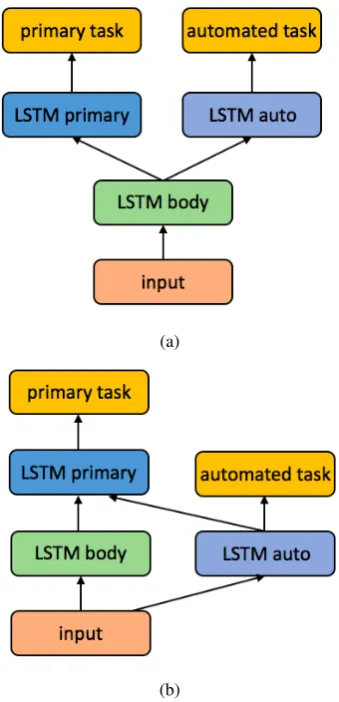
We present two ways of using automated multi-task learning: (1) the MRNN, a multi-multi-tasking RNN where the tasks share an LSTM layer, and (2) the CRNN, a cascaded RNN where the net-work is augmented with a concatenative layer su-pervised by the automated task. Examples of ei-ther network are shown in Figure1.
In summary, our main contributions are:
• We introduce the concept of automated tasks for multi-task learning with deep recurrent networks.
• We show that using the CRNN and the MRNN trained in parallel on a secondary au-tomated task allows the network to achieve better results in sentiment analysis, topic pre-diction, and hashtag recommendation.
2 Automated Multi-task Learning
We generalize multi-task learning by incorporat-ing automated tasks with our two MTL models: the CRNN and the MRNN. In the following sub-sections, we describe the automated tasks, the models, and their respective training methods.
2.1 Automated Tasks
The set of automated tasks we suggest include (1) next word prediction, (2) next character
(a)
[image:2.595.96.266.67.419.2](b)
Figure 1: MRNN (a) and CRNN (b) model
tion, and (3) missing word completion.
For word and character generation, we trained a language model to predict the next word or charac-ter given the words or characcharac-ters from the previous K steps. For the missing word completion task, we removed a random non-stop-word from each document and replaced it with a UNK placeholder. The removed word is fed into a word2vec model trained on Google News (Le and Mikolov,2014) and the resulting vector is the target. We per-formed regression to minimize the mean squared error of predicting the missing word vector given the text. We generated predictions by finding the target word vector with the highest cosine similar-ity to the output vector.
2.2 MRNN
The multi-tasking RNN, MRNN, is an MTL model that we use to train our primary and auto-mated tasks in parallel. The MRNN’s initial layers are shared, and the later layers branch out to sepa-rate tasks. A basic example of an MRNN is shown
in Figure1.
The MRNN is constructed such that the primary task and automated task(s) share a body of units. This body is supervised by both the primary and automated task(s) and learns internal representa-tions for both tasks.
2.3 CRNN
(Søgaard and Goldberg, 2016) showed that a higher-level task can benefit from making use of a shared representation learned by training on a lower-level task. Similarly, the CRNN assumes that the primary task has a hierarchical relation-ship with the automated task. A basic example of a CRNN is shown in Figure1.
Specifically, we designed the CRNN to use the representations learned from an automated task as a concatenative input (Ghosh et al.,2016;Lipton et al., 2015) for the primary task. Furthermore, such a model can be supervised on an identical task at different network layers.
3 Experiments
We evaluate the performance of our models on binary sentiment analysis of the Rotten Tomato Movie Review dataset, topic prediction on the AG News dataset, and hashtag recommendation on a Twitter dataset. For each of these datasets, we compared the results from the MRNN and CRNN to a corresponding LSTM model. We separately tuned the hyper-parameters for each model with the validation sets and took the average results across the multiple runs. Note that the baseline LSTM models are 2-layered. Our MTL models and the LSTM baseline have the exact same num-ber of parameters along the primary task stream.
In the following experiments, we use 512 LSTM cells for all models trained on the Rotten Tomato dataset and 128 LSTM cells for the AG News and Twitter datasets. Before each output layer, we have a single fully connected layer con-sisting of 512 hidden units for the Rotten Tomato dataset and 128 hidden units for the AG News and Twitter datasets. We use a batch size of 128 and apply gradient clipping with the norm set to 1.0 on all the parameters for all experiments.
Dataset Doc. Count Categories Avg. WC
RTMR 10662 2 20
AGNews 127600 4 34
[image:3.595.79.286.62.105.2]Twitter 5964 71 70*
Table 1: Dataset statistics. (*character count) Thus, the quantitative results of the missing word completion experiments have been omitted from this paper. We hypothesize that missing word completion is more useful for datasets with longer documents where discarding individual words will not have a major effect on each document.
3.1 Data
The Rotten Tomato Movie Review (RTMR)1
(Pang and Lee,2005) dataset consists of 5331 pos-itive and 5331 negative review snippets. The task is to predict review sentiment. The dataset is ran-domly split into 90% for the training and valida-tion sets and 10% for test set (Dai and Le,2015). The AG News2(Zhang et al.,2015) dataset
con-sists of 120,000 training and 7,600 testing docu-ments. The task is to classify the documents into one of four topics. Following (Wang and Tian,
2016), we took 18,275 documents from the train-ing set as validation data.
The Twitter dataset consists of 5,964 tweets. The task is to predict one of the 71 hashtag labels. We collected 300,000 tweets using the Twitter API. We removed all retweets, URLs, uncommon symbols, and emojis. We lowercased all the char-acters in the tweets. We kept the tweets with the 71 most popular English hashtags, and removed the hashtags from the tweets. We used an 80/10/10 split of the remaining data. Although Twitter’s Developer Policy prevents us from releasing the dataset, the entire data collection pipeline will be made available upon publication.
4 Rotten Tomatoes 4.1 Training Details
The primary task for the Rotten Tomatoes dataset is sentiment analysis. We used word genera-tion as the automated task. The input is a 300-dimensional word2vec vector for each word. The primary task output consists of two softmax units, representing a positive or negative review. The au-tomated task output is next word prediction of the word2vec representation, and hence is a 300 unit tanh layer. For LSTM we use a learning rate of
1cs.cornell.edu/people/pabo/movie-review-data/ 2di.unipi.it/gulli/AG corpus of news articles.html
0.0001. For the MTL models, we need to tune the learning rate hyper-parameter of the automated task. Instead of tuning the primary and automated task hyper-parameters separately, we found an al-ternative method for tuning the learning rates us-ing the followus-ing equation wherelractualis the only learning rate hyper-parameter.lractualis optimized on the validation set.
lrprim(epoch) =epoch∗(total Epochslractual )
lrauto(epoch) =lractual−lrprim(epoch) (1)
We apply this type of learning rate modulation in order to simulate network pre-training on the au-tomated task in the earlier epochs, learn shared representations in the intermediate epochs through multi-task learning, and train more exclusively on the primary task during the later epochs. We used anlractualof 0.01.
The MTL and LSTM models both use word-level word2vec representations trained on Google News (Le and Mikolov,2014). The primary sen-timent analysis task is trained using Adam opti-mizer (Kingma and Ba, 2014) on cross-entropy loss while the automated word generation task is trained using mean-squared error. We continue to use Adam optimizer in the rest of our experiments.
4.2 Results
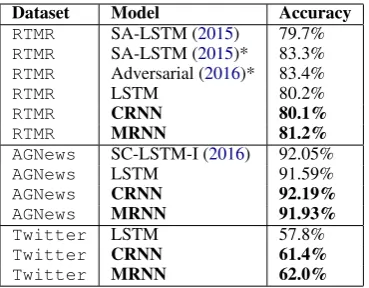
Dataset Model Accuracy RTMR SA-LSTM (2015) 79.7% RTMR SA-LSTM (2015)* 83.3% RTMR Adversarial (2016)* 83.4%
RTMR LSTM 80.2%
RTMR CRNN 80.1%
RTMR MRNN 81.2%
AGNews SC-LSTM-I (2016) 92.05%
AGNews LSTM 91.59%
AGNews CRNN 92.19%
AGNews MRNN 91.93%
Twitter LSTM 57.8%
Twitter CRNN 61.4%
[image:4.595.72.257.61.205.2]Twitter MRNN 62.0%
Table 2: Experimental results. (*trained on exter-nal unlabeled dataset)
word generation. We suspect that sentiment anal-ysis is primarily keyword based and cannot fully take advantage of the automated language model task. Additionally, we found that the MTL mod-els can be trained with much higher learning rates than a standard LSTM, allowing for convergence in many fewer epochs. The MRNN model con-verged within the first 10 epochs, whereas the LSTM model required approximately 30 epochs to converge.
5 AG News
5.1 Training Details
For the AG News experiment, the primary task is topic prediction and the automated task is word generation. The input to the model is the 300-dimensional word2vec representations of the words from the documents. The primary task out-put uses a softmax layer with 4 units. The auto-mated task output is represented by a tanh layer with 300 units. The learning rate for the LSTM is 0.001. For the MRNN, the learning rates undergo the same linear function as in the Rotten Tomatoes experiment wherelractualis 0.01.
5.2 Results
For AG News dataset, we compare our experiment result with skip-connected LSTM (Wang and Tian,
2016), the previous state-of-the-art model on this dataset. The CRNN outperforms state-of-the-art by 0.14% and MRNN by 0.26%. We believe the CRNN beats the MRNN due to a hierarchical rela-tionship between topic prediction and word gener-ation. We suspect that topic prediction, which re-lies on a holistic understanding of a document, can effectively take advantage of the language model.
6 Twitter
We ran an experiment showing that our models can perform well in challenging environments with lit-tle data. We used a small dataset of 5,964 tweets. We performed regression on the word2vec repre-sentation of the hashtag given the tweet. We chose regression over classification of one-hot targets because our chosen hashtags are inherently non-orthogonal and can benefit from semantic repre-sentations in vector space. We trained three mod-els: an LSTM model, the MRNN, and the CRNN.
6.1 Training Details
For the Twitter experiment, the primary task is hashtag recommendation and the automated task is character prediction. We use character predic-tion as the automated task due to the large amount of misspellings and colloquialisms in tweets.
The input to the model is the 66-dimensional one-hot encoding of the characters corresponding to the ASCII characters that we kept during pre-processing. The primary task output is a tanh layer with 300 units. The automated task output uses a softmax layer with 66 units. For all the models we chose a fixed learning rate of 0.001 based on our observation that different learning rates have little effect on the relative trend between the models on this particular task. A constant, equal learning rate allows us to compare the accuracy curves of each network against epochs run.
Since several of the hashtags are very similar to each other (i.e. #Capricorn and #Scorpio), we marked a prediction as correct if the predicted se-mantic vector’s top 5% (top 4) closest cosine dis-tance words contained the target hashtag.
6.2 Results
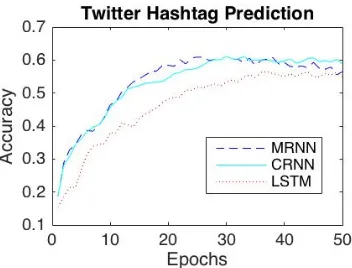
With the MRNN, we achieve a 4.2% gain in accu-racy over the LSTM in the Twitter dataset. With the CRNN, we achieve a 3.6% gain in accuracy. Additionally, we have shown in Figure2that both the MRNN and CRNN models converge faster than the LSTM model; both MTL models take ap-proximately half of the number of epochs to reach 50% accuracy using the same constant learning rate.
7 Conclusion
Figure 2: Hashtag prediction in Twitter.
and hashtag recommendation. Note that the con-cept of automated tasks can be extended to non-NLP sequence tasks such as image categorization with next row prediction as the automated task. Because automated MTL can be integrated into an existing network by adding a new branch to a pre-existing graph, we can substitute bidirectional LSTMs (Schuster and Paliwal,1997), GRUs ( Gul-cehre et al.,2014), and vanilla RNNs for LSTMs in our MTL models. We will experiment on these variations in the future.
References
R. Ando and T. Zhang. 2005. A framework for learning predictive structures from multiple tasks and unla-beled data.Journal of Machine Learning Research. Dzmitry Bahdanau, Kyunghyun Cho, and Yoshua Ben-gio. 2014. Neural machine translation by jointly learning to align and translate. arXiv preprint arXiv:1409.0473.
Trapit Bansal, David Belanger, and Andrew McCal-lum. 2016. Ask the gru: Multi-task learning for deep text recommendations. InProceedings of the 10th
ACM Conference on Recommender Systems, pages
107–114. ACM.
Yong Cheng, Wei Xu, Zhongjun He, Wei He, Hua Wu, Maosong Sun, and Yang Liu. 2016. Semi-supervised learning for neural machine translation.
arXiv preprint arXiv:1606.04596.
Andrew M Dai and Quoc V Le. 2015. Semi-supervised sequence learning. InAdvances in Neural
Informa-tion Processing Systems, pages 3079–3087.
Shalini Ghosh, Oriol Vinyals, Brian Strope, Scott Roy, Tom Dean, and Larry Heck. 2016. Contextual lstm (clstm) models for large scale nlp tasks. arXiv preprint arXiv:1602.06291.
Caglar Gulcehre, Kyunghyun Cho, Razvan Pascanu, and Yoshua Bengio. 2014. Learned-norm pooling
for deep feedforward and recurrent neural networks, part 1 edition, volume 8724 LNAI ofLecture Notes in Computer Science (including subseries Lecture Notes in Artificial Intelligence and Lecture Notes in Bioinformatics). Springer Verlag.
Geoffrey Hinton, Li Deng, Dong Yu, George E Dahl, Abdel-rahman Mohamed, Navdeep Jaitly, Andrew Senior, Vincent Vanhoucke, Patrick Nguyen, Tara N Sainath, et al. 2012. Deep neural networks for acoustic modeling in speech recognition: The shared views of four research groups.IEEE Signal Process-ing Magazine, 29(6):82–97.
Yoon Kim. 2014. Convolutional neural net-works for sentence classification. arXiv preprint arXiv:1408.5882.
P. Kingma and J. Ba. 2014. Adam: A method for stochastic optimization. arXiv preprint arXiv:1412.6980.
Quoc V Le and Tomas Mikolov. 2014. Distributed rep-resentations of sentences and documents. InICML, volume 14, pages 1188–1196.
Zachary C Lipton, Sharad Vikram, and Julian McAuley. 2015. Generative concatenative nets jointly learn to write and classify reviews. arXiv preprint arXiv:1511.03683.
Pengfei Liu, Xipeng Qiu, and Xuanjing Huang. 2016. Deep multi-task learning with shared memory.
arXiv preprint arXiv:1609.07222.
Xiaodong Liu, Jianfeng Gao, Xiaodong He, Li Deng, Kevin Duh, and Ye-Yi Wang. 2015. Representation learning using multi-task deep neural networks for semantic classification and information retrieval. In
HLT-NAACL, pages 912–921.
Minh-Thang Luong, Quoc V Le, Ilya Sutskever, Oriol Vinyals, and Lukasz Kaiser. 2015. Multi-task sequence to sequence learning. arXiv preprint
arXiv:1511.06114.
Takeru Miyato, Andrew M Dai, and Ian Good-fellow. 2016. Adversarial training methods for semi-supervised text classification. arXiv preprint
arXiv:1605.07725.
Bo Pang and Lillian Lee. 2005. Seeing stars: Exploit-ing class relationships for sentiment categorization with respect to rating scales. InProceedings of the 43rd annual meeting on association for computa-tional linguistics, pages 115–124. Association for Computational Linguistics.
Mike Schuster and Kuldip K Paliwal. 1997. Bidirec-tional recurrent neural networks. IEEE Transactions
on Signal Processing, 45(11):2673–2681.
Meeting of the Association for Computational Lin-guistics, volume 2, pages 231–235. Association for Computational Linguistics.
Yiren Wang and Fei Tian. 2016. Recurrent residual learning for sequence classification. InProceedings of the 2016 Conference on Empirical Methods in
Natural Language Processing, page 938943.
Asso-ciation for Computational Linguistics.
Yonghui Wu, Mike Schuster, Zhifeng Chen, Quoc V Le, Mohammad Norouzi, Wolfgang Macherey, Maxim Krikun, Yuan Cao, Qin Gao, Klaus Macherey, et al. 2016. Google’s neural ma-chine translation system: Bridging the gap between human and machine translation. arXiv preprint
arXiv:1609.08144.