Automatic Evaluation of Summaries Using Document Graphs
Eugene Santos Jr., Ahmed A. Mohamed, and Qunhua Zhao Computer Science and Engineering Department
University of Connecticut
191 Auditorium Road, U-155, Storrs, CT 06269-3155 {eugene, amohamed, qzhao}@engr.uconn.edu
Abstract
Summarization evaluation has been always a chal-lenge to researchers in the document summariza-tion field. Usually, human involvement is necessary to evaluate the quality of a summary. Here we present a new method for automatic evaluation of text summaries by using document graphs. Data from Document Understanding Con-ference 2002 (DUC-2002) has been used in the experiment. We propose measuring the similarity between two summaries or between a summary and a document based on the concepts/entities and relations between them in the text.
1 Introduction
Document summarization has been the focus of many researchers for the last decade, due to the increase in on-line information and the need to find the most important information in a (set of) document(s). One of the biggest challenges in text summarization research is how to evaluate the quality of a summary or the performance of a summarization tool. There are different approa-ches to evaluate overall quality of a summariza-tion system. In general, there are two types of evaluation categories: intrinsic and extrinsic (Sparck-Jones and Galliers, 1996). Extrinsic ap-proaches measure the quality of a summary based on how it affects certain tasks. In intrinsic approa-ches, the quality of the summarization is evaluated based on analysis of the content of a summary itself. In both categories human involvement is used to judge the summarization outputs. The problem with having humans involved in evalua-ting summaries is that we can not hire human
jud-ges every time we want to evaluate summaries (Mani and Maybury, 1999). In this paper, we dis-cuss a new automated way to evaluate machine-generated summaries without the need to have human judges being involved which decreases the cost of determining which summarization system is best. In our experiment, we used data from Do-cument Understanding Conference 2002 (DUC-2002).
2 Related Work
Researchers in the field of document summariza-tion have been trying for many years to define a metric for evaluating the qua lity of a machine-generated summary. Most of these attempts invol-ve human interference, which make the process of evaluation expensive and time-consuming. We discuss some important work in the intrinsic cate-gory.
equivalent to it in meaning. This, of course, will affect the score assigned to the system dramatic a-lly. It is also obvious that sentence precision/recall is only applicable to the summaries that are gene-rated by sentence extraction, not abstraction (Ma-ni, 2001).
2.2 Content-Based Measure
Content-based measure computes the similarity at the vocabulary level (Donaway, 2000 and Mani, 2001). The evaluation is done by creating term frequency vectors for both the summary and the model summary, and measuring the cosine simila-rity (Salton, 1988) between these two vectors. Of course, the higher the cosine similarity measure, the higher the quality of the summary is. Lin and Hovy (2002) used accumulative n-gram matching scores between model summaries and the summa-ries to be evaluated as a performance indicator in multi-document summaries. They achieved their best results by giving more credit to longer n-gram matches with the use of Porter stemmer.
A problem raised in the evaluation approaches that use the cosine measure is that the summaries may use different key terms than those in the ori-ginal documents or model summaries. Since term frequency is the base to score summaries, it is possible that a high quality summary will get a lower score if the terms used in the summary are not the same terms used in most of the document’s text. Donaway et al. (2000) discussed using a common tool in information retrieval: latent se-mantic indexing (LSI) (Deerwester et al., 1990) to address this problem. The use of LSI reduces the effect of near-synonymy problem on the similarity score. This is done by penalizing the summary less in the reduced dimension model when there are infrequent terms synonymous to frequent terms. LSI averages the weights of terms that co-occur frequently with other mutual terms. For example, both “bank” and “financial institution” often occur with the term “account” (Deerwester et al., 1990). Even though using LSI can be useful in some cases, it can produce unexpected results when the document contains terms that are not synonymous to each other, but, however, they co-occur with other mutual terms.
2.3 Document Graph
2.3.1 Representing Content by Document Graph
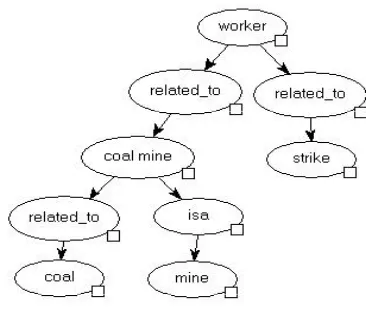
Current approaches in content-based summariza-tion evaluasummariza-tion ignore the relasummariza-tions between the keywords that are expressed in the document. Here, we introduce our approach, which measures the similarity between two summaries or a sum-mary and a document based on the relations (bet-ween the keywords). In our approach, each document/summary is represented as a document graph (DG), which is a directed graph of con-cepts/entities and the relations between them. A DG contains two kinds of nodes, concept/entity nodes and relation nodes. Currently, only two kinds of relations, “isa” and “related to”, are cap-tured (Santos et al, 2001) for simplicity.
To generate a DG, a document/summary in plain text format is first tokenized into sentences; and then, each sentence is parsed using Link Par-ser (Sleator and Temperley, 1993), and the noun phrases (NP) are extracted from the parsing re-sults. The relations are generated based on three heuristic rules:
• The NP-heuristic helps to set up the hierar-chical relations. For example, from a noun phrase “folk hero stature”, we generate re-lations “folk hero stature isa stature”, “folk hero stature related to folk hero”, and “folk hero isa hero”.
• The NP-PP-heuristic attaches all preposi-tional phrases to adjacent noun phrases. For example, from “workers at a coal mine”, we generate a relation, “worker related to coal mine”.
Figure 1: A partial DG.
2.3.2 Similarity Comparison between two Document Graphs
The similarity of DG1 to DG2 is given by the
equation:
M m N n DG DG Sim
2 2 ) ,
( 1 2 = +
which is modified from Montes-y-Gómez et al. (2000). N is the number of concept/entity nodes in DG1, and M stands for number of relations in DG1; n is the number of matched concept/entity nodes in two DGs, and m is the number of mat-ched relations. We say we find a matmat-ched relation in two different DGs, only when both of the two concept/entity nodes linked to the relation node are matched, and the relation node is also mat-ched. Since we might compare two DGs that are significantly different in size (for example, DGs for an extract vs. its source document), we used the number of concept/entity nodes and relation nodes in the target DG as N and M, instead of the total number of nodes in both DGs. The target DG is the one for the extract in comparing an extract with its source text. Otherwise, the similarity will always be very low. Currently, we weight all the concepts/entities and relations equally. This can be fine tuned in the future.
3 Data, and Experimental Design
3.1 Data
Because the data from DUC-2003 were short (~100 words per extract for multi-document task), we chose to use multi-document extracts from DUC-2002 (~200 words and ~400 words per
ex-tract for multi-document task) in our experiment. In this corpus, each of ten information analysts from the National Institute of Standards and Technology (NIST) chose one set of newswi-re/paper articles in the following topics (Over and Liggett, 2002):
• A single natural disaster event with docu-ments created within at most a 7-day win-dow
• A single event of any type with documents created within at most a 7-day window • Multiple distinct events of the same type (no
time limit)
• Biographical (discuss a single person) Each assessor chose 2 more sets of articles so that we ended up with a total of 15 document sets of each type. Each set contains about 10 docu-ments. All documents in a set are mainly about a specific “concept.”
A total of ten automatic summarizers participa-ted to produce machine-generaparticipa-ted summaries. Two extracts of different lengths, 200 and 400 words, have been generated for each document-set.
3.2 Experimental Design
A total of 10 different automatic summarization systems submitted their summaries to DUC. We obtained a ranking order of these 10 systems ba-sed on sentence precision/recall by comparing the machine generated extracts to the human genera-ted model summaries. The F-factor is calc ulated from the following equation (Rijsbergen, 1979):
)
(
2
R
P
R
P
F
+
×
×
=
where P is the precision and R is the recall. We think this ranking order gives us some idea on how human judges think about the performance of different systems.
used the average of the F-factors for ranking pur-poses.
4 Results
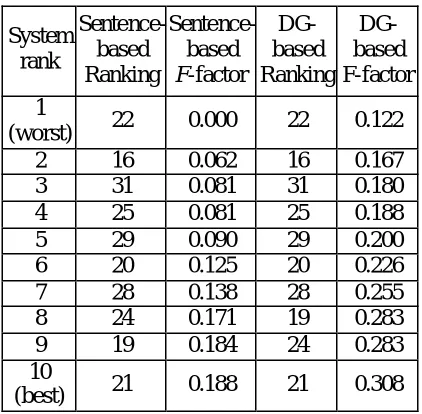
The ranking orders obtained based on sentence precisions and recalls are shown in Tables 1 and 2. The results indicate that for sentence precision and recall, the ranking order for different summa-rization systems is not affected by the summariza-tion compression ratio. The ranking results for 200-word extracts and 400-word extracts are ex-actly the same.
Since the comparison is between the machine generated extracts and the human created model extracts, we believe that the rankings should rep-resent the performance of 10 different automated summarization systems, to some degree. The ex-periments using DGs instead of sentence matc hing give two very similar ranking orders (Spearman rank correlation coefficient [Myers and Well, 1995] is 0.988) where only systems 24 and 19 are reversed in their ranks (Tables 1 and 2). The re-sults show that when the evaluation is based on the comparison between machine generated ex-tracts and the model exex-tracts, our DG-based evaluation approach will provide roughly the same ranking results as the sentence precision and recall approach. Notice that the F-factors obtained
by experiments using DGs are higher than those calculated based on sentence matching. This is because our DG-based evaluation approach com-pares the two extracts at a more fine grained level than sentence matching does since we compare the similarity at the level of concepts/entities and their relations, not just whole sentences. The simi-larity of the two extracts should actually be higher than the score obtained with sentence matching because there are sentences that are equivalent in meaning but not syntactically identical.
Since we believe that the DGs captures the se-mantic information content contained in the res-pective documents, we rank the automatic summarization systems by comparing the DGs of their extract outputs against the DGs of the orig i-nal documents. This approach does not need the model summaries, and hence no human involve-ment is needed in the evaluation. The results are shown in Tables 3 and 4. As we can see, our ran-kings are different from the ranking results based on comparison against the model extracts. System 28 has the largest change in rank in both 200-word and 400-word summaries. It was ranked as the worst by our DG based approach instead of num-ber 7 (10 is the best) by the approaches comparing to the model extracts. We investigated the extract content of system 28 and found that many extracts System
rank
Sentence-based Ranking
Sentence-based F-factor
DG-based Ranking
DG-based F-factor
System rank
Sentence-based Ranking
Sentence-based F-factor
DG-based Ranking
DG-based F-factor
1
(worst) 22 0.000 22 0.122
1
(worst) 22 0.000 22 0.181
2 16 0.062 16 0.167 2 16 0.128 16 0.235
3 31 0.081 31 0.180 3 25 0.147 25 0.256
4 25 0.081 25 0.188 4 31 0.150 31 0.266
5 29 0.090 29 0.200 5 29 0.155 20 0.273
6 20 0.125 20 0.226 6 20 0.172 29 0.279
7 28 0.138 28 0.255 7 28 0.197 28 0.316
8 24 0.171 19 0.283 8 24 0.223 19 0.337
9 19 0.184 24 0.283 9 19 0.224 24 0.355
10
(best) 21 0.188 21 0.308
10
(best) 21 0.258 21 0.372
Table 1: Model Summaries vs. machine-generated summaries. Ranking results for 200
words extracts
Table 2: Model Summaries vs. machine-generated summaries. Ranking results for 400
generated by system 28 included sentences that contain little information, e.g., author’s names, publishers, date of public ation, etc. The following are sample extracts produced for document 120 by systems 28, 29 (the best ranked) and a human jud-ge, at 200-words.
[Extract for Document 120 by System 28]
John Major, endorsed by Margaret Thatcher as the politician closest to her heart, was elected by the Conservative Party Tuesday night to succeed her as prime minister.
Hong Kong WEN WEI PO
By MICHAEL CASSELL and IVOR OWEN By MICHAEL THOMPSON-NOEL
By DOMINIC LAWSON From Times Wire Services
By WILLIAM TUOHY, TIMES STAFF WRITER From Associated Press
[Extract for Document 120 by System 29]
John Major, endorsed by Margaret Thatcher as the politician closest to her heart, was elected by the Conservative Party Tuesday night to succeed her as prime minister.
Aides said Thatcher is "thrilled". Hurd also quickly conceded.
ONE year ago tomorrow, Mr John Major surpri-sed everyone but himself by winning the general election.
It has even been suggested that the recording of the prime minister's conversation with Michael Brunson, ITN's political editor, in which Major used a variety of four-, six - and eight-letter words to communicate his lack of fondness for certain colleagues, may do him good.
BFN
[Colin Brown article: "Cabinet Allies Close Ranks But Bring
Right-wing MPs confirmed the findings in an INDEPENDENT ON SUNDAY/NOP [National Opinion Poll] poll that Michael Heseltine was the favourite to replace Mr Major, if he is forced out. The Labour Party controls 90 local councils, whe-reas the Conservatives only control 13, with a sharp contrast in strength between the two sides. If he did not see the similarity, that is still more revealing.
[Extract for Document 120 by a human judge -- model extract]
John Major, endorsed by Margaret Thatcher as the politician closest to her heart, was elected by the Conservative Party Tuesday night to succeed her as prime minister.
While adopting a gentler tone on the contentious issue of Britain's involvement in Europe, he shares her opposition to a single European currency and shares her belief in tight restraint on government spending.
FT 08 APR 93 / John Major's Year: Major's blue period - A year on from success at the polls, the prime minister's popularity has plunged.
The past 12 months have been hijacked by inter-nal party differences over Europe, by the debacle surrounding UK withdrawal from the exchange rates mechanism of the European Monetary Sys-tem, and by a continuing, deep recession which has disappointed and alienated many traditional Tory supporters in business.
Its Leader"] [Text] In local government elections across Britain yesterday, the Conservatives suffe-red their worst defeat ever, losing control of 17 regional councils and 444 seats.
Even before all of the results were known, some Tories openly announced their determination to challenge John Major's position and remove him from office as early as possible.
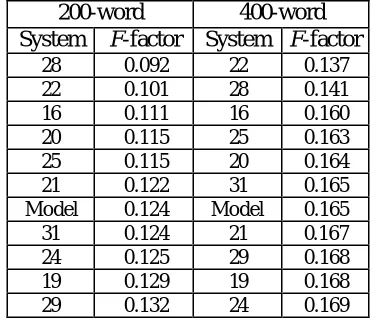
200-word 400-word System F-factor System F-factor
28 0.092 22 0.137
Table 5: Average F-factors for the model sum-maries and machine-generated sumsum-maries.
Of the 59 submitted 200-word extracts by sys-tem 28, 39 extracts suffer the problem of having less informative sentences. The number of such sentences is 103, where the total number of sen-tences is 406 from all the extracts for system 28. On average, each extract contains 1.75 such sen-tences, where each extract has 6.88 sentences. For the 400-words extracts, we found 54 extracts among the 59 submitted summaries also have this problem. The total number of such sentences was 206, and the total number of sentences was 802 sentences. So, about 3.49 sentences do not con-tain much information, where the average length of each extract is 13.59 sentences. Thus, a large
portion of each extract does not contribute to the do example, will not be considered a good sum-mary, either on the criterion of summary coheren-ce or summary informativeness, where coherencoheren-ce is how the summary reads and informativeness is how much information from the source is preser-ved in the summary (Mani, 2001).
From the results based on comparing extracts against original documents, we found that several systems perform very similarly, especially in the experiments with 400-word extracts (Table 4). The results show that except for systems 22 and 28 which perform significantly worse, all other systems are very similar, from the point of view of informativeness.
Finally, we generated DGs for the model extra-cts and then compared them against their original documents. The average F-factors are calculated, which are listed in Table 5 along with the scores for different automatic summarization systems. Intuitively, a system provides extracts that contain more information than other systems will get a higher score. As we can see from the data, at 200-words, the extracts generated by systems 21, 31, 24, 19, and 29 contain roughly the same amount of information as those created by humans, while the other five systems performed worse than human judges. At 400-words, when the compres-sion ratio of the extracts is decreased, more sys-tems perform well; only syssys-tems 22 and 28 System
Table 3: Machine-generated summaries vs. source documents. Ranking results for 200
words extracts
Table 4: Machine-generated summaries vs. source documents. Ranking results for 400
generated summaries that contain much less in-formation than the model summaries.
5 Discussion and Future Work
In DUC 2002 data collection, 9 human ju dges were involved in creating model extracts; how-ever, there are only 2 model extracts generated for each document set. The sentence precisions and recalls obtained from comparing the machine gen-erated extracts and human gengen-erated model ex-tracts are distributed along with raw data (DUC-2002. http://www-nlpir.nist.gov/projects/duc), with the intent to use them in system performance comparison. Van Halteren (2002) argued that only two manually created extracts could not be used to form a sufficient basis for a good benchmark. To explore this issue, we obtained a ranking order for each human judge based on the extracts he/she generated. The results showed that the ranking orders obtained from 9 different judges are actu-ally similar to each other, with the average Spearman correlation efficient to be 0.901. From this point of view, if the ranking orders obtained by sentence precision and recall based on the model extracts could not form a good basis for a benchmark, it is because of its binary nature (Jing et al., 1998), not the lack of sufficient model ex-tracts in DUC 2002 data.
Van Halteren and Teufel (2003) proposed to evaluate summaries via factoids, a pseudo-semantic representation based on atomic informa-tion units. However, sufficient manually created model summaries are need; and factoids are also manually annotated. Donaway et al. (2000) sug-gested that it might be possible to use content-based measures for summarization evaluation wit-hout generating model summaries. Here, we pre-sented our approach to evaluate the summaries base on document graphs, which is generated au-tomatically. It is not very surprising that different measures rank summaries differently. A similar observation has been reported previously (Radev, et al, 2003). Our document graph approach on summarization evaluation is a new automatic way to evaluate machine-generated summaries, which measures the summaries from the point of view of informativeness. It has the potential to evaluate the quality of summaries, including extracts, abs-tracts, and multi-document summaries, without human involvement. To improve the performance of our system and better represent the content of the summaries and source documents, we are working in several areas: 1) Improve the results of
natural language processing to capture informa-tion more accurately; 2) Incorporate a knowledge base, such as WordNet (Fellbaum, 1998), to ad-dress the synonymy problem; and, 3) Use more heuristics in our relation extraction and genera-tion. We are also going to extend our experiments by comparing our approach to content-based mea-sure approaches, such as cosine similarity based on term frequencies and LSI approaches, in both extracts and abstracts.
6 Acknowledgments
This work was supported in part by the Advanced Research and Development Activity (ARDA) U.S. Government. Any opinions, findings and conclu-sions or recommendations expressed in this mate-rial are those of the authors and do not necessarily reflect the views of the U. S. Government.
References
Scott Deerwester, Susan T. Dumais, George W. Furnas, Thomas K. Landauer, and Richard Harshman. 1990. Indexing by latent semantic analysis. Journal of the American Society for In-formation Science, 41(6): 391-407.
Robert L. Donaway, Kevin W. Drummey, and Laura A. Mather. 2000. A comparison of rank-ings produced by summarization evaluation measures. In Proceedings of the Workshop on Automatic Summarization, pages 69-78.
Christiane Fellbaum. 1998. WordNet: An Elec-tronic Lexical Database. MIT Press.
Jade Goldstein, Mark Kantrowitz, Vibhu Mittal, and Jaime Carbonell. 1999. Summarizing text documents: Sentence selection and evaluation metrics. In Proceedings the 24th Annual Interna-tional ACM SIGIR Conference on Research and Development in Information Retrieval, pages 121-128, ACM, New York..
Hans van Haltern. 2002. Writing style recognition and sentence extraction. DUC’02 Conference Proceedings.
Hans Van Halteren and Simone Teufel, 2003. Ex-amining the consensus between human summa-ries: Initial experiments with factoid analysis. In HLT/NAACL-2003 Workshop on Automatic Summarization.
In American Association for Artificial Intelli-gence Spring Symposium Series, pages 60-68. Chen-Yew Lin. 2001. Summary evaluation
environment. http://www.isi.edu/~cyl/SEE. Chin-Yew Lin and Eduard Hovy. 2002. Manual
and automatic evaluation of summaries. In Pro-ceedings of the Workshop on Automatic Summa-rization post conference workshop of ACL-02, Philadelphia, PA, U.S.A., July 11-12 (DUC 2002).
Inderjeet Mani. 2001. Summarization evaluation: An overview. In Proceedings of the NTCIR Workshop 2 Meeting on Evaluation of Chinese and Japanese Text Retrieval and Test Summari-zation, National Institute of Informatics.
Inderjeet Mani and Mark T. Maybury. 1999. Ad-vances in Automatic Text Summarization. The MIT Press.
Manuel Montes-y-Gómez, Alexander Gelbukh, and Aurelio López-López. 2000. Comparison of conceptual graphs. In Proceedings of MICAI-2000, 1st Mexican International Conference on
Artificial Intelligence, Acapulco, Mexico. Jerome L. Myers and Arnold D. Well. 1995.
Re-search Design and Statistical Analysis, pages, 488-490, Lawrence Erlbaum Associates, New Jersey
Paul Over and Walter Liggett. 2002. Introduction to DUC-2002: An intrinsic evaluation of generic news text summarization systems. Document Understanding Conferences website (http://duc.nist.gov/)
Kishore Papineni, Salim Roukos, Todd Ward, and Wei-Jing Zhu. 2001. BLEU: A Method for Auto-matic Evaluation of Machine Translation. Technical Report RC22176 (W0109-022), IBM Research Division, Thomas J. Watson Research Center.
Dragomir R. Radev, Simone Teufel, Horacio Sag-gion, Wai Lam, John Blitzer, Hong Qi, Arda Celebi, Danyu Liu, and Elliott Drabek. 2003. Evaluation challenges in large-scale document summarization. In Proceedings of the 41st
An-nual Meetring of the Association for Computa-tional Linguistics, July 2003, pages 375-382. Keith van Rijsbergen. 1979. Information
Re-trieval. Second Edition Butterworths, London. Gerard Salton. 1988. Automatic Text Processing.
Addison-Wesley Publishing Company.
Eugene Santos Jr., Hien Nguyen, and Scott M. Brown. 2001. Kavanah: An active user interface
Information Retrieval Agent Technology. Mae-bashi, Japan, October 2001, pages 412-423. Danny Sleator and Davy Temperley. 1993.
Pars-ing English with a link grammar. In Proceed-ings of the Third International Workshop on Parsing Technologies, pages 277-292.