A Study on Bio Inspired Optimization Algorithms
V.Bugcy Mettilda
1, D. Saravanan
2Department of Mathematics1,2,Research Scholar1, Professor2 JJ College of Arts and Science (Autonomous), Pudukkottai, Tamilnadu, India.
Abstract- Nature is definitely a wide and topmost origin of inspiration to solve hard and complex problems in mathematics as well as in computer science since it shows extremely discrete, dynamic, drastic, intricate and fascinating phenomenon. Bio-inspired Optimization is a term that suffuses a wide variety of computational approaches that are based on the principles of biological systems. This motivates the application of biology to optimization problems. This paper aims to present a brief study on Bio-inspired optimization algorithms. In fact bio-inspired algorithms develop a majority of all nature inspired algorithms. Biologically –inspired computing and optimization is a major subset of natural computation. This paper introduces a broad idea of biologically inspired optimization algorithms, composed by the biological field that inspired each and areas where these algorithms have been most successfully applied.
Keywords: Bio-inspired algorithms; optimization algorithms.
1. INTRODUCTION:
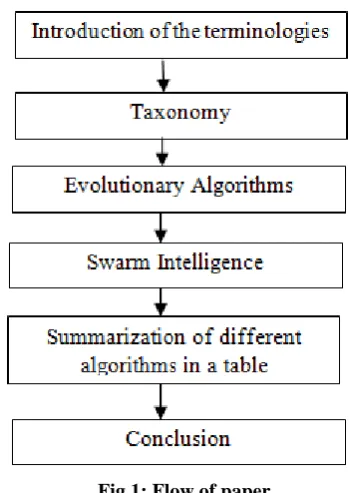
The real beauty of nature inspired algorithms is in the fact that it obtains its solitary inspiration from nature. In other words, Nature is always the best teacher and its designs or references and capabilities are extremely huge and mysterious that researchers take effort to mimic nature in technology. Since bio inspired algorithms are a subset of nature inspired algorithms, they have the ability to annotate and conclude complex relationships from intrinsically very simple primary conditions and rules with little or no knowledge of the search locality. Bio inspired algorithms can confer an augmented basis for these problem solving and decision making. They give solutions to the optimization problems which can define and decide arduous or toilsome dealings from nature. They have the capable of providing heuristic –based solutions. Keeping the key focus as centre this study continues as shown in the following figure:
Fig 1: Flow of paper
Optimization:
reliability, longevity, efficiency and utilization etc. This decision making process is known as optimization.
Biology With Optimization:
Biology with optimization is an immense approach in the field of science and engineering. We can say that bio inspired optimization is an umbrella rots those envelopes a wide variety of optimization approaches which are based on the principles of biological systems [1]. Bio inspired computing has come up as a new epoch in computing encircling a wide range of applications suffusing almost all regions including computer networks, robotics, security, biomedical engineering, production engineering, control systems, data mining, parallel processing, power systems etc.
The Bio inspired optimization is listed as follows: (i) Ant Colony Optimization (ACO) (ii) Bee Colony Optimization (BCO) (iii) Bat Algorithm (BA)
(iv) Krill Herd (KH) Algorithm The following are some new classes of optimization techniques:
1. Simulated Annealing (SA) 2. Neural Network (NN)
3. Evolutionary Algorithms (EA) 4. Genetic Algorithms (GA)
Bio inspired optimization techniques become significant or important for education and educational departments. Today the world is being encountered by more and more complicated, vast and ill structured problems. On the other hand people observe that apparently simple or banal structures and organizations in nature are capable of dealing with the indecisive tasks.
This survey is an attempt to summarize the recent discoveries in the new arena of bio inspired optimization algorithms. It works as signpost or torchbearer which gives motivation and inspiration or successive research in all areas of optimization. This survey is also meant for researches to give the state of the project on theoretical results of bio inspired optimization algorithms. This paper introduces scrutinize and review on the BIAS along with taxonomy and the unison applications areas.
Fig 2: Taxonomy
2. EVOLUTIONARY ALGORITHMS:
Evolutionary algorithms is one of the classifications of bio-inspired optimization algorithms, EAs are the most well known classical established algorithms derived from nature inspired algorithms . It is inspired by genetic evolution process. Its branches are population based stochastic search algorithms working with best-to survive criteria [2]. Most EAs may be divided into generational algorithms which update the whole sample once per iteration and steady-state algorithms, which update the sample-a few candidate solutions at a time. The main paradigms of Bio inspired evolutionary computation are shown in fig 3.
solution. EAs confer solutions to many real-world complexes, Optimization problems that are arduous to tackle using the conventional methods, due to their nature that implies discontinuities of the search space, non-differentiable objective functions, vague arguments and function values. EAs can handle problems with any combination of the challenges that may be encountered in real world applications such as local optima, multiple objectives, constraints, dynamic components etc.
2.1 Genetic Algorithms (GA):
The most well-known paradigm of EAs is Genetic Algorithm (GA). It is an evolutionary based stochastic optimization Algorithm with a global search potential proposed by Holland in 1975[3]. The GA is inspired by population genetics including heredity and gene frequencies. GAs follows the principles of Charles Darwin theory of survival of the fittest. Algorithms start with initializing a population of solution (chromosome). It includes representation of the problem usually in the form of a bit vector. For each chromosome assess the fitness by using an appropriate fitness function competent for the problem. Based on this, the best chromosomes are chosen into the mating pool in where they undergo cross over and mutation and thus giving new set of off springs. There are three principal genetic operators in GA.
i) Selection ii) Crossover iii) Mutation
GA is useful and efficient because:
The search space is large complex or poorly known.
The mathematical analysis is not available Domain knowledge is exceptional to
encode to narrow the search space. It works by its own internal rules for
complex or loosely defined problems. Traditional search method fails.
2.2Genetic Programming (GP):
GP was proposed by koza in 1992[4], being an extension to GA but differs from the latter in terms of representation of the solution. GP represents an indirect encoding of a potential solution in the form of a tree, in which search is applied to the solution directly. The next basic difference is in the variable length representation adopted by GP is contrast with the fixed length encoding in GA. In GP a population is progressively improved by selectively relinquishing or discarding the not – so-fit Population and breeding new children from better populations. Like other EAS, the GP solution begins with a random population of individuals such as equations or computer programs. The four steps in Genetic programming involve:
1) It generates an initial population of computer programs comprising the functions and terminals.
2) Executes each program in the population and assigns it as a fitness value according to how well it gives solution to the of the operators and parameters.
2.3Evolution Strategies (ES):
Evolution strategies was developed by three students (Bienert, Rechenberg ,Schwefel ) at the technical University in Berlin in 1964[5]. ES is a global optimization algorithm inspired by the theory of adaptation and evolution by means of natural selection. Specifically, the technique is inspired by the species – level process of evolution. It employs a simple procedure for selecting individuals called Truncation selection, and only uses mutation as the Tweak operator. A very important feature of ES is the Utilization of self – adaptive mechanisms to control the application of mutation.
There are some common selection and sampling schemes in ES as follows:
(1+1)-ES: This selection mechanism is a
simple in which works by creating one real – valued vector of object variables from is origin (parent) by applying mutation with an identical standard deviation to every object variable. Then the resulting child (individual) is evaluated and selected from the current generation to generate individual with ƛ >= µ, and the best µ off springs from the next generation.
2.4 Evolutionary Programming (EP): then filled in with children. Second, EP was applied to most any representation.
2.5Differential Evolution (DE):
DE is a modern optimization technique in EA family proposed by and price in 1995[6] .DE & GA are similar in one respect. Populations of individuals are used to search for an optimal solution. They both differ in the mutation and recombination phase. In GAS, mutation as the result of small perturbations to the genes of an individual whereas in DE, mutation operator of DE favors exploration. Hence DE adapts automatically the mutation increments to the best value based on the stage of the evolutionary process. Therefore mutation is not based on a predefined probability density function in DE.
3. SWARM INTELLIGENCE (SI):
Swarm Intelligence (SI) proposed kennedy and Ebrhart in 2001 [7] belong to a wider class of algorithms called Bio-Inspired Algorithms (BIA). It is a recent and emerging paradigm in BIA for implementing adaptive systems. The term swarm is used for the assembling of animals such as fish schools, insect colonies (ants, termites and honey bees) and bird flocks performing collective activities. I based algorithms are subset of bio-inspired algorithms. SI is an existence of EC while EAs are based on genetic adaptation of
organisms.SI is based on collective social behavior of organisms.SI has been developed alongside with EAs. Some of the most well-known strategies are discussed below.SI can be described by considering the following five fundamental principles [8]. Proximate principle: The swarm should be able to do simple spare and time computations.
Quality principle: The swarm should be able to respond to quality factors in the Environment. Diverse Response principle: The swarm should not commit all of its resources along excessively narrow channels.
Stability principle: The population should not change its mode of behavior every time of the environment changes.
Adaptability principle: The swarm must be able to change its behavior mode when it matters.
3.1Particle Swarm Optimization (PSO):
PSO was developed by J.kennedy and R.Ederhart in 1995[9].It is a computational intelligence oriented stochastic, population-based globalOptimization technique. It mimics the flocking behavior of birds searching for food. The birds fly in a solution space and the optimum solution is determined by their flocking behavior .This algorithm is based on population .In PSO term swarm is used for a collection of particle birds called population which moves in search space to find the shortest distance between source and destination. The shortest path followed by a bird is to be considered as local or particle best solution. Particles tend to move towards its local best position (lbest) found by them so far. The best position reached by their neighborhoods. They also keep the track of global best ( gbest )solution.
3.2Ant Colony Optimization (ACO):
ACO is one of the most successful swarm based algorithms proposed by Dorigo and Dicaro in 1999[10]. The ACO is inspired by the foraging search behavior of real ants and their ability in finding the shortest paths. Since Ants are blind and small in size they are still able to find shortest route to find their food. They make use of their antenna and pheromones to be in touch with each other. This is a population based general search technique for the solution of difficult combinational optimization problems.ACO is inspired by the capability of monitoring and synchronization with searching solutions for local problems.
3.3Artificial Bee Colony (ABC):
Based on the behavior of the bees in nature, various swarm intelligence algorithms are available. These algorithms are classified into two foraging behavior and mating behavior.ABC is a predominant algorithm simulating the intelligent foraging behavior of a honey bee swarm developed by karaboga and Basturk [11].Bees are the possible solutions to the problem and they fly within the
environment to find the best food source location (best solution).There are three types of bees in ABC algorithm: he scout bees that fly randomly in the search space without guidance. The employed bees that exposit the neighborhood of their food sources selecting a random solution to be perturbed and the onlooker bees are placed on the food sources using a probability based selection process. The ABC algorithm seeks to balance exploration and exploitation by combining local search methods with global search method.
4. SUMMARIZATION OF DIFFERENT
ALGORITHMS
This survey presents a summarization of the different algorithms which allow finding better optimization [12, 13, 14, 15].
Table1. Summarization of different algorithms in a table:
5. CONCLUSION:
of a range of BIAs drawn from with the natural Phenomena including the EAs with their families (GA,GP,ES,DE) and from SI algorithms (PSO,ACO,ABC,FA,BA).The work highlighted the important features of these algorithms in terms of their parameters, evolutionary mechanism and applications. Almost all of the EA and SI algorithms perform with heuristic population-based search procedures that incorporate random variation and selection .The main focus of this extensions or in some modified form nevertheless bio inspired algorithms are among the most powerful algorithms for optimization which is going to have a wide impact on future generation computing.
Table1. Summarization of different algorithms in a table
Algorithms Year of
development
Researcher Operators Description
GA 1975 Holland Crossover,
The population is progressively improved by selectively discarding the not-so-fit population and breading new children from better populations. Selection is generally made by ranking the individuals according to their fitness. Individuals with better fitness are carried over to the next generation.
ES 1964 Bienert, called Truncation selection, mutation is used as the tweak operator. Parents are selected from the current generation to generate new individuals and the better survival become the next generation.
DE 1995 R.Storn,
K.Price.
Crossover, Mutation, Selection
The members are randomly generated to cover the entire search space uniformly. The objective functions are evaluated until a termination condition is satisfied. crossover and mutation are applied on well as the experience of other particles. Used to work out the most challenging
Ants are able to find the shortest route to their food. Uses their antenna and pheromones for communication. This capability of monitoring and synchronization helps in finding solutions for local problems. environment to find the best food source location.
FA 2007 Xin-she yang Attraction,
Brightness,
(Intensity). their brightness. The firefly with high brightness and least distance is the best solution of an object function.
CSA 2009 Xin-she yang
and Suash Deb
Breeding behavior, Selection, Reproduction.
Cuckoo birds select their home nest by randomly tacking over the nest of some other birds for reproduction.
BA 2010 Xin-she yang Stimulation,
Echolocation.
Based on the stimulation of echolocation behavior of micro bats. The bat produces a very high sound to detect it prey which echoes back with some frequency.
REFERENCES:
[1] Dan Simon, “Biography – Based optimization”, IEEE transactions on Evolutionary computation, Vol.12, No.6 (December 2008).
[2] Back, T.1996: Evolutionary algorithms in theory and practice, Oxford University press.
[3] Holland, J.H., Adaptation in Natural and Artificial system, the MIT press, 1975. [4] Koza, John, R. 1992 Genetic
Programming: on the programming off computers by means of Natural selection, Cambridge, MA: The MIT press.
[5] Beyer, H.G and schwefel, H.P. 2002: Evolution strategies, Natural Computing 1, 3 – 52.
[6] Storn, R. Price, K. Differential evolution – a simple and efficient heuristic for global optimization over continuous spaces, Journal of Global Optimization 11 (1997) 341 – 359.
[7] Bonabeau, E., Dorigo, M. and Theraulaz., G. 1999; Swarm intelligence. Oxford University press.
[8] Millonas, M.M., Swarms, 1994. Phase transitions and collective intelligence. An Artificial Life III,Addison-wesley,Reading,PP.417-445.
[9] Kennady,J.,Eberhart,R.1999.Swarm Intelligence. Oxford University press. [10]Dorigo,M.,Maniezo,V.,&Colorni,A.11996
.Ant System: Optimization by a colony of agents. IEEE Transactions, Man & Cybernetics-partB,26,29-41.
[11]Karaboga, D.,Basturk,B.2007.A powerful and efficient algorithm for numerical function optimization: Artificial Bee Colony (ABC) algorithm, Journal of Global Optimization 39,459-471.
[12]Xin-She Yaung and Xin He.,2013.”Firefly Algorithm: Recent Advances and Applications”,Int,J. Swarm Intelligence,Vol.1,No.1,PP.36-50.
[13]Xin-She Yaung,2010.”Firefly Algorithm, Stochastic Test Functions and Design Optimization”, Int,J. Bio-Insired Comutation Vol2,No.2,PP.78-84.
[14]Xin-She Yaung and Suash Deb,2010.”Engineering Optimization by Cuckoo Search”. Int,J.Mathematical Modelling and Numerical Optimization,Vol.,No.4,PP.330-343. [15]15.Xin-She Yaung,203.”Bat
Algorithm:Literature review and applications”,Int,J.BBio-Inspired