Available online: https://edupediapublications.org/journals/index.php/IJR/ P a g e | 845
Impact of Multiple Intelligence on Academic Achievement of Higher
Secondary Students
M. Balasubramaniam
Ph.D.Scholar, Bharathiar University, Coimbatore.
Dr. D.Sivakumar
Principal, CK College of Education, Cuddalore
ABSTRACT
The main aim of the study is to find out the significance difference in multiple intelligence and academic achievement of higher secondary students. Survey method was adopted for this study. The sample consists of 300 higher secondary students in and around Namakkal district. Sample Random Sampling Technique was used. Multiple Intelligence tool was used to collect the data. For the purpose of analysis ‘t’ test was used. The findings of the study were: 1) There is no significant difference between male and female higher secondary students in their multiple intelligence. 2) There is significant difference between male and female higher secondary students in their academic achievement. 3) There is significant relationship between multiple intelligence and academic achievement of higher secondary students.
Keywords: Multiple Intelligence, Academic achievement and Higher Secondary Students. __________________________________________________________________________
INTRODUCTION
Armstrong (2000) demonstrated how a multiple-intelligences approach can take
place informally in a traditional style class, where the teacher lectures with rhythmic
emphasis (musical), draws picture on the board to illustrate points (spatial), makes rhythmic
gestures as he talks (bodily-kinesthetic), pauses to give students time to reflect
(intrapersonal), asks questions that invite spirited interaction (interpersonal) and includes
references to nature in his lectures (naturalist). Armstrong reminded through the medium of
singing and chanting. Further, he also suggested musical techniques which lead to higher
order of thinking skills and to increase understanding of the learning material. He advocated
the use of musical concepts, for example, conflicting rhythms to denote conflict and quiet
Available online: https://edupediapublications.org/journals/index.php/IJR/ P a g e | 846 interpersonal and all the other intelligences for teaching is essentially encompasses. Good
teachers always have their practice in teaching; such a way reaching beyond the extension
and the blackboard to awaken students minds.
In order to ensure deep learning, understanding and development of critical thinking
skills in students is the core. Armstrong suggested that Bloom’s “taxonomy of educational
objectives” providing a kind of quality-control mechanism through which teachers can judge
how deeply students’ minds have been stirred by a multiple-intelligences curriculum
NEED AND SIGNIFICANCE OF THE STUDY
Multiple Intelligence is defined and elucidate as the mental capacity and potential
that enable an individual to adapt himself to his environment and the more important part of
it is the ability of the individual to adapt the environment to fulfill his needs such as
psychological, social, emotional and spiritual. Without such two pronged adaptation, an
individual can not carry himself as an efficient one in his life. Hence multiple intelligence
poses itself as an imperative factor in an individual’s life right from the infancy to adult
hood. Learning as a process of acquiring change in the behaviour through intellectual and
emotional attempts, depends much on multiple intelligence and its various dimensions. If
learning is to lead to achievement, multiple intelligence has to play its significant role in
leading the change of behaviour towards a desirable and expected role.
STATEMENT OF THE PROBLEM
The present investigation is to describe “Impact of Multiple Intelligence on
Available online: https://edupediapublications.org/journals/index.php/IJR/ P a g e | 847 OPERATIONAL DEFINITION OF THE KEY TERMS
Multiple Intelligence : Multiple Intelligence is a set of skills allowing individuals to
find and resolve genuine problem they face. Multiple intelligence includes verbal/linguistic
intelligence, logical/mathematical intelligence, visual/spatial intelligence,
bodily-kinesthetic intelligence, musical/rhythmic intelligence, interpersonal intelligence,
intrapersonal intelligence, naturalistic intelligence and existentialistic intelligence of Howard
Gardner.
ACADEMIC ACHIEVEMENTS
“Achievement is proficiency of performance in a given skill or body of knowledge”
(Dictionary of Education, 1954).
HIGHER SECONDARY STUDENTS
By higher secondary students the Investigator means the students doing standards
XI and XII in higher secondary schools is Tamil Nadu state.
OBJECTIVES
1. To find out the level of multiple intelligence and its dimensions of higher secondary
students
2. To find out the significant difference between multiple intelligence and its dimensions of
higher secondary students in terms of gender
3. To find out the significant difference between multiple intelligence and its dimensions of
higher secondary students in terms of locality
Available online: https://edupediapublications.org/journals/index.php/IJR/ P a g e | 848
5. To find out the significant difference between academic achievement of higher
secondary students in terms of gender
6. To find out the significant relationship between academic achievement of higher
secondary students in terms of locality
7. To find out the significant difference between multiple intelligence and academic
achievement of higher secondary students
HYPOTHESES OF THE STUDY
There is no significant difference between male and female higher secondary
students in their multiple intelligence and its dimensions
1. There is no significant difference between rural and urban higher secondary students in
their multiple intelligence and its dimensions
2. There is no significant difference between male and female higher secondary students
in their academic achievement
3. There is no significant difference between rural and urban higher secondary students in
their academic achievement
4. There is no significant relationship between multiple intelligence and academic
Available online: https://edupediapublications.org/journals/index.php/IJR/ P a g e | 849 METHODOLOGY
The investigator has used survey method for the present investigation.
POPULATION AND SAMPLE
According to John W.Best and James V. Kahan (1992) “A population is any group of
individuals that have one or more characteristics in common that are of interest to the
researcher. The population may be all the individuals of a particular type, or a more
restricted part of that group” (p.11)
The population of this study consists of 300 higher secondary school students in around
Namakkal district in Tamilnadu.
TOOLS USED
By keeping the various objectives of the present study, the investigator has
necessitated the development of the following tools for the data collection.
Multiple Intelligence: Constructed and validated by M.Antony Raj and Philomine
Bala (2009).
Academic Achievement Tool: No separate tool was prepared by the investigator to
measure the achievement score. The mark in Tamil language in their half yearly
exams conducted by he school as recorded in the respective school register were
taken as the achievement score in Tamil language
STATISTICAL TECHNIQUES USED
The investigator has used Percentage analysis, mean, SD, t-test, Pearson Product
Moment Correlation,
Available online: https://edupediapublications.org/journals/index.php/IJR/ P a g e | 850 TABLE 1 : Level of Multiple Intelligence of Higher Secondary Students
Dimension Total Sample
Low Moderate High No. % No. % No. % Verbal
300
53 29.4 199 41.7 48 28.29
Logical 46 13.4 209 60.4 45 26.2
Visual 55 29.4 194 41.6 51 29.0
Kinesthetic 51 9.1 203 54.5 46 36.4
Musical 42 29.5 217 41.5 41 29.0
Interpersonal 58 13.2 189 60.1 53 26.7
Intrapersonal 47 29.2 211 41.7 42 29.1
Naturalistic 49 12.4 204 62.6 47 25.0
Existentialistic 54 29.5 197 41.7 49 28.9
Multiple
Intelligence 59 18.4 189 66.6 52 15.0
18.4%, 66.6%, 15% of higher secondary students have low, moderate and high level
multiple intelligence respectively
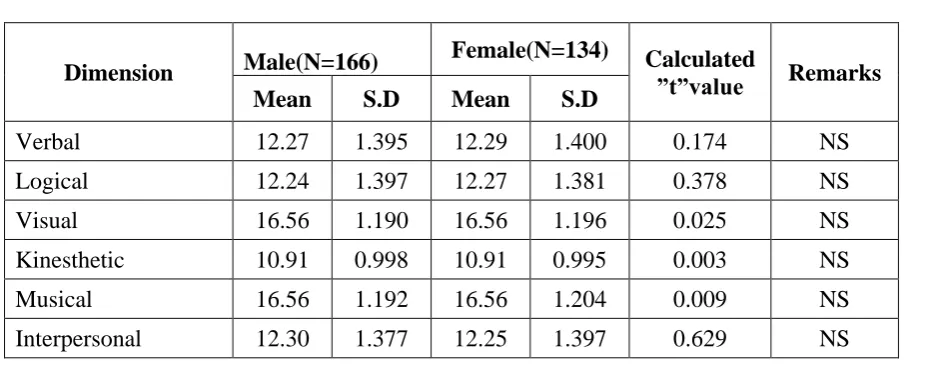
TABLE 2 : Difference between Male and Female Higher Students in their multiple intelligence
Dimension Male(N=166)
Female(N=134) Calculated
”t”value Remarks Mean S.D Mean S.D
Verbal 12.27 1.395 12.29 1.400 0.174 NS
Logical 12.24 1.397 12.27 1.381 0.378 NS
Visual 16.56 1.190 16.56 1.196 0.025 NS
Kinesthetic 10.91 0.998 10.91 0.995 0.003 NS
Musical 16.56 1.192 16.56 1.204 0.009 NS
Available online: https://edupediapublications.org/journals/index.php/IJR/ P a g e | 851
Intrapersonal 16.58 1.187 16.56 1.194 0,231 NS
Naturalistic 18.33 1.424 18.31 1.461 0.203 NS
Existentialistic 16.56 1.188 16.55 1.198 0.146 NS
Multiple
Intelligence 132.31 3.110 132.26 3.099 0.284 NS Table Value for d f 298 is 1.96 at level of significance
It is inferred from the above table that there is no significant difference between male and female higher secondary students in their verbal, logical, visual, kinaesthetic, musical, interpersonal, intrapersonal, naturalistic, existentialistic and multiple intelligence.
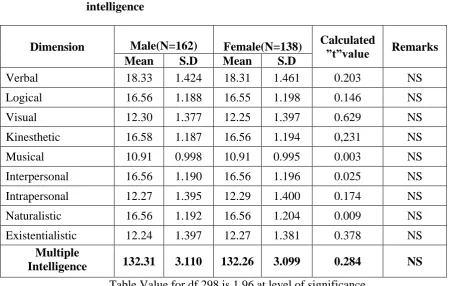
TABLE 3 : Difference between Rural and Urban Higher Students in their multiple intelligence
Dimension Male(N=162) Female(N=138) Calculated
”t”value Remarks Mean S.D Mean S.D
Verbal 18.33 1.424 18.31 1.461 0.203 NS
Logical 16.56 1.188 16.55 1.198 0.146 NS
Visual 12.30 1.377 12.25 1.397 0.629 NS
Kinesthetic 16.58 1.187 16.56 1.194 0,231 NS
Musical 10.91 0.998 10.91 0.995 0.003 NS
Interpersonal 16.56 1.190 16.56 1.196 0.025 NS
Intrapersonal 12.27 1.395 12.29 1.400 0.174 NS
Naturalistic 16.56 1.192 16.56 1.204 0.009 NS
Existentialistic 12.24 1.397 12.27 1.381 0.378 NS
Multiple
Intelligence 132.31 3.110 132.26 3.099 0.284 NS Table Value for df 298 is 1.96 at level of significance
It is inferred from the above table that there is no significant difference between rural and urban higher secondary students in their verbal, logical, visual, kinaesthetic, musical, interpersonal, intrapersonal, naturalistic, existentialistic and multiple intelligence.
TABLE 4 : The level of Male and Female Students in their academic Achievement
Academic Achievement
Low Average High
Available online: https://edupediapublications.org/journals/index.php/IJR/ P a g e | 852
Total 42 21.60 218 62.40 40 16.00
It is inferred from table that 21.60% of the low,62.40% average and 16.00% high level of achievement.
TABLE 5 : Difference between Boys and Girls Students in their Achievement
Category Mean SD
Count N
Calculated
Value ‘t’ Remarks
Boys 60.15 14.82 166
2.46 Significant
Girls
55.18 12.05 134
(At 5% level of significance, the table value ‘t’ is 1.96)
Since the calculated value of ‘t’ is greater than the table value for 298 degrees of freedom of 5% level, the hypothesis is rejected. Therefore there is significant difference between boys and girls students in their achievement in Tamil language.
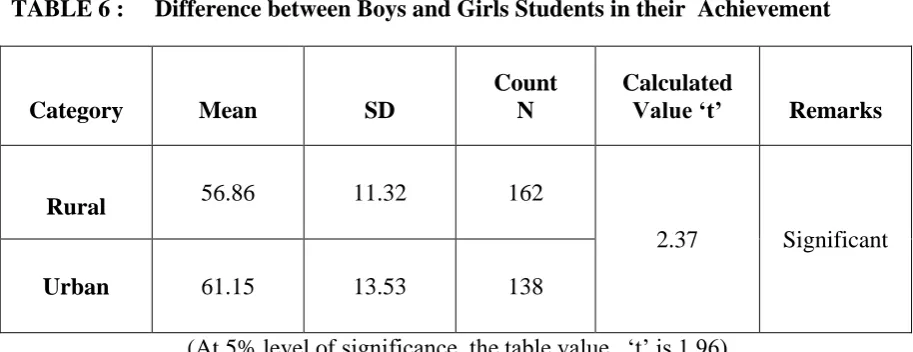
TABLE 6 : Difference between Boys and Girls Students in their Achievement
Category Mean SD
Count N
Calculated
Value ‘t’ Remarks
Rural 56.86 11.32 162
2.37 Significant
Urban 61.15 13.53 138
(At 5% level of significance, the table value ‘t’ is 1.96)
Since the calculated value of ‘t’ is greater than the table value for 298 degrees of freedom of 5% level, the hypothesis is rejected. Therefore there is significant difference between rural and urban students in their achievement in Tamil language.
Available online: https://edupediapublications.org/journals/index.php/IJR/ P a g e | 853 Category Ʃx Ʃy Ʃx2 Ʃy2 Ʃxy Calculated
Value ‘t’ Remarks
Male 4161 28681 258935 11132953 1628868 0.553 significant
Female 6203 46350 362439 17706074 2380849 0.480 significant (For 298 df,at 5% level of significance, the table value is 0.138)
It is inferred from the above table that there is significant relationship between Multiple Intelligence and Academic achievement of higher Secondary schools Students in their Tamil language.
FINDINGS
1. 18.4%, 66.6%, 15% of higher secondary students have low, moderate and high level
multiple intelligence respectively.
2. 21.60% of the low, 62.40% average and 16.00% high level of academic achievement.
3. There is no significant difference between male and female higher secondary students in
multiple intelligence and its dimensions
4. There is no significant difference between rural and urban higher secondary students in
their multiple intelligence and its dimensions
5. There is significant difference between male and female higher secondary students in their
academic achievement
6. There is significant difference between rural and urban higher secondary students in their
academic achievement
7. There is significant relationship between Multiple Intelligence and Academic achievement of higher Secondary schools Students.
Available online: https://edupediapublications.org/journals/index.php/IJR/ P a g e | 854 1. There is significant difference between boys and girls students in their academic
achievement. The fact that girls were better than boys may be due to their hardworking nature towards achievement without any distraction.
2. There is significant difference between rural and urban high school students in their achievement. The result that urban students have high achievement may be due to the fact that urban students have complete infrastructural facilities for their studies. Even in their home too, the parents are ready to offer separate study room with necessary facilities like study table with chair, lightings, reference books etc.
3. The study reveals that there is a significant positive correlation between Multiple Intelligence and academic achievement among higher secondary students. The level of Emotional Intelligence highly influences or impact the achievement level of higher secondary students.
All the final analysis, the investigator has come out with a conclusion that Emotional Intelligence has significant impact on the Academic Achievement of Higher Secondary Students.
CONCLUSION
Schools are the organs of the life of the Nation. They are ultimately responsible for the development of well integrated, all round, wholesome personalities. They should contribute to the intelligence and values of their pupils physically, socially, morally, emotionally, personally and intellectually. They have to develop moral as well as national character. They have to develop moral as well as national character. The role of students in fostering multiple intelligence should in no way be underestimated. They have a magnificent role to play by making use of all opportunities in and out of the school to develop the multiple intelligence. Unless the students make conscious efforts in this direction, it will prove to be unserviceable. The students themselves should first try to develop their knowledge, values and academic abilities.
RERECENCES
1. Agarwal J.C (1986), Educational research, Arya Book Deport., New Delhi
2. Gardner, H. (1999), Intelligences Reframed: Multiple Intelligences for the 21st Century. New York. Basic Books.
Available online: https://edupediapublications.org/journals/index.php/IJR/ P a g e | 855 4. Annaraja. P and Anthony Muthu. P (2009), A study on Multiple Intelligence of primary
school teachers, Unpublished M.Phill thesis, Tamilnadu Teachers Education University, Chennai, Tamilnadu
5. Bindu Gowri v.p (2005), Impact of learning environment on academic achievement of higher secondary students. M.Phil. Dissertation, Manonmaniam Sundaranar University, Tirunelveli
6. Jeba Y and Annaraja. P (April 2008), A study on relationship between Multiple Intelligence and Achievement in Chemistry among High School Students, Unpublished M.Ed thesis, M.S University, Tirunelveli, Tamilnadu