,
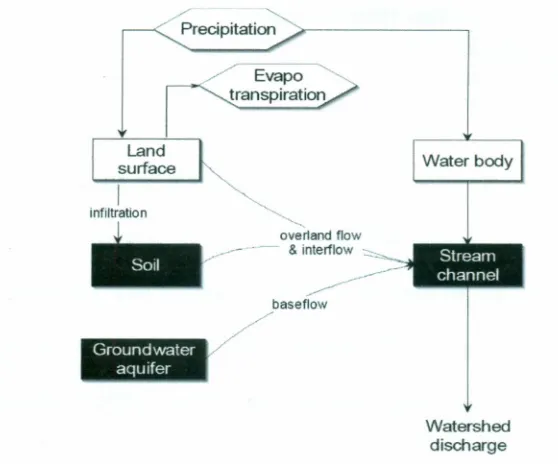
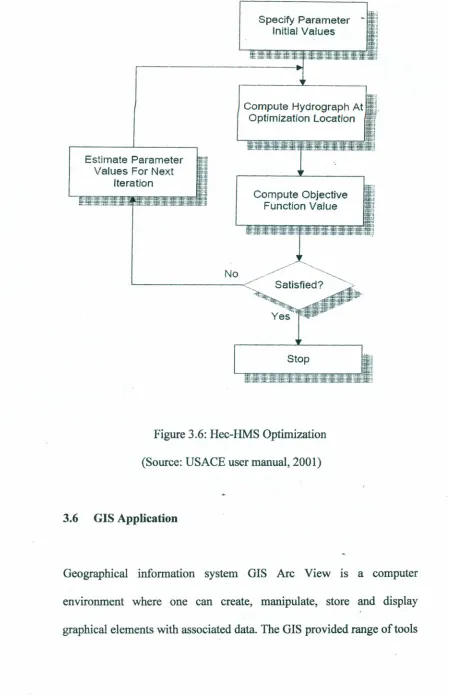
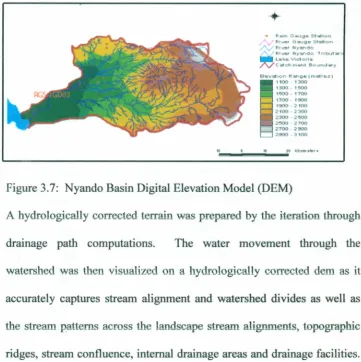
\
RAINFALL~RUNOFF
MODELING OF THE NYANDO IUVE
R BAS
I
-N
,
FOR FLOOD MITIGATION
I;
By
ELLYOKE
AJIGOH
A THESIS SUBMITTED IN PARTIAL FULFILLMENT OF THE REQUIREMENTS FOR
THE AWARD OF THE DEGREE OF MASTER OF SCIENCE IN HYDROLOGY AND
WATER RESOURCES IN THE SCHOOL OF PURE AND APPLIED SCIENCES OF
KENYAITA UNIVERSITY
Ajigoh, O. -~~~ Rainjall-runnoff modeling of the
1111111111111111
2009/339353DECLARATION
This thesis is my original work and has not been presented for a degree in any other University or any other award.
Signature
c::..~~~.
EllyOkewe Ajigoh
Admin. No. 156/10517/04Date
We confirm that this thesis has been submitted with our approval as university supervisors:
Signature ... ~ ..
.
.
2~I
..
p..«.I..
~.e
.
1.
Dr. Christopher
M. Ondield GEOGRAPHY DEPARTMENT KENYAIT
A UNIVERSITYDate
Signa
& ~ ~
.
..
2.?:
:
f.
.
o.
..
~
..
fQ
.
~
.
2.Dr. Joy A. Obando
GEOGRAPHY DEPARTMENT KENYA
ITA
UNIVERSITYDEDICATION
ACKNOWLEDGEMENT
I am especially grateful to my supervisors Dr. C.M.Ondieki and Dr.
l.A
.
Obando
For their critical comments and contributions during my thesis work
_
Special thanks to the various institutions and organizations that provided data especially
ministry of water development and Irrigation for stream flow data and the Meteorological
department for the rainfall data
'
To the poly leT staff, thanks for providing us with the unlimited time on the internet. Special
thanks to the staff of
Kenya polytechnic GIS laboratory. In particular Mr. Lusichi who was
always ready to assist with Gis tools
'
Last but not least ,thanks to my colleagues in 2004 class for the masters
of science in
Hydrology and water resources namely; Mr. Julius Wanyonyi(posthumously),Mr. Ronald
sungu, Mr. John K. Mwangi and my research college Mr. Muli
L
TABLE OF CONTENTS
Title .i
Declaration .ii
Dedication .iii
Acknowledgements .iv
Table of contents v
List of tables xi
List of figures xii
Abbreviations and acronyms xiv
Abstract, , xv
CHAPTER ONE:
INTRODUCTION
11.Background 1
1.1Area of study 2
1.2 Relief and Drainage 2
1.3 Climate 4
1.4 Geology and Soils 4
1.5 Problem .statement. 6
1.6 Justification 8
1.7 Main objective 8
1.8 Specific objective .9
1.9 Research questions
:
:·
.
~
.9
1.10 Significance of study 9
CHAPTER
T
WO: LITERATURE REVIEW
112.Introduction '" 11
2.1 Flood generation processes 11
2.2 Flood: the underlying factors 14
2.3 Models 19
2.3.1 Categorization of mathematical models 20
2.3.2 HEC-lIMS , 22
2.3.3 Constituents of a model. 23 I
CHAPTER THREE: METHODOLOGY
_
253 Introduction 25
3.1 Data Acquisition and processing 25
3.2 Data Analysis 29
3.2.1 Stream Flow 29
3.2.2 Rainfall 30
3.2.3 Correlation and Regression 31
3.3 Frequency Analysis 32
3.3.1 Fitting a distribution 35
3.3.2 Plotting position 36
3.4 Hydrologic Modeling :.::.
.
39
3.4.1 HEC-HMS model components 40
3.4.1.1 Run offVolwne ~ 41
3.4.1.2 Loss rate 42
3.4.2 Direct Runoff 43
3.4.2.1. Base Flow 47
3.4.3 Channel flow 48
3.5 Modeling with HEC-HMS 52
3.5.1 HMS Basin model. 53
3.5.2 HMS Meteorologic model.. 55
3.5.3 HMS model Control Specification .59
3.5.4 HMS Model Resolution 59
3.5.4.1 Temporal Resolution 59
3.5.4.2 Spatial Resolution 60
3.5.5 Parameters and their Constraints : 61
3.5.6. HMS Model Calibration and Verification : 62
3.5.6.1 Goodness of fit. 65
3.5.6.2 Parameter Sensitivity 65
3.5.6.3 Optimization 66
3.6 GIS Application 68
..3.6.1 Basin Digital Elevation Model (OEM) 69
3.6.2 Determination of Flow Direction .. 71
3.6.3 DEM import to HEC-HMS 72
3.7. Flood Area zoning ' 73
3.7.1 Generating TIN 73
3.7.2 Water level above river bank 74
CHAPTER FOUR: RESULTS AND
DISCUSSION
764.1 Rating Curve and Flow Hydrograph 76
4.2 Rainfall Runoff Regression : 77
4.3 Frequency Analysis 78
4.4 Hydrologic Modeling 81
4.4.1 Model Results 82
4.4.2 Model Sensitivity : 85
4.4.3 Channel routing 87
4.4.4 Modeled parameters 89
4.5 GIS Application Results 91
4.6. Discussion : 94
4;6.1'Rainfall-Runoff 94
4.6.2 Frequency Analysis 94
4.6.3 Hydrological and GIS modeling 95
CHAPTER FIVE: CONCLUSIONS AND
RECOMMENDATIONS .
.
...
985.1 Conclusions 98
5.2 Recommendations 99
5.2.1 Implementation 99
5.5.2 Research 99
References 101
Appendices ; 106
Appendix 1 Nyando basin Calibration data 106
Appendix 2: HEC-HMS Nyando basin model Elements 106
Appendix3: Nyando longitudinal river profile and plan 107
Appendix 4: Nyando river width, bank level and bed level from RGS .
LIST OF TABLE
S
Table 3.1 Rainfall stations within study area 27
Table 3.2 River Gauging stations within study area ; 28
Table 4.1 Data extension for type 1 distribution 80
Table4.2 Nyando sub basin model outputs 82
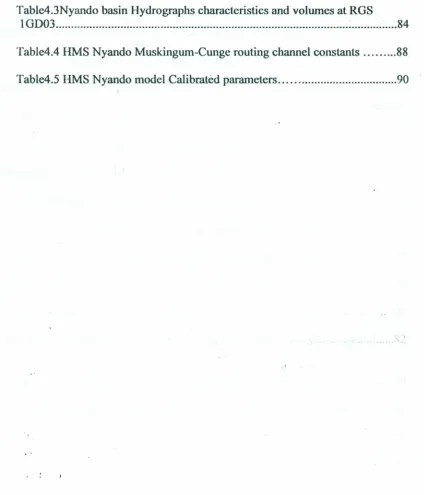
Table4.3Nyando basin Hydrographs characteristics and volumes at RGS
1GD03 ; 84
Table4.4 HMS Nyando Muskingurn-Cunge routing channel constants 88
LIST OF FIGURES
Figu
r
e 1
.
1
Nyando catchment sub
-
basin areas
3
F
igure 1.2 Nyando sub
-
basin study area
10
Figure3.1 Snyd
er'
s Unit
H
ydrograph
.
47
Figure3.2 Fini
te
difference method space-time for Muskingum-Cunge flow
com
put
ation
51
Figure 3.3 He
c-H
ms presentation o
f
the watershed Hydrology
53
F
igu
r
e3
.
4 Nyando River basin
H
MS basin
m
odel
..
54
Fi
gure3.5 Hec-HMS calibrat
i
on procedure
63
F
igure 3.6
Hec-Hms optimization
..
.
.
..
..
...
.
•
..
...
.
...
..
.
.
...
.
..
.
...
.
68
Fi
gure3.7 Nyando Basin Digit
a
l elation model.
.
'
"
70
F
igure3.8 The eight
-
direction pour point flow model
71
F
i
gure 4.1 Nyando RiverRGSIGD03 Rating curve
76
Figure 4.2 Nyando River 1988 Flow Hydrograph at RGSIGD03
77
Figure 4
.
3 Nyando River basin Rainfall-Runoff Regression Line
78
F
igure 4
.
4 Nyando river Gumbel plot for (1969 - 1997)
79
F
igur
e
4.5Nyando simulated verses observed flow at RGS IGD03
81
Fi
gur
e
4.6: Simulated sub
-
basin hydrographs compared to observed hydrograph
atl GD03
83
F
igure4.7 RGS IG
D
03 Nyando simulated and observed Hydrograph
85
Figure4.9 Simulated hydro graph reach contribution at junction 1 verses observed
Hydrograph at 1G003 :.; ~..89
Figure4.lO: 100 year return period flood inundated area map 92
Figure4.11 :50 year return period flood inundated area map ~ 93
Figure 4.12: 25 year return period flood inundated area map 93
ASCII
CDF
DEM
ESRl
GEV
GIS
ABBREVIATIONS
AND ACRONYMS
American Standard codes for information interchange
Cumulative distribution function
Digital elevation model
Environmental Systems Research Institute
General Extremal Value
Geographical Information System
HEC-GEO- HMS Hydrological Engineering Centre Geospatial Hydrological
Modeling Extension
HEC-HMS
ICRAF
IPPC
ITCZ
JICA
MOWD
TIN
UH
USACE
USGS
Hydrological Engineering Centre- Hydrological Modeling
International Centre on Agro forestry
Intergovernmental Panel on Climate Change
Inter-Tropical Convergence Zone
Japan International cooperation Agency
Ministry of water Development
Probability density function
Triangulated Irregular Network
Unit hydrograph
United stale Army Corps Engineers
United states Geological Survey
WMO
MAP
RMS
World Meteorological Organization
Mean areal precipitation
Abstract
The study objective was to model the Nyando River basin for flood mitigation. The methods
used include the rainfall-runoff relationship peak food frequency Analysis mapping of
inundation river plain areas for various return period floods. The study was carried out using
a
vailable basin measured variables. The main data used for the study were daily rainfall and
daily stream flow obtained from the Meteorological Department and Ministry of water
Development respec
ti
vely. The basin rainfall-rainfall relationship was established by
correlation and regression analysis.
The extreme flood peak
.
magnitudes and their return
periods were establish
e
d by frequency of the type 1 Gumbel distribution. The river hydrologic
modeling was carrie
d
out using HEC-HMS for simulation of stream flow hydrographs. To
delineate flood vulne
ra
ble areas on the basin, a digital elevation model of the Nyando river
basin was made by
GI
S Arc View tools. Using TIN, Triangulated irregular network which
defined flooded areas corresponding to water levels above river banks at each cross section
for the known flood magnitude and return period. The regression result established a direct
relationship between basin rainfall and runoff. The frequency analysis showed the floods for
return periods of 10, 25, 50,100 years to be 327.9, 397
.
9,457, 510.8
m3/srespectively. The
mean annual flood was
198.7m3/secthe hydrologic modeling showed that the southern sub
catchment contributed most to the hydrograph. The study
.
indicates that the HEC-HMS
modeled the flow of Nyando fairly well as depicted by the hydrographs
.
With any given
rainfall input the area under inundation can be determined using the model parameters
established for Nyando. This is important for flood mitigation measures. This study has
successfully'
linked the hydrologic model HEC-HMS, Gumbel frequency analysi
s,
and GIS
Arc View water surface modeling in flood inundation mapping for the Nyando basin.
CHAPTER ONE
INTRODUCTION
1. Background
The Lake Victoria drainage basin of Kenya lies to the west of the Great
East Africa Rift Valley between longitudes 340and 350eastlOand1.5°
south and covers an area of 46,229
km
2,
out of Kenya's total land area of 579,770knr
'.
Six large perennial rivers namely: River Sio to the north, Rivers Nzoia, Yala, Nyando, Sondu and Kuja to the south drain thebasin, including a number of other numerous small streams that also
discharge into the Lake.
The study area of the Nyando basin is a sub-catchment of the Lake
Victoria drainage Basin. The Nyando catchment area receives mean
annual rainfall of about 1300mm. The rainfall in the basin generates an
annual runoff depth of 222 mm with an average runoff ratio of 17.1%,
IleA
(1992). The sub basins of Lake Victoria have considerable runoff coefficient varying from 16 % to 33 %.Most of the rivers that drain into Lake Victoria on the eastern shore on
the Kenyan side of the lake cause at nual flooding problems in their
lakeshore occurs in the highlands of western Kenya, mostly between March and Mayas well as during the month of December.
1.1 Study Area
The Nyando catchment is a sub basin of the larger Lake Victoria basin is
located to the east of the shore of lake Victoria in western Kenya. The
catchment is in the south of the Equator at 3S<>.Eand lOS and lies between Lake Victoria to the west, Tinderet hills to the east, Nandi escarpment to
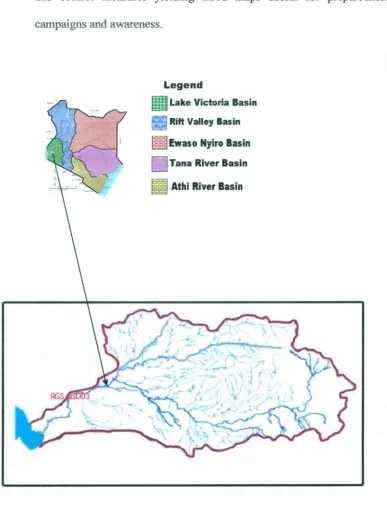
the north and the Mau Escarpment to the south (figure 1.2) shows the
Nyando basin and its sub catchments.
The land slopes generally in the south west direction. The altitude within
the study area varies from about 1000 m above mean sea mean level at
Lake Victoria to over 3000 m above mean sea level in the escarpment
areas.
1
.
2
Relief and DrainageThe Nyando River and its tributaries drain the Nyando River sub-basin
of the Lake Victoria basin. The Nyando River catchment extends over an
area of 33S6km2, ReA (1992). The main channel is River Nyando
starting from the Mau and the Nandi Escarpment forming deep V-shaped
mean sea level. The gradient is steeper upstream than mid and
downstream where it flattens out in the swampy lower areas towards the lake, JICA (1992).
The Nyando catchment may be divided into a number of sub catchments,
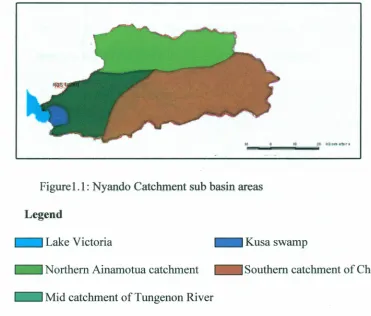
but the three distinct ones these are: the northern catchment of the Ainamotua around Tinderet forest which has a drainage area of 840 km2,the mid catchment of river Tungenon which drains an area of 500
km2 and the southern catchment of the Cherongit that drains 900 km2.
The remaining area is part of the Kusa swamp (figure l. 1). There are three main tributaries joining up stream before RGS 1GD03 to form the
main Nyando River channel.
.•
.
..
Figure 1.1 : Nyando Catchment sub basin areas
Legend
Lake Victoria _ Kusa swamp
Northern Ainamotua catchment Southern catchment of Cherongit
1.3 Climate
The climate of Nyando sub-basin area is hot and humid with a mean
annual temperature of 22°C, (Woodhead, 1968). The mean annual
rainfall varies from 1000mm near the lake to over 1600mm in the
highland. The rainfall shows a bimodal pattern, with peaks during March
to May and October to November. These are long and short rainy
seasons respectively.
The rainfall is controlled by the northward movement of the Inter
Tropical Convergence Zone ITCZ. Altitude, proximity to the highlands
and nearness to the Lake shore however cause considerable spatial
variation in the rainfall. The climate of the Lake Victoria region is
therefore hot and wet with the two distinct rainy seasons.
1.4 Geology and Soils
The Nyando catchment area landscape is based on geological structures
such as, rocks, faults, sediments and past geological formations. The
basement consists of the Nyanzian Precambrian system that is overlain
by the Bukoban system, Cole (1950). After several depositions, folding
Bukoban and Nyanzian rocks and subsequent weathering processes, this
has produced different soils with unique physical and chemical
characteristics that cover the region.
The Nyando catchment's physiography is as a result of these geological
processes forming scarps at the rift faults having east-west to east north
east i.e. west to south west direction that shapes the Kavirondo rift that
branch from the main north-south orientation of the Great Rift Valley
systems.
The Nandi and Mau escarpments that are dominated by foot slopes
followed by gently sloping piedmont plains and very flat alluvial plains
dominate the lower catchment of the Nyando. At the base of the scarps,
numerous streams cut deep through the poorly sorted beds of coarse
gravel, sand and sandy clays in the plains. On the upper reaches the
streams gradient are in excess of 20°.
The soils on the plains are derived from Holocene sedimentary deposits,
Andriese and Van Der pouw (1985). These soils are described as
problem soils in terms of management and use, Waruru et al (1992). On the highlands the soils are derived from a variety of parent materials that
The grey and black soils in the Kano plains are mainly found from the
surface alluvial deposits and Pleistocene deposits of sandy red soils
derived from granite found mainly at the foot of the escarpment and on
piedmonts along the escarpment
1.5 Problem Statement
Over the years floods by rivers that drain into Lake Victoria have
occurred, where the most remembered were the historical 1961, WMO (2004). Equally high events have recurred in the 1980's and the 1990's.
Given such frequency of events there is an urgent need to address the
seasonal flooding problem.
A report by nCA (2006) on Nyando basin estimated that the area
perennially affected by flood is about 20,000 hectares and that the floods
do affect about 42,000 persons whenever they occur.
There is need for flood control measures to be implemented. Structural
measures have already been put in place on River Nyando by the
construction of flood control levees, but these have not fully controlled
flooding and its impacts. This is partly because floods are natural and
Though more reassuring; the construction of river bank levees is an
expensive undertaking with an annual recurring cost. The levees
constructed near the banks confine the river flood flow to a defined flood
path. This mode of containment of flood waters denies the biodiversity their needs as they which depend on flood waters of the river when it
spreads out.
The ideal thing would be to develop a management strategy of warning
systems on the river flow to provide alerts of impending flood conditions
on the basin seasonally, based on river basin modeling. This type of approach would provide manageable risk of floods by giving the flood
plain's residents opportunities to use the flood plain and yet stay safe.
Flood warnings and sustainable flood defences will continue to prevent
property damage, loss of life and minimize distress. There is need to
develop an approach to flood management that could improve the
functions of the river basin as a whole; recognizing that floods do have beneficial effects and can never be fully controlled. Such effort should
seek to minimize the negative effects and maximize the flood plain
1.6 Justification
The reason for modeling the Nyando River Basin has been motivated by
the need to provide tools to assist in management solutions to flood
problems within the catchment. At present the river basin lacks adequate telemetry system for operating a real-time forecasting and flood warning
system due to the basin's short lag time, WMO(2004), therefore
necessitating intermediary options.
The conceptual foundation of this multi- disciplinary study approach is
that river flood plains are regional centres of ecological organization.
The system depends on interactions among dynamics, nonlinear physical
and biological processes that relate to water, heat, materials flux and retention to fluvial landscape change.
1
.
7
Main ObjectiveThe main o.!>jective of this research was to determine flood indicator
benchmarks for River Nyando sub-basin from the rainfall-runoff
1.8
SpecificObjectives
a. To determine the rainfall- runoff relationship in Nyando sub basin.
b. To Examine the frequency of flooding in Nyando sub basin.
c. To determine river level threshold that constitute flood threat in the
Sub basin.
d. To identify and zone flood vulnerable areas by modeling.
1
.
9
ResearchQuestions
a What is the relationship between rainfall and stream flow in the Nyando
Sub-basin?
b. At what time intervals does flooding occur in the Nyando sub basin?
c. What are the flood magnitudes and their corresponding river stages?
d. What areas ofNyando sub basin get inundated during flood?
1
.
10
Significanceof the Study
The Nyando River Basin modeling will facilitate zonmg of flood
vulnerable areas. The calibration of the HEC-HMS model on River
and control measures yielding flood maps useful for preparedness
campaigns and awareness.
Legend
Lake Victoria Basin
Rift Valley Basin
::t=
Ewaso Nyiro BasinTana River Basin
" Athi River Basin
Figure 1.2: Nyando sub- basin study area.
CHAPTER
TWO
LITERATURE REVIEW
2 Introduction
Floods refer to water flows or an overflow of streams from their natural or
artificial banks, inundating adjacent low lying areas. Floods are one of the most
common and widespread of all natural disasters. Floods are likely to be a major
concern in the future especially with larger population moving and living near
water courses.
2.1 FloodGenerationProcesses
The rainfall runoff process as described by the kinematic wave method is such that,
the lateral flow is equal to the difference between the rates of rainfall and
infiltration, while the channel flow is taken as flow per unit width of plane, Chow,
V.T.(1988). The characteristic equations that describe the process at the initial are:
aA
aQ
-+-=q
at
ax
I(2.1)
(2.2)
aA
= rate of mass stored within the control volume,at
q I is the discharge, Sf is energy grade line, and So is bed slope
The above equations can be solved to simulate an outflow hydrograph in
response to rainfall of a specified duration. The above kinematic wave
model equation is a one dimensional flow consideration, though when
adjustments are done to the equations they do produce a more realistic
outflow hydrograph (Eie1son, 1970; Overton and Meadows, 1976
Stephenson and Meadows, 1986).
The consequence of a rainfall event usually results in an ever-changing
flow pattern and for that reason a mathematical representation of the
event must include both steady state and non-steady terms.
In rising river water, the advance of the peak: flood wave does not in
general represent the velocity of flowing water. When a flood advances
from the headwaters of a stream, the advancing wave must first fill up
the river channel or immediate valley to the flood line. The peak of the
wave at any point farther down the river is in general caused by water
that has passed any upstream point at a time later than the occurrence of
When a flood is caused by rain, the flood waves may be caused by the local runoff or by combined local and head water runoff; hence the peak of the flood crest in the lower valley may occur earlier or may be simultaneous with the flood crest at points on upper catches. The relative time of the flood crest therefore is entirely a matter of distribution of the rainfall that produces the flood and the flood channel capacity.
From the records of past floods, it is evident that the average flood to be expected every year is exceeded by floods of less frequency, that may occur at intervals of between 5 to 10 years. These will be considerably exceeded by greater floods which may occur at intervals of between 50 to 100 years. Greater floods may follow each other at smaller intervals but the average appearance of the greatest floods is rare and uncertain.
Typically a stream will overflow its normal channel about once in 2 to 3 years and invade low lying places on its flood plains. The overflow occurs when the volume of water entering a stream channel exceeds the hydraulic capacity of the channel.
distribution of rainfall, stream pattern, antecedent moisture condition,
temperature, seasons of the year and the physical features of the
watershed, such as topography, soils geology and drainage pattern,
Waananen et al (1977).
The areas within the Nyando River Basin is characterized by poorly
drained fine textured deep black cotton soils of the clayey soils that are
derived from phonolites. The condition of the soils, the drainage system
and the low lying lands that characterises the plains is a contributor to
water stagnation. Flooding is therefore common occurrence with
frequent periodic inundation of the area after downpours in the
escarpments and the highlands, Orengo et al (2001).
2.2 Floods: The underlying factors
Studies on British rivers and their catchments reported in, Shaw (1994)
showed that catchment characteristics playa major role in flooding and
flood forecasting. The factors evaluated on this study were: size, shape
and area of the catchment; density and distribution of streams; overland
and channel slope; catchments storage, soil and geology, and climate in
The two mam constants in a basin are; land and water and are
interdependent and must be both considered for efficient catchment
management
.
It is also important to note that catchments reflect a
natural unit where there is
interaction of vegetation
,
soil and the
underlying geological formation upon which precipitation provides the
common end products such as runoff, stream flow and ground water,
Singh
(1990).
There are few areas in the world in where runoff has not been affected by
the
influence of man particularly in the tropics.
Apart from vast areas of
rainforest which have been cleared
,
former grasslands have been
ploughed up and swamps have been drained.
There has also been a great increase in urbanization and a resultant
spread of artificial impermeable surfaces. All these activities influence
the response of a catchment area to rainfall and consequently the pattern
and distribution of rainfall and runoff has been altered, Ward and
Robinson (1990).
Human influence on runoff may result from application of specific
agricultural techniques and practices. These practices cause sudden
changes in catchment characteristics for example the vegetative cover in
may be modified substantially by forest cutting and removal procedures,
Ward and Robinson (1990).
The result is that changes within a catchment area have been related to a
modified output of runoff from a catchment, Hewlett & Helvey (1970).
Based on these, one way of understanding the hydrological effects on
land is to relate the effects of land use and manipulation to increase in
severity of floods. The objective of such a study would be to find out
whether flooding is caused by increase in rainfall intensity or duration,
reduced infiltration capacity or a reduced efficiency of the drainage
network.
The disastrous widespread flooding which affected two-thirds of
Bangladesh in September 1980, WMO (2004) are similar to the one
experienced in Nyando basin plains frequently. These may be partially
attributed to large-scale forest removal, deteriorating flood situations or
global climate change. These have caused local alterations in the
frequency of intense or prolonged precipitation and increases in flood
magnitude and frequency.
The available evidence is however largely circumstantial and often
difficult to interpret. It is equally true that land use continuously changes
Flood studies on rivers are essential so as to understand the phenomena
using tools such as runoff models. The models may be deterministic;
where all input, parameters and processes in the model are considered
free of random variation and known with certainty, as in HEC-HMS or
stochastic; where the model describes the random variation and
incorporates the description in the predictions of outputs ,USACE
(2001).
Flood disasters in the Nyando River Basin are a complex construct of the
increasing vulnerability of the population occupying the flood prone
area. The increasing flood instances are caused by heavy rainfall
interacting with hilly slopes on the upper catchments where vegetation
cover is missing yielding flash floods in the vicinity of the foothills.
Other anthropogenic factors such as increased economic use of flood
plains and improved reporting of the impact of floods have given a
perception of increased flood disasters. In the Nyando River Basin, the
factors contributing to increased flood disaster have been identified as
population pressure deteriorating infrastructure and environmental
A study on flooding by The Ministry of Water Resources, Management and Development at the River gauging station 1GD03 on Nyando for the period 1969 to 1997 indicated that flood discharges for different return periods have since increased significantly, MOwn (2004). The study draws inference that during the period 1980 to 1987 the peak discharges had decreased due to the afforestation programs that were undertaken.
In 1997 and 1998, peak discharges increased sharply due to massive destruction of forest cover. The peak discharges could not be attributed to the rainfall patterns, but to catchment characteristics. The understanding of catchment hydrological problems such as floods requires detailed studies using models.
Baseline survey report on Nyando river basin ,JICA (2006) identified various factors that contribute to people's vulnerability to flood manifestation in the Kano plains as: changes in land use in the upper catchment zone, deforestation, channel siltation, catchment deterioration,
reduced vegetative cover and cultivation on steep slopes thus contributing to flush flood at the lower basin.
attributes people's vulnerability to floods to resource scarcity among
other factors.
Flood forecasting and prediction may vary from simple statistical
rainfall- runoff relationship to complex mathematical modeling. The use
and selection of a model depends on data availability, computation
capacity and the basic characteristics of catchment such as time of
concentration. This is the time for runoff to reach its peak, when the
entire water-shed is assumed to be contributing to flow at the outlet
point, Chow (1964).
The application of USGS model for flood forecasting was evaluated on
River Nyando using ground and satellite data, Muthusi (2004).The study identified five river bank sections that were vulnerable to flood breaches
and recommended mapping to determine their extents.
2.3 Models
Models are physical or mathematical representation of a process that can
be used to predict some aspect of the process. Some unknown output is
related to known input. When the Hec-Hms model for example is used in
the rainfall-runoff study, the known input is precipitation and the
flow is the known input while the downstream flow was the unknown
output. Models take a variety of forms such as the linear reservoir
equation, Nash (1957).
S=kQ (2.3)
Where
S is storage and Q is discharge
Physical models are reduced dimensional representation of the real
world system. A physical model of a watershed for example would be a
large surface with overhead sprinkling devices that simulate the
precipitation input, Singh (1998).
2
.
3.1
Categorization of Mathematical Models
Mathematical models may be categorized as event or continuous models.
Other classifications include; lumped or distributed models, conceptual
or empirical, and; deterministic or stochastic models. Event models
simulate runoff from a single storm, the duration of the storm ranging
from a few hours to a few days.
Hec-Hms model uses mostly event models. Continuous models are
models that simulate longer period events such as predicting watershed
In a distributed model the spatial variation of characteristics and
processes are considered explic
i
tly while in a lumped model the spatial
variation are averaged or ignored.
A conceptual model is built upon a baseline of knowledge of the
pertinent physical processes that act on the input to produce the output
.
An
e
mpirica
l
model is built upon observation of input and oU1J?ut
wi
t
h
out seeking to represent explicit the processes, Singh
(1988).Models wou
l
d be described as deterministic if all input parameters, and
processes in the model are considered free of random variations and are
known w
i
th certainty. Stochastic models describe random variations and
incorporate the descriptions in their output predictions, USACE
(2001).Mathematical models are equations or sets of equations that represent the
response of a hydrological system component to a chang
,
e in hydro
meteorological conditions, USACE
(2001).Their presentation in
Hec-Hms program are in part quantitative expressions of a process or
phenomenon being observed, analysed or predicted (Overton and
Meadows,
1976).They represent an idealized situation that has
2.3.2 Hec-Hms model
The Hec-Hms model is a computer program that comprises of a variety
of sub- models that perform various operations of the watershed as; loss
abstractions, runoff transformation, open channel routing, rainfall-runoff
simulation, and parameter estimation.
The program uses a graphical user interface for data input and provides
an integrated analysis platform for the hydrologic components. The
program also provides data storage and management tools with graphic
and reporting facilities.
The choice of the Hec Hms model for the study was based on its scope,
flexibility, ease of data input requirements, ability to accept raw data
without any pre-processing and the wide rage of choices for abstraction
and transformation methods it provides, USACE (2002).
Hec-Hms model was used for catchment hydrological study on river
Kyeekolo in Kaiti Makweni district Kenya to evaluate the application of
hydrological models as tools for water resources planning I?anagement
The study recommended the construction of dams in the catchment to
maximize the use of rain water that runs to waste. It also recommended
afforestation to restore land cover.
2.3.3 Constituents of a Model
Most models including the model Hec-Hms that describes the watershed
response to precipitation have common components:
State variables are tenus in the model equation that represent the state of
the hydrologic system at any particular time and location.
Parameters represent in numerical measure the properties of the real
world that control the relationship of input to system output. They are the
''tuning knobs" of a model as they are adjusted so that the model can
accurately predict the physical system response.
Boundary condition, are values .of a system input. They are the forces that act on the hydrologic system and cause it to change. In Hec-Hms,
precipitation into a watershed is the force which on its application causes
Initial conditions for a model represent the initial state of either soil
moisture in the watershed or the runoff at the start of the storm being
analysed. For a routing model the initial condition is the flow in the
CHAPTER THREE
METHODOLOGY
3 Introduction
This Chapter presents the data collection and analysis methods used in
the study. The methods included; regression and correlation analysis, flood frequency analysis, hydrological modeling and GIS application.
3.1 Data Acquisition and Processing
The data for this research were acquired from various Government
agencies. The hydrological data was obtained from the Ministry of Water
and Irrigation. The rainfall records were obtained from the Kenya
Meteorological Department and the topographic maps were obtained
from the Survey of Kenya.
The daily rainfall and stream flow data acquired from the various sources
were organized on a spreadsheet for each year of record ranging from
1969 to 1997.
The stream flow and rainfall records for the period of the study were
The missing rainfall data were filled up using the weighted average of
four station method, McCuen (1988). The method uses delineation of
four quadrants in the north-south and east-west lines passing th;ough the
rain gauge station in each quadrant which is the nearest to the rain gauge
station with missing data in the quadrant selected. The weights
applicable to each of the four stations are computed as the reciprocal of
the square of the distance between the station and the origin of the
quadrants.
Then the rainfall recorded at the four stations in the four quadrants are
multiplied by their respective weights and added. The resulting sum is
divided by the sum of the weights to yield the missing rainfall.
Px=
1
1
1
1
-
2
P
I
+-2P
2
+-2P3
+-2P4
r,
r2
r3
r4
1
111
-2-+-2 +-2 +-2
r
Ir
2
r
3
r4
(3.1)
Where Px is the missing station X rainfall.
The mean and standard deviations for each of the variable data set of the
flow discharge and rainfall for the years in record were computed as:
x
1 n
=-Lx;
n ;=1
(3.3)
The rainfall and stream flow stations in the study area are given in Table
3.1and 3.2 respectively whereas all the rainfall data were considered, the
stream flow station with the long term flow records 1GD03 was used
Table3.1 Rainfall stations within Nyando sub-basin
Name 8tationCode Latitudes Longitudes
Kibwani 8935033 00:03'N 36°:06 'E
Ahero 9034086 0°:08' 8 34°:56' E
Songhor 9035009 0°:04' 8 35°:19'8
Kipkeleion 9035020 0°:12' 8 35°:28' E
Tinga 9035188 0°:05' S 35°:27' E
Koru 9035230 0°:08' S 35°:17' E
Table3.2 River gauging Stations within Nyando sub-basin
Station Code Latitudes Longitudes .
IGB03 00°:04':20
-s
35°:0':20" S"
IGB05 00°:01 ':35" S 35°:10':03" S
IGB06 00°:03':10" S 35°:08':36"
S;
IGBll 00°:01 ':30" S 35°:10':35" E
.
IBC04 00°:15'10" S 35°:24':50 "E
1GC06 00°:12':00" S 35°:28':00" E
IGD03 00°:08':00" S 34°:59':25" E
IGD04 00°:06':05" S 35°:02':40" S
3.2 Data Analysis
3.2.1
Stream flow
From the gauged data for the station, 1GD03 a rating curve was obtained
by fitting a regression between the gauge heights and their corresponding
flows.
The regression took the form: Y=a+bX (3.4)
Where Y is the gauged river flow discharge (m3/s) and X is the gauge
height (m) at the gauging site, a and b are constants
The daily stream flow data were first cumulated to obtain annual flow
volumes. The cumulated annual flow volumes were then transformed to
obtain a regression relationship - between rainfall and runoff. The
transformation of flow volume involves converting the runoff. from flow
rate units to depth by numerical integration of the direct IUIf off quantity at
the gauging site and weighting as;
Depth of direct runoff (mm) =
n
0.36xMIQ;
1=;
A
(3.5)Where A is the catchment area ( m2)
3.2.2 Rainfall
The daily point rainfall data were converted to mean areal rainfall using
the Thiessen (1911) polygon weighting method. The Thiessen polygon
weights are obtained by connecting adjacent stations on a catchment map
by straight lines and erecting perpendicular bisectors to each connecting
line. The polygon formed by the perpendicular bisectors around a station
encloses an area which is anywhere closer to the station than any other
station. The area is taken to be best represented by the precipitation at the
enclosed station.
Based on this approach, the Thiessen method transforms individual
station point rainfall to catchment areal rainfall. The areal rainfall
computed on daily basis is then cumulated to obtain mean areal rainfall
for the basin.
- ~pa
The mean areal rainfall is computed as: p =~ -' -'
;=J A
(3.6)
Where:
Pi is the station precipitation
a, is the enclosed polygon area around station i
The Thiessen method transforms individual station point rainfall to
catchment areal rainfall. The computed areal daily rainfall is then
cumulated to obtain mean annual areal rainfall for the basin.
3.2.3
Correlation and RegressionThe correlation coefficient of the data set was estimated as:
i n
rij=
~:CXi
_~)2~:CYj _
y)2i=! j=!
(3.7)
x
is meanofx
Y
is mean ofy
Sx
is the standard deviation of x
S, is the standard deviation of y
A regression relationship between the two variables X and Y was
obtained by an equation of the form given in equation 3
.
4 where X is the
dependent variable.
The regression objective was two fold. First it served to determine the
rating curve equation for the RGS data of gauge height and measured
discharge (3.2.1), and secondly it was to establish rainfall-runoff
3.3 Frequency Analysis
Flood Frequency analysis is one the most important studies of river
hydrology. It seeks to use past records to determine the probability of
occurrence of extreme events. The magnitude of extreme floods can be
related to their frequency of occurrence through the use of a probability
distribution.
The selection of a distribution function to describe a random variable is
based on observed historical data and the underlying physical
phenomenon. For describing the peak discharges series, the extreme
.
value type 1 distribution is the most suitable.
The uncertainties associated with hydrological events are overcome by
evaluating and assessing the probability that the output variable of
interest will exceed some set target level by using a probability density
function (pdf) and cumulative distribution function (cdf) to describe the
event.
The data analysis for extreme peak discharge series relies on the
selection of the distribution type. The type of distribution that is suitable
1996). The general extreme value (GEV) distribution types such as the
extreme value type 1,use the cumulative density function (cdf)'to defme
the event probability.
In this study the type 1 distribution was used to plot the peak discharges
against their probabilities of non-exceedence. The cumulative probability
distribution (cdf) is described as:
[ x-u]
F(X)=exp -1(~) (3.8)
The same expressed as a probability density function (pdf) is:
1
[x-u
x-u]
f (x) = -exp - -- - exp(--)
a
a
a
(3.9)The mean f.i and the variance a in the Gumbel distribution equation are
related to the location parameter
u
and the scale parametera,
(Bedientand Huber, 1988)
u= u
+
0.5777a
(3.10)and
(3.11)
The parameters transformation makes it possible to express the
standardized variate
x-u
Y
T=
--a
The Variant was then transformed as a form of cumulative distribution
function express as:
G(Yr)
=
exp[- exp(Yr)]' (3.13)The transformed variables make the plot of the variables on an ordinary
scale possible.
The distribution graph is then plotted with the extreme discharges on the
ordinate and the variant or the return period on the.abscissa. The values
of the variant for plotting are computed based on the return period as
YT=-ln[ -In(1- ~)]. (3.14)
The extreme value type 1 introduced by Gumbel (1941) is one of the
widely used probability analysis for extreme values in hydrological
events. The distribution is based on building a relationship between the
probabilities of the occurrence of an event, its return period and the
magnitude of the extreme hydrological events such as floods.
The distribution is based on a theoretical interpretation for describing
the physical process of the hydrological phenomena where hydrological
analyses are asymptotic and are valid only for large and independent
The peak stream flow as described by Gwnbel distribution considers the
daily flow as a statistical variable unlimited to positive end of the
distribution having defined a flood as the largest value of the 365 daily
flows. Based on the theory of e
x
treme flows the annual largest values of
a nwnber of years of records approaches a definite pattern of frequency
dist
r
ibution and can be
f
itted
i
n a theoretical extremal distribution of
type
l.
Th
e
extreme value distribution is justified only when it is shown that the
val
u
e
of the daily discharges follows an exponential type distribution.
The annual peaks selected were the largest of the 365 daily discharges
and the numbers in record is large enough for the asymptotic theory to
apply. The probability of an event Q being less than X is expressed as:
f ( ) [X - u ] e-y
Q<x
=exp - e
x
p(
-
~)
-
co ~ X ~ a=
e-
(3
.
15)
Y
T
a (x - fJ) ,reduced variate
(3.16)
3.3.1 Fitting a Distribution
There are three models that are commonly used for extreme value
analysis. These are Gwnbel
,
Frescher and Weibull distribution functions.
scale parameters while others need shape parameter as well
.
IIiorder to
determine whether or not a particular sample from a population fits a
Gumbel or other probability distribution a plot that produces points that
fall close to a straight line assures that the fitted distribution is the
reasonable model
,
Devore (2002)
.
To
ex
amine the frequency of flooding of Nyando River, a Gumbel
pro
ba
bility plot of extreme peak discharges for RGS 1GD03 was done.
Th
e f
itting of the
extreme peak flow records on a Gumbel distribution
cu
r
v
e
was achieved by using the Weibull plotting method.
The Weibull method assigns probability and return periods for the data
set by sorting them in series in ascending order of magnit;Ide. The basis
of this is that the probability
p
is related to the return period T of the
flood and that the plotting position or variate is related to the flood
magnitude
.
3.3.2 Plotting position
The peak discharge series set was ranked for the analysis by the Weibull
method to compute the probability and the corresponding return periods.
in descending order. The probability of each observation is computed as
m
pl=
-n+1 (3.17)
Where pl is the left sided probability (probability of having les~ than the
series)
m
=
is the rankN= number of observation.
The return period for each observation is computed as
T=N
+
1 (3.18)m
Where T =the return period
N=total number of items in the set
m
=
the rankThe plotting position of the observation of the extreme peak discharge is
in the ordinate and the variant YT expressed as
1
Y =-ln[-In(--)]
T ~()()
(3.19)
Other than defining the reduced variate in terms of probability the same
can be based on the return period selected T where the reduced variate
YT is computed in terms ofthe return period for the left hand probability
as:
(3.20)
The variate for right-hand probability can also be computed in
YT=
-Ln
[In(~)J
T-1 (3.21)
The application of recorded data "beyond the existing records requires
data extension by extrapolation with reliable means. This was done for
values that were out side the range of the recorded data -based on the
extreme value distribution of the type 1 using the',frequency factor
method.
The extreme value type 1 distribution, Gumbel's gives the probability of
-•.-Y
being exceeded as
P
= 1_e (3.22)The type 1 distribution, a part from fitting of the Gumbel line also
describes a T- year flood with an equation as:
-XT= X +
(0.7797Y
T
- 0
.
45005) Sx
(3.23)Any flood of magnitude X for any return period T may be computed as:
(3.24)
Where
KT
is the frequency factor for any return period computed as:Kr = _
J6(r+Lnln
r(x) )
7r
T(k -1)
The floods usually fallon the mean line, therefore a standard error of
estimate is used to compute for the values that fall on the envelope lines
on both sides of the mean line. The computation for the error ~as based
on a 95% confidence limit for the't' test distribution as:
1
S
-SE (XT)=
2
..
[1
+
1.14K(T)+
1.1
O(K(T»2r
N (3.26)
3.4
HydrologicModeling
The Hydrologic modeling was done using HEC-HMS model
(version2.2.2), a computer program, which defines a river basin by state
variables, initial conditions, boundary conditions and parameters. The
Hec-Hms model was found suitable for the study of a large river basin
covering an area of 2665 km2 starting from the control point at RGS
1GD03 upstream.
The area under study was defined by the drainage pattern, hydro climatic
data, and operational controls. The program provided working platforms
that made it possible to create the various components of the basin
namely: hydrologic elements in the basin model, meteorologic model
The Hec-Hms model version used for this study provided analytical
tools that converted point rainfall to mean areal rainfall, mean areal
rainfall to a temporal distributed mean areal rainfall, a temporal
distributed mean areal rainfall to a hyetograph and hyetograph to
hydrograph.
3.4.1
Hec-HMS Modeling Components
The Hec-Hms model is a hydrologic model developed by the Hydrologic
Engineering Centre. The program simulates the surface runoff response
of a river basin to precipitation by representing the basin as an
interconnected system of hydrologic and hydraulic components such as
sub basin, streams channels, sinks and reservoirs. The Hec-Hms uses
separate model to represent each component of the runoff process such
as runoff volume, direct runoff arid channel flow.
3.4
.
1.1
Runoff Volume
In the Hec-Hms , runoff volumes may be computed using any of the
following; Initial and constant- rate, SCS curve number (CN), Gridded
SCS CN, Green and Ampt, Deficit and constant rate or Soil Moisture
event, lumped, empirical distributed, empirical, or fitted parameter
models.
The runoff volume model addresses the questions about the volume of
precipitation that falls on the watershed by interrogating, how much
infil
t
ration is on pervious surface, and how much runoff comes from the
impe
r
vious surface, and how it runs off
.
Th
e
program provides many choices of carrying out that computation.
Th
e
Nyando study the Green & Ampt was used. The Green &
'
Ampt is a
conceptual model of infiltration of precipitation in a watershed. The
model computes the precipitation loss on the pervious area in a time
interval as:
(3.27)
Where
f
tis loss during period t
,
( mm)
k is saturated hydraulic conductivity,
(mmIh)( ¢ - B )
Volume moisture deficit
Sf
is wetting front suction, (mm)
The parameters that were estimated to model with the Green &Ampt
equation are; initial loss, hydraulic conductivity, wet front suction and
volume moisture deficit.
The initial loss is the parameter designating a function of the watershed
moisture at the begirming of the precipitation US ACE, (2002). It may be
estimated in the same manner as the initial abstraction. The hydraulic
conductivity is the parameter derived as a function of texture class.
The wetting front Suction is the parameter that is estimated as a function
of pore size distribution and also texture class. The volume moisture
deficit (¢ - B) is the parameter that defines the soil porosity less the
initial content according to Rawls and according to Brakensiek, (1982)
3.4.1.2 Loss' Rate
The basin loss rate applied in the program is based on the fact,that all the
land and water in a watershed can be categorized as either directly
connected impervious surface or pervious surface. The impervious
surface was that part of the watershed for which all the precipitation
runoff with no infiltration, interception, evaporation, or other losses the
precipitation to the pervious surface was subject to losses.
In
the basinspecified as percent imperviousness. The selection was on the basis that
the loss method was more physically based in approach to infiltration of
water into the soil.
The Green and Ampt.method was considered ideal for Nyando Basin
study as the parameterization method are derived as functions of soil
class texture, soil porosity and initial water content which were possible
to relate to a largely rural basin. The Green and Ampt method modelled
infiltration by the combining an unsaturated flow from Darcy's law with
the requirement of mass conservation.
The parameters for the Green and Ampt that were specified in the model
are; initial loss in mm, volume moisture deficit ratio, wet front suction in
mm, and conductivity in mmIh and percent imperviousness. The concept
was that once the initial loss has accounted for interception and
depression storage, the excess precipitation is computed using the Green
and Ampt equation.
3
.
4
.
2 Direct Runoff
The Hec-Hms uses various direct runoff models such as the user
specified unit hydro graph (UH), Clark's, Snyder's, SCS UH, ModClark,
lumped, empirical, fitted parameter, measured parameter models. In this
study the Snyder's UH is used.
The model Hec-Hms simulates direct runoff of excess precipitation on a
watershed using transforms, which "transforms the excess precipitation
into point runoff'. The option for the process in the program uses
conceptual models such as the unit hydro graph, the kinematic
-wave
model. The direct runoff was computed based on the unit hydro graph transform.
The unit hydro graph method on its part is an empirical relationship of
direct runoff to excess precipitation that was originally proposed by
Sherman in 1932, as the basin outflow resulting from one unit of direct
runoff generated uniformly over the drainage area at a uniform rainfall
rate during a specific period of rainfall duration (USACE, 2000).
The computation as done by the model Hec-Hms is on the discrete
representation of excess precipitation in which "pulse" of precipitation is
known for each time interval and based on that it then solves the discrete
convolution equation for linear system as:
nsM
Q
n =LPmUn-m
+1m=l
(3.28)
Where
Pm
=
rainfall excess depth in time interval m ~ t to (m+1) ~t;m= total number of discrete rainfall pulses; and
Un-rn+1 = UH ordinates at time (n-m+ 1) ~ t.
Qnand Pmare flow and depth respectively.
The use of the equation was in the implicit assumptions that were made
in the model.
The unit hydro graph equation applied for the transform was the
parametric unit hydrograph developed by Snyder in 1938 (USACE2000).
The Snyder Unit Hydrograph (figure 3.1), was an event lumped,
empirical, fitted parameter model that had characteristics that are related
to the watershed characteristics. The form of Snyder unit hydro graph
method as used in the Hec- Hms model uses the Clarke unit hydrograph
method to compute the hydro graph ordinates.
The Clarke method on its part uses the Snyder unit hydro graph to select
the lag time; peak flow and total time base flow as the critical
characteristics of the Unit graph. The parameters that were estimated for
the Snyder Unit Hydrograph were UH lag tp and coefficient CpoThe time
to peak, tp may be expressed as;
tp=CCt (LLc)O.3 (3.29)
Where
L=length of the main stream from the outlet to the divide;
L, =length a long the main stream from the outlet to a point nearest the
watershed centroid;
C= a conversion constant
Cp is calibrated at from 0.1 to 1
The transform method is used
tq
compute direct runoff from excessrainfall that is based on the fact that precipitation that did not infiltrate or
felt on directly connected imperviousness surface becomes excess
precipitation.
While excess precipitation can remain on the surface in depression or
ponds, it typically moves down-gradient on the watershed land surface
and becomes direct runoff. In the transform method, the Snyder unit
hydro graph was used to compute direct run off from the excess
precipitation.
The parameters for the Snyder transform are the Snyder standard lag,
Snyder peaking coefficient cp both in units of time as indicated in figure
:_t
p
-.
,Discharge per urut excess precipitation
depth
Time
Figure 3.1: Snyder's unit hydrograph
(Source: USACE Technical reference manual, 2000)
3.4.2.1 Base flow
The Hec-Hms provides a number of methods to compute base flow these
include the Constant monthly varying value, Exponential recession and
linear reservoir volume accounting. The base flow models are described
as; event, lumped, empirical or fitted parameter models. In this study the
exponential recession method was used to determine the base flow
recession.
The parameterization for the sub basin to account for the base flow was
based on the fact that water that infiltrate through the soil in a watershed
passes through the unsaturated vadoze zone and enters the ground water.
Ground water is rarely static but slowly moves down gradient through
The movement of ground water makes them
the principle source of
stream flow during dry periods as it returns to the stream channel directly
from beneath. The ground water flow that returns to the stream is the
base flow. That quantity of returned ground flow was modelled by
recession method
.
The
recessionmethod was considered suitable for the base flow
modeling as it uses an exponentially declining base flow that applies
clas
s
ic separation techniques.
The parameters for the recession base flow are the initial flow that was
defined by a point on the hydrograph when it appeared that the runoff
took over as the main flow on the rising limb, a recession constant that
defines decay rate, and the threshold flow that defines the point on the
hydrograph where base flow becomes the major flow on the falling limb
of the flood hydrograph.
3.4.3 Channel flow
The Hec-Hms provides a number of methods to compute channel flow.
These
are;
Kinematic
wave,
.
Lag,
Modified
plus,
Muskingum,
confluence and bifurcation
.
These channel flow models are described as
;
event
,
lumped
,
conceptual
,
measured parameter, quasi- conceptual and
continuous model
.
In this study the Muskingum-Cunge standard section
was used
.
Routing with Hec-Hms was carried out when the various stream reach on
the b
asi
n model were parameterized so that they could represent the flow
of w
at
e
r in the open channel
.
The routing process relies on the concept
that
w
ater requires a certain amount of time to travel down a reach.
In the channel a flood wave is attenuated by friction and channel storage
as it passes through a reach. The process of computing the travel time
and attenuation of water flowing in the reach is routing. The parameters
that were specified for a reach to compute travel time and attenuation
using Muskingum-Cunge Method are; reach length in (m), water energy
slope (m/m), stream bottom width (m), side slope and Manning's number
.n. Hec-Hms model provides other options for channel routing other
than the Muskingum- Cunge standard method used here.
This form of routing computes downstream hydrograph for a given
upstream boundary condition based on the solution of the continuity
aA aQ
equa
t
ion -
+ -
=
q[and the diffusion form of the momentum
at
Ox
Sf
=
So - By , the combined equations using linear approximation yieldsax
the convective diffusion equation
aQ
aQ
a
2Q
-+c-=j.1-+cq (3.30)
at
ax
ax
2 Ij.1
= ~
=
Hydraulic diffusion, c=
aQ
=
wave celerity, B=
topzs«
,
aA
water surface
A finite difference approximation of the partial derivative combined with
these coefficients gives discharge as
Q
t=( M-2kx)1+[
/).t+2kx]1
+(2k(1-x)-M)O' (331)2k(1- x)
+
M I 2k(1-xr+
/).t /-1 2k(1- x)+
M /-1 •The solution of the constants yields the Muskingum - Cunge routing
equation in tlie form for the fust reach:
(3.32)
The Muskingum - Cunge Routing equation may be solved by other
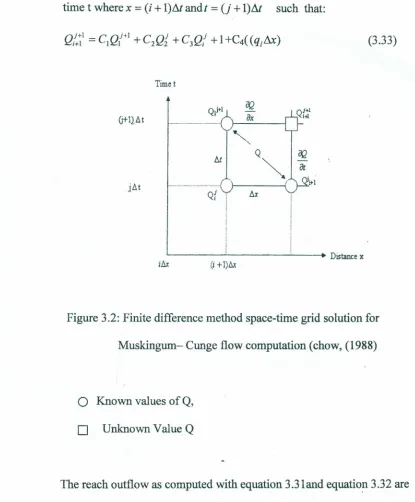
approaches other than the equations above in the form of a linear scheme
by solving a time space computational grid figure 3.2, where the
time t where x
=
(i+1)Mand!=
(j +1)i1! such that:Q
L~l=
C1Q
t
1 + C2Q
j
+C
3Q
!
+ 1+C4((q,L1x)(3
.
33)
Timet
jAt
Qj+l
1+1
i+l
QJ, Ax
I !
'---'---'---+ Distance x
i& (i+1)&
Figure 3.2: Finite difference method space-time grid solution for
Muskingum- Cunge flow computation (chow, (1988)
o
Known values of Q,o
Unknown Value QThe reach outflow as computed with equation 3.31 and equatio~ 3.32 are
modified to
O,
=C/
t-1 +C
21
2 +C
30
t_1 + C4(q,L1x)(3
.
34)
with the coefficients to the equation given as:
M-2KX
C
1=
2KX(1-X)+M
C _ i1!+2KX
2 - 2K(1-X)+M
(3.35)