Gentry-Halevi’s implementation of fully
homomorphic encryption
Moon Sung Lee
National Institute for Mathematical Sciences, Daejeon, KOREA 151-742 [email protected]
Abstract. In Gentry’s fully homoomrphic cryptosystem, a sparse sub-set sum problem is used and a big sub-set is included in the public key. In the implementation of a variant of Gentry’s scheme, to reduce the size of the public key, Gentry and Halevi used a specific form of a sparse subset sum problem with geometric progressions. In this note, we show that their sparse subset sum challenges are rather easy given the aggres-sive choice of parameters. Our experiment shows that even their large instance of a sparse subset sum problem could be solved within two days with probability of about 44%. A more conservative parameter choice can easily avoid our attack.
Keywords: sparse subset sum, lattice reduction, dimension reduction method, geometric progression, homomorphic encryption
1
Introduction
In 2009, Gentry described a fully homomorphic cryptosystem based on ideal lattices [2]. Following Gentry’s framework, several variants and optimizations of Gentry’s fully homomorphic encryption were introduced [13, 11, 4, 3, 12]. In Gentry’s scheme, he first constructed a “somewhat homomorphic” scheme that supports evaluating low-degree polynomials on the encrypted data, squashing the decryption procedure to a low-degree polynomial that is supported by the scheme. In this procedure, he used a sparse subset sum and assumed that given big set of integers and a target sum, it would be difficult to find a sparse subset that sums up to a target.
Recently, a variant of Gentry’s scheme was implemented [4, 3]. In [3], Gentry and Halevi showed several optimizations that allow them to implement all as-pects of the scheme, providing concrete parameter sets with Internet challenges which consist of main challenges and underlying sparse subset sum challenges. One of the optimizations used to reduce the public key size in [3] was to con-struct a specific form of the sparse subset sum. Their sparse subset sum consists of big sets defined as geometric progressions such that sum of elements in each big set equals the secret key.
the specific form and aggressive parameter choice made in the [3]. Our analysis and experiments show that even the large SSSP challenge is solvable within two days with a high probability.
We present two methods with which to attack this problem. The first is a dimension reduction method which was used in previous research [9, 7]. The second is a probabilistic method which is more efficient. Both methods use lattice reduction algorithms with slightly different lattices from those considered in [3]. The rest of the paper is organized as follows. We first review lattices and the sparse subset sum problem in the next section. In Section 3, we review a specific form of a sparse subset sum problem and the lattice-based attack considered in [3] . Our attacks and experimental results are shown in Section 4, after which we discuss the secure parameter briefly in Section 5. We conclude the paper in Section 6.
2
Background
2.1 Lattices
A full-rankn-dimensionallatticeis a discrete subgroup ofRn, represented as the
set of all integer combinations of some basismatrix B whose rows are linearly independent vectorsb1, . . . ,bn inRn. This lattice is denoted asL=L(B). The
determinant of a lattice Lis denoted as det(L) =|det(B)|.
Short vectors and Lattice basis reduction. The length of the shortest nonzero vector in a lattice Lis denoted λ1(L). Minkowski’s theorem says that we have λ1(L)<√ndet(L)1/nfor anyn-dimensional latticeL. Heuristically, for random
lattices we do not expect to find any vectors of lengthlifldet(L)1/n. However,
forldet(L)1/n, we expect exponentially many vectors of lengthl.
Short vectors can be found using lattice basis reduction algorithms, for exam-ple, the LLL [8] and BKZ [10] algorithms. In small dimensions, the first vector of the output basis of the LLL algorithm is often shortest nonzero vector in a lattice.
2.2 Sparse Subset Sum Problem
Given a big set of integers A={a1, a2, . . . , an}, t andM in Z, a sparse subset
3
The Sparse Subset Sum Construction
In [3], instances of a sparse subset sum problem consist ofsbig setsB1, . . . ,Bs,
each withS elements inZdsuch that the sum of the elements in eachBk equals
the secret key w modulo d. The public key includes s big sets, namely s·S elements from Zd. To reduce the size of this public key, big sets are defined
as geometric progressions in Zd: the k’th big set Bk consists of the elements
x(k, i) =hxk·Riid fori= 0,1, . . . , S−1, whereRis some public parameter and
hzid represents a reduction ofzmodulod. Thus, there is a single secret indexik
in every big set such that X
k
x(k, ik) =
X
k
xk·Rik =w (modd). (1)
At this point, this specific form of SSSP requests these secret indexes.
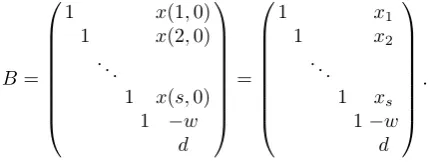
Gentry and Halevi chose the parameter R to avoid lattice-based attacks. More specifically, the following basis is considered to set the parameterR,
B =
1 x(1,0)
1 x(2,0) . ..
1 x(s,0) 1 −w d =
1 x1
1 x2
. .. 1 xs
1−w d . (2)
Clearly, the latticeL=L(B) contains a vector (Ri1, Ri2, . . . , Ris,1,0) which re-veals secret indexes. To hide this vector,Rwas chosen such thatR(s+1)(S−1)> d≈2nt. This choice ensures that the length of this secret vector is larger than λ1(L(B)) according to Minkowski’s theorem. Thus, finding the shortest vector in L(B) does not reveal the secret indexes. The parameters of the fully homo-morphic scheme used for public challenges are shown in Table 1 [3, Table 3].
In the next section, we modify the above lattice basis to make the shortest vector reveal the secret indexes.
sparse big-set big-set Dimensionnbit-sizetsubset-sizes sizeS ratioR
Toy 512 380 15 512 226
Small 2048 380 15 512 2102
Medium 8192 380 15 547 2381
Large 32768 380 15 2185 2381
4
Solving the SSSP challenges
In this section, we modify the above lattice basis in two ways, one leads to a deterministic method to SSSP while the other one leads to a probabilistic method. Also, experimental results of the second method are shown since it is faster.
Recall thatRwas chosen such that
RS−1> d1/(s+1). (3) To reverse this inequality, we increase the right-hand side in Section 4.1; while we decrease the left-hand side in Section 4.2.
4.1 Dimension reduction method
Note thatik in equation (1) has onlyS possibilities. Using this fact, we use the
dimension reduction method which was used to attack NTRU [6] in [9] and later against GGH [5] in [7]. Namely, for each possibility of i1, we find the shortest vector in the lattice generated by the following basis matrix
B0 =
1 x2N
. ..
1 xsN
1h−w+x1Ri1i dN
dN
, (4)
for a suitable constantN which could be set to d1/s. At this stage, this lattice L(B0) has the dimension (s+ 1); for the correct indexi1, the shortest vector is expected to reveal the secret indexes if RS−1 < d1/s, which is the case for the parameters in [3]. Reducing the dimension of the lattice basis by one, we could make the shortest vector of the lattice reveal the secret indexes if we know i1. Because we do not knowi1, we should tryS times.
In general, we need to choose the integerk0 such that RS−1 < d1/(s+1−k0) and trySk0 times. In the SSSP challenges,k
0= 1 is sufficient.
This clearly shows that the SSSP challenges in [3] are rather easily solvable by lattice-based attacks. In the next subsection, we present another method.
4.2 Probabilistic method
To decrase the left-hand side of equation (3), we first select the integer l0 such that
RS−1−l0< d1/(s+1). (5)
Then randomly choose non-negative integersl1, l2, . . . , lsless than or equal to
can expect that with a probability of (S−l0)/S, the secret indexik is in the
interval [lk, lk+S−1−l0]. When this situation arises, equation (1) becomes
X
k
xk·Rik=
X
k
xkRlk·Rik−lk =w (modd), (6)
and the shifted secret vector (Ri1−l1, Ri2−l2, . . . , Ris−ls,1,0) may be the shortest vector in the lattice generated by following basis matrix
B00=
1 hx1Rl1i dN
1 hx2Rl2i dN
. ..
1 hxsRlsidN
1 −wN
dN
, (7)
for the suitable constantN, which is set tod1/(s+1). With a probability of ((S− l0)/S)s, the length of the shifted secret vector could be the shortest vector of L(B00) since
RS−1−l0 < d1/(s+1)= (dN)1/(s+2). (8) Thus, lattice reduction algorithms would find the secret indexes with a proba-bility of ((S−l0)/S)s.
Due to the aggressive parameter choice, a rather smalll0 is sufficient. For a small challenge, l0 = 35 satisfies equation (5) and the probability of success is about 34%. For a large challenge,l0= 114 is sufficient and the success probability becomes 44%.
In the next subsection, the experimental results of this method for SSSP challenges are shown.
4.3 Experiments
For experiments, we used small and medium challenges from the homepage1 as well as a large challenge obtained from the authors of [4]. The integer l0 was chosen as shown in the Table 2 such that equation (5) is satisfied. And non-negative integers l1, . . . , ls less than l0 are randomly chosen. Then the lattice
basis B00 is reduced using the LLL algorithm in the FPLLL library [1]. In the results, we could find the secret indexes for all SSSP challenges.
Timing results for SSSP challenges are shown in the Table 2. As the table shows, even the large challenge is solved within two days. Our experiment was conducted in a CPU core i7 running at 3.40GHz. This clearly shows that the parameter choice for the SSSP in [4] was too aggressive in that it did not consider these attacks.
1
sparse big-set lattice subset-sizes sizeS determinantd l0 reduction time
Small 15 512 log2d≈785006 35 7m
Medium 15 547 log2d≈3148249 35 1h 49m Large 15 2185 log2d≈12625500 114 34h 22m
Table 2.Timing results for SSSP challenges
5
Discussion
To remedy our attack, it is necessary to change the parameters such thatRS−1 d1/(s+1). One could use larger values for sand/or R. For example, as noted in [3], using s= 30 is likely to increase the size of the key (and the running time) by only about 5-10%. When this choice is made, our attacks become inefficient. Our first attack, dimension reduction method needs to eliminate at least 16 rows, implying a complexity level of at leastS16. Our probabilistic method also requires l0≈S/2 implying that the probability of success is only about 2−s= 2−30. Thus, this seems to be a reasonable choice.
Note that our result does not imply the insecurity of the fully homomor-phic encryption in [3], as we only solved a sparse subset sum problem with the knowledge ofw, which is a secret key in practice. As is discussed in [12], the real attacker of homomorphic encryption scheme does not know the secret keywand would encounter what has been termed the hidden sparse subset sum problem, which we do not know how to solve at present.
6
Conclusion
In this paper, we demonstrated how to solve a specific form of the sparse subset sum problem given in [3] using lattice reduction algorithms. Our experiments show that the parameter choice in [3] is too aggressive. We also note that modi-fying the parameters easily remedies this situation. Although our attack is not a threat to the fully homomorphic encryption in [3] in practice, it shows that one should be careful when embedding structures into the problem, such as geometric progressions into a sparse subset sum problem in this case.
References
1. Cad´e, D., Pujol, X., Stehl´e, D.: FPLLL library, version 3.1.1, http://perso.ens-lyon.fr/damien.stehle
2. Craig Gentry. Fully homomorphic encryption using ideal lattices. InProceedings of the 41st annual ACM symposium on Theory of computing, STOC ’09, pages 169–178, New York, NY, USA, 2009. ACM.
4. Craig Gentry and Shai Halevi. Implementing gentry’s fully-homomorphic encryp-tion scheme. In Kenneth Paterson, editor,Advances in Cryptology – EUROCRYPT 2011, volume 6632 ofLecture Notes in Computer Science, pages 129–148. Springer Berlin / Heidelberg, 2011. 10.1007/978-3-642-20465-4 9.
5. Oded Goldreich, Shafi Goldwasser, and Shai Halevi. Public-key cryptosystems from lattice reduction problems. InProceedings of the 17th Annual International Cryptology Conference on Advances in Cryptology, pages 112–131, London, UK, 1997. Springer-Verlag.
6. Jeffrey Hoffstein, Jill Pipher, and Joseph Silverman. Ntru: A ring-based public key cryptosystem. In Joe Buhler, editor,Algorithmic Number Theory, volume 1423 of Lecture Notes in Computer Science, pages 267–288. Springer Berlin / Heidelberg, 1998. 10.1007/BFb0054868.
7. Moon Lee and Sang Hahn. Cryptanalysis of the ggh cryptosystem. Mathematics in Computer Science, 3:201–208, 2010. 10.1007/s11786-009-0018-5.
8. Ak Lenstra, H W Lenstra, and L Lov´asz. Factoring polynomials with rational coefficients. Mathematische Annalen, 261(4):515–534, 1982.
9. Alexander May and Joseph Silverman. Dimension reduction methods for convo-lution modular lattices. In Joseph Silverman, editor, Cryptography and Lattices, volume 2146 ofLecture Notes in Computer Science, pages 110–125. Springer Berlin / Heidelberg, 2001. 10.1007/3-540-44670-2 10.
10. C. P. Schnorr and M. Euchner. Lattice basis reduction: Improved practical algo-rithms and solving subset sum problems.Mathematical Programming, 66:181–199, 1994. 10.1007/BF01581144.
11. N. Smart and F. Vercauteren. Fully homomorphic encryption with relatively small key and ciphertext sizes. In Phong Nguyen and David Pointcheval, editors,Public Key Cryptography – PKC 2010, volume 6056 ofLecture Notes in Computer Science, pages 420–443. Springer Berlin / Heidelberg, 2010. 10.1007/978-3-642-13013-7 25. 12. N.P. Smart and F. Vercauteren. Fully homomorphic simd operations. Cryptology
ePrint Archive, Report 2011/133, 2011. http://eprint.iacr.org/.