Limits of Extractability Assumptions with
Distributional Auxiliary Input
Elette Boyle
∗Technion Israel
[email protected]
Rafael Pass
†Cornell University
[email protected]
August 24, 2015
Abstract
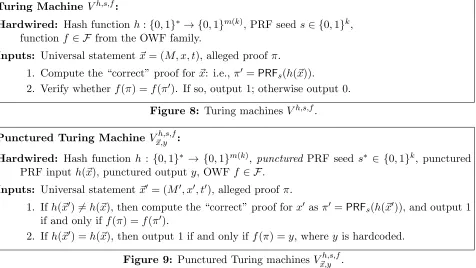
Extractability, or “knowledge,” assumptions have recently gained popularity in the crypto-graphic community, leading to the study of primitives such as extractable one-way functions, extractable hash functions, succinct non-interactive arguments of knowledge (SNARKs), and (public-coin) differing-inputs obfuscation ((PC-)diO), and spurring the development of a wide spectrum of new applications relying on these primitives. For most of these applications, it is required that the extractability assumption holds even in the presence of attackers receiving some auxiliary information that is sampled from somefixed efficiently computable distributionZ.
We show that, assuming the existence of public-coin collision-resistant hash functions, there exists an efficient distributionsZ such that either
• PC-diOfor Turing machines does not exist, or
• extractable one-way functions w.r.t. auxiliary inputZ do not exist.
A corollary of this result shows that additionally assuming existence of fully homomorphic en-cryption with deen-cryption inN C1, there exists an efficient distributionZ such that either
• SNARKs forNPw.r.t. auxiliary inputZ do not exist, or
• PC-diOforN C1 circuits does not exist.
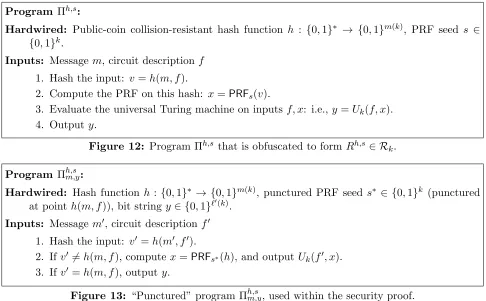
To achieve our results, we develop a “succinct punctured program” technique, mirroring the powerful punctured program technique of Sahai and Waters (STOC’14), and present several other applications of this new technique. In particular, we construct succinct perfect zero knowledge SNARGs and give a universal instantiation of random oracles in full-domain hash applications, based on PC-diO.
As a final contribution, we demonstrate thateven in the absence of auxiliary input, care must be taken when making use of extractability assumptions. We show that (standard) diO w.r.t. any distributionDover programs and bounded-length auxiliary input is directly implied by any
∗
This work was primarily completed while the first author was a postdoc at Cornell University, supported in part by AFOSR YIP Award FA9550-10-1-0093. This research has received funding from the European Union’s Tenth Framework Programme (FP10/ 2010-2016) under grant agreement no. 259426 ERC-CaC.
†
Pass is supported in part by a Alfred P. Sloan Fellowship, Microsoft New Faculty Fellowship, NSF Award CNS-1217821, NSF CAREER Award CCF-0746990, NSF Award CCF-1214844, AFOSR YIP Award FA9550-10-1-0093, and DARPA and AFRL under contract FA8750-11-2- 0211. The views and conclusions contained in this document are those of the authors and should not be interpreted as representing the official policies, either expressed or implied, of the Defense Advanced Research Projects Agency or the US Government.
†
obfuscator that satisfies the weaker indistinguishability obfuscation (iO) security notion anddiO
for a slightly modified distribution D0 of programs (of slightly greater size) and no auxiliary
input. As a consequence, we directly obtain negative results for (standard)diOin the absence of auxiliary input.
1
Introduction
Extractability Assumptions.
Extractability, or “knowledge,” assumptions (such as the “knowledge-of-exponent” assumption), have recently gained in popularity, leading to the study of primitives such as extractable one-way functions, extractable hash-functions, SNARKs (succinct non-interactive arguments of knowledge), and differing-inputs obfuscation:• Extractable OWF: An extractable family of one-way (resp. collision-resistant) functions [Dam91, HT98, CD09], is a family of one-way (resp. collision-resistant) functions{fi}such that any attacker who outputs an elementy in the range of a randomly chosen functionfi given the index i must “know” a pre-imagexof y (i.e., fi(x) =y). This is formalized by requiring for every adversaryA, the existence of an “extractor”E that (with overwhelming probability) given the view ofA outputs a pre-image xwheneverAoutputs an element y in the range of the function.
For example, the “knowledge-of-exponent” assumption of Damgard [Dam91] stipulates the existence of a particular such extractable one-way function.
• SNARKs: Succinct non-interactive arguments of knowledge (SNARKs) [Mic94, Val08, BCCT12] are communication-efficient (i.e., “short” or “succinct”) arguments for NP with the property that if a prover generates an accepting (short) proof, it must “know” a cor-responding (potentially long) witness for the statement proved, and this witness can be efficiently “extracted” out from the prover.
• Differing-inputs obfuscation: [BGI+12, BCP14, ABG+13] A public-coin differing-inputs obfuscator O for program-pair distribution D is an efficient procedure which ensures if any efficient attackerAcan distinguish obfuscationsO(C1) and O(C2) of programsC1, C2 generated viaDgiven the randomnessrused in sampling, then it must “know” an inputx such thatC1(x)6=C2(x), and this input can be efficiently “extracted” fromA.
A recently proposed (weaker) variant known aspublic-coin differing-inputs obfuscation[IPS15] additionally provides the randomness used to sample the programs (C0, C1)← Dto the ex-traction algorithm (and to the attackerA).
The above primitives have proven extremely useful in constructing cryptographic tools for which instantiations under complexity-theoretic hardness assumptions are not known (e.g., [HT98, BCCT12, GLR11, DFH12, BCP14, ABG+13, IPS15]).
Extraction with (Distribution-Specific) Auxiliary Input.
In all of these applica-tions, we require a notion of anauxiliary-inputextractable one-way function [HT98, CD09], where both the attacker and the extractor may receive an auxiliary input. The strongest formulation requires extractability in the presence of anarbitraryauxiliary input. Yet, as informally discussed already in the original work by Hada and Tanaka [HT98], extractability w.r.t. an arbitrary aux-iliary input is an “overly strong” (or in the language of [HT98], “unreasonable”) assumption. Indeed, a recent result of Bitansky, Canetti, Rosen and Paneth [BCPR14] (formalizing earlier in-tuitions from [HT98, BCCT12]) demonstrates that assuming the existence of indistinguishability obfuscators for the class of polynomial-size circuits1there cannot exist auxiliary-input extractable one-way functions that remain secure for an arbitrary auxiliary input.1
The notion of indistinguishability obfuscation [BGI+12] requires that obfuscationsO(C1) and O(C2) of any two
equivalent circuitsC1 andC2(i.e., whose outputs agree on all inputs) from some classCare computationally
However, for most of the above applications, we actually do not require extractability to hold w.r.t. an arbitrary auxiliary input. Rather, as proposed by Bitansky et al [BCCT12, BCCT13], it often suffices to consider extractability with respect to specific distributionsZof auxiliary input.2 More precisely, it would suffice to show that for every desired output length`(·) and distribution
Z there exists a function familyFZ(which, in particular, may be tailored forZ) such thatFZ is
a family of extractable one-way (or collision-resistant) functions{0,1}k → {0,1}`(k)with respect toZ. In fact, for some of these results (e.g., [BCCT12, BCCT13]), it suffices to just assume that extraction works for just for theuniform distribution.
In contrast, the result of [BCPR14] can be interpreted as saying that (assuming iO), there do not exist extractable one-way functions with respect toevery distribution of auxiliary input: That is, for every candidate extractable one-way function familyF, there existssomedistribution
ZF of auxiliary input that breaks it.
Our Results.
In this paper, we show limitations of extractability primitives with respect to distribution-specificauxiliary input (assuming the existence of public-coin collision-resistant hash functions (CRHF) [HR04]). Our main result shows a conflict between public-coin differing-inputs obfuscation for Turing machines [IPS15] and extractable one-way functions.Theorem 1.1(Main Theorem – Informal). Assume the existence of public-coin collision-resistant hash functions. Then for every polynomial`, there exists an efficiently computable distributionZ
such that one of the following two primitives does not exist:
• extractable one-way functions {0,1}k → {0,1}`(k)w.r.t. auxiliary input from Z.
• public-coin differing-inputs obfuscation for Turing machines.
By combining our main theorem with results from [BCCT12] and [IPS15], we obtain the following corollary:
Theorem 1.2 (Informal). Assume the existence of public-coin CRHF and fully homomorphic encryption with decryption in N C1.3 Then there exists an efficiently computable distributionZ such that one of the following two primitives does not exist:
• SNARKs w.r.t. auxiliary input fromZ.
• public-coin differing-inputs obfuscation for N C1 circuits.
To prove our results, we develop a new proof technique, which we refer to as the “succinct punc-tured program” technique, extending the “puncpunc-tured program” paradigm of Sahai and Waters [SW14]; see Section 1.1 for more details. This technique has several other interesting applications, as we discuss in Section 1.3.
As a final contribution, we demonstrate thateven in the absence of auxiliary input, care must be taken when making use of extractability assumptions. Specifically, we show that differing-inputs obfuscation (diO) for any distributionDof programs and bounded-length auxiliary inputs, is directly implied by any obfuscator that satisfies a weaker indistinguishability obfuscation (iO) security notion (which is not an extractability assumption) and diO security for a related dis-tributionD0 of programs (of slightly greater size) which doesnot contain auxiliary input. Thus,
negative results ruling out existence of diO with bounded-length auxiliary input directly imply negative results fordiOin a setting without auxiliary input.
2
As far as we know, the only exceptions are in the context of zero-knowledge simulation, where the extractor is used in the simulation (as opposed to being used as part of a reduction), and we require simulation w.r.t. arbitrary auxiliary inputs. Nevertheless, as pointed out in the works on knowledge [HT98, GS12], to acheive “plain” zero-knowledge [GMR89, BLV06] (where the verifier does not receive any auxiliary input), weaker “bounded” auxiliary input assumptions suffice.
Theorem 1.3(Informal). LetDbe a distribution over pairs of programs and`-bounded auxiliary input informationP × P × {0,1}`. There existsdiOwith respect toDif there exists an obfuscator satisfyingiOin addition todiOwith respect to a modified distributionD0overP0× P0 for slightly
enriched program classP0, andno auxiliary input.
Our transformation applies to a recent result of Garget al.[GGHW14], which shows that based on a new assumption (pertaining to special-purpose obfuscation of Turing machines) general-purposediO w.r.t. auxiliary input cannot exist, by constructing a distribution over circuits and bounded-length auxiliary inputs for which no obfuscator can bediO-secure. Our resulting conclu-sion is that, assuming such special-purpose obfuscation exists, then general-purposediO cannot exist,even in the absence of auxiliary input.
We view this as evidence that public-coin differing inputs may be the “right” approach defi-nitionally, as restrictions on auxiliary input without regard to the programs themselves will not suffice.
Interpretation of Our Results.
Our results suggest that one must take care when making extractability assumptions, even in the presence of specific distributions of auxiliary inputs, and in certain cases even in the absence of auxiliary input. In particular, we must develop a way to distinguish “good” distributions of instances and auxiliary inputs (for which extractability assumptions may make sense) and “bad” ones (for which extractability assumptions are unlikely to hold). As mentioned above, for some applications of extractability assumptions, it in fact suffices to consider a particularly simple distribution of auxiliary inputs—namely the uniform distribution.4 We emphasize that our results do not present any limitations of extractable one-way functions in the presence of uniform auxiliary input, and as such, this still seems like a plausible assumption at this point.Comparison to [GGHW14].
An interesting subsequent5 work of Garg et al. [GGHW13, GGHW14] contains a related study of differing-inputs obfuscation. In [GGHW14], the authors propose a new “special-purpose” circuit obfuscation assumption, and demonstrate based on this assumption an auxiliary input distribution (whose size grows with the desired circuit size of circuits to be obfuscated) for which general-purpose diO cannot exist. Using similar techniques of hashing and obfuscating Turing machines as in the current work, they further conclude that if the new obfuscation assumption holds also forTuring machines, then the “bad” auxiliary input distribution can have bounded length (irrespective of the circuit size).Garget al.[GGHW14] show the “special-purpose” obfuscation assumption is a falsifiable as-sumption (in the sense of [Nao03]) and is implied by virtual black-box obfuscation for the relevant restricted class of programs, but plausibility of the notion in relation to other primitives is other-wise unknown. In contrast, our results provide a direct relation between existing, studied topics (namely, diO, EOWFs, and SNARKs). Even in the case that the special-purpose obfuscation assumptiondoeshold, our primary results provide conclusions forpublic-coindiO, whereas Garg et al.[GGHW14] consider (stronger) standarddiO, with respect to auxiliary input.
And, utilizing our final observation (which occurred subsequent to [GGHW14]), we show that based on their same special-purpose obfuscation assumption for Turing machines, we can in fact rule out general-purposediOfor circuits even in the absence of auxiliary input.
1.1
Proof Techniques
To explain our techniques, let us first explain earlier arguments against the plausibility of tractable one-way functions with auxiliary input. For simplicity of notation, we focus on ex-tractable one-way function over {0,1}k → {0,1}k (as opposed to over {0,1}k → {0,1}`(k) for
4
Note that this is not the case for all applications; e.g. [HT98, GKP+13, BGI14, GS12] require considering more complicated distributions.
5A version of our paper with Theorem 1 and 2 for (standard) differing-inputs obfuscation in the place of public-coin
some polynomial `), but emphasize that the approach described directly extends to the more general setting.
Early Intuitions.
As mentioned above, already the original work of Hada and Tanaka [HT98], which introduced auxiliary input extractable one-way functions (EOWFs) (for the specific case of exponentiation), argued the “unreasonableness” of such functions, reasoning informally that the auxiliary input could contain a program that evaluates the function, and thus a corresponding extractor must be able to “reverse-engineer”any such program. Bitansky et al [BCCT12] made this idea more explicit: Given some candidate EOWF familyF, consider the distributionZF overauxiliary input formed by “obfuscating” a program Πs(·) for uniformly chosens, where Πs(·) takes as input a function index e from the alleged EOWF familyF ={fi}, applies a pseudorandom function (PRF) with hardcoded seedsto the indexi, and then outputs the evaluationfi(PRFs(i)). Now, consider an attacker A who, given an index i, simply runs the obfuscated program to obtain a “random” point in the range of fi. If it were possible to obfuscate Πs in a “virtual black-box (VBB)” way (as in [BGI+12]), then it easily follows that any extractor E for this particular attackerAcan invertfi. Intuitively, the VBB-obfuscated program hides the PRF seed s (revealing, in essence, only black-box access to Πs), and so ifE can successfully invert f
i on
A’s outputfi(PRFs(i)) on a pseudorandom input PRFs(i), he must also be able to invert for a trulyrandom input. Formally, given an indexi and a random pointy in the image offi, we can “program” the output of Πs(i) to simply bey, and thusE will be forced to inverty.
The problem with this argument is that (as shown by Barak et al [BGI+12]), for large classes of functions VBB program obfuscation simply does not exist.
The Work of [BCPR14] and the “Punctured Program” Paradigm of [SW14].
Intriguingly, Bitansky, Canetti, Rosen and Paneth [BCPR14] show that by using a particular PRF and instead relying on indistinguishability obfuscation, the above argument still applies! To do so, they rely on the powerful “punctured-program” paradigm of Sahai and Waters [SW14] (and the closely related work of Hohenberger, Sahai and Waters [HSW14] on “instantiating ran-dom oracles”). Roughly speaking, the punctured program paradigm shows that if we use indis-tinguishability obfuscation to obfuscate a (function of) a special kind of “puncturable” PRF6 [BW13, BGI14, KPTZ13], we can still “program” the output of the program ononeinput (which was used in [SW14, HSW14] to show various applications of indistinguishability obfuscation). Bitansky et al. [BCPR14] show that by using this approach, then from any alleged extractor E
we can construct a one-way function inverterInv by “programming” the output of the program Πs at the input i with the challenge value y. More explicitly, mirroring [SW14, HSW14], they consider a hybrid experiment where E is executed with fake (but indistinguishable) auxiliary input, formed by obfuscating a “punctured”variant Πsi,y of the program Πs that contains an i-punctured PRF seeds∗ (enabling evaluation of PRFs(j) for anyj 6=i) and directly outputs the hardcoded valuey :=fi(PRFs(i)) on input i: indistinguishability of this auxiliary input follows by the security of indistinguishability obfuscation since the programs Πs
i,y and Πs are equivalent wheny =fi(PRFs(i)) = Πs(i). In a second hybrid experiment, the “correct” hardcoded value y is replaced by arandomevaluationfi(u) for uniformu; here, indistinguishability of the auxiliary inputs follows directly by the security of the punctured PRF. Finally, by indistinguishability of the three distributions of auxiliary input in the three experiments, it must be thatE can extract an inverse to y with non-negligible probability in each hybrid; but, in the final experiment this implies the ability to invert a random evaluation, breaking one-wayness of the EOWF.
The Problem: Dependence on
F
.
Note that in the above approach, the auxiliary input distribution is selected as a function of the family F = {fj} of (alleged) extractable one-way6
functions. Indeed, the obfuscated program Πs must be able to evaluate f
j given j. One may attempt to mitigate this situation by instead obfuscating a universal circuit that takes as input both F and the index j, and appropriately evaluates fj. But here still the sizeof the universal circuit must be greater than the running time offj, and thus such an auxiliary input distribution would only rule out EOWFs with a-priori bounded running time. This does not suffice for what we aim to achieve: in particular, it still leaves open the possibility that for every distribution of auxiliary inputs, there may exist a family of extractable one-way functions that remains secure for that particular auxiliary input distribution (although the running time of the extractable one-way function needs to be greater than the length of the auxiliary input).
A First Idea: Using Turing Machine Obfuscators.
At first sight, it would appear this problem could be solved if we could obfuscateTuring machines. Namely, by obfuscating a universal Turing machine in the place of a universal circuit in the construction above, the resulting program Πswould depend only on the size of the PRF seeds, and not on the runtime offj ∈F. But there is a catch. To rely on the punctured program paradigm, we must be able to obfuscate the program Πsin such a way that the result is indistinguishable from an obfuscation of a related “punctured” program Πs
i,y; in particular, thesizeof the obfuscation must be at least as large as
|Πs
i,y|. Whereas the size of Πs is now bounded by a polynomial in the size of the PRF seed s, the description of this punctured program must specify a punctured input i (corresponding to an index of the candidate EOWFF) and hardcoded output valuey, and hence must grow with the size of F. We thus run into a similar wall: even with obfuscation of Turing machines, the resulting auxiliary input distributionZ would only rule out EOWF with a-priori bounded index length.
Our “Succinct Punctured Program” Technique.
To deal with this issue, we develop a “succinct punctured program” technique. That is, we show how to make the size of the obfuscation be independent of the length of the input, while still retaining its usability as an obfuscator. The idea is two-fold: First, we modify the program Πstohashthe input to the PRF, using a collision-resistant hash functionh. That is, we now consider a program Πh,s(j) =fj(P RFs(h(j))). Second, we make use of differing-inputs obfuscation, as opposed to just indistinguishability obfuscation. Specifically, our constructed auxiliary input distributionZ will sample a uniformsand a random hash functionh(from some appropriate collection of collision-resistant hash functions) and then output a differing-inputs obfuscation of Πh,s.
To prove that this “universal” distributionZover auxiliary input breaksallalleged extractable one-way functions over{0,1}k → {0,1}k, we define a one-way function inverterInvjust as before, except that we now feed the EOWF extractorE the obfuscation of the “punctured” variant Πh,si,y
which contains a PRF seed punctured at point h(i). The program Πh,si,y proceeds just as Πh,s except on all inputsjsuch thath(j) is equal to this special valueh(i); for those inputs it simply outputs the hardcoded valuey. (Note that the indexiis no longer needed to specify the function Πh,si,y—rather, just its hashh(i)—but is included for notational convenience). As before, consider a hybrid experiment whereyis selected as y:= Πh,s(i).
Whereas before the punctured program was equivalent to the original, and thus bility of auxiliary inputs in the different experiments followed by the definition of indistinguisha-bility obfuscation, here it is no longer the case that if y = Πh,s(i), then Πh,s
i,y is equivalent to Πh,s—in fact, they may differ on many points. More precisely, the programs may differ in all pointsj such thath(j) = h(i), but j 6=i (since fj andfi may differ on the input P RFs(h(i))). Thus, we can no longer rely on indistinguishability obfuscation to provide indistinguishability of these two hybrids.
We resolve this issue by relyingdiffering-inputs obfuscationinstead of just indistinguishability obfuscation. Intuitively, if obfuscations of Πh,s and Πh,s
same), andj 6=i(since we chose the hardcoded value y= Πh,s(i) to be consistent with Πh,s on inputi. Thus, if the obfuscations can be distinguished, we can find a collision inh, contradicting its collision resistance.
To formalize this argument using just public-coin diO, we require that h is a public-coin collision-resistant hash functions [HR04].
1.2
Removing Auxiliary Input in
di
O
The notion of public-coindiOis weaker than ”general” (not necessarily public-coin)diO in two aspects: 1) the programsM0,M1 are sampled using only public randomness, and 2) we consider only a very specific auxiliary input that is given to the attacker—namely the randomness of the sampling procedure.
In this section, we explore another natural restriction ofdiOwhere we simply disallow auxiliary input, but allow for ”private” sampling ofM0,M1. We show that “bad side information” cannot be circumvented simply by simply disallowing auxiliary input, but rather such information can appear in theinput-output behaviorof the programs to be obfuscated.
More precisely, we show that for any distributionDoverP × P × {0,1}` of programsP and bounded-length auxiliary input, the existence ofdiOw.r.t.Dis directly implied by the existence of anyindistinguishability obfuscator (iO) that is diO-secure for a slightly enriched distribution of programsD0 overP0× P0,withoutauxiliary input.
Intuitively, this transformation works by embedding the “bad auxiliary input” into the input-output behaviorof the circuits to be obfuscated themselves. That is, the new distribution D0 is formed by sampling first a triple (P0, P1, z) of programs and auxiliary input from the original distribution D, and then instead considering the tweaked programs Pz
0, P1z that have a special additional inputx∗(denoted later as “mode=∗”) for whichPz
0(x∗) =P1z(x∗) is defined to bez. This introduces no new differing inputs to the original program pair P0, P1, but now there is no hope of preventing the adversary from learningzwithout sacrificing correctness of the obfuscation scheme.
A technical challenge arises in the security reduction, however, in which we must modify the obfuscation of thez-embedded programPbz to “look like” an obfuscation of the original program Pb. Interestingly, this issue is solved by making use of asecond layerof obfuscation, and is where theiOsecurity of the obfuscator is required. We refer the reader to Section C for details.
1.3
Other Applications of the “Succinct Punctured Program”
Tech-nique
As mentioned above, the “punctured program” paradigm of [SW14] has been used in multiple applications (e.g., [SW14, HSW14, GGHR, BZ14]). Many of them rely on punctured programs in an essentially identical way to the approach described above, and in particular follow the same hybrids within the security proof. Furthermore, for some of these applications, there are significant gains in making the obfuscation succinct (i.e., independent of the input size of the obfuscated program). Thus, for these applications, if we instead rely on public-coin differing-inputs obfuscation (and the existence of public-coin collision-resistant hash functions), by using our succinct punctured program technique, we can obtain significant improvements. For instance, relying on the same approach as above, we can show based on these assumptions:
• “Succinct” Perfect Zero-Knowledge Non-InteractiveUniversalArgument System (with com-munication complexity k for every ), by relying on the non-succinct Perfect NIZK con-struction of [SW14].
the results of [HSW14] showing how to provide a trapdoor-function specific instantiation of the random oracle in the FDH.7
We explore these applications further in Section B.
1.4
Overview of Paper
We focus in this submission on the primary result: the conflict between public-coin differing inputs obfuscation and extractable OWFs (and SNARKs). Further preliminaries, applications of our succinct punctured programs technique, and our transformation removing auxiliary input in differing-inputs obfuscation are deferred to the Supplementary Materials (which appear at the end of this file).
2
Preliminaries
2.1
Public-Coin Differing-Inputs Obfuscation
The notion of public-coin differing-inputs obfuscation was introduced by Ishaiet al. [IPS15] as a refinement of (standard) differing-inputs obfuscation [BGI+12] to exclude certain cases whose feasibility has been called into question. We now present the definitions of [IPS15], focuing only on Turing machine obfuscation; the definition easily extends also to circuits.
Definition 2.1 (Public-Coin Differing-Inputs Sampler for TMs). An efficient non-uniform sam-pling algorithmSamp={Sampk}is called apublic-coin differing inputs samplerfor the parame-terized collection of TMsM={Mk} if the output ofSampk is always a pair of Turing machines (M0, M1) ∈ Mk × Mk such that |M0| = |M1| and for every efficient non-uniform algorithm
A={Ak}there exists a negligible functionsuch that for allk∈N,
Prhr← {0,1}∗; (M0, M1)←Sampk(r); (x, ,1t)← Ak(r)
: M0(x)6=M(x)∧ steps(M0, x) =steps(M1, x)i≤(k).
Definition 2.2 (Public-Coin Differing-Inputs Obfuscator for TMs). A uniform PPT algorithm
O is a public-coin differing-inputs obfuscator for the collection M ={Mk} if the following re-quirements hold:
• Correctness: For every k ∈ N, every M ∈ Mk, and every x, we have that Pr[ ˜M ←
O(1k, M) : ˜M(x) =M(x)] = 1.
• Security: For every public-coin differing-inputs samplerSamp={Sampk}for the ensemble
M, every efficient non-uniform distinguishing algorithmD={Dk}, there exists a negligible functionsuch that for allk,
Pr[r← {0,1}∗; (M0, M1)←Sampk(r); ˜M ← O(1k, M0) :Dk(r,M˜) = 1]− Pr[r← {0,1}∗; (M
0, M1)←Sampk(r); ˜M ← O(1 k, M
1) :Dk(r,M˜) = 1] ≤(k).
2.2
Differing-Inputs Obfuscation
For each distributionD={Dk}overMk× Mk× {0,1}∗ (specifying program pairs and auxiliary input), we define differing-inputs obfuscation secure with respect to D. We present a defini-tion as formalized in [BCP14], which is a variant of the nodefini-tion of “differing-inputs” obfuscadefini-tion of [BGI+12].8
7That is, [HSW14] shows that for every trapdoor one-to-one function, there exists some way to instantiate the random
oracle so that the resulting scheme is secure. In constrast, our results shows that there exists a single instantation that works no matter what the trapdoor function is.
8Formally, our notion of differing-inputs obfuscation departs from differing-inputs obfuscation of [BGI+12] in three
Definition 2.3 (Differing-Inputs Obfuscator w.r.t. Distribution D). A uniform PPT machine diOis adiffering-inputs obfuscator w.r.t. distributionDoverMk× Mk× {0,1}∗if it satisfies the following correctness and security properties:
• Correctness: There exists a negligible functionnegl(k) such that for every security param-eterk∈N, for allM ∈ Mk, for all inputsx, we have
Pr[ ˜M ←diO(1k, M) : ˜M(x) =M(x)] = 1−negl(k).
• Security: For every non-uniform PPT adversary A and polynomial p(k), there exists a non-uniform PPT extractorEand polynomialq(k) such that for everyk∈N, it holds with overwhelming probability over (M0, M1, z)← Dthat
Prhb← {0,1}; ˜M ←diO(1k, Mb) :A(1k,M , z) =˜ b i
≥ 1
2+ 1 p(k)
=⇒ Prw←E(1k, M0, M1, z) :M0(w)6=M1(w)≥ 1
q(k).
Definition 2.4 (Differing-Inputs Obfuscator forTM). A uniform PPT machinediOTM is called
a differing-inputs obfuscator for the class TM of polynomial-size Turing machines if it satisfies the following. For eachk, letMk be the class of Turing machines Π containing a description of a Turing machineM of size bounded byk, such that Π takes two inputs, (t, x), with|t|=k, and the output of Π(t, x) is defined to be the the output of running the Turing machineM(x) fort steps. ThendiOTM is a differing-inputs obfuscator for {Mk}.9
2.3
Extractable One-Way Functions
For this work, we consider a slightly weakened version of EOWFs w.r.t. distributional auxiliary input information, from some distribution Z. Namely, we require one-wayness and extractabil-ity to hold with overwhelming probabilextractabil-ity over auxiliary input z sampled fromZ; in contrast, typical definitions require these properties to hold for any auxiliary input z in some auxiliary input set Z (e.g., all length-bounded values). For example, “standard” auxiliary-input-secure EOWFs [CD08] are required to be Z-auxiliary-input EOWFs forevery (possibly non-uniformly generated) distributionZ.
We present a non-uniform version of the definition, in which both one-wayness and extractabil-ity are with respect tonon-uniformpolynomial-time adversaries.
Definition 2.5(Z-Auxiliary-Input EOWF). Let`, mbe polynomially bounded length functions.
An efficiently computable family of functionsF =nfi:{0,1}k→ {0,1}`(k)
i∈ {0,1}
m(k), k∈ N
o ,
associated with an efficient probabilistic key samplerKF, is a Z-auxiliary-input extractable
one-way functionif it satisfies:
require the extractorEto extract a differing input forM0, M1givenanypair of programsM00, M
0
1evaluating equivalent
functions. Third, [BGI+12] consider also adversaries who distinguish with negligible advantage(k), and require that extraction still succeeds in this setting, but within time polynomial in 1/. In contrast, we restrict our attention only to adversaries who succeed with noticeable advantage.
9
Note that applying the properties of differing-inputs obfuscation to this class of Turing machines {Mk}implies
that for programs Π0,Π1∈ Mkdefined above (corresponding to underlying size-kTuring machinesM0, M1), efficiently
distinguishing between obfuscations of Π0 and Π1 implies that one can efficiently extract an input pair (t0, x0) for
which Π0(t0, x0)6= Π1(t0, x0). In particular, eitherM0(x0)6=M1(x0) orRuntime(M0, x0)6=Runtime(M1, x). Thus, if
restricting attention to a subclass ofMk for which each pair of programs satisfiesRuntime(M0, x) =Runtime(M1, x)
for each inputx, then “standard” extraction is guaranteed (i.e., such that the extracted input contains x0 satisfying
M0(x0) 6= M1(x0)). In the sequel, when referring to a differing-inputs obfuscation of a Turing machineM, we will
implicitly mean the related program ΠM as above, but will suppress notation of the additional input t. For our
application, it will be the case for the relevant class of Turing machines that every pair of programsM0, M1 has same
• One-wayness: For non-uniform polynomial-timeAand sufficiently large k∈N,
Pr
z← Zk; i← KF(1k); x← {0,1}k; x0← A(i, fi(x);z) :fi(x0) =fi(x)≤negl(k).
• Extractability: For any non-uniform polynomial-time adversary A, there exists a non-uniform polynomial-time extractor E such that, for sufficiently large security parameter k∈N:
Prz← Zk; i← KF(1k); y← A(i;z); x0← E(i;z) :∃xs.t.fi(x) =y∧fi(x0)6=y
≤negl(k).
3
Public-Coin Differing-Inputs Obfuscation or Extractable
One-Way Functions
In this section, we present our main result: a conflict between extractable one-way functions (EOWF) w.r.t. a particular distribution of auxiliary information and public-coin differing-inputs obfuscation (“PC-diO”) (for Turing Machines).
3.1
From PC-
di
O
to Impossibility of
Z
-Auxiliary-Input EOWF
We demonstrate a bounded polynomial-time uniformly samplable distributionZ (with bounded poly-size output length) and a public-coin differing-inputs sampler for Turing MachinesD(over
TM×TM) such that if there exists public-coin differing-inputs obfuscation for Turing machines (and, in particular, for the program samplerD), and there exist public-coin collision-resistant hash functions (CRHF), then there donotexist extractable one-way functions (EOWF) w.r.t. auxiliary information sampled from distributionZ. In our construction,Z consists of an obfuscated Turing machine.
We emphasize that we provide a single distributionZof auxiliary inputs for whichallcandidate EOWF familiesFwith given output length will fail. This is in contrast to the result of [BCPR14], which show for each candidate familyF that there exists a tailored distributionZF (whose size
grows with|F |) for whichF will fail.
Theorem 3.1. For every polynomial`, there exists an efficient, uniformly samplable distribution
Z such that, assuming the existence of coin collision-resistant hash functions and public-coin differing-inputs obfuscation for Turing machines, then there cannotexist Z-auxiliary-input extractable one-way functions {fi :{0,1}k → {0,1}`(k)}.
Proof. We construct an adversaryAand desired distributionZon auxiliary inputs, such that for any alleged EOWF familyF, there cannot exist an efficient extractor corresponding to Agiven auxiliary input fromZ (assuming public-coin CRHFs andPC-diO).
The Universal AdversaryA. We consider a universal PPT adversaryAthat, given (i, z)∈ {0,1}poly(k)× {0,1}n(k), parseszas a Turing machine and returnsz(i). Note that in our setting,i corresponds to the index of the selected functionfi∈ F, and (looking ahead) the auxiliary input zwill contain an obfuscated program.
The Auxiliary Input Distribution Z. LetPRF ={PRFs:{0,1}m(k)→ {0,1}k}s∈{0,1}k
be a puncturable pseudorandom function family, andH={Hk} a public-coin collision-resistant hash function family withh:{0,1}∗→ {0,1}m(k) for eachh∈ H
k. (Note that by Theorem A.5, punctured PRFs for these parameters exist based on OWFs, which are implied by CRHF). We begin by defining two classes ofTuring machines:
M=nΠh,s
s∈ {0,1}
k, h∈ H
k, k∈N
o ,
M∗=nΠh,s i,y
s∈ {0,1}
k, y∈ {0,1}`(k), h∈ H
k, k∈N
Turing Machine Π
h,s:
Hardwired:
Hash function
h
:
{
0
,
1
}
∗→ {
0
,
1
}
m(k), PRF seed
s
∈ {
0
,
1
}
k.
Inputs:
Circuit description
f
i1. Hash the index:
v
=
h
(
i
).
2. Compute the PRF on this hash:
x
=
PRF
s(
v
).
3. Output the evaluation of the universal Turing machine on inputs
f
i, x
: i.e.,
y
=
U
k(
f
i, x
).
Figure 1:
Turing machines Π
h,s∈ M
.
Auxiliary Input Distribution
Z
k:
1. Sample a hash function
h
← H
kand PRF seed
s
← K
PRF(1
k).
2. Output an obfuscation ˜
Π
←
PC
-
di
O
(Π
h,s).
Figure 2:
The auxiliary input distribution
Z
k.
which we now describe. We assume without loss of generality for each kthat the corresponding collection of Turing machines Πh,s ∈ M
k, Πh,si,y ∈ M∗k are of thesame size; this can be achieved by padding. (We address the size bound of each class of machines below). In a similar fashion, we may further assume that for eachkthe runtime of each Πh,s and Πh,si,y on any given inputfi is equal (see discussion in Section 2.2).
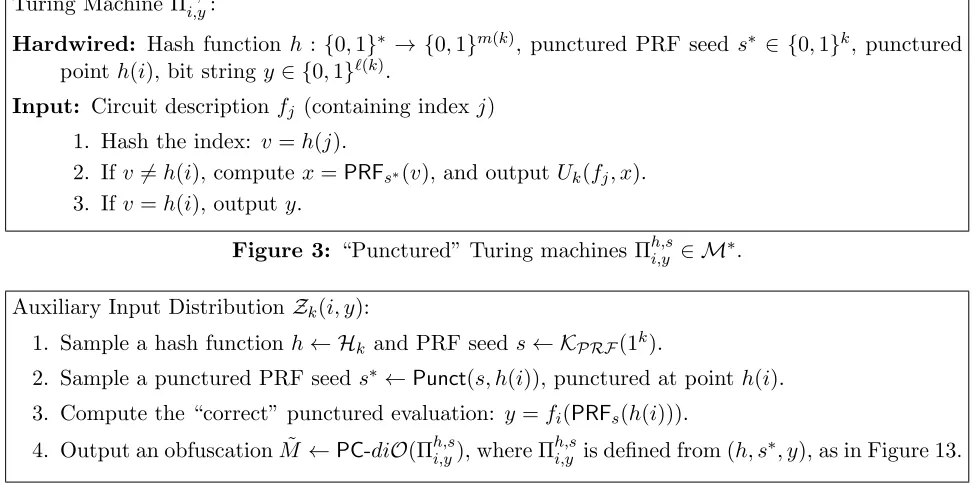
At a high level, each machine Πh,s accepts as input a poly-size circuit description of a function fi (with canonical description, including a function index i), computes the hash of the corre-sponding indexi w.r.t. the hardcoded hash functionh, applies a PRF with hardcoded seeds to the hash, and then evaluates the circuitfion the resulting PRF output valuex: that is, Π
h,s i,y(fi) outputsUk(fi,PRFs(h(i))), where Uk is the universal Turing machine. See Figure 1. Note that each Πh,s can be described by a Turing machine of sizeO(|s|+|h|+|U
k|), which is bounded by p(k) for some fixed polynomial p.
The machines Πh,si,y perform a similar task, except that instead of having the entire PRF seeds hardcoded, they instead only have apuncturedseeds∗derived fromsby puncturing it at the point h(i) (i.e., enabling evaluation of the PRF on all points excepth(i)). In addition, it has hardwired an output y to replace the punctured result. More specifically, on input a circuit descriptionfj (with explicitly specified indexj), the program Πh,si,y first computes the hash h=h(j), continues computation as usual for anyh6=h(i) using the punctured PRF key, and forh=h(i), it skips the PRF andUk evaluation steps and directly outputs y. Note that because his not injective, this puncturing may change the value of the program on multiple inputsfj(corresponding to functions fj ∈ F with h(j) =h(i)). When the hardcoded value y is set to y =fi(PRFs(h(i))), then Πh,si,y agrees with Πh,sadditionally on the inputf
i, but not necessarily on the other inputsfj for which h(j) =h(i). (Indeed, whereas the hash of their indices collide, and thus their corresponding PRF outputs,PRF(h(j)), will agree, the final step will applydifferentfunctionsfj to this value).
Turing Machine Π
h,si,y:
Hardwired:
Hash function
h
:
{
0
,
1
}
∗→ {
0
,
1
}
m(k), punctured PRF seed
s
∗∈ {
0
,
1
}
k, punctured
point
h
(
i
), bit string
y
∈ {
0
,
1
}
`(k).
Input:
Circuit description
f
j(containing index
j
)
1. Hash the index:
v
=
h
(
j
).
2. If
v
6
=
h
(
i
), compute
x
=
PRF
s∗(
v
), and output
U
k(
f
j, x
).
3. If
v
=
h
(
i
), output
y
.
Figure 3:
“Punctured” Turing machines Π
h,si,y∈ M
∗.
Auxiliary Input Distribution
Z
k(
i, y
):
1. Sample a hash function
h
← H
kand PRF seed
s
← K
PRF(1
k).
2. Sample a punctured PRF seed
s
∗←
Punct
(
s, h
(
i
)), punctured at point
h
(
i
).
3. Compute the “correct” punctured evaluation:
y
=
f
i(
PRF
s(
h
(
i
))).
4. Output an obfuscation ˜
M
←
PC
-
di
O
(Π
i,yh,s), where Π
h,si,yis defined from (
h, s
∗, y
), as in Figure 13.
Figure 4:
The “punctured” distribution
Z
k(
i, y
).
h← His not detrimental to its collision resistance. And, the values i, s, ands∗ are completely independentof the CRHF security (i.e., a CRHF adversary reduction could simply generate them on its own in order to breakh). Therefore, we ultimately need only rely onpublic-coindiO.
We finally consider the size of the program(s) to be obfuscated. Note that each Πh,si,y can be described by a Turing machine of sizeO(|s∗|+|h|+|y|+|Uk|). Recall by Theorem A.5 the size of the punctured PRF key |s∗| ∈ O(m0(k)`(k)), where the PRF has input and output lengths m0(k) and `(k). In our application, note that the input to the PRF is not the function index i itself (in which case the machine Πh,si,y would need to grow with the size of the alleged EOWF family), but rather thehashedindexh(i), which is of fixed polynomial length. Thus, collectively, we have|Πh,si,y| is bounded by a fixed polynomialp0(k), and finally that there exists a single fixed
polynomial bound on the size ofallprograms Πh,s∈ M,Πh,s
i,y ∈ M∗. This completely determines the auxiliary input distributionZ ={Zk}, described in full in Figure 2. (Note that the size of the auxiliary output generated by Z, which corresponds to an obfuscation of an appropriately padded program Πh,s is thus also bounded by a fixed polynomial ink).
A
Has No Extractor.
We show that, based on the assumed security of the underlying tools, the constructed adversary Agiven auxiliary input from the constructed distribution Z ={Zk}, cannot have an extractorE satisfying Definition 2.5:Proposition 3.2. For any non-uniform polynomial-time candidate extractor E for A, it holds thatE fails with overwhelming probability: i.e.,
Prz← Zk; i← KF(1k); y← A(i;z); x0← E(i;z) :∃xs.t. fi(x) =y∧fi(x0)6=y
≥1−negl(k).
Proof. First note that given auxiliary inputz← Zk,Aproduces an element in the image of the selectedfi with high probability. That is,
Pr
z← Zk;i← KF(1k);y← A(i;z) :∃xs.t.fi(x) =y
≥1−negl(k).
Program Pair Sampler
Samp
(1
k, r
):
1. Sample a hash function
h
=
H
k(
r
h).
2. Sample an EOWF index
i
=
KF
(1
k;
r
i).
3. Sample a PRF seed
s
=
K
PRF(1
k;
r
s).
4. Sample a punctured PRF seed
s
∗=
Punct
(
s, h
(
i
);
r∗
).
5. Let
y
=
f
i(
PRF
s(
h
(
i
))).
6. Denote
r
:= (
r
h, r
i, r
s, r∗
).
7. Output program pair (Π
h,s,
Π
h,si,y), defined by
h, i, s, s
∗, y
as above (and padded to equal length).
Figure 5:
Program pair sampler algorithm, to be used in public-coin differing inputs security step.
have with overwhelming probability
A(i;z) = ˜M(fi) = Πh,s(fi) =fi(PRFs(h(i))),
wherez= ˜M is an obfuscation of Πh,s∈ M; i.e., z= ˜M ←PC-diO(Πh,s).
Now, suppose for contradiction that there exists a non-negligible function(k) such that for allk∈Nthe extractorE successfully outputs a preimage corresponding to the outputA(i;z)∈ Range(fi) with probability(k): i.e.,
Pr
z← Zk; i← KF(1k); x0← E(i;z) :fi(x0) =A(i;z) =fi(PRFs(h(i)))≥(k).
where as before,s, hare such thatz=PC-diO(Πh,s). We show that this cannot be the case, via three steps.
Step 1: Replace
Z
with “punctured” distribution
Z
(
i, y
).
For every indexiof the EOWF familyFandk∈N, consider an alternative distributionZk(i, y) that, instead of sampling and obfuscating a Turing machine Πh,sfrom the classM, as is done forZ, it does so with a Turing machine Πh,si,y ∈ M∗as follows. First, it samples a hash functionh← Hk and PRF seedsas usual. It then generates apuncturedPRF keys∗←Punct(s, h(i)) that enables evaluation of the PRF on all points except the valueh(i). For the specific index i, it computes the correct full evaluation y:=fi(PRFs(h(i))). Finally, Zk(i, y) outputs an obfuscation of the constructed program Πh,si,y asspecified in Figure 13 from the values (h, s∗, y): i.e., ˜M ←PC-diO(Πh,si,y). See Figure 4 for a full description ofZ(i, y).
We now argue that the extractor E must also succeed in extracting a preimage when given a valuez∗← Zk(i, y) from this modified distribution instead ofZk.
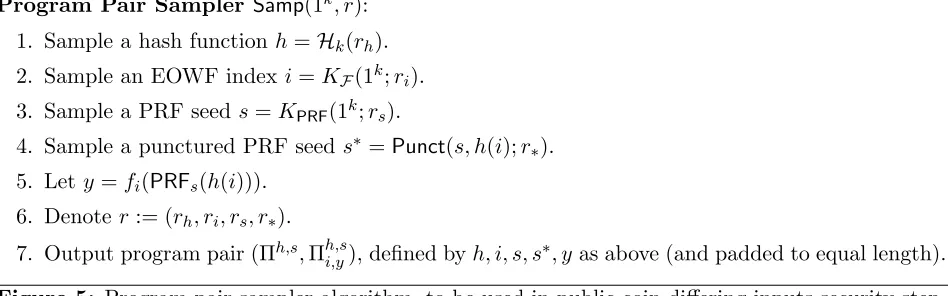
Consider the Turing Machine program sampler algorithm Sampas in Figure 5.
We first argue that, by the (public-coin) collision resistance of the hash familyH, the sampler algorithmSampis a public-coin differing-inputs sampler, as per Definition??.
Claim 3.3. Sampis a public-coin differing-inputs sampler. That is, for all efficient non-uniform
APC, there exists a negligible functionsuch that for all k∈N,
Pr
r← {0,1}∗; (M0, M1)←Samp(1k, r); (x,1t)← APC(1k, r) :
M0(x)6=M1(x)∧steps(M0, x) =steps(M1, x) =t
≤(k). (1)
Proof. Suppose, to the contrary, there exists an efficient (non-uniform) adversaryAPC and
non-negligible functionα(k) for which the probability in Equation 1 is greater thanα(k). We show such an adversary contradicts the security of the (public-coin) CRHF. Consider an adversaryACR
in the CRHF security challenge. Namely, for a challenge hash functionh← Hk(rh), the adversary
CRHF adversaryACR(1k, h, rh):
1. Imitate the remaining steps ofSamp. That is, sample an EOWF indexi=KF(1k;ri); a PRF seeds=KPRF(1k;rs); and a punctured PRF seeds∗=Punct(s, h(i);r∗). Define
y=fi(PRFs(h(i))) andr= (rh, ri, rs, r∗), and letM0= Πh,s andM1= Πh,si,y.
2. RunAPC(1k, r) on the collection of randomnessrused above. In response,APCreturns
a pair (x,1t).
3. ACR outputs the pair (i, x) as an alleged collision in the challenge hash functionh.
Now, by assumption, the valuexgenerated byAPC satisfies (in particular) thatM0(x)6=M1(x).
From the definition ofM0, M1(i.e., Πh,s,Π h,s
i,y), this must mean thath(i) =h(x) (since all values withh(x)6=h(i) were not changed from Πh,sto Πh,si,y),andthati6=x(since Πh,si,y(i) was specifically “patched” to the correct output value Πh,s(i)). That is,A
CRsuccessfully identifies a collision with
the same probabilityα(k), which must thus be negligible.
We now show that this implies, by the security of the public-coindiO, that our original EOWF extractorEmust succeed with nearly equivalent probability in the EOWF challenge when instead of receiving (real) auxiliary input fromZk, bothE andAare given auxiliary input from the fake distributionZk(i, y). (Recall thatis assumed to beE’s success in the same experiment as below but withz← Zk instead ofz∗← Zk(i, y)).
Lemma 3.4. It holds that
Prhi← KF(1k); z∗← Zk(i, y); x0 ← E(i;z∗) :
fi(x0) =A(i;z∗) =fi(PRFs(h(i))) i
≥(k)−negl(k). (2)
Proof. Note that given z∗ ← Zk(i, y) (which corresponds to an obfuscated program of the form Πh,si,y) our EOWF adversary A indeed will still output Πh,si,y(i) = y := fi(PRFs(h(i))) (see Fig-ures 13,4).
Now, suppose there exists a non-negligible function α(k) for which the probability in Equa-tion (2) is less than (k)−α(k). We directly use such E to design another adversary AdiO to
contradict the security of the public-coin diO with respect to the program pair sampler Samp
(which we showed in Claim 3.3 to be a void public-coin differing inputs sampler). Recall thediO
challenge samples a program pair (Πh,s,Πh,s
i,y)←Samp(1k, r), selects a randomM ← {Πh,s,Π h,s i,y} to obfuscate as ˜M ←PC-diO(1k, M), and gives as a challenge the pair (r,M˜) of the randomness used by Sampand obfuscated program. Define AdiO (who wishes to distinguish which program
was selected) as follows.
PC-diOadversaryAdiO(1k, r,M˜):
1. Parse the given randomnessr used inSampas r= (rh, ri, rs, r∗) (see Figure 5).
2. Recompute the corresponding “challenge index”i=KF(1k;ri). Let z∗= ˜M. 3. Run the extractor algorithmE(i;z∗), and receive back an alleged preimagex0. 4. Recomputeh=Hk(rh),s=KPRF(1;rs), again using the randomness fromr.
5. Iffi(x0) =fi(PRFs(h(i))) — i.e., ifE succeeded in extracting a preimage — thenAdiO
outputs 1. Otherwise,AdiO outputs 0.
Now, if ˜M is an obfuscation of Πh,s, then this experiment corresponds directly to the EOWF challenge where E (and A) is given auxiliary input z ← Zk. On the other hand, if ˜M is an obfuscation of Πh,si,y, then the experiment corresponds directly to the same challenge whereE (and
A) is given auxiliary inputz∗ ← Zk(i, y). Thus, AdiO will succeed in distinguishing these two
Step 2: Replace “correct” hardcoded
y
in
Z
(
i, y
)
with random
f
ievaluation.
Next, we consider another experiment whereZk(i, y) is altered to a nearly identical distribution
Zk(i, u) where, instead of hardcoding the “correct” i-evaluation valuey =fi(PRFs(h(i))) in the generated “punctured” program Πh,si,y, the distributionZk(i, u) now simply samples a random fi output y =fi(u) for an independent random u← {0,1}k. We claim that the original EOWF extractorE still succeeds in finding a preimage when given this new auxiliary input distribution:
Lemma 3.5. It holds that
Prhi← KF(1k); z∗∗← Zk(i, u); x0← E(i;z∗∗) :
fi(x0) =A(i;z∗∗) =fi(u) i
≥(k)−negl(k). (3)
Proof. This follows from the fact thatPRFs(h(i)) is pseudorandom, even given theh(i)-punctured keys∗.
Formally, consider an algorithm A0
PRF which, on input the security parameter 1
k, a pair of
valuesi, h, and a pair s∗, x (that will eventually correspond to a challenge punctured PRF key, and eitherPRFs(h(i)) or randomu), performs the following steps.
AlgorithmA0
PRF(1
k, i, h, s∗, x):
1. Takey=fi(x), and obfuscate the associated program Πh,si,y: i.e.,z∗∗←PC-diO(1k,Π h,s i,y). 2. Run the EOWF extractor given indexiand auxiliary inputz∗∗: x0 ← E(i;z∗∗). 3. Output 0 if E succeeds in extracting a valid preimage: i.e., if fi(x0) = y∗ = fi(x).
Otherwise, output a random bitb← {0,1}.
Now, suppose Lemma 3.5 does not hold: i.e., the probability in Equation (3) differs by some non-negligible amount from (k). Then, expanding out the sampling procedure of Zk(i, y) and
Zk(i, u), we have for some non-negligible functionα(k) that
Prhi← KF(1k); h← Hk; s← KPRF(1k); s∗←Punct(s, h(i)); u← {0,1}k;
b← {0,1}:A0
PRF(1
k, i, h, x b) =b
i
≥ 1
2+α(k), (4)
wherex0:=PRFs(h(i)) andx1:=u. Indeed, in the caseb= 0, the auxiliary inputz∗∗ generated byAPRFand given toE has distribution exactlyZ(i, y), whereas in the case b= 1, the generated
z∗∗has distribution exactlyZ(i, u).
In particular, there exists a polynomial p(k) such that for infinitely many k, there exists an indexik and hash functionhk∈ Hk with
Prhs← KPRF(1k); s∗←Punct(s, h(ik)); u← {0,1}k;
b← {0,1}:A0PRF(1
k, i
k, h, xb) =b i
≥1
2 + 1
p(k), (5)
wherex0, x1are as before.
Consider a non-uniform punctured-PRF adversary AI
PRF (with the ensemble I = {ik, hk} hardcoded) that first selects the challenge point hk(ik); receives the PRF challenge information (s∗, x) for this point; executesA0
PRFon input (1k, ik, hk, s∗, x), and outputs the corresponding bit boutput byA0
Step 3: Such an extractor breaks one-wayness of EOWF.
Finally, we observe that this means that E can be used to break the one-wayness of the original function family F. Indeed, given a random key i and a challenge output y =fi(u), an inverter can simply sample a hash functionhandh(i)-punctured PRF seeds∗ on its own, construct the program Πh,si,y withits challenge y hardcoded in, and sample an obfuscation z∗∗ ←PC-diO(Πh,si,y). Finally, it runs
E(i, z∗∗) to inverty∗, with the same probability(k)−negl(k).
This concludes the proof of Theorem 3.1.
3.2
PC-
di
O
or SNARKs
We link the existence of public-coin differing-inputs obfuscation for N C1 and the existence of succinct non-interactive arguments of knowledge (SNARKs), via an intermediate step ofproximity extractable one-way functions (PEOWFs), a notion related to EOWFs, introduced in [BCCT12]. Namely, assume the existence of fully homomorphic encryption (FHE) with decryption in N C1 and public-coin collision-resistant hash functions. Then, building upon the results of the previous subsection, and the results of [IPS15, BCCT12], we show:
1. Assuming SNARKs for NP, there exists an efficient distribution Z such that public-coin differing-inputs obfuscation forN C1implies that therecannotexist PEOWFs{f :{0,1}k →
{0,1}k}w.r.t.Z.
2. PEOWFs{f :{0,1}k→ {0,1}k}w.r.t. this auxiliary input distributionZareimplied bythe existence of SNARKs forNPsecure w.r.t. a second efficient auxiliary input distributionZ0,
as shown in [BCCT12].
3. Thus, one of these conflicting hypotheses must be false. That is, there exists an efficient distributionZ0 such that assuming existence of FHE with decryption inN C1and collision-resistant hash functions, then either: (1) public-coin differing-inputs obfuscation for N C1 does not exist, or (2) SNARKS forNPw.r.t.Z0 do not exist.
Note that we focus on the specific case of PEOWFs with k-bit inputs and k-bit outputs, as this suffices to derive the desired contradiction; however, the theorems following extend also to the more general case of PEOWF output length (demonstrating an efficient distributionZto rule out each potential output length`(k)).
3.2.1
Proximity EOWFs
We begin by defining Proximity EOWFs.
Proximity Extractable One-Way Functions (PEOWFs).
In a Proximity EOWF (PEOWF), the extractable function family {fi} is associated with a “proximity” equivalence relation ∼ on the range of fi, and the one-wayness and extractability properties are modified with respect to this relation. The one-wayness is strengthened: not only must it be hard to find an exact preimage of v, but it is also hard to find a preimage of any equivalent v ∼ v0. The extractability requirement is weakened accordingly: the extractor does not have to output an exact preimage ofv, but only a preimage of of some equivalent valuev0∼v.As an example, consider functions of the formf :x7→(f1(x), f2(x)) and equivalence relation on range elements (a, b)∼(a, b0) whose first components agree. Then the proximity extraction property requires for any adversaryAwho outputs an image element (a, b)∈Range(f) that there exists an extractorE finding an inputxs.t.f(x) = (a, b0) for some b0 not necessarily equal tob.
Definition 3.6(Z-Auxiliary-Input Proximity EOWFs). Let`, mbe polynomially bounded length functions. An efficiently computable family of functions
F=nfi:{0,1}k → {0,1}`(k)
i∈ {0,1} m(k), k
∈N
o ,
associated with an efficient probabilistic key sampler KF, is a Z-auxiliary-input proximity
ex-tractable one-way function if it satisfies the following (strong) one-wayness, (weak) extraction, and public testability properties:
• (Strengthened) One-wayness: For non-uniform polynomial-timeAand sufficiently large security parameterk∈N,
Pr
z← Zk; i← KF(1k); x← {0,1}k; x0← A(i, fi(x);z) :fi(x0)∼fi(x)
≤negl(k).
• (Weakened) Extractability: For any non-uniform polynomial-time adversary A, there exists a non-uniform polynomial-time extractor E such that, for sufficiently large security parameterk∈N,
Pr
z← Zk; i← KF(1k); y← A(i;z); x0← E(i;z) :∃xs.t.fi(x) =y∧fi(x0)6∼y
≤negl(k).
• Publicly Testable Relation: There exists a deterministic polytime machineT such that, given the function indexi,T acceptsy, y0 ∈ {0,1}`(k)if and only ify∼
ky0.
3.2.2
(
PC
-
di
O
for
N C
1+ PC-CRHF + FHE + SNARK )
⇒
No
Z
-PEOWF
We now show that, assuming the existence of public-coin collision-resistant hash functions (CRHF) and fully homomorphic encryption (FHE) with decryption in N C1,10 then for some efficiently computable distributions ZSNARK,ZPEOWF, if there exist public-coin differing-inputs obfuscators
forN C1 circuits, and SNARKs w.r.t. auxiliary input Z
SNARK, then therecannot exist PEOWFs
w.r.t. auxiliary inputZPEOWF. This takes place in two steps.
First, we remark that an identical proof to that of Theorem 3.1 rules out the existence of
Z-auxiliary-input proximity EOWFs in addition to standard EOWFs, based on the same as-sumptions: namely, assuming public-coin differing-inputs obfuscation for Turing machines, and public-coin collision-resistant hash functions. Indeed, assuming the existence of a PEOWF extrac-torE for the adversaryAand auxiliary input distributionZ (who extracts a “related” preimage to the target value), the same procedure yields a PEOWF inverter who similarly extracts a “re-lated” preimage to any challenge output. In the reduction, it is merely required that the success ofE is efficiently and publicly testable (this is used to construct a distinguishing adversary for the differing-inputs obfuscation scheme, in Step 1). However, this is directly implied by the public testability of the PEOWF relation∼, as specified in Definition 3.6.
Theorem 3.7. There exist an efficient, uniformly samplable distribution Z such that, assum-ing the existence of public-coin collision-resistant hash functions and public-coin differassum-ing-inputs obfuscation for polynomial-size Turing machines, there cannot exist (publicly testable)Z -auxiliary-input PEOWFs{fi:{0,1}k → {0,1}k}.
Now, in [IPS15], it was shown that public-coin differing-inputs obfuscation for the class of all polynomial-time Turing machines can be achieved by bootstrapping up from public-coin differing-inputs obfuscation for circuits in the classN C1, assuming the existence of FHE with decryption inN C1, public-coin CRHF, and public-coin SNARKs for NP.
Putting this together with Theorem 3.7, we thus have the following corollary.
Corollary 3.8. There exists an efficient, uniformly samplable distribution Z s.t., assuming ex-istence of public-coin SNARKs and FHE with decryption in N C1, then assuming the existence of public-coin differing-inputs obfuscation forN C1, there cannot exist PEOWFs {f
i :{0,1}k →
{0,1}k} w.r.t. auxiliary inputZ.
10
3.2.3
( SNARK + CRHF )
=
⇒ Z
-PEOWF
As shown in [BCCT12], Proximity EOWFs (PEOWFs) with respect to an auxiliary input dis-tribution Z are implied by collision-resistant hash functions (CRHF) and SNARKs secure with respect to a related auxiliary input distributionZ0.11
Loosely, the transformation converts any CRHF family F into a PEOWF by appending to the output of eachf ∈ F a succinct SNARK argumentπxthat there exists a preimagexyielding output f(x). (If the Prover algorithm of the SNARK system is randomized, then the function is also modified to take an additional input, which is used as the random coins for the SNARK generation). The equivalence relation on outputs is defined by (y, π)∼(y0, π0) ify=y0(note that this relation is publicly testable). More explicitly, consider the new function familyF0 composed
of functions
fcrs0 (x, r) = f(x),Prove(1k,crs, f(x), x;r) ,
where a functionfcrs0 ∈ F0is sampled by first sampling a functionf ← F from the original CRHF
family, and then sampling a CRS for the SNARK scheme,crs←CRSGen(1k).
Now (as proved in [BCCT12]), the resulting function family will be a PEOWF with respect to auxiliary input Z if the underlying SNARK system is secure with respect to an augmented auxiliary input distributionZSNARK := (Z, h), formed by concatenating a sample fromZ with a
function indexhsampled from the collision-resistant hash function familyF. (Note that we will be considering public-coin CRHF, in which casehis uniform).
Theorem 3.9 ([BCCT12]). There exist efficient, uniformly samplable distributions Z,ZSNARK
such that, assuming the existence of collision-resistant hash functions and SNARKs forNPsecure w.r.t. auxiliary input distributionZSNARK, then there exist PEOWFs{fi:{0,1}k→ {0,1}k}w.r.t.
Z.
3.2.4
Reaching a Standoff
Observe that the conclusions of Corollary 3.8 and Theorem 3.9 are in direct contradiction. Thus, it must be that one of the two sets of assumptions is false. Namely,
Corollary 3.10. Assuming the existence of public-coin collision-resistant hash functions and fully homomorphic encryption with decryption inN C1, there exists an efficiently samplable distribution
ZSNARK such that one of the following two objects cannot exist:
• SNARKs w.r.t. auxiliary input distribution ZSNARK.
• Public-coin differing-inputs obfuscation forN C1.
More explicitly, we have thatZSNARK = (Z, U), whereZ is composed of an obfuscated program,
andU is a uniform string (corresponding to a randomly sampled index from a public-coin CRHF family).
References
[ABG+13] Prabhanjan Ananth, Dan Boneh, Sanjam Garg, Amit Sahai, and Mark Zhandry. Differing-inputs obfuscation and applications. Cryptology ePrint Archive, Report 2013/689, 2013.
[BBP04] Mihir Bellare, Alexandra Boldyreva, and Adriana Palacio. An uninstantiable random-oracle-model scheme for a hybrid-encryption problem. InEUROCRYPT, pages 171– 188, 2004.
11
[BCCT12] Nir Bitansky, Ran Canetti, Alessandro Chiesa, and Eran Tromer. From extractable collision resistance to succinct non-interactive arguments of knowledge, and back again. In ITCS, pages 326–349, 2012.
[BCCT13] Nir Bitansky, Ran Canetti, Alessandro Chiesa, and Eran Tromer. Recursive composi-tion and bootstrapping for snarks and proof-carrying data. InSTOC, pages 111–120, 2013.
[BCP14] Elette Boyle, Kai-Min Chung, and Rafael Pass. On extractability obfuscation. In Theory of Cryptography - 11th Theory of Cryptography Conference, TCC, pages 52– 73, 2014.
[BCPR14] Nir Bitansky, Ran Canetti, Omer Paneth, and Alon Rosen. On the existence of extractable one-way functions. In STOC 2014, pages 505–514, 2014.
[BG08] Boaz Barak and Oded Goldreich. Universal arguments and their applications. SIAM J. Comput., 38(5):1661–1694, 2008.
[BGI+12] Boaz Barak, Oded Goldreich, Russell Impagliazzo, Steven Rudich, Amit Sahai, Salil P. Vadhan, and Ke Yang. On the (im)possibility of obfuscating programs. J. ACM, 59(2):6, 2012.
[BGI14] Elette Boyle, Shafi Goldwasser, and Ioana Ivan. Functional signatures and pseu-dorandom functions. In Public-Key Cryptography - PKC 2014 - 17th International Conference on Practice and Theory in Public-Key Cryptography, pages 501–519, 2014. [BLV06] Boaz Barak, Yehuda Lindell, and Salil P. Vadhan. Lower bounds for non-black-box
zero knowledge. J. Comput. Syst. Sci., 72(2):321–391, 2006.
[BP13] Elette Boyle and Rafael Pass. Limits of extractability assumptions with distributional auxiliary input. Cryptology ePrint Archive, Report 2013/703, 2013.
[BR93] Mihir Bellare and Phillip Rogaway. Random oracles are practical: A paradigm for designing efficient protocols. In Dorothy E. Denning, Raymond Pyle, Ravi Ganesan, Ravi S. Sandhu, and Victoria Ashby, editors, ACM Conference on Computer and Communications Security, pages 62–73. ACM, 1993.
[BR96] Mihir Bellare and Phillip Rogaway. The exact security of digital signatures - how to sign with rsa and rabin. InEUROCRYPT, pages 399–416, 1996.
[BV14] Zvika Brakerski and Vinod Vaikuntanathan. Lattice-based FHE as secure as PKE. In Innovations in Theoretical Computer Science, ITCS’14, Princeton, NJ, USA, Jan-uary 12-14, 2014, pages 1–12, 2014.
[BW13] Dan Boneh and Brent Waters. Constrained pseudorandom functions and their appli-cations. InAdvances in Cryptology - ASIACRYPT 2013 - 19th International Confer-ence on the Theory and Application of Cryptology and Information Security, pages 280–300, 2013.
[BZ14] Dan Boneh and Mark Zhandry. Multiparty key exchange, efficient traitor tracing, and more from indistinguishability obfuscation. In Advances in Cryptology - CRYPTO 2014 - 34th Annual Cryptology Conference, pages 480–499, 2014.
[CD08] Ran Canetti and Ronny Ramzi Dakdouk. Extractable perfectly one-way functions. InICALP (2), pages 449–460, 2008.
[CD09] Ran Canetti and Ronny Ramzi Dakdouk. Towards a theory of extractable functions. In Omer Reingold, editor,TCC, volume 5444 ofLecture Notes in Computer Science, pages 595–613. Springer, 2009.
[CGH04] Ran Canetti, Oded Goldreich, and Shai Halevi. The random oracle methodology, revisited. J. ACM, 51(4):557–594, 2004.
[DFH12] Ivan Damg˚ard, Sebastian Faust, and Carmit Hazay. Secure two-party computation with low communication. InTCC, pages 54–74, 2012.
[GGH+13] Sanjam Garg, Craig Gentry, Shai Halevi, Mariana Raykova, Amit Sahai, and Brent Waters. Candidate indistinguishability obfuscation and functional encryption for all circuits. InFOCS, 2013.
[GGHR] Sanjam Garg, Craig Gentry, Shai Halevi, and Mariana Raykova. Two-round secure MPC from indistinguishability obfuscation. InTheory of Cryptography - 11th Theory of Cryptography Conference, TCC.
[GGHW13] Sanjam Garg, Craig Gentry, Shai Halevi, and Daniel Wichs. On the implausibility of differing-inputs obfuscation and extractable witness encryption with auxiliary input. Cryptology ePrint Archive, Report 2013/860, 2013.
[GGHW14] Sanjam Garg, Craig Gentry, Shai Halevi, and Daniel Wichs. On the implausibility of differing-inputs obfuscation and extractable witness encryption with auxiliary input. InCRYPTO 2014, pages 518–535, 2014.
[GGM86] Oded Goldreich, Shafi Goldwasser, and Silvio Micali. How to construct random functions. J. ACM, 33(4):792–807, 1986.
[GK03] Shafi Goldwasser and Yael Tauman Kalai. On the (in)security of the fiat-shamir paradigm. InFOCS, pages 102–, 2003.
[GKP+13] Shafi Goldwasser, Yael Tauman Kalai, Raluca A. Popa, Vinod Vaikuntanathan, and Nickolai Zeldovich. How to run turing machines on encrypted data. In CRYPTO (2), pages 536–553, 2013.
[GLR11] Shafi Goldwasser, Huijia Lin, and Aviad Rubinstein. Delegation of computation without rejection problem from designated verifier cs-proofs.IACR Cryptology ePrint Archive, 2011:456, 2011.
[GMR89] Shafi Goldwasser, Silvio Micali, and Charles Rackoff. The knowledge complexity of interactive proof systems. SIAM Journal on Computing, 18(1):186–208, 1989. [GS12] Divya Gupta and Amit Sahai. On constant-round concurrent zero-knowledge from
a knowledge assumption. Cryptology ePrint Archive, Report 2012/572, 2012. http://eprint.iacr.org/.
[GSW13] Craig Gentry, Amit Sahai, and Brent Waters. Homomorphic encryption from learn-ing with errors: Conceptually-simpler, asymptotically-faster, attribute-based. In CRYPTO (1), pages 75–92, 2013.
[HR04] Chun-Yuan Hsiao and Leonid Reyzin. Finding collisions on a public road, or do secure hash functions need secret coins? In CRYPTO, pages 92–105, 2004.
[HSW14] Susan Hohenberger, Amit Sahai, and Brent Waters. Replacing a random oracle: Full domain hash from indistinguishability obfuscation. In EUROCRYPT 2014, pages 201–220, 2014.
[HT98] Satoshi Hada and Toshiaki Tanaka. On the existence of 3-round zero-knowledge protocols. In Hugo Krawczyk, editor, CRYPTO, volume 1462 of Lecture Notes in Computer Science, pages 408–423. Springer, 1998.
[IPS15] Yuval Ishai, Omkant Pandey, and Amit Sahai. Public-coin differing-inputs obfusca-tion and its applicaobfusca-tions. In TCC 2015, pages 668–697, 2015.
[KPTZ13] Aggelos Kiayias, Stavros Papadopoulos, Nikos Triandopoulos, and Thomas Zacharias. Delegatable pseudorandom functions and applications. In CCS’13, pages 669–684, 2013.
[KS98] B. Kaliski and J. Staddon. PKCS #‘: RSA cryptography specifications version 2.0, 1998.
[Nao03] Moni Naor. On cryptographic assumptions and challenges. InCRYPTO, pages 96– 109, 2003.
[SW14] Amit Sahai and Brent Waters. How to use indistinguishability obfuscation: deniable encryption, and more. In STOC 2014, pages 475–484, 2014.