ISSN (Print) : 2320 – 3765 ISSN (Online): 2278 – 8875
I
nternational
J
ournal of
A
dvanced
R
esearch in
E
lectrical,
E
lectronics and
I
nstrumentation
E
ngineering
(An ISO 3297: 2007 Certified Organization)
Website: www.ijareeie.com
Vol. 6, Issue 7, July 2017
Infant's Cry Detection Using Linear
Frequency Cepstrum Coefficients
Rajeshwari G Dandage, Prof. P.R. Badadapure
Department of E & TC, Imperial College of Engineering and Research, Pune University, India
ABSTRACT: Infant crying can be viewed as an organic alert framework, and it is the principal methods for correspondence for infants. Newborn child crying signs trouble or needs, requires the consideration of guardians or parental figures and inspires them to ease the pain. Here, we for the most part centered around mechanization of Infant's Cry. For this usage we utilize Linear Frequency Cepstrum Coefficient Cepstrum (LFCC) for highlight extraction and VQ codebook formatching tests utilizing LBG calculation. The child crying specimens gathered from different cryingbaby having 0-6months age. There are 150 babie's sound as preparing information, each of whichrepresents the 30 hungry baby cries, 30 languid newborn child cries, 30 needed to burp baby cries, 30 inpain newborn child cries, and 30 awkward newborn child cries (could be on account of his/her diaper is wet/toohot/icy air or anything else).The testing information is 40, separately 8 newborn child sobs for each sort ofinfant cry. The distinguishing proof of newborn child cries based the base separation of Euclidean distance.The, order of the cry in five classes neh – hunger owh – sluggish, heh – uneasiness ,eair –lower gas, eh – burp.Here for characterization of the cry our framework is partitioned into two stages. To begin with, in preparing stage, in which LFCC is connected for highlight extraction, and after that VQ codebooks are created to compressthe include vectors. Second, is the trying stage in which highlights extraction and codebookgeneration of tests are rehashed. Here, examination of the codebook format of tests to theall the accessible layouts in the database are conveyed in view of Euclidian separation between them.LFCC adequately catch the lower and additionally higher recurrence attributes than MFCC,hence we will get great outcomes over MFCC.
KEYWORDS: LFCC,SVM.
I. INTRODUCTION
Crying is a sort of communication for babies to express their physical and enthusiastic condition i.e. emotional condition. There are many explanations behind newborn child to cry, for example, sadness, hunger, lonely, anger, and discomfort. Furthermore, vital information, such as the health status of the infant can be obtained from the cry itself. Along these lines, many examines have been directed to dissect the qualities of newborn child cry that offer signs to various sorts of cries and pathologies. These explores take into consideration the comprehension of different needs of the newborn children so that reasonable treatment can be given, in this manner, keeping any further intricacies of the babies.
ISSN (Print) : 2320 – 3765 ISSN (Online): 2278 – 8875
I
nternational
J
ournal of
A
dvanced
R
esearch in
E
lectrical,
E
lectronics and
I
nstrumentation
E
ngineering
(An ISO 3297: 2007 Certified Organization)
Website: www.ijareeie.com
Vol. 6, Issue 7, July 2017
the cepstrum and the mel-frequency cepstrum is that in the MFC, the frequency bands are equally spaced on the mel scale, which approximates the human auditory system's response more closely than the linearly-spaced frequency bands used in the normal cepstrum. This frequency warping can allow for better representation of sound, for example, in audio compression.
MFCCs are commonly derived as follows:
1. Take the Fourier transform of (a windowed excerpt of) a signal.
2. Map the powers of the spectrum obtained above onto the mel scale, using triangular overlapping windows. 3. Take the logs of the powers at each of the mel frequencies.
4. Take the discrete cosine transform of the list of mel log powers
II. LITERATURE SURVEY
In literature, the problem and the previous techniques of Infant Cry Pattern Classification is described
“Reyes-Galaviz, et.al [1] They proposed Evolutionary-neural framework to group baby cry units for pathologies ID in as of recently born babies; this work displays a newborn child cry programmed recognizer improvement, with the target of ordering two sorts of baby cries, ordinary and neurotic, from as of late conceived babies. Extraction of acoustic elements is utilized, for example, MFCC, acquired from Infant Cry Units sound waves, and a hereditary element determination framework consolidated with a bolster forward information defer neural system, prepared by versatile learning rate back-spread. For the examinations, recordings from Cuban and Mexican infants are utilized, arranging ordinary and obsessive cry in three distinct trials; Cuban children, Mexican Babies, and Cuban and Mexican infants. In this paper the entire procedure is portrayed; in which the acoustic elements extraction is incorporated, the cross breed framework outline, usage, preparing and testing. The Favorable circumstances: It is additionally demonstrated a correlation between a straightforward conventional sustain forward neural system and another supplemented with the proposed hereditary component choice framework, to diminish the element input vectors. The disadvantages of this method are It genetic feature selection system combined with a feed forward input delay neural network, trained by adaptive learning rate back-propagation.[1]
“Orozco, Jet.al [2] they are proposed Analysis of a newborn child cry recognizer for the early ID of pathologies. This work exhibits the advancement and examination of a programmed recognizer of newborn child cry, with the objective of classifying three classes, normal, hypo acoustics and asphyxia They utilize acoustic component extraction strategies like MFCC, for the acoustic preparing of the cry's sound wave, and a Feed Forward Input Delay neural system with preparing in light of Gradient Descent with Adaptive Back-Propagation for order. The total newborn child cry database is spoken to by plain content vector records, which permits the documents to be effortlessly prepared in any programming condition. The paper portrays the plan, execution and in addition experimentation forms and the examination of consequences of each sort of investigation performed. The advantages of this technique are the utilization vital segment examination keeping in mind the end goal to lessen vector's size and to enhance preparing time. The disadvantage of the system is bolster forward Input Delay neural system with preparing in light of Gradient Descent with Adaptive Back-Propagation for order.[2]
ISSN (Print) : 2320 – 3765 ISSN (Online): 2278 – 8875
I
nternational
J
ournal of
A
dvanced
R
esearch in
E
lectrical,
E
lectronics and
I
nstrumentation
E
ngineering
(An ISO 3297: 2007 Certified Organization)
Website: www.ijareeie.com
Vol. 6, Issue 7, July 2017
with the target to characterize two sorts of cry: typical and neurotic cry from hard of hearing children. In this review, They utilized acoustic attributes got by the Linear Prediction procedure and as a classifier a neural system that was prepared with the scaled conjugate inclination calculation. Preparatory outcomes are appeared, which, up to the occasion, are exceptionally promising. The advantage of this system is development of an automatic recognition system of newborn child cry, the crying sign is examined to remove the more imperative components in the time area .The disadvantage of this system is The crying wave is separated to take out insignificant or undesirable data like noise, channel mutilation, and other specific flag's qualities. The data are reduced when removing repetitive component.[4] Várallyay, et.al [5] They proposed Acoustic features analysis for acknowledgment of ordinary and holocaustic newborn child cry in view of neural systems, Acoustic examination of baby cry signals has been turned out to be a fantastic device in the zone of programmed recognition of neurotic status of a newborn child. This paper examines the utilization of parameter weighting for direct expectation cepstral coefficients to give the hearty portrayal of newborn child cry signals. Three classes of newborn child cry signs were viewed as, for example, typical cry signals, cry signals from hard of hearing infants and children with asphyxia. A Probabilistic Neural Network is proposed to arrange the baby cry signals into typical and neurotic cries. The trial comes about exhibit that the recommended components and characterization calculations give extremely encouraging arrangement. The Points of interest: PNN is prepared with various spread components or smoothing parameter to get better arrangement exactness. The disadvantages is it can be viewed as the parameter weighting for straight forecast cepstral coefficients to give the vigorous portrayal of newborn child cry signals.[5]
N.S.A.Wahid et.al [6] In this paper, They concentrated different features, selection techniques and classifiers to perform multiclass classification of infant cry. They found that the mix of ghostly and element components could enhance the execution of the order framework for all determination procedures with the exception of CNS. For determination procedures, One R, Relief F, and CFS accomplished great execution on generally cases. FCBF and CNS, then again demonstrated the most noticeably awful execution as they diminished the framework execution after the element choice for all cases. For classifiers, RBFN got better execution regarding exactness and Kappa measurement than MLP. Also, RBFN required less time to choose components and prepare the classifier when connected with One R, Relief F, and CFS choice methods. The best arrangement precision of 93.43% (Kappa estimation of 0.91) was acquired from MFCC + ΔMFCC + ΔΔMFCC include set when utilizing CFS determination system and RBFN classifier. Despite the fact that CFS was not ready to essentially enhance the classifier execution, it was able to achieve the goal of feature selection by maintaining the performance of the classifier with a reduced feature subset in most cases.
ISSN (Print) : 2320 – 3765 ISSN (Online): 2278 – 8875
I
nternational
J
ournal of
A
dvanced
R
esearch in
E
lectrical,
E
lectronics and
I
nstrumentation
E
ngineering
(An ISO 3297: 2007 Certified Organization)
Website: www.ijareeie.com
Vol. 6, Issue 7, July 2017
III. PROPOSED SYSTEM
The block diagram of the proposed system is given below
Fig1:- Block Diagram of the system
The input to the system is the bio signal i.e. infant baby cry sound then the features is extracted from the sound using LFCC and the output is extracted.
ISSN (Print) : 2320 – 3765 ISSN (Online): 2278 – 8875
I
nternational
J
ournal of
A
dvanced
R
esearch in
E
lectrical,
E
lectronics and
I
nstrumentation
E
ngineering
(An ISO 3297: 2007 Certified Organization)
Website: www.ijareeie.com
Vol. 6, Issue 7, July 2017
V. EXPERIMENTAL SETUP
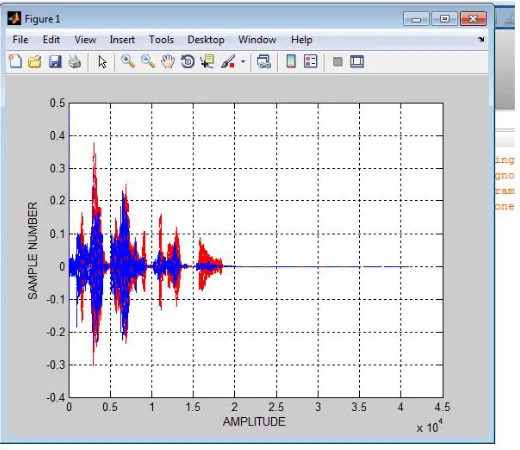
Infant crying signals have the diverse temporal and spectral characteristics, which are vital nods in distinguishing them from all-purpose sounds such as speech. Fig.2 demonstrates the speech and infant crying signal.
Fig .2.denoised Signal
ISSN (Print) : 2320 – 3765 ISSN (Online): 2278 – 8875
I
nternational
J
ournal of
A
dvanced
R
esearch in
E
lectrical,
E
lectronics and
I
nstrumentation
E
ngineering
(An ISO 3297: 2007 Certified Organization)
Website: www.ijareeie.com
Vol. 6, Issue 7, July 2017
Fig4. Signal After LFCC
Fig5. Signal after classification
Accuracy Computation
We have computer recognition rate for MFCC and LFCC with proposed architecture given above.
Recognition_rate = number of speech recognized
/number of speech presented;
Test Case LFCC MFCC Angry 93.33% 80.87% Discomfort 88.19% 86.73% Hungry 94.57% 79.89% Pain 87.22% 85.11% Average
Recognition Rate
ISSN (Print) : 2320 – 3765 ISSN (Online): 2278 – 8875
I
nternational
J
ournal of
A
dvanced
R
esearch in
E
lectrical,
E
lectronics and
I
nstrumentation
E
ngineering
(An ISO 3297: 2007 Certified Organization)
Website: www.ijareeie.com
Vol. 6, Issue 7, July 2017
VI. CONCLUSION
The proposed system is designed to be helpful to the doctors and parents. The device stores if any feedback is received from the user after each classification of cry. This set of feedbacks is considered for future improvement of the classification model. It also keeps a history or log of few previous cry results which can be considered for later observation if no one attends the baby when it is crying. This research can be extended for more number of classes in order to accomplish a better diagnosis of neonatal cry, which could be followed by betterment in the classification model. With the help out of Codebook model and LFCC without trouble perceive newborn child's infant cry and confirmed children feelings by utilizing KNN with the prevalent accuracy. Codebook model and LFCC with the prevalent accuracy.
REFERRENCES
[1] “Reyes-Galaviz, O., Verduzco, A., Arch-Tirade, E., and Reyes- Garcia, C., Analysis of an infant cry recognizer for the early identification of pathologies. Nonlinear Speech Modeling and Applications. 3445:404– 409, 2005”
[2] “Orozco, J., and Garcia, C., Detecting pathologies from infant cry applying scaled conjugate gradient neural networks, in European Symposium on Artificial Neural Networks, Bruges (Belgium), 2003, pp. 349–354”
[3] Garcia, J., and Garcia, C., Acoustic features analysis for recognition of normal and hypoacustic infant cry based on neural networks. Lecture Notes in Computer Science, Artificial Neural Nets Problem Solving Methods, 2687:615–622, 2003. doi:10.1007/3-540-44869- 178 “
[4] “Reyes-Galaviz, O., Cano-Ortiz, S., and Reyes-Garca, C., Evolutionary-neural system to classify infant cry units for pathologies identification in recently born babies, in 8th Mexican International Conference on Artificial Intelligence, MICAI 2009, Guanajuato, Mexico, 2009, pp. 330–335.” [5]Várallyay, G., Jr, Benyó, Z., Illényi, A., Farkas, Z., and Kovács, L., Acoustic analysis of the infant cry: classical and new methods, in 26th Annual Internation Conference of the IEEE EMBS, San Francisco,CA,USA, 2004, pp. 313–316”
[6] N.S.A.Wahid, P.Saad , M.Hariharan “Automatic Infant Cry Pattern Classification for a Multiclass Problem” ISSN: 2180-1843 e-ISSN: 2289-8131 Vol. 8 No. 9 September – December 2016 45-51
[7] BhagatpatilVarsharani V, V. M. Sardar “An Automatic Infants Cry Detection Using Linear Frequency Cepstrum Coefficients(LFCC) ” INTERNATIONAL JOURNAL OF TECHNOLOGY ENHANCEMENTS AND EMERGING ENGINEERING RESEARCH, VOL 3, ISSUE 02 29-34 ISSN 229-347-4289 Copyright © 2015 IJTEEE.
[8] Shashidhar G. Koolagudi • K. SreenivasaRao “Emotion recognition from speech: a review” Int J Speech Technol (2012) 15:99–117 DOI 10.1007/s10772-011-9125-1 Received: 7 July 2011 / Accepted: 17 December 2011 / Published online: 4 January 2012 © Springer Science+Business Media, LLC 2011