Block Based Face Recognition Algorithm
1 Dr. A Lenin Fred, 2S. Wilson1 Principal, Mar Ephraem College of Engineering and Technology, Marthandam, Tamilnadu, India 2Research scholar and AP, Computer Science,
CSI JayarajAnnapackiam College, Nallur, Tamilnadu, India
Abstract
Face recognition is the compulsory task in many public as well as private sectors. In the last two decades, there are several researches has been carried out. The objective of this paper is to identify the face with a single training image for each class. Texture property is extracted as feature using Gray Level Co-occurence matrix (GLCM). Block matching algorithm such as Full Search, Diamond Search, hexagon search and octagon search are used for classification. Experimental were conducted for all these algorithms and Full Search is proved to be best when compared to all other algorithms. These results are compared with recent face recognition techniques. The proposed method recognizes 99% of the face correctly.
Keywords: Block matching algorithm, correlation
1. Introduction
In general, a single face will be stored for each class. But during identification, the person may be in different posture, different light condition etc. Hence, identifying the face at any level is a challenging task. Many face recognition algorithms have been proposed. Face recognition falls under three main categories namely holistic approach, feature-based approach and hybrid approach. Holistic method uses the original image as an input for the face recognition system. The examples for holistic methods are Principle Component Analysis (PCA), Linear Discriminant Analysis (LDA), Independent Component Analysis (ICA) and so on. The main advantage of the holistic approaches is that they do not destroy any of the information in the images by concentrating on only limited regions or points of interest [1]. This same property is its greatest drawback, too, since most of these approaches start out with the basic assumption that all the pixels in the image are equally important [2]. Consequently, these techniques are not only computationally expensive but require a high degree of correlation between the test and training images, and do not perform effectively under large variations in pose, scale and illumination, etc. [3]. In the latest comprehensive FERET evaluation [4] [5], the probabilistic Eigenface [6], the Fisherface [7] and the EBGM [8] methods were ranked as the best three techniques for face recognition. Even though the EBGM method is feature-based in general, its success depends on its application of holistic neural network methods at the feature level. In Feature based method, the local feature
point such as eye, nose, and mouth are first extracted, then it will be send to the classifier. The main advantage offered by the featured-based techniques is that since the extraction of the feature points precedes the analysis done for matching the image to that of a known individual, such methods are relatively robust to position variations in the input image [1]. In principle, feature-based schemes can be made invariant to size, orientation and/or lighting [9]. Other benefits of these schemes include the compactness of representation of the face images and high speed matching [10]. The major disadvantage of these approaches is the difficulty of automatic feature detection and the fact that the implementer of any of these techniques has to make arbitrary decisions about which features are important [2]. After all, if the feature set lacks discrimination ability, no amount of subsequent processing can compensate for that intrinsic deficiency [9]. .Finally a Hybrid method is used to recognize both the local feature and whole face region [11- 16]. If the face is to be recognized, three processes should be done. They are face detection, dimensionality reduction and face recognition. The dimensionality reduction is used to solve the curse of dimensionality. It can be divided into two parts they are Feature Extraction and Feature Selection. The feature extraction process can be broadly classified into four types they are linear method, non linear methods, Multi linear methods and tensor space methods. Face images have more texture property. This paper extracts texture feature from face images using Gray Level Co-occurence Matrix (GLCM). Features are extracted by dividing the image into blocks. This block based approach extracts the features around neighbours. Earlier approaches extract features for whole image. It may not give fine detail of the image. But block based approach fine detail of the image. Section II explores the working architecture of the proposed method. Section III explains feature extraction process. Section IV briefly describes Block matching algorithm. Section V describes how the face is classified using the extracted features demonstrates experimental results followed by Conclusion in Section VI.
II.
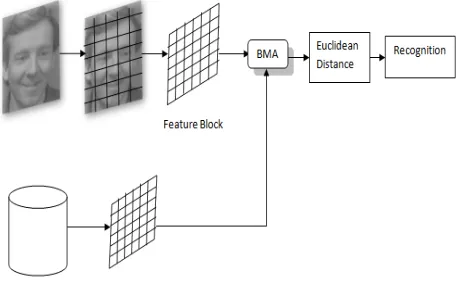
SYSTEM ARCHITECTURE
reshaping is done as the image is to be divided into equal-sized blocks. The next step is to divide the face image into blocks of equal size 4 x 4. Features are extracted for each block. This feature block is compared with the feature block of the training image in the database.
Fig. 1 System Architecture
The proposed work uses Gray Level Co-occurence matrix (GLCM) for each block. The gray level co-occurrence matrix (GLCM) is one of the most popular second-order statistical featured Texture property. Haralick in [17] described the use of GLCMs for texture analysis. Usually, this analysis is carried out separately for each image by using macroblocks, each with N x N pixels. The G x G gray level co-occurrence matrix Pd for a
displacement vector defined as d = (dx, dy) (polar
coordinates, d = (r,θ): The entry (i,j) of Pd is the number of
occurrences of the pair of gray levels i and j which are d distance apart. It is given by
(1) where N x N = (r+ dx,s+ dy) and | .
| is the cardinality of the set. Instead of using the number of occurrences, we used the probability of occurrence. Thus, we can define the normalized co-occurrence matrix P,P : G x G → [0,1] for an image as
is used.
(3)
IV. BLOCK MATCHING ALGORITHM
(a)
b
)
(a)
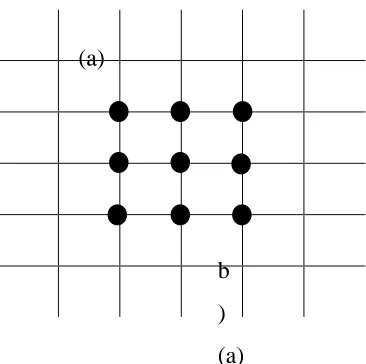
Fig. 2 (a) Full Search (b) Diamond Search
Fig. 3 Hexagon Search
(b)
motion vectors (Vx, Vy). The distance is calculated to identify how far the feature block is deviated from the current feature block. It is given
by
where x,y indicates the current location i.e. (0,0),
denotes deviated location.
V. FACE RECOGNITION
As the original image is resized to 128 x
128 and the image is divided into 4 x 4 equal sized blocks, total number of blocks obtained are
32 x 32. So, after calculating the distance, we have 1024 blocks.
To identify the face, mean value of the distance is calculated. It is given by
(4)
the recognized face.
VI. EXPERIMENTAL RESULTS
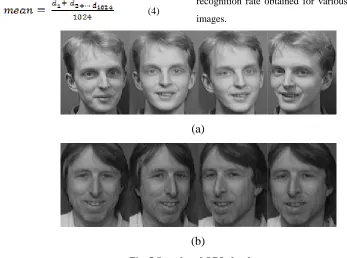
Experiments are conducted in ORL database. In ORL database, there are 40 classes. Only one
image is used to compare with the query image. The sample images from ORL database are shown in Fig. 5.
The efficiency of the proposed method is evaluated using recognition rate. Recognition rate is calculated as
(5) The recognition rate obtained for various
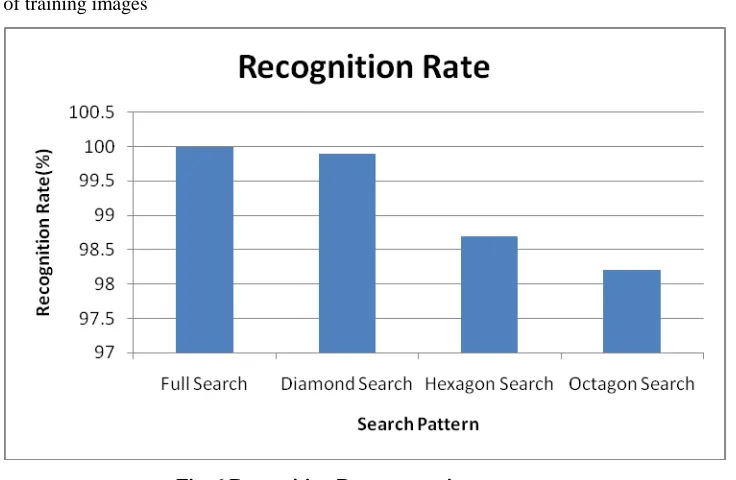
search patterns are shown in Table I. The results are shown pictorially in Fig. 5. Table I also shows the
recognition rate obtained for various number of training images.
(a)
From the Fig. 6, it is clear that full search method achieves better recognition rate than other algorithms.
Table I Recognition rate for various search patterns
Method Recognition Rate (%)
N=1 N=3 N=5
Full Search 100 100 100
Diamond Search 99.85 99.9 100
Hexagon Search 98.17 99.12 99.35
Octagon Search 98.42 97.3 97.9
N= Number of training images
Fig. 6 Recognition Rate comparison
Face recognition is a challenging task as it
contains different gesture, illumination etc. Face recognition is more efficient if it identifies the face using
single training image. This paper introduces block based face recognition technique using various search patterns. It
rate than other search patterns. The full search method is tested with various number of training images. Experimental results proved that Full search method
achieved better recognition rate even with single training image.
References
[1] T. Jebara, "3D Pose Estimation and Normalization for Face Recognition," Center for Intelligent Machines, McGill University, Undergraduate Thesis May, 1996.
[2] R. Cendrillon and B. C. Lowell, "Real-Time Face Recognition using Eigenfaces," in Proceedings of the SPIE International Conference on Visual Communications and Image Processing, Vol.4067, 2000, pp.269-276.
[3] C. Beumier and M. Acheroy, "Automatic Face Recognition," in
Proceedings symposium IMAGING. Eindhoven, The Netherlands, 2000, pp.77-89.
[4] P. J. Phillips, P. Rauss, and S. Der, "FERET (FacE REcognition Technology) Recognition Algorithm Development and Test Report," U.S. Army Research Laboratory ARL-TR-995, 1996. [5] P. J. Phillips, H. Moon, S. A. Rizvi, and P. J. Rauss, "The FERET
Evaluation Methodology for Facerecognition Algorithms," in
Proceedings, IEEE Conference on Computer Vision and Pattern
Recognition, 1997, pp.137-143.
[6] B. Moghaddam, C. Nastar, and A. Pentland, "A Bayesian Similarity Measure for Direct Image Matching," in Proceedings 13th International Conference on Pattern Recognition, 1996, pp.350- 358.
[7] P. N. Belhumeur, J. P. Hespanha, and D. J. Kriegman, "Eigenfaces vs. Fisherfaces: Recognition using class specific linear projection," IEEE Transactions on Pattern Analysis and Machine Intelligence, Vol.19, pp.711-720, 1997.
[8] L. Wiskott, J.-M. Fellous, N. Krüger, and C. von der Malsburg, "Face Recognition by Elastic Bunch Graph Matching," IEEE Transactions on Pattern Analysis and Machine Intelligence, Vol.19, pp.775- 779, 1997
[9] I. J. Cox, J. Ghosn, and P. N. Yianilos, "Featurebased face
Computer Vision, Vol.588, Lecture Notes In Computer Science, G. Sandini, Ed. London, UK: Springer-Verlag, 1992, pp.782-800. [11] Rama Chellappa, Charles L. Wilson, And Saad Sirohey,”Human
and machine recognition of faces: A Survey”,Proceedings of the IEEE,1995
[12] William A. Barrett,” A Survey of Face Recognition Algorithms and Testing Results”,Proceedings of the IEEE,1998.
[13] W.Zhao,R.Chellapa,A.Rosenfield,P.J.Philips,” Face Recognition : A Literature Survey”,2001
[14] W.Zhao,R.Chellapa,A.Rosenfield,P.J.Philips, “Face Recognition: A Literature Survey”, ACM proceedings, 2003
[15] Xiaoyang Tana,b, Songcan Chena,c, Zhi-Hua Zhoub, Fuyan Zhangb,” Face recognition from a single image per person:Asurvey”,Published in Elseiver,2006
[16] Patil A.M., Kolhe S.R. and Patil P.M,” 2D Face Recognition Techniques: A Survey”,2010
[17] R. Haralick, K. Shanmugan, and I. Dinstein, “Textural feature for image classification,” IEEE Trans. Systems, Man, Cybern., vol. SMC-3, no. 6, pp. 610–621, Nov. 1973.
[18] J. Huska and P. Kulla, “Trends in block-matching motion estimation algorithms,” Dept. of Radioelectronics, Slovak Univ. of Technology, Bratislava, Tech. Rep.
[19] S. Zhu and K.-K. Ma, “A new diamond search algorithm for fast block-matching motion estimation,” in Proc. Int. Conf. Inf. Commun. Signal Process. (ICICS ’97), vol. 1, Sep. 9–12, 1997, pp.292–296.
[20] C. Zhu, X. Lin, and L.-P. Chau, “Hexagon-based search pattern for fast block motion estimation,” IEEE Trans. Circuits Syst. Video Technol.,vol. 12, no. 5, pp. 349–355, May 2002.
Prof. Dr. A. Lenin Fred received B.E in Computer
Science and Engineering from Madurai Kamaraj University, India, in 1995 with First class. He has
passed M.E. Degree in the same discipline in Madurai Kamaraj
University, India and awarded in 2001 with First class. He received his Ph.D. (Doctor of Philosophy) in
Computer Science and Engineering at Manonmaniam Sundaranar University, Tirunelveli, India in 2010.
His research interest has widen over a variety of fields such as Information Technology, Digital Image
Processing, Biometrics, Automatic Fingerprint Identification System and Biometrics.
S.Wilson received his MCA degree
from Manonmaniam Sundaranar University in Tirunelveli, India in
1998 with First class. On 2008, he passed out M.Phil degree in the field of computer science from the same university andin
2010 he completed M.Tech (Computer Science and Information technology) degree with First class. Also,
he qualified in State Eligibility Test (SET) for lectureship on 2012 conducted by Bharathiar