Sequential Aggregate Signatures with Short Public Keys:
Design, Analysis and Implementation Studies
Kwangsu Lee∗ Dong Hoon Lee† Moti Yung‡
Abstract
The notion of aggregate signature has been motivated by applications and it enables any user to compress different signatures signed by different signers on different messages into a short signature. Sequential aggregate signature, in turn, is a special kind of aggregate signature that only allows a signer to add his signature into an aggregate signature in sequential order. This latter scheme has applications in diversified settings, such as in reducing bandwidth of a certificate chains, and in secure routing protocols. Lu, Ostrovsky, Sahai, Shacham, and Waters presented the first sequential aggregate signature scheme in the standard (non idealized ROM) model. The size of their public key, however, is quite large (i.e., the number of group elements is proportional to the security parameter), and therefore they suggested as an open problem the construction of such a scheme with short keys. Schr¨oder recently proposed a sequential aggregate signature (SAS) with short public keys using the Camenisch-Lysyanskaya signature scheme, but the security is only proven under an interactive assumption (which is considered a relaxed notion of security). In this paper, we propose the first sequential aggregate signature scheme with short public keys (i.e., a constant number of group elements) in prime order (asymmetric) bilinear groups which is secure under static assumptions in the standard model. Further, our scheme employs constant number of pairing operation per message signing and message verification operation. Technically, we start with a public key signature scheme based on the recent dual system encryption technique of Lewko and Waters. This technique cannot give directly an aggregate signature scheme since, as we observed, additional elements should be published in the public key to support aggregation. Thus, our construction is a careful augmentation technique for the dual system technique to allow it to support a sequential aggregate signature scheme via randomized verification. We further implemented our scheme and conducted a performance study and implementation optimization.
Keywords: Public key signature, Aggregate signature, Sequential aggregate signature, Dual system encryption, Bilinear pairing.
1
Introduction
Aggregate signature is a relatively new type of public key signature which enables any user to combine
n signatures signed by differentnsigners on differentn messages into a short signature. The concept of public key aggregate signature (PKAS) was introduced by Boneh, Gentry, Lynn, and Shacham [9], and
∗Columbia University, NY, USA. Email:[email protected]. Supported by the MKE (The Ministry of
Knowl-edge Economy), Korea, under the ITRC (Information Technology Research Center) support program (NIPA-2012-H0301-12-3007) supervised by the NIPA (National IT Industry Promotion Agency).
†Korea University, Seoul, Korea. Email: [email protected]. Supported by the National Research Foundation of
Korea (NRF) grant funded by the Korea government (MEST) (No. 2010-0029121).
they proposed an efficient PKAS scheme in the random oracle model using the bilinear groups. After that, numerous PKAS schemes were proposed using bilinear groups [14, 22, 6, 7, 1, 15] or using trapdoor permutations [24, 3, 25].
One application of aggregate signature is the certificate chains of the public key infrastructure (PKI) [9]. The PKI system has a tree structure, and a certificate for a user consists of a certificate chain from a root node to a leaf node, each node in the chain signing its predecessor. If the signatures in the certificate chain are replaced with a single aggregate signature, then the bandwidth for signatures transfer can be significantly saved. Another application is to the secure routing protocol of the internet protocol [9]. If each router which participates in the routing protocol uses PKAS instead of a public key signature (PKS), then the communication overload of signature transfer can be dramatically reduced. Further, aggregate signatures have other applications such as reducing bandwidth in sensor networks or ad-hoc networks, and in software authentication in the presence of software update [1].
1.1 Previous Methods
Aggregate signature schemes are categorized asfullaggregate signature,synchronizedaggregate signature,
andsequential aggregate signature depending on the type of signature aggregation. They have also been
applied to regular signatures in the PKI model, and to ID-based signatures (with trusted key server). The first type of aggregate signature isfull aggregate signaturewhich enables any user to freely aggre-gate different signatures of different signers. This full aggreaggre-gate signature is the most flexible aggreaggre-gate signature since it does not require any restriction on the aggregation step (though, restriction may be needed at times for certain applications). However, there is only one full aggregate signature scheme that was pro-posed by Boneh et al. [9]. Since this scheme is based on the short signature scheme of Boneh et al. [10], the signature length it provides is also very short. However, the security of the scheme is just proven in the idealized random oracle model and the number of pairing operations in the aggregate signature verification algorithm is proportional to the number of signers in the aggregate signature.
The second type of aggregate signature issynchronized aggregate signaturewhich enables any user to combine different signatures with the same synchronizing information into a single signature. The synchro-nized aggregate signature has a demerit which dictates that all signers should share the same synchronizing information (like a time clock or other shared value). Gentry and Ramzan introduced the concept of syn-chronized aggregate signature, they proposed an identity-based synsyn-chronized aggregate signature scheme using bilinear groups, and they proved its security in the random oracle model [14]. We note that identity-based aggregate signature (IBAS) is an ID-identity-based scheme and thus relies on a trusted server knowing all private keys (i.e., its trust structure is different than in regular PKI). However, it also has a notable advantage such that it is not required to retrieve the public keys of signers in the verification algorithm since an identity string plays the role of a public key (the lack of public key is indicated in our comparison table as public key of no size!). Recently, Ahn et al. presented a public key synchronized aggregate signature scheme without relying on random oracles [1].
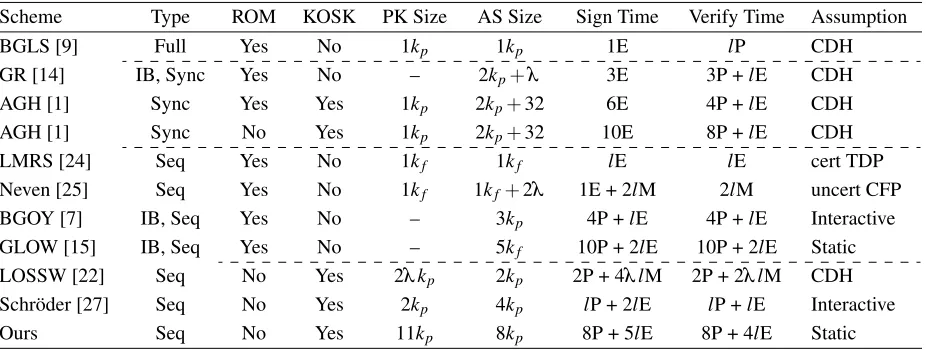
Table 1: Comparison of aggregate signature schemes
Scheme Type ROM KOSK PK Size AS Size Sign Time Verify Time Assumption
BGLS [9] Full Yes No 1kp 1kp 1E lP CDH
GR [14] IB, Sync Yes No – 2kp+λ 3E 3P +lE CDH
AGH [1] Sync Yes Yes 1kp 2kp+32 6E 4P +lE CDH
AGH [1] Sync No Yes 1kp 2kp+32 10E 8P +lE CDH
LMRS [24] Seq Yes No 1kf 1kf lE lE cert TDP
Neven [25] Seq Yes No 1kf 1kf+2λ 1E + 2lM 2lM uncert CFP
BGOY [7] IB, Seq Yes No – 3kp 4P +lE 4P +lE Interactive
GLOW [15] IB, Seq Yes No – 5kf 10P + 2lE 10P + 2lE Static
LOSSW [22] Seq No Yes 2λkp 2kp 2P + 4λlM 2P + 2λlM CDH
Schr¨oder [27] Seq No Yes 2kp 4kp lP + 2lE lP +lE Interactive
Ours Seq No Yes 11kp 8kp 8P + 5lE 8P + 4lE Static
ROM = random oracle model, KOSK = certified-key model, IB = identity based
λ = security parameter,kp,kf = the bit size of element for pairing and factoring,l= the number of signers
P = pairing computation, E = exponentiation, M = multiplication
al. presented an identity-based sequential aggregate signature scheme in the random oracle model using an interactive assumption [6], but it was shown that their construction is not secure by Hwang et al. [17]. After that, Boldyreva et al. proposed a new identity-based sequential aggregate signature by modifying their previous construction and proved its security in the generic group model [7]. Recently, Gerbush et al. showed that the modified IBAS scheme of Boldyreva et al. is secure under static assumptions using the dual form signatures framework [15]. The first sequential aggregate signature scheme without the random oracle idealization was proposed by Lu et al. [22]. They converted the PKS scheme of Waters [28] to the PKAS scheme, and proved its security under the well known CDH assumption. However, the scheme of Lu et al. has a demerit since the number of group elements in the public key is proportional to the security parameter (for a security of 280they need 160 elements or about 80 elements in a larger group); they left as an open question to design a scheme with shorter public key. Schr¨oder proposed a PKAS scheme with short public keys relying on the Camenisch-Lysyanskaya signature scheme [27], however the scheme’s security is proven under an interactive assumption (which typically, is a relaxation used when designs based on static assumptions are hard to find).1 Therefore, the construction of sequential aggregate signature scheme with short public keys without relaxations like random oracles or an interactive assumptions was left as an open question.
1.2 Our Contributions
Challenged by the above question, the motivation of our research is to construct an efficient sequential aggregate signature scheme secure in the standard model (i.e., without employing assumptions like random oracle or interactive assumptions as part of the proof) with short public keys (e.g., constant number of group
1Gerbush et al. showed that a modified Camenisch-Lysyanskaya signature scheme in composite order groups is secure under
static assumptions [15]. However, it is unclear whether the construction of Schr¨oder can be directly applied to this modified Camenisch-Lysyanskaya signature scheme. The reason is that aggregatingGp1 and Gp2 subgroups is hard and a private key
elementg2,3∈Gp2p3 can not be generated by the key generation algorithm of an aggregate signature scheme. Additionally, our
elements). To achieve this goal, we use the public key signature scheme derived from the identity-based encryption (IBE) scheme that adopts the innovative dual system encryption techniques of Waters [29, 21]. That is, an IBE scheme is first converted to a PKS scheme by the clever observation of Naor [8]. The PKS schemes that adopt the dual system encryption techniques are the scheme of Waters [29] which includes a random tag in a signature and the scheme of Lewko and Waters [21] which does not include a random tag in a signature. The scheme of Waters is not appropriate to aggregate signature since the random tags in signatures cannot be compressed into a single value. The scheme of Lewko and Waters in composite order groups is easily converted to an aggregate signature scheme if the element ofGp3 is moved from a private key to a public key, but it is inefficient because of composite order groups.2 Therefore, we start the construction from the IBE scheme in prime order (asymmetric) bilinear groups of Lewko and Waters. However, this PKS scheme which is directly derived from the IBE scheme of Lewko and Waters is not easily converted to a sequential aggregate signature scheme (as far as we see). The reason is that we need a PKS scheme that supports multi-user setting and public re-randomization to construct a SAS scheme by using the randomness reuse technique of Lu et al. [22], but this PKS scheme does not support these two properties.
Here we first construct a PKS scheme in prime order (asymmetric) bilinear groups which supports multi-user seting and public re-randomization by modifying the PKS scheme of Lewko and Waters, and we prove its security using the dual system encryption technique. Next, we convert the modified PKS scheme to a SAS scheme with short public keys by using the randomness reuse technique of Lu et al. [22], and we prove its security without random oracles and based on the traditional static assumptions. Our security proof crucially relies on the fact that we add additional randomization elements to the SAS verification algorithm, so that we can expand these elements to a semi-functional space; this allows us to introduce in the SAS scheme public-key elements used in aggregation. Note that Table 1 gives a comparison of past schemes to ours. Finally, to support our claim of efficiency, we implemented our SAS scheme using the PBC library (code available from authors [19]) and we measured the performance of the scheme. Additionally, as part of the implementation we provide a computational preprocessing method which improves the amortized performance of our scheme.
1.3 Additional Related Work
There are some works on aggregate signature schemes which allow signers to communicate with each other or schemes which compress only partial elements of a signature in the aggregate algorithm [4, 2, 16, 11]. Generally, communication resources of computer systems are very expensive compared to the computation resources. Thus, it is preferred to perform several expensive computational operations instead of a single communication exchange. Additionally, a signature scheme with added communications does not corre-spond to a pure public key signature schemes, but correcorre-sponds more to a multi-party protocol. In addition, signature schemes which compress just partial elements of signatures cannot be an aggregate signature since the total size of signatures is still proportional to the number of signers.
Another research area related to aggregate signature is multi-signature [5, 22]. Multi-signature is a special type of aggregate signature in which all signers generate signatures on the same message, and then any user can combine these signature to a single signature. Aggregate message authentication code (AMAC) is the symmetric key analogue of aggregate signature: Katz and Lindell introduced the concept of AMAC
2We can safely move the element of
Gp3from a private to a public key since it is always given in assumptions. Lewko obtained
and showed that it is possible to construct AMAC schemes based on any message authentication code schemes [18].
2
Preliminaries
We first define public key signature and sequential aggregate signature, and then give the definition of their correctness and security.
2.1 Public Key Signature
A public key signature (PKS) scheme consists of three PPT algorithmsKeyGen,Sign, andVerify, which are defined as follows: The key generation algorithmKeyGen(1λ) takes as input the security parameters
1λ, and outputs a public keyPKand a private keySK. The signing algorithmSign(M,SK)takes as input a
messageMand a private keySK, and outputs a signatureσ. The verification algorithmVerify(σ,M,PK)
takes as input a signature σ, a messageM, and a public keyPK, and outputs either 1 or 0 depending on the validity of the signature. The correctness requirement is that for any(PK,SK)output byKeyGenand any M∈ M, we have that Verify(Sign(M,SK),M,PK) =1. We can relax this notion to require that the verification is correct with overwhelming probability over all the randomness of the experiment.
The security notion of existential unforgeability under a chosen message attack is defined in terms of the following experiment between a challengerCand a PPT adversaryA:Cfirst generates a key pair(PK,SK)
by running KeyGen, and givesPK toA. Then A, adaptively and polynomially many times, requests a signature query on a messageM under the challenge public keyPK, and receives a signatureσ. Finally, A outputs a forged signatureσ∗ on a message M∗. C then outputs 1 if the forged signature satisfies the
following two conditions, or outputs 0 otherwise: 1)Verify(σ∗,M∗,PK) =1 and 2) M∗ was not queried byAto the signing oracle. The advantage ofAis defined asAdvPKSA =Pr[C=1]where the probability is taken over all the randomness of the experiment. A PKS scheme is existentially unforgeable under a chosen message attack if all PPT adversaries have at most a negligible advantage in the above experiment (for large enough security parameter).
2.2 Sequential Aggregate Signature
A sequential aggregate signature (SAS) scheme consists of four PPT algorithms Setup, KeyGen, Ag-gSign, and AggVerify, which are defined as follows: The setup algorithm Setup(1λ) takes as input a
security parameter 1λ and outputs public parameters PP. The key generation algorithm KeyGen(PP)
takes as input the public parameters PP, and outputs a public keyPK and a private key SK. The aggre-gate signing algorithm AggSign(AS0,M,PK,M,SK) takes as input an aggregate-so-far AS0 on messages
M= (M1, . . . ,Ml) under public keysPK= (PK1, . . . ,PKl), a message M, and a private keySK, and out-puts a new aggregate signature AS. The aggregate verification algorithmAggVerify(AS,M,PK) takes as input an aggregate signatureAS on messages M= (M1, . . . ,Ml)under public keys PK= (PK1, . . . ,PKl), and outputs either 1 or 0 depending on the validity of the sequential aggregate signature. The correctness requirement is that for each PP output by Setup, for all (PK,SK) output by KeyGen, any M, we have thatAggVerify(AggSign(AS0,M0,PK0,M,SK),M0||M,PK0||PK) =1 whereAS0 is a valid aggregate-so-far signature on messagesM0under public keysPK0.
Setup: Cfirst initializes a certification listCL as empty. Next, it runsSetupto obtain public parameters
PPandKeyGento obtain a key pair(PK,SK), and givesPKtoA.
Certification Query: A adaptively requests the certification of a public key by providing a key pair
(PK,SK). ThenCadds the key pair(PK,SK)toCLif the key pair is a valid one.
Signature Query: Aadaptively requests a sequential aggregate signature (by providing an aggregate-so-farAS0 on messagesM0under public keysPK0), on a messageMto sign under the challenge public keyPK, and receives a sequential aggregate signatureAS.
Output: Finally (after a sequence of the above queries),Aoutputs a forged sequential aggregate signature
AS∗on messagesM∗under public keysPK∗.Coutputs 1 if the forged signature satisfies the following three conditions, or outputs 0 otherwise: 1)AggVerify(AS∗,M∗,PK∗) =1, 2) The challenge public keyPK must exists inPK∗ and each public key inPK∗except the challenge public key must be in
CL, and 3) The corresponding messageMinM∗of the challenge public keyPK must not have been queried byAto the sequential aggregate signing oracle.
The advantage ofAis defined asAdvSASA =Pr[C=1]where the probability is taken over all the random-ness of the experiment. A SAS scheme is existentially unforgeable under a chosen message attack if all PPT adversaries have at most a negligible advantage (for large enough security parameter) in the above experiment.
2.3 Asymmetric Bilinear Groups
Let G,Gˆ andGT be multiplicative cyclic groups of prime order p. Letg,gˆ be generators of G,Gˆ. The bilinear mape:G×Gˆ →GT has the following properties:
1. Bilinearity: ∀u∈G,∀vˆ∈Gˆ and∀a,b∈Zp,e(ua,vˆb) =e(u,vˆ)ab.
2. Non-degeneracy:∃g,gˆsuch thate(g,gˆ)has order p, that is,e(g,gˆ)is a generator ofGT.
We say thatG,Gˆ,GT are bilinear groups with no efficiently computable isomorphisms if the group opera-tions inG,Gˆ,andGTas well as the bilinear mapeare all efficiently computable, but there are no efficiently computable isomorphisms betweenGand ˆG.
2.4 Complexity Assumptions
We employ three static assumptions in prime order bilinear groups. Assumptions 1 and 3 have been used extensively, while Assumption 2 was introduced by Lewko and Waters [21].
Assumption 1 (Symmetric eXternal Diffie-Hellman) Let(p,G,Gˆ,GT,e)be a description of the asym-metric bilinear group of prime orderp. Letg,gˆbe generators ofG,Gˆ respectively. The assumption is that if the challenge values
D= ((p,G,Gˆ,GT,e),g,gˆ,gˆa,gˆb)andT,
are given, no PPT algorithmBcan distinguishT =T0=gˆabfromT =T1=gˆcwith more than a negligible advantage. The advantage ofBis defined asAdvAB1(λ) =Pr[B(D,T0) =0]−Pr[B(D,T1) =0]
where the
Assumption 2 (LW2)Let(p,G,Gˆ,GT,e)be a description of the asymmetric bilinear group of prime order
p. Letg,gˆbe generators ofG,Gˆ respectively. The assumption is that if the challenge values
D= ((p,G,Gˆ,GT,e),g,ga,gb,gc,gˆ,gˆa,gˆa 2
,gˆbx,gˆabx,gˆa2x)andT,
are given, no PPT algorithmBcan distinguishT =T0=gbcfromT =T1=gdwith more than a negligible
advantage. The advantage ofBis defined asAdvAB2(λ) =Pr[B(D,T0) =0]−Pr[B(D,T1) =0]
where the
probability is taken over the random choice ofa,b,c,x,d∈Zp.
Assumption 3 (Decisional Bilinear Diffie-Hellman)Let(p,G,Gˆ,GT,e)be a description of the asymmetric bilinear group of prime order p. Let g,gˆbe generators ofG,Gˆ respectively. The assumption is that if the challenge values
D= ((p,G,Gˆ,GT,e),g,ga,gb,gc,gˆ,gˆa,gˆb,gˆc)andT,
are given, no PPT algorithmBcan distinguishT =T0=e(g,gˆ)abcfromT =T1=e(g,gˆ)d with more than a
negligible advantage. The advantage ofBis defined asAdvAB3(λ) =Pr[B(D,T0) =0]−Pr[B(D,T1) =0]
where the probability is taken over the random choice ofa,b,c,d∈Zp.
3
Aggregate Signature
We construct a SAS scheme in prime order (asymmetric) bilinear groups and prove its existential unforge-ability under a chosen message attack. The main idea is to modify a PKS scheme to support multi-user setting and signature aggregation by using the “randomness reuse” technique of Lu et al. [22]. To support multi-user setting, it is required for all users to share common elements in the public parameters. To use the randomness reuse technique, it is crucial for a signer to publicly re-randomize a sequential aggregate signa-ture to prevent a forgery attack. Thus we need a PKS scheme with short public key that supports “multi-user setting” and “public re-randomization”.
Before we present a SAS scheme, we first construct a PKS scheme with short public key that will be augmented to support multi-user setting and public re-randomization. One method to build a PKS scheme is to use the observation of Naor [8] that private keys of fully secure IBE are easily converted to signatures of PKS. Thus we can convert the prime order IBE scheme of Lewko and Waters [21] to a prime order PKS scheme. However, this directly converted PKS scheme does not support multi-user setting and public re-randomization since it needs to publish additional public key components: Specifically, we need to publish an element g for multi-user setting and elements u,h for public re-randomization. Note that ˆg,uˆ,hˆ are already in the public key, butg,u,hare not. One may try to publishg,u,hin the public key. The technical difficulty arising in this case is that the simulator of the security proof can easily distinguish the changes of the verification algorithm that checks the validity of the forged signature from the normal verification algorithm to the semi-functional one, without using an adversary.
To solve this problem, we devise a method that allows a PKS scheme to safely publish elementsg,u,hin the public key for multi-user setting and public re-randomization. The main idea is to additionally randomize the verification components using ˆv,vˆν3,vˆ−π in the verification algorithm. If a valid signature is given in the verification algorithm, then the additionally added randomization elements ˆv,vˆν3,vˆ−π are canceled. Otherwise, the added randomization components prevent the verification of an invalid signature. Therefore, the simulator of the security proof cannot distinguish the changes of the verification algorithm even ifg,u,h
3.1 Our PKS Scheme
The PKS scheme in prime order bilinear groups is described as follows:
PKS.KeyGen(1λ): This algorithm first generates the asymmetric bilinear groups
G,Gˆ of prime order pof bit sizeΘ(λ). It chooses random elementsg,w∈Gand ˆg,vˆ∈Gˆ. Next, it chooses random exponents
ν1,ν2,ν3,φ1,φ2,φ3∈Zpand setsτ =φ1+ν1φ2+ν2φ3,π=φ2+ν3φ3. It selects random exponents
α,x,y∈Zpand setsu=gx,h=gy,uˆ=gˆx,hˆ=gˆy. It outputs a private keySK= (α,x,y)and a public key as
PK= g,u,h,w1=wφ1,w2=wφ2,w3=wφ3,w, gˆ,gˆν1,gˆν2,gˆ−τ,
ˆ
u,uˆν1,uˆν2,uˆ−τ, hˆ,hˆν1,hˆν2,hˆ−τ,vˆ,vˆν3,vˆ−π,
Ω=e(g,gˆ)α .
PKS.Sign(M,SK): This algorithm takes as input a message M∈ {0,1}k where k<
λ and a private key SK= (α,x,y). It selects random exponentsr,c1,c2∈Zpand outputs a signature as
σ= W1,1=gα(uMh)rwc11,W1,2=w2c1,W1,3=w3c1,W1,4=wc1,
W2,1=grwc2
1,W2,2=wc22,W2,3=wc32,W2,4=wc2
.
PKS.Verify(σ,M,PK): This algorithm takes as input a signatureσon a messageM∈ {0,1}kunder a public
keyPK. It first chooses random exponentst,s1,s2∈Zpand computes verification components as
V1,1=gˆt,V1,2= (gˆν1)tvˆs1,V1,3= (gˆν2)t(vˆν3)s1,V1,4= (gˆ−τ)t(vˆ−π)s1,
V2,1= (uˆMhˆ)t,V2,2= ((uˆν1)Mhˆν1)tvˆs2,V2,3= ((uˆν2)Mhˆν2)t(vˆν3)s2,V2,4= ((uˆ−τ)Mhˆ−τ)t(vˆ−π)s2.
Next, it verifies that∏4i=1e(W1,i,V1,i)·∏i4=1e(W2,i,V2,i)−1 ?=Ωt. If this equation holds, then it outputs 1. Otherwise, it outputs 0.
We first note that the inner product of(φ1,φ2,φ3,1)and(1,ν1,ν2,−τ)is zero sinceτ=φ1+ν1φ2+ν2φ3,
and the inner product of(φ1,φ2,φ3,1)and(0,1,ν3,−π)is zero sinceπ =φ2+ν3φ3. Using these facts, the
correctness requirement of the above PKS scheme is easily verified as
4
∏
i=1e(W1,i,V1,i)·
4
∏
i=1e(W2,i,V2,i)−1=e(gα(uMh)r,gˆt)·e(gr,(uˆMhˆ)t)−1=Ωt.
Theorem 3.1. The above PKS scheme is existentially unforgeable under a chosen message attack if
As-sumptions 1, 2, and 3 hold. That is, for any PPT adversaryA, there exist PPT algorithmsB1,B2,B3such
thatAdvPKSA (λ)≤AdvBA11(λ) +qAdv A2
B2(λ) +Adv A3
B3(λ)where q is the maximum number of signature queries
ofA.
The proof of this theorem is given in Section 4.1.
3.2 Our SAS Scheme
SAS.Setup(1λ): This algorithm first generates the asymmetric bilinear groups
G,Gˆ of prime order pof bit size Θ(λ). It chooses random elements g,w∈Gand ˆg,vˆ∈Gˆ. Next, it chooses random exponents
ν1,ν2,ν3,φ1,φ2,φ3∈Zpand setsτ=φ1+ν1φ2+ν2φ3,π=φ2+ν3φ3. It publishes public parameters
as
PP= g,w1=wφ1,w2=wφ2,w3=wφ3,w, gˆ,gˆν1,gˆν2,gˆ−τ,vˆ,vˆν3,vˆ−π
.
SAS.KeyGen(PP): This algorithm takes as input the public parameters PP. It selects random exponents
α,x,y∈Zpand computesu=gx,h=gy,uˆ=gˆx,uˆν1= (gˆν1)x,uˆν2= (gˆν2)x,uˆ−τ= (gˆ−τ)x,hˆ=gˆy,hˆν1=
(gˆν1)y,hˆν2= (gˆν2)y,hˆ−τ= (gˆ−τ)y. It outputs a private keySK= (α,x,y)and a public key as
PK= u,h, uˆ,uˆν1,uˆν2,uˆ−τ,hˆ,hˆν1,hˆν2,hˆ−τ,
Ω=e(g,gˆ)α .
SAS.AggSign(AS0,M0,PK0,M,SK): This algorithm takes as input an aggregate-so-farAS0= (S01,1, . . . ,S02,4)
on messagesM0= (M1, . . . ,Ml−1)under public keysPK0= (PK1, . . . ,PKl−1)wherePKi= (ui,hi, . . . ,Ωi), a messageM∈ {0,1}kwherek<
λ, a private keySK= (α,x,y)withPK= (u,h, . . . ,Ω)andPP. It first checks the validity ofAS0by callingAggVerify(AS0,M0,PK0). IfAS0is not valid, then it halts. If the public keyPK ofSK does already exist in PK0, then it halts. Next, it selects random exponents
r,c1,c2∈Zpand outputs an aggregate signature as
AS= S1,1=S01,1gα(S
0
2,1)
xM+y· l−1
∏
i=1(uMi
i hi)r(uMh)rw1c1,S1,2=S10,2(S
0
2,2)
xM+y·wc1
2 ,
S1,3=S01,3(S
0
2,3)
xM+y·
wc1
3, S1,4=S
0
1,4(S
0
2,4)
xM+y·
wc1,
S2,1=S02,1·g
r
wc2
1, S2,2=S02,2·w
c2
2, S2,3=S02,3·w
c2
3, S2,4=S02,4·w
c2 .
SAS.AggVerify(AS,M,PK): This algorithm takes as input a sequential aggregate signatureASon messages
M= (M1, . . . ,Ml)under public keysPK= (PK1, . . . ,PKl)wherePKi= (ui,hi, . . . ,Ωi). It first checks that any public key does not appear twice inPKand that any public key inPKhas been certified. If these checks fail, then it outputs 0. Ifl=0, then it outputs 1 ifS1=S2=1, 0 otherwise. It chooses
random exponentst,s1,s2∈Zpand computes verification components as
C1,1=gˆt,C1,2= (gˆν1)tvˆs1,C1,3= (gˆν2)t(vˆν3)s1,C1,4= (gˆ−τ)t(vˆ−π)s1,
C2,1=
l
∏
i=1(uˆMi
i hˆi)t,C2,2=
l
∏
i=1((uˆν1 i )
Mihˆν1 i )
t ˆ
vs2,
C2,3=
l
∏
i=1((uˆν2 i )
Mihˆν2 i )
t(vˆν3)s2,C
2,4=
l
∏
i=1((uˆ−τi )Mihˆi−τ)t(vˆ−π)s2.
Next, it verifies that∏4i=1e(S1,i,C1,i)·∏4i=1e(S2,i,C2,i)−1 ?=∏li=1Ωti. If this equation holds, then it outputs 1. Otherwise, it outputs 0.
The aggregate signatureAS is a valid sequential aggregate signature on messagesM0||Munder public keysPK0||PKwith randomness ˜r=r0+r,c˜1=c01+c02(xM+y) +c1,c˜2=c02+c2wherer0,c01,c02are random values inAS0. The sequential aggregate signature has the following form
S1,1=
l
∏
i=1gαi l
∏
i=1(uMi
i hi)r˜wc1˜1,S1,2=wc2˜1,S1,3=wc3˜1,S1,4=wc˜1,
Theorem 3.2. The above SAS scheme is existentially unforgeable under a chosen message attack if the PKS
scheme is existentially unforgeable under a chosen message attack. That is, for any PPT adversaryAfor the
above SAS scheme, there exists a PPT algorithmBfor the PKS scheme such thatAdvSASA (λ)≤AdvPKSB (λ).
The proof of this theorem is given in Section 4.2.
3.3 Extensions
In this section, we discuss various extensions of our SAS scheme.
Multiple Messages. The SAS scheme of this paper only allows a signer to sign once in the aggregate algorithm. To support multiple signing per one signer, we can use the method of Lu et al. [22]. The basic idea of Lu et al. is to apply a collision resistant hash functionH to a message M before performing the signing algorithm. If a signer wants to add a signature on a messageM2into the aggregate signature, he first removes his previous signature onH(M1) from the aggregate signature using his private key, and then he
adds the new signature on theH(M1||M2)to the aggregate signature.
Multi-signatures. The SAS scheme of this paper can be easily converted to a multi-signature scheme. In case of multi-signature, some elements of public keys in SAS can be moved to the public parameters since multi-signature only allows signers to sign on the same message. Compared to the multi-signature scheme of Lu et al. [22], our multi-signature scheme has short size public parameters.
4
Security Analysis
In this section, we analyze the security of the basic PKS scheme and our SAS scheme.
4.1 Proof of Theorem 3.1
To prove the security of our PKS scheme, we use the dual system encryption technique of Lewko and Waters [21]. We describe a semi-functional signing algorithm and a semi-functional verification algorithm. They are not used in a real system, rather they are used in the security proof. When comparing our proof to that of Lewko and Waters, we employ a different assumption since we have published additional elements
g,u,hused in aggregation (in fact, direct adaptation of the earlier technique will break the assumption and thus the proof). A crucial idea in our proof is that we have added elements ˆv,vˆν3,vˆ−π in the public key which are used in randomization of the verification algorithm. In the security proof when moving from normal to semi-functional verification, it is the randomization elements ˆv,vˆν3,vˆ−π which are expanded to the semi-functional space; this enables deriving semi-functional verification as part of the security proof under our assumption, without being affected by the publication of the additional public key elements used for aggregation.
For the semi-functional signing and verification we set f =gyf,fˆ=gˆyf wherey
f is a random exponent inZp.
PKS.SignSF. The semi-functional signing algorithm first creates a normal signature using the private key. Let(W10,1, . . . ,W20,4)be the normal signature of a messageMwith random exponentsr,c1,c2∈Zp. It selects random exponentssk,zk∈Zpand outputs a semi-functional signature as
σ= W1,1=W10,1(fν1ν3−ν2)
skzk
,W1,2=W10,2(f−ν3)
skzk
,W1,3=W10,3f
skzk
,W1,4=W10,4,
W2,1=W20,1(fν1ν3
−ν2)sk,W
2,2=W20,2(f
−ν3)sk,W
2,3=W20,3f
sk,W
2,4=W20,4
PKS.VerifySF. The semi-functional verification algorithm first creates a normal verification components using the public key. Let(V10,1, . . . ,V20,4)be the normal verification components with random exponents
t,s1,s2 ∈Zp. It chooses random exponents sc,zc ∈Zp and computes semi-functional verification components as
V1,1=V10,1,V1,2=V10,2,V1,3=V10,3fˆ
sc,V
1,4=V10,4(fˆ
−φ3)sc,
V2,1=V20,1,V2,2=V20,2,V2,3=V20,3fˆsczc,V2,4=V20,4(fˆ−φ3)sczc.
Next, it verifies that∏4i=1e(W1,i,V1,i)·∏i4=1e(W2,i,V2,i)−1 ?=Ωt. If this equation holds, then it outputs 1. Otherwise, it outputs 0.
Note that if the semi-functional verification algorithm verifies a semi-functional signature, then the left part of the above verification equation contains an additional random elemente(f,fˆ)sksc(zk−zc). Ifz
k=zc, then the semi-functional verification algorithm succeeds. In this case, we say that the signature is nominally
semi-functional.
The security proof uses a sequence of games G0,G1,G2,G3: The first gameG0 will be the original
security game and the last gameG3 will be a game such that an adversaryAhas no advantage. Formally,
the hybrid games are defined as follows:
Game G0. This game is the original security game. In this game, the signatures that are given toA are
normal and the challenger use the normal verification algorithmPKS.Verifyto check the validity of the forged signature ofA.
Game G1. We first modify the original game to a new gameG1. This game is almost identical toG0except
that the challenger use the semi-functional verification algorithmPKS.VerifySFto check the validity of the forged signature ofA.
Game G2. Next, we change G1 to a new game G2. This game is the same as the G1 except that the
signatures that are given to A will be functional. At this moment, the signatures are semi-functional and the challenger use the semi-semi-functional verification algorithmPKS.VerifySFto check the validity of the forged signature. Suppose thatAmakes at mostqsignature queries. For the security proof, we define a sequence of hybrid games G1,0, . . . ,G1,k, . . . ,G1,q whereG1,0 =G1. In G1,k, a
normal signature is given to Afor all j-th signature queries such that j>k and a semi-functional signature is given toAfor all j-th signature queries such that j≤k. It is obvious thatG1,qis equal to
G2.
Game G3. Finally, we define a new game G3. This game differs from G2 in that the challenger always
rejects the forged signature ofA. Therefore, the advantage of this game is zero sinceAcannot win this game.
For the security proof, we show the indistinguishability of each hybrid games. We informally describe the meaning of each indistinguishability as follows:
• Indistinguishability ofG0andG1: This property shows thatAcannot forge a semi-functional
• Indistinguishability ofG1 andG2: This property shows that the probability ofAto forge a normal
signature is almost the same when the signatures given to the adversary are changed from normal type to semi-functional type. That is, if the probability ofAto forge a normal signature is different inG1
andG2, thenAcan distinguish two games.
• Indistinguishability ofG2andG3: This property shows thatAcannot forge a normal signature if it is
only given semi-functional signatures. That is, ifAforges a normal signature, then it can distinguish
G2fromG3.
The security (unforgeability) of our PKS scheme follows from a hybrid argument. We first consider an adversaryAto attack our PKS scheme in the original security gameG0. By the indistinguishability ofG0
andG1, we have thatAcan forge a normal signature with a non-negligibleε probability, but it can forge a
semi-functional signature with only a negligible probability. Now we should show that theε probability of Ato forge a normal signature is also negligible. By the indistinguishability ofG1andG2, we have that theε
probability ofAto forge a normal signature is almost the same when the signatures given toAare changed from normal type to semi-functional type. Finally, by the indistinguishability ofG2andG3, we have thatA
can forge a normal signature with only a negligible probability. Summing up, we obtain that the probability ofAto forge a semi-functional signature is negligible (from the indistinguishability ofG0andG1) and the
probability ofAto forge a normal signature is also negligible (from the indistinguishability ofG2andG3).
Let AdvGjA be the advantage ofA inGj for j=0, . . . ,3. LetAdv G1,k
A be the advantage of Ain G1,k fork=0, . . . ,q. It is clear thatAdvG0
A =Adv
PKS
A (λ),Adv G1,0
A =Adv
G1 A,Adv
G1,q
A =Adv
G2
A, andAdv G3 A =0. From the following three Lemmas, we prove that it is hard forAto distinguishGi−1fromGiunder the given assumptions. Therefore, we have that
AdvPKSA (λ) =AdvGA0+
2
∑
i=1AdvGi
A−Adv
Gi A
−AdvG3
A ≤
3
∑
i=1Adv
Gi−1
A −Adv
Gi A
=AdvAB11(λ) + q
∑
k=1AdvAB22(λ) +Adv A3
B3(λ).
This completes our proof.
Lemma 4.1. If Assumption 1 holds, then no polynomial-time adversary can distinguish betweenG0 and
G1with non-negligible advantage. That is, for any adversaryA, there exists a PPT algorithmB1such that
Adv
G0
A −Adv
G1 A
=AdvAB1
1(λ).
Proof. Before proving this lemma, we introduce Assumption 1-A as follows: Let (p,G,Gˆ,GT,e) be a
description of the asymmetric bilinear group of prime order p. Let k,kˆ be generators of G,Gˆ respec-tively. Assumption 1-A is stated as following: given a challenge tupleD= ((p,G,Gˆ,GT,e),k,kˆa,kˆd1,kˆd2) andT = (A1,A2), it is hard to decide whetherT = (kˆad1,kˆad2) or T = (kˆd3,kˆd4) with random choices of
a,d1,d2,d3,d4 ∈Zp. It is easy to prove by simple hybrid arguments that if there exists an adversary that breaks Assumption 1-A, then it can break Assumption 1. Alternatively, we can tightly prove the reduction using the random self-reducibility of the Decisional Diffie-Hellman assumption.
Suppose there exists an adversaryAthat distinguishes betweenG0andG1with non-negligible
advan-tage. SimulatorB1that solves Assumption 1-A usingAis given: a challenge tupleD= ((p,G,Gˆ,GT,e),
k,kˆ,kˆa,kˆd1,kˆd2)andT= (A1,A2)whereT=T0= (A01,A02) = (kˆad1,kˆad2)orT=T1= (A11,A12) = (kˆad1+d3,kˆad2+d4).
ThenB1that interacts withAis described as follows:B1first chooses random exponentsν1,ν2,φ1,φ2,φ3∈
gx,h=gy,w=kyw,gˆ=kˆyg,uˆ=gˆx,hˆ=gˆy. It implicitly setsν3=a,π=φ2+aφ3and publishes a public key
as
g,u,h,w1=wφ1,w
2=wφ2,w3=wφ3,w, gˆ,gˆν1,gˆν2,gˆ−τ, uˆ,uˆν1,uˆν2,uˆ−τ,
ˆ
h,hˆν1,hˆν2,hˆ−τ, vˆ=kˆyv,vˆν3 = (kˆa)yv,vˆ−π=kˆ−yvφ2(kˆa)−yvφ3,
Ω=e(g,gˆ)α.
It sets a private key as (α,x,y). Additionally, it sets f =k,fˆ=kˆ for the semi-functional signature and
verification. A adaptively requests a signature for a messageM. To response this sign query, B1 creates a normal signature by callingPKS.Signsince it knows the private key. Note that it cannot create a semi-functional signature since it does not knowka. Finally,Aoutputs a forged signatureσ∗= (W1∗,1, . . . ,W2∗,4)
on a messageM∗ fromA. To verify the forged signature,B1first chooses a random exponentt∈Zpand computes verification components by implicitly settings1=d1, s2=d2as
V1,1=gˆt,V1,2= (gˆν1)t(kˆd1)yv,V1,3= (gˆν2)t(A1)yv,V1,4= (gˆ−τ)t(kˆd1)−yvφ2(A1)−yvφ3,
V2,1= (uˆM
∗
ˆ
h)t,V2,2= ((uˆν1)M
∗
ˆ
hν1)t(kˆd2)yv,V
2,3= ((uˆν2)M
∗
ˆ
hν2)t(A
2)yv,
V2,4= ((uˆ−τ)M
∗
ˆ
h−τ)t(kˆd2)−yvφ2(A
2)−yvφ3.
Next, it verifies that ∏4i=1e(W1∗,i,V1,i)·∏i4=1e(W2∗,i,V2,i)−1 ?=Ωt. If this equation holds, then it outputs 0. Otherwise, it outputs 1.
To finish this proof, we now show that the distribution of the simulation is correct. We first show that the distribution usingD,T0= (A01,A02) = (kˆad1,kˆad2)is the same asG0. The public key is correctly distributed
since the random blinding valuesyg,yw,yv are used. The signatures is correctly distributed since it uses the signing algorithm. The verification components are correctly distributed as
V1,3= (gˆν2)t(vˆν3)s1= (gˆν2)t(kˆyva)d1 = (gˆν2)t(A01)
yv,
V1,4= (gˆ−τ)t(vˆ−π)s1 = (gˆ−τ)t(kˆ−yv(φ2+aφ3))d1 = (gˆ−τ)t(kˆd1)−yvφ2(A01)
−yvφ3,
V2,3= ((uˆν2)M
∗
ˆ
hν2)t(vˆν3)s2 = ((uˆν2)M∗hˆν2)t(kˆyva)d2 = ((uˆν2)M∗hˆν2)t(A0
2)
yv
V2,4= ((uˆ−τ)M
∗
ˆ
h−τ)t(vˆ−π)s2= ((uˆ−τ)M∗hˆ−τ)t(kˆ−yv(φ2+aφ3))d2
= ((uˆ−τ)M∗hˆ−τ)t(kˆd2)−yvφ2(A0
2)−yvφ3.
We next show that the distribution of the simulation usingD,T1= (A11,A12) = (kˆad1+d3,kˆad2+d4)is the same
asG1. We only consider the distribution of the verification components sinceT is only used in the
ver-ification components. The difference betweenT0= (A01,A02) andT1= (A11,A12) is thatT1= (A11,A12)
addi-tionally has (kˆd3,kˆd4). ThusV
1,3,V1,4,V2,3,V2,4 that have T = (A1,A2) in the simulation additionally have
(kˆd3)yv,(kˆd3)−yvφ3,(kˆd4)yv,(kˆd4)−yvφ3 respectively. If we implicitly sets
c=yvd3, zc=d4/d3, then the
verifi-cation components for the forged signature are semi-functional sinced3,d4are randomly chosen. We obtain
Pr[B1(D,T0) =0] =AdvGA0 and Pr[B1(D,T1) =0] =AdvGA1 from the above analysis. Thus, we can easily derive the advantage ofB1as
AdvAB11(λ) =Adv A1−A B1 (λ) =
Pr[B1(D,T0) =0]−Pr[B1(D,T1) =0] =
Adv
G0
A −Adv
G1 A
.
This completes our proof.
Lemma 4.2. If Assumption 2 holds, then no polynomial-time adversary can distinguish betweenG1 and
G2with non-negligible advantage. That is, for any adversaryA, there exists a PPT algorithmB2such that
Adv
G1,k−1
A −Adv
G1,k A
=AdvAB2
Proof. Suppose there exists an adversaryAthat distinguishes betweenG1,k−1andG1,k with non-negligible advantage. A simulatorB2that solves Assumption 2 usingAis given: a challenge tupleD= ((p,G,Gˆ,GT,e),
k,ka,kb,kc,kˆa,kˆa2,kˆbx,kˆabx,kˆa2x)andT whereT =T0=kbc orT =T1=kbc+d. ThenB2that interacts with
Ais described as follows: B2 first selects random exponentsν1,ν2,ν3,yτ,π,A,B,α,yu,yh,yw,yv∈Zpand setsg=ka,u= (ka)Akyu,h= (ka)Bkyh,w=kyw,gˆ=kˆa,uˆ= (kˆa)Akˆyu,hˆ = (kˆa)Bkˆyh,vˆ=kˆyv. It implicitly sets
φ1= (ν1ν3−ν2)b−ν1π+ (a+yτ),φ2=−ν3b+π,φ3=b,τ=a+yτ and publishes a public key as
g,u,h,w1= ((kb)ν1ν3−ν2k−ν1π(ka)kyτ)yw,w
2= ((kb)−ν3kπ)yw,w3= (kb)yw,w,
ˆ
g,gˆν1,gˆν2,gˆ−τ = (kˆa2(kˆa)yτ)−1), uˆ,uˆν1,uˆν2,uˆ−τ = ((kˆa2)A(kˆa)yu+Ayτkˆyuyτ)−1, ˆ
h,hˆν1,hˆν2,hˆ−τ = ((kˆa2)B(kˆa)yh+Byτkˆyhyτ)−1, vˆ,vˆν3,vˆ−π,Ω=e(ka,kˆa)α.
Additionally, it sets f=k,fˆ=kˆ for the semi-functional signature and verification. Aadaptively requests a signature for a messageM. If this is a j-th signature query, thenB2handles this query as follows:
• Case j<k : It creates a semi-functional signature by callingPKS.SignSFsince it knows the tuple
(fν1ν3−ν2,f−ν3,f,1)for the semi-functional signature.
• Case j=k: It selects random exponentsr0,c01,c02∈Zp and creates a signature by implicitly setting
r=−c+r0,c1=c(AM+B)/yw+c01,c2=c/yw+c02as
W1,1=gα(kc)−(yuM+yh)(uMh)r
0
(T)(ν1ν3−ν2)(AM+B)(kc)(−ν1π+yτ)(AM+B)wc
0
1
1 ,
W1,2= (T)−ν3(AM+B)(kc)π(AM+B)w
c01
2,W1,3= (T)
(AM+B)wc01
3,W1,4= (k
c)(AM+B)wc01,
W2,1=gr
0
(T)(ν1ν3−ν2)(kc)(−ν1π+yτ)wc
0
2
1,W2,2= (T)−ν3(kc)ywπw
c02
2,W2,3=Tw
c02
3 ,W2,4= (kc)ywwc
0
2.
• Case j>k : It creates a normal signature by callingPKS.Signsince it knowsα of the private key. Note thatx,yare not required.
Finally,Aoutputs a forged signatureσ∗= (W1∗,1, . . . ,W2∗,4)on a messageM∗. To verify the forged signature, B2first chooses random exponentst0,s1,s2∈Zpand computes semi-functional verification components by implicitly settingt=bx+t0,sc=−a2x,zc=AM∗+Bas
V1,1=kˆabx(kˆa)t
0
,V1,2= (kˆabx)ν1(kˆa)ν1t
0
ˆ
vs1,
V1,3= (kˆabx)ν2(kˆa)ν2t0vˆν3s1(kˆa2x)−1,V
1,4= (kˆabx)−yτ(kˆa
2
)−t0(kˆa)−yτt0vˆ−πs1,
V2,1= (kˆabx)AM∗+B(kˆbx)yuM∗+yh(uˆM∗hˆ)t0,
V2,2= (kˆabx)(AM
∗+B)ν
1(kˆbx)(yuM∗+yh)ν1(uˆM∗hˆ)ν1t0vˆs2,
V2,3= (kˆabx)(AM
∗+B)ν
2(kˆbx)(yuM∗+yh)ν2(uˆM∗hˆ)ν2t0vˆν3s2(kˆa2x)−(AM∗+B),
V2,4= (kˆabx)−(AM
∗+B)y
τ−(yuM∗+yh)(kˆbx)−(yuM∗+yh)yτ(kˆa2)−(AM∗+B)t0(kˆa)−(yuM∗+yh)t0(uˆM∗hˆ)−yτt0vˆ−πs2.
Next, it verifies that∏4i=1e(W1∗,i,V1,i)·∏4i=1e(W2∗,i,V2,i)−1 ?=e(ka,kˆabx)α·e(ka,kˆa)αt
0
. If this equation holds, then it outputs 0. Otherwise, it outputs 1.
distributed since the random blinding valuesyu,yh,yw,yvare used. Thek-th signature is correctly distributed as
W1,1=gα(uMh)rwc11 =gα(k
(aA+yu)MkaB+yh)−c+r0(kyw((ν1ν3−ν2)b−ν1π+(a+yτ)))c(AM+B)/yw+c01
=gα(kc
)−(yuM+yh)(uMh)r0(T)(ν1ν3−ν2)(AM+B)(kc)(−ν1π+yτ)(AM+B)wc
0
1
1,
W1,2=wc21 = (k
yw(−ν3b+π))c(AM+B)/yw+c01 = (T)−ν3(AM+B)(kc)π(AM+B)wc
0
1
2 ,
W1,3=wc13 = (kywb)c(AM+B)/yw+c
0
1 = (T)(AM+B)wc
0
1
3,
W1,4=wc1 = (kyw)c(AM+B)/yw+c
0
1 = (kc)(AM+B)wc
0
1.
The semi-functional verification components are correctly distributed as
V2,1= (uˆM
∗
ˆ
h)t= (kˆ(aA+yu)M∗kˆaB+yh)bx+t0= (kˆabx)AM∗+B(kˆbx)yuM∗+yh(uˆM∗hˆ)t0,
V2,2= ((uˆν1)M
∗
ˆ
hν1)tvˆs2= (kˆ(aA+yu)ν1M∗kˆ(aB+yh)ν1)bx+t0vˆs2
= (kˆabx)(AM∗+B)ν1(kˆbx)(yuM∗+yh)ν1(uˆM∗hˆ)ν1t0vˆs2,
V2,3= ((uˆν2)M
∗
ˆ
hν2)t(vˆν3)s2fˆsczc= (kˆ(aA+yu)ν2M∗kˆ(aB+yh)ν2)bx+t0(vˆν3)s2kˆ−a2x(AM∗+B)
= (kˆabx)(AM∗+B)ν2(kˆbx)(yuM∗+yh)ν2(uˆM∗hˆ)ν2t0vˆν3s2(kˆa2x)−(AM∗+B),
V2,4= ((uˆ−τ)M
∗
ˆ
h−τ)t(vˆ−π)s2(fˆ−φ3)sczc
= (kˆ−(aA+yu)(a+yτ)M∗kˆ−(aB+yh)(a+yτ))bx+t0(vˆ−π)s2kˆ−b(−a2x)(AM∗+B)
= (kˆabx)−(AM∗+B)yτ−(yuM∗+yh)(kˆbx)−(yuM∗+yh)yτ(kˆa2)−(AM∗+B)t0(kˆa)−(yuM∗+yh)t0(uˆM∗hˆ)−yτt0vˆ−πs2.
The simulator can create the semi-functional verification components with only fixedzc =AM∗+Bsince
sc,sc enable the cancellation of ˆka 2bx
. Even though the simulator uses the fixed zc, the distribution of zc is correct sinceA,Bare information theoretically hidden toA. We next show that the distribution of the simulation usingD,T1=kbc+d is the same asG1,k. We only consider the distribution of thek-th signature
sinceT is only used in thek-th signature. The only difference betweenT0 andT1 is that T1 additionally
haskd. The signature componentsW1,1,W1,2,W1,3,W2,1,W2,2,W2,3that haveT in the simulation additionally
have(kd)(ν1ν3−ν2)(AM+B),(kd)−ν3(AM+B),(kd)(AM+B),(kd)(ν1ν3−ν2),(kd)−ν3,kdrespectively. If we implicitly setsk =d,zk =AM+B, then the distribution of thek-th signature is the same asG1,k except that thek-th signature is nominally semi-functional.
Finally, we show that the adversary cannot distinguish the nominally semi-functional signature from the semi-functional signature. The main idea of this is that the adversary cannot request a signature for the forgery message M∗ in the security model. Suppose there exists an unbounded adversary, then the adversary can gather the valueszk=AM+B from the k-th signature and zc =AM∗+B from the forged signature. It is easy to show thatzk,zc look random to the unbounded adversary since f(M) =AM+Bis pair-wise independent function andA,Bare information theoretically hidden to the adversary. We obtain Pr[B2(D,T0) =0] =Adv
G1,k−1
A and Pr[B2(D,T1) =0] =Adv
G1,k
A from the above analysis. Thus, we can easily derive the advantage ofB2as
AdvAB22(λ) =
Pr[B2(D,T0) =0]−Pr[B2(D,T1) =0] =
Adv
G1,k−1
A −Adv
G1,k A
.
Lemma 4.3. If Assumption 3 holds, then no polynomial-time adversary can distinguish betweenG2 and
G3with non-negligible advantage. That is, for any adversaryA, there exists a PPT algorithmB3such that
AdvG2A −Adv
G3 A
=AdvAB3
3(λ).
Proof. Suppose there exists an adversaryAthat distinguishG2fromG3with non-negligible advantage. A
simulatorB3that solves Assumption 3 usingAis given: a challenge tupleD= ((p,G,Gˆ,GT,e),k,ka,kb,kc, ˆ
k,kˆa,kˆb,kˆc)andT whereT =T0=e(k,kˆ)abcorT =T1=e(k,kˆ)d. ThenB3that interacts withAis described
as follows: B3 first chooses random exponentsν1,ν3, φ1,φ2,φ3 ∈Zp and sets π=φ2+ν3φ3. It selects
random exponentsyg,x,y,yw,yv∈Zpand setsg=kyg,u=gx,h=gy,w=kyw,gˆ=kˆyg,uˆ=gˆx,hˆ=gˆy,vˆ=kˆyv. It implicitly setsν2=a,τ=φ1+ν1φ2+aφ3,α=aband publishes a public key as
g,u,h,w1=wφ1,w
2=wφ2,w3=wφ3,w, gˆ,gˆν1,gˆν2= (kˆa)yg,gˆ−τ=kˆ−yg(φ1+ν1φ2)(kˆa)−ygφ3,
ˆ
u,uˆν1,uˆν2= (gˆν2)x,uˆ−τ= (gˆ−τ)x,hˆ,hˆν1,hˆν2 = (gˆν2)y,hˆ−τ= (gˆ−τ)y,
ˆ
v,vˆν3,vˆ−π, Ω=e(ka,kˆb)y2g.
Additionally, it sets f =k,fˆ=kˆ for the semi-functional signature and semi-functional verification. A
adaptively requests a signature for a messageM. To respond to this query, B3 selects random exponents
r,c1,c2,sk,z0k∈Zpand creates a semi-functional signature by implicitly settingzk=byg/sk+z0kas
W1,1= (uMh)rwc1
1(k
b)ν1ν3ygkν1ν3skz0k(ka)−skz0k,
W1,2=wc21(k
b)−ν3yg
k−ν3skz0k,W
1,3=wc31(k
b)yg
kskz0k,W
1,4=wc1,
W2,1=grwc12k
ν1ν3sk(ka)−sk,W
2,2=wc22k
−ν3sk,W
2,3=wc32k
sk,W
2,4=wc2.
The simulator can only create a semi-functional signature sincesk,zkenables the cancellation ofkab. Finally,
A outputs a forged signatureσ∗= (W1∗,1, . . . ,W2∗,4)on a message M∗. To verify the forged signature, B3
first chooses random exponentss1,s2,sc0,z0c∈Zpand computes semi-functional verification components by implicitly settingt=c,sc=−acyg+s0c,zc=−acyg(xM∗+y)/sc+z0c/scas
V1,1= (kˆc)yg,V1,2= (kˆc)ygν1vˆs1,V1,3=vˆν3s1kˆs
0
c,V
1,4= (kˆc)−yg(φ1+ν1φ2)vˆ−πs1kˆ−φ3s
0
c,
V2,1= (kˆc)yg(xM
∗+
y),V
2,2= (kˆc)yg(xM
∗+
y)ν1vˆs2,V
2,3=vˆν3s2kˆz
0
c,
V2,4= (kˆc)−yg(xM
∗+y)(φ
1+ν1φ2)vˆ−πs2kˆ−φ3z0c.
Next, it verifies that∏4i=1e(W1∗,i,V1,i)·∏i4=1e(W2∗,i,V2,i)−1 ?= (T)y 2
g.If this equation holds, then it outputs 0. Otherwise, it outputs 1.
To finish the proof, we first show that the distribution of the simulation using D,T =e(k,kˆ)abc is the same asG2. The public key is correctly distributed since the random blinding valuesyg,yw,yvare used. The semi-functional signature is correctly distributed as
W1,1=gα(uMh)rw1c1(fν1ν3−ν2)skzk=kygab(uMh)rwc11 (kν1ν3−a)sk(byg/sk+z
0
k)
= (uMh)rwc11(kb)ν1ν3ygkν1ν3skz0k(ka)−skz0k.
The semi-functional verification components are correctly distributed as
V1,3= (gˆν2)t(vˆν3)s1fˆsc= (kˆyga)cvˆν3s1kˆ−acyg+s
0
c=vˆν3s1kˆs0c,
V1,4= (gˆ−τ)t(vˆ−π)s1(fˆ−φ3)sc= (kˆ−yg(φ1+ν1φ2+aφ3))cvˆ−πs1kˆ−φ3(−acyg+s
0
c)
V2,3= (uˆν2M
∗
ˆ
hν2)t(vˆν3)s2fˆsczc= (kˆyga(xM∗+y))c(vˆν3)s2kˆ−acyg(xM∗+y)+z0c=vˆν3s2kˆz0c,
V2,4= (uˆ−τM
∗
ˆ
h−τ)t(vˆ−π)s2(fˆ−φ3)sczc
= (kˆ−yg(φ1+ν1φ2+aφ3)(xM∗+y))c(vˆ−π)s2(kˆ−φ3)−acyg(xM∗+y)+z0c
= (kˆc)−yg(xM∗+y)(φ1+ν1φ2)vˆ−πs2kˆ−φ3z0c,
Ωt=e(g,gˆ)αt =e(k,kˆ)y 2
gabc= (T
0)y
2 g.
We next show that the distribution of the simulation usingD,T1=e(k,kˆ)d is almost the same asG3. It is
obvious that the signature verification for the forged signature always fails ifT1=e(k,kˆ)dis used except with 1/pprobability sincedis a random value inZp. We obtain Pr[B3(D,T0) =0] =AdvGA2 and Pr[B3(D,T1) =
0] =AdvG3
A from the above analysis. Thus, we can easily derive the advantage ofB3as
AdvAB3
3(λ) =
Pr[B3(D,T0) =0]−Pr[B3(D,T1) =0] =
Adv
G2
A −Adv
G3 A
.
This completes our proof.
4.2 Proof of Theorem 3.2
Our overall proof strategy for this part follows Lu et al. [22] and adapts it to our setting. The proof uses two properties: the fact that the aggregated signature result is independent of the order of aggregation, and the fact that the simulator of the SAS system possesses the private keys of all but the target PKS.
Suppose there exists an adversaryAthat forges the above SAS scheme with non-negligible advantageε. A simulatorBthat forges the PKS scheme is first given: a challenge public keyPKPKS= (g,u,h,w1, . . . ,w,
ˆ
g, . . . ,gˆ−τ,uˆ, . . . ,uˆ−τ,hˆ, . . . ,hˆ−τ,vˆ,vˆν3,vˆ−π,Ω). ThenBthat interacts withAis described as follows:Bfirst constructs PP= (g,w1, . . . ,w,gˆ, . . . ,gˆ−τ,vˆ,vˆν3,vˆ−π) and PK∗ = (u,h,uˆ, . . . ,uˆ−τ,hˆ, . . . ,hˆ−τ,Ω=e(g,gˆ)α)
fromPKPKS. Next, it initializes a certification listCLas an empty one and givesPPandPK∗toA. Amay adaptively requests certification queries or sequential aggregate signature queries. IfArequests the certifi-cation of a public key by providing a public keyPKi= (ui,hi, . . . ,Ωi)and its private keySKi= (αi,xi,yi), then B checks the private key and adds the key pair (PKi,SKi) toCL. IfA requests a sequential aggre-gate signature by providing an aggreaggre-gate-so-farAS0 on messagesM0= (M1, . . . ,Ml−1) under public keys
PK0= (PK1, . . . ,PKl−1), and a messageMto sign under the challenge private key ofPK∗, thenBproceeds
the aggregate signature query as follows:
1. It first checks that the signatureAS0is valid and that each public key inPK0exits inCL.
2. It queries its signing oracle that simulatesPKS.Signon the messageMfor the challenge public key
PK∗and obtains a signatureσ.
3. For each 1≤i≤l−1, it constructs an aggregate signature on messageMiusingSAS.AggSignsince it knows the private key that corresponds toPKi. The result signature is an aggregate signature for mes-sagesM0||Munder public keysPK0||PK∗since this scheme does not check the order of aggregation. It gives the result signatureAStoA.
Finally,Aoutputs a forged aggregate signatureAS∗= (S∗1,1, . . . ,S2∗,4)on messagesM∗= (M1, . . . ,Ml)under public keysPK∗= (PK1, . . . ,PKl)for somel. Without loss of generality, we assume thatPK1=PK∗. B
1. Bfirst checks the validity ofAS∗by callingSAS.AggVerify. Additionally, the forged signature should not be trivial: the challenge public keyPK∗must be inPK∗, and the messageM1must not be queried
byAto the signature query oracle.
2. For each 2≤i≤l, it parsesPKi = (ui,hi, . . . ,Ωi) fromPK∗, and it retrieves the private keySKi=
(αi,xi,yi)ofPKifromCL. It then computes
W1,1=S∗1,1·
l
∏
i=2gαj(S∗
2,1)xiMi+yi
−1
,W1,2=S∗1,2·
l
∏
i=2(S∗2,2)xiMi+yi−1,
W1,3=S∗1,3·
l
∏
i=2(S2∗,3)xiMi+yi−1,W
1,4=S∗1,4·
l
∏
i=2(S∗2,4)xiMi+yi−1,
W2,1=S∗2,1,W2,2=S∗2,2,W2,3=S2∗,3,W2,4=S∗2,4.
3. It outputs σ = (W1,1, . . . ,W2,4) as a non-trivial forgery of the PKS scheme since it did not make a
signing query onM1.
To finish the proof, we first show that the distribution of the simulation is correct. It is obvious that the public parameters and the public key are correctly distributed. The sequential aggregate signatures is correctly distributed since this scheme does not check the order of aggregation. Finally, we can show that the result signatureσ = (W1,1, . . . ,W2,4) of the simulator is a valid signature for the PKS scheme on the
messageM1under the public keyPK∗since it satisfies the following equation:
4
∏
i=1e(W1,i,V1,i)·
4
∏
i=1e(W2,i,V2,i)−1
=e(S∗1,1,gˆt)·e(S1∗,2,gˆν1tvˆs1)·e(S∗
1,3,gˆν2
t ˆ
vν3s1)·e(S∗
1,4,gˆ−τ
t ˆ
v−πs1)·e( l
∏
i=2gαi,gˆt)−1·
e(S∗2,1,
l
∏
i=2(uˆMi i hˆi)
t
)−1·e(S∗2,2,
l
∏
i=2(uˆMi i hˆi)
ν1tvˆδis1)−1·e(S∗
2,3,
l
∏
i=2(uˆMi i hˆi)
ν2tvˆδis1)−1·
e(S∗2,4,
l
∏
i=2(uˆMi
i hˆi)−τtvˆ−π δis1)−1·e(S∗2,1,(uˆ
M1hˆ)t)−1·e(S∗
2,2,(uˆ
M1hˆ)ν1tvˆs2)−1·
e(S∗2,3,(uˆM1hˆ)ν2tvˆν3s2)−1·e(S∗
2,4,(uˆ
M1hˆ)−τtvˆ−πs2)−1
=e(S∗1,1,C1,1)·e(S∗1,2,C1,2)·e(S∗1,3,C1,3)·e(S1∗,4,C1,4)·e(
l
∏
i=2gαi,gˆt)−1·
e(S∗2,1,
l
∏
i=1(uˆMii hˆi)t)−1·e(S∗2,2,
l
∏
i=1(uˆMii hˆi)ν1tvˆs˜2)−1·e(S∗2,3,
l
∏
i=1(uˆMii hˆi)ν2tvˆs˜2)−1·
e(S∗2,4,
l
∏
i=1(uˆMi i hˆi)
−τt ˆ
v−πs˜2)−1·
=
4
∏
i=1e(S∗1,i,C1,i)·
4
∏
i=1e(S∗2,i,C2,i)−1·e( l
∏
i=2gαi,gˆt)−1= l
∏
i=1Ωti· l
∏
i=2Ω−i t =Ωt1
0 1 2
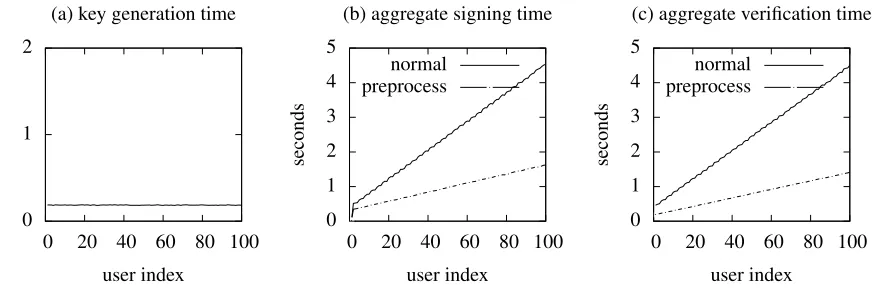
0 20 40 60 80 100
seconds
user index (a) key generation time
0 1 2 3 4 5
0 20 40 60 80 100
seconds
user index (b) aggregate signing time
0 1 2 3 4 5
0 20 40 60 80 100
seconds
user index
(c) aggregate verification time
normal preprocess
normal preprocess
Figure 1: Performance of our SAS scheme
5
Implementation
In this section, we report on the implementation of our SAS scheme and analysis of its performance. Then, we propose a method to improve the performance of our scheme in a typical applications scenario.
We used the Pairing Based Cryptography (PBC) library of Ben Lynn [23] to implement our SAS scheme. According to the NIST recommendations for the 80-bit security [26], the key size of elliptic curve systems should be at least 160 bits and the key size of discrete logarithm systems should be at least 1024 bits. For 80-bit security, we, therefore, selected the Miyaji-Nakabayashi-Takano (MNT) curve with embedding degree 6 since this embedding degree is close to the optimal value, i.e., 1024/160=6.4 for this level of security. In the MNT curve with embedding degree 6, the group size ofG should be at least 171 bits and the group size ofGT should be at least 1024 bits since the security of theGT group is related to the security of the discrete logarithm [13]. Therefore, we used a 175-bit MNT curve that is generated by the MNT parameter generation program in the PBC library.
5.1 Signature and Public Key Size
We compare the signature size and the public key size of Lu et al.’s SAS scheme (the earlier scheme with non relaxed-model proof, based on a static assumption and standard model) with our SAS scheme. The original SAS scheme of Lu et al. is described using symmetric bilinear groups, but it can also be described using asymmetric bilinear groups. In the 175-bit MNT curve with point compression, the group size ofGis about 175 bits, the group size of ˆGis about 525 bits, and the group size ofGT is 1050 bits respectively.