Panoramic Image Formation Using Corner
Detection On Image Grids
Amar Nath Shukla1 Imran Ullah Khan2 Manshi Shukla3 Research Scholar, Assistant Professor, Assistant Professor, Electronics & Communication Engineering Electronics&Communication Engineering Computer Science & Engineering Maharana Pratap Engineering College, Integral University, RIMT-IET,
Kanpur, Uttar Pradesh Lucknow, Uttar Pradesh Mandi Gobindgarh, Punjab
Abstract— Today, creating panoramic images becomes important task for many scientific research, business decisions and entertainment applications. The goal of this paper is to implement the approach to create full view of mosaics from colour image sequences through corner detection. The complete methodology is divided into various phases: a) Contrast Adjustment and Noise Reduction, b) Grid Formation, c) Registration of image grids, d) Selection of Control Points (Corners), e) Stitching. The methodology of panoramic image creation can be applied on noisy and low contrast image grids. The process starts with 2-grids that can be extended as per the requirements of the images. The registration is done among geo-referenced grids of the images. The stitching is performed among the corners in the grids. These corners are the control points of the mosaiced image. At the end, panoramic image is received which can be used for further analysis. The mosaiced image is free from geometric de-formation.
Keywords— panoramic image, image mosaicing, image registration, contrast adjustment, noise reduction.
I. INTRODUCTION
The aim of computer vision is to understand and interpret the information represented by the images. Information from many images can be combined into one image to aid for better understanding of what they represent. Image mosaicing is a technique which enables to combine together many small images into a one large image, from which more information can be collected easily. A mosaic is an assemblage of two or more overlapping images (tiles) used to create a continuous representation of a predefined area. For image mosaicing Geo-referenced images are used to construct the mosaic and software is used to automatically place each image in its correct position. There are many application area where image mosaicing is used . Some of them are: Tele-reality application, Robotics, Medical Applications, Satellite Imaging, geological and archaeological surveys, ecology studies, environmental damage assessment and detection of temporal changes in system, GIS. The features required in an image mosaicing are accuracy in joining the image, the ability to adjust colors, the simplicity of usage, and flexibility in its application.
The steps in image mosaicing are:
Image Registration
Feature Extraction
Homography Compution
Image Wrapping
Image Blending
The main problem of image mosaicing is a combination of following problems:
Geometric deformations
Image registration
Seams in image mosaics
A. Geometric Deformation
Geometric deformation determines the transformations that align images to be combined into a mosaic. This may be Euclidean (Rigid body) transformation, a similarity transformation, affine or, in the most general case, projective transformation.
B. Image Registration
Image registration or image alignment is a fundamental task in image processing to overlay two or more images used. Registration methods can be loosely divided into following classes:
algorithms that use image pixel values directly i.e., correlation method.
algorithms that use frequency domain method i.e., Fast Fourier transform based methods (FFT)
algorithms that use low level feature such as edges and corners i.e., feature based method.
algorithms that use high level features such as identified (parts of) object or a relation between features i.e., graph theoretic methods.
C. Seams in image mosaic
This is very critical for any image mosaicing technique. Image mosaicing involves a combination of images which have overlapping regions. The cut and paste process involves selecting this region in mosaics. There are two ways to determine this region.
Using colour/gray scale information from all constituent images for the region of overlap (median, average, etc.)
Selecting a region from one of images.
Method (i) requires accurate alignment over the entire image area, otherwise resulting mosaic will be blurred. The method (ii) requires alignment only along the seams. This is more useful in cases where camera motion, scene geometry and imaging condition are challenging.
II. PROBLEM IDENTIFICATION
Many image mosaicing Techniques are designed and implemented to generate a panoramic image. Each technique is developed to deal with following problems arises during image mosaicing:
Global Homogrpahy: Global configuration
involves calculation of the transform (homography), which aligns two images.
Image Perception: Image perception level is also
considered as it can affect the analysis process.
Local Homography: Even after good global
configuration, some pixel might not align in the two images. This might cause ghosting or blur in the blended image.
Image Selection: Automatic selection of images to
blend from a given set of images.
Image blending: After one of the images has been
transformed using the homography calculated above a decision needs to be made about the color to be assigned to the overlapping regions. Blending also becomes important when there exists a moving object in the images taken.
Auto exposure compensation: Most cameras have
an automatic exposure control. The images taken can therefore be of variable brightness in the overlapping region which might cause the mosaic to look unrealistic.
Seamlines: When images are mosaiced, a seam
line can be seen. This can reduce the accuracy of the algorithm.
Simplicity: The algorithm should be simple to
understand and to implement.
III. PROBLEM FORMULATION
In this paper, the researcher identified the problems associated with the image mosaicing technique. On the basis of these problems the researcher formulated the problem for the research as follows:
“The algorithm should be designed that can generate mosaiced image from multiple geo-referenced images with the capabilities of being simple, free from seams and good perception level.”
IV. METHODOLOGY
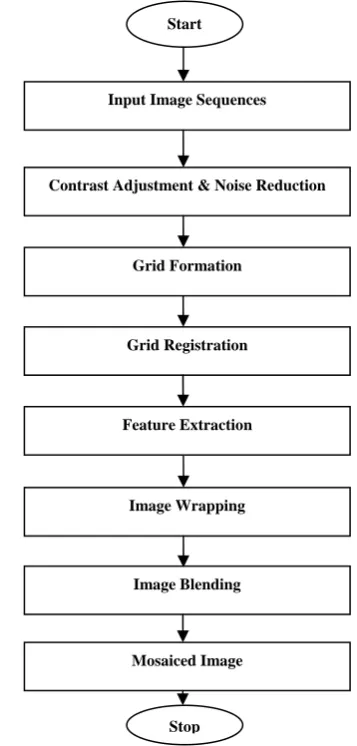
Fig. 1, in this paper represents the proposed methodology to find mosaiced image, which has following steps:
A. Input Image Sequence
Two color image sequences are input to the system. Each image is of .JPEG or .JPG format. These images can be degraded by the environmental effects or of low contrast. These image sequences are geo-referenced in nature.
B. Contrast Adjustment & Noise Reduction
Due to environmental effects noise is added to the image which degrades the quality and perception level of the image ,i.e. the image requires the noise reduction techniques. In the thesis, Gaussian filter is used to filter the noise. Image can also be of low contrast , so this
type of image is processed by histogram equalization technique which is simple and effective.
C. Grid Formation
After making images degradation free, these images will be divided into grids. The number of grids depends on the application and two image sequences. The both images are divided into atleast 2 grids.
D. Grid Registration
Now, the grids of these 2 images are registered using geometric transformations.
E. Feature Extraction
Inthis step, the feature is extracted in the grids, which wraps the images. Here, Harris corner detection process is implemented. This detection process is simple and can be implemented on the images easily. The corners are the very basic feature of any image.
F. Image Wrapping
Now the grids are wrapped according to the features extracted.
G. Image Blending
At last the all grids are blended in order to avoid seams in the mosaiced image. Two types of blending techniques are implemented and compared.
Figure 1. Flow Chart of Proposed Methodology
Start
Contrast Adjustment & Noise Reduction
Grid Formation
Grid Registration
Image Wrapping Input Image Sequences
Feature Extraction
Image Blending
Mosaiced Image
V. EXAMPLE
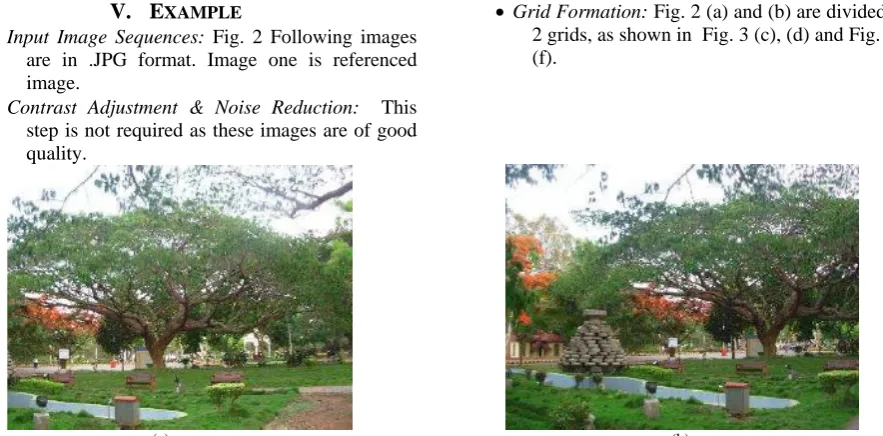
Input Image Sequences: Fig. 2 Following images
are in .JPG format. Image one is referenced image.
Contrast Adjustment & Noise Reduction: This
step is not required as these images are of good quality.
Grid Formation: Fig. 2 (a) and (b) are divided into 2 grids, as shown in Fig. 3 (c), (d) and Fig. 4 (e), (f).
(a) (b) Figure 2. A Park Images to be mosaiced, (a) First Image, (b) Second Image
(c) (d) Figure 3. Grids of the first image of Fig. 4.2 (a), (c) Left Grid, (d) Right Grid
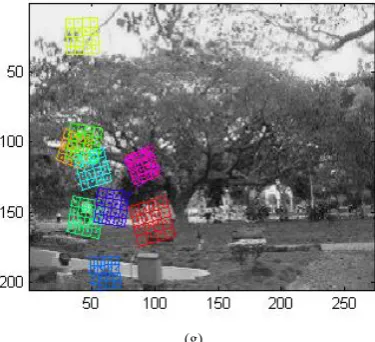
Grid Registration and Feature Extraction: This can be performed on the basis of Fig. 3 (c), (d) and Fig. 4 (e), (f). The Fig. 7 shows the 10 features those are extracted from the images.
Image Wrapping and Blending: The following
figure shows the result of these steps, see Fig. 5 and Fig. 6.
Figure 5. The Mosaiced Image of a Park
Figure 6. The Cylindrically Mosaiced Image of a Park
(g)
(h)
Figure 7. The features Extracted from Images in Fig. 2, (g) from First Image, (h) from Second Image
VI. CONCLUSION
The paper proposed a methodology, in order to achieve the desired objectives and to find the solution of problems associated with an Image Mosaicing Techniques while producing a panorama of mosaiced image. The proposed methodology designed to fulfil main objective to generate mosaiced image from multiple geo-referenced images with the capabilities of being simple, free from seams and good perception level.
The proposed methodology of panoramic image creation can be applied on noisy and low contrast image grids. The process starts with 2-grids formation and followed by the registration, the stitching of the corners in the grids. At the end, panoramic image is received which can be used for further analysis. The researcher compares the results of simple mosaicing and cylindrical mosaicing.The panoramic image is free from abnormalities to give large viewing area images from sequences of images. The mosaicing is done by feature extraction, corner, in the proposed methodology. Image enhancement techniques are used to improve the mosaiced image according to the human perception.
VII. FUTURE WORK
The proposed methodology provides better results, but still has some improvements to be done. The work can be done in order to generate mosaicing results in RGB color format and to improve the performance of cylindrical mosacing.
REFERENCES
[1] Sevket Gumustekin, 1999. An Introduction to Image Mosaicing. [2] Richard Szeliski, 2006. Image Alignment and Stitching: A Tutorial
Foundations and Trends in Computer Graphics and Vision, Vol. 2, No 1, pages 1104 .
[3] Getian Ye, 2005. Image Registration and Super-resolution Mosaicing. Doctoral thesis School of Information Technology and Electrical Engineering, Australian Defence Force Academy University College, The University of New South Wales.
[4] Rafael C. Gonzalez, Richard E. Woods, 2002. Digital Image Processing. Pearson Education, Second Edition.
[6] Lisa Gottesfeld Brown, December 1992. A survey of image registration techniques (abstract), ACM Computing Surveys (CSUR) archive, Volume 24 , Issue 4, Pages: 325 – 376.
[7] Ardeshir Goshtasby,2005. 2-D and 3-D Image Registration for Medical, Remote Sensing, and Industrial Applications, Wiley Press. [8] J. Michael Fitzpatrick,Vanderbilt University, Derek L. G. Hill,
King’s College London and Calvin R. Maurer. Image Registration .Jr. University of Rochester
[9] R. L. Harder and R. N. Desmarais, 1972. Interpolation using surface splines , J. Aircraft, vol. 9, pp. 189–191.
[10] R. Szeliski and H.-Y. Shum,1997. Creating full view panoramic image mosaics and texture-mapped models, Computer Graphics (SIGGRAPH'97), pages 251-258.
[11] J. B. A. Maintz and M. A. Viergever, 1998. A survey of medical image registration, Med. Image Anal., vol. 2, pp. 1–36.
[12] E. Noirfalise, J.T. Lapresté, F. Jurie and M Dhome . Real-time Registration for Image Mosaicing. LASMEA - CNRS UMR 6602, Université Blaise-Pascal, F-63177 Aubière – FRANCE.
[13] Simonson, K., Drescher, S., Tanner, F., 2007. A Statistics Based Approach to Binary Image Registration with Uncertainty Analysis, IEEE Pattern Analysis and Machine Intelligence, Vol. 29, No. 1. [14] Domokos, C., Kato, Z., Francos, J., 2008. Parametric estimation of
affine deformations of binary images, Proceedings of IEEE International Conference on Acoustics, Speech, and Signal Processing.
[15] Jharna Majumdar and Y. Dilip, 2002. Implementation of Image Registration Algorithms for Real-time Target Tracking Through Video Sequences. Defence Science Journal, Vol. 52, No. 3, pp. 227-242.
[16] A.N. Netravali and B.G. Hasskell, 1995. Digital Pictures: Representation, Compression and Standards, 2nd Ed., New York:Plenum Press.
[17] B. Ayazifar and J.S. Lim, 1992. Pel-adaptive model-based interpolation of spatially subsampled images, Proc. Of Intl. Conf. on Acoust. Speech and Signal Processing, Vol. 3653, pp. 181-184. [18] N.B. Karayiannis and A.N. Venetsanopoulos, 1991. Image
Interpolation Based on Variational Principles, Signal Process, Vol. 25, pp. 259-288.
[19] Dan Su, Philip Willis. Image Interpolation by Pixel Level Data-Dependent Triangulation”, Volume xx (200y), Number z, pp. 1–13.
[20] Example for Gaussian blur (low pass filtering) applied to a wood- block print and an etching in order to remove details for picture comparison.
[21] Shapiro, L. G. & Stockman, G. C, 2001. Computer Vision, page 137, 150, Prentence Hall.
[22] Mark S. Nixon and Alberto S. Aguado, 2008. Feature Extraction and Image Processing, Academic Press, p. 88.
[23] Erik Reinhard, 2006. High dynamic range imaging: Acquisition, Display, and Image-Based Lighting, Morgan Kaufmann, pp. 233–234.
[24] Fisher, Perkins, Walker & Wolfart ,2003. Spatial Filters - Laplacian of Gaussian.
[25] S. M. Smith and J. M. Brady, SUSAN, 1997. a new approach to low-level image processing, in International Journal of Computer Vision, 23(1):45-78.
[26] C. A. Glasbey and K. V. Mardia,1998. A review of image-warping methods, Journal of Applied Statistics, 25(2):155–172.
[27] Mikkel B. Stegmann, 2001. Image Warping, Informatics and Mathematical Modelling.
[28] Richa Shukla, Rohit Raja, 2013. Grid Based Multiple Features Based On Image Mosaicing, IJARCET, Volume 2, Issue 2, p. no. 424-427.
[29] Hemlata Joshi, Mr.KhomLal Sinha, 2013. A Survey on Image Mosaicing Techniques, IJARCET, Volume 2, Issue 2, p. no. 365-369. [30] Dilipsinh Bheda,Mahasweta Joshi, Vikram Agrawal, 2014. A Study on Features Extraction Techniques for Image Mosaicing, IJIRCCE, Vol. 2, Issue 3, pp. 3432-3437.
[31] Udhav Bhosle, Subhasis Chaudhuri, Sumantra Dutta Roy. A Fast Method for Image Mosaicing using Geometric Hashing, Department of Electrical Engineering, IIT Bombay, {udhav,sc,sumantra}@ee.iitb.ac.in
[32] Shafaf Ibrahim, Noor Elaiza Abdul Khalid, Mazani Manaf, 2011. Image Mosaicing for Evaluation of MRI Brain Tissue Abnormalities Segmentation Study. INTERNATIONAL JOURNAL OF BIOLOGY AND BIOMEDICAL ENGINEERING, Issue 4, Volume 5, pp. 181-189.
[33] WANG Yue, WU Yun-dong, WANG Hui. Free Image Registration and Mosaicing based on TIN and improved Szeliski Algorithm. [Retrieved on 03-07-2014].
[34] Richard Szeliski, 1994. Image Mosaicing for Tele-Reality Applications. Digital Equipment Corporation, Cambridge Research Lab. CRL 94/2.
[35] Armagan Elibol, Nuno Gracias, Rafael Garcia, Art Gleason, Brooke Gintert. Efficient autonomous image mosaicing with applications to coral reef monitoring. [Retrieved on 03-07-2014]. [36] H. Sawhney, S. Hsu, and R. Kumar, 1998. Robust video mosaicing
through topology inference and local to global alignment, European Conference on Computer Vision, vol. II, Freiburg, Germany, pp. 103–119.
[37] R. Kumar, H. Sawhney, S. Samarasekera, S. Hsu, H. Tao, Y. Guo, K. Hanna, A. Pope, R. Wildes, D. Hirvonen, M. Hansen, and P. Burt, 2001.Aerial video surveillance and exploitation, Proceedings of the IEEE, vol. 89, no. 10, pp. 1518–1539.
[38] Z. Zhu, E. Riseman, A. Hanson, and H. Schultz, 2005. An efficient method for geo-referenced video mosaicing for environmental monitoring, Machine Vision and Applications, vol. 16, no. 4, pp. 203–216.
[39] R. M. Eustice, H. Singh, J. J. Leonard, and M. R. Walter, 2006. Visually mapping the RMS titanic: Conservative covariance estimates for SLAM information filters, International Journal of Robotics Research, vol. 25, no. 12, pp. 1223–1242.
[40] D. Lirman, N. Gracias, B. Gintert, A. Gleason, R. P. Reid, S. Negahdaripour, and P. Kramer, 2007. Development and application of a video–mosaic survey technology to document the status of coral reef communities, Environmental Monitoring and Assessment, vol. 159, pp. 59–73.
[41] O. Pizarro and H. Singh, 2003. Toward large-area mosaicing for underwater scientific applications, IEEE Journal of Oceanic Engineering, vol. 28, no. 4, pp. 651–672.
[42] A. Gleason, D. Lirman, D. Williams, N. Gracias, B. Gintert, H. Madjidi, R. Reid, G. Boynton, S. Negahdaripour, M. Miller, and P. Kramer, 2007. Documenting hurricane impacts on coral reefs using two–dimensional video–mosaic technology, Marine Ecology, vol. 28, no. 2, pp. 254–258.
[43] D. Lirman, N. Gracias, B. Gintert, A. Gleason, G. Deangelo, M. Dick, E. Martinez, and R. P. Reid, 2010. Damage and recovery assessment of vessel grounding injuries on coral reef habitats using georeferenced landscape video mosaics, Limnology and Oceanography: Methods, vol. 8, pp. 88–97.