Optimization of Routing using Hybrid of Genetic and Hill Climbing
Algorithm for MANET
Swati Arya1and Neeti Kashyap2
1
Computer Science Department, THE NORTHCAP UNIVERSITY, Gurgaon, Haryana, India
2
Computer Science Department, THE NORTHCAP UNIVERSITY, Gurgaon, Haryana, India
Abstract
MANET is a collection of wireless mobile host. Mobile networks have no fixed infrastructure. These networks are widely spread. Generally this property made networks more serviceable in various fields. But at a same time there is no central control over their mobility. Sender and receiver does not have same path between them for routing as nodes are mobile. One of the complicated tasks is routing. Route discovery and route maintenance are recognized with many routing protocols. There are limited resources for wireless nodes. When same data is send parallel to many destination instead of multiple unicast data transmission, multicasting is done. It is difficult to provide QoS in networks. Frequently and unpredictably networks topology may change due to which challenging problem arise in multicast routing. In this paper we focus on hybrid of hill climbing and genetic algorithm for multi constrained multicast routing method. In this proposal we try to optimize the routes with various QoS parameters like delay, total residual battery energy, packet delivery ratio and throughput by selecting proper fitness function.
Keywords: MANET, Multicast Routing, QoS
1. Introduction
MANET has no fixed infrastructure and mobile nodes communicate with each other through wireless links. In transmission range when mobile hosts moves in and out then it form or destroy wireless links. In two communication nodes intermediate mobile hosts behaves as router. Due to this mobile hosts can be used as routers or hosts. Hosts can moves freely and randomly when they are mobile. When mobile hosts are added and deleted it affects the routing paths creation. Due to which frequently and unpredictably networks topology change. This cause difficulty in routing for unicast and multicast as topology changes dynamically. Better paths can be best known from quality of service like packet loss delivery, delay, throughput and jitter. Route information is exchanged with the help of routing protocols. Security, QoS, control overhead, robustness and efficiency in multicast routing are the main issues. In computer networks data is transmitted from source to the part of destination node in multicast routing. It sends same data to multiple recipients
and communication cost is reduced. Channel bandwidth is reduced in case of multicast then that of multiple unicast. In QoS there are many restrictions due to which routing under QoS is complicated. Resource utilization is considered more in most of the QoS routing algorithms. As topology changes frequently and there are many restrictions it leads to difficulty in QoS routing. In large networks it is not possible to have up to date information. Different QoS are required in different applications like delay and bandwidth are important factor in multimedia applications. Unicast and multicast routing are routing problems. It is difficult to provide QoS [1] in networks. It is difficult to find optimal routes in multicast routing and to provide QoS in routing. Utilization of network is maximized and for data traffic it help to provide QoS guarantee which is a challenging task due to which for determining multicast routes there is a need for efficient multicast routing protocols.
There are many heuristic methods that help to find optimal routes which are different from non linear programming NNs [2], Fuzzy logic [3], Ant Algorithm [4], Genetic algorithm [5,6].In this paper we propose a hybrid of hill climbing and genetic algorithm for multi constrained multicast routing method. In this proposal we try to optimize the routes with various QoS parameters like delay, total residual battery energy, packet delivery ratio and throughput by selecting proper fitness function. For optimization we used genetic operator in genetic algorithm. To improve the performance of routing we select suitable values for population size, mutation probability and crossover probability. The main motive of this proposal it to provide optimal solution and for routing path getting the robustness.
2. Problem Formulation
multiplicative and additive. Applications and networks are more accurately modeled by multiple metrics. It is difficult to find path between multiple metrics and it is NP complete [7] problem. This factor is important in many applications particularly for delay sensitive applications. Properties that define the complete path for the value of metric are minimal property, multiplicative and additive. Example of minimal property is battery energy and bandwidth. Minimal property helps to find minimum available battery energy and bandwidth from nodes and links on path. Minmetric=minj { metricj} is the mathematical representation where j is node of metric. Example of multiplicative property is packet delivery rate and is represented as Mulmetric=∏ (j Mulmetricj). Example of additive property is hop number and path delay and is represented as Totalmetric =Σ (j metricj). G is an undirected graph which defines set of edges and set of vertices such as E is group of edges and V is collection of vertices. (x,y) denotes connecting nodes where x,y ϵ V and an edge e ϵ E. r is the root of tree T and r ϵ V. Multicast routing defines constraints to make feasible tree they are residual power bound (R), bandwidth (B), delay variation bound(D) and path delay bound (P). R is min{ R (k) }>R, ∀ k ϵ E for any node k. B is {B (e) }>B, ∀ e ϵ E on each link of multicast tree is the minimum bandwidth. P is Σe ϵ p(r,v) P(e) < P, ∀ e ϵ E from source and destination gives accepted end to end delay. D is time window in multicast group for different members Σe ϵ p(r,v) P(e) - Σe ϵ p(r,x) P(e) ≤ D, ∀ e ϵ E.
3. Network Model and Encoding
3.1 Flooding Limited Mechanism
Let G = (V,E ) be a weighted graph in which V is mobile host which are a set of vertices whereas E is communication links that connects the mobile hosts which are a set of edges. Limited flooding mechanism is used for route establishment. It includes three parameters that must be limited that are residual battery powermin, bandwidthmin and jittermax. These constraints are defined as
powermin =min {power (n)} bandwidthmin = min{bandwidth(e)}
jittermax =max{jitter(e)}
where n is any mobile host that belongs to set of vertices and e is any link that belongs to set of edges.
Let P is the minimum power constraint, B is the minimum bandwidth constraints and J is the maximum jitter constraints that must be limited by QoS constraints P, B, J. Some QoS constraints must be satisfied by QoS based routing problem.
Suitable routing path is known by broadcasting QRREQ packet using flooding limited mechanism. Join discovery is activated by sender host that sends data to number of receiver host. Sender host sends QRREQ packets to all its neighboring nodes, when they receive these packets they check the power, bandwidth and jitter for resemble with QoS constraints (P, B, J). Set of routes are explored when the request packet is accepted and it will add routes in routing table and request is rebroadcasted to next hop. If the route is not received within time period then these entries are deleted. Time period is define as
delaymax = max Σdelay(e)
where delay(e) is time from sender to receiver host. It will give value of delay constraints. Delay max is limited by QoS constraints which gives path from sender to receiver host. Limited flooding [8-10] helps in route establishment. In source neighborhood list it can be possible that destination is not present in it while discovering routes then route request packets are broadcasted by source. At each host admission decision is made for join request packet receiving. In route entry cache accepted routes are added and request is rebroadcast to next hop. If some replies didn’t come in time then these replies are ignored and are deleted from route entry table.
Flooding mechanism is based on two conditions that are on QoS constraints depends on request packets and replay packets. In case of request packet it depends on power, bandwidth and jitter whereas for replay packet it is based on delay factor. In route discovery QRREQ packets are broadcasted to neighboring host and all the QoS constraints are checked and satisfied.
Route is generated and all the set constraints are meets with the help of flooding limited mechanism as it increases the chance for generation of routes. For connecting it uses the available detailed information in multicast routing. To code multicast tree and for delivering a packet and is done with sequence and topology encoding method. It is done when multicast tree is computed. In this case like any other source routing algorithm, it transmits packet to multicast group from multicast source.
3.2 Sequence and topology encoding
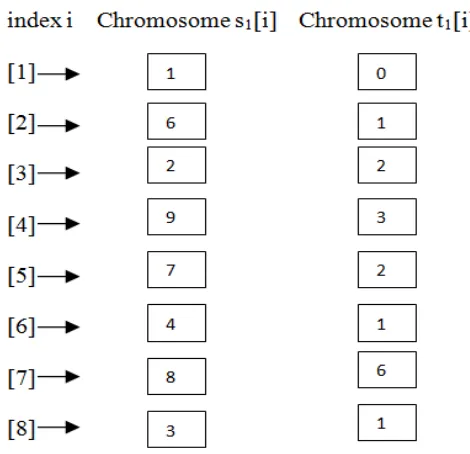
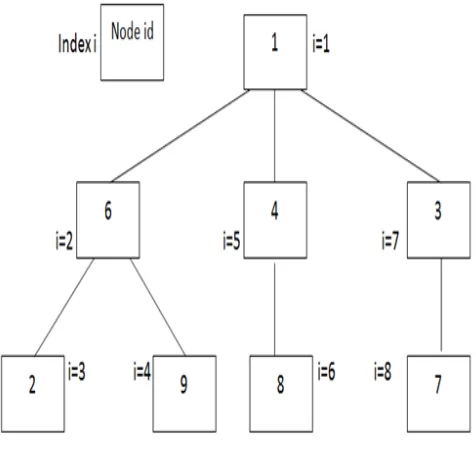
crossover and mutation is applied. Best individual is picked for mating by using various selection criteria. Multicast tree [13] is converted to sequence and topology encoding by using two strings s and t. Topology encoding is represented by string t. The nodes in the tree for sequence encoding are represented by string s. Position must be indexed on multicast tree with contains n number of nodes with s and t string. Depth first search algorithm is applied to search orders of nodes.
Fig. 1(a) Multicast Tree T1
Let s[1,n], t[1,n] be two arrays and position index is represented by i. First element of string s acts as root of multicast tree. In this s[i] represents host at position index i and t[i] represents predecessor of host s[i] and gives position index and in string t the father of node i is placed in position index. Value of t[1] set as 0 because there is no predecessor for the root host. Figure 1 and 2 shows sequence and topology codes. Let string s1={1, 6, 2, 9, 7, 4, 8, 3} , string s2={1, 6, 2, 9, 4, 8, 3, 7}and t1={0, 1, 2, 3, 2, 1, 6,1} and t2={0, 1, 2, 2, 1, 5, 1, 7}. Topology encoding of the tree is used by t1 and t2. String s1 and s2 are used to select interior nodes as shown in string t1 and t2.
3.3 Fitness Function
The major drawback of existing algorithm is that in this fitness value is calculated using fitness function in multiplicative form but it only consists of penalty function, residual battery energy and end-to-end delay. So there is a need to implement a system that satisfies more QoS [14] constraints to make the route more stable and feasible. In new approach path loss and throughput are included too in the fitness function. It defines that path loss of individual
value is less than parent node. Path loss is defined as total time taken to the data loss.
fitpl=net_time/data_loss.
Data_loss is minimized so it is 1/data_loss. Data loss is the loss of data during transmission so it must be minimum. Throughput is defined as how much data is transmitted and power lost during received
fitt=rx_pw/2. So fitness function in new approach is as
fitT=fitp*fitd*fitr*fitpl*fitt
where fitp is penalty function, fitd is end to end delay and fitr is repair function. These functions are defined in Yen, Yun-Sheng, et al.[15].
Fig. 1(b) Sequence and topology encoding
In this approach we are trying to maximize the fitness value so that along with maximization of residual power and minimization of delay [16] we try to minimize the path loss and throughput. The selection of routes depends upon fitness value. Higher the value of fitness function more is the chance of selection of that route. So with the help of this new proposed fitness function packets are transmitted from source to destination by maximizing lifetime and minimizing path loss, throughput and delay.
4. Genetic and Hill Climbing Algorithm
4.1 Elitist Selection
climbing algorithm is used. Hill climbing algorithm is less random and more systematic. In this approach selection of parents for first generation is done with the help of hill climbing. The best chromosome is one with the highest fitness value. For next generation other two parents are one from hill climbing and other parent is from fitness function. High value from fitness function gives the next parent.
Fig. 2(a) Multicast Tree T2
Fig. 2(b) Extended sequence and topology encoding
In this H represents parent from hill climbing algorithm. F1, F2, F3 and more represents the highest fitness value in generations and high fitness value chromosome is selected as parent for next generation this repeats as same for next generations. Chromosome of parent t2 is the best of the generations. Then crossover and mutation is done on parent chromosome.
Fig. 3 Selection of Parent Chromosome
4.2 Crossover and Mutation Operation
Tree encoding topology is used to avoid the loops. The degree of nodes is reduced after the mutation operation. Multicast tree [20] is represented by string s and string t. not only memory is saved using extended sequence and topology encoding but also decoding operations are cut down. In case of genetic operations this proposed encoding technique is easy.
5. Simulation Results
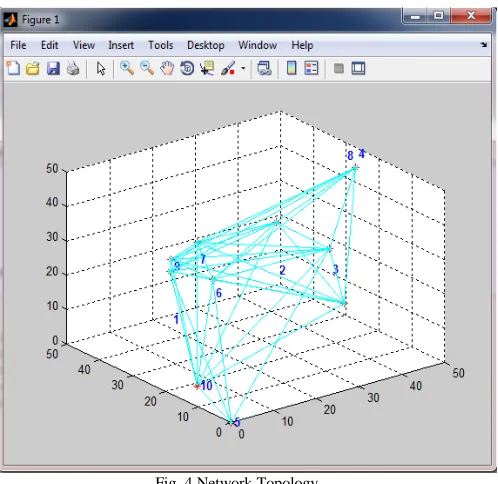
Simulation is done on MATLAB 8.1 in ad hoc networks to simulate QoS multicast routing. Generation is set as 100. Other parameters are Pm=0.05 is mutation probability, Pc=0.8 is crossover probability, and population size is set to 30. Simulation rectangle area is 50m by 50m by 50m. Figure 4 represents the 50m by 50m by 50m simulation rectangular region. Over the network source and destination pairs are randomly spread. In this network 10 mobile nodes are represented and how they are connected with each other is shown. It represents connection of mobile nodes with each other in a region.
Fig. 4 Network Topology
In figure 5 the connection of mobile nodes is represented but these nodes are connected with each other without forming any cycle in the network. This is done by applying minimum spanning tree algorithm on mobile nodes. It represents tree like structure and how nodes are connected with each other by removing cycle and making this network more useable.
Fig. 5 Mobile Nodes without cycles
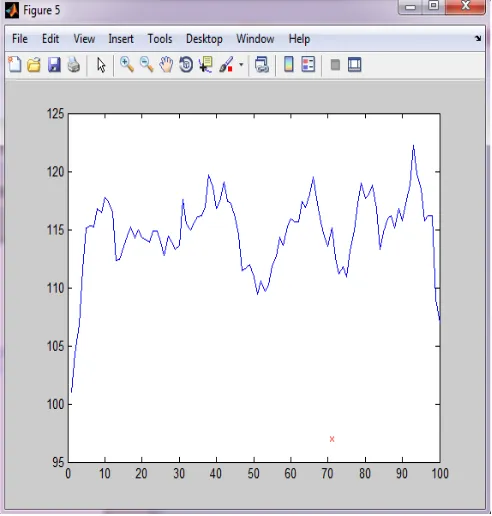
Figure 6 gives relation between fitness vs generation. In 100 generation it represents the fitness values. In every generation circle represents the best fitness value in each generation. Higher the fitness value higher is the chance to select the path. Red circle represents maximum fitness value.
Figure 7 represents the same that is result of fitness in various generations but this representation is on logarithmical scale. Cross represents the fitness values in different generations.
Fig. 6 Fitness value vs Generation (x scale:linear)
Fig. 7 Fitness value vs Generation (x scale:log)
Fig.8 Path Loss Vs Generations
6. Conclusion
In this paper we focus on hybrid of hill climbing and genetic algorithm for multi constrained multicast routing
method. Selection of undesirable links and nodes along with search space is reduced by using flooding limited mechanism. Coding and decoding process is simplified by providing coding scheme that is tree based using sequence and topology encoding method. In this node with the lower energy is replaced with the higher energy from leaf node during a chromosome mutation process.
A Two point crossover is used in two parental chromosomes for mixing genes which cause less interruption in recombination of operators. Fitness function is proposed and the values of fitness functions help in selection of routes by maximizing the higher residual battery and minimizing the delay time. New approach is based on path loss and throughput along with lifetime and delay for selecting the best route from source to destination by using new fitness and decrease the randomization and making the system more systematic.
References
[1] Seema, Y. Singh, and V. Siwach. "Quality of Service in MANET." International Journal of Innovations in Engneering and Technology (IJIET) 1.3 (2012).
[2] B.P.V. Kumar, P. Venkataram, Reliable multicast routing in mobile n networks: a neural-network approach, IEE Proceedings-Communications 150 (5)(2003) 377–384.
[3] C.G. Yue, Y.W. Jing, Uncertain parameters for multicast routing based on a fuzzy number genetic algorithm, in: Sixth International Conference on Intelligent Systems Design and Applications (ISDA’06), vol. 1, October 2006, pp. 903–907.
[4] Y.P. Liu, M.G. Wu, J.X. Qian, The distributed multicast routing scheme with delay constraint using ant colony optimization, in: The Sixth World Congress on Intelligent Control and Automation (WCICA 2006), vol. 1, June 2006, pp. 3062–3066.
[5] M.S. Zahrani, M.J. Loomes, J.A. Malcolm, et al., Genetic local search for multicast routing with pre-processing by logarithmic simulated annealing,Computers and Operations Research 35 (6) (2008) 2049–2070.
[6] A.T. Haghighat, K. Faez, M. Dehghan, GA-Based heuristic algorithms for QoS based multicast routing, in: Knowledge-based Systems, vol. 16, 2003,pp. 305–312.
[7] Asraf, Noor M., Raja N. Ainon, and Phang Keat Keong. "QoS parameter optimization using multi-objective genetic algorithm in MANETs." Mathematical/Analytical Modelling and Computer Simulation (AMS), 2010 Fourth Asia International Conference on. IEEE, 2010.
[8] Y.-S. Yen, H.-C. Chang, R.-S. Chang, H.-C. Chao, Routing with adaptive path and limited flooding for Mobile ad hoc networks, in: International Symposium on Wireless Pervasive Computing (ISWPC’06), January 2006.
[9] S.-Y. Tseng, Y.-M. Huang, C.-C. Lin, Genetic algorithm for delay and degree-constrained multimedia broadcasting on overlay networks, Computer Communications 29 (17) (2006) 3625–3632. [10] Y.M. Huang, T.C. Chiang, A sequence and topology encoding for
multicast protocol (STMP) in wireless ad hoc networks, in: Proceedings of the Fourth International Conference on Parallel and Distributed Computing, Applications and Technologies, 2003, pp. 351–355.
mobile ad hoc networks, Journal of Internet Technology 7 (2) (2006) 131–137.
[12] S.-Y Tseng, Y.-M. Huang, C.-C. Lin, ST encoding: an efficient scheme for encoding trees in genetic algorithms, Journal of Internet Technology 6 (1)(2007).
[13] Chen, Shigang, KlaraNahrstedt, and Yuval Shavitt. "A QoS-aware multicast routing protocol." Selected Areas in Communications, IEEE Journal on 18.12 (2000): 2580-2592.
[14] Wu, Kui, and Janelle Harms. "QoS support in mobile ad hoc networks."Crossing Boundaries-the GSA Journal of University of Alberta 1.1 (2001): 92-106.
[15] Yen, Yun-Sheng, et al. "Flooding-limited and multi-constrained QoS multicast routing based on the genetic algorithm for MANETs." Mathematical and Computer Modelling 53.11 (2011): 2238-2250.
[16] Tseng, Sheng-Yuan, Yueh-Min Huang, and Chang-Chun Lin. "Genetic algorithm for delay-and degree-constrained multimedia broadcasting on overlay networks." Computer Communications
29.17 (2006): 3625-3632
[17] S.-Y Tseng, Y.-M. Huang, C.-C. Lin, ST encoding: an efficient scheme for encoding trees in genetic algorithms, Journal of Internet Technology 6 (2007).
[18] A.T. Haghighat, K. Faez, M. Dehghan, GA-Based heuristic algorithms for QoS based multicast routing, in: Knowledge-based Systems, vol. 16, 2003,pp. 305–312.
[19] Barolli, Leonard, Akio Koyama, and Norio Shiratori. "A QoS routing method for ad-hoc networks based on genetic algorithm."
Database and Expert Systems Applications, 2003. Proceedings. 14th International Workshop on. IEEE, 2003
.
[20] B. Sun, H. Jiang, S. Cheng, Y. He, Multicasting along energy-efficient meshes in mobile ad hoc networks, in: Proceedings of IEEE Wireless Communications and Networking Conference, vol. 2, 2002, pp. 807–811.
First Author I completed my bachelor’s in Computer Science and
Engineering from Kurukshetra University in 2014. Presently I am pursuing M.Tech from The NorthCap University, Gurgaon. My research interest is in networking.
Second Author I completed my MTech and BTech from GGS