Exploiting Scope for Shallow Discourse Parsing
Rashmi Prasad
∗, Aravind Joshi
∗, Bonnie Webber
†∗University of Pennsylvania
Philadelphia, PA, USA
rjprasad,[email protected]
†University of Edinburgh
Edinburgh, Scotland [email protected]
Abstract
We present an approach to automatically identifying the arguments of discourse connectives based on data from the Penn Discourse Treebank. Of the two arguments of connectives, called Arg1 and Arg2, we focus on Arg1, which has proven more challenging to identify. Our approach employs a sentence-based representation of arguments, and distinguishes intra-sentential connectives, which take both their arguments in the same sentence, from inter-sentential connectives, whose arguments are found in different sentences. The latter are further distinguished by paragraph position into ParaInit connectives, which appear in a paragraph-initial sentence, and
ParaNonInit connectives, which appear elsewhere. The paper focusses on predicting Arg1 of Inter-sentential ParaNonInit connectives,
presenting a set of scope-based filters that reduce the search space for Arg1 from all the previous sentences in the paragraph to a subset of them. For cases where these filters do not uniquely identify Arg1, coreference-based heuristics are employed. Our analysis shows an absolute 3% performance improvement over the high baseline of 83.3% for identifying Arg1 of Inter-sentential ParaNonInit connectives.
1.
Introduction
Recent work on discourse parsing based on the discourse-level annotations of the Penn Discourse Treebank (Prasad et al., 2008) has addressed the problem of identifying the two arguments of explicit discourse connectives (Dinesh et al., 2005; Wellner and Pustejovsky, 2007; Elwell and Baldridge, 2008; Wellner, 2009). This “shallow” discourse parsing resembles chunking at the sentence level, since it does not concern itself with building the structure of the entire text, as is the case with many prior discourse parsing methods developed within different frameworks (Marcu, 1997; Forbes et al., 2003; Polanyi et al., 2004; Baldridge et al., 2007). Explicit discourse connectives in the Penn Discourse Treebank (PDTB)1 are expressions from well-defined syntactic classes that denote discourse relations (e.g., cause, contrast, elaboration) between two abstract object arguments, such as events, states, and propositions.2 Ex. (1) and Ex. (2) show two annotation tokens for the con-trastive connective but. (The two arguments of the connec-tive are called Arg1 and Arg2 in the PDTB. Arg2 is the argument syntactically associated with the connective and shown in bold in the examples here. Arg1 is simply the other argument, shown in italics in the examples. Connec-tives are underlined.)
(1) Despite all these innovations, most of the diamonds are still found in the sand swept away by the men wielding shovels and brushes – the ignominiously named “bedrock sweepers” who toil in the wake of the excavators.
La-1
http://www.seas.upenn.edu/˜pdtb. The PDTB corpus is available from the Linguistic Data Consortium, catalog entry LDC2008T05.
2The PDTB also annotates implicit discourse relations as well
as relations expressed with non-connective expressions (called Al-ternative Lexicalizations (AltLex)). These relation types are not within the scope of this paper.
boring in blue and gray overalls, they are supposed to concentrate on cleaning out crevices, and not strain their eyes looking for diamonds. But should they spy one, the
company will pay a bonus equal to one-third its value.
[wsj 1121]
(2) I’m not suggesting that the producers start putting to-gether episodes about topics like the Catholic-Jewish dis-pute over the Carmelite convent at Auschwitz. That issue,
like racial tensions in New York City, will have to cool down, not heat up, before it can simmer. But I am
sug-gesting that they stop requiring Mr. Mason to inter-rupt his classic shtik with some line about ”caring for other people” that would sound shmaltzy on the lips of Miss America. [wsj 2369]
For the discourse parsing task, identification of Arg2 is rel-atively trivial in that it is syntactically associated with the connective. However, as Ex. (1) and Ex. (2) show, Arg1 may or may not be adjacent to the connective, thus making the task challenging. This difference in difficulty is attested by all prior attempts at identifying the arguments of con-nectives. In this paper, we take Arg2 of connectives to be easily identifiable, and focus on the task of identifying the Arg1 argument.
and further, whether the connective and its Arg1 are col-located in the same paragraph or not. Our motivation for such a classification rests in the idea that discourse rela-tions are structured differently as one progresses from the sentence to the paragraph, which is a coherent grouping of sentences, and then from the paragraph to the entire text, which is a coherent grouping of paragraphs. Third, using our approach, we focus on identifying one category of con-nectives in our classification and present an algorithm for identifying their Arg1 argument. The algorithm involves a filter-rank-evaluate method that combines the applica-tion of scope-based heuristics for filtering potential candi-date arguments, followed by coreference-based heuristics for ranking and evaluating the remaining candidates. Our application of the algorithm shows that our approach and method is promising, showing a 3% absolute improvement over the high 83.3% baseline of selecting the immediately previous sentence as Arg1.
2.
The Penn Discourse Treebank: Overview
The PDTB (Prasad et al., 2008; PDTB-Group, 2008) is to date the largest available annotated corpus of discourse relations, with two major distingishing features. First, discourse relations are low-level and annotated indepen-dently of each other, so that no commitments are made to-wards any particular theory of high-level discourse struc-ture. Given that there is little agreement among discourse researchers as to the nature of high-level discourse repre-sentations, this theory-neutrality makes the corpus appeal-ing to a broad audience. In addition, the low-level anno-tations also lend to greater reliability in the annoanno-tations. Second, discourse relations, when explicit, are lexically grounded, thus making several discourse processing tasks more computationally tractable.
Annotated in the PDTB are discourse relations realized explicitly by discourse connectives and alternatively lex-icalized expressions, or implicitly between adjacent sen-tences. Each discourse relation is annotated with a sense label drawn from a hierarchical sense classification. Dis-course relations and their arguments are also annotated for their attribution, to record how they are ascribed - to the writer of the text or some other individual.
In this paper, we will focus on explicit connectives and their arguments, illustrated in Ex. (1) and Ex. (2). Explicit connectives are drawn from three syntactic classes: subor-dinating conjunctions, coorsubor-dinating conjunctions, and dis-course adverbials. Arguments of connectives can appear anywhere in the text, and they can span single clauses, mutliple clauses, or multiple sentences, as well as nomi-nalizations that refer to abstract objects. There are a total of 40600 tokens of discourse relations annotated in PDTB, 18459 (45%) of which are explicit connectives. The dis-tribution of the location of Arg1 of explicit connectives, reported in Prasad et al. (2008), shows that the majority (61%) of explicit connectives have Arg1 in the same sen-tence as the connective, with 30% of Arg1s in the sensen-tence immediately preceding the connective, and 9% of Arg1s in some non-adjacent sentence.
3.
Span and Location of Arguments
Before developing algorithms and models for identifying the arguments of connectives in the PDTB, two important issues arise. The first is due to the fact that arguments don’t necessarily span a single clause or a single sentence. They can also span multiple clauses, multiple sentences, and even noun phrases and verb phrases. Furthermore, ar-guments within sentences can be discontinuous so that they don’t necessarily project a single constituent in the syntax. This wide variation in the syntactic possibilities of argu-ment spans makes the task of their identification quite chal-lenging. Prior work has either tackled the problem of iden-tifying exact argument spans, or circumvented the problem in some way. Dinesh et al. (2005) attempt to identify the exact argument spans of subordinating conjunctions. Since both arguments of this class of connectives are invariably in the same sentence, they develop a tree-subtraction algo-rithm to identify both arguments. They tackle the prob-lem further by examining the sources of errors and suggest-ing improvements to the tree-subtraction heuristics. Well-ner and Pustejovsky (2007), WellWell-ner (2009) and Elwell and Baldridge (2008), on the other hand, attempt to identify the arguments of all classes of connectives using MaxEnt rankers and CRFs, but circumvent the problem of an ex-act argument match by assuming a “head-based” represen-tation of arguments. This allows them to handle the full variation found in the syntax of the arguments.
The second issue is due to the fact that different types of connectives might be subject to different types of con-straints in discourse. Thus, it is useful to separate connec-tives into distinct classes based on the methods being fol-lowed or on the view one adopts of how connectives differ from each other. For example, the tree-subtraction algo-rithm in Dinesh et al. (2005) developed specifically for sub-ordinating conjunctions would not be able to handle coordi-nating conjunctions or discourse adverbials because it op-erates directly on syntactic trees where the argument (syn-tactic) dependencies for the three classes of connectives are quite different. In Elwell and Baldridge (2008), where argu-ments for all connectives are identified, separate models are developed for connectives grouped into their three syntactic classes. Importantly, this kind of classification of connec-tives was shown to improve on the results of Wellner and Pustejovsky (2007), where no such classification was made and a single model was used for all connectives.
Our own approach, which also considers these issues, dif-fers from prior work, as discussed below.
3.1. Sentence-based Representation of Arguments
the sentence was equated with the head of the main clause, but it would also preclude other candidate arguments in the same sentence that would be mostly spurious and un-necessarily complicate (or even bias) the search problem. Secondly, some applications such as extractive summariza-tion extract complete sentences for inclusion in summaries. Thus, it is useful to explore as a first approximation how well a sentence-based representation of arguments would fare in the discourse parsing task.
3.2. Classifying Connectives by Arg1 Location
Like Elwell and Baldridge (2008), we believe that differ-ent connectives are subject to differdiffer-ent constraints. How-ever, we don’t believe that the syntax of connectives fully captures these constraints, specifically for the purpose of identifying their arguments. In particular, connectives from different syntactic classes share properties with respect
to their Arg1 location. For example, the arguments of
both subordinating conjunctions (e.g., because, when) and sentence-medial coordinating conjunctions (e.g., and, but, or) will both be found in the same sentence as the con-nective (and identified through tree-subtraction heuristics (Dinesh et al., 2005)). The same is not true of sentence-initial coordinating conjunctions, whose Arg1s are located in a different sentence. This in fact led Wellner (2009) to treat sentence-initial But as a discourse adverbial, and sentence-medial but as a coordinating conjunction. And fi-nally, Arg1s of discourse adverbials are located mostly in different sentences, but they can also be found in the same sentence as the connective.
We therefore propose that explicit connectives should be classified in terms of their expected sentence collocation with their Arg1s, that is, those that take both their argu-ments in the same sentence (henceforth, intra-sentential connectives), and those whose arguments are found in dif-ferent sentences (henceforth, inter-sentential connectives). This kind of partitioning has also been explored in Web-ber (2009). We note that this classification can be made reliably based partly on their syntactic class (for subordi-nating conjunctions) and partly on their sentential position (for coordinating conjunctions). Since syntactic class and sentential position alone are not reliable for distinguish-ing discourse adverbials, however, we experimented with a simple binary classifier to classify intra-sentential discourse adverbials from inter-sentential ones. We used as features the connective head, connective position and syntactic path from the connective to the root of the sentence. Our pre-liminary results show that the discourse adverbials can be classified for their two types of Arg1 location with high ac-curacy (93%, with an 86% baseline for Arg1 being located in a different sentence).
In addition, we propose that inter-sentential connectives should be further partitioned into two classes based on their paragraph position — those that appear in a paragraph-initial sentence (henceforth, ParaInit connectives) and those that appear elsewhere in the paragraph (henceforth, ParaNonInit connectives). This is because of the suggested role of paragraphs as the high-level “building blocks” of a discourse, with each paragraph defining a particular “local focus” within the overall topic of the text and exhibiting
a coherent organization of the sentences around that focus (Hearst, 1997). Thus, we hypothesize that ParaNonInit con-nectives and their Arg1s would more likely be collocated in the same paragraph, while the Arg1 of a ParaInit connec-tive can only occur in a previous paragraph. This is indeed what we find in the PDTB: 98% (4301/4373) of the Para-NonInit connectives are collocated with their Arg1 in the same paragraph. Ex. (1) and Ex. (2) illustrate such connec-tives.
We also hypothesize that ParaInit connectives would pose a more significant challenge than ParaNonInit connectives, since new paragraphs are often motivated by a new focus that may be linked to some topic or entity mentioned any-where in the prior text. This hypothesis is also confirmed in the PDTB: While 91% (3962/4373) of the time, Arg1 of ParaNonInit connectives is the previous sentence, this is true only 49% (1110/2243) of the time for Arg1 of ParaInit connectives. In addition, although the Arg1 of ParaInit con-nectives is in the immediately preceding paragraph 79% (1767/2243) of the time, it is also not the case that the first sentence of this paragraph is selected more often as Arg1. Looking at the cases where such paragraphs contain more than one sentence (1348/2243), we find that this turns out to be even less frequent, i.e., 36% (166/1348). Ex. (3) il-lustrates a case where the Arg1 of ParaInit In addition is located medially in the previous paragraph.
(3) Countries in the region also are beginning to consider a framework for closer economic and political ties. The
economic and foreign ministers of 12 Asian and Pacific nations will meet in Australia next week to discuss global trade issues as well as regional matters such as transportation and telecommunications. Participants will include the U.S., Australia, Canada, Japan, South Korea and New Zealand as well as the six members of the Association of Southeast Asian Nations – Thailand, Malaysia, Singapore, Indonesia, the Philippines and Brunei.
In addition, the U.S. this year offered its own plan for
cooperation around the Pacific rim in a major speech by Secretary of State James Baker, following up a pro-posal made in January by Australian Prime Minister Bob Hawke. [wsj 0043]
These distributions confirm our hypothesis that the problem of identifying Arg1 of ParaInit connectives is much harder than for ParaNonInit connectives, and confirms the value of partitioning the inter-sentential connectives into ParaInit and ParaNonInit classes. Overall, our approach for classi-fying connectives captures the idea that discourse relations are structured differently as one progresses from the sen-tence to the paragraph, which is a coherent grouping of sentences, and then from the paragraph to the entire text, which is a coherent grouping of paragraphs.
but also contains sentence-initial coordinating conjunctions and rare occurrences of subordinating conjunctions. We ex-plored several heuristics for identifying the Arg1 sentences of these connectives and developed an algorithm based on these heuristics. One heuristic involved the use of corefer-ence chains, for which we used the OntoNotes-2.0 coref-erence annotations (Weischedel et al., 2007),3. The source
corpus for OntoNotes-2.0 partially overlaps the source cor-pus for the PDTB, namely the Wall Street Journal (WSJ) corpus, and it is this overlapping portion (598 WSJ texts) that we used in order to take advantage of the OntoNotes coreference annotation. For the connectives of interest here, the overlapping portion yielded 743 tokens of con-nectives along with their arguments.4
The rest of this section first describes our algorithm, which consists of a component for filtering potential candidate Arg1 sentences (Arg1Ss) and a component for ranking and evaluating the candidate Arg1Ss. We then present the re-sults we obtained from a manual application of the algo-rithm.5
4.1. Filtering Potential Candidate Arg1 Sentences
The problem of identifying the Arg1S of a connective starts with the creation of a set of potential candidate sentences. For any Inter-sentential ParaNonInit connective, this con-sists of all and only the sentences appearing prior to the connective’s sentence within the same paragraph. After this set is created, some candidates are filtered out according to the criteria described below.
4.1.1. Connectives in Opaque Direct Speech Segments
We define direct speech segments (DS segments) as seg-ments containing one or more sentences appearing as quoted speech within quotation marks, with the speaker source, or speech attribution (Prasad et al., 2007), explic-itly specified at most once for all the included sentences. Thus, in Ex. (4), there are two direct speech segments, DS1 and DS2, shown with square brackets and subscripts.6DS2 illustrates a common property of WSJ texts — having di-rect speech sentences distributed across multiple sentences, when all such sentences are enclosed within a single begin-ning and end quotation, and the atttribution, if explicit, is associated with any one of the sentences. In DS2, the attri-bution (“he predicts”) is associated with its final sentence.
3
LDC Catalog Entry LDC2008T04.
4
The actual number of connectives appearing in the overlap-ping portion of PDTB and OntoNotes is actually greater than 743. However, for this paper, we have ignored connectives whose Arg1 spans multiple sentences, as well as the few connectives whose Arg1 sentence was not in the same paragraph as the connective. We have also excluded connectives which appeared in the second sentence of the paragraph, since these would trivially select the immediately previous sentence, i.e., the first sentence of the para-graph, as Arg1.
5
Although we began this work with the goal of automating the algorithm, we faced some challenges in automatically detect-ing direct speech segments, which our algorithm requires (Sec-tion 4.1.1.). We plan to tackle this task again in future work.
6
In all examples henceforth, we show all sentences from the beginning of the paragraph upto the connective’s sentence.
(4) Butch McCarty, who sells oil-field equipment for Davis Tool Co., is also busy. A native of the area, he is back now after riding the oil-field boom to the top, then sur-viving the bust running an Oklahoma City convenience store. [DS1 “First year I came back there wasn’t any work,” he says.]DS1[DS2 “I think it’s on the way back
now. But it won’t be a boom again. No major booms,
no major setbacks,” he predicts.]DS2[wsj 0725]
Because quoted speech in WSJ-style texts can assume quite complex forms, it is necessary to define how to determine the boundaries of DS-segments. One question that arises is whether to treat adjacent segments like DS1 and DS2 in Ex. (4) as a single segment or as two distinct segments. For the task of discourse parsing, we adopted the more re-strictive strategy of associating a DS-segment with at most one explicit mention of attribution. Thus, although DS1 and DS2 are adjacent in the text in Ex. (4), and both have the same attribution (i.e., Butch McCarty, referred to with the pronoun “he” in both segments), they are nevertheless treated as two distinct segments.
DS segments need not have explicit attributions, as can be seen for the DS1 segment in Ex. (5). Importantly, note that although the attribution for DS1 is inferred from the previ-ous sentence where the quoted speech is indirect, these two sentences are not grouped together into a single segment.
(5) Corporations and museums are among the serious buyers, giving greater market stability, says Robert Persky of the Photograph Collector. [DS1 “When I see prints going into the hands of institutions, I know they aren’t going to come back on the market.”]DS1Most in demand: classic
photographs by masters such as Stieglitz and Man Ray. [wsj 0120]
In research related to Centering Theory (Grosz et al., 1995), it has been argued that the referential mechanisms of a discourse appearing in a direct speech segment should be determined independently of the text surrounding it (Kameyama, 1998). We extend this idea to discourse re-lations as well. In particular, we hypothesize that DS seg-ments close off the scope for the interpretation of discourse connectives. For our Arg1 identification algorithm, this means that for connectives appearing within DS segments, sentences that do not also appear in the same DS segment as the connective are filtered out from the potential candidate set. Thus, for the connective But in Ex. (4), although the potential candidate set contains the previous four sentences in the paragraph, all but the immediately previous sentence are filtered out.7
Note that the DS segment filter only applies to connectives in non-initial sentences of such segments. Connectives that appear in initial sentences of such segments are treated like connectives appearing in non-DS segments.
4.1.2. Connectives in Opaque Parenthesized Segments
Just like DS segments, parenthesized segments, identifiable by enclosing parentheses, are often distributed over
multi-7
ple sentences, as shown in Ex. (6).
(6) When Anne Volokh and her family immigrated to the U.S. 14 years ago, they started life in Los Angeles with only $400. They’d actually left the Soviet Union with $480, but during a stop in Italy Ms. Volokh dropped $80 on a black velvet suit. Not surprisingly, she quickly adapted to the American way. Three months after she ar-rived in L.A. she spent $120 she didn’t have for a hat. (“A turban,” she specifies, “though it wasn’t the time for
that 14 years ago. But I loved turbans.”) [wsj 1367]
Like DS segments, we hypothesize that parenthesized seg-ments also close off the scope for the interpretation of con-nectives, and the set of potential candidates for connectives appearing in such segments are filtered to exclude sentences that belong outside the connectives’ parenthesized segment. Thus, the set of five candidate sentences for the connective But in Ex. (6) is reduced to just the one prior sentence that appears in the same parenthesized segment as the connec-tive. Also, as for DS segments, this filter applies only to connectives in non-initial sentences of such segments.
4.1.3. Connectives Outside Opaque Zones
For connectives that appear in non-opaque zones, or in the initial sentences of opaque zones, all prior sentences ap-pearing in other opaque zones are excluded from the set of potential candidates. This filter was implemented as a nat-ural extension of the two previous filters, in that the opac-ity of DS segments and parenthesized segments also ren-ders them unavailable for the interpretation of connectives outside those segments. But a more direct motivation for this filter comes from the hypothesis that DS segments and parenthesized segments in discourse are most often used to present elaborations, digressions, or background informa-tion. Structurally, they create embedded segments in the discourse that connectives outside these segments are un-likely to take as arguments. Ex. (7) and Ex. (8) show the application of this filter. In Ex. (7), the set of two potential candidates for the connective But is reduced to one after filtering out the immediately previous sentence which con-stitutes a DS segment. Likewise, in Ex. (8), the set of two potential candidates for the connective though is filtered to exclude the immediately previous sentence which consti-tutes a parenthesized segment.
(7) Big buyers like Procter & Gamble say there are other spots on the globe, and in India, where the seed could be grown. “It’s not a crop that can’t be doubled or tripled,”
says Mr. Krishnamurthy. But no one has made a serious
effort to transplant the crop. [wsj 0515]
(8) If all of this seems a little stale, it’s redeemed in part by some tricky plot twists: The usual suspects are found to be guilty, then not guilty, then guilty – but of a different crime. (In last week’s rape case, for example, the girl
turns out to have been a victim of incest, and the biggest villains are the politicians who exploit the case.) Most of
all though, the show is redeemed by the character of Mancuso. [wsj 1397]
4.1.4. Exclusions Beyond Contrastive Sentences
Different classes of connectives are compatible with dif-ferent discourse structures. Here, we explored the role of
contrastive connectives in defining rhetorical zones in the discourse. In particular, we hypothesized that a sentence-initial contrastive connective like but or however introduces a new rhetorical zone into a paragraph that limits the argu-ment possibilities of subsequent connectives. For our algo-rithm, this means that sentences prior to a sentence-initial contrastive connective are barred from the candidate set of a subsequent connective.
As an example, consider the connective So in Ex. (9). It has four sentences in its potential candidate set. However, since the immediately preceding sentence starts with the contrastive connective (But), all earlier ones are filtered out from this set. The same filtering is done for the connec-tive but in the last sentence of this example (annotation not shown). The contrast filter will again exclude sentences ap-pearing before the prior contrastive sentence, although here the filter would yield two sentences in the candidate set in-stead of the one candidate obtained for so.
(9) Which brings up the worst and meanest ghost of all – the ghost of the shah of Iran. When the shah died, President Carter was so scared that the shah’s ghost would blame him for shoving him out to make way for the ayatollah that he declared the Carter Doctrine. Mr. Carter said he would go to war to stop anyone from trying to grab Iran. But that ghost wouldn’t settle for words, he wanted
money and people – lots. So Mr. Carter formed three
new Army divisions and gave them to a new bureau-cracy in Tampa called the Rapid Deployment Force.
But that ghost wasn’t fooled; he knew the RDF was nei-ther rapid nor deployable nor a force – even though it cost $8 billion or $10 billion a year. [wsj 2112]
4.1.5. Interaction of Filters
Except for the contrast filter, all the other three filters are mutually exclusive for any given connective. The contrast filter, on the other hand, is applied on the result of each of these three filters. Thus, in each case, the resulting candi-date set may be further reduced on application of the con-trast filter. An example of such an interaction is shown in Ex. (10) for the connective Still. Here, the filter to exclude opaque segments (Section 4.1.3.) applies on the initial set of potential candidates and excludes the parenthesized sen-tence from the set. Subsequent to this, the application of the contrast filter identifies the second sentence of the graph as a contrastive sentence and thus excludes the para-graph’s first sentence from the candidate set.
(10) We had great success in Somalia. But then it turned out that President Siad Barrah was not at all a nice per-son and the Navy pointed out that the base he promised
us in Berbera had silted up about a hundred years ago and anyway was 1,244 miles from the mouth of the Gulf.
(But who’s counting.) Still, Berbera was the best we
could get, so we stay in bed with President Barrah.
[wsj 2112]
(11d): [Fed]>(11b): [Fed]
(11d): [the mutinous Fed member]>(11b): [A “ senior Fed official ”] (11d): [the chairman ’s]>(11c): [Chairman Greenspan]
(11d): [the chairman ’s decision *PRO* to remain silent]>(11a): [Mr. Greenspan ’s decision *PRO* to keep quiet]
Figure 1: Coreference Chains for Ex. (11)
CorefA: If the entity mention in the connective’s sentence has a pronominal form, Arg1 is the first sentence linked via
the coreference chain for this entity. As long as such entities are present in the entity set, this rule will always yield an Arg1S on the very first evaluation.
CorefB: If the entity mention in the connective’s sentence has a non-pronominal form, then Arg1 is the first
sen-tence that has a non-pronominal mention of the entity in the coreference chain for that entity. This rule may fail to yield an Arg1S since there may not be any non-pronominal mentions in the coreference chains.
Figure 2: Evaluation Rules for Coreference Chains
this would have led to the exclusion of the correct Arg1S from the candidate set of the connective.
4.2. Ranking Candidate Arg1 Sentences Using Coreference
The filtering process as described in Section 4.1. yields one or more candidates in the set of potential candidates. If there is only one, this is simply selected as Arg1S. Oth-erwise, a coreference-based decision procedure is imple-mented to rank the multiple candidate Arg1Ss. The close interaction of discourse structure and coreference has been proposed and studied by several researchers, although it is somewhat of a “chicken and egg” problem. While some argue that anaphora resolution is dependent on discourse structure (Cristea et al., 2000; Asher and Lascarides, 2003), arguments for the reverse dependence have also been made (Seretan and Cristea, 2002). In our approach, we take the latter position. Furthermore, from a practical point of view, exploring the role of coreference for discourse structuring is more reasonable rather than the other way around, since the state of the technology in coreference resolution is cur-rently ahead of that in discourse parsing.
Before using the coreference information in our algo-rithm, we manually examined the annotations provided by OntoNotes for the paragraphs in which our connectives ap-peared. Since our dataset is small and because the goal of this study was to explore the importance of various discourse features rather than build a state-of-the-art dis-course parsing system, we wanted to ensure high relia-bility for the input features. We found that we needed to augment the coreference annotation along the follow-ing lines: (a) correctfollow-ing annotations which were in error given the OntoNotes guidelines; (b) adding annotations that were missing, given the OntoNotes guidelines; (c) annotat-ing certain bare plurals that corefer to “specific” classes of entities; and (d) annotating set-instance anaphoric relations. We applied the following coreference-based ranking of can-didate Arg1Ss on our augmented version of OntoNotes (henceforth called OntoNotes+). For each connective, the set of entities mentioned in its own sentence were extracted from OntoNotes+ and ordered according to their string or-der within the sentence. Then, for each entity in the set,
backward-looking coreference chains were created over the sentences remaining in the candidate set for that connective. If an entity was mentioned more than once in a sentence, only its first string-wise mention was recorded. If no coref-erence chains were retrieved for an entity, it was discarded from the entity set. We illustrate this with Ex. (11), where the target connective And is in the very last sentence. Four entities were identified in this sentence, shown in Fig. (1) -vertical order reflecting the string order of their mentions. Since none of the potential candidates are excluded by the filters, all are available for coreference chains, which yields non-empty chains for all entities. In the coreference chains shown in the figure,>indicates a coreference link between entities in different sentences. For example, the first chain in the figure shows that “Fed” in (11d) corefers with “Fed” in (11b).
(11) a. Mr. Greenspan’s decision to keep quiet also prompted a near-mutiny within the Fed’s ranks. b. A “senior Fed official” spoke on Saturday after the
market swoon to both the Washington Post and the New York Times, saying the Fed was prepared to pro-vide as much credit as the markets needed.
c. The statement angered Chairman Greenspan, but it was greeted with applause by the Bush administra-tion and the financial markets.
d. And, while the mutinous Fed member hasn’t gone
public, some Fed governors, most notably Vice Chairman Manuel Johnson, are known to have disagreed with the chairman’s decision to remain silent.
For identifying Arg1, coreference chains are evaluated in the given order according to the two mutually exclusive rules shown in Fig. 2. The first chain that a rule succeeds on is selected and the search terminated. If the evaluation fails overall, Arg1S is resolved by default to the sentence imme-diately preceding the connective. The coreference evalua-tion rules are partially inspired by Centering Theory con-straints on the realization of anaphoric expressions in local discourse segments (Grosz et al., 1995).
connec-tive’s sentence (“Fed”) has a non-pronominal form. Tracing its coreference chain leads to the identification of (11b) as Arg1, which is the correct resolution in this case.
Ex. (12) illustrates a case where CorefB again applies but sentence (12b) in the coreference chain is rejected as Arg1S because it only contains pronominal mentions of the entity. The single coreference chain for Ex. (12) is shown in Fig. 3, with links to the two sentences, (12b) and (12a). Although (12b) is the closer candidate, it is rejected because the en-tity is mentioned with a pronominal form. The CorefB rule therefore moves back along the chain and finds that the en-tity is mentioned with a non-pronominal form in sentence (12a), which is therefore (correctly) selected as Arg1.
(12) a. The framers hardly discussed the appropriations
clause at the Constitutional Convention of 1787, ac-cording to Madison’s notes.
b. To the extent they did, their concern was to ensure fiscal accountability.
c. Moreover, the framers believed that the nation
needed a unitary executive with the independence and resources to perform the executive func-tions that the Confederation Congress had per-formed poorly under the Articles of Confedera-tion. [wsj 0112]
(12c): [the framers]>(12b): [they]>(12a): [The framers]
Figure 3: Coreference Chains for Ex. (12)
5.
Results and Discussion
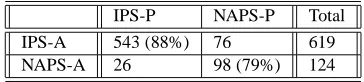
The first author applied the filtering, ranking and evaluation heuristics to the full set of 743 tokens in the overlapping portion of PDTB and OntoNotes. Coreference chains came from the augmented OntoNotes+, as described earlier. The baseline for comparison was selection of the immediately previous sentence as Arg1, which was 83.3% (619/743) in our data set.8 We acheived an overall accuracy of 86.3%, a 3% improvement over the baseline.
Since the data set is very unbalanced and highly skewed towards the baseline, we also created a confusion matrix for the results, to look at how the algorithm performed for cases with immediately previous sentence Arg1s (IPS) ver-sus cases with Arg1s in non-adjacent sentences (NAPS). The confusion matrix shown in Table 1 shows that a signif-icant proportion of both IPS (88%) as well as NAPS Arg1s (79%) are correctly identified.
IPS-P NAPS-P Total IPS-A 543 (88%) 76 619 NAPS-A 26 98 (79%) 124
Table 1: Confusion Matrix. Rows show actual classes (“-A”). Columns show predicted classes (“-P”)
8
Note that because we are using a subset of the PDTB in our analysis, the baseline in our data set is different from the baseline over the entire corpus, which is 91% (see Section 3.1.).
There are two forms of error. The first type (12%) reflect what we believe might be errors and misannotations in the PDTB annotation, which is to be expected as part of an-notation noise in any corpora. In Ex. (13), for instance, both sentences prior to the connective And are available as candidates for coreference ranking since none of the filters apply, and there is a single coreference chain from the con-nective’s sentence, with a single link between “Fed” in the last sentence and “Fed” in the first sentence. Although the CorefB rule would use this information to select the first sentence as Arg1, it is the second sentence that is annotated as Arg1 in PDTB. However, a closer look at the annota-tion shows that the second sentence is an elaboraannota-tion of the first sentence, which ought to have made the first sentence a more appropriate choice for Arg1.
(13) The Fed chairman’s caution was apparent again on the Monday morning after the market’s plunge, when the central bank took only modest steps to aid the markets.
A surprisingly small amount of reserves was added to the banking system. And, by the end of that week, the key
federal funds interest rate, which is largely controlled by the Fed, had settled at 8.75%, barely changed from the level of just under 9% that prevailed the previous week. [wsj 0598]
The remaining errors occurred because the algorithm sim-ply failed to work for the particular case. In Ex. (14), for instance, none of the filters lead to exclusion of any Arg1 candidates. Further, no coreference chains are found for the connective’s sentence, as a result of which the algorithm de-faults to the immediately previous sentence as Arg1. How-ever, the correct Arg1 is two sentences away, as shown in the example.
(14) Thousands of East Germans fled to Czechoslovakia af-ter the East Berlin government lifted travel restrictions.
The ban on cross-border movement was imposed last month after a massive exodus of emigres to West Ger-many. Also, a Communist official for the first time
said the future of the Berlin Wall could be open to discussion. [wsj 0174]
This suggests that additional heuristics or modifications to the heuristics might be needed to account for the full set of cases. We believe that the coreference ranking and eval-uation, in particular, needs further investigation. We also believe that we need a more sophisticated account and, hence, annotation of coreference and anaphoric relations in general. Although OntoNotes overcomes some limitations of previously coreference annotated corpora (e.g., MUC-6, MUC-7, and ACE corpora) by annotating reference to events, for example, there are arguably further gaps to be filled for a proper treatment of anaphoric relations in dis-course (Poesio and Artstein, 2008).
6.
Conclusion and Future Work
classifies connectives in terms of their expected collocation with their arguments in sentences and paragraphs. In addi-tion to being practically useful, our approach is also theo-retically and empirically well-founded. Following our ap-proach, we have also developed a heuristics-based method for identifying the arguments of connectives, focussing on more challenging Arg1, which can be arbitrarily far from its connective. Our heuristics capture well-founded scope constraints and coreference preferences in discourse for the interpretation of discourse relations. Compared to a high baseline of selecting the immediately previous sentence as Arg1, our manual application of the algorithm on the data showed an absolute 3% improvement, showing that the pro-posed approach and method holds promise. However, the error analysis shows room for improvement, since most er-rors are due to failure of the algorithm. We believe that the coreference heuristics need further investigation, which will be carried out shortly. Also planned is the automation of our method, where the difficulty to date has been auto-matically detecting direct speech segments, as the scope-based heuristics require.
Acknowledgements
This work was partially supported by NSF grants EIA-05-63063, and IIS-07-05671. We would like to thank Partha Pratim Talukdar for participating in early experiments to-wards this work, and Geraud Campion and Shai Nir for help with the data preparation.
7.
References
Nicholas Asher and Alex Lascarides. 2003. Logics of con-versation. Cambridge University Press.
Jason Baldridge, Nicholas Asher, and Julie Hunter. 2007. Annotation for and robust parsing of discourse structure on unrestricted texts. Zeitschrift fur Sprachwissenschaft, 26:213–239.
Dan Cristea, Nancy Ide, Daniel Marcu, and Valentin Tablan. 2000. An empirical investigation of the relation between discourse structure and co-reference. In Pro-ceedings of the 18th conference on Computational lin-guistics, Morristown, NJ, USA. Association for Compu-tational Linguistics.
Nikhil Dinesh, Alan Lee, Eleni Miltsakaki, Rashmi Prasad, Aravind Joshi, and Bonnie Webber. 2005. Attribution and the (non)-alignment of syntactic and discourse argu-ments of connectives. In Proceedings of the ACL Work-shop on Frontiers in Corpus Annotation II: Pie in the Sky, Ann Arbor, Michigan.
Robert Elwell and Jason Baldridge. 2008. Discourse con-nective argument identification with concon-nective specific rankers. In Proceedings of ICSC-2008.
Kate Forbes, Eleni Miltsakaki, Rashmi Prasad, Anoop Sarkar, Aravind Joshi, and Bonnie Webber. 2003. D-LTAG system: Discourse parsing with a lexicalized tree adjoining grammar. Journal of Logic, Language and In-formation, 12(3).
Barbara J. Grosz, Aravind K. Joshi, and Scott Weinstein. 1995. Centering: A framework for modeling the lo-cal coherence of discourse. Computational Linguistics, 21(2):203–225.
Marti A. Hearst. 1997. TextTiling: Segmenting text into multi-paragraph subtopic passages. Computational Lin-guistics, 23(1):33–64.
Megumi Kameyama. 1998. Intrasentential centering: A case study. In M.A. Walker, A.K. Joshi, and E.F. Prince, editors, Centering Theory in Discourse, pages 89–112. Oxford University Press, Oxford, U.K.
Alan Lee, Rashmi Prasad, Aravind Joshi, and Bonnie Web-ber. 2008. Departures from tree structures in discourse: Shared arguments in the Penn Discourse Treebank. In Proceedings of the Constraints in Discourse III Work-shop, Potsdam, Germany.
Daniel Marcu. 1997. The rhetorical parsing of natural lan-guage texts. In Proceedings of the Meeting of the Asso-ciation for Computational Linguistics.
Massimo Poesio and Ron Artstein. 2008. Anaphoric an-notation in the ARRAU corpus. In Proceedings of 6th International Conference on Language Resources and Evaluation (LREC 2008), Marrakech, Morocco.
Livia Polanyi, Chris Culy, Martin H. van den Berg, Gian Lorenzo Thione, and David Ahn. 2004. A rule based approach to discourse parsing. In Proceedings of the 5th SIGdial Workshop on Discourse and Dialogue, Cambridge, MA.
Rashmi Prasad, Nikhil Dinesh, Alan Lee, Aravind Joshi, and Bonnie Webber. 2007. Attribution and its annota-tion in the Penn Discourse TreeBank. Traitement Au-tomatique des Langues, Special Issue on Computational Approaches to Document and Discourse, 47(2).
Rashmi Prasad, Nikhil Dinesh, Alan Lee, Eleni Milt-sakaki, Livio Robaldo, Aravind Joshi, and Bonnie Web-ber. 2008. The Penn Discourse TreeBank 2.0. In Pro-ceedings of 6th International Conference on Language Resources and Evaluation (LREC 2008).
PDTB-Group. 2008. The Penn Discourse TreeBank 2.0 Annotation Manual. Technical Report IRCS-08-01, In-stitute for Research in Cognitive Science, University of Pennsylvania.
Violeta Seretan and Dan Cristea. 2002. The use of refer-ential constrains in structuring discourse. In Proceed-ings of The Third International Conference on Language Resources and Evaluation (LREC 2002), Las Palmas, Spain.
Bonnie Webber. 2009. Genre distinctions for discourse in the Penn TreeBank. In Proceedings of the Association for Computational Linguistics, Singapore.
Ralph Weischedel, Sameer Pradhan, Lance Ramshaw, Martha Palmer, Nianwen Xue, Mitchell Marcus, Ann Taylor, Craig Greenberg, Eduard Hovy, Robert Belvin, and Ann Houston. 2007. Ontonotes release 2.0. Techni-cal report, Linguistic Data Consortium.
Ben Wellner and James Pustejovsky. 2007. Automatically identifiying the arguments of discourse connectives. In Proceedings of EMNLP-CoNLL.