
Language Modeling for Document Selection
in Question Answering
Nicolas Foucault, Gilles Adda, Sophie Rosset LIMSI - CNRS
Abstract
Usually, in the Question Answering do-main, for a question in natural language, precise answers to the question are ex-tracted from documents according only to the context of the question. In this work, we complemented this approach by adding a filtering process on top of the docu-ment retrieval. This way, the system re-evaluates the documents it has originally selected during the information retrieval step before the answer extraction and scor-ing. Such re-evaluation aims at filtering out documents considered unusable for the search. Based on statistical language mod-eling, the filtering process firstly deter-mines the intrinsic relevancy of a docu-ment and then decides whether this doc-ument isa priori relevant for finding an-swers. Evaluation on factoid questions and a collection of 500k web documents has shown our approach properly supports the Question Answering task.
1 Introduction
Question-Answering (QA) systems can be seen as an extension of the Information Retrieval (IR) en-gines. In IR systems a user is able to search for information using a set of keywords. The search result is a set of documents or links to documents the user needs to peruse to find the precise infor-mation he asked for. In contrast, the QA task con-sists of providing short, relevant answers to nat-ural language questions which can be textual or spoken. For instance, looking for the main ac-tors playing in the ”Titanic” movie directed by James Cameron, a possible question to a QA sys-tem would be: Who did play the main roles in the Titanic movie directed by James Cameron?. In re-turn, the system might reply: Leonardo DiCaprio and Kate Winslet.
Question-Answering systems usually follow a standard strategy. They start by preprocessing the documents before their indexation.
The indexation for subsequent retrieval is done by a classical (e.g. Lucene1) or specific search en-gine (Rosset et al., 2008) developped on purpose to best fit the system needs.
Following these steps which predates any re-trieval, the work turns towards the questions. The question analysis aims at providing information from the question that has to be found in the doc-uments. The second part of the analysis aims to predict what type of answers the question ex-pects (Pardino et al., 2008), usually a named en-tity category (such as person, location, etc.) and also to predict what the question class is, so as to constrain the system to search for specific answer types.
The results of these analysis are given to the search engine which retrieves whole documents or snippets, based on the indexation, in order the system finally rank candidates answers it extracted from them.
In this paper, we describe a method which first determines the intrinsic relevancy of a document using a language model and then decides whether this document is relevant for searching answers to any question. In the following section we present related work. Section 3 presents the pro-posed method. Section 4 shows experiments con-ducted for its evaluation. Finally, in section 5 we conclude and gives future perspectives about our work.
2 Related Work
In QA the document selection is done given a spe-cific question. As far as we know, no work ad-dressed the problem of selecting documents inde-pendently to the question, using only a document
1http://www.lucene.apache.org
quality evaluation. Such a method involves assess-ing whether a document is intrinsically relevant or not, and is totally compliant with previous and fur-ther analysis in the standard QA strategy.
Statistical language modeling (SLM) seems suitable for such a task. SLM (Jelinek et al., 1990; Rosenfeld, 2000) provides an easy way to cope with the complexity of natural language by ex-pressing various language phenomena in terms of simple parameters in a statistical model. If SLMs have not been used extensively in pure QA, al-though they have shown promizing results e.g. to evaluate the intrinsic relevancy of documents esti-mated for ranking passages (Ganesh and Varma, 2009), they are classically used to help solving tasks closely related to the QA one, especially when topic modeling is worth e.g. entity linking and guided summarization 2(Varma et al., 2010).
3 Document evaluation method
3.1 Overview
The document evaluation method applied to a givenddocument is 2-twofold: firstly,dis scored using a language model (LM) in order to estimate its intrinsic relevancy. Then, a Gaussian Mix-ture Model (GMM) predicts whether d is rele-vant, given a model ofa priorirelevant documents (which are the documents included in the develop-ment set, DEV) and the LM. In other words,dis considered as relevant only if d is close enough both to the documents used to build the LM and to the DEV documents.
The LM is built on a very large collection of journalistic articles to define a model with a broad scope. Preliminary experiments have shown that the perplexity (PPX) and the out of vocabulary words(OOV) ratio were the most suitable param-eters to characterize the document relevancy. PPX is defined as:
P P X(d) =PLM(d) − 1
|d| (1)
wherePLM(d)is the document estimated proba-bility, given the LM, and|d|is the number of word ind. PPX might be seen as a distance betweend and the documents known by the LM. OOV ratio is defined as:
OOV(d) =
d∩LM
|d| (2)
2for details about such tasks see the KBP/GS tracks at
http://www.nist.gov.tac
whered∩LM are the words indwhich belong to the LM vocabulary, and conversely d∩LM are the words in d unknown by the LM. OOV is a ratio, corresponding to the number of words un-known by the LM divided by the total number of words ind.
3.2 Methods
The first step is to build a 3-gram LM based on a 500k words dictionary obtained from a large cor-pus of French newspapers articles. Then, OOV and PPX scores are calculated to each DEV docu-ments using the LM and we estimate the distribu-tion (assuming they are Gaussian) related to each parameter by calculation of the mean and standard deviation. Finally, we define a GMM which com-bines the OOV and PPX distributions. The GMM acts as a binary classifier able to predict whether any new web page isrelevantorirrelevant.
As the DEV set is noisy, and contains some er-rors or marginal documents i.e. theoutliers doc-uments, we introduced a variant to estimate the distributions in our method and remove the out-liers from the DEV set. In order to find them, we used the OOV and PPX parameter mean values estimated based on the DEV documents. Any of the DEV documents having a PPX and/or an OOV score either too high or too low, given the mean values is considered as an outlier.
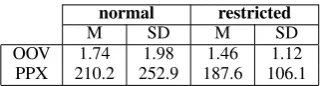
The approach using the variant is named the re-strictedmethod, as oppsed to thenormalmethod, which was first described. For each method, we give the mean and deviation values used to build the GMMs in Table 1. As we can see in this ta-ble, removing outliers affects largely both PPX and OOV distributions.
We defined 3 ways to combine the OOV and PPX distributions estimated during the GMM cre-ation: OOV+PPX, OOV alone and PPX alone. The F filtering function of our GMM is defined as:
F =M p+c×SDp (3)
wherep∈ {OOV+P P X, OOV, P P X}M pand SDpcorresponds to the mean and standard devia-tion related top. Relying on some preliminary ex-periments, we chosec ∈ {0,0.5,1,1.5,2,2.5,3}
over-all cand pvalues, plus the two ways of creating GMMs, we built a total of 42 GMMs.
normal restricted
M SD M SD
OOV 1.74 1.98 1.46 1.12 PPX 210.2 252.9 187.6 106.1
Table 1: Mean (M) and standard deviation (SD) estimated for the OOV and PPX parameters and thenormalvs.restrictedmethods.
3.2.1 Data
The data used in our work is split in 3 corpora: the documents collection used in the LM creation, the DEV documents set used to generate the GMMs and the corpus of documents (french5G) used to test our filtering method during the experiments.
The first corpora is about 2G words. It is com-posed of French news articles in journalistic style. 85% of them come from newspapers e.g. Le Monde, AFP, and web newspapers e.g. Google news, Yahoo!.
The second corpora counts 509 documents. This corpora has been released behind the pre-vious QA evaluation campaign we participated in (Quintard et al., 2010). It gathers documents containing only adjudicated answers to the evalu-ation questions found by the systems participant. As a control, we verified that the GMMs we build have rejected less than 10% of the DEV docu-ments.
The last corpora count 499734 French web pages, provided by the Quaero project.
4 Evaluation
4.1 Experimental setup
4.1.1 Ritel-qa
The QA system used in our experiments is pre-sented in details in (Rosset et al., 2008).
The same complete and multilevel analysis is carried out on both questions and documents. The analysis identifies about 300 different types of en-tities.
From the question analysis, the system build a search descriptor that contains the important ele-ments of the question, the question class predicted from them, and the possible answer types with as-sociated weights. This search descriptor is used by our IR engine to retrieve documents and snip-pets (Rosset et al., 2008). Then answer extractions
and validation procedures are applied (Bernard et al., 2009).
4.1.2 List selection
We submitted to each GMM induced in Section 3 the entire french5G corpus and obtained 42 differ-ent lists of a-priori relevant documdiffer-ents used dur-ing our experiments. Table 2 shows the quantity of documents composing these lists according to each GMM, as a ratio of the total number of doc-uments in the corpus. We also created thefull-list, which is composed of all french5G documents.
All the lists were used to feed a filter we plugged in our QA chain to refine the original documents selection made by the system during the IR step. To reduce the number of eligible documents for searching answers we intersect the list of docu-ments retrieved by the system during the IR step with one of the 43 lists. The objective of this filter is to help the QA system to choose the best docu-ments given an estimation of their quality and the question.
For the tuning of answer selection parameters of our QA system, we use a set of 722 factoid questions and answers references (Quintard et al., 2010) as well as the 43 document lists provided by the filtering module. For all the possible configu-rations of parameters, the system provides results for the complete QA chain. These results after tun-ing serve as a basis for selecttun-ing the best document lists.
We defined two different list selection method-ologies. In the first one (methodology-1), each question class is associated to the same list: the list for which the QA system obtains the best global success rate. In the second one (methodology-2), the best per-class list is selected, for each of the most frequent question class found throughout the training set. In this case, based on the different success rates obtained per class after tuning, the filtering module automatically determines how to associate question class and document list.
4.2 Results
We evaluated the performance of the different doc-ument lists on a test set of 309 factoid ques-tions (Quintard et al., 2010) independant from the training set.
method normal restricted
c 0 0.5 1 1.5 2 2.5 3 0 0.5 1 1.5 2 2.5 3 OOV+PPX 27.0 49.5 65.3 75.4 81.8 86.0 88.7 21.0 33.9 45.3 54.7 62.7 69.1 74.0
OOV 39.1 58.7 72.8 81.8 87.4 91.0 93.3 32.9 45.4 56.3 65.2 72.6 78.2 82.5 PPX 47.3 71.9 82.2 87.2 90.1 91.8 93.0 39.9 55.5 66.2 73.1 78.0 81.6 84.2
Table 2: Quantity of a-priori relevant documents per lists, as a ratio of the French Quaero corpus french5G, for each of the 42 GMMs obtained with different distribution combination of LM parame-ters (OOV, PPX, OOV+PPX),cvalue (c∈[0−3]) and method (normal vs. restricted).
using the full-list (baseline). For instance, for methodology-1, the best document list (o+p2.5n) has been generated based on the GMM merging OOV and PPX information with a cvalue of 2.5 following thenormalapproach for its creation (see section 3.2). Thebaselinesystem does not use our approach for document filtering. The lines 2 to 4 and 5 to 7 of table 3 shows the results obtained with methodology-1 and -2, respectively.
Results are measured given the classical QA evaluation metrics: precision (or top-1), mean re-ciproqual rank and recall (or top-10).
S L Qc P MRR R #q
baseline full all 31.7 39.5 53.4 309 best-1 o+p2.5n all 33.0 40.6 55.0 309 best-qc p2.5n loc 57.6 64.5 75.8 66
best-1 o+p2.5n loc 54.5 62.8 75.8 66 best-2 - all 31.1 39.4 54.7 309
- p1.5r time 29.2 38.5 56.2 48 - p2n loc 54.5 63.2 75.8 66
Table 3: Results on the test data following methodology-1 (top) and methodology-2 (bot-tom).S: system;L: document list selection mode;
Qc: question class;P: precision;MRR: mean re-ciprocal rank;R: recall;#q: number of questions.
According to the best-1 line, using a docu-ment filtering improves the overall results: all the metrics are improved by ∼1% absolute. In methodology-1 one single list is chosen for all question classes, which could be sub-optimal lo-cally, i.e. given a specific question class. This is shown in the first part of the Table 3 with the ora-cle results (best-qc) associated to thelocalization class. If the system had used this list instead of the general best list, the results could have been improved on this question class by almost 3% of precision. The other methodology (choosing the best list for each question class) seemed then to be more optimal. Although, using methodology-2 we observed a significant gain on tuning data, this gain was not preserved with new data (best-2). This is due to an insufficient amount of training
data for each question class.
We see also that normal lists give better results than the restricted ones. This shows that, given the small number of DEV documents used to generate the GMMs, the filtering should aim only at remov-ing unarguably bad documents where the system would not be able to extract any correct answers. If a more decent number of developement docu-ments would have been available, more precise fil-tering techniques could have been more success-ful.
S L Qc P MRR R #q
best-1 o+p2.5n all 33.0 40.6 55.0 309 baseline full all 31.7 39.5 53.4 309 random - all 31.4 39.2 53.4 309 09best-1 p3r all 28.2 34.2 45.6 309 09baseline full all 24.6 31.6 45.6 309 Table 4: Results on the test data using methodology-1 (best-1, 09best-1, baseline and 09baseline) and choosing one among the 42 lists for each question class (random). 09point out re-sults obtained on our 2009 QA chain. S: system;
L: document list;Qc: question class;P: precision;
MRR: mean reciprocal rank;R: recall; #q: num-ber of questions.
5 Conclusion and perspectives
We have presented a method to evaluate the intrin-sic quality of web pages to be used in a question-answering system. The approach is twofold: first the intrinsic relevancy of a document is deter-mined using a n-gram language model and then a GMM-based classifier decides whether this doc-ument may be considered as relevant for search-ing answers to any question. The GMMs are built based on the perplexity, the out-of-vocabulary ra-tio and a combinara-tion of these two informara-tions. For this purpose, we completed the classical QA model with a filtering on top of the document re-trieval, before the extraction of answers.
The results show that the a-priori document fil-tering approach provides a significant improve-ment of the QA system, for all measures.
We observed the best lists are not the most fil-tering ones but those which kept 80%-90% of the documents. We also observed the best results ob-tained on the tuning using a per-class decision about the lists were not confirmed on the test data, showing the amount of training data is insufficient to leverage the question classification at this point. The parameters used in our experiments are very primitive. They are able to filter out only ex-tremely irrelevant documents. In addition to the intrinsic relevancy, we plan testing extra features to support the filtering process. Given the nature of the QA task, we think semantic features like document topics (extracted from URL) could be very useful.
We also think it would be interesting to investi-gate in the direction of creating specialized classi-fiers (based on SLMs or other) to support the doc-uments classification according to outputs of lin-guistics analyzers.
Size and content of web documents are ex-tremely variable. Reducing this variability should help Web-oriented QA. Thus, we plan to segment the documents prior to filtering.
Acknowledgments
This work has been partially financed by OSEO under the Quaero program.
References
G. Bernard, S. Rosset, O. Galibert, E. Bilinski, and G. Adda. 2009. The limsi participation in the qast
2009 track: experimentating on answer scoring. In
CLEF 2009, Corfu, Grece, September.
Surya Ganesh and Vasudeva Varma. 2009. Exploit-ing the use of prior probabilities for passage retrieval in question answering. InRANLP-2009, pages 99– 102, Borovets, Bulgaria, September. Association for Computational Linguistics.
F. Jelinek, B. Merialdo, S. Roukos, and M. Strauss I, 1990. Readings in Speech Recognition, chapter Self-organized language modeling for speech recog-nition, pages 450–506. Morgan Kaufmann.
M. Pardino, J.M. G´omez, H. Llorens, R. M´unoz-Terol, B. Navarro-Colorado a nd E. Saquete, P. Mart´ınez-Barco, P. Moreda, and M. Palomar. 2008. Adapting ibqas to work with text transcriptions in qast task: Ibqast. InCLEF 2008, Aarhus, Denmark, Septem-ber.
Ludovic Quintard, Olivier Galibert, Gilles Adda, Brigitte Grau, Dominique Laurent, V´eronique Moriceau, Sophie Rosset, Xavier Tannier, and Anne Vilnat. 2010. Question answering on web data: The qa evaluation in quæro. InLREC’10, Valletta, Malta, may.
Ronald Rosenfeld. 2000. Two decades of statistical language modeling: Where do we go from here.
Proceedings of the IEEE, 88(8):1270–1278.
S. Rosset, O. Galibert, G. Bernard, E. Bilinski, and G. Adda. 2008. The limsi participation to the qast track. InWorking Notes of CLEF 2008 Workshop, Aarhus, Denmark, September.
![Table 2: Quantity of a-priori relevant documents per lists, as a ratio of the French Quaero corpusfrench5G, for each of the 42 GMMs obtained with different distribution combination of LM parame-ters (OOV, PPX, OOV+PPX), c value (c ∈[ 0 −3] ) and method (no](https://thumb-us.123doks.com/thumbv2/123dok_us/1090881.1137697/4.595.310.519.359.426/quantity-relevant-documents-corpusfrench-obtained-different-distribution-combination.webp)
