The use of interaction methods in a
blended learning environment
Evaluating the use of interaction methods in the blended
learning environment in two courses of a Masters program at
the University of South Australia, unit Systems Engineering &
Evaluation Centre
By: Marieke Klink
University of Twente
Faculty of Behavioural Sciences
Educational Science and Technology
The use of interaction methods in a
blended learning environment
Evaluating the use of interaction methods in the blended
learning environment in two courses of a Masters program
at the University of South Australia, unit Systems
Engineering & Evaluation Centre
By: Marieke Klink
University of Twente, Faculty of Behavioural Sciences
Educational Science and Technology, master track Human Resource
Development
Enschede, January 2006
Supervisors:
Dr. Irene Visscher-Voerman (University of Twente)
Executive summary
Eight lessons learned
The University of South Australia, unit Systems Engineering & Evaluation Centre in Adelaide wants to ensure that the LMEF Masters program is representative of best teaching practice in post graduate education, and, that the program is meeting the needs of the client. From this perspective, they have asked for an evaluation of the Research Methods in a Multidisciplinary Environment’ course (RMME). When conducting an evaluation study, one can focus on several perspectives. Because the length of this research project was only a few months and the learning was delivered in a blended learning environment, this research project focused on the different interaction methods in a blended learning environment.
In this executive summary different recommendations will be given which are elaborated in the written implementation plan. By implementing these recommendations, the quality of the interaction methods in the blended learning environment of the RMME course can be
improved.
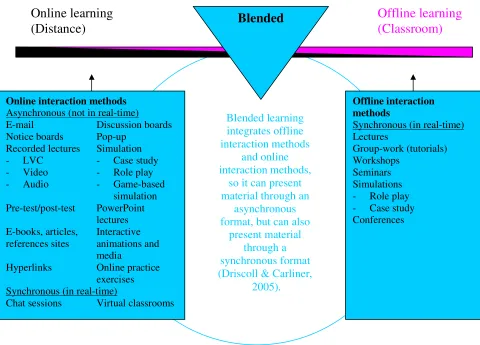
There are many different possibilities of blending interaction methods, but there are no standard rules available to find the correct blend. The only thing that can be said is that the correct blend of blended learning must be targeted so that there is an overlap in the resources. The students should be able to obtain the same information by means of several formats and manners and the students should be able to get answers to questions which are important to them, regardless of time, location, place or learning preferences. See figure 2 for different possibilities to blend.1
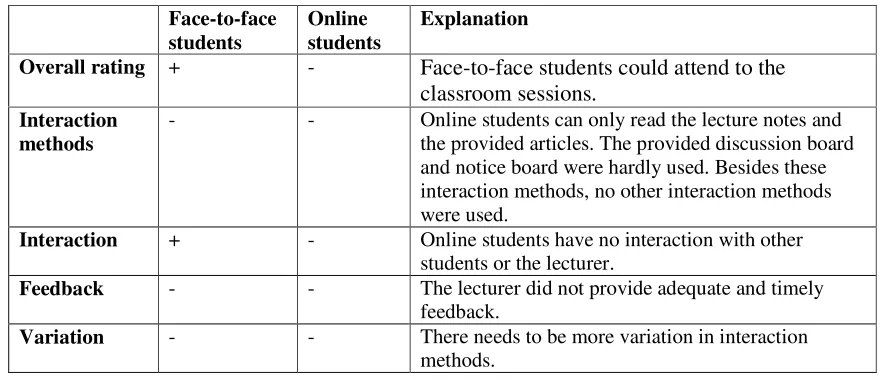
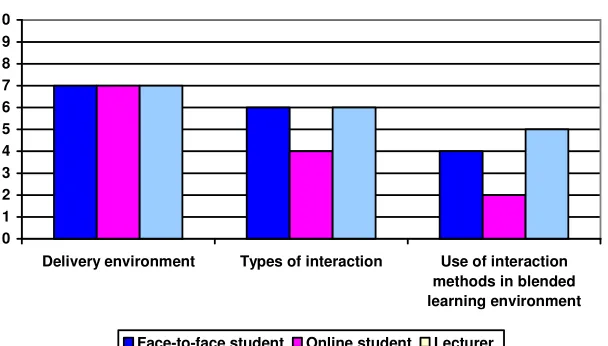
To find out what the quality of the interaction methods in the blended learning environment of the RMME course of LMEF Masters program was and how it could be improved, different activities were undertaken.2 In table 1, the major findings are presented. See also figure 1 for the satisfaction of the users (students and the lecturer).3
Table 1
Major findings
1 More detailed information about the literature research can be found in chapter 2 of the report. 2 More detailed information about the activities undertaken can be found in chapter 3 of the report.
Face-to-face
students Online students Explanation
Overall rating + - Face-to-face students could attend to the classroom sessions.
Interaction
methods - - Online students can only read the lecture notes and the provided articles. The provided discussion board and notice board were hardly used. Besides these interaction methods, no other interaction methods were used.
Interaction + - Online students have no interaction with other students or the lecturer.
Feedback - - The lecturer did not provide adequate and timely feedback.
Satisfaction of the users
0 1 2 3 4 5 6 7 8 9 10
Delivery environment Types of interaction Use of interaction methods in blended learning environment
Face-to-face student Online student Lecturer
Figure 1. Satisfaction of the users
Conclusions and recommendations
From the results of this research, it can be concluded that the course needs to pay more attention to the online students and there needs to be more variety in interaction methods. The recommendations to achieve this are summarized under the following topics:
- Interaction
- Interaction (teaching) methods - Feedback
- General recommendations - Assignments
In total there were 34 recommendations of which three related to interaction, eighteen about interaction (teaching) methods, five on feedback, two about assignments and six general recommendations. Each recommendation is elaborated in the written implementation plan. The implementation plan is divided into five chapters: introduction, recommendations, planning, costs and risks.4
By implementing the recommendations, the quality of the interaction methods in the blended learning environment of the RMME course can be improved. The first priority is to
implement the eight recommendations that are, in this text, presented in a framework. Based on the results, these recommendations were most important. After these recommendations are implemented, it is advised to implement the remaining recommendations.
1. Recommendations with respect to interaction
This way the online students have real-human interaction with their lecturer. This allows the students to ask questions and get instant feedback while the lecturer can further motivate them.
3 More detailed conclusions about the RMME course can be found in chapter 4 of the report. 4 The written implementation plan can be found in appendix 9 of the report.
After the above recommendation related to interaction is implemented, the next step is to implement the following recommendations. It is advised:
- that the lecturer creates at the beginning of the course, a place on the discussion board where students have to submit their personal background information.
- that the lecturer uses the students’ background information in the material, so that especially the online students can relate to this.
2. Recommendations with respect to interaction (teaching) methods
Research has shown that practice of what is being taught moves skills and knowledge from short-term to long-term memory (Driscoll & Carliner, 2005). Because of this, the use of interaction methods is very important.
When relevant questions asked by one student are submitted on the discussion board, all the students can read the questions and the answers given. Especially for online students who cannot attend to the face-to-face meetings this can be very helpful.
When the lecturer allows the other students opportunities to answer a question, the lecturer lets the students think for themselves first before given or confirming the correct answer.
Role-play simulation is a learning strategy in which the students assume the roles of fictional characters in a defined scenario. Role-play strategies are one of the less expensive simulation options, because the program can be run in a live virtual classroom
environment. This can be done via text in the form of e-mail, instant messaging, threaded discussions, or in a traditional face-to-face session. Role-plays take advantage of adult learners’ life experiences. The students are able to try out different problem-solving strategies in a safe environment. Students can be asked to do things such as take a point of view contrary to their believes and thus to explore a different point of view. Students are also able to try approaches and reflect on the outcomes (Driscoll & Carliner, 2005). A case study is a presentation, in narrative form, of an actual event that has occurred inside an organization (Driscoll & Carliner, 2005; Palloff & Pratt, 2005). They are not prescriptive, nor are they used to prove a point; they are designed to develop critical analysis and decision-making skills. Case studies should be used when the goal is to enable participants to: (1) apply previously learned theories to the circumstances in the case, (2) decide what is pertinent, (3) identify the real issues, (4) decide what should have been done, and (5) develop a plan of action (Driscoll & Carliner, 2005).
It is advised to make use of online practice exercises.
It is advised that the lecturer stimulates the students to use the discussion board by:
- Submitting general feedback on the discussion board.
- Submitting relevant questions, asked by one student via for example e-mail or in the face-to-face meetings, on the discussion board.
- When a student places a question on the discussion board, it is advised that the lecturer also gives the other students opportunities to answer that question.
- It is advised that the lecturer respond after a couple of days (for example at the end of the week) to the answers given by the student.
Recorded programs are becoming a common form. A popular method is the use of a live virtual classroom. Live virtual classroom programs can be recorded and then made available for viewing as recorded lectures. It is like watching a video of a live traditional classroom program (Driscoll & Carliner, 2005). This is especially important for the online students, because they do not have the possibility to attend a face-to-face classroom meeting.
After the above recommendations related to interaction (teaching) methods are implemented, the next step is to implement the following recommendations. It is advised:
- to structure the discussion board by lesson.
- that all students and the lecturer receive an e-mail when something has been submitted on the discussion board.
- to keep the notice board up-to-date.
- that, when something new is submitted on the notice board, the students receive an email. - to submit the newest information on top of the notice board.
- to make use of hyperlinks in an e-learning environment. - to make use of interactive animations and media. - to make use of a live virtual classroom.
- to make use of PowerPoint slides with pictures, graphics and diagrams. - to make use of classroom discussions.
- that at the beginning of each course some time is spend on how to work effectively in groups. - to submit a document in the e-learning environment of how to work effectively in groups.
- that the lecturer stimulates group-work, by showing interest in how the group-work is progressing. - that halfway trough working in groups in the course, the students fill in a questionnaire about
collaboration.
3. Recommendations with respect to feedback
This should give the lecturer enough time to think about the question. The lecturer may be very busy when he gets the e-mail or phone call, but it should be possible to answer the questions within 3 days. For students, 3 business days is not too long. If it takes more than 3 days for the lecturer to answer questions, students may get de-motivated and not want to finish the assignment on time.
This is important, so students know where they are in their learning process. When they only get general feedback, they would not know these specifics.
After the above recommendations related to feedback are implemented, the next step is to implement the following recommendations. It is advised:
- to mark assignments within 3 weeks. - that the feedback is constructive.
- that general feedback is submitted on the discussion board.
It is advised to make use of recorded lectures in an e-learning environment.
It is advised to answer e-mails or phone calls within 3 business days.
4. General recommendations
This way the lecturer knows whether or not the students can log-in, and can offer them help if they cannot. If students have problems with log-in during the course, they know who they can contact and do not have to spend a lot of time searching in the universities website for a contact person.
After the above recommendation is implemented, the next step is to implement the following recommendations. It is advised:
- to submit more detailed course information on the universities website. - to put the buttons in the same order.
- to use the same format for the course outline.
- to deliver the learning material two lessons in advance.
5. Recommendations with respect to assignments It is advised
- that the written material is more explicit as to what steps need to be taken to complete the assignments.
- that the lecturer submits extra information concerning the assignments on the discussion board.
Critical factors
The success of the recommendations depends on critical factors. One of those factors is the time and effort spent by the lecturers on implementing the suggested recommendations. When lecturers for example want to qualify themselves in making interactive animations, recorded lectures or online practice exercises such as quizzes: they must take the time to really learn. If they need to do a workshop, they should make that effort and do that workshop.
Thinking of an idea for a practice exercise or an interactive animation takes a lot of time, even more when the lecturer is going to create it himself. The lecturer should be realizing that and take that time. Another critical factor is money. When more time must be taken on improving the course, this will cost money particularly if an outside organisation develops interactive animations for the course. Finally, a big risk is that the lecturer begins preparing and organizing the course one or two weeks before the course starts. This is too late for most recommendations. If the lecturer does not take these recommendations into account, does not plan for them in his personal agenda, or just ignore them, then the recommendations will most likely fail to improve the course.
Blended
Online interaction methods
Asynchronous (not in real-time)
E-mail Discussion boards
Notice boards Pop-up Recorded lectures
- LVC
- Video - Audio
Simulation - Case study - Role play - Game-based
simulation Pre-test/post-test PowerPoint
lectures E-books, articles,
references sites Interactive animations and media
Hyperlinks Online practice exercises Synchronous (in real-time)
Chat sessions Virtual classrooms
Offline interaction methods
Synchronous (in real-time) Lectures
Group-work (tutorials) Workshops
Seminars Simulations - Role play - Case study Conferences
Blended learning integrates offline interaction methods
and online interaction methods,
so it can present material through an
asynchronous format, but can also
present material through a synchronous format (Driscoll & Carliner,
2005).
Online learning
(Distance)
Offline learning
(Classroom)
Abstract
The University of South Australia, unit Systems Engineering & Evaluation Centre in Adelaide liked to have proof that the LMEF Masters program was representative of best teaching practice in post graduate education, and, that the program was meeting the needs of the students.
The research of this master project was aimed at writing recommendations to improve the interaction methods that are offered or could be offered to the students in the blended learning environment of the courses ‘Research Methods in a Multidisciplinary Environment’ and ‘Operational Test and Evaluation’ of the LMEF Masters now and in the future. The main question of this research project was ‘How can the use of interaction methods in the blended
learning environment of the courses ‘Research Methods in a Multidisciplinary Environment’ (RMME) and ‘Operational Test and Evaluation’ (OTE) of the LMEF Masters Program ensure best teaching practice?’.
This main question can be answered by looking at the two following sub-questions:
1. What is the quality of the blended learning environment of the RMME and OTE courses of the LMEF Masters program, with respect to the interaction methods?
2. How can the quality of the blended learning environment of the RMME and OTE courses of the LMEF Masters program be improved, with respect to the interaction methods? There were two phases in this research project: the first phase was an evaluation phase in which sub-question one was answered. To do this, the two courses ‘Research Methods in a Multidisciplinary Environment’ and ‘Operational Test and Evaluation’ given in this master program were explored, a document analysis was made, the curriculum was looked at
carefully with a focus on interaction methods in a blended learning environment, an interview with the contact person of Defence Science and Technology Organisation, an interview with the coordinator of AITEC, interviews with lecturers and with students were conducted and a questionnaire was developed and send to the students.
The second phase of this research project was a phase towards the recommendations in which sub-questions two was answered. Based on the results of all these activities in the evaluation phase, conclusions and recommendations were written about the interaction methods in a blended learning environment to improve the two courses. In total there were 34
recommendations of which three related to interaction, eighteen about interaction (teaching) methods, five on feedback, two about assignments and six general recommendations. The recommendations were discussed with lecturers and students. This way it was made sure that the recommendations fit with the needs of the students and that they were usable for the lecturers. After that, final conclusions and recommendations were written about dealing with interaction methods in a blended learning environment, to improve the quality of the courses ‘Research Methods in a Multidisciplinary Environment’ and ‘Operational Test and
Table of content
Executive summary ...3
Abstract...9
Foreword...13
1 Introduction ...14
1.1 Context ...14
1.1.1 Defence Science and Technology Organisation ...15
1.1.2 AITEC ...15
1.1.3 Systems Engineering and Evaluation Centre...15
1.1.4 Learning for Masters of Engineering For DSTO staff ...16
1.1.5 Course one to be evaluated: Research Methods in a Multidisciplinary ...17
Environment 1.1.6 Course two to be evaluated: Operation Test and Evaluation...18
1.2 Intended curriculum ...19
1.3 Relevance of the study ...19
1.4 Reading guide ...20
2 Theoretical background ...21
2.1 Ways to deliver education ...21
2.1.1 Synchronous environment ...22
2.1.2 Asynchronous environment ...23
2.1.3 Blended learning ...23
2.2 Types of interaction in a blended learning environment...24
2.3 Strategies of interacting with students in a blended learning environment...26
2.3.1 Blending Offline and Online Learning...27
2.3.2 Blending Self-Paced and Live, Collaborative Learning...28
2.4 Conclusion...35
3 Research design...37
3.1 Phase 1: Evaluation phase ...37
3.1.1 Research questions 1 ...38
3.1.2 Activities...39
3.2 Phase 2: Towards the recommendations ...42
3.2.1 Research question 2...42
3.2.2 Activities...42
4 Results research question 1 RMME...45
4.1 Results from the analysis of the course website ...45
4.2 Results from the AITEC questionnaire ...46
4.2.1 Summary of the results from the AITEC questionnaire RMME 2003...46
4.2.2 Summary of the results from the AITEC questionnaire RMME 2004...47
4.3 Results of the questionnaire developed by researchers...47
4.4 Results from the interview with students and the lecturer of the RMME course...48
4.5 Conclusions RMME...50
4.5.1 General aspects...50
4.5.2 Positive aspects of the RMME course...51
4.5.4 Preferences students and lecturer ...52
4.6 Overall conclusion ...53
5 Results research question 1 OTE ...54
5.1 Results from the analysis of the course website ...54
5.2 Results from the AITEC questionnaire ...55
5.2.1 Summary of the results from the AITEC questionnaire OTE 2003...55
5.2.2 Summary of the results from the AITEC questionnaire OTE 2004...56
5.3 Results of the questionnaire developed by researchers...56
5.4 Results from the interview with students and the lecturer of the OTE course ...57
5.5 Conclusions OTE...59
5.5.1 General aspects...59
5.5.2 Positive aspects of the OTE course ...60
5.5.3 Aspects that can be improved in the OTE course ...61
5.5.4 Preferences students and lecturer ...62
5.6 Overall conclusion ...62
6 Results research question 2 RMME and OTE...63
6.1 Results formative evaluation of the recommendations ...64
6.1.1 Results of the students ...64
6.1.2 Results of the lecturers ...66
6.1.3 Differences between students and the lecturer...66
6.2 Conclusion...67
6.2.1 Recommendations that can stay the same ...67
6.2.2 Recommendations that need to be adjusted...68
6.2.3 The recommendation that needed to be removed ...70
6.3 Overall conclusion ...70
7 Implementation plan...71
7.1 Structure implementation plan ...71
7.2 Recommendations with respect to interaction...72
7.3 Recommendations with respect to interaction (teaching) methods ...73
7.3.1 Discussion board in an e-learning environment...74
7.3.2 Notice board in an e-learning environment ...75
7.3.3 Online practice exercises ...76
7.3.4 Hyperlinks...76
7.3.5 Interactive animations and media...77
7.3.6 Simulations: Role-play & Case-study ...77
7.3.7 Recorded lectures ...78
7.3.8 Live virtual classroom ...78
7.3.9 PowerPoint slides with pictures, graphics and diagrams...79
7.3.10 Classroom Discussions...80
7.3.11 Group-work...80
7.4 Recommendations with respect to feedback ...82
7.5 Recommendations with respect to the assignments...83
7.6 General recommendations...84
7.6.1 Course explanation...84
7.6.2 Course website (e-learning environment)...84
7.6.3 Delivery environment...85
7.6.5 Delivery of learning material...85
8 Discussion...86
8.1 Discussion research methods...86
8.2.1 Validity ...86
8.2 Discussion results...87
8.2.1 Reliability / Validity...87
8.2.2 Implementation of the recommendations ...88
8.3 Follow-up studies...89
8.3.1 Improvement of this research project...89
8.3.2 Take the use of interaction methods in a blended learning environment ...90
along in evaluation 8.4 Main question ...90
9 References ...91
Appendix 1: Interview questions lecturers...95
Appendix 2: Interview questions students...96
Appendix 3: Developed questionnaire ...99
Appendix 4: Results research question 1 RMME ...102
Appendix 5: Results research question 1 OTE...113
Appendix 6: Recommendations ...124
Appendix 7: Results research question 2 RMME ...127
Appendix 8: Results research question 2 OTE...135
Foreword
In this report a description is given of a research project that was carried out for the round-off of the master Human Resource Development at the University of Twente, Enschede, the Netherlands. The last few months I have been occupied with interaction methods in a blended learning environment.
There are a lot of people that I have to thank for their big help during this final project. First, I want to thank my supervisor Irene Visscher-Voerman at the University of Twente. I learned a lot from her, even when it was not always easy to communicate via e-mail. I also want to thank David Cropley, my supervisor at the University of South Australia. He was always very busy, but tried to make time for me and of course, thanks to him, I could do my final project in Australia.
I also really want to thank other staff people at unit SEEC. First I want to thank Michael Harris for his cooperation in my research project and for his tips which helped me improve my English. I want to thank Paul Bunnick, Ian Price, Lynn Busschenschut and Melissa Madex, for their help. We could always come in and ask them something, which was great! Finally, I want to thank my family and friends in the Netherlands. Especially my parents and Rob. Mum and Dad, thanks for making this trip to Australia possible and for all the support during my study period. Rob, thank you for all the support during my study period and the times when I needed a hearing ear. You were always there.
Last, but not least, I want to thank Chantal Scholten for joining me on this trip. I learned a lot from her, for my future work and for me as a person. Sometimes it was hard to see you every day, but it was a great time and experience! I didn’t want to miss you on this journey!
Marieke Klink
1
Introduction
In this report a description is given of a research project that was carried out for the round-off of the master Human Resource Development at the University of Twente, Enschede, the Netherlands. In this research two master courses for the department of Systems Engineering & Evaluation centre (SEEC) of the University of South Australia (UniSA) were evaluated and recommendations for improvement were made. When conducting an evaluation study, one can focus on several perspectives. Because the length of this research project was only a few months and the learning is delivered in a blended learning environment (see for an
explanation, chapter 2), this research project focused on the different interaction methods in a blended learning environment that are offered or could be offered to the students.
This chapter is an introduction to this research project. In this chapter the context of this research project will be explained in section 1.1. In section 1.2 the intended curriculum will be explained and in section 1.3 the relevance will be discussed. Finally, in section 1.4 the reading guide for this whole report will be given.
1.1
Context
The department of SEEC is a department of UniSA. It runs a master program for the staff of the Defence Science and Technology Organisation (DSTO). SEEC wants to be sure that the Learning for Masters of Engineering For DSTO staff (LMEF) program is representative of best teaching practice in postgraduate education, and, that the program is meeting the needs of the client. From this perspective, they have asked for an evaluation of two of the LMEF courses. The courses to be evaluated were ‘Research Methods in a Multidisciplinary Environment’ (RMME) and ‘Operational Test and Evaluation’ (OTE).
Below, in figure 1, a structure of the several stakeholders involved is presented. This is done to make clear what the relationships between the stakeholders involved are.
Figure 1. Structure of the organisations University of Adelaide University of
South Australia
Flinders University
DSTO
AITEC
Other providers
SEEC
In the following sections the several stakeholders in this research project that are presented in figure 1 are explained. In section 1.2.1 the organisation SEEC will be explained. In section 1.2.2 the organisation DSTO will be explained and in section 1.2.3 the organisation AITEC will be explained.
After these organisations are explained, section 1.2.4 will focus on the LMEF Masters
Program. In section 1.2.5 and 1.2.6 the content and the aims/learning objectives of the RMME and OTE course will be discussed. Finally, in section 1.2.7 the curriculum will be discussed.
1.1.1 Defence Science and Technology Organisation
The Defence Science and Technology Organisation (DSTO) is part of Australia's Department of Defence. DSTO's role is to ensure the expert, impartial and innovative application of science and technology to the defence of Australia and its national interests.
DSTO has a yearly budget of approximately $300 million and employs about 2300 staff, predominantly scientists, engineers, IT specialists and technicians.
DSTO has a presence in nearly every state and territory in Australia. It has its corporate office at Defence headquarters in Canberra with research facilities in Melbourne, Edinburgh (near Adelaide), Canberra, Sydney, HMAS Stirling at Rockingham (near Perth), Scottsdale in Tasmania, and Innisfail in northern Queensland.
At all times, DSTO works closely with the industry, science and technology community to enhance its ability to support Australia's defence capabilities and to contribute to national wealth.
1.1.2 AITEC
The Department of Defence has contracted an external organisation, AITEC. AITEC is the organization that provides the liaison and administration between DSTO and UniSA. AITEC is responsible for all aspects of the university enrolment, including payment of fees and graduations, and evaluating the courses and programs.
1.1.3 Systems Engineering and Evaluation Centre
The Systems Engineering and Evaluation Centre is an official research centre within the University of South Australia. The centre was established in 1999 as the successor of the Australian Centre for Test and Evaluation (ACTE). ACTE was founded in 1992 to provide a focus for Test and Evaluation in the Asia-Pacific region.
The centre uses specialised facilities for research and technical staff to work with clients to help them understand their complex systems and improve their practices.
SEEC staff members are experts in understanding and resolving complex problems. SEEC staff represents four key centres of expertise:
- Systems Engineering - Test and Evaluation
- Capability Development and Acquisition - Aviation Systems Safety
SEEC offers the following programs:
- Systems Engineering (SE) and Test and Evaluation (T&E) coursework and research degree programs ranging from Graduate Certificate to Doctor of Philosophy (PhD). - Professional Training Programs, to allow participation of our courses without
One of the tailored programs is for DSTO’s ‘Continuing Education Initiative Masters program’ (CEI), a post-graduate education program for existing employees of DSTO. This part of the program at UniSA is called the LMEF Masters program (a Masters of
Engineering).
In total, there are 27 people working at SEEC, including 4 support staff members. Most of these staff members teach and do research. In total 6 staff members of the SEEC staff teach in the LMEF program. Two of them are involved in the courses to be evaluated.
1.1.4 Learning for Masters of Engineering For DSTO staff
To understand the research project, it is important to understand the context. To understand the context one can look at the curriculum. A curriculum can be looked at in different ways. A general distinction can be made between the three levels ‘intended’, ‘implemented’ and ‘attained’ (Van den Akker, 2004). A more detailed overview is given in table 1 (Van den Akker, 2004).
It is important to look at the levels ‘intended’, ‘implemented’ and ‘attained’, because together they can give a clear image of the education offered to the students of the RMME and OTE courses. When looking at these three levels, it can be analysed if the vision, the way the lecturers think and the way the students think are the same about the curriculum.
Table 1
Typology of Curriculum representations
Ideal Vision (rationale or basic philosophy underlying a curriculum)
Intended
Formal/Written Intentions as specified in curriculum documents and/or materials
Perceived Curriculum as interpreted by its users (especially teachers)
Implemented
Operational Actual process of teaching and learning (also: curriculum-in-action)
Experiential Learning experiences as perceived by learners Attained
Learned Resulting learning outcomes of learners
One of the big challenges for curriculum improvement in general and for this formative evaluation research in particular is creating consistency between the different parts of the curriculum. One way to look at a curriculum is by dividing the curriculum in components. In this research the ten curriculum components of table 2 (Van den Akker, 2004) were used to describe the two courses RMME and OTE of the LMEF Masters program. Each of the components can be subdivided in one of the three levels of the typology of curriculum representations, intended,
implemented and attained. The intended curriculum will be explained in section 1.2. The implemented and attained curriculum will be presented in chapter 4 and 5.
Table 2
Curriculum components
Component: Description:
Rationale Why are they learning?
Aims & Objectives Toward which goals are they learning?
Learning activities How are they learning?
Teacher role How is the teacher facilitating learning? Materials & Resources With what are they learning?
Grouping With whom are they learning?
Location Where are they learning?
Time When are they learning?
Assessment How far has learning progressed?
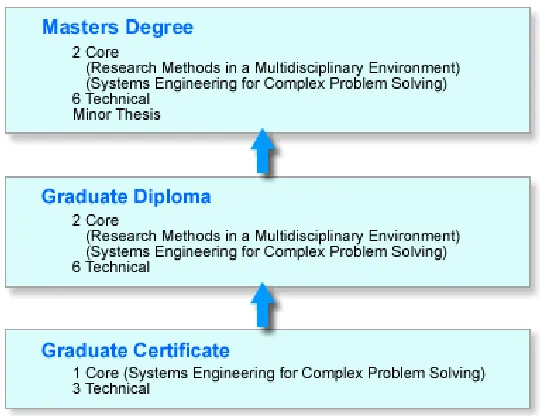
The three organisations discussed above played a role in the LMEF Masters program. In this subsection the focus will be on this LMEF Masters program. In figure 2 the streams of the LMEF program are presented. The LMEF Masters includes two compulsory core courses, Systems Engineering for Complex Problem Solving and Research Methods in a
Multidisciplinary Environment (RMME), and six elective technical courses. Operational Test and Evaluation (OTE) is one of those elective technical courses. The LMEF Masters program is mainly offered via online learning. There are also some face-to-face sessions. Therefore, there is talked about a blended learning environment. For more detailed explanation about blended learning, see chapter 2.
Figure 2. Streams of LMEF Masters program
1.1.5 Course one to be evaluated: Research Methods in a Multidisciplinary Environment
One of the courses that has been evaluated was the RMME course. The content of the RMME course covers:
- The nature of inquiry and the selection of appropriate methods to suit the types of problems encountered by DSTO and the defence sector.
- Research techniques, for example the design of experiments, data validation and interpretation.
- Research design, qualitative and quantitative research, sources of data, data collection procedures, measurement strategies, questionnaire design, interviewing techniques, content analysis, literature surveys, information databases, statistical techniques and evaluation.
- Development of a research program.
The aims/learning objectives are:
- To provide the student with the fundamental concepts and practice of engineering research in a multidisciplinary environment where no-engineering functions may be present.
On completion of this course students should be able to:
- Describe the key elements in the design of research programs;
- Appreciate the fundamental concepts of qualitative and quantitative research; - Understand the fundamentals of data collection and research methodology; - Apply skills in gathering and analysing information; and
- Apply skills and knowledge of the methods for writing effectively for research degrees.
The lecturer of the RMME course provided six traditional classroom meetings and made use of an e-learning environment. Each classroom meeting took a whole day. The RMME course used a text book. Other readings and materials were provided online. The students were learning mainly individual. During the classroom meetings, the course made use of 7 tutorials (not marked group-work).
1.1.6 Course two to be evaluated: Operation Test and Evaluation
The other course that has been evaluated was the RMME course. The content of the OTE course covers:
- The definition of Operational Test and Evaluation.
- Differences from Development and Acceptance Test and Evaluation. - Human factors.
- Methods of reporting. - Critical issues.
- Statistical confidence levels. - Operational test plans. - Safety and suitability testing. - Operational test reports.
The aims/learning objectives are:
- To introduce the principles of the specialist discipline of Operational Test and Evaluation.
On completion of this course students should be able to:
- Appreciate the elemental components of an Operational Test and Evaluation program; - Appreciate the thrust of Operational Test and Evaluation is a systems-level approach to
demonstrating usefulness in achieving users' requirements;
- Understand the relationships between the elements of Operational Test and Evaluation; - Understand the differences between Operational Test and Evaluation and other types of
Test and Evaluation; and
- Understand the human factors affecting Operational Test and Evaluation.
The lecturer of the OTE course provided the course mostly online. In this course there were three classroom meetings scheduled. Each classroom meeting took about 2 hours.
The course provided all readings and materials online. In the OTE course the
1.2
Intended curriculum
A part of the ideal curriculum is ‘to give independent, expert, professional advice on the application of science and technology to the defence of Australia, DSTO provides DSTO-specific postgraduate education programs for staff.’ (Defence Science and Technology Organisation, 2005).
The intended curriculum is specified in the official documents Continuing education
initiative, Policy statement DSTO (2005) and Procedures and guidelines (2005). The LMEF Masters program is aiming specifically at maintaining and enhancing DSTO’s scientific and technology knowledge base and research capability. This is the rationale according to the interview with the contact person of DSTO, the contact person of AITEC (an external organisation, contracted by the Department of Defence) and the interviews with the students. The LMEF Masters program is a program of part-time postgraduate study in a selected range of scientific and technological disciplines that lead to the award of Graduate Certificate, Graduate Diploma or Masters Degree, or DSTO staff may choose for individual courses. DSTO supports the career development of its entire staff, and recognises continuing education and lifelong learning. These are key ingredients for a successful career in DSTO.
DSTO pays the relevant university fees and charges for staff approved to undertake the LMEF Masters program.
1.3
Relevance of the study
DSTO is a very important client of SEEC. SEEC does a lot of work with them, both teaching and research. DSTO invests a lot of money in the unit SEEC, so it is important to keep them satisfied by delivering high quality courses. Another important reason for this research was that the lecturers and the staff know they are giving effective and efficient education; they know that they are doing a good job. By taking part in this research they can get the proof to show this to other people and organisations.
There has never been a research about the way of teaching and the interaction methods that are offered or could be offered in a blended learning environment to the students. The lecturers do not have the proof that they are doing a good job. Through this research they can demonstrate to other people and organisations that they are using interaction methods in their blended learning environment in the best possible way.
Interaction in a learning environment
Because in this research project special attention was given to the use of interaction methods in a blended learning environment, the first question one can ask himself is: Why is the use of interaction important in a blended learning environment?
Interaction is an important item of the learning process (Tu, 2000), and the level of interaction has an impact on the quality of the learning experience (Navarro & Shoemaker, 2000;
Vrasidas & McIsaac, 1999, In Driscoll & Carliner, 2005).
Students should be active participants, not passive spectators. It is the job of the instructional designers to make this happen. To make the students active participants cannot be guaranteed entirely. If students are not motivated, the chance on passive spectators is still present, even if the design of the course is perfect.
be improved if the levels of interaction are higher (Gokhale, 1995; Kekkonen-Moneta & Moneta, 2002, In Driscoll & Carliner, 2005; Althaus, 1997; Fulford & Zhang, 1993).
The blended learning environment of the courses RMME and OTE should make use of interactive methods, to make sure the students can be as active as the environment lets them. In this research the interactivity of the blended learning environment was analysed. There was looked at what were the best interaction methods to use in a blended learning environment that fit with the characteristics of the students of the RMME and OTE courses?
It is relevant to know which interaction methods were used in the blended learning environment of the courses RMME and OTE and which interaction methods in a blended learning environment were best suited for the students of the courses RMME and OTE. This way the use of interaction methods in the blended learning environment of the two courses can ensure best teaching practice. In this research project it was examined how the interaction methods in the blended learning environment of the courses RMME and OTE were already implemented correctly and how the interaction methods in the blended learning environment of the courses RMME and OTE could be improved. This was done by a formative evaluation.
So, the main question that was answered in this research project is as follows:
How can the use of interaction methods in the blended learning environment of the courses ‘Research Methods in a Multidisciplinary Environment’ (RMME) and ‘Operational Test and Evaluation’ (OTE) of the LMEF Masters Program ensure best teaching practice?
With ‘ensure best teaching practice’ the focus will be on the interaction methods in a blended learning environment and not, for example, on how good the lecturer is grounded didactically.
This main question was answered by looking at the two following sub-questions:
1. What is the quality of the blended learning environment of the RMME and OTE courses of the LMEF Masters program, with respect to the interaction methods?
2. How can the quality of the blended learning environment of the RMME and OTE courses of the LMEF Masters program be improved, with respect to the interaction methods?
This research project is combined with the research project of Scholten (2006). She focused on the use of learning styles in adult learning. Both research projects evaluated the courses RMME and OTE of the LMEF Masters program. Each researcher focused on one perspective and at the end of the research project, these perspectives were combined in writing the recommendations.
1.4
Reading guide
2
Theoretical background
In the previous chapter the main question of this research has been formulated:
‘How can the use of interaction methods in the blended learning environment of the courses ‘Research Methods in a Multidisciplinary Environment’ (RMME) and ‘Operational Test and Evaluation’ (OTE) of the LMEF Masters Program ensure best teaching practice?’
In this chapter a theoretical background will be developed that helps answering the main question. Also, when writing the recommendations to improve the two courses RMME and OTE of the LMEF Masters program, it is important to have more theoretical background. By defining the conceptual framework, the quality of the LMEF Masters program can be
determined. To dot that, this literature research will help to answer the following questions: - What are the different ways to deliver education?
- What are the different types of interaction in a blended learning environment? - What are different strategies of interacting with students in a blended learning
environment?
The questions mentioned above help to answer sub-question 1: ‘What is the quality of the blended learning environment of the RMME and OTE courses of the LMEF Masters program, with respect to the interaction methods?’
In this chapter the core terms are delineated. These core terms are delineated, because these terms are used in this research project. In section 2.1 the different ways to deliver education will be discussed, including the blending learning environment. Section 2.2 addresses the different types of interactions that can be used in a blended learning environment. Section 2.3 concerns the interaction methods that can be used in a blended learning environment.
2.1
Ways to deliver education
There are different ways to deliver education. The two main environments to deliver education in, are (Kasser, Sitnikova, Tran & Yates, 2005):
- Face-to-face learning in a traditional classroom or in a live virtual classroom where the students (adult students that are in fulltime employment) and the instructor gather at the same time and/or place (synchronous);
- Online over the Internet in a non-real-time (asynchronous) environment. This environment has become known as an asynchronous learning environment.
There are a large number of possible environments with various mixes of synchronous and asynchronous delivery and interaction methods. There are many possibilities to expand these environments. These possibilities are shown in figure 3. It is called the spectrum of
synchronicity (Kasser, Sitnikova, Tran & Yates, 2005).
Online/distance learning Traditional classroom (Offline learning) / Live virtual classroom
Asynchronous
Blended
Synchronous
The face-to-face delivery environment, traditional classroom or a live virtual classroom lies at the synchronous end of the spectrum. In a synchronous environment the students are in the same classroom or online at the same (Hanna, Glowacki-Dudka & Conceição-Runlee, 2000). At the other end of the spectrum is the totally asynchronous delivery environment. An asynchronous environment delivers education in non-real-time (Hanna, Glowacki-Dudka & Conceição-Runlee, 2000). This environment represents the self-paced studies, correspondence schools and other techniques in which there is no synchronous contact between anyone in the class’ (Kasser, Sitnikova, Tran & Yates, 2005, p.2).
The traditional classroom or a live virtual classroom can be combined with asynchronous methods. When asynchronous methods are also used, the traditional classroom or live virtual classroom moves away from the edge of the synchronous end of the spectrum towards the centre (Kasser, Sitnikova, Tran & Yates, 2005). The delivery environment is no longer purely synchronous; it is called a blended learning environment. In this way the education will be delivered synchronous and asynchronous (Salmon 2004).
As a result of the above it can be concluded that there are three ways to deliver education: - Synchronous delivery environment
- Asynchronous delivery environment - Blended learning environment
In the following subsections the three delivery environments will be discussed and the advantages of each delivery environment will be given. Finally, the focus of the delivery environments for this research will be mentioned.
2.1.1 Synchronous environment
In a synchronous environment, the students are in the same classroom or online at the same time (Hanna, Glowacki-Dudka & Conceição-Runlee, 2000; McVay Lynch, 2004). In this environment there is a feeling of coming together and it is similar to being part of a face-to-face classroom.
Synchronous delivery online creates a sense of a virtual community. It means that everyone has to be on the computer at the same time. It requires of the students to coordinate with the instructor and classmates to plan a schedule to be available at a prescribed time (McVay Lynch, 2004).
Advantages
There are four advantages to synchronous environment (McVay Lynch, 2004): 1. Motivation: synchronous systems focus the energy of the group and provide
motivation. The face-to-face and online students are motivated to keep up with their peers and continue with their studies.
2. Instantaneous interaction: real-time interaction with its opportunity to convey tone and nuance helps develop group cohesion and the sense of being part of the learning community.
4. Pacing: synchronous events encourage students to keep up-to-date with the course and provide a discipline to learning that helps people prioritize their studies and manage their time more effectively.
2.1.2 Asynchronous environment
An asynchronous environment delivers education in non-real-time. The most common type of interaction in an e-learning environment is the asynchronous. Students participate in an asynchronous activity at convenient times for them (Hanna, Glowacki-Dudka & Conceição-Runlee, 2000) usually within a specified framework, such as one week (McVay Lynch, 2004). In the asynchronous way the information is presented and conveyed, the e-learning materials are accessible at all times. The student can access the e-learning environment easily with the help of the Internet (Achtenhagen & Lempert, 2000, In Kamin & Hagenhoff, 2004; Weller, 2002).
Advantages
There are four advantages to the asynchronous media approach (McVay Lynch, 2004): 1. Flexibility: access to the teaching material, on the Web or in computer conference
discussions, can take place at any time and from any location with an Internet/capable computer.
2. Time to reflect: rather than having to react immediately, asynchronous systems allow students time to think over ideas, check references, go back to previous messages and take the amount of time to prepare a comment.
3. Situated learning: because the technology allows access from home and work, students can easily integrate the course concepts and materials into their working environment. 4. Cost/effective technology: text-based asynchronous systems require little bandwidth
and low-end computers to operate, thus access, particularly global access, is more equitable.
2.1.3 Blended learning
When a delivery environment is not purely synchronous or asynchronous, it is called a blended learning environment. Blended learning integrates learning programs in different formats to achieve a common goal. Blended learning programs integrate face-to-face programs (classroom) and online programs, so it can present material through an
asynchronous format, but can also present material through a synchronous format (Driscoll & Carliner, 2005). According to Rossett, Douglis & Frazee, 2003) blended learning programs blend material presented from the traditional classroom and live virtual classroom
(synchronous) and asynchronous instruction.
Advantages
Advantages of blended learning are (Driscoll & Carliner, 2005):
1. Blended learning lets designers split off prerequisite material from the rest of a course. In courses with only classroom sessions, the students also have to follow this material, even if they have mastered it. In blended learning the students who can demonstrate mastery of the prerequisite content can skip the online part and go directly to the classroom section. Those who are not familiar with the content can learn it in their own time, without other students nearby, who already know the material and are expressing their frustration with these beginners.
the learning system, followed by computer-based modules that teach the different audiences how to use the system in the appropriate way.’
3. Blended learning can help reduce total training time and minimize time away from the job for training (travel time) (Hoffman, 1994-2005).
4. For the instructors who feel threatened by e-learning, the blended learning includes comfort, especially for those who are concerned about a meaningful future role for classroom learning.
5. Blended solutions offer self-study modules, which can be completed by the student whenever he/she chooses to do so instead of having to be present at the instructor-led session (Hoffman, 1994-2005).
Focus of this research
In the subsections 2.1.1, 2.1.2 and 2.1.3 the three delivery environments have been discussed. In this research project the courses RMME and OTE were evaluated. These courses made use of a blended delivery environment. The delivery environment was not purely synchronous or asynchronous. Some students followed the courses only online, but for the online students it is also possible to have a blended learning environment. The teachers can, for example, make use of a live virtual classroom. There are different types of interaction and different
interaction methods that can be used in a blended learning environment. In section 2.2 and 2.3 these different possibilities will be discussed.
2.2
Types of interaction in a blended learning environment
In section 2.1 different learning environments were discussed. The courses RMME and OTE made use of a blended learning environment. In a blended learning environment different types of interaction can take place. This section will first discuss what interaction is and why interaction is important in a learning environment. Secondly, this section will discuss the different types of interaction that can be used in a blended learning environment. Finally, the focus of this research on the types of interaction will be mentioned.
Interaction
Interaction is a crucial concept in a learning environment. Interaction makes the environment interactive. The word interactivity is used in a variety of ways. The meaning – interaction between two or more people- is not the only one. It would be useful if the word ‘interactivity’ were reserved for educational situations in which human responses – either vocal or written – referred to previous human responses. The educational value of any specific interactive session could then be seen in terms of the degree to which each statement built on previous ones (Daniel, 1996).
Different types of interaction in a blended learning environment
When one is designing a course that is delivered in a blended learning environment, there are different types of interaction that can be included. According to Gilbert & Moore (1998) there are three types of interactions:
- Student-content interaction, which occurs when the student reflects on the content and questions the material in order to analyse, synthesize, and evaluate it.
- Student-instructor interaction refers to interaction in which the student and the instructor have exchanges in which the instructor seeks to stimulate interest, clarify questions, guide, motivate, and dialog with the student.
Hanna, Glowacki-Dudka & Conceição-Runlee (2000) also mention these three types of interaction. They also mention three other types of interaction. As opposed to Gilbert & Moore they divide the types of interaction in human interactions and non-human interaction. Human interactions include interaction between teacher, student, student-guest expert or student-community member. Non-human interactions are interactions between student-tools, student-content and student-environment. In table 3 the different types of interactions are explained.
Table 3
Types of interactions according to Hanna, Glowacki-Dudka & Conceição-Runlee (2000) Human interactions Types of activities
Student – teacher - Self-regulated learning (A web-based conferencing environment may require students to manage their time, process information, plan and manage their resources, and evaluate their own work. Students can seek help when they need it.)
- Collaborative problem solving (The teacher posts a problem to be solved by individual students.)
- The teacher and the students participate in the collective activities and knowledge sharing.
- The teacher observes, monitors, and provides feedback to the students.
- The teacher facilitates group processes by responding to questionable situations, such as discussion problems, group dynamics issues, or misunderstandings.
Student – student - Students complete group-work to improve their social and critical thinking skills.
- Students access group knowledge and support through collaborative problem solving.
- Students design a website for an instructional program Student – Guest Expert or
Students – community Member
- Students collaborate with guests on projects to gain diverse expertise.
- Students discuss real-life situations with practitioners in the community.
- Students work together with community members to solve problems and share knowledge
Non-human interactions Types of activities
Student – tools - Students operate software (text copying and pasting, file transferring, image grabbing, brainstorming, outlining, and flow charting)
- Students manipulate software (changing contents, values, and/or parameters to verify, test, and extend understanding). - Students communicate using the software (promoting
discourse, sharing ideas, reviewing work, asking questions, and collaborating).
Student – content - Students work with and make sense of the information available on the web, in books, and in databases.
Focus of this research
According to the above, this research was focused on a combination of the model of Gilbert & Moore (1998) and Hanna et al. (2000). This way there will be a focus on human interaction and non-human interaction. The focus of the human interaction was on: student-teacher interaction, student-student interaction, student-guest expert or student-community member interaction; and on the non-human interaction: content interaction and
student-environment interaction. The student-tool interaction was combined with student-student-environment interaction, because these are very related to each other. Tools are used in the environment, so it is hard to make a distinction between these two types of interactions. In the blended
learning environment a combination of these types of interaction should be used to address the different learning styles of the students.
In the next section the different interaction methods will be discussed. These different methods use different types of interaction.
2.3
Strategies of interacting with students in a blended learning
environment
In section 2.2 it was explained that different types of interaction should be used in a blended learning environment. This requires different interaction methods. This section will focus on interaction methods in the different ways of blending. In these different ways of blending, different interaction strategies of interaction with students will occur.
There are different activities, which can be carried out in the learning process. These different activities can be implemented by using ‘traditional’ techniques or by the use of technology. The challenge lies in finding the ‘optimum blend’ (Lam, Akkerman, Ter Horst, De Laat & Monachesi, 2005). There are no rules available to find the ‘optimal blend’. The most
important appreciation of blended learning is that the student should be able to get an answer to questions that are important for him/her, independently of time, location, place and learning preferences. The correct blend of blended learning must be aimed so that there is an overlap in the resources, because the student should be able to obtain the same information by means of several formats and manners (Lam, Akkerman, Ter Horst, De Laat & Monachesi, 2005).
As a result of the above, now a number of options to blend will be given. These options could also be used in the courses RMME and OTE.
First, subsection 2.3.1 will discuss how to blend offline learning and online learning. Subsection 2.3.2 will focus on a specific way of blending, namely blending self-paced and live-collaborative learning.
In these two subsections, different interaction methods will be discussed and the focus of this research will be explained. The first focus was mainly on, if the different interaction methods were used in the blended learning environment of the two courses. If the interaction methods were used, it was analysed if the use of the interaction methods could be improved. If
2.3.1 Blending Offline and Online Learning
At the simplest level, a blended learning experience combines offline and online forms of learning where the online learning usually means ‘over the Internet or intranet,’ and offline learning happens in a more traditional classroom setting (Singh & Reed, 2001).An example of this type of blending may include a learning program that provides study materials and research resources over the Web while providing instructor-led, classroom training sessions as the main medium of instruction. In the following section, interaction methods of blending offline and online learning will be discussed and the focus of this research will be explained.
Offline learning
Offline meetings are synchronous. The students and instructor are at the same time at the same place. Offline learning is focused on student-teacher, student-student, student-guest lecture and student-content interaction. Examples of offline learning are the use of instructor-led classrooms and lectures, group-work (tutorials), classroom discussions, hands-on labs and workshop, and/or field trips. These interaction methods will be discussed later in this section.
Online learning
Online learning can be an asynchronous activity and a synchronous activity. Online learning is mostly an asynchronous activity. The learning program only provides the students study materials and research resources over the Web. In the RMME and OTE courses there are also students who only follow the course online. There are different strategies for online learning. Yacci (2000) and Jonassen and Reeves (1996, In Driscoll & Carliner, 2005) call providing study material and research resources over the Web ‘learning through computers’. One can learn without a teacher, and that is what learning through computers is all about. The learning takes place when computers are used as communication devises or as means of providing information. These interactions are student-centred. The student is interacting with raw information and content and the environment.
Learning through computers is about using content and information without an instructor. This strategy is focused on student-content interaction. The resources in learning through computers include articles & e-books (print materials), databases, virtual tours and references sites. This strategy has the nature of self-directed learning and is managed by the student. This kind of strategy is best aligned with the definition of self-directed learning (Candy, 1991, In Driscoll & Carliner, 2005; McVay Lynch, 2004). It stresses learning projects organized, executed, and evaluated by students without the assistance of a facilitator. The successful online student needs to be an independent student (McVay Lynch, 2004)
The study of Internet usage by Pew Foundation (2001, In Driscoll & Carliner, 2005) found that both adults and teens use the Internet to teach themselves new things. The study found that 80 percent of all Internet users have done an Internet search to find the answer to a specific question. So, much self-directed learning takes place, that way it is important in an e-learning environment.
Online learning can also be synchronous. Students and/or instructor are then meeting at the same time. Synchronous interaction methods focus on student-teacher, student-student, student-guest lecture and student-content interaction. Examples of synchronous online activities are:
Live Virtual Classrooms
Live virtual classes (lvc) take place in real time. The virtual classroom is an online learning experience in which the instructor and students work together in real time. Working together, the instructor and students have live audio dialog while sharing slides, viewing a software application, surfing the Internet, working in virtual rooms, asking questions and making assessments (Driscoll & Carliner, 2005). They also call this video-conferencing. It allows the student to see the instructor and the classmates and talk to them while sitting at his (home) computer. Many desktop videoconferencing products have been introduced that have the ability to project an image of the person who was called onto a small window on the computer screen (McVay Lynch, 2004).
What are reasons for making use of a live virtual classroom program? There are three reasons for making use of a live virtual classroom. The first reason is that the content is faster and less expensive to develop than self-paced instruction. The majority of live virtual classrooms programs are simply PowerPoint presentations with a lecture. A second reason to use live virtual classroom programs is that they can provide group learning without the travel and expense of traditional classroom programs. The last reason to make use of these programs is that many of the virtual classroom programs offer the option of recording a session and editing it for later viewing(Driscoll & Carliner, 2005).
Focus of this research
In this research it was analysed in what way the courses RMME and OTE made use of asynchronous and synchronous online interaction methods.
If the courses made use of asynchronous online interaction methods, the following criteria were used to evaluate these interaction methods. These criteria are based upon the above literature:
- The course make use of online articles & e-books (print materials)? Yes or no. - The course make use of databases? Yes or no.
- The course make use of virtual tours? Yes or no. - The course make use of references sites? Yes or no.
If the courses did not make use of asynchronous online interaction methods, it was analysed if it was recommended to make use of these interaction methods.
If the courses made use of synchronous online interaction methods, the following criteria were used to evaluate the use of a live virtual classroom. These criteria are based upon the above literature:
- The live virtual classroom make use of working together, yes or no - The live virtual classroom make use of live audio dialog while:
sharing slides? Yes or no.
viewing a software application? Yes or no. surfing the Internet? Yes or no.
working in virtual rooms? Yes or no.
Asking questions and making assessments? Yes or no.
If the courses did not make use of synchronous online interaction methods, it was analysed if it was recommended to make use of these interaction methods.
2.3.2 Blending Self-Paced and Live, Collaborative Learning
solitary, on-demand learning at a place that is managed or controlled by the student. Collaborative learning on the other hand implies a more dynamic communication among many students that brings about knowledge sharing. The blending of self-paced and collaborative learning may include review of important literature on a regulatory change or new product followed by a moderated; live online, peer-to-peer discussion of the materials application to the student’s job and customers. In the following section interaction methods of self-paced and live, collaborative learning will be discussed.
Self-paced learning
Self-paced learning is an asynchronous format. Driscoll & Carliner (2005) also call this learning from computers. The students interact with the computer. This strategy is related to using the computer as a guide, tutor, teacher and facilitator. Within this strategy there are possibilities to interact with peers and the instructor, but most of the lesson’s structure and feedback are delivered via the computer. The strategies are focused on student-content
interaction and student-environment interaction. The students work most of the time alone and work at their own pace. So, self-pace learning is also offline learning. The goal of the learning is to master the predefined skills and knowledge.
The goal of programs that are using the strategies for learning from the computer is that students are able to learn 24/7, at their own speed (Driscoll & Carliner, 2005).
The philosophy behind this design is behaviourism. To teach lower-level skills, such as knowledge (such as define, order, name, recall, stage, and list), comprehension (such as classify, describe, report, select, and discuss), and application (such as demonstration, solve, use, write, and apply) this strategy of learning from computers is the best to use.
The computer acts as a teacher and a guide. The computer provides structure and
reinforcement in lessons through making use of pre-test, post-test, exercised, personalized feedback, and other tactics (Driscoll & Carliner, 2005).
Self-paced learning can be divided in three major categories (Driscoll & Carliner, 2005; (Singh & Reed, 2001):
- self-paced instruction - simulations
- recorded lectures
Instructional designers often mix these three categories. In the next section the three
categories will be explained. After each category the focus of this research will be mentioned.
Self-paced instruction
Self-paced instructional programs range from simple text-based programs to complicated multimedia programs featuring complex branching. The text-based programs are similar to online workbooks. The self-paced instruction programs rely on the printed word to deliver the content and feature questions that help the students master his command of the content. The more complicated multimedia programs use rich media and branching strategies based on pre-tests, student’s preferences, and responses to exercises to present a personalized learning experience. The more complicated multimedia programs can offer opportunities to contact the instructor or peers for example by email, instant messaging, discussion board or telephone (Driscoll & Carliner, 2005).
The following interactions methods are possible in self-paced instruction.
Pre-test/post-test
self-paced instruction. Pre-test can be used to determine what the students already know or not know. It can save the students a lot of time covering material they already know. This prevents boredom and frustration. The pre-test/post-test should cover the content of the course (Driscoll & Carliner, 2005; Office for Domestic Preparedness, 2003).
Practice exercises
Research has shown that practice of what is being taught moves skills and knowledge from short-term to long-term memory. Designing practice exercises in an e-learning environment is one of the most challenging interaction types to build. This method should develop practice exercises that allow students to practice the behaviour specified in the lesson objectives. Mostly the objectives are at a higher level than the practice exercises.
Practice exercises should be delivered by using a variety of techniques. The practice exercises are constrained by what the authoring software is capable of and the budget available. The more complex the answer, the more costly, and time-consuming is it to develop exercises. Some practice exercises include the following (Driscoll & Carliner, 2005):
- Drag and drop is used when one wants students to practise building, assembling physical items, or arranging conceptual information.
- Fill in the box is used to develop the student’s ability to recall and apply information. - Multiple-choice questions are used where well-written, multiple-choice questions can
provide students with practice of higher-level skills than simple recall.
- Application simulations are used to allow students to practice using software in a safe environment.
Students are presented with one opportunity to complete a Practice Exercise. After students complete the Practice Exercise, they should be provided with feedback. For correct responses, the students will be told that their response is correct, and given the reason why. For incorrect responses,