Label-Free Detection of Single Biological Molecules Using
Microtoroid Optical Resonators
Thesis by
Judith Su
In Partial Fulfillment of the Requirements
for the Degree of
Doctor of Philosophy
California Institute of Technology
Pasadena, California
2014
© 2014
Judith Su
Abstract
Being able to detect a single molecule without the use of labels has been a long standing goal of
bioengineers and physicists. This would simplify applications ranging from single molecular binding
studies to those involving public health and security, improved drug screening, medical diagnostics,
and genome sequencing. One promising technique that has the potential to detect single molecules
is the microtoroid optical resonator. The main obstacle to detecting single molecules, however, is
decreasing the noise level of the measurements such that a single molecule can be distinguished from
background. We have used laser frequency locking in combination with balanced detection and data
processing techniques to reduce the noise level of these devices and report the detection of a wide
range of nanoscale objects ranging from nanoparticles with radii from 100 to 2.5 nm, to exosomes,
ribosomes, and single protein molecules (mouse immunoglobulin G and human interleukin-2). We
further extend the exosome results towards creating a non-invasive tumor biopsy assay. Our results,
covering several orders of magnitude of particle radius (100 nm to 2 nm), agree with the ‘reactive’
model prediction for the frequency shift of the resonator upon particle binding. In addition, we
demonstrate that molecular weight may be estimated from the frequency shift through a simple
formula, thus providing a basis for an “optical mass spectrometer” in solution. We anticipate
that our results will enable many applications, including more sensitive medical diagnostics and
fundamental studies of single receptor-ligand and protein-protein interactions in real time. The
thesis summarizes what we have achieved thus far and shows that the goal of detecting a single
Contents
Abstract iv
1 Introduction 1
1.1 Biological and chemical sensing using microtoroid optical resonators . . . 1
1.2 The microtoroid as a viable, quantitative biosensor . . . 5
1.3 What is the true limit of detection? The single molecule controversy . . . 8
2 Microtoroid creation and experimental setup overview 10 2.1 Toroid fabrication . . . 10
2.2 Modification of CO2 laser reflow system . . . 12
2.3 Optical fiber pulling setup . . . 14
2.4 Testing setup . . . 16
3 Improving the signal-to-noise ratio using laser frequency locking 20 3.1 Introduction . . . 20
3.2 System Overview . . . 22
3.3 Conceptual Model . . . 28
3.4 Symbolic Model . . . 29
3.5 PID Control . . . 30
3.6 Converting voltage to wavelength using a Mach-Zehnder interferometer . . . 32
3.7 Verifying peak tracking . . . 33
3.9 Why does frequency locking enable the detection of smaller particles? . . . 36
3.10 Open and Closed Loop Laser Noise Analysis . . . 38
4 System characterization 41 4.1 Data processing . . . 41
4.1.1 Overview . . . 41
4.1.2 Filtering . . . 42
4.1.3 Median filtering . . . 48
4.1.4 Total variation denoising . . . 50
4.1.5 Step finding . . . 55
4.1.5.1 Step finding algorithm . . . 55
4.1.5.2 Discussion . . . 56
4.1.6 Effect of median filter . . . 66
4.1.7 Summary and conclusions regarding filtering and step finding methods . . . . 67
4.2 Single particle detection . . . 68
4.2.1 Experimental protocol . . . 68
4.2.2 Bead detection results . . . 68
5 Biological detection 75 5.1 Surface functionalization . . . 75
5.1.1 Linker synthesis . . . 75
5.1.2 Fluorescent images of linker binding . . . 75
5.1.3 X-ray photoelectron spectroscopy (XPS) results . . . 78
5.1.4 microRaman spectroscopy results . . . 79
5.2 Ribosome detection . . . 80
5.3 Exosomes as a non-invasive tumor biopsy assay . . . 82
5.3.1 Data from exosomes grown in culture . . . 83
5.3.3 Comparison to Nanosight . . . 87
6 Single molecule detection 92
6.1 Detection of human IL-2 and mouse IgG . . . 92
6.2 Theoretical basis for particle detection . . . 99
6.3 Conclusions . . . 103
A Other projects 104
A.1 Integration with microfluidics . . . 104
A.2 Building a more robust biosensor . . . 105
B Matlab programs 108
List of Figures
1.1 Biosensing with a Biacore surface plasmon resonance instrument . . . 3
1.2 The microtoroid as an example of a whispering gallery mode optical resonator. . . 4
1.3 Response trace for a microtoroid WGM resonator. . . 7
1.4 Dose response curves for protein A binding to human Fc fragments. . . 7
2.1 Toroid fabrication flow stream . . . 11
2.2 SEM micrograph of an array of microtoroids. . . 12
2.3 Effect of the flat top laser beam shaper . . . 13
2.4 CO2 laser schematic . . . 13
2.5 CO2 laser setup photographs . . . 14
2.6 Taper puller schematic and photograph . . . 16
2.7 Testing setup schematic . . . 17
2.8 Testing setup pictures . . . 18
2.9 Schematic of microtoroid aligned with optical fiber . . . 19
3.1 Overview of a conventional scanning method . . . 21
3.2 Overview of Frequency Locked Optical Whispering Evanescent Resonator (FLOWER). 22 3.3 An overview of the frequency locking method for peak tracking . . . 23
3.4 Block diagram of how a resonance peak is located (path shown in red). . . 24
3.5 Sequence of operations how the quality factor of a microtoroid is measured over time. 25 3.6 Block diagram of toroid control system. . . 27
3.8 Conceptual basis for how the error signal is generated. . . 29
3.9 Block diagram of PID control. . . 31
3.10 Output of the Mach-Zehnder interferometer . . . 32
3.11 Tracking the resonance peak of the toroid in response to heating. . . 34
3.12 Noise level of system before frequency locking is implemented . . . 35
3.13 Noise level of system after frequency locking is implemented . . . 36
3.14 Noise level of system after frequency locking is implemented . . . 38
3.15 Laser linewidth as function of integration time . . . 39
3.16 System Bode plot. . . 40
4.1 Data processing overview . . . 42
4.2 Data processing flow chart . . . 43
4.3 Time trace of filtered data set . . . 44
4.4 Filtering a raw data set (blue) in frequency space . . . 45
4.5 The plateau region of a step has a slight slope . . . 46
4.6 Zoomed in comparison between frequency filtering methods . . . 48
4.7 Median filters of varying window sizes being applied . . . 49
4.8 Data after a median filter of 1001 has been performed . . . 50
4.9 Total variation denoising algorithm run for a variety of differentλ. . . . 52
4.10 A zoom-in of the total variation denoising algorithm run for a variety of differentλ . 53 4.11 Total variation denoising algorithm shown with onlyλof 5×10⁻⁴. . . 54
4.12 A comparison of TVD results with median filter results. . . 54
4.13 Outline of step fitting algorithm . . . 56
4.14 Outline of step fitting algorithm (cont’d) . . . 57
4.15 Step fits and histograms with various filters applied . . . 59
4.16 Histograms created from data processed just a linear filter . . . 60
4.17 Histograms created from data processed with a median filter. . . 61
4.19 TVD histograms with Gaussian curve overlays. . . 63
4.20 Step number step fit quality curves for linearly, median, and TVD filtered data . . . . 63
4.21 Step duration step fit quality curves for linearly, median, and TVD filtered data . . . 64
4.22 Step amplitude step fit quality curves for linearly, median, and TVD filtered data . . 64
4.23 Step fit quality plot for pure buffer. . . 65
4.24 Histograms created for pure buffer data. . . 65
4.25 Step-finding algorithm finds no significant steps for a sloped line with random noise. . 66
4.26 Effect of median filter on time resolution. . . 67
4.27 Sample cell schematic . . . 69
4.28 Bead detection comparison before and after frequency locking. . . 70
4.29 Detection ofr= 100 nm beads in water. . . 71
4.30 Bead detection data . . . 72
4.31 r= 10 nm particle detection data at different powers . . . 73
4.32 Summary of bead detection data. . . 74
5.1 Linker schematic . . . 76
5.2 Fluorescent images of linker binding . . . 77
5.3 FITC-Fc binding to the microtoroid’s surface (no linker) . . . 78
5.4 XPS data demonstrating linker binding. . . 79
5.5 Surface microRaman spectroscopy results . . . 80
5.6 Model of ribosome complex from Saccharomyces cerevisiae . . . 81
5.7 Individual ribosome detection . . . 82
5.8 Exosome cartoon . . . 83
5.9 Exosome detection using the microtoroid . . . 85
5.10 Exosome detection for a non-invasive tumor biopsy assay. . . 86
5.11 Step detection of individual exosomes . . . 87
5.12 Compiled exosome detection results from mice with tumors implanted. . . 88
6.1 Structure of human IL-2 . . . 93
6.2 Structure of an intact IgG2a monoclonal antibody . . . 93
6.3 IL-2 detection data scales with concentration. . . 95
6.4 Time trace for mouse IgG. . . 97
6.5 Summary of particle detection by FLOWER. . . 98
6.6 Individual human interleukin-2 (2 nm radius) detection. . . 98
6.7 IL-2 detection data at three different concentrations . . . 99
6.8 Summary of particle detection data. . . 100
6.9 Maximum wavelength shift may be used to predict mass. . . 101
A.1 Schematic of toroidal integration with microfluidics . . . 105
A.2 Photographs of a microtoroid and optical fiber inside a microfluidic device . . . 105
A.3 Creating microtoroids optimized for mode splitting. . . 106
List of Tables
4.1 Maximum step amplitude histograms . . . 62
5.1 Mouse tumor data: Fit parametera(steady state value, fm) . . . 86
5.2 Mouse tumor data: Fit parameter 1/b(rise time (s)) . . . 87
5.3 Mouse tumor data: Initial slope (ab) . . . 87
5.4 Nanosight data: Total number of particles/mL . . . 91
6.1 IL-2 binding data: Initial slope (fm/s) . . . 96
6.2 IL-2 binding data: Q-value . . . 96
Chapter 1
Introduction
1.1
Biological and chemical sensing using microtoroid optical
resonators
Highly sensitive biodetection is important for many applications such as high throughput drug
discovery studies, as it can dramatically reduce the amount of analyte needed and speed the assays.
A variety of applications in medical diagnostics (e.g., detecting trace amounts of tumor specific
antigens to monitor the re-occurrence of cancer) and public health (e.g., detecting bacteria or viruses)
would benefit from improved speed and sensitivity [1]. If the sensitivity can be pushed to the single
molecule level, fundamental studies become more direct and decisive, permitting, for example, studies
of molecular conformations at a single molecule level [2]. Since the early reports in the mid-70’s
[3], label-mediated single-molecule detection has become routine in many laboratories. Certain
biophysical events, such as, the action of molecular motors (myosins and kinesins) are best studied
from a single molecule viewpoint. Basic features, such as the motor’s step size, would be obscured
by the averaging from traditional bulk measurements.
Biosensing techniques can be separated into two categories: those that require labeling of the
target molecule (e.g., by attaching some fluorescent [4], radioactive [5], or enzymatic tag), and those
that are label-free, sensing directly some physical property of the analyte. The majority of single
molecule studies have required labels, using a bead or dye on a molecular motor to follow its motion
difficult to generate, and for small analytes, might perturb the molecular events under study. One
of the most commonly used label-free tests is, the ELISA, which senses an analyte via its binding
to an antibody. In recent years, there has been a push towards the development of sensitive
label-free techniques, resulting in a range of new ultra-sensitive techniques including optical microcavities
[6, 7], mechanical sensors such as cantilevers [8, 9], and electrical sensors such as nanowires [10]
and ion-sensitive field-effect transistors (ISFETs) [11]. The current gold standard for label-free, low
concentration biosensing is the Biacore [12], an instrument first commercialized in 1990 that has
since received over 1200 citations, attesting to its utility and popularity. The Biacore’s operation
is based upon surface plasmon resonance [12, 13], sensing the binding of an unlabeled analyte to a
cognate receptor that has been covalently bound to a thin metal surface. The analyte binding is
measured as the deflection of a laser bounced off the metal-solution interface, because the change
in the index of refraction from the analyte alters the manner in which the plasmon waves of the
metal substrate’s surface interact with the evanescent light. While this sensing mechanism is
label-free, the Biacore is not highly sensitive. It requires that enough analyte binds to alter the index of
refraction over the region of the laser illumination. As a result, the typical lower limit of detection
of the Biacore is on the order of nM in∼250µl of solution (Figure 1.1), several orders of magnitude greater than the typical of the single molecule regime (∼attomolar concentrations).
Recently a class of devices known as whispering gallery mode (WGM) optical resonators has
attracted attention due to their potential for ultra-sensitive biological and chemical detection. These
devices are named after the whispering gallery acoustical effect discovered by Lord Rayleigh while
standing under the dome in St. Paul’s cathedral in London. Whispers at one end of the dome could
be heard at the other end due to the sound reflecting along the edges of the dome with low loss
[14]. Whispering gallery mode optical resonators operate based on light circulating inside a glass
device. The figure of merit for these devices is known as the quality factor (Q), defined as the ratio
of the resonant wavelength (λ), to its linewidth (∆λ). Q is proportional to how many times the light
Figure 1.1: Biosensing with a Biacore surface plasmon resonance instrument.(A) The binding of analytes to covalently attached binding partners (i.e., antibodies or receptors) changes the index of refraction near the metal film and changes the angle of the reflection. As the change in index of refraction requires no exogenous label, and is proportional to the amount of analyte bound, the magnitude and rate of deflection provide a simple means to obtain quantitative data on binding. (B) Biacore response plot (sensorgram) of biotinylated-protein G binding to streptavidin (linked to the sensor chip). A half log dilution series was preformed from micromolar down to attomolar concentrations. The minimum detectable response was 3.16 nM. Traces from smaller concentrations spanning nine orders of magnitude superimpose as the lowest trace and are indistinguishable from noise.
fluid, permitting a Biacore-like sensing of an analyte bound to the surface. Because these devices
are made of glass they can be functionalized to allow for the specific attachment of “bait” molecules.
When analyte molecules bind to the bait this causes a change in the index of refraction near the
device, which in turn alters the resonance frequency (Figure 1.2). The high Q contributes to the
sensitivity in two ways: first, the light circulates in a small mode volume over 250,000 times,
re-interrogating any bound analyte many times; second, the high Q value gives a narrow resonance
peak, whose wavelength can be measured accurately.
The most widely used of these optical resonators for biosensing are the microsphere [15–24],
microring [25–42], and microtoroid [43–48], so named because of their geometries. Due to the heat
reflow (melting) treatment designed to remove surface imperfections, microspheres and microtoroids
possess an extremely (atomic scale) smooth surface finish [44], and thus retain light for longer (on the
order of tens of nanoseconds) periods of time. Microrings retain the lithographic blemishes caused
during manufacturing; however, they can be fabricated in conjunction with a waveguide to input
light (as opposed to microspheres and microtoroids that require critical positioning of a tapered
Figure 1.2: The microtoroid as an example of a whispering gallery mode optical resonator. (A) A scanning electron micrograph of a microtoroid. (B) A schematic of the evanescent wavefront interacting with molecules near the microtoroid (not to scale) (C) Molecules binding to the toroid’s surface changes the resonant frequency of the device. Whispering gallery mode resonators provide enhanced sensitivity as light interacts with the analyte molecules multiple times.
to perform many experiments simultaneously on a large scale. To date, microspheres have been
shown capable of detecting a single nucleotide polymorphism in a µM of solution [22] as well as a single InfA virus [15] and microrings have been used to simultaneously detect 5 different protein
markers with picomolar sensitivity [49].
Compared to microspheres and microrings, microtoroids are likely to have the greatest sensitivity
[44]. Microtoroids have demonstrated 100 times higher quality values in water [50] and have smaller
mode volumes than microspheres, which should increase sensitivity by increasing the number of
times light circulates and by concentrating more light in a smaller volume. In addition, the toroids
have fewer propagation angles than a sphere, and they are easier to mode match to the optical fiber
taper, maximizing the size and sharpness of the drop in transmission of the optical fiber that appears
at the WGM resonance (Figure 1.2).
Extremely high sensitivity was demonstrated by Lu et al. [50], who used a Mach-Zehnder
inter-ferometer as a means to more accurately measure the laser wavelength, allowing them to subtract
laser frequency jitter noise from the measured toroidal response signal, thus enhancing sensitivity.
has a mass of 6 ag, and BSA has a mass of 0.1 ag [21]. We note that detection signal strength scales
with particle volume [18].
In a hybrid dual-resonator approach, microspheres have recently been coupled to 70 nm radius
silica core gold nanoshells to boost signal in order to detect single BSA (∼14 nm) molecules [21], however, this approach is limited in that there are only two hotspots per nanoparticle and one
nanoparticle per microsphere limiting the active detection area of the sensor. The advance described
here, Frequency Locked Optical Whispering Evanescent Resonator (FLOWER), would improve the
detection capabilities of optical resonators in general, including hybrid systems.
1.2
The microtoroid as a viable, quantitative biosensor
To compare the microtoroid [44] as a biosensor with the Biacore, we performed parallel analyses of
the same series of analyte solutions (Protein A) and binding partners attached to the sensors (Fc
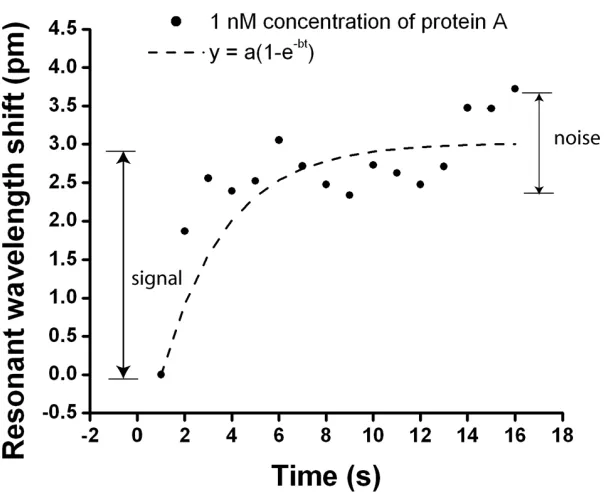
Region of human IgG). An example microtoroid response trace for a 1.0 nM concentration of protein
A shows a measured resonance shift of the toroid with a signal-to-noise ratio (SNR) of >3 in 15 seconds (Figure 1.3), significantly faster than the Biacore performance at 3 nM (Figure 1.1B). The
Biacore, and other emerging label-free biodetection techniques such as cantilevers [51], are in general
slower, with steady state response times of up to hours. The fast response times of the microtoroids
offer advantages for applications such as high throughput analyses and medical diagnostics. This
data was taken via the conventional swept-frequency method in which the laser continuously scans
through a range of wavelengths to find the resonance wavelength of the microtoroid.
Quantitative parameters such as equilibrium dissociation constants (Kd, the concentration of
analyte that produces a response at half saturation) can be extracted from the microtoroid from
a dose-response curve. For the Biacore, this involves plotting the steady state beam deflection for
a series of concentrations; for the microtoroids this involves plotting the steady state resonance
wavelength shift. Figure 1.4 compares the dose-response curves for the Biacore and microtoroid
sensors, using the same Protein A-IgG interaction pair as used in Figure 1.3. Good agreement of the
the sparse (N = 1) data set. Interestingly, the dose-response curve of the toroid is steeper (Hill
Figure 1.3: Response trace for a microtoroid WGM resonator. The resonance wavelength shifts within seconds to a new value after a 1 nM solution of protein A is flowed onto a toroid functionalized with the Fc region of human IgG. The response to the flow rate of 50µl/min is fit adequately by a simple exponential (r2 = 0.7).
A
B
1.3
What is the true limit of detection? The single molecule
controversy
In 2007, a paper was published by in Science [52] claiming to have detected single molecules using the
microtoroid, however, this result was met with considerable skepticism [27, 53–55]. In this report, an
antibody directed against interleukin-2 was non-specifically bound to the surface of the microtoroid
and a low concentration of interleukin-2 was flowed by. Sudden, step-like changes in resonance
wavelength were taken to be the response of the microtoroid to single molecules. As expected, the
rate of these events linearly scaled with concentration (but the amplitude did not) and followed
Poisson binding statistics in time as would be expected for single molecule detection. In addition,
an experiment was performed in which fluorescently tagged molecules were bound to the microtoroid
so that their unitary photo-bleaching could be used to “count” molecules. Unitary blue shifts in
the resonance wavelength and corresponding increases in the quality factor of the microtoroid were
seen, as anticipated when particles with large absorption cross-sections bleach or un-bind from the
microtoroid.
In support of these experiments, a thermo-optic model was proposed to explain the step-like
shifts from single molecules binding [52]. The thermo-optic theory proposed that the local heating
of the toroid would result from the large circulating power interacting with single molecules bound
to the toroid. The temperature dependence of the index of refraction would thereby amplify any
wavelength shift as single molecules bound to the toroid. The molecular cross-sections used to
calculate the expected shifts from a single molecule, however, were recorded as more than a factor
of a 1000 too large, calling into question the reported match between experiment and theoretical
prediction [54, 56]. As stated in [54]:
Thus, the model as developed in [52] does not predict the experimentally observed steps, given
the real absorbance cross sections. A correction was later published retracting the model [57]. As a
further point of controversy, the results have yet to be repeated [53, 55].
Linear theory suggests that the shift is dependent purely on index of refraction changes in the
evanescent field due to the binding of a molecule, and not on the quality factor of the toroid or
laser power [54]. Arnold, et al., computed the ratio of the contribution from the linear reactive
mechanism to the thermo-optic mechanism for both a sphere and a toroid and found that the
contribution from the thermo-optic mechanism should only be 40% of the linear mechanism, and
not several thousand times larger as was initially predicted [52]. Therefore, we expect the observed
shift to be approximately predicted by the linear mechanism alone by at least within a factor of 2.
This greatly simplifies the model.
Questions have also been raised regarding the high binding rate of molecules to the microtoroid’s
surface. Squires et al., [51] modeled based on pure diffusion what the time between binding events
should be and arrived at an estimate of one event every six to seven seconds for a molecule of
diffusivityD= 10µm2/s and a concentration of 10 fM. Furthermore, Squires et al., calculated that equilibrium should take around one hour to reach. Recent work by Arnold, et al., has shown that
microspherical optical resonators generate optical trapping forces that cause significantly enhanced
(100×) nanoparticle transport velocities [58]. We anticipate this effect to be even greater in our frequency-locked system as we are always on resonance as opposed to sweeping past resonance, thus
increasing the amount of circulating power our devices experience. This significantly increases the
expected particle encounter rate. Our rates are consistent with the binding rates from nanowire
experiments which report saturation from the binding of thousands of molecules within seconds at
similar concentrations [10]. We note that the binding rates from our experiments and from nanowire
experiments are dramatically faster than the mass transport predicted by Squires et al. A full
analysis of the mass transport in this system remains unavailable, and the discrepancy between
Chapter 2
Microtoroid creation and
experimental setup overview
2.1
Toroid fabrication
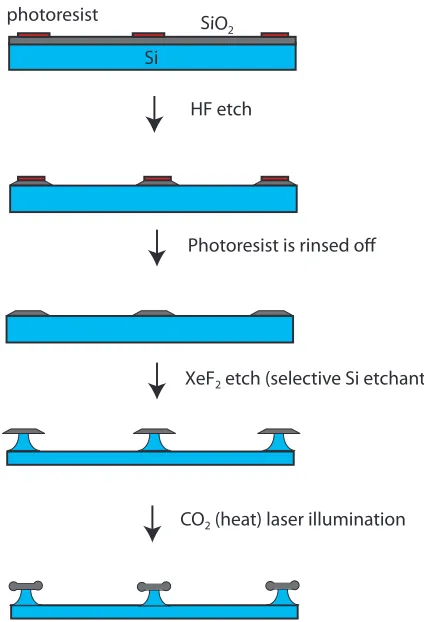
Microtoroids are fabricated using a combination of lithography and etching techniques [44]. An
overview of this process may be seen in Figure 2.1. First, circular pads of photoresist are patterned
on top of a silicon wafer with a 2 micron thick thermal oxide layer. After patterning, the areas
in between the circular pads are etched away using hydrofluoric acid, leaving behind a silicon pad
with an SiO2 top. The silicon pad is selectively undercut using XeF2 etching to form a pillar. This
structure is known as a microdisk. To generate an atomically smooth surface finish, the microdisk is
melted or reflowed using a CO2 laser. This process collapses the microdisk into a smooth structure
known as a microtoroid. To further ensure high quality factors, we used intrinsic silicon wafers.
These wafers have been doped with a less than typical amount of Boron. The presence of Boron
lowers the index of refraction of the microtoroid and has been shown as a result to lower the quality
Si
SiO2
photoresist
HF etch
Photoresist is rinsed off
XeF2 etch (selective Si etchant)
CO2 (heat) laser illumination
Figure 2.2: SEM micrograph of an array of microtoroids. Toroids are fabricated on a silicon wafer following the procedures of [44]. Toroid fabrication was performed using the cleanroom facilities at the Kavli Nanoscience Institute (KNI), Caltech.
2.2
Modification of CO
2laser reflow system
One significant challenge in creating microtoroids, is the successful creation of microtoroids with
ultra-high (>108) quality factors. This requires extremely uniform heating of the toroid when it
is in the microdisk stage. To improve our yield of ultra-high-quality microtoroids, we implemented
a flat top laser beam shaper (Edmund Optics) made out of ZnSe that converts the Gaussian laser
beam input from our CO2 laser to a collimated flat output beam. As shown in Figure 2.3, the flat
top laser beam shaper provides more uniform illumination and therefore a more uniform reflow of
the microdisk. A schematic of the CO2 laser reflow system may be seen in Figure 2.4. Because the
wavelength of the CO2laser light (10.6µm) is invisible to the human eye, the laser was first aligned using a Helium Neon laser at 633 nm. Some photographs of the setup are shown in Figure 2.5.
generator to the CO2 laser.
A
B
Figure 2.3: Uniform illumination of the microdisk allows for a symmetric toroidal structure to be created. To aid in this process, a flat top laser beam shaper was used. The effect of the flat top laser beam shaper may be seen by shooting the CO2 laser beam at a glass coverslip and looking at the shape of the melted glass. As shown in (A), before the addition of the beam shaper the beam spot is non-circular while as shown in (B), after the addition of the beam shaper the beam spot is very circular and uniform.
CO2 laser
flat top laser beam shaper
ZnSe plano convex lens ZnSe mirror
CCD
sample plane HeNe laser
mirror (flipped down during reflow process)
alignment laser beam steering mirrors
pinhole
pinhole
ZnSe beam combiner
CO2 laser
HeNe laser ZnSe mirror
Flat top laser beam shaper pinhole
Plano-convex focusing lens
ZnSe beam combiner
Sample holder HeNe
1
1
Figure 2.5: CO2 laser reflow system photographs. As shown in the photographs, the CO2 laser was hard mounted onto an air floated optical table for stability. The beam was steered using ZnSe mirrors and aligned through two pinholes. Finally, the beam was focused onto the microdisk sample using a plano-convex ZnSe lens. For visualization purposes a beam combiner which passes light at
10.6µm and reflects light at 633 nm was placed before the sample so that the visible light could be
reflected through an imaging column and towards a camera.
2.3
Optical fiber pulling setup
There are several ways of coupling light into microresonators, including direct illumination, prism
coupling, and tapered optical fiber coupling. Of these, we use evanescent coupling from a tapered
optical fiber because of its low loss [60–62]. In a typical optical fiber, the cladding and large diameter
of the fiber prevents evanescent light from leaking out of the fiber. In our case, we want the evanescent
mode to leak out from the part of the fiber adjacent to the toroid. This can be easily achieved by
removing the cladding from the fiber in this region and by pulling on the fiber to shrink its diameter
in this region. When the fiber’s diameter is on the order of or smaller than the optical wavelength,
a significant amount of optical power is carried in the evanescent field of the fiber. When the toroid
is brought within this evanescent field, light naturally couples from the fiber to the toroid and back
again. It is important to develop a repeatable method for thinning the fiber in a small region, which
Briefly, a spool of single mode optical fiber was purchased from Newport and about a meter was
unwound. One end of the spool was fiber coupled into the laser, while a 1 cm portion of cladding
was removed from the middle of the unwound section. Removing the cladding changes the index of
refraction of the optical fiber making it multi-mode, so the optical fiber is simultaneously thinned
and pulled until it can only support one mode again. The first step in this procedure is washing the
portion of the optical fiber that has had the cladding removed with isopropanol alcohol and clamped
on either end with magnetic clamps. The assembly was mounted above a hydrogen torch and the
fiber was simultaneously heated and pulled in opposite directions at 60µm/min using two stepper motors (Edmund Optics). To make the heating and thus the thickness of the optical fiber more
uniform, the hydrogen torch was dithered horizontally (Figure 2.6(a) and Figure 2.6(b)) at 1 Hz.
Pulling was stopped when the fiber became single mode (i.e., when the core diameter reduced to a
diameter at which only one mode of light propagation was supported). This was visually estimated
to occur when the laser light through the optical fiber stopped blinking and therefore we could
conclude that significant intensity fluctuations had stopped. The end of the optical fiber was then
cleaved and inserted into an auto-balanced photodetector using a bare fiber adapter. A typical waist
stepper motor
stepper motor optical fiber
hydrogen torch (dithered horizontally at 1 Hz)
(a) Optical fiber taper puller schematic.
hydrogen torch
motor controller CCD
viewing microscope
stepper motor stepper motor
motor to dither torch
taper holder taper
(b) Optical fiber taper puller picture.
Figure 2.6: (a) Schematic of the optical fiber taper puller. To thin the optical fiber sufficiently such that the majority of the light is carried evanescently, the optical fiber is heated using a hydrogen torch and pulled using two stepper motors. To enable more uniform heating of the optical fiber, the hydrogen torch was dithered at a frequency of 1 Hz. (b) Photograph of the optical fiber taper puller. The optical fiber is held in place using a custom machined holder with magnetic clamps. Two stepper motors pull the optical fiber in opposite directions while a hydrogen torch heats the fiber. For visualization purposes, an imaging column with a low (10×) magnification objective and CCD camera is positioned such that a side view of the optical fiber may be seen while pulling occurs.
2.4
Testing setup
Once an optical fiber has been pulled, the resonance peak of the microtoroid may be found by
first bringing the toroid into close proximity to the optical fiber using a three-axis nanopositioner
(Physik Instrumente). The coupling efficiency of light into the toroid may be tuned by controlling
the distance between the optical fiber and the microtoroid [56]. A schematic of the testing setup
is shown in Figure 2.7. Two imaging columns are placed perpendicular to each other to generate a
top view and a side view image of the microtoroid so that the microtoroid may be visually aligned
that reflects infrared light was placed in front of both imaging light sources. Some photographs of
the setup may be seen in Figure 2.8. A schematic of the toroid positioned in relation to the optical
fiber is shown in Figure 2.9.
top illumination
side illumination
nanopositioner
light
ligh
t
CCD
C
CD
50/50 beam splitter
hot mirror
hot mirror
nanopositioner
3-axis stage
taper holder toroid
fiber spool top viewing column
enclosure to minimize air currents laser
fiber spool
auto-balanced detector
top viewing column
top view side view
22 mm
1 mm
side view
6.4 mm
optical fiber
top view
inlet syringe
8.4 mm
Chapter 3
Improving the signal-to-noise ratio
using laser frequency locking
3.1
Introduction
The main hurdle for single molecule detection is improving the signal-to-noise ratio such that the one
molecule can be distinguished from background. Typically with whispering gallery mode resonators,
molecular binding events are detected by continuously scanning the input frequency of a laser using
a function generator and monitoring transmission dips in the optical fiber output that occur when
Oscilloscope Pump (~633 nm)
Histogram of Binding Events Frequency Scanning
Step finding
Figure 3.1: Overview of a conventional scanning method for tracking resonant wavelength shifts using a microtoroid optical resonator. In this system, the wavelength of a tunable laser is continuously scanned through a range of wavelengths using a function generator to locate the resonant wavelength of the microtoroid. The output of the scan is detected using a photodetector and the results are displayed using an oscilloscope.
Once resonance is found, the wavelength trace is recorded and curve fit to find the peak. Tracking
the centroid of the peak over time generates a data set to which steps may be fit and a histogram
of binding events may be created. This method takes a long time and has accuracy limited to the
rate (typically 100 Hz for a conventional tunable laser system such as New Focus 6300) and range
at which the laser is being swept.
Our frequency locking approach is an improvement over prior scanning systems that
continu-ally sweep back and forth over a large frequency range (3.1×10⁴ fm, only occasionally matching resonance. In contrast, our work directly tracks the resonant wavelength location within a narrow
and adaptively varied frequency range with a fixed length of 19 fm. Thus we track discrete
fluctu-ations in signal more accurately and quickly, permitting slight and transient events to be detected
(Figure 3.2). Frequency locking feedback control has been used in applications such as in scanning
tunneling microscopy to maintain tip-surface separation [63]; however, to the best of our knowledge
b a
x +
PID
error signal
laser detector
dither
Time avg microtoroid c
+
x
Wavelength (λ)
T
o
ro
id
re
sp
o
n
se
(d)
We measure the amount the laser shifts to stay on resonance (d)
new location
computer
Figure 3.2: (a) Rendering of a microtoroid coupled to an optical fiber (not to scale). In our system, a frequency-tuned laser beam is evanescently coupled to a microtoroid (∼90 microns in diameter) using an optical fiber (red). At resonance, light (red curved arrow) coming out of the microtoroid destructively interferes with light going straight through the optical fiber (red arrow), causing a dip in the transmission (peak in absorption) vs. light wavelength. (b) Conceptual basis for particle detection. The laser frequency (red solid line) is locked to the resonance frequency of the microtoroid (blue line). As particles bind, the resonant frequency of the microtoroid shifts to a new location (green dotted line). We measure the control signal needed to keep the laser locked to the microtoroids new resonance frequency (red dashed line). (c) Block diagram of the sensing control system. A small high-frequency dither is used to modulate the driving laser frequency. When multiplied by the toroid output and time-averaged, this dither signal generates an error signal whose amplitude is proportional to the difference between the current laser frequency and resonant frequency. This error signal is sent to a PID controller whose output is used to set the laser frequency, thus completing the feedback loop. A computer records the observed frequency shifts.
This approach has two main advantages:
1. Continuously staying on resonance. We are tracking the peak with greater accuracy.
2. Sampling more points per second. We sample at 20 kHz vs. 100 Hz which permits more
averaging. At present, we have achieved millisecond time resolution with the potential for
microsecond time resolution as we are limited only by the speed of our electronics.
3.2
System Overview
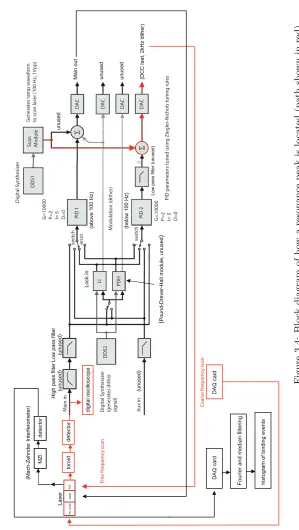
Locking the laser frequency to the resonance frequency of the microtoroid is first achieved by finding
the location of the resonance peak by using conventional scanning methods (Figure 3.4). The quality
Oscilloscope and Balanced Detector Pump (~633 nm)
Histogram of Binding Events Data acquisition card
Feedback controller
Toptica
Computational filtering and step finding Control signal
Figure 3.3: An overview of the frequency locking method for peak tracking. In this system, as op-posed to continuously scanning through a range of wavelengths to locate the resonant wavelength of the microtoroid, a feedback controller continuously tunes the wavelength of the laser to the resonant wavelength of the cavity. By measuring the amount of voltage it takes to keep the wavelength of the laser matched to the resonant wavelength of the cavity, changes in resonant wavelength may be more accurately monitored.
may be determined by curve fitting to a Lorentzian using a custom-written LabVIEW program as
d io d e H ig h p a s s f ilt e r (unused) L o w p a s s f ilt e r (unused) (D C C I s e t, 2 kH z d it h e r) L o c k i n (u n u s e d ) ( P o u n d -D re v e r-H a ll m o d u le , u n u s e d ) to ro id d e te c to r L o w p a s s f ilt e r (u n u se d ) u n u s e d M Z I (M a c h -Z e h n d e r In te rf e ro m e te r) d e te c to r D A Q c a rd Fouri e r a n d me d ia n f il te ri n g h is to g ra m o f b in d in g e v e n ts (a b o v e 1 0 0 H z ) (b e lo w 1 0 0 H z ) PZ T L a s e r swit ch swit ch er ror Ma in o u t u n u s e d u n u s e d G=10 0 0 0
P=2 I= 5 D=0 G=10
0
0
0
P=2 I= 5 D=0
PID pa ramet ers tun ed usin g Ziegler -N ich ols t un ing rules Dig it a l S yn th esiz er G en er a tes r a mp w a v ef or m to sca n la ser ( 1 0 0 H z, 1 V pp ) Dig it a l S yn th esiz er (gener a tes dith er sig n a l) iz e r G en G en G en G en G en G en G en G en G en to to to sca 0 C oarse fr equenc y scan D A Q c a rd DC mo tor Fine fr equenc y scan d ig it a l o sci llo sco p e M odula tion (dit h er) DDS2
PID 1 PID 2
DDS1
S
can Module
Non-linear curve fit to a Lorentzian Max iterations: 10
While Loop
Input signal from A/D card
coefficients matrix Write to spreadsheet
Extract portion of signal
Display of signal and curve fit
Plot of Q value over time
Figure 3.5: Sequence of operations how the quality factor of a microtoroid is measured over time.
After the peak is found, frequency locking is achieved using a lock-in regulator system
(Dig-ilock 110, Toptica Photonics). Briefly, a digital synthesizer generates a dither (sinusoidal external
reference waveform) signal. This dither signal is sent directly to the laser diode which dithers the
frequency over a small range around the resonance peak. This response is detected by a high speed
auto-balanced photodiode (Nirvana, New Focus) and sent to a lock-in error signal generator which
multiplies the modulated signal with the output from the photodiode to create an error signal. An
explanation of why this generates an error signal is given in Section 3.3. The error signal which
repre-sents the difference between the laser frequency and the cavity resonance, is then minimized by being
sent to two proportional-integral-derivative (PID) feedback controllers. The first controller handles
fast (>100 Hz) fluctuations while the second controller handles slow (<100 Hz) fluctuations. These
controllers attempt to match the laser frequency with the cavity frequency by outputting the
appro-priate voltage needed to minimize the error signal. This output voltage is converted to wavelength
A general overview of the system is presented in Figure 3.6. Although the controller can output a
dither signal up to 10 MHz, in the experiments presented in this thesis, a dither signal of 2 kHz was
used. We note that the dither signal is removed in pre-processing and therefore does not limit the
d io d e H ig h p a s s f ilt e r (unused) L o w p a s s f ilt e r (unused) (D C C I s e t, 2 kH z d it h e r) L o c k i n (u n u s e d ) ( P o u n d -D re v e r-H a ll m o d u le , u n u s e d ) to ro id d e te c to r L o w p a s s f ilt e r (u n u se d ) u n u s e d M Z I (M a c h -Z e h n d e r In te rf e ro m e te r) d e te c to r D A Q c a rd D ig it a l lo w p a s s f ilt e r H is to g ra m o f b in d in g e v e n ts (a b o v e 1 0 0 H z ) (b e lo w 1 0 0 H z ) PZ T L a s e r swit ch swit ch er ror Ma in o u t u n u s e d u n u s e d G=1 00 00
P=2 I= 5 D=0 G=1
00
00
P=2 I= 5 D=0
3.3
Conceptual Model
An intuitive understanding of how the feedback controller generates an error signal that is sent
to the laser controller may be seen in Figure 3.7. Because the resonance peak (given by L(x) = 1
π
0.5Γ
(x−x0)2+(0.5Γ)2) of the microtoroid is symmetric it is difficult to know on what side of the peak
the laser frequency is located. The derivative of the original signal, however, may be readily used to
locate the center of the peak as it crosses zero at the center and is antisymmetric around the peak.
This makes the derivative a good error signal for the feedback loop as if the laser is to the left of
the peak the error is positive, and if the laser is to the right of the peak, the error is negative. Zero
error is achieved at the top of the peak.
−60 −4 −2 0 2 4 6
0.05 0.1 0.15 0.2 0.25 0.3 0.35
x
L(x)
−6 −4 −2 0 2 4 6
−0.25 −0.2 −0.15 −0.1 −0.05 0 0.05 0.1 0.15 0.2 0.25
L’(x)
x
Figure 3.7: Lorentzian (Γ = 1) and its derivative. The derivative is antisymmetric about the peak
As shown in Figure 3.8, because the toroid response and the dither signal are in phase on the
left side of the peak, the result of the demodulation (multiplying and taking the time average), is
positive. On the right side of the peak, the toroid response and the dither signal are out of phase
−3
0
−2
−1
0
1
2
3
0.1
0.2
0.3
0.4
x
L(x)
−3
−2
−1
0
1
2
3
−0.2
−0.1
0
0.1
0.2
L’(x)
x
DitherToroid response in phase
Toroid response out of phase
error signal negative error signal
positive
Figure 3.8: Conceptual basis for how the error signal is generated. Demodulating (multiplying and taking the time average) the dither signal with the toroid response gives the derivative.
3.4
Symbolic Model
We can show that the error signal is the derivative of the unmodulated toroid response as follows.
Letd(t) = sinω(t) be the dither signal andI =g(λ) be the toroid response to a given wavelength
v1(t) = βg(λ)≈β
[
g(λ0) + ∂g
∂λ
λ=λ0
(λ−λ0)
]
= β
[
g(αv0) +¯ ∂g ∂λ
λ=αv¯0
(αv0−αv0)¯
]
,
(3.1)
where the central wavelength, λ0, for the Taylor expansion was chosen to be αv0, where ¯¯ v0 is the time average ofv0 over times somewhat longer than the period of the dither signal. The reason for this will become clear shortly. Asv0(t) =d(t) +e(t),we have ¯v0=e(t).
The lock-in amplifier is designed to generate an error signal based on the time average of the
product of the dither signal and the measured photodiode signal:
e(t) = ⟨d(t)·v1(t)⟩
=
⟨
sinω(t)β
(
g(αe(t))) + ∂g
∂λ
λ=αe(t) αsinω
)⟩
=
⟨
βg(α(e(t))) sinωt+αβ ∂g
∂λ
λ=αe(t) sin2ωt
⟩
= 0 +
⟨
αβ ∂g
∂λ
λ=αe(t)
(
1
2−cos 2ωt
)⟩ =1 2αβ ∂g ∂λ
λ=αe(t)
(3.2)
Thus, the error signal generated by the lock-in amplifier is indeed proportional to the derivative of
the unmodulated toroid response,∂g/∂λ.
3.5
PID Control
PID controllers are the most common feedback control system [65]. They are designed for a system
to reach a setpoint as quickly as possible by outputting a control signalu(t) based on the following three component algorithm:
u(t) =kpe(t) +ki ∫ t
0
e(τ)dτ+kd
de
where,e(t) is an error signal, andkp,ki, andkdare tuning parameters that represent proportional
gain, integral gain, and derivative gain, respectively. This is represented in block diagram form in
Figure 3.9.
PID 1 + 2
e(t)
P
I
D
Σ
PID out
+
+
+
Figure 3.9: Block diagram of the PID feedback controller. The error signal from the lock-in regulator is sent to the PID controller. The contributions from the P, the I, and the D, components are multiplied by the error signal and summed to give a signal that causes the controller to reach its set point in a quick and stable way.
Proportional gain produces an output that is proportional to the error, integral gain produces
an output that is proportional to the integral of the error and derivative gain produces an output
that is proportional to the derivative of the error. In this way, proportional gain takes care of the
present error, integral gain takes care of past errors, and derivative gain attempts to predict future
errors through linear extrapolation by calculating a slope.
The values for the PID controllers are set by using a heuristic known as the Ziegler-Nichols
tuning rules that help the system stabilize as quickly as possible. Essentially the overall gain of
the controller is increased until the system oscillates. The gain at which this occurs is denoted as
Ku and the period of oscillation of the system is denoted asTu. The values for proportional gain,
integral time, and derivative time are then given as follows: kp = 0.6Ku, ki= 0.6Ku/(0.5Tu), and
kd= (0.6Ku)(0.125Tu) [65]. The rise and settling times for our system were characterized by sending
3.6
Converting voltage to wavelength using a Mach-Zehnder
interferometer
The voltage the feedback controller sends to the laser controller to adjust the wavelength of the laser
may be converted to a wavelength using a calibration factor determined from the distances between
fringes of a fiber Mach-Zehnder interferometer (MZI). A MZI was created by splitting the output
of the laser into two paths using a 50/50 visible coupler (New Focus). A delay was added in one of
the paths by adding an additional fiber that was several meters long. The output was recombined
using another 50/50 coupler and sent to a photodiode whose output was displayed on an oscilloscope
screen (Figure 3.10). As the laser frequency changes as the laser piezo voltage is being swept, the
output of the MZI changes in a fringe sinusoidal pattern. One can compare how much voltage is
put on the piezo with how the laser frequency changes by counting the fringes.
∆λ
The fringe spacing may be calculated as follows: Let ∆z be the difference in length between
the two fibers. A peak occurs if ∆z=Nλn, whereN is an integer number,nis the fiber refractive index andλis the free space wavelength of the light carried by the optical fiber. Therefore, the free spectral range is:
∆λ = λN−λN+1 = n∆z
N −
n∆z
N+ 1
= n∆z(1
N −
1
N+ 1)
= n∆z( 1
N2+ 1)≈
n∆z
N2 (3.4)
We can calculateN based on the approximate wavelength of the laser being used (λN = 635 nm):
N =n∆z
λN
. (3.5)
Therefore,
∆λ = n∆z
(nλ∆z
N )
2
= λ
2
N
n∆z. (3.6)
From Figure 3.10, the calibration factor ∂V∂λ = ∆∆Vλ, where V is the voltage applied to the piezo. UsingλN = 635 nm,n= 1.6 (optical fiber core) [66], and ∆z = 3 meters, gives a ∆λof 8.3×10⁻⁵.
Given that there are 11 peaks in 8×10⁻⁵ seconds (Figure 3.10), this gives a calibration factor of 0.031 nm/V.
3.7
Verifying peak tracking
We tested whether or not our system was adequately tracking the toroid resonance by turning on the
the refractive index of the microtoroid and/or causes thermal expansion, the toroid’s resonance
frequency shifts upon heating from the lamp [67].
Figure 3.11: Tracking the resonance peak of the toroid in response to heating. As the toroid heats and the resonance peak location shifts, the controller outputs voltage to track the peak. Heating was applied using a microscope lamp. The lamp was turned on at 5.8 seconds.
To prevent resonance frequency shifts due to heating from the microscope lamp during
experi-ments, a hot mirror that reflects infrared light back to the lamp, was added in the light path between
both lamps and the microtoroid to minimize the heating effects noticed above.
3.8
Determining the noise level of our system
We calculate the noise level of our system before frequency locking was implemented to be ∼ 1 pm (Figure 3.12). This was calculated by taking the standard deviation over 10 seconds of data
after HEPES buffer was introduced to the system under stopped flow conditions. Our experimental
system and conditions are described in more detail in 4.2.1. To computationally eliminate thermal
0 10 20 30 40 50 60 −3
−2 −1 0 1 2 3 4 5 6
Time (s)
Resonan
ce
w
av
elength shift (pm)
data
data after polynomial fit has been subtracted
Figure 3.12: Noise level of system before frequency locking is implemented. The noise level was calculated from the RMS over 10 seconds of buffer data to be∼1 pm.
calculating the standard deviation (Figure 3.12, red line). After frequency locking is implemented,
we calculate the noise level of our system to be∼0.07 fm (Figure 3.13). We calculate the standard deviation over 60s in Figure 3.12 and over 10s in Figure 3.13 because in older case, the sampling
frequency was less due to a different data acquisition card and so we get better statistics sampling
over a larger time scale. If we calculate the noise level (standard deviation) over 1 ms intervals
which is the approximate time between binding events for our r = 2.5 nm nanoparticle experiments,
this number reduces further to∼9.6×10⁻⁴fm. This represents an average over 20 data points for 10,000 intervals. We note that the noise level decreases when averaging over smaller time intervals
as our noise is not white noise. Before this number was calculated, we first computationally filter
0 2 4 6 8 10 −1
0 1 2 3 4 5 6
Time (s)
Resonan
ce
w
av
elength shift (fm)
data
data after polynomial fit has been subtracted
Figure 3.13: Noise level of system after frequency locking is implemented. The noise level was calculated from the RMS over 10 seconds of buffer data to be 0.07 fm. Over 1 ms this number reduces to∼9.6×10⁻⁴ fm.
3.9
Why does frequency locking enable the detection of smaller
particles?
The primary reason that frequency locking enables the detection of smaller particles is because
of its much faster time resolution (0.5 ms) compared to the temporal resolution of a conventional
frequency-sweep method. This faster response time improves the detection method via multiple
mechanisms:
1. Small particles have short residence times, requiring quick response. Because small particles
experience greater Brownian forces, reduced van der Waals adhesive forces, and reduced optical
trapping forces, they do not bind for long periods of time, but instead are rapidly ejected from
toroid’s evanescent field due to thermal fluctuations. For example, the r = 2.5 nm beads studied here bind for only 1.5 ms, on average. For a conventional frequency-swept system, it
2. Rapid response times reduce noise for moderate to long residence times/times between
subse-quent particles by permitting averaging or low-pass filtering of the data. For a step duration of
timeT, the uncertainty in the plateau height is proportional to√τ /T, whereτis the response
time. This reduction of error is analogous to the reduction in standard error of the mean when
making multiple measurements of the same system.
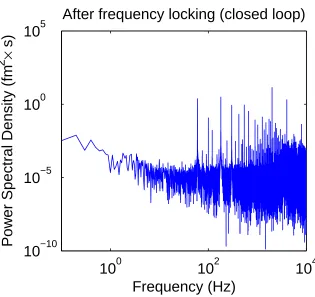
3. The noise in our system is not white. Instead, as shown in the power spectrum resulting from a
measurement of pure buffer solution (Figure 3.14), the noise amplitude is significantly greater
at frequencies below 10 Hz than it is at frequencies between 10 Hz and 1000 Hz. (Note the spikes
at frequencies greater than 10 Hz represent known narrow-band known noise sources, e.g., 60
Hz electrical noise and its harmonics, which we easily filter out and do not affect the ultimate
noise level of our measurements.) The higher noise levels below 10 Hz likely stem from physical
effects such as thermal drift, fluid convection, or environmental vibrations. By using a system
that can identify events occurring more rapidly than 10 Hz, the low-frequency noise sources do
not contribute significant error to our measurements, whereas they significantly impact slower
frequency-swept systems. This reduces the relevant noise floor in our experiments, enabling
10
010
210
410
−1010
−510
010
5Frequency (Hz)
Power Spectral Density (fm
2
×
s)
After frequency locking (closed loop)
Figure 3.14: Noise level of system after frequency locking is implemented. The power spectrum of a typical buffer data set after the addition of feedback control. The tallest peaks correspond to known noise sources and their multiples.
3.10
Open and Closed Loop Laser Noise Analysis
In this section, we discuss efforts to analyze the noise present from the laser. Note that additional
further post-processing is used to filter our data and further reduce noise levels.
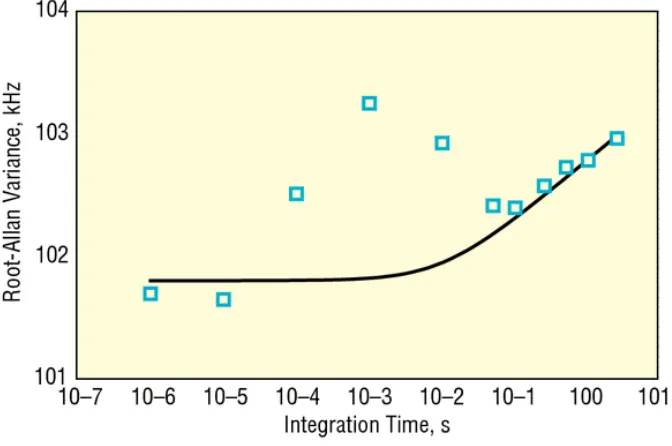
From specifications given by the laser manufacturer, Figure 3.15, we estimate our laser frequency
fluctuations to be ∼100 kHz when sampled at a repetition rate of 2 kHz. This corresponds to a noise level of 0.1 femtometers. This number is further reduced by post-processing to remove known
sources of noise and a median filter. We note that longer PID integration times act as a filter to
reduce noise, however, if too much of the signal is filtered, then locking cannot occur.
To more precisely analyze the noise present from the laser, one method would be to construct
fluctu-ations. To reduce intensity noise from the laser, one can monitor the output of the interferometer
using a balanced detector, which subtracts out the noise due to laser intensity fluctuations.
There-fore, the signal from the photodetector will represent the frequency response of our system without
contamination from intensity noise from the laser.
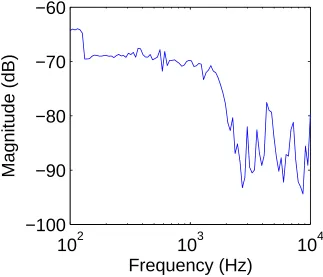
We also provide a Bode plot (Figure 3.16) of our system when the laser is locked to a microtoroid.
This gives the closed loop frequency response of our system. From Figure 3.16, we can see that
our controller responds strongly to laser frequency fluctuations up to repetition rates of ∼ 2 kHz (controller bandwidth), while faster fluctuations cannot be accurately tracked. This shows that our
controller stays locked up to a frequency of 2 kHz.
10
2
10
3
10
4
−100
−90
−80
−70
−60
Frequency (Hz)
Magnitude (dB)
Chapter 4
System characterization
4.1
Data processing
4.1.1
Overview
Our data processing occurs in two main steps:
1. filter the data to reduce noise
2. find step (binding) events in our data using a step finding algorithm
In order to obtain the best approach for our system for our system we compared several methods.
Remove unwanted frequencies: replace unwanted frequencies with 0 replace unwanted frequencies with nearby surrounding values
mean filter
median filter
total variation denoising
step finding algorithm of Kerssemakers, et al.
generate histogram of binding events Apply non-linear filter:
Find steps:
Process data:
Experimental steps: Specific approaches attempted:
Red box indicates optimal path
Figure 4.1: An overview of our data processing procedure representing all approaches tested. The optimal paths are shown inside the red box.
4.1.2
Filtering
We digitally filter our data to eliminate known sources of noise. We record the voltage of our
feedback controller outputs at 20,000 Hz using a 24-bit National Instruments data acquisition card
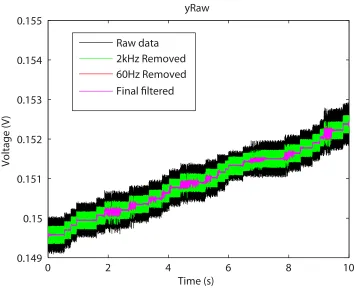
(NI-PCI-4461). The signal that we record is corrupted by the dither signal, which is at a frequency
that we specify and so we may easily filter out. We accomplish this by taking the Fourier transform
of the data in MATLAB (see Appendix A) and multiplying it with a matrix that is set to 1 for the
values we wish to retain and set to 0 for the values we wish to discard. In this manner, we also filter
out 60 Hz electronic line noise and all of its subsequent multiples (120, 180, 240, etc.) (Figure 4.2).
We also remove 100 Hz as empirically it was found that the experiments in the lab had 100 Hz noise.
An example of our filtering procedure being performed is shown in Figure 4.3 which represents
data from the selective binding of exosomes (r∼20 nm vesicles) to the microtoroid’s surface. These experiments are discussed in more detail in Section 5.3. We pick exosomes to demonstrate our data
processing technique as they are large biological molecules with clearly observable steps. We show
that the same data processing works for smaller molecules in Section 6. The corresponding time
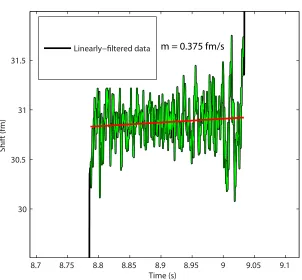
actually have a slight slope (m= 0.38 fm/s) (Figure 4.5(a)) that is the same order of magnitude as
the slope seen in linearly filtered buffer data (m = 0.16 fm/s) (Figure 4.5(b)). A slope is present
in the buffer (no molecule) data due to index of refraction changes caused by heating due to the
resonant recirculation of light within the microtoroid [67].
raw data
FFT
x
FFT
-1
filtered data
filter
raw freqs
1
1
1
0
0
1
0
2
4
6
8
10
0.149
0.15
0.151
0.152
0.153
0.154
0.155
yRaw
Time (s)
Voltage (V
)
Raw data
2kHz Removed
60Hz Removed
Final filtered
Frequency (Hz)
FFT
P
o
w
er Spec
.
(a) Filtering a raw data set.
100 200 300 400 500 600 700 800 900 1000
10−10
10−5
Frequency (Hz)
FFT Power Spec
.
(b) Zoom-in of power spectrum.
8.7 8.75 8.8 8.85 8.9 8.95 9 9.05 9.1 30
30.5 31 31.5
Time (s)
Shi
ft (fm
)
Linearly−filtered data m = 0.375 fm/s
(a) The plateau region of the particle binding data in Figure 4.3 has a slight slope.
7.5 8 8.5 9 9.5 10
3.5 4 4.5 5 5.5 6 6.5 7
Time (s)
Resonan
ce
w
av
elength shift (fm)
m = 0.164 fm/s
(b) Buffer (no molecule) data has a slight slope as well.
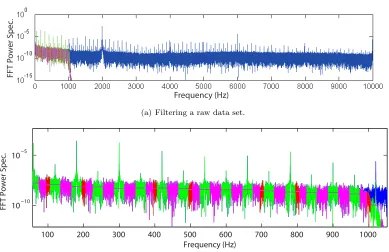
For comparison, we also tried replacing unwanted frequencies with values close to the local
surrounding values as opposed to zero. An example of this filtering method being performed is
shown in Figure 4.4(a). A more clear zoomed in inset of the filter is shown in Figure 4.4(b).
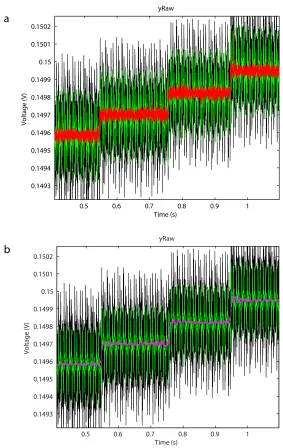
A comparison between the final filtered data and the filtered data in Figure 4.3 may be seen in
Figure 4.6. As shown in Figure 4.6, replacing unwanted frequencies with zero results in a cleaner
0.5 0.6 0.7 0.8 0.9 1 0.1493
0.1494 0.1495 0.1496 0.1497 0.1498 0.1499 0.15 0.1501 0.1502
yRaw
Time (s)
Voltage (V
)
0.5 0.6 0.7 0.8 0.9 1 0.1493
0.1494 0.1495 0.1496 0.1497 0.1498 0.1499 0.15 0.1501 0.1502
yRaw
Time (s)
Voltage (V)
a
b
Figure 4.6: Zoomed in comparison between replacing unwanted frequencies with nearby frequencies (a) and replacing unwanted frequencies with zero (b). The green trace shows the data after the 2 kHz dither signal has been removed. Red represents the data after 60 Hz electronic line noise and its multiples has been removed, and magenta shows the final filtered data. Replacing unwanted frequencies with 0 results in better a signal-to-noise ratio.
4.1.3
Median filtering
After removing unwanted frequencies, we can further improve the signal-to-noise ratio by applying a
of the window. This method is often preferred over the moving average as the moving average may
smooth out desired steps. To determine the optimal window size for our data, we experimented with
several different window sizes. Figure 4.7 shows the data after applying the zero filter with median
filters of varying window sizes applied. From Figure 4.7 we conclude that a window size of 1001
points (total data length is 200,000 points or 10 seconds) is optimal.
0 2 4 6 8 10
−50 −40 −30 −20 −10 0 10 20 30 40 50
y With Median Filters
Time (s)
Shift (fm
)
Linearly−filtered data Median Window 5 Median Window 11 Median Window 101 Median Window 1001
(a) Median filters of varying window sizes being applied to the data.
5.4 5.6 5.8 6 6.2 6.4 6.6
0 5 10 15 20 25
y With Median Filters
Time (s)
Shift (fm
)
Linearly−filtered data Median Window 5 Median Window 11 Median Window 101 Median Window 1001
(b) A zoom in of median filters of different window sizes being applied
Figure 4.8 shows an overlay of the linearly filtered data before and after the median filter with
a window size of 1001 has been performed.
0 1 2 3 4 5 6 7 8 9 10
−50 −40 −30 −20 −10 0 10 20 30 40 50
Linear filtered data (black) and Median filtered data with window size 1001 (red)
Time (s)
Shift (fm)
Figure 4.8: A time trace of the data after a median filter of 1001 points has been performed (red).
4.1.4
Total variation denoising
We also examined the effects of applying a noise removal technique known as total variation denoising
(TVD) to our data. TVD is a signal processing technique developed by Rudin in 1992 [68] that
has been shown to reduce noise while preserving sharp edges. The algorithm works by finding an
approximate signal that is close to the original signal but with less variation (noise). TVD has been
reported to be better at detecting step like events than either a mean or median filter [69].
In more detail, the algorithm minimizes the sum of two terms: (1) a measure of how close the
approximate signal is to the original signal and (2) an expression for the variation. The variation
V(y) of a signal may be defined as:
V(y) =∑
n
One measure of how close an approximate signal (yn) is with the data trace (xn) is the sum of square
errors between the two:
E(x, y) =1
2
∑
n
(xn−yn)2 (4.2)
The sum of these two may be written as:
E(x, y) +λV(y) (4.3)
where λ is a user-defined parameter known as the regularization parameter that affects that amount of denoising that occurs. Ifλis too small, no denoising will occur, however, ifλis too large, a flat line will result (i.e., variation will be minimized, but the approximation signal will look nothing
like the input signal). The goal of TVD is to find aynsuch that Equation 4.3 is minimized. For our
work we use code provided by Max Little [69]. Fig