Available Online at www.ijcsmc.com
International Journal of Computer Science and Mobile Computing
A Monthly Journal of Computer Science and Information Technology
ISSN 2320–088X
IJCSMC, Vol. 2, Issue. 11, November 2013, pg.222 – 229
RESEARCH ARTICLE
An Effect and Analysis of Parameter
on Ant Colony Optimization for
Solving Travelling Salesman Problem
Km. Shweta
1, Alka Singh
21
Computer Science & Engineering, GBTU, India
²Computer Science & Engineering, GBTU, India
1
[email protected]; 2 [email protected]
Abstract—Ant Colony optimization has proved suitable to solve a wide range of combinatorial optimization (or NP-hard) problems as the Travelling Salesman Problem (TSP). The first step of ACO algorithm is to set the parameters that drive the algorithm. The parameter has an important impact on the performance of the ant colony algorithm. The basic parameters that are used in ACO algorithms are; the relative importance (or weight) of pheromone, the relative importance of heuristics value, initial pheromone value, evaporation rate, and a parameter to control exploration or exploitation. In this Paper we present the effect of parameter on ACO algorithm for solving Travelling Salesman Problem for 52 nodes.
Keywords— Ant Colony Optimization; Parameter tuning in ACO; Travelling salesman problem
I.INTRODUCTION
II.TRAVELLING SALESMAN PROBLEM
Its statement is quiet simple, but yet remains one of the most challenging problems. The problem state that there given a set of cities, a salesman needs to visit all cities without having any redundancy of city except the starting and finish city such that the traversed path is optimal. It comes under the set of NP Hard problem which means the problem complexity increases exponentially as the size increases. If salesman need to travel “n” cities then there are (n-1)! Different tours and it is known as asymmetric TSP. For the symmetric case there are many distinct solutions (n-1)! /2 for “n” cities[2]. The application range of TSP is very wide some of them are mentioned below:
Distribution of goods and resources
Planning Bus lines
Machine Scheduling
Integrated Circuits
planning, logistics, and the manufacture of microchips
III.ANT COLONY OPTIMIZATION
Ant Colony optimization belongs to wider field of swarm intelligence. Swarm intelligence is a nature inspired approach which mimics the behaviors of insects and of other animals.
A. Ant System
Ant System is very firstalgorithm of ACO, it has its own historical importance. Ants deposit a certain amount of pheromone while walking, and each ant probabilistically prefers to follow a direction rich in pheromone [3] Initially, ants are put on randomly chosen city. In path construction step ant k currently at city i select the next city j by using probabilistic transition rule
[τ ij (t)]α [ ij]β if j Jk(i)
∑k ε allowed[τ ik (t)]α [ ik]β
ρ kij(t) =
0 otherwise (1)
ij is heuristic visibility, ij = 1/dij, α and β are two parameter which can be tuned to
determine importance of the pheromone trail and heuristic visibility, Jk(i) is the feasible neighbourhood of ant k which is not yet visited. The pheromone τij, associated
with the edge joining cities i and j, is updated as follows
τij=(1-ρ).τij(t)+m∑∆τkij (2) k=1
IV.EXPERIMENT AND ANALYSIS
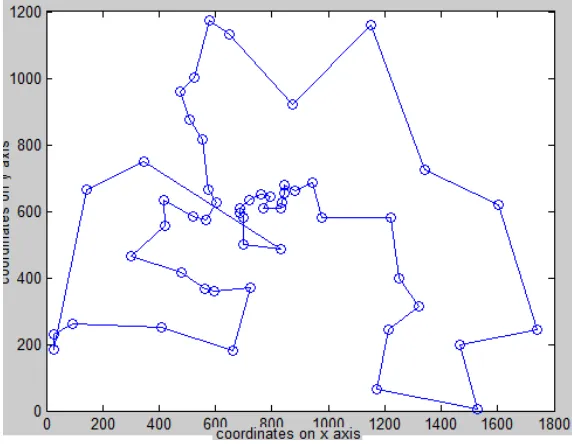
For Experiment we take Berlin52 city problem and find out the solution, with the help of Matlab tool , the important parameter is tuned to observe the effect as well as to find the parameter for which solution is optimal. At last the deep analysis is done to understand the variation of parameter.
Fig. 1. Berlin 52 Node Problem
A. Pheromone Factor
Keep the other parameter still; adjust the value of α to get results
Fig. 2. Graph
The result obtained by experiments and graph it is clear that as α increase , the greater
possibility of ants choose the path belong to the previous tour will be, in the new tour. In ant
system α indicate the importance of collected pheromone on the edges.
B. Heuristic factor
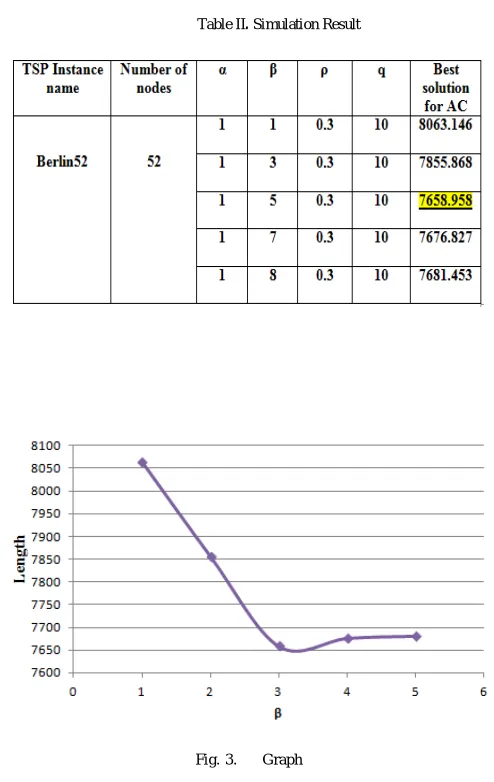
Keep the other parameter still; adjust the value of β to get results.
As the increase of β, the possibility of ants choosing the local shortest path will increased the speed of convergence gets faster. To get optimal solution, algorithm must get balance between global optimization and fast convergence.
C. The Residue Coefficient of Pheromone
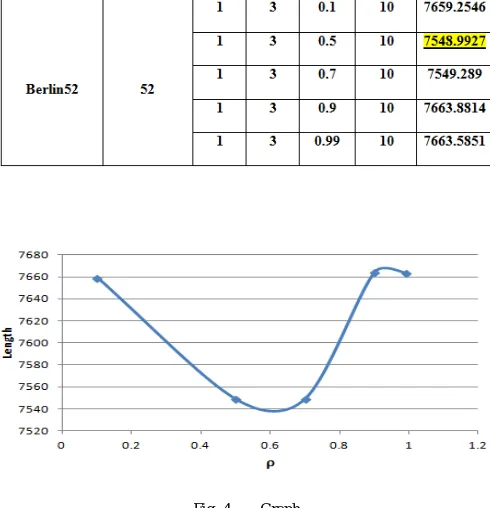
Keep the other parameter constant; tune the value of ρ to get results.
Table III. Simulation Result
Fig. 4. Graph
The residue of pheromone left by ant on the edge evaporates with time. The parameter ρ
directly effect the global search capability as well as randomness. When the number of nodes increases, the pheromones on the path which will never be traversed become 0.
D. The Amount of Pheromone
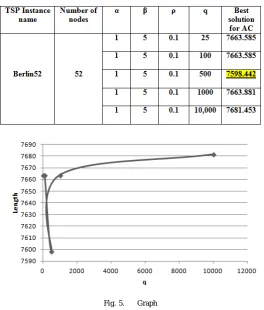
Table IV. Simulation Result
Fig. 5. Graph
By the above shown graph we can summarize that the effect of amount q to the performance
depends on the three parameters (pheromone factor α, heuristic factor β and the residues coefficient of pheromone ρ)
V.RESULT
Fig. 7. Evolution of best length.
VI.TEST AND COMPARE
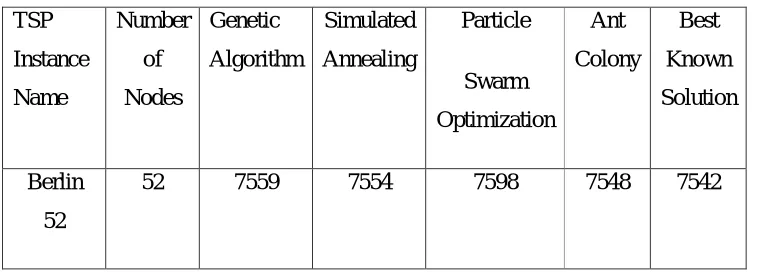
The performance of ACO was compared with the performance of other naturally inspired
global optimization methods: simulated annealing (SA) genetic algorithm (GA), Particle
Swarm Optimization (PSO) results as follows:
Table V. Comparison Table
TSP Instance Name Number of Nodes Genetic Algorithm Simulated Annealing Particle Swarm Optimization Ant Colony Best Known Solution Berlin 52
52 7559 7554 7598 7548 7542
The Quality of the produced solutions is given in terms of the relative deviation
from the optimum, that is
deviation (%)=100*(aco -opt)/ opt
Where ac denotes the cost of the optimum found by ant colony algorithm, and opt is the cost of the optimal solution. Relative deviation for 52 nodes is 0.079
VII.CONCLUSION
REFERENCES
[1] Dorigo, M., Maniezzo V. and Colorni A,” The ant system:Optimization by a colony of cooperating agents”. in IEEE Transactions on Systems, Man and Cybernetics- Part B
Cybernetics, Vol 26(1), pp: 29-41, 1996.
[2] Atif Ali Khan, Muhammad Umair Khan and Muneeb Iqbal ”Multilevel graph partitioning scheme to solve Travelling Salesman Problem,” in Ninth International
conference on Information Technology, 2012.