A CLUSTER BASED EXPENDITE MESSAGE
AUTHENTICATION PROTOCOL FOR VANETS
A.M.Suhavaneswari
1A.Muthukrishnan
2 1PG Student, Anna University, Chennai. Regional Centre Madurai, Tamilnadu, (India)
2
Faculty, Anna University, Chennai. Regional Centre Madurai, Tamilnadu, (India)
ABSTRACT
It is well recognized that security plays a vital for the reliable operation of vehicular ad hoc networks
(VANETs). One of the critical security issues is the revocation of misbehaving vehicles, which is essential for the
prevention of malevolent vehicles from other vehicles. Vehicular ad hoc networks (VANETs) adopt the Public
Key infrastructure (PKI) and Certificate Revocation Lists (CRLs) for their security. In any PKI system, the
confirmation of a received message is performed by checking if the record of the sender is included in the
current CRL, and verifying the validity of the certificate and signature of the sender. The proposed scheme is an
Expedite Message Authentication Protocol (EMAP) for VANETs, which replaces the time-consuming CRL
checking process by an efficient revocation checking process. The revocation check process in EMAP uses a
keyed Hash Message Authentication Code shared only between non revoked On-Board Units (OBUs). EMAP
can decrease the message loss ratio due to the message verification delay compared with the conventional
authentication methods employing CRL. By conducting security analysis and performance evaluation by NS2
simulator tool, EMAP is demonstrated to be secure and efficient.
Keywords:
Message Authentication, Certificate Revocation
I INTRODUCTION
The ad hoc network (VANET), as a special kind of mobile ad hoc network, has been subject to extensive
research efforts not only from the government but also from academia and the automobile industry in recent
years. Different from the traditional ad hoc networks, the VANET contains not only mobile nodes—vehicles—
but stationary roadside units (RSUs) as well. Due to this hybrid architecture, the VANET introduces new
methods to facilitating road safety and traffic management and providing multimedia services for vehicles on
the road. According to the dedicated short-range communications (DSRC) [1] in road safety-related
applications, each vehicle equipped with onboard units (OBUs) will broadcast routine traffic messages with the
information of position, current time, direction, speed, acceleration/deceleration, and traffic events, etc. With
this information, drivers can be better aware of their driving environment and take early action to respond to an
security and privacy issues in VANETs must be resolved [2]–[5]. Without security and privacy guarantees, an
adversary to a VANET can either false information to delude other drivers, and even cause a purposeful traffic
accident, or track the locations of the interested vehicles by collecting their routine traffic messages. The ad hoc
network (VANET), as a special kind of mobile ad hoc network, has been subject to extensive research efforts
not only from the government but also from academia and the automobile industry in recent years. Different
from the traditional ad hoc networks, the VANET contains not only mobile nodes—vehicles—but stationary
roadside units (RSUs) as well. Due to this hybrid architecture, the VANET opens new doors to facilitating road
safety and traffic management and providing multimedia services for vehicles on the road. According to the
dedicated short-range communications (DSRC) [1] in road safety-related applications, each vehicle equipped
with onboard units (OBUs) will broadcast routine traffic messages with the information of position, current
time, direction, speed, acceleration/deceleration, and traffic events, etc. With this information, drivers can be
better aware of their driving environment and take early action to respond to an abnormal situation, such as a
traffic accident. However, before putting this attractive application into practice, security and privacy issues in
VANETs must be resolved [2]–[5]. Without security and privacy guarantees, an adversary to a VANET can be a
false information to mislead other drivers, and even cause a deliberate traffic accident, or track the locations of
the interested vehicles by collecting their routine traffic messages. Therefore, how to achieve unidentified
authentication has become a fundamental requirement for securing VANETs. To ensure reliable operation of
VANETs and increase the amount of authentic information gained from the received messages, each OBU
should be able to check the revocation status of all the received certificates in a timely manner. Most of the
existing works overlooked the authentication delay resulting from checking the CRL for each received
certificate. In this paper, we introduce an expedite message authentication protocol (EMAP) which replaces the
CRL checking process by an efficient revocation checking process using a fast and secure HMAC function.
EMAP is suitable not only for VANETs but also for any network employing a PKI system. To the best of our
knowledge, this is the first solution to reduce the authentication delay resulting from checking the CRL in
VANETs
II RELATED WORK
In spontaneous vehicular communications, the primary security requirements are identified as entity
authentication, message integrity, non-repudiation, and privacy preservation. Deploying an efficient PKI is a
well-recognized solution for achieving security and privacy for practical vehicular networks [6], [7]. Although
VANETs have recently gained extensive attention, very few works have addressed the design of a PKI that is
suitable for the security requirements of VANETs. In [6], Hubaux identifies the specific issues of security and
privacy challenges in VANETs and claims that a PKI should be well deployed to protect the transited messages
and to mutually authenticate among network entities. In [1], Raya and Hubaux use a classical PKI to provide
secure and privacy-preserving communications to VANETs. For this approach, each vehicle needs to preload a
huge pool of anonymous certificates. The number of the loaded certificates in each vehicle should be large
enough to provide security and privacy preservation for a long time, e.g., one year. Each vehicle can update its
number of certificates in each vehicle incurs inefficiency for certificate management, as revoking one vehicle
implies revoking the huge number of certificates loaded in it.
Lin et al. [7] use the group signature in [10] to secure the communications between vehicles. For the group
signature technique, any group member can sign messages on behalf of the group without revealing its real
identity. Signatures can be verified using the group public key, thus providing excellent privacy for the users, as
the identities of the users are revealed in neither signing nor verifying a message. However, the delay incurred in
this technique to verify a signature is linearly proportional to the number of revoked vehicles. In this paper the
reprogramming protocols are discussed and also classify the different reprogramming protocols. SDRP is the
distributed protocol which supports multiple users simultaneously and also it is important in large-scale sensor
networks used by different users from both public and private sectors. The security to this protocol is provided
by Elliptic curve encryption Scheme but the Elliptic Curve Integrated Encryption Scheme (ECIES) is the best
Encryption scheme. The research focuses on achieving secrecy using ECIES algorithm for encryption, and
authentication using Hashing technique.
III EXPEDITE MESSAGE AUTHENTICATION PROTOCOL
The proposed EMAP uses a fast HMAC function and novel key sharing scheme employing probabilistic random
key distribution
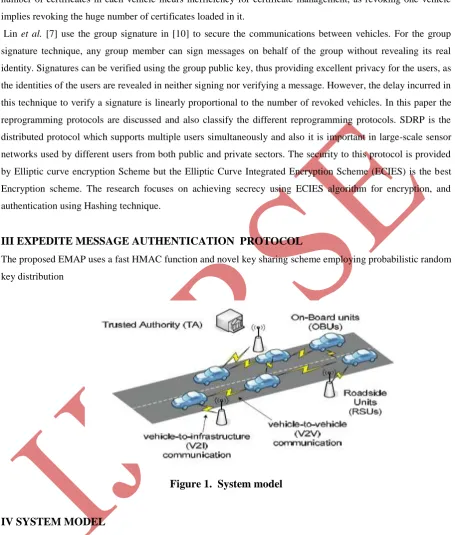
Figure 1. System model
IV SYSTEM MODEL
As shown in Fig. 1, the system model under consideration consists of the following:
1. A Trusted Authority, which is responsible for providing anonymous certificates and distributing secret keys to
all OBUs in the network.
2.Roadside units (RSUs), which are fixed units distributed all over the network. The RSUs can communicate
securely with the TA.
3.OBUs, which are embedded in vehicles. OBUs can communicate either with other OBUs through V2V
V SYSTEM INITIALIZATION
The TA initializes the system by executing Algorithm 1. PK iudenotes the ith public key for OBUu, where the
corresponding secret key is SKu. PIDi u denotes the ith pseudoidentity (PID) for OBUu, where the TA is the
only entity that can relate PIDi to the real identity of OBUu; sigTA and (PID||PKi) and PKi is the signature .|| is
the concatenation of PIDi and PKiu .C is the number of certificates loaded in each OBU
Algorithm 1. System initialization
1: Select two generators P;Q € GG1 of order q,
2: for i ->1,l do
3: Select a random number ki € Zq 4: Set the secret key K=kiQ €GG1
5: Set the corresponding public key K= P/KI
6: end for
7: Select an initial secret key Kg € GG2 to be shared between all the non-revoked OBUs 8: Select a master secret key s € ZZ
9: Set the corresponding public key PS=SP
10: Choose hash functions H:{0,1}
11: Select a secret value v € ZZ and V00=V
12: for i 1; j do . to obtain a set V of hash chain values
13: Set VI=h(v-1)
14: end for
15: for all OBUu in the network, TA do
Announce H, h, P, Q, and P to all the OBUs
VI MESSAGE AUTHENTICATION
Since we adopt a generic PKI system, the details of the TA signature on a certificate and an OBU signature on a
message are not discussed in this paper for the sake of generality. We only focus in how to accelerate the
revocation checking process, which is conventionally performed by checking the CRL for +every received
certificate. The message signing and verification between different entities in the network are performed as
follows:
6.1 Message Signing
Before any OBUu broadcasts a message M, it calculates its revocation check REVcheck as REVcheck =
HMAC(Kg; PIDk||Tstamp)2 where Tstamp is the current time stamp, and = HMAC(Kg; PIDk||Tstamp)2is the
hash message authentication code on the concatenation of PIDu and Tstamp using the secret key Kg. Then,
OBUu broadcasts
M||Tstamp||certu(PIDuPKusigTA(PIDu||PKu))||sigu(M||Tstamp)|| REVcheck)
6.2 Message Verification
Any OBUy receiving the message (M||Tstamp||cert(PIDu;PKu;sigTA(PIDu||PKu)Tstamp REVcheck can verify
it by executing Algorithm 2.
Algorithm 2. Message verification
1: Check the validity of Tstamp
2: if invalid then
3: Drop the message
4: else
5: Check REVcheck = HMAC(Kg : PIDukTstamp)
6: if invalid then
7: Drop the message
8: else
9: Verify the TA signature on certOBUu
10: if invalid then
11: Drop the message
12: else
13: Verify the signature sig(M||Tstamp) using OBUu
public key PKu
if invalid then
15: Drop the message
16: else
17: Process the message
18: end if
19: end if
20: end if
21: end if
VII PERFORMANCE EVALUATION
Authentication Delay compare the message authentication delay employing the CRL with that employing
EMAP to check the revocation status of an OBU. As stated earlier, the authentication of any message is
performed by three consecutive phases: checking the sender’s revocation status, verifying the sender’s
certificate, and verifying the sender’s signature. For the first
authentication phase which checks the revocation status of the sender, we employ either the CRL or EMAP. For
EMAP, we adopt the Cipher Block Chaining Advanced Encryption Standard (CBC-HMAC AES and Secure
Figure 2.Packet Delivery Ratio
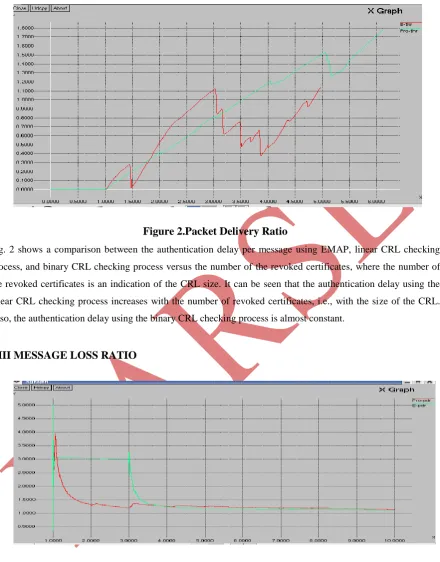
Fig. 2 shows a comparison between the authentication delay per message using EMAP, linear CRL checking
process, and binary CRL checking process versus the number of the revoked certificates, where the number of
the revoked certificates is an indication of the CRL size. It can be seen that the authentication delay using the
linear CRL checking process increases with the number of revoked certificates, i.e., with the size of the CRL.
Also, the authentication delay using the binary CRL checking process is almost constant.
VIII MESSAGE LOSS RATIO
Figure 5 Throughput Ratio
[
The average message loss ratio is defined as the average ratio between the number of messages dropped every
300 msec, due to the message authentication delay, and the total number of messages received every 300 msec
by an OBU. It should be noted that interested in the message loss incurred by OBUs due to V2V
the road condition every 300 msec. In order to react properly and instantly to the varying road conditions, each
OBU should verify the messages received during the last 300 msec before disseminating a new message
about the road condition. Therefore, we chose to measure the message loss ratio every300 msec
IX CONCLUSION
In this paper the reprogramming protocols are discussed and also classify the different reprogramming
protocols. SDRP is the distributed protocol which supports multiple users simultaneously and also it is
important in large-scale sensor networks used by different users from both public and private sectors. The
security to this protocol is provided by Elliptic curve encryption Scheme but the Elliptic Curve Integrated
Encryption Scheme (ECIES) is the best Encryption scheme. The research focuses on achieving secrecy using
ECIES algorithm for encryption, and authentication using Hashing technique.
REFERENCES
[1]. H. Chan, A. Perrig, and D. Song,(2003) ―Random Key Predistribution Schemes for Sensor Networks,‖
Proc. IEEE Symp, Security and Privacy, pp. 197-213, 2003.
[2]. L. Eschenauer and V.D. Gligor,(2002) ―A Key-Management Scheme for Distributed Sensor
Networks,‖ Proc. ACM Conf. Computer and Comm. Security, pp. 41-47, 2002.
[3]. J.J. Haas, Y. Hu, and K.P. Laberteaux,(2009) ―Design and Analysis of a Lightweight Certificate
Revocation Mechanism for VANET,‖ Proc. Sixth ACM Int’l Workshop Vehicular InterNetworking,
pp. 89-98, 2009.
[4]. K.P. Laberteaux, J.J. Haas, and Y. Hu,(2008) ―Security Certificate Revocation List Distribution for
VANET,‖ Proc. Fifth ACM int’l Workshop Vehicular Inter-NETworking, pp. 88-89, 2008.
[5]. R. Lu, X. Lin, H. Luan, X. Liang, and X. Shen,(2012) ―Pseudonym Changing at Social Spots: An
Effective Strategy for Location Privacy in Vanets,‖ IEEE Trans. Vehicular Technology, vol. 61, no.
1,pp. 86-96, Jan. 2012.
[6]. Y. Sun, R. Lu, X. Lin, X. Shen, and J. Su,(2010) ―An Efficient Pseudonymous Authentication Scheme
with Strong Privacy Preservation for Vehicular Communications,‖ IEEE Trans.Vehicular Technology,
vol. 59, no. 7, pp. 3589-3603, Sept. 2010.
[7]. A. Wasef and X. Shen, (2008) ―PPGCV: Privacy Preserving Group Communications Protocol for
Vehicular Ad Hoc Networks,‖ Proc. IEEE Int’l Conf. Comm. (ICC ’08), pp.1458-1463, 2008.
[8]. A. Wasef, Y. Jiang, and X. Shen, (2010) ―DCS: An Efficient Distributed Certificate Service Scheme
for Vehicular Networks,‖ IEEE Trans.Vehicular Technology, vol. 59, no. 2 pp 533-549, Feb. 2010. [9]. A. Wasef and X. Shen,(2009) ―EDR: Efficient Decentralized Revocation Protocol for Vehicular Ad
Hoc Networks,‖ IEEE Trans. Vehicular Technology, vol. 58, no. 9, pp 5214-5224, Nov. 2009
[10] S. Zhu, S. Setia, S. Xu, and S. Jajodia,(2006) ―GKMPAN: An Efficient Group Rekeying Scheme for