IN THIS
ISSUE
The New Research in Pesticides.... _.__.__. ___________ _.._. _._ _..._____ _ .._________ W. B. Ennis, Jr. Reindeer Ranching in Fennoscandia. _____ ______ .___._...___ __ __....I_._.____ George W. Scatter Range Study Tour in the Soviei Union ______.____. ___ _._...____.___. . ..C. Kenneth Pearse Time of Burning as it Affects Soil Moisture in an Ordinary Upland Bluesfem Prairie in the Flint Hills _______.___..___.._.__..__ _ .___. __ ____ . . . ..KZing L. Anderson Grass Seedlng Response fo Halogefon Compe~i~ion...C. Wayne Cook Species Composition Changes in Seeded Grasslands Converied from Chaparral ____.___ . . ..C. M. McKeZZ, Victor W. Brown, Charles F. Walker, and R. M. Love Damage fo Mesquite, Lehmann Lovegrass, and Black Grama by a Hoi June
Fire ____________.__ ___. _ __._ _ ___.._. ____________ ____ ___.____________.__ ________. ____.___._ ._________ Dwight R. Cable Pesticides: Perils and/or Benefiis fo Wildlife ____ ___ __... _ ._._._. William I-I. Lawrence Chemical Composifion and Digestibility of Plants from Annual Range and
from Pure-Stand Plots... ._.____ _ ._._._ _______-_.____ _..__._.... _ __.___.-.-. George M. Van Dyne Vegetation Response fo An Ozark Woodland Spraying
L. K. Halls and H. S. Crawford 297 301 305
311 317
321
326 329
332
336 Technical Notes:
Hurricane Sourgrass: Scourge or Blessing! ___._._. _._____.__ ._._. __ ._.._.__. ..B. Zra Judd 341 Cesium-137 In Bromus fecforum L. In Relation fo Precipitation Regimes
and Harvest Yields... . ..__._______ _ _____.___._ _____._.___ .__.._...__._..__. . . ..W. H. Rickard 343 Control of Prickly Burnef (Poferium spinosum L.) in Rangelands of
Southern Judean Foothill Region __..._.____. N. G. Seligman and J. K&sir 343 Management Notes:
Control of Saw Palmetto and Recovery of Native Grasses
Lewis L. Yarlett 344 An Improved AUM for Range Caffle~... _________. ___._ .___..___._ . ..John F. VaZZentine 346 Book Reviews:
Readings in Resource Management and Conservation N. Keith Roberts 346 Curreni Literature .__.____.___ ________._.._ _..__.___________ ._.___ ____ __._ _______ ____.__._ ___.________.__.____._________.___ News and Nofes... _.._______ _ _..____._.__.____________ _ ___________.____ _ ___. . _____.___._._._ _ ____ ___.__.____________..___ Leffer fo the Ediior ____._.___ ____ _._._..__.._.______.__ __ _.__._ ________ .____._______._.__..._ _._._ .____ ___________________.____ With the Sectiozis ___.. ___________ .._____ _.._._____________ ____ _______.__________ ..__ ____.____ ____ _ ____ _..________________________ Society Business . . .._ ___._..___ .______..__...._.. ______ _.__ ____._______ ______ ____ __.. ___ _____ ___ ____ ______________________________
Message from the President _________._____._______ I __.____._ _ _.______._.______._ _ _.____ C. H. Wasser Program Ninefeenih Annual Meeting: Feb. 1-4, 1966... ..__ _____ Convention Preview: New Orleans... .___._._ ___.__ ._...____ _._ ._____ ___._.__________._._____ . . . .
348 352 354 354 356 356 359 363 Index .__..._.__________.____.______._..__.._..___ _.__ ._..___. _._.__._.._ ..___._. _ ____.__... _ ___... _.____._._ .____ _ .___._._ ______.____ 366
Cover Phot~FIorida
Grasses Increase after palmetto control
See prize-winning picture story by Lew YarleffJourncd of
Volume 18, Number 6 November, 1965RANGE MANAGEMENT
The New Research in Pesticide2
W. B. ENNIS, JR.Crops Research Division, AgriculturaZ Research Service, U. S. Department of Agriculture, Beltsville, Maryland
Highlight
Agricultural pests cause fremen- dous losses and they must be con- trolled. Pesticides are essential but in using them adequate safeguards and operational procedures are nec- essary fo proiecf against possible ad- verse effects on man, animals, plants, fish, wildlife, and ofher values in man’s environment. Interim and ex- panded research is underway fo curb the side effects of pesticides. Several new research approaches are being followed in affempfs fo cotitrol a wide range of pests.
Blights, plagues, weeds and in- sects have always dogged man’s attempts to produce food, feed, and fiber. Sometimes he has been able to control the pests. Often when he has not been able to do so, society has suffered and, on occasion, much of it has perished. Take for example the potato late-blight disease in Ireland which in 1845 and 1846 all but destroyed the potato crops. The potato crop was, and still is, a major source of food for the island. At least one mil- lion people died from starvation or from disease caused by poor nutrition. Farmers today can prevent such tragic and serious losses from plant disease epi- demics.
Year by year, despite an abun- dance of hand labor, crop plant- ings are lost in the tropics and
1 An invitational paper presented at the 18th Annual Meeting of the American Society of Range Man- agement, Las Vegas, Nevada, Feb- ruary 9-10, 1965.
other regions of high rainfall because of heavy weed competi- tion. Some crops can no longer be grown in places that have become infested with such pe- rennials as nutsedge, quack- grass, Johnsongrass and field bindweed. Rangelands and other grazing lands are frequently so overrun with brush or poisonous plants that livestock production is no longer profitable. Herbi- cides, combined with other methods, offer a new tool to push back the invaders that threaten agricultural production in many areas.
Insects ravage food and feed crops. They transmit diseases to plants, animals, and man, and constitute a nuisance in man’s environment. Insecticides have made possible the enhancement of the quality and amount of ag- ricultural products and they pro- tect the health of people against such diseases as malaria, typhus, and yellow fever.
History is replete with ex- amples of the ravages of pests. In situations where other meth- ods were ineffective and un- economical, necessity has f arced farmers and ranchers to adopt chemical methods for controlling weeds, insects, nematodes, and plant and animal diseases. Since 1940, more effective pesticides and more knowledgeable use of them have revolutionized Ameri- can farming methods. This revo- lution, based on technological
297
progress, has increased farm out- put by 60%. Today one farmer can feed 26 people, whereas in 1940 almost 8 million more farm workers were needed because of the farming techniques, crop varieties, fertilizers and pesti- cides available at that time. Pes- ticides have made a major con- tribution to this dramatic in- crease in efficiency.
Pesticides are essential, but in using them we must assure the public of operational regulations to safeguard and assure the wholesomeness of our food, feed, and drinking water, and to keep airborne fumes and pesticide spray from endangering health. I am pleased to report that an in- terim and expanded research effort is underway to curb the side effects of pesticides.
298
ENNIS
FIGURE 1. Pesticide Obstacle Course. Many hurdles must be overcome before a pesticide is marketed and used by ranchers and farmers.
tional activities are emphasizing
pesticide safety more and more.
Scientists know of no instance
of human cancer caused by reg-
istered pesticide. Despite wide-
spread use of pesticides, the wild-
life population is in many in-
stances increasing.
We must
make doubly certain that pesti-
cides are not hazards through
contaminating our ground water,
streams, and lakes, and that resi-
dues and degradation products
in the environment have no real
significance. Research must be
continued, to improve pest-con-
trol procedures by chemical, bi-
ological, cultural, and whatever
other methods may be needed to
render pest control entirely safe.
To insure the safety and effec-
tiveness of the pesticides used in
this country, many painstaking
procedures are already followed
(Fig. 1). These involve an in-
creasingly difficult
obstacle
course for pesticides before they
reach our farms and ranches. To
determine whether a pesticide
will pass or not pass the require-
ments of this obstacle course,
many scientists and private and
public agencies are making their
essential contribution. Each of
these obstacles represents an as-
sessment of the usefulness, or
the safety, or both, of the chemi-
cal to be offered for sale to
ranchers, farmers, and others.
The first contribution is made
by the chemical industry which
synthesizes, screens,
and dis-
covers the biological activity of
a new compound and determines
- sometimes cooperatively with
scientists in public institutions-
that it has utility for controlling
weeds, plant diseases, insects,
nematodes, or other pests. Re-
search determines whether it
may be acutely toxic to animals,
and its chronic effects-whether
it is likely to leave residues on
food or feed, or to have a harm-
ful effect on fish and wildlife, or
their habitat.
Along with the work done by
the chemical industry, scientists
in public agencies are making
an intensive study of the effec-
tiveness of the potential pesti-
tidal compounds for controlling
specific pests. They determine
the dosages required, as well as
the best method of application
for maximum effectiveness at
the smallest dosage, at the least
cost, and minimum least adverse
side effects on .other values in
the environment.
Research is also being con-
ducted on selected pesticides to
determine their mechanism of
action, their degradation
in
plants, animals, soil or water;
and their beneficial or possibly
adverse effects on fish and wild-
life. Many agencies are involved
in this effort.
There are a number of ap-
proaches to the control of pests.
Nonchemical techniques have
been employed throughout re-
corded history. The mechanical
control of weeds and insects,
crop rotation for the control of a
number of pests, cultural and
management practices such as
plowing, cultivating, reseeding,
managed grazing, and the breed-
ing and selection of plants re-
sistant to pests are not new.
Natural predators and parasites
continually suppress
certain
pests; considerable emphasis is
placed on introducing the natu-
ral parasites and predators for
some of our more formidable in-
troduced insect and weed pests.
Since 1940, as we have said,
chemical pesticides have offered
the greatest potential for com-
bating crop and livestock pests.
Undoubtedly, pesticides will con-
tinue to play an important part
in American agriculture.
Progress with chemical control
hinges on various principles of
selective toxicity. That some sub-
stances affect only certain spe-
cies is paramount in all branches
of biological control. It is the
basis for synthesis and formula-
tion of effective herbicides that
kill weeds and leave the crop un-
harmed, and of insecticides and
fungicides that do not injure the
host plants.
PESTICIDES
299
and man above all. For example,
herbicides are selective because
they kill some plants without in-
juring others. This is one kind of
essential selectivity. But they
should also be required to kill
weeds without injuring man, do-
mestic animals, wildlife, and fish.
New Research Approaches
Research on pesticides has re-
cently been intensified to de-
velop application methods that
completely prevent or drastically
reduce the chances of contami-
nating environment.
I would like to cite examples
of research now underway and
on which progress is being made.
Reduction of Spray
Drift. -The drift of sprays and dusts of
pesticides from target areas has
long been recognized as a prob-
lem. When 2,4-D was first used
commercially almost 20 years
ago, the drifting of sprays and
dusts to cotton fields and vine-
yards was a critical problem.
Difficulty is still encountered in
using this compound, but gen-
erally speaking, guidelines have
been established to permit its
safe use to control weeds with-
out harming susceptible crops in
the vicinity. Similarly, the drift-
ing of insecticides to non-target
crops and pastures has some-
times produced residue problems.
Research is being conducted
by both private and public agen-
cies to devise principles, formu-
lations, and equipment for the
distribution of pesticides which
eliminate or minimize contami-
nation of bordering non-target
areas. For example, a lOO-ft boom
sprayer at Woodward,
Okla-
homa, permits spraying about
250 acres per lo-hour day of
rangeland for brush and weed
control. Spray drift is markedly
reduced as compared to that of
aerial application.
Special applicators have been
devised for helicopters and other
aircraft to deliver invert emul-
sions of sufficient droplet size
and uniformity to reduce drift.
Granules of pesticides
have
been developed with sufficient
specific gravity that target areas
can be hit, but without drifting
to adjacent areas.
A more recent development is
the use of a finely-ground water-
swellable polymer that absorbs
water solutions of particular pes-
ticides and can be sprayed as
discrete pre-sized particles that
do not drift appreciably.
Reducing
Dosage and Minimiz- ingResidues.-Where
treatment
of the soil rather than plant foli-
age is the objective, use of gran-
ular formulations promises to re-
duce residue problems. Granular
formulations are available which
do not adhere to the foliage but
which roll off to be deposited on
the surface of the soil in suffi-
cient concentration as to prevent
the growth of small annual
weeds and germinating weed
seeds. Granular formulations
may also be used to control in-
sects that inhabit or crawl on the
soil.
Surfactants, solvents, and vari-
ous other spray additives are be-
ing studied in relation to pesti-
cide selectivity and dosage re-
duction.
Some of these substances in-
crease toxicity of a herbicide
several-fold. In other instances
toxicity is unaffected. Under
some conditions, toxicity of one
herbicide may be increased by a
given surfactant, whereas the ac-
tivity of another herbicide may
be reduced by the same surfac-
tant. These effects of formulat-
ing agents can be exploited to
achieve the desired pest control,
yet reduce hazards to other
values in the environment.
Residual toxicity of herbicides
and other pesticides in the soil
can be markedly affected by
solvents and formulating agents.
For example, the solvent and
carrier of the herbicide EPTC
affect the persistence of the her-
bicide in the soil. EPTC persists
for a much shorter period where
kerosene rather than xylene, ace-
tone, and other carriers are used.
The differential effects of formu-
lating substances on the behavior
of herbicides and other pesti-
cides can be exploited to develop
methods for selective control of
pests and to minimize residues
of pesticides in the soil.
The use of a surfactant with
diuron for the post-emergence
control of weeds in cotton has
made possible the lowering of
herbicide dosage from 1 to %
pound per acre. Costs to the
grower and soil residue prob-
lems are both reduced.
R e d u c in g Volatilization, and Dosages, and Increasing Effec- tiveness of Pesticides. -
Tech-
niques and principles of apply-
ing pesticides are being de-
veloped to prevent loss of pesti-
cides to the air by volatilization,
and to reduce the amounts re-
quired for pest control.
For example, volatile herbi-
cides may be applied with pre-
cision in subsurface layers to ob-
tain weed control at lower do-
sage, and without volatilization
to the atmosphere. The technique
is illustrated as follows. The row
of the crop is divided into 3
bands: (A) the drill or point
where the crop seeds are planted;
and (B) and (C) the left and
right shoulders of the row, re-
spectively. Successful use of this
technique involves the subsur-
face application of the herbicide
EPTC on each side of the drill of
cotton and a preemergence sur-
face application of diuron over
the planted cotton seeds. These
treatments can be made with
special applicators mounted on a
tractor that prepares the seed-
bed; applies the EPTC subsur-
face; packs the seedbed; plants
the cotton seed; repacks the seed-
bed; and applies diuron to the
soil surface directly over the
planted seed. Good control of the
perennial, nutsedge, and annual
weeds is achieved.
300
ENNIS
seed planted in hills. Soil borne
disease organisms can be con-
trolled, yet unnecessary treat-
ment of other soil in the field
can be avoided.
Mechanism
of
Action and Metabolism of Pesticides. - In-creased attention is being given
to gaining an understanding of
how pesticides work to kill pests.
Their fate in plants, soils, ani-
mals and insects is also being
explored. For example, the ARS
has recently initiated a program
of research on the metabolism of
pesticides in plants, animals, and
insects in a new $2 million fa-
cility at Fargo, North Dakota.
Publicly-supported
basic re-
search along this line is being
conducted at a number of other
institutions.
An example of the progress al-
ready made towards selective
toxicity is based on differential
biochemical processes in plants.
For example, some plants will
convert within the plant, by beta
oxidation, the herbicidally inac-
tive 4- (2,4-DB) to the active 2,4-
D and thereby be killed. Other
plants that do not possess this
ability are not killed. Other com-
pounds may be detoxified by
certain plants and not by others.
For example, corn plants detoxi-
fy the herbicide, simazine, to a
non-phytotoxic compound
but
most weeds are not capable of
biochemically detoxifying sima-
zine and are killed. Such under-
standing of how herbicides act
to kill or not to kill plants pro-
vides bases for the development
of highly specific chemicals to
control pests without adverse
side effects.
Degradation of Pesticides in Soil and
Water.-Increased
re-
search is seeking to determine
the behavior and fate of pesti-
cides in soils and in water-how
long different pesticides persist
in different soils; how they move
in soils; how they are broken
down; and the nature of degra-
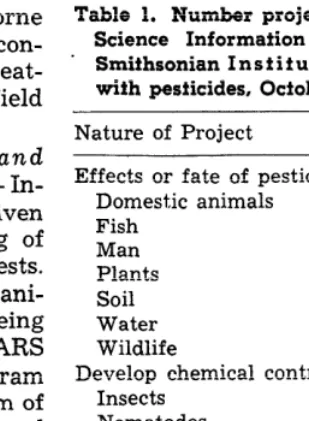
Table 1. Number projects on file ai Science Information Exchange,
. Smithsonian Insiitufion, dealing with pesticides, October 1964.
Nature of Project No. Effects or fate of pesticides
Domestic animals Fish
Man Plants Soil Water Wildlife
Develop chemical control of- Insects
Nematodes Plant Diseases Weeds
Other pests
9 12 4 200 76 22 28 116 56 229 205 52
dation products. Specific soil or-
ganisms that break down pesti-
cides are being studied and pesti-
cide effects on organisms deter-
mined.
Monitoring programs are soon
to determine the levels of pesti-
cides already in agricultural soils
and the changes that occur after
application, whether by farmers
or custom applicators. They will
also determine the amounts pres-
ent in waters that may adjoin
areas subject to heavy pesticide
treatment. Non-agricultural
agencies are involved in monitor-
ing pesticide levels in foods, in
potable
water supplies,
in
streams, and in man and wildlife.
The magnitude of the research
effort to determine the effects
of pesticides is illustrated by the
number of projects receiving
Federal support now on file with
the Science Information
Ex-
change at the Smithsonian Insti-
tution in Washington, D.C. (Table
1). The number of USDA re-
search projects dealing with toxic
or residual effects of pesticides
also gives a measure of this
effort (Table 2). The relative re-
search emphasis given different
pesticides in the USDA program
is shown in Table 3.
Many new projects not reflect-
Table 2. Federal projects dealing with toxic or residual effects of pesticides, January 1965.
Effects on:
- Number
Man 23
Animals 38
Animal Products i9
Wildlife 6
Fish 2
Beneficial Insects 7
Cereals 16
Oilseeds 2
Feeds & Forage 19
Fibers 7
Foods 6
Forest & Trees 10
Fruits 23
Nuts 2
Sugar Crops 5
Tobacco 7
Vegetables 15
Other Plants 19
Soils 21
Water 2
TOTAL 249
Table 3. Federal projects dealing with effects and fate of pesfi- tides.
Pesticides Number
Air Pollutants Bactericides Defoliants Fungicides
Hormones & Growth Regulators
Herbicides Insecticides Nematocides Other
14 84 18 111 125 125 380 30 9
ed in the tables are being initi-
ated in 1965,
Reindeer Ranching in Fennoscandia
GEORGE W. SCO!I’TERRange Ecologist, Canadian Wildlife Service, Department of Northern Affairs and National Resources, Edmonton, Alberta.
Highlight
Reindeer in Fennoscandia make use of a forage resource which would otherwise be of limiied value. This article discusses the status of reindeer ranching, ifs economics, and the attempts fo improve the animals and grazing practices.
In Russia and Fennoscandia hundreds of thousands of do- mesticated reindeer utilize the rangelands of the Arctic and Subarctic regions. Since vast areas in northern Alaska and northern Canada are suitable for similar production, I have al- ways had a strong desire to es- tablish closer contacts with co- workers in Northern Europe and to study their research tech- niques and management meth- ods. My employer, the Canadian Wildlife Service of the Depart- ment of Northern Affairs and National Resources, made it pos- sible for me to travel to Norway, Sweden, and Finland for this purpose during the summer of 1964. I am indebted to Mr. Skuncke, Dr. Ahti, and Dr. Skjenneberg who provided me with well-planned itineraries several months in advance of my visit. Such careful organization allowed me to see a good cross- section of the reindeer industry during my seven-week stay. Ap- preciation is also extended to others who provided me with such warm hospitality through- out my travels. My impressions of the reindeer industry follow. The reindeer population in Norway, Sweden, and Finland totals approximately 710,000 ani- mals (Table 1). These are all domesticated animals except for 40,000 wild reindeer in Norway and a few wild ones along the Finnish-Russian boundary. These reindeer graze approxi-
mately 40,000,OOO hectares (98,- 840,000 acres) and in 1963 they produced a revenue of $5,590,000
(Canadian) . In Sweden and
northern Norway the ownership of reindeer is largely restricted to Lapps. There is no such re- striction in southern Norway or Finland. Sweden has 50 grazing districts or siidas, with 34 in the mountains and 16 in the forests. About 2,800 families make their living totally or partially from the reindeer industry. In Nor- way 500 families own approxi- mately 150,000 reindeer. Rein- deer are owned by companies in southern Norway. In Finland some 500 families make their liv- ing from the reindeer industry. Additional families in the 62 grazing districts in Finland re- ceive part of their income from the reindeer industry. Most of the rangelands used by reindeer within the three countries are grazed without payment of fees. Both the mountain reindeer and the forest reindeer have been domesticated in Fenno- scandia. Forest reindeer are
more sedentary and spend most of the year within the forest. Mountain reindeer migrate con- siderable distances and use al- pine areas as summer pasture. Mountain reindeer have short, triangular faces and are some- what smaller than the forest reindeer, which have more rec- tangular faces. Also, some work- ers feel there are marked be- haviour differences. The taxo- nomic status of these two groups is now being investigated.
Rangelands
Approximately 40,000,OOO hec- tares of rangelands are available for use by reindeer. Summer rangelands are abundant and re- ceive light to moderate use only. Research and management per- sonnel seem to agree that the abundance of winter pasture is the factor that sets the upper limit on the number of reindeer within many districts. Many winter ranges that I saw ap- peared to be used to capacity; with some regions overutilized, while others were only lightly grazed. More emphasis on bet- ter distribution of animals on the ranges, with more use of lightly grazed areas and protec- tion or reduced use on over- grazed ranges, would seem de- sirable.
In winter, the reindeer, like the wild caribou in Northern
Table 1. Numbers of reindeer, hectares of rangeland, and income from fhe reindeer industry in Fennoscandia.
Country
Approximate number of reindeer
Approximate Approximate area of income from rangeland reindeer
in hectares1 industry (1963) 2 Norway
Sweden Finland
40,000 Wild 200,000 Domestic 250,000 Domestic
30 Wild 220,000 Domestic
11,000,000 16,000,OOO
13,000,000
7,500,OOO krone ($1,140,000 Canadian)
9,000,OOO krona ($1,910,000 Canadian)
7,500,OOO marks ($2,540,000 Canadian) Total 710,030
IOne hectare = 2.471 acres.
40,000,000 $5,590,000 (Canadian)
302
SCOTTER
FIGURE 1. The herders have followed these reindeer from the winter rangelands to the calving grounds. Note the light colour of some animals. (Photo S. Skjenneberg)
Canada, are particularly fond of those kinds of lichens which reach their greatest abundance in the pine and spruce wood- lands of the boreal forest or taiga. Although spruce-lichen forests are abundant in Canada, they are extremely rare in Northern Scandinavia and Fin- land and are replaced in impor- tance by the pine-lichen forests that form the basis for the rein- deer industry in many regions., For more than half the year li- chens are a favourite item in the diet of reindeer. In Norway the main rangelands for reindeer are birch forests and other mountain pastures.
Artificial feeds are being de- veloped to substitute for the lichens on the winter range. Such feeds are necessary to pre- vent the serious losses of rein- deer which have occurred during severe winters in the past. Feed- ing trials in Sweden and Norway suggest that the rations devel- oped are suitable. Such feeding practices could carry more ani- mals through the winter. Addi- tional benefits should accrue such as higher calf weights at birth and at market age, higher calf survival, and higher milk production by the mother. Rein- deer owners have not readily ac- cepted the possible values of such a feeding program.
Reducing the number of herd
sires is a second method of mak- ing better use of the winter range. Breeding experiments in Norway suggest the male-female ratio could be 1: 15 with young bulls and 1: 20 to 1: 30 with ma- ture bulls without causing any decrease in the calf crop.
Another method by which the summer herds could be ex- panded would be to market at an early age all animals not being retained for breeding. It appears pointless to carry steers on the range beyond two years, because gain per kilogram of food con- sumed is slight. The most eco- nomical age for the slaughter of reindeer appears to be at about six months of age. Gain in weight per kilogram of forage consumed decreases after that age.
Improved breeding practices would also allow for the selec- tion of animals which are the most efficient in terms of forage use per kilogram of gain. All of these methods should produce more salable meat without in- creasing the use of the winter range.
In an effort to integrate farm- ing practices with the reindeer industry, grazing trials are be- ing carried out on grass pastures at the Apukka Agricultural Ex- perimental Station, a few miles north of Rovaniemi, Finland. One-half hectare of such pasture
supported 10 reindeer for four weeks. Grass pastures could also be used to advantage
in fatten-
ing animals for the autumn slaughter. Such trials tend to support the idea that lichens are not a necessary component of the reindeer diet.The proper utilization of li- chen rangelands is still a ques- tion of prime importance. It is generally agreed that the maxi- mum quantity of forage is pro- duced by the major forage li- chens at the end of the first phase of growth, which lasts ap- proximately 10 years. The Rus- sians are recommending a three- year pasture rotation utilizing 30 to 35% of the lichens every third year. Near the breeding station of AskankylZ, Finland, a pasture of 4 square kilometers
(400 hectares) supported 200 reindeer for 16 months. Now that the animals have been re- moved from the heavily grazed pasture, it would be interesting to study the recovery of this now protected area. Several advan- tages may accrue from such in- tensive use. These include less herding, the possibility for easier and better management during calving and slaughtering peri- ods, and better utilization of the less preferred forage species. Such a grazing system might be based on an 8 to lo-year rotation.
At the Askankyls breeding station two sets of twins oc- curred in 120 births during the last year. Females of the year become, pregnant, much to the displeasure of the owners. Such happenings may reflect the ex- cellent rangelands that surround the Askankylg area. Neither of these conditions has been re- ported for caribou in Northern Canada, Conception of calves has been reported from Norway, also.
REINDEER RANCHING 303
FIGURE 2. The use of supplemental feeds for reindeer, while possible and desirable, may not always be economically feasi- ble. (Photo S. Persson)
sylvatica, C. rangiferina, and C. uncialis were preferred over C. alpestris. This observation con- firms those made in northwest- ern Manitoba by the writer.
My studies in Northern Can- ada showed that arboreal lichens may contribute substantially to the diet of caribou, particularly under severe weather conditions when other food sources are less available. The use of arboreal li- chens by reindeer was clearly demonstrated at the Kuolpa Reindeer Research Station near Gallivare, Sweden. These lichens have been utilized so persistent- ly that a definite high line on the branches and trunks of trees is discernable. One of the major conflicts between the forest and reindeer industries involves these arboreal lichens. The arbo- real lichens are so favoured by the reindeer that animals con- centrate in winter felling areas and many are injured or killed by falling trees. The forest in- dustry must report such losses. Foresters report that the buzz of the power saws attracts the rein- deer to the immediate cutting area.
FIGURE 3. Conformation of this mature female reindeer is su- perior to that found in many herds. Both sexes are antlered.
(Photo S. Persson)
Wild Reindeer , in Norway.-Per- haps the most interesting reindeer range in Fennoscandia is one near Kongsvoll used by about 10,000 of Norway’s 40,000 wild reindeer. In that district there is considerable controversy between sportsmen and government agencies regarding the number of reindeer and the condi- tion of the range. The sportsmen claim that the winter range has been overgrazed and that more reindeer should be harvested. Some of the sportsmen have pointed out that in September wild reindeer calves weigh about one-half the amount of domestic reindeer calves. Trophy antlers have decreased in size, and the condition and weight of the ani- mals have decreased compared with former years. Although I could not verify those claims, the extremely overgrazed condition of the range examined is good evidence that changes have occurred. From my appraisal of the range, it would ap- pear that the government should al- low greater harvests of reindeer. This case is in sharp contrast to North America, where government agencies recognize the need for more liberal harvests of game in many areas, but are thwarted by a con- servative public.
The value of the wild reindeer herds in Norway should be consid-
ered in the light of the income ob- tained from licenses, guide fees, purchase of food, and accommoda- tion. Such expenditures by hunters add to both the local and national economies. The potential value of such herds does not seem to be rec- ognized generally.
Compafibilify with Foresfry and Farming
The first impression one gains when talking with foresters is that there is a conflict between the forest and reindeer industries. Upon fur- ther questioning, however, there appears to be little conflict except that during the winter tree-cutting season. During that period foresters incur expense trying to prevent the animals from concentrating near trees which are soon to fall. On the other hand, reindeer grazing pro- duces openings in the lichen cover which may increase the germination of certain forest seeds.
304 SCOTTER
time, but still much less than after severe wild fires.
In a heavily grazed district near Jokkmokk, Sweden, tree seedlings have been established in a fenced exclosure and in a comparable un- fenced area. To date there appears to be little difference in the survival of the protected and unprotected pine seedlings.
There is some conflict between reindeer and farmers in Norway and in the southerly limits of the rein- deer industry in Finland. Reindeer are known to have damaged fences and to have trampled and grazed on hay fields.
Research
Research is being conducted on a variety of subjects. Fenced ex- closures and comparable unfenced plots are being used to study the effects of fire, simulated grazing, simulated trampling, and fertilizer on lichen ranges. The possible uses of artificial winter forage and grass pastures are being studied, as are the influences of female body weight on calf size, calf weight, and the conception rate.
A considerable amount of atten- tion is being paid to stock improve- ment in Norway, Sweden, and Fin- land. Scientific breeding experi- ments are being conducted in each country. The breeding research, at least in part, has been stimulated by the presence of larger and better quality reindeer in Russia. Animals which do not conform to stock im- provement standards are now being culled from the herds. Much empha- sis is being placed on the selection of bulls but in the writer’s opinion lit- tle attention is being placed on the selection of females. In some small herds larger calf weights have been obtained by introducing bulls from more distant herds.
In the past it has been a habit of the owners to sell the better animals and to keep the poorer ones for breeding purposes. Some owners even considered it a disgrace to sell poor quality animals and so they were retained for breeding. Light- coloured reindeer, although consid- ered as undesirable breeding stock by some scientists because the ani- mals may be less thrifty and more subject to premature death, are highly prized by many owners for clothing and herd location. They claim that the light-coloured animals
can be seen at much greater dis- tances than the darker ones. All these factors may have led to an in- ferior type of animal.
In Sweden, the Kuolpa Reindeer Research Station started operation in 1955. The major research objec- tives there have been to study summer food habits of reindeer, to determine animal growth rates, to determine whether mountain and forest reindeer are different sub- species, and to study parasites and diseases, artificial feeds, and the best age and method of castration. Also, warble-fly control studies and rut- ting-behaviour studies have been made. Effective control of the war- ble fly is now possible through the use of injections.
Near L+dingen in Norway, breed- ing experiments for stock improve- ment are being conducted as are studies on feeding trials, warble-fly control, slaughtering methods, and practical herding and management techniques. Preliminary results in- dicate a 120 to 1:30 bull-cow ratio may be suitable for good calf crops. Breeding studies were conducted at Askankyla in Finland, also.
Other research includes studies of the radioactivity levels in the lichen- reindeer-human food chain and studies of reindeer taxonomy. The present radioactivity levels in the food chain are not considered haz- ardous to humans,
Marketing and Slaughtering Improved slaughtering methods and facilities are being established in all three countries. Both hygienic and economic aspects have prompted such changes. September was sug- gested as the best time for slaugh- tering males and November or De- cember for females. Slaughtering of young animals is being emphasized.
Cooperatives have been estab- lished for marketing reindeer meat. Development of luxury markets for calf meat in the finest hotels is be- ing promoted. The promoters hope to obtain a premium price for a quality product. A reindeer meatball canning industry has been estab- lished, and possible expansion to United States markets is being con- sidered.
Increased interest in the product might be stimulated in the more southerly regions of the producing countries if recipes for reindeer meat preparation were prepared and
FIGURE 4. Butchery trucks are being used to improve slaughtering facilities in some areas. (Photo S. Persson)
distributed. The producers certainly have an excellent product to sell!
Economic Outlook
Throughout the tour I asked research and management per- sonnel about the long term eco- nomic outlook for the industry. Without exception, they consid- ered it bright. In Finland, for example, the income from the reindeer industry has nearly doubled in the last ten years. Further improvement is antici- pated. Inflated money value is no doubt responsible for some of the recent increase.
One of the present problems is to reduce the number of very small owners and absentee own- crs, and to increase the number of families obtaining all or a large portion of their livelihood from the reindeer industry. In Finland, for example, there are 25,000 owners in 5,500 families. An economic unit for a family would appear to be from 300 to 600 reindeer. Owners of small herds of animals, in general, are less concerned about improving the management of their rein- deer.
Educafion Programs
Practices such as improved breeding, winter feeding, and warble-fly control, all accepted by the livestock industry in North America, are making slow advances. Education is, of course, the answer to the problem. In Norway a film is being made to illustrate some of the desirable procedures. More effort to trans- late the findings of research and management into the language of the reindeer owners would seem worthwhile.
The Association of Reindeer Owners (Paliskuntain Yhdistys) has been established to protect, perpetuate, and promote the reindeer industry in Finland. The organization, whose ex- penses are met by taxing each member on the basis of the num- ber of animals owned, has done much to encourage and to or-
REINDEER RANCHING
ganize the industry. Conclusions
Reindeer in Fennoscandia uti- lize a land resource which would otherwise be of little value. For this and other reasons the indus- try should be encouraged and promoted. Although there is still room for improvement, the reindeer industry has become more efficient in recent years. Efficiency could possibly be in- creased in the following ways:
1. It is generally agreed that winter range is the factor which will curtail the expansion of the reindeer industry. More effec- tive range use can be obtained by reducing the number of males in the herds, by slaughtering younger animals, by selecting animals which are more efficient in forage utilization, and by arti- ficial feeding.
Range Study Tour in the Soviet Union
, C. KENNETH PEARSEAgricuZturaZ Officer (Range Management) Pasture and Fodder Crops Branch. Food and Agriculture Organiza- tion of the United Nations, Rome, Italy1
Highlight
Range management and utilization in fhe semi-arid and arid zones of Kazakhstan, Turkedan, and Uzbeki- stan were presenied fo a group of Fellows who attended a nine-week Study Tour sponsored by F.A.O. Lec- tures and field trips disclosed fhe vast exfeni of these ranges, many in good condition, and the methods of handling of livestock on State and Collective Farms. Methods of re- search and grazing management and reseeding practices showed many similarities with developments in other regions of the world with simi- lar climate and vegetation.
A group study tour organized in the Spring of 1964 provided an unusual opportunity for ob- serving and studying the prog-
1Mr. Pearse served as FAO Liaison Officer for the Group Fellowship Study Tour on Grassland Man- agement and Utilization in Arid and Semi-Arid Regions in the USSR, March 31 to May 31, 1964.
ress of range research and the status of range and livestock management in some little known portions of the Soviet Union. The tour was sponsored by the Food and Agriculture Or- ganization of the United Nations. Arrangements for the tour and the lectures were made by the Ministry of Agriculture, Repub- lic of Kazakhstan, U.S.S.R. The headquarters of the group was in the capital city of Alma Ata, and field trips extended over much of the arid and semi-arid regions of the Kazakhstan as well as of the Republics of Turk- eman and Uzbekistan. Nine Fel- lows, from Argentina, Iran, Is- rael and Pakistan, participated in the tour which lasted for nine weeks.
The lectures, which covered a total of twenty days, presented
305
2. The quality of reindeer has deteriorated because of poor breeding practices. Improved breeding practices such as cull- ing of the inferior animals and changing of the gene pool by introducing males from other herds should increase both size and quality.
3. Research and management results are not widely used by the owners. An education pro- gram is required.
4. Development of a luxury market for reindeer meat should be encouraged.
5. The number of reindeer owners should be reduced and restricted to those’who derive a large part or all of their income from the animals.
The outlook for the industry would appear to be fairly bright.
a detailed review of the vegeta- tion, its distribution, botanical, taxonomic and ecological rela- tionships and forage value. Range improvement by reseed- ing, soil and water conservation and other practices, and physical improvements through, for in- stance, road building, were also discussed. Herbarium speci- mens, wall maps and charts were used. All lectures were given in Russian with translation into English, the common language of the Fellows.
Practices such as improved breeding, winter feeding, and warble-fly control, all accepted by the livestock industry in North America, are making slow advances. Education is, of course, the answer to the problem. In Norway a film is being made to illustrate some of the desirable procedures. More effort to trans- late the findings of research and management into the language of the reindeer owners would seem worthwhile.
The Association of Reindeer Owners (Paliskuntain Yhdistys) has been established to protect, perpetuate, and promote the reindeer industry in Finland. The organization, whose ex- penses are met by taxing each member on the basis of the num- ber of animals owned, has done much to encourage and to or-
REINDEER RANCHING
ganize the industry. Conclusions
Reindeer in Fennoscandia uti- lize a land resource which would otherwise be of little value. For this and other reasons the indus- try should be encouraged and promoted. Although there is still room for improvement, the reindeer industry has become more efficient in recent years. Efficiency could possibly be in- creased in the following ways:
1. It is generally agreed that winter range is the factor which will curtail the expansion of the reindeer industry. More effec- tive range use can be obtained by reducing the number of males in the herds, by slaughtering younger animals, by selecting animals which are more efficient in forage utilization, and by arti- ficial feeding.
Range Study Tour in the Soviet Union
, C. KENNETH PEARSEAgricuZturaZ Officer (Range Management) Pasture and Fodder Crops Branch. Food and Agriculture Organiza- tion of the United Nations, Rome, Italy1
Highlight
Range management and utilization in fhe semi-arid and arid zones of Kazakhstan, Turkedan, and Uzbeki- stan were presenied fo a group of Fellows who attended a nine-week Study Tour sponsored by F.A.O. Lec- tures and field trips disclosed fhe vast exfeni of these ranges, many in good condition, and the methods of handling of livestock on State and Collective Farms. Methods of re- search and grazing management and reseeding practices showed many similarities with developments in other regions of the world with simi- lar climate and vegetation.
A group study tour organized in the Spring of 1964 provided an unusual opportunity for ob- serving and studying the prog-
1Mr. Pearse served as FAO Liaison Officer for the Group Fellowship Study Tour on Grassland Man- agement and Utilization in Arid and Semi-Arid Regions in the USSR, March 31 to May 31, 1964.
ress of range research and the status of range and livestock management in some little known portions of the Soviet Union. The tour was sponsored by the Food and Agriculture Or- ganization of the United Nations. Arrangements for the tour and the lectures were made by the Ministry of Agriculture, Repub- lic of Kazakhstan, U.S.S.R. The headquarters of the group was in the capital city of Alma Ata, and field trips extended over much of the arid and semi-arid regions of the Kazakhstan as well as of the Republics of Turk- eman and Uzbekistan. Nine Fel- lows, from Argentina, Iran, Is- rael and Pakistan, participated in the tour which lasted for nine weeks.
The lectures, which covered a total of twenty days, presented
305
2. The quality of reindeer has deteriorated because of poor breeding practices. Improved breeding practices such as cull- ing of the inferior animals and changing of the gene pool by introducing males from other herds should increase both size and quality.
3. Research and management results are not widely used by the owners. An education pro- gram is required.
4. Development of a luxury market for reindeer meat should be encouraged.
5. The number of reindeer owners should be reduced and restricted to those’who derive a large part or all of their income from the animals.
The outlook for the industry would appear to be fairly bright.
a detailed review of the vegeta- tion, its distribution, botanical, taxonomic and ecological rela- tionships and forage value. Range improvement by reseed- ing, soil and water conservation and other practices, and physical improvements through, for in- stance, road building, were also discussed. Herbarium speci- mens, wall maps and charts were used. All lectures were given in Russian with translation into English, the common language of the Fellows.
306 PEARSE
the viewpoint or queries of the Fellows from other countries. On the whole, the quality of the lec- tures, the references to experi- ment station results and observa- tions on grazing exclosures extending back for periods of 40 years and more and the descrip- tions of detailed range inventor- ies and mapping over vast areas, stimulated the interest of the Fellows and created impatience to see the work in the field.
The three major trips, carried out by plane, train, bus and jeep covered some 2,000 Km. (1,243 miles) . The travel effectively
showed the vastness of the graz- ing lands of tb Kazakhstan and Uzbekistan regions and provided good opportunity to observe state farms, collective farms, camel breeding stations and the large and active Kazakhstan In- stitute of Animal Breeding.
On these trips our hosts spared no effort for the Fellows’ com- fort and provided lavish and abundant food, drink and enter- tainment. Many interesting and new technical developments were seen and the field trips were well managed. Language presented a difficulty, since, al- though all the Fellows were ca- pable in English, practically none of the hosts were, and tech- nical translation is difficult at best. There was a lack of empha- sis on a basic scientific and tech- nical approach in the fieldwork as opposed to the lectures. None of the lecturers in plant work ac- companied the group on the trips and there seemed to be little understanding or appreciation of the fact that the Fellows would want to see range exclosures, re- seeding or other trials or studies, application of range inventory, range management trials or es- tablished experiment stations. The fact that the field trips were arranged by the Ministry of Ag- riculture which is concerned with practical production rather than technology may explain why we failed to see in the field
many of the extremely interest- ing things that were described in the classroom.
Rangelands and their Use The countryside around Alma Ata is reminiscent of the plains and foothills of the Intermoun- tain USA with vast sweeps of semi-desert and desert range- lands dominated by shrubs, but with a variety of grasses and forbs in the understory. To the south and east the conifer-clad slopes of the Tein Shan moun- tains rise to alpine meadows used for summer grazing.
The natural pasture lands of Kazakhstan cover more than 400 million acres and provide about 80% of the fodder require- ments of the sheep, goats, camels, cattle and horses of the Republic. Animals graze the arid and semi- arid rangelands yearlong except for a few days each winter when snows up to several feet in depth, or more commonly freezing rain and ice make the forage unavail- able.
About half of the total range area is not grazed because of lack of stock water. Rivers, springs, lakes, and other natural sources provide water for grazing about 100 million acres, and an inten- sive program of water develop- ment using wells, pipelines, and reservoirs has made possible the grazing of an almost equal area since 1955.
For the most part the produc- tive conditions of the desert and semi-desert rangelands is good. Much of the area is under- stocked because of the remote- ness of the region and lack of stock water. A large scale mi- gration of about 30% of the live- stock to neighbouring countries, which took place in the early 1930’s substantially reduced grazing pressure and numbers are only recently being restored. The sheep population of Kazakh- stan in 1954 was reported at 17.5 million head compared with slightly more than 30 million in
1964 and a goal of 50 million set for 1970.
Sheep are the most important species of livestock, accounting for 52% of the value of all live- stock products of Kazakhstan. In addition to meat and wool they yield valuable karakul lamb skins as well as a large propor- tion of the milk supply. Many breeds which differ in fatness of tail, coarseness of wool, stature, adaptability and usefulness for meat, wool, lambskin and milk production have been developed. These have been selected from local types and developed by crossing with Merino, Romney Marsh, Lincoln, and other im- ported breeds, as well as with the wild Argali sheep of the local mountains.
Both camels and horses are raised more for the production of meat and milk than for trans- portation or work. Horse milk, especially is esteemed for its medicinal properties and com- mands a price of three times that of cows’ milk. Over 200,000 mares are kept for milk in Kaz- akhstan. Improved breeds yield 3,400 litres per lactation of nine months and maintain a produc- tive life of about eighteen years.
Cattle are not important range animals and are generally kept in small numbers, usually tethered, or closely herded.
ported. On sands and sandy loams other species of sagebrush (A. pauci- flora, A. arenaria) occur and Agro- pyron sibiricum is the dominant grass with lesser amounts of Ari- stida pennata and Elymus giganteus. Several species of Eurotia add to the forage supply which amounts to 400- to 500 lb/acre.
Semi deserts are grazed yearlong although many of the livestock are moved to higher mountain pastures for the summer, or to sandy desert ranges for the winter. Even on year- long semi-desert ranges, seasonal use is recognized as a desirable practice. Thus during summer, full use is made of small moist areas in depres- sions and along water courses, and in winter most of the animals are grazed close to the major streams or in other areas of broken topog- raphy where there is some natural shelter from storms.
Desert rangelands receive from 4 to 6 inches of precipitation an- nually and cover very large areas. North of about 43” north latitude rainfall is rather evenly distributed through the year with a low maxi- mum in spring. Temperatures ex- ceed 90F in the summer and may fall below freezing for about 4 months in the winter. Soils are brown and grey-brown with low humus content and are frequently alkaline or salty. Southern deserts receive about 70% of the yearly precipitation in March and April. Summer temperatures frequently exceed 1OOF and freezing tempera- tures extend over about 3 months in winter. Grey desert soils pre- dominate. Extensive sand areas oc- cur within the desert range area. Sands cover about 65 million acres in Kazakhstan, and about 45% of Uzbekistan and 75% of Turkestan.
The desert range types are com- plex with a great variety of xero- phytic growth forms and species representing m any families. Two principal types are recognized: (1) “Semi-brush wormwood and thistle deserts” typified by species of Artemisia and perennial Salsola and (2) “Saksaul and brush deserts” dominated by large shrubs of which the genus HaZoxyZon is charac- teristic. Common in the first are Artemisia terrae .aZbae, A. turanica, A. semiarida, SaZsoZa Zaricijolia and S. arbuscula. Other shrubs include Anabasis salsa, Atriplex cana, Euro-
RUSSIAN STUDY TOUR
tia joliatum and Kochia prostrata. Grasses include Stipa capillata, Lasiagrostis caragana and Agropyron sibiricum. Ephemerals and ephe- moroides include literally hundreds of species of Agropyron, Bromus, Poa, Carex, Iris, AZZium, Papaver, Plantago, Crepis and many other genera. Forage yields amount to from 150 to 200 lb/acre.
Saksaul deserts may present a dwarf forest aspect because of the size of the brush species which in- cludes Haloxylon persicum, H. aphyllum H. ammodendron, CaZZi- gonum spp., E p h e d r a strobilacea and Ammodendron conollyi, Aristida pennata, Agropyron sibiricum, Stipa and a host of ephemerals make up the understory. Average forage production varies from 80 to 200 lb/acre. Most of the shrubby species of the deserts provide not only palatable and nutritious forage but are also valued as a source of fuel. Desert ranges are chiefly used for autumn, winter and spring grazing. Most of the livestock of the region winter in the extensive sandy deserts. In the spring full advantage is taken of the usually abundant forage provided by the annual ephemerals and ephemoroides.
Collective and state farms yield 87% of the meat and 94% of the wool produced in Kazakhstan. It was possible to obtain some idea of the organization and manner of handling the livestock through visits to a number of farms of both types. At the central headquarters of such farms are located dwellings for the workers, a social club, boarding school, kindergarten and day nur- series, a hospital, bathhouse and dining hall, veterinary station, shops and administrative offices. Major outstations on the range have living accommodations for 12 to 16 fami- lies, corrals, shearing and feed storage facilities, and veterinary and artificial insemination stations. At each isolated range watering place, dwellings for from 2 to 6 families and corrals for 800 to 2,500 sheep are established, the size of the de- velopment depending on the .graz- ing capacity of the area served and the length of the grazing season. The goal in water development is between 4 and 8 miles between watering sites. Sheep are generally brought into the corrals each night and there artificial insemination and
307
veterinary service is provided and hay and supplements are fed in winter.
The Timur State Farm in the Chumkent Region comprises 388,000 acres of which about 15,000 are planted to barley, alfalfa, and maize. Annual precipitation at the head- quarters averages about 8 inches. In 1955 when the state farm was organized, it carried 3,000 camels and 2,000 sheep. It now supports, without additional feedstuffs, 85,000 sheep, 16,000 camels, 1,800 cattle and 900 horses. The sheep are orga- nized in bands of 800 to 850 head, each band being the responsibility of a single shepherd and his family.
A typical outstation visited, lo- cated in the semi desert, had 7,000 acres of summer range and 6,000 acres of winter range and provided for three bands of 800 sheep each. Winter range consisted of rough broken areas along a river while spring and summer grazing was provided by ephemerals, grasses and browse on Artemisia flats. At this outstation sheep received about 200 lb/head of hay as winter sup- plement. On other farms sheep might migrate several score miles to winter in sandy areas in the des- ert or to summer on mountain meadows. As on most state farms, all ewes are artificially inseminated by the shepherd and most receive hormone injections to induce mul- tiple births. Twin lambs are the rule and four and five lambs per ewe are common. One shepherd achieved a 228% lamb crop. The farm average was 137% in 1964.
Most of the shepherds are young graduates of secondary school. The average annual income of a shep- herd family was stated as equivalent to $7,700 at the official rate of ex- change. Some details were given of the record of an outstanding shep- herd who had received the Order of Lenin for his efforts. His band totalled 810 sheep from which 11 were lost during the year. In 1964 this band returned the following gross income: