Optimally Secure Block Ciphers from Ideal Primitives
?Stefano Tessaro??
Department of Computer Science University of California, Santa Barbara
http://www.cs.ucsb.edu/~tessaro/
Abstract. Recent advances in block-cipher theory deliver security analyses in models where one or more underlying components (e.g., a function or a permutation) areideal(i.e., randomly chosen). This paper addresses the question of findingnewconstructions achieving the highest possible security level under minimal assumptions in such ideal models.
We present a new block-cipher construction, derived from the Swap-or-Not construction by Hoang et al. (CRYPTO ’12). Withn-bit block length, our construction is a secure pseudorandom permutation (PRP) against attackers making 2n−O(logn)block-cipher queries, and 2n−O(1)queries to the underlying
component (which has itself domain size roughly n). This security level is nearly optimal. So far, only key-alternating ciphers have been known to achieve comparable security usingO(n) independent random permutations. In contrast, we only use asingle functionorpermutation, and still achieve similar efficiency.
Our second contribution is a generic method to enhance a block cipher, initially only secure as a PRP, to additionally withstand related-key attacks without substantial loss in terms of concrete security.
?©IACR 2015. This is the full version of a paper to appear in the proceedings of ASIACRYPT 2015 ??
1 Introduction
Several recent works provide ideal-model security proofs for key-alternating (i.e., Even-Mansour like) ciphers [25,23,14,2,50,16,15,19,26,31,17] and for Feistel-like ciphers [29,20,34,42,38]. In these proofs, the underlying components (wich are either permutations or functions) are chosen uniformly at random, and are public, i.e., the attacker can evaluate them. At the very least, these proofs target pseudorandom permutation (PRP) security: The block cipher, under a secret key, must be indistinguishable from a random permutation, provided the attacker makes at most q queries to the cipher, and at mostqF queries to the underlying component, forq andqF as large as possible. Ideal-model proofs imply that the block cipher is secure against generic attacks (i.e., treating every component as a black box). Heuristically, however, one hopes for even more: Namely, that under a careful implementation of the underlying component, the construction retains the promised security level.
Contributions.This paper contributes along two different axes:
- Weaker assumptions.We present a new block-cipher design achieving near-optimal security, i.e., it remains secure even whenq andqF approach the sizes of the block-cipher and component domains, respectively. Our construction can be instantiated from a function or, alternatively, from asinglepermutation. This is the first construction from a function with such security level, and previous permutation-based constructions all relied on multiple permutations to achieve such high security.
- Related-key security. We show how to enhance our construction to achieve related-key se-curity without significantly impacting its efficiency and sese-curity. This is achieved via a generic transformation of independent interest.
This work should not be seen primarily as suggesting a new practical block-cipher construction, but rather as understanding the highest achievable security level in the model block ciphers are typically analyzed. The resulting technical questions are fairly involved, and resolving them is where we see our contributions.
Still, we hope that our approach may inspire designers. Our instantiation from a permutation gives a possible path for a first proof-of-concept implementation, where one simply takes a single-round of AES as the underlying permutation. (And in fact, even a simpler object may be sufficient.)
1.1 First contribution: Full-domain security
We start by explaining our construction from a (random) function. Concretely, we consider block-cipher constructionsBCwith block lengthnand key lengthκ using an underlying keylessfunction
F withm-bit inputs. We say thatBCis (q, qF)-secure(as a PRP) if no attacker can distinguish with substantial advantage the real world – where it can query qF times a randomly sampled function F and overallq times the block cipher BCFK (using the function F and a random secret key K) – from an ideal world where BCFK is replaced by an independent random permutation of the n-bit strings. (In fact, we typically also allow inverse queries to the block cipher and the permutation.)
Here, we target (near) optimal security, i.e., we would like to achieve security for q and qF as close as possible to 2n and 2m, respectively, whenever m ≥ n. That is, the construction should remain secure even if the adversary can query most of its domain, and of that of the underlying functionF. We note that the question is meaningful for every value of m≥n, but we specifically target the case wherem≈n, e.g., m=n, orm=n+O(logn).
Previous constructions from functions fall short of achieving this: Gentry and Ramzan [29], and the recent generalization of their work by Lampe and Seurin [38], use a Feistel-based approach with m = n/2, and this hence yields (at best) (2n/2,2n/2)-security. (The work of [38] approaches that security level for increasing number of rounds.) In contrast, key-alternating ciphers (KACs) have been studied in several works [23,14,2,50,16,15,19,26,31], and the tightest bounds show them to be (2n(1−ε),2n(1−ε))-secure, when usingO(1/ε) rounds calling each an (independent) n-bit random
permutation. However, there is no way of making direct use of KACs given only a non-invertible
function.
The WSN construction.Our construction – which we callWhitened Swap-or-Not(WSN) – adds simple whitening steps to the Swap-or-Not construction by Hoang, Morris, and Rogaway [33], which was designed for the (different) setting where the component functions are secret-key primitives. Concretely, theWSNconstruction, on inputX =X0, iteratesRtimes a very simple round structure
of the form
Xi+1←Xi⊕(Fb(i)(Wi⊕max{Xi, Xi⊕Ki})·Ki),
whereWiandKiare round keys, max of two strings returns the largest with respect to lexicographic ordering, and Fb(i)(x) returns the first bit of F(x) in the first half of the rounds, and the second bit in the second half. (Moreover, ·denotes simple scalar multiplication with a bit, i.e., b·X =X if b= 1, and 0n else.) In particular, our construction requires F to only output 2 bits. The round structure is very weak1, and it differs from the construction of [33] in that thesameround function is invoked over multiple rounds, and as this function is public, we use a keyWi to whiten the input. We prove the following:
Main Theorem. (Informal)TheWSNconstruction forR=O(n) rounds is (2n−O(logn),2n−O(1) )-secure.
Note thatO(n) rounds are clearly asymptotically optimal.2 For some parameter cases, techniques
from [49,47] can in fact be used to obtain a (2n,2n(1−ε))-secure PRP, at the cost of a higher number of rounds.
Functions vs. permutations.It is beyond the scope of this paper to assess whether a function is a better starting point than a permutation in practice. Independently of this, we believe that studying constructions fromfunctionsis a fundamental theoretical problem for at least two reasons. Foremost, functions are combinatorially simpler than permutations, and thus, providing con-structions from them (and thus enabling a secure permutation structure) is an important theoretical question, akin to (and harder than) the problem of building PRPs from PRFs covered by a multi-tude of papers. Also, practical designs from keyless round functions have been considered (cf. e.g. [1]).
1
A single round can easily be distinguished from a random permutation with a constant number of queries, as every inputxis mapped to eitherxorx⊕Ki.
2Even for one single query, every internal call toFcan supply at most one bit of randomness, and the output must
In addition, our construction only requires c = 2 output bits, and it is worth investigating whether such short-output functions are also harder to devise than permutations. We in fact provide some theoretical evidence that this may not be the case. We prove that an elegant construction by Hall, Wagner, Kelsey, and Schneier [32] can be used to transform any permutation from n+c bits to n +c bits into a function from n bits to c bits which is perfectly indifferentiable [44] from a random function. This property ensures that the concrete security of every cipher using a function F : {0,1}n → {0,1}c is preserved if we replace F with the construction from π, and allow the adversary access to π and its inverse π−1. The construction makes 2c permutation calls, and thus makes only sense for smallc. In contrast, it should be noted that the only indifferentiable construction of a permutation from functions is complex and weakly secure [34], and that no suitable constant-complexity high-security constructions of large-range functions from permutations exist, the most secure construction being [41,46].
A single-permutation instantiation.With c = 2, combining the WSN construction with the HWKS construction yields a secure cipher with n-bit block length from a single permutation on (n+ 2)-bit strings. In contrast, we are not aware of any trick to instantiate KACs from a single permutation retaining provable nearly-optimal security, even by enlarging the domain of the per-mutation. The only exception is the work of [15], which however only considers two rounds and hence falls short of achieving full-domain security.
The complexity of the resulting construction matches (asymptotically) that of KACs when tar-geting (2n−O(logn),2n−O(1))-security. Nonetheless, a clear advantage of KACs is that their security degrades smoothly when reducing the number of rounds, whereas here O(n) rounds remain neces-sary even for (1,0)-security. We note that in the setting of functions constructions with such smooth security degradations are not known, even in the simpler setting of [33].
Reducing the key length.Arguably, an obvious drawback of our construction is that the key length grows with the number of rounds. We note that this is also true for key-alternating ciphers, and it is not unique to our construction.
It is worth noting that the key lengthcanbe reduced via standard techniques without affecting security, by deriving the round keys from a single (n−d)-bit master keyK asKi←H(Kk hi−1i) andWi←H(Kk hR+i−1i) for alli∈[R] and a function H:{0,1}n→ {0,1}n(to be modeled as random in the proof), where h·i denotes the (d=dlog(2R) + 1e)-bit binary encoding of an integer in [2R]. (Note that d = O(logn).) The security proof is fairly straightforward, and omitted – it essentially accounts to excluding the event that H is queried on one of the values related to the key, and the reducing the analysis to the one with large keys. This adds an additional qH·R/2n−d term to the bound, where qH is the number of queries toH.H can in fact be built from the very same functionF, but this requires a slightly more involved analysis.
1.2 Second contribution: Related-key security
In the second part, we show how to generically make anyblock-cipher construction secure against
related-key attacks(or RKA secure, for short) while preserving full-domain security andsmallinput length of the underlying function.
of the form (φ,+, X) or (φ,−, Y) for φ ∈ Φ and X, Y ∈ {0,1}n, resulting in BC
φ(K)(X) and
BC−φ(1K)(Y).
It is easy to see that WSNisnotRKA secure if the classΦallows for XORing chosen offsets to individual keys. Querying an inputX(with the original key), and queryingX⊕∆while adding∆to K1 results in the same output with probability 1/2. In the random permutation model, two recent
works [26,19] have shown that KACs are RKA secure (for appropriate key scheduling), yet the resulting construction is only (2n/2,2n/2)-secure. Here, in contrast, we target full-domain security of the cipher.
Related-key secure key-derivation.We consider a generic approach to shield ciphers from related-key attacks using related-key secure key-derivation functions (or RKA-KDF, for short). These are functions KDF:{0,1}κ → {0,1}` with the property that under a random secret key K, the outputs of KDF(φ(K)), for different φ∈ Φ, look random and independent. A similar concept was proposed by Lucks [40], and further formalized by Barbosa and Farshim [3]. For any secure block cipherBC, the new block cipher computes, for keyK and input X, the valueBCKDF(K)(X),
and is easily proved to be RKA-secure. Note that this approach is very different from the one used for standard-model RKA-secure PRF and PRP constructions (as in [4]), which leverage algebraic properties of PRF constructions.3
Building RKA-KDFs in ideal models may appear too easy: A hash function H : {0,1}κ → {0,1}`, when modeled as a random oracle [6], is a secure RKA-KDF. However, such construction can be broken in 2κ/2 queries by a simple collision argument.4 If our goal is to achieve security almost 2n to preserve security of e.g. WSN above, then we need to setκ ≥2n. But what if we are building our block cipher from a primitive with n-bit inputs, like the very same primitive used to build the block cipher, as in theWSN setting above?
One approach is to use a domain extender in the sense of indifferentiability [44]. The only known construction with (near) optimal security is due to Maurer and Tessaro [45] (MT), and further abstracted by Dodis and Steinberger [22]. Unfortunately, instantiations of the MT construction are very inefficient, and makeO(nc) calls to the underlying function for some undetermined (and fairly large)c.
MT-based RKA-KDFs.As our second contribution, we provide a highly parallelizable construc-tion of a RKA-KDF from a keyless funcconstruc-tion with nearly optimal security, i.e., its outputs are pseudorandom even when evaluated on q = 2n(1−ε) related keys, and the underlying function can be evaluated qF = 2n(1−ε) times, where ε >0. Our construction is a variant of the MT construc-tion. However, while the latter is inefficient as it relies on a complex combinatorial object, called an input-restricting function family, here, we show that to achieve RKA-KDF security it is sufficient to use a much simpler hitter [30], which can for instance be built from suitable constant-degree expander graphs.
Overall, our construction needs O(n) calls to independent n-to-n-bit functions. (It can also be reformulated to call a single n-to-n-bit function.) We see it as a challenging open problem to improve the complexity, but we note that this already yields the most efficient known approach to ensure high related-key security for block ciphers built from ideal primitives.
3
Also, our requirements are stronger than those for non-malleable codes and non-malleable key-derivation [24,27].
4
For example, forQ:= 2κ/2, and an additive RKA attack asking for random∆1, . . . , ∆Q, one of the valuesH(K⊕∆i)
is going to collide with constant probability with one of the valuesH(Xi), for independentκ-bit stringsX1, . . . , XQ,
Indifferentiability.The question of building a block cipher from a random function which is as secure as an ideal cipher (with respect to indifferentiability) was studied and solved by [20,34]. In the same vein, indifferentiable KAC-like cipher constructions from permutations have been given [2,37,31]. While these constructions are related-key secure, their concrete security is fairly weak.
2 Preliminaries
2.1 Notation
Throughout this paper, we let [n] :={1, . . . , n}. Further, we denote byFcs(m, n) the set of functions mapping m-bit strings to n-bit strings, and by Fcs(∗, n) the set of functions {0,1}∗ → {0,1}n. Similarly, we let Perms(n) ⊂Fcs(n, n) be the set of permutations on {0,1}n. Given a string X ∈ {0,1}m, we denote by X[i . . . j] (for i < j) the sub-string consisting of bits i, i+ 1, . . . , j−1, j of X. We also write X≤i instead of X[1. . . i]. Further, given another stringX0 ∈ {0,1}n, we denote by XkX0 the (m+n)-bit concatenation of X and X0.
Algorithms, constructions, and adversaries in this paper are with respect to some (not further specified) RAM model of computation. We explicitly denote byC[F] the fact that a constructionC
(implementing a function) makes queries to another functionF, and we denote byAO the fact that an adversaryA accesses an oracle O. We denote byx ←$ S the process of sampling x from the set
S uniformly at random, and by y← A$ O the process of running the randomized algorithmA with access to a randomized oracle O, and sampling its outputy. Also, we denote byAO ⇒y the event that the concrete valuey is output in the same experiment. In general, we use a notation close to the one of Bellare and Rogaway’s Game Playing framework [7], which we hope to be self evident.
Additionally, we denote byPr[X=x] the probability that the random variable takes the valuex, and byE[X] its expected value. Also, thestatistical distancebetween two random variablesXandX0 isSD(X, X0) = 12P
x|Pr[X=x]−Pr[X
0=x]|, where the sum is over all values which can be taken by X orX0. It is well known that if X+ is the set of values x such that Pr[X=x]≥Pr[X0=x], thenSD(X, X0) =P
x∈X+(Pr[X =x]−Pr[X0 =x]).
2.2 Ideal models
Our analyses are in therandom function model, where algorithms and adversaries are relative to a randomly chosen function F ←$ Fcs(m, `) for parametersm and `. A variant of the model grants access tomultipleindependent random functionsF1, . . . , Ft
$
←Fcs(m, `), but these can equivalently be implemented in the single random function model for m0 = m+dlogte, where the individual functionsFiare obtained asFi(X) =F(hii kX), withhiirepresenting adlogte-bit encoding ofi. We often denoteF = (F1, . . . , Ft) to stress this dual representation explicitly. Therefore, all upcoming definitions are in the single random function model without loss of generality.
We also recall that we can build a function F from m bits to ` bits by making ` calls to a function fromm+dlog`e bits to a single bit, i.e., F(X) =F0(h0i kX)k · · · kF0(h`−1i kX). The statement can be made precise via the notion of perfect indifferentiability [44], which we review in AppendixA.
The definitions of this section also naturally extend to the random permutation model, where adversaries and algorithms can query one or more random permutations sampled uniformly from
2.3 Block ciphers and (related-key) pseudorandomness
Let BC[F] : {0,1}κ × {0,1}n → {0,1}n be an efficient construction making calls to a function F ∈Fcs(m, `). (We generally omit F whenever clear from the context.) We say that BC =BC[F] is a (κ, n)-block cipher if BC(K,·) is a permutation for all κ-bit K and all F ∈Fcs(m, `), and use the notationBCK to refer to this permutation. Typically, we assume thatBCK and BC−K1 are very efficient to compute given K, where efficiency in particular implies a small number of calls toF.
(Multi-user) PRPs.We require block ciphers to be securepseudorandom permutations (PRPs)[39]. In particular, we consider a multi-user version of PRP security, which captures joint indistinguisha-bility of an (a-priori unbounded) number of block-cipher instantiations under different independent keys. The traditional (single-user) PRP notion is recovered by considering adversaries making queries for one single key. While the single- and multi-user versions are related by a hybrid argu-ment, sticking with the latter will allow potentially tighter bounds in the second part of this paper, as the standard hybrid argument cannot be made very tight given only an overall bound on the number of queries.
To this end, we consider two security gamesPRP-bABC,F forb∈ {0,1}. In both,F ←$ Fcs(m, `) is initially sampled, as well as independent keysK1, K2, . . .
$
← {0,1}κ, and permutationsP
1, P2, . . .
$
←
Perms(n).5 Then, the adversary Ais executed, and is allowed to issue two types of queries: - Function queries x, returning F(x)
- Construction queries (i, σ, z), where i ∈ N, σ ∈ {−,+}, z ∈ {0,1}n. For b = 1, the query returnsBCKi(z) (ifσ= +, this is aforward query) orBC−K1
i(z) (ifσ =−, and this is abackward query). For b= 0, the query returns Pi(z) or Pi−1(z), respectively.
Finally, Aoutputs a bit, which is also the game’s output. Then,PRP-security ofBC is defined via the following advantage metric
AdvPRPBC,F(A) :=PrPRP-1ABC,F ⇒1−PrPRP-0ABC,F ⇒1 .
We also denote by AdvPRPBC,F(q, qF) the maximal advantage of an adversary A making at most q construction queries and qF function queries. Informally, we say that BC is (q, qF)-secure if
AdvPRPBC,F(q, qF) is “small”, i.e., negligible in κ.
Related-key secure PRPs.We target the traditional notion of a related-key secure (or RKA-secure) PRP introduced by Bellare and Kohno [5]. In particular, for a key lengthκ, we consider a familyΦ⊆Fcs(κ, κ) ofkey transformations. Given a (κ, n)-block cipher BC=BC[F] as above, we define the following two gamesRKA-PRP-1 andRKA-PRP-0. The gameRKA-PRP-bABC,F,Φproceeds
as follows: It first samples F ←$ Fcs(m, `), a key K ← {0$ ,1}κ, and 2κ independent permutations Pk0 ←$ Perms(n) for all κ-bit k0. Then,A issues two types of queries:
- Function queries x, returning F(x)
- Construction queries (σ, φ, X), whereσ ∈ {−,+},φ∈ Φ, z ∈ {0,1}n. For b = 1, the query returns BCφ(K)(z) (if σ = +, this is a forward query) or BC−φ(1K)(z) (if σ = −, and this is a
backward query). Forb= 0, the query returns Pφ(K)(z) orPφ−(1K)(z), respectively.
Finally, Aoutputs a bit, which is also the game’s output. We define the RKA-PRP advantage as
AdvRKA-PRPBC,F,Φ (A) =PrRKA-PRP-1ABC,F,Φ ⇒1−PrRKA-PRP-0ABC,F,Φ ⇒1 . The advantage measure AdvRKA-PRPBC,F,Φ (q, qF) is defined by taking the maximum.
3 The Whitened Swap-or-Not Construction
3.1 The construction
We present a construction of a block cipher using a functionF :{0,1}n→ {0,1}2, which we refer to
as theWhitened Swap-or-Not construction, or WSNfor short. This construction naturally extends the Shuffle-or-Not construction by Hoang, Morris, and Rogaway [33] to the keyless-function setting. For any even round number R = 2r, the construction WSN = WSN(R) expects round keys K1, . . . , KR and whitening keysW1, . . . , WR, which are all n-bit strings. Its computation proceeds as follows, where j(i) = 1 if i≤r, and j(i) = 2 else, and we interpret F as two functions F1 and
F2 such thatFj(x) returns the j-th bit of F(x) for j ∈ {1,2}.
ConstructionWSN(KR)
1,...,KR,W1,...,WR(X): // X∈ {0,1}
n X0 ←X
For i= 1, . . . , R do
Xi−0 1 ←max{Xi−1, Xi−1⊕Ki} Bi ←Fj(i)(Wi⊕Xi−0 1)
IfBi = 1 thenXi←Xi−1⊕Ki elseXi←Xi−1
ReturnXR
In the description, the max of two strings is with respect to the lexicographic order, and note that its purpose is to elect a unique representant for every pair{X, X⊕Ki}. As in [33], the construction extends naturally to domains which are arbitrary abelian groups. However, we will stick with the special case of bit strings in the following.
It is easy to see that the construction can efficiently be inverted given the keys, simply by reversing the order of the rounds.
3.2 Security of the WSN construction
Compared with the original Swap-or-Not construction,WSNadds at each round a whitening keyWi to the input of a (publicly evaluable) round functionFj(i), as opposed to using asecretindependent
random functionFi (which in particular cannot be queried directly by the adversary). It is a well-known folklore fact that for a function F : {0,1}n → {0,1}, the construction mapping a key W and an inputX toF(W ⊕X) is indistinguishable from a random function under a random secret key W whenF is random and publicly evaluable.
However, the high security ofWSN does not follow by simply composing this folklore fact with the original analysis [33]. This is because the folklore construction can easily be distinguished from a random function via Θ(2n/2) queries to F(W ⊕ ·) (or a random function f ←$ Fcs(n,1)), and Θ(2n/2) queries toF.6 To overcome this, a valid black-box instantiation would use a more complex construction mappingXtoF(W1⊕X)⊕ · · · ⊕F(Wk⊕X) (analyzed in [28]) for the round functions within Swap-or-Not. This would however result in roughly Θ(n2) calls to F, as opposed to Θ(n) achieved by WSN.
6
Roughly, pickX1, . . . , XQ, X10, . . . , X 0
Qto be independent uniformn-bit strings of lengthn−k, for somek=dlogne
andQ≈2n/2. Then one just queriesY
z,i←F(W⊕(Xikz)) andYz,j0 ←F(X 0
jkz) for alli, j∈[Q] andz∈ {0,1}k.
Security of WSN.The following theorem establishes the concrete security of theWSN construc-tion with R= 2r rounds.
Theorem 1 (Security of WSN). For all q, qF >0 and for all r ∈N, we have
AdvPRPWSN(2r),F(q, qF)≤2
√
2√q2n/4
1 2 +
q·r+qF 2·2n
r/4
.
The proof of Theorem 1is given in Section3.3below. Note that if r·q+qF = (1−α)2n, then the above term can be made to be 2−n forr =O(n/α). For example, this allows to infer security for q= 2n−logn−O(1) and qF = 2n−2.
We also have no reason to believe that the construction would be insecure if we used a function with a single output bit throughout the evaluation, but we could not find a suitable proof and leave this analysis as an open problem.
Single-permutation instantiation.The WSN construction can be instantiated from a single permutation if we are ready to enlarge the domain of the permutation ton+ 2 bits. This follows from a result of independent interest, proved in Appendix B. Namely, we prove that a 2c-call construction of a function Fπ ∈ Fcs(n, c) from any permutation π ∈ Perms(n+c) due to Hall, Wagner, Kelsey, and Schneier [32] isperfectlyindifferentiable [44] from a random function. This in particular implies (by the composition theorem in AppendixA) that we can replace the functionF by our construction and still achieve thesame security bound in the random permutation model.
Full-domain security.Two recently published works [49,47] enhance swap-or-not tofull-domain security (i.e., security againstq = 2nqueries) at the cost of making O(n2) calls to the construction
in the worst-case. (The later work [47] shows how to reduce the complexity toO(n) in theaverage
case.) One could hope to use their results generically to obtain (2n,2n(1−ε))-security in our setting. Unfortunately, these results require security for q = 2n−1, which is unattainable by the above bound. By inspecting the proof of Theorem 1, it is however not hard to verify that a version of the WSN construction with independent round functions F1, . . . , FR can be made to achieve (2n−1,2n(1−ε))-security (in essence, this is because one can easily reduce the exponential term in the bound to 12 +qF+q
2·2n r/4
) and the results from [49,47] can be used in a black-box way.
Nevertheless, we point out that in contrast to the small-domainsetting of [49,47], here we are mostly targeting a large n(e.g., n= 128), for which 2n(1−ε) security can be largely sufficient. The additional cost may thus not be necessary.
3.3 Proof of Theorem 1
Non-adaptive security.Let BC =BC[F] be a (κ, n)-block cipher construction based on some functionF :{0,1}m→ {0,1}`. Now, let us fix a set of tuplesT
F ={(xi, yi)}i∈[qF]withxi ∈ {0,1}
m and yi ∈ {0,1}` for all i∈[qF], and such that every xi appears only in one pair in TF. Moreover, let us fix a sequence X of q distinct inputs such that X[j] = (ij, Xj) for all j ∈ [q], where ij ∈N
and Xj ∈ {0,1}n.
Then we consider two processes – sampling two sequencesY andY0 ofq n-bit strings – defined as follows:
- Y (the real world distribution) is obtained by sampling random κ-bit strings K1, K2, . . .
$
← {0,1}κ, sampling a random F $
←Fcs(m, `) conditioned on satisfying F(xi) =yi for all i∈[qF], and finally letting Y[j]←BC[F]Kij(Xj) for all j∈[q].
- Y0 (the ideal world distribution) is obtained by sampling random permutations P1, P2, . . .
$
←
Perms(n), and lettingY[j]←Pij(Xj) for alli∈[q].
Then, we define the advantage metric
AdvNCPAPRPBC,F (X, TF) :=SD(Y,Y0),
where SD denotes statistical distance. Moreover, let AdvNCPAPRPBC,F (q, qF) denote the maximum of
AdvNCPAPRPBC,F (X, TF) taken over allq-sequences Xand all sets TF of size qF.
From non-adaptive to adaptive security.We make use of the following lemma. The proof is very similar to previous works [36,38] and makes crucial use of Patarin’s H-coefficient method [48]. The main difference is that our version deals with the multi-user PRP security notion. (A self-contained version of the proof is found in Appendix G.)
Given a (κ, n)-block cipherBC[F] relying on a functionF :{0,1}m→ {0,1}`, then letBC[F
1]◦
BC−1[F2] be the (2κ, n)-block cipher which relies on two functions F1, F2 :{0,1}m → {0,1}`, and
which on input X ∈ {0,1}n and given key K
1kK2 ∈ {0,1}2κ, returns BC[F2]−K12(BC[F1]K1(X)).
The following lemma tells us that if BC is non-adaptively secure (as in the above notion), then
BC ◦BC−1 is adaptively secure in the sense of being a secure PRP for attackers making both forward and backward queries.
Lemma 1 (Non-adaptive ⇒ Adaptive Security). For all q, qF, we have
AdvPRPBC[F
1]◦BC−1[F2],(F1,F2)(q, qF)≤4· q
AdvNCPAPRPBC[F],F (q, qF).
Note that a stronger version of this statement (essentially without the square root) can be proved [43,18] in the setting whereqF = 0.
Non-adaptive analysis of WSN.We first adopt a slightly different representation of the WSN construction. In particular, let WSN(r) = WSN(r)[F] be the construction relying on a function F :{0,1}n→ {0,1}which operates as the originalWSNconstruction forr rounds, but always uses the the function F (instead of using one function F1 for the first half, and the function F2 for the
second half of the evaluation). Then, it is easy to see that
WSN(2r)[F1, F2] =WSN (r)
[F1]◦
WSN(r)[F2]
−1
, (1)
The key element of our proof is the following lemma, which, combined with Lemma 1 and Equation (1) immediately yields Theorem1.
Lemma 2 (Non-adaptive security of WSN). For all q and qF, and N = 2n,
AdvNCPAPRP
WSN(r)[F],F(q, qF)≤ 1 2q √ N 1 2 +
q·r+qF 2N
r/2
.
Proof (Of Lemma 2). We fix a sequence of q distinct queriesX, as well as a set TF of qF input-output pairs. For now, we only consider the single-key setting, i.e., all queries X[j] are of thesame
index ij = 1, and thus we omit these indices ij. (We argue below how the multi-user case follows easily from our proof.) Denote the randomly chosen round keys as K = (K[1], . . . ,K[r]) and the corresponding whitening keys as W= (W[1], . . . ,W[r]).
We are going to consider the evolution of the evaluation ofWSNon these inputssimultaneously, and denote the joint state aftert∈ {0} ∪[r] rounds asXt= (Xt[1], . . . ,Xt[q]), withX0=X. With
U uniformly distributed on the set ofq distinctn-bit strings, we are going to upper bound
AdvNCPAPRP
WSN(r)[F],F(X, TF) =SD(Xr,U).
For any i ∈ [q], denote by Qt[i] the set of input-output pairs corresponding to the t F queries made to computeXt[i] fromX0[i]. Let nowUt,i be a uniformly distributed value on the setSt,i := {0,1}n\ {X
t[1], . . . ,Xt[i−1]}, and let Ut,i to be a uniform (q−i)-tuple of distinct strings from St,i+1. Then, for allt∈ {0} ∪[r],
SD(Xt,U)≤ q
X
i=1
SD((X≤i−t 1,Ut,i−1),((X≤it ,Ut,i))
≤ q
X
i=1
SD((Q≤i−t 1,X≤i−t 1, Ut,i,Ut,i),(Q≤i−t 1,X ≤i t ,Ut,i))
= q
X
i=1
SD((Q≤i−t 1,X≤it ),(Q≤i−t 1,X≤i−t 1, Ut,i)) = q
X
i=1
E[SD(Xt[i], Ut,i)] . (2)
sinceSD(f(X), f(Y))≤SD(X, Y) for allf, X, Y, and thei-th expectation in the sum is overQ≤i−t 1,
X≤i−t 1,W≤t, andK≤t.
For all a∈St,i, we now we define the random variablept,i(a) as the probability that Xt[i] =a conditioned on the actual values taken by the random variables Q≤i−t 1, Xt≤i−1,W≤t,K≤t. (In particular, pt,i(a) is a random variable itself, as it is a function of these random variables.) Also, let Ni:=N −i+ 1. Then, by Cauchy-Schwarz and Jensen’s inequalities, we obtain
E[SD(Xt[i], Ut,i)] = 1 2 ·E
X a∈St,i
pt,i(a)− 1 Ni ≤ 1 2 · √ N v u u u tE X a∈St,i
We are going to give a recursive formula for E[∆t,i], where
∆t,i :=
X
a∈St,i
pt,i(a)− 1 Ni
2
.
Note that∆0,i =E[∆0,i] = 1− N1i. It is now convenient to assume that Q≤i−t 1,X ≤i−1
t ,K≤t,W≤t are fixed to some values (and thus so are ∆t,i and pt,i(a)), and we are going to study E[∆t+1,i], where the expectation is now over X≤i−t+11,K[t+ 1],W[t+ 1] and Q≤i−t+11. In particular, defineQb (for b ∈ {0,1}) to be the set of all inputs of queries to F for which we know the corresponding output, i.e.,x∈ Qb if (x, b)∈TF or (x, b)∈Qt[j] for somej∈[i−1]. Moreover let Q:=Q0∪ Q1
and Q:=|Q|, and note thatQ≤t·(i−1) +qF.
With the above being fixed, we are now considering the random experiment where we sample
K[t+ 1] and W[t+ 1], and we are going to compute the expectation of ∆t+1,i in this experiment. More concretely, we define a function ϕ : St,i → St+1,i (which is also a random variable, as it depends onSt+1,i,K[t+ 1] and W[t+ 1]) as follows:
ϕ(a) =
a if (1) max{a⊕K[t+ 1], a} ⊕W[t+ 1]∈ Q0, or
(2)a⊕K[t+ 1]∈/ St+1,i
and max{a⊕K[t+ 1], a} ⊕W[t+ 1]∈ Q, or/
(3)a⊕K[t+ 1]∈St,i and max{a⊕K[t+ 1], a} ⊕W[t+ 1]∈ Q,/ a⊕K[t+ 1] if (4) max{a⊕K[t+ 1], a} ⊕W[t+ 1]∈ Q1, or
(5)a /∈St+1,i and max{a⊕K[t+ 1], a} ⊕W[t+ 1]∈ Q./
Note thatϕ is a bijection. Indeed, if Xt[i] =a impliesXt+1[i] =a0 (wherea0 ∈ {a, a⊕K[t+ 1]}),
then ϕ(a) = a0 (this corresponds to exactly one of the first four cases), and otherwise we let ϕ(a) =a. Also note thatϕdoes not depend (directly) onQ≤i−t+11, only onSt+1,i,K[t+ 1],W[t+ 1], and Q≤i−t 1. Using both the bijectivity of ϕas well as the linearity of expectation,
E[∆t+1,i] =
X
a∈St,i E
"
pt+1,i(ϕ(a))− 1 Ni
2#
.
Recall that the expectation here is over the choice of Q≤i−t+11,K[t+ 1] andW[t+ 1]. We prove the following lemma in Appendix C.
Lemma 3. For all a∈St,i,
E
pt+1,i(ϕ(a))−N1i
2
=1−3 4
Ni(N−Q)
4·N2 pt,i(a)− N1i
2
+14N−QN2 ∆t,i .
We can thus replaceE
pt+1,i(ϕ(a))− N1i
2
in the above, and using the fact that∆t,i =Pa∈St,i(pt,i(a)−
1
Ni)
2, this simplifies to
E[∆t+1,i] =
X
a∈St,i E
"
pt+1,i(ϕ(a))−
1 Ni
2#
≤
1−Ni·(N−Qt) 2·N2
ProcedureMAIN:
// GameRKA-KDF-b,b∈ {0,1}
F ←$ Fcs(m, n),G←$ Fcs(∗, `) K← {0,$ 1}κ
b0← A$ F,Eval
Returnb0
ProcedureEval(φ):
// GameRKA-KDF-b,b∈ {0,1} Ifb= 0then
ReturnKDF[F](φ(K)) Else returnG(φ)
ProcedureF(x): ReturnF(x)
Fig. 1. RKA-KDF security.The procedureEval, in both games, takes as input a functionφ∈Φ. Also, the notation G(φ) denotesGapplied to some unique bit-encoding of the functionφ.
whereQt=t(i−1)+qF. Now, we come back to thinking ofX≤i−t 1,K≤tandW≤tas being randomly chosen (rather than fixed), and evaluate E[∆t,i] recursively. The above in particular implies that
E[∆t,i]≤1−Ni·(N−Q)
2·N2
E[∆t−1,i], and thus
E[∆r,i]≤
1−Ni·(N−Qr−1) 2·N2
r
≤
1 2 +
r·q+qF 2N
r
.
Now, we can put this together with (2) and (3), and see that
SD(Xr,Uq)≤ 1 2q·
√ N·
1 2 +
r·q+qF 2N
r/2
.
Note that for the multi-user case, the proof is essentially the same, with slightly more complex notation. The only difference is that we define St,i and all related quantities only with respect to the previous queries for the same key / user. The upper bounds are the same however, as they only depend on N,q and qF. This concludes the proof of Lemma 2. ut
4 Related-Key Security
4.1 Related-key secure key derivation
We consider the general notion of a related-key secure key-derivation function, or RKA-KDF for short. Informally, for a class of key-transformation functions Φ ⊆ Fcs(κ, κ), this is a function
KDF : {0,1}κ → {0,1}` such that KDF(φ(K)) gives independent, pseudorandom values for every φ∈Φ. A similar notion was considered by Lucks [40] and by Barbosa and Farshim [3].
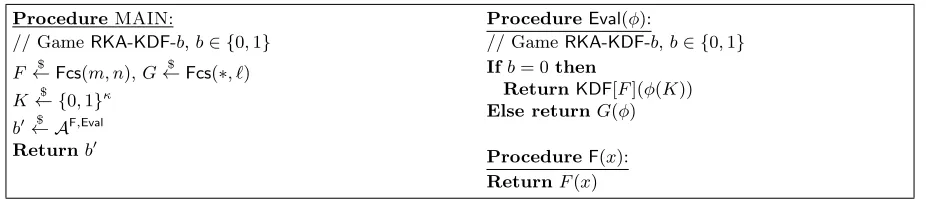
Formal definition.Let KDF[F] : {0,1}κ → {0,1}` be a construction that calls a function F : {0,1}m → {0,1}n. In Figure 1, we define the security games RKA-KDF-0 and RKA-KDF-1 involving an adversaryAand a class of key transformationsΦ⊆Fcs(κ, κ). In the real world (Game
RKA-KDF-0), the adversary A makes queries to a random function F via the F oracle and can obtain evaluations of KDF[F](φ(K)) for multiple φ∈Φof its choice via the Eval oracle, and these values should be indistinguishable from random values, which are returned by the Eval oracle in the ideal world (i.e., in GameRKA-KDF-1). The RKA-KDF-advantage is then defined as
AdvRKA-KDFKDF,F,Φ (A) =PrRKA-KDF-0AKDF,F,Φ⇒1−PrRKA-KDF-1AKDF,F,Φ ⇒1 ,
Remark 1. An alternative definition has the Eval oracle return G(φ(K)) for a random function G←$ Fcs(κ, `). Our choice is better suited to the composition theorem below, and shifts the burden of dealing with the combinatorics ofΦ to the RKA-KDF security proof.
The composition theorem.We can compose an arbitrary (`, n)-block cipher constructionBC[F] and a key-derivation functionKDF:{0,1}κ → {0,1}` using the same functionF, into a new (κ, n) block cipherBC=BC[F,KDF] such that
BCK(X) =BCKDF(K)(X). (4)
for every K ∈ {0,1}κ and X ∈ {0,1}n. The following theorem shows that if BC is a secure PRP andKDF is RKA-KDF secure, then the compositionBCis a related-key secure PRP. Note that the fact that we consider multi-user PRP security is central in allowing us a tight reduction.
Theorem 2 (The Composition Theorem). Let BC = BC[F,KDF] be the (κ, n)-block cipher defined above, and assume that BC makes at most t calls to F upon each invocation. Let Φ ⊂
Fcs(κ, κ) be a class of key transformations. Then, for all q, qF,
AdvRKABC,F,Φ-PRP(q, qF)≤2·AdvKDF,F,ΦRKA-KDF(q, qF +q·t) +AdvPRPBC,F(q, qF).
Proof (Sketch). One uses RKA-KDF security to transition from RKA-PRP-1 to a setting where each query (φ, x) to the block cipher is replied with an independent keyKφ as BCKφ(x), i.e., we
map every φwith an independent κ-bit key Kφ. This is exactly PRP-1 (except that users are now identified by elements ofΦ) and results in the additive termAdvRKA-KDFKDF (q, qF +q·t) in the bound by a standard reduction. Similarly, one uses RKA-KDF security to transition from RKA-PRP-0 to a setting where each query (φ, x) to the block cipher is replied with an independent permutation Pφ, and this exactly maps toPRP-0, and results in another additive term AdvRKA-KDFKDF (q, qF+q·t).
The final bound follows by the triangle inequality. ut
Note that in a similar way, if KDF and BC use different functions F and F0, then we can reduce
AdvRKA-KDFKDF,F,Φ (q, qF +q·t) to AdvRKA-KDFKDF,F,Φ (q, qF).
4.2 Efficient RKA-KDF-secure construction
This section presents anRKA-KDF-secure construction from a (small number of) random functions F : {0,1}n → {0,1}n approaching (2n(1−ε),2n(1−ε))-security. (As we argue below, this can be
turned into a construction from a single function F :{0,1}n → {0,1} with standard tricks.) Our construction will guarantee Φ-RKA-KDF-security for every class Φ ⊆ Fcs(κ, κ) with the following two properties for (small) parametersγ, λ∈[0,1]:
γ-collision resistance. PrhK ← {0$ ,1}κ :φ(K) =φ0(K)i≤γ for any two distinctφ, φ0 ∈Φ.
λ-uniformity. For anyφ∈Φ, we have thatSD(K, φ(K))≤λforK← {0$ ,1}κ, i.e.,φ(K) isλ-close to uniform for a random key K.
Combinatorial hitters.Our construction makes use of the standard combinatorial notion of a hitter [30], which we introduce with a slightly different parameterization than what used in the literature. Consider a family of functions E= (E1, . . . ,Et) such thatEi:{0,1}κ→ {0,1}n.
Definition 1 (Hitters). The functionsE= (E1, . . . ,Et) withEi :{0,1}κ → {0,1}n are an (α, β )-hitter if for all subsets Q ⊆ {0,1}n with |Q| ≤β·2n, Pr[K← {0,1}κ :∀i∈[t] :Ei(K)∈ Q]≤α.
In our setting, we are going to have β = 2−nε (for some (small) ε > 0, and in particular 1−β ≥ 1
2) and α = 2
−n. There are polynomially-computable explicit constructions of hitters (cf.
e.g. [30] for an overview) with sufficiently good parameters for our purposes, where
κ= 2n+O(log(1/α)) =O(n), t=O(log(1/α)) =O(n). (5)
AppendixD gives further details about a concrete example of a “reasonably”’ cheap construction relying on random walks on constant-degree expander graphs. We will require our hitters to be
injective, i.e., for any two inputsX andX0, there must existisuch thatEi(X)6=Ei(X0). It is easy to enforce injectivity for any hitter by just addingO(κ/n) functions to the family.
The MT Construction.We now present our construction of anRKA-KDF-secure function, which follows the framework of Maurer and Tessaro [45]. Let E= (E1, . . . ,Et) be such that Ei :{0,1}κ → {0,1}n. Moreover, let F
i,j :{0,1}n → {0,1}2κ+n for i∈[t] and j ∈ [r], Gj :{0,1}n → {0,1}` for j∈[r]. For simplicity, denote F = (Fi,j)i∈[t],j∈[r]and G= (Gi)i∈[t].
The MT[E, F, G] construction operates as follow. (Here, denotes multiplication of (2κ+n )-bit-strings interpreted as elements of the corresponding extension fieldF22κ+n.)
ConstructionMT[F, G](K): // K ∈ {0,1}κ
(1) For allj∈[r], compute
S[j]← t
K
i=1
Fi,j(Ei(K))
!
[1. . . n].
(2) Compute K0 ←Lr
j=1Gi(S[i]).
(3) Return K0.
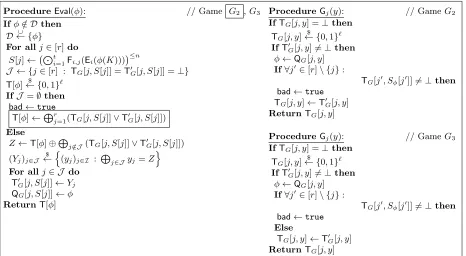
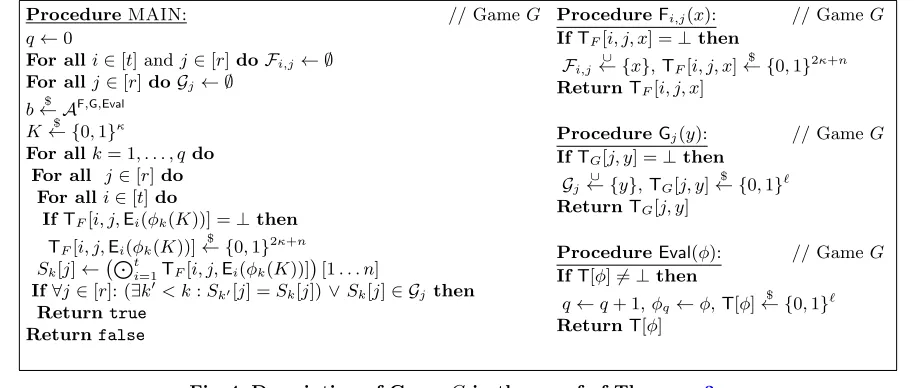
RKA-KDF security.The above construction is indifferentiable from a random oracle [45,22] wheneverEis a so-calledinput-restricting function family. While this combinatorial property would also imply RKA-KDF security, explicit constructions of such function families require a very large t=O(nc) for a large constant c, as discussed in [22].
Here, in contrast, we show that for RKA-KDF security it is sufficient ifE is a good hitter. The following theorem summarizes the concrete parameters of our result. The complete proof is found in AppendixE. We give some intuition further below.
Theorem 3 (RKA-KDF-Security of MT). Let Ebe an(α, β=qF/2n)-injective hitter. Moreover,
let Φ ⊆Fcs(κ, κ) be a (γ, λ)-well behaved set of key transformations. Then, for all adversaries A
making q queries toEval, qF queries to theF-functions, and qG queries to theG-functions,
AdvRKAMT,(-F,GKDF),Φ(A)≤ 4rt
2n +q(α+λ) +q
2γ+q·
qG+q 2n
r
Instantiations.Let us target security forqF =q= 2n(1−ε) (e.g.,ε=O(1/n)),`=n, and additive attacksΦ=Φ⊕withγ =λ= 0. First note that because we wantα≈2−nandβ= 2−εn, then we can useEwithκ=O(n) andt=O(n) by (5). Moreover, we need to ensure that 2r(1−n)·2n(1−ε)(r+1) <1
or alternatively r(nε−1) > n(1−ε), which is true for r = r(ε) = Ω(1−εε ), and r = O(n) for ε=O(1/n).
Therefore, the construction evaluates a linear number of functions with linear output O(n), or alternatively,O(n2) single-bit functions{0,1}n→ {0,1}. This can be turned into evaluatingO(n2)
one single function{0,1}n+2 logn+O(1)→ {0,1}.7 Improving upon this appears a significant barrier.
The MT construction can be combined with the WSN construction above to obtain an RKA-secure block cipher with (2n(1−ε),2n(1−ε))-security via Theorem2 for any classΦ with smallλ, γ. Overview of the proof of Theorem 3.We explain here the basic ideas behind the proof of Theorem3.
To start with, it is convenient to first consider a toy construction, using only t functions F = (Fi)i∈[t] with Fi ∈ Fcs(n, `), in conjunction with a hitter E = (E1, . . . ,Et) as above. On input
K ∈ {0,1}κ, it outputsLt
i=1Fi(Ei(K)). Also, let us only consider RKA-KDFattackers which make
all qF of their F queries beforehand, and only then query Eval on inputs φ1, . . . , φq, where the φi functions are such thatφi(K) is uniform for a uniform K.
Assume without loss of generality the uniform key K is sampled after the F-queries have been made. Since E is an (α, β = qF/2n)-hitter, then by the union bound, for every k ∈ [q] there exists some i∗(k) such that Ei∗(k)(φk(K)) wasnot queried toFi∗(k) in the first phase, except with
probability q·α. Therefore, for all k ∈[q], the value Lt
i=1Fi(Ei(φk(K))) is individually uniform, even given the transcript of theF queries, but unfortunately, this does not guarantee independence of these outputs. Indeed, for twokand k0, we may well havei∗(k) =i∗(k0), and we cannot exclude that for all i 6= i∗(k) both values Fi(Ei(φk(K))) and Fi(Ei(φk0(K))) are known as part of the
F-queries made in the first phase. Then, the output values fork andk0 are clearly correlated. Instead, by using two rounds with functions (Fi,j)i∈[t],j∈[r] and (Gj)j∈[r] (where Fi,j ∈Fcs(n, n) and Gj ∈Fcs(n, `)), we would generate valuesSk[j]←Lti=1Fi,j(Ei(φk(K))) hoping that, in addi-tion to being individually uniform as above,Sk[j] and Sk0[j] are unlikely to collide for anyk6=k0.
If the final output of the construction isLr
j=1Gj(Sk[j]), the above would imply security: Indeed, with very high probability, we can show that for every k, there is going to always exist some j∗ such that Sk[j∗] was never queried to Gj∗ previously directly by the attacker (because of the
individual uniformity of the value) and that no otherk06=kis such thatSk0[j∗] =Sk[j∗]. (Exploiting
independence of the Sk[j]’s, the probability that suchj∗ does not exist can be made very small, of the order qG+q
2n r
.)
There is a final catch. Imagine we are in the above “unfortunate” setting, i.e., for two kand k0 and j ∈[r], we have i∗(k) =i∗(k0), and for alli6=i∗(k),Fi,j(Ei(φk(K))) and Fi,j(Ei(φk0(K))) are
known. Then, the fact thatSk[j] and Sk0[j] collided is already determined by the transcript of the
F queries, independent ofFi∗(k),j(Ei∗(k)(φk(K))). Our approach to address this problem is to make
the output of the F-values larger (roughly 2κ+nbits) and to use multiplication. This will make sure that given that any two partial product defined by the F queries as above will not collide (over 2κ+nbits), and thus (by the fact that multiplication with truncation gives a universal hash function), the final products, truncated at nbits, will also be unlikely to collide.
7
Note that we can play a bit with parameters, and given a functionF:{0,1}n→ {0,1}, interpret it as a function
{0,1}n0+2 log(n0) → {0,1} for a suitable n0
References
1. C. Adams,RFC 2144 - The CAST-128 Encryption Algorithm. Internet Activities Board, May 1997.
2. E. Andreeva, A. Bogdanov, Y. Dodis, B. Mennink, and J. P. Steinberger, “On the indifferentiability of key-alternating ciphers,” inCRYPTO 2013, Part I, vol. 8042 ofLNCS, pp. 531–550, Aug. 2013.
3. M. Barbosa and P. Farshim, “The related-key analysis of Feistel constructions,” inFSE 2014, vol. 8540 ofLNCS, pp. 265–284, Mar. 2015.
4. M. Bellare and D. Cash, “Pseudorandom functions and permutations provably secure against related-key attacks,” inCRYPTO 2010, vol. 6223 ofLNCS, pp. 666–684, Aug. 2010.
5. M. Bellare and T. Kohno, “A theoretical treatment of related-key attacks: RKA-PRPs, RKA-PRFs, and appli-cations,” inEUROCRYPT 2003, vol. 2656 ofLNCS, pp. 491–506, May 2003.
6. M. Bellare and P. Rogaway, “Random oracles are practical: A paradigm for designing efficient protocols,” in
ACM CCS 93, pp. 62–73, Nov. 1993.
7. M. Bellare and P. Rogaway, “The security of triple encryption and a framework for code-based game-playing proofs,” inEUROCRYPT 2006, vol. 4004 ofLNCS, pp. 409–426, May / June 2006.
8. E. Biham, “New types of cryptanalytic attacks using related keys,”Journal of Cryptology, vol. 7, no. 4, pp. 229– 246, 1994.
9. E. Biham, O. Dunkelman, and N. Keller, “A related-key rectangle attack on the full KASUMI,” in ASI-ACRYPT 2005, vol. 3788 ofLNCS, pp. 443–461, Dec. 2005.
10. E. Biham, O. Dunkelman, and N. Keller, “Related-key impossible differential attacks on 8-round AES-192,” in
CT-RSA 2006, vol. 3860 ofLNCS, pp. 21–33, Feb. 2006.
11. A. Biryukov, O. Dunkelman, N. Keller, D. Khovratovich, and A. Shamir, “Key recovery attacks of practical complexity on AES-256 variants with up to 10 rounds,” inEUROCRYPT 2010, vol. 6110 ofLNCS, pp. 299–319, May 2010.
12. A. Biryukov and D. Khovratovich, “Related-key cryptanalysis of the full AES-192 and AES-256,” in ASI-ACRYPT 2009, vol. 5912 ofLNCS, pp. 1–18, Dec. 2009.
13. A. Biryukov, D. Khovratovich, and I. Nikolic, “Distinguisher and related-key attack on the full AES-256,” in
CRYPTO 2009, vol. 5677 ofLNCS, pp. 231–249, Aug. 2009.
14. A. Bogdanov, L. R. Knudsen, G. Leander, F.-X. Standaert, J. P. Steinberger, and E. Tischhauser, “Key-alternating ciphers in a provable setting: Encryption using a small number of public permutations - (extended abstract),” inEUROCRYPT 2012, vol. 7237 ofLNCS, pp. 45–62, Apr. 2012.
15. S. Chen, R. Lampe, J. Lee, Y. Seurin, and J. P. Steinberger, “Minimizing the two-round Even-Mansour cipher,” inCRYPTO 2014, Part I, vol. 8616 ofLNCS, pp. 39–56, Aug. 2014.
16. S. Chen and J. P. Steinberger, “Tight security bounds for key-alternating ciphers,” in EUROCRYPT 2014, vol. 8441 ofLNCS, pp. 327–350, May 2014.
17. B. Cogliati, R. Lampe, and Y. Seurin, “Tweaking Even-Mansour ciphers,” in CRYPTO 2015, Part I, LNCS, pp. 189–208, Aug. 2015.
18. B. Cogliati, J. Patarin, and Y. Seurin, “Security amplification for the composition of block ciphers: Simpler proofs and new results,” inSAC 2014, vol. 8781 ofLNCS, pp. 129–146, Aug. 2014.
19. B. Cogliati and Y. Seurin, “On the provable security of the iterated Even-Mansour cipher against related-key and chosen-key attacks,” inEUROCRYPT 2015, Part I, vol. 9056 ofLNCS, pp. 584–613, Apr. 2015.
20. J.-S. Coron, J. Patarin, and Y. Seurin, “The random oracle model and the ideal cipher model are equivalent,” inCRYPTO 2008, vol. 5157 ofLNCS, pp. 1–20, Aug. 2008.
21. Y. Dodis, T. Ristenpart, and T. Shrimpton, “Salvaging Merkle-Damg˚ard for practical applications,” in EURO-CRYPT 2009, vol. 5479 ofLNCS, pp. 371–388, Apr. 2009.
22. Y. Dodis and J. P. Steinberger, “Domain extension for MACs beyond the birthday barrier,” in EURO-CRYPT 2011, vol. 6632 ofLNCS, pp. 323–342, May 2011.
23. O. Dunkelman, N. Keller, and A. Shamir, “Minimalism in cryptography: The Even-Mansour scheme revisited,” inEUROCRYPT 2012, vol. 7237 ofLNCS, pp. 336–354, Apr. 2012.
24. S. Dziembowski, K. Pietrzak, and D. Wichs, “Non-malleable codes,” inICS 2010, pp. 434–452, Jan. 2010. 25. S. Even and Y. Mansour, “A construction of a cipher from a single pseudorandom permutation,” Journal of
Cryptology, vol. 10, no. 3, pp. 151–162, 1997.
26. P. Farshim and G. Procter, “The related-key security of iterated even-mansour ciphers,” inFSE 2015, LNCS, 2015.
28. P. Gaˇzi and S. Tessaro, “Secret-key cryptography from ideal primitives: A systematic overview,” inIEEE Infor-mation Theory Workshop - ITW 2015, 2015.
29. C. Gentry and Z. Ramzan, “Eliminating random permutation oracles in the Even-Mansour cipher,” in ASI-ACRYPT 2004, vol. 3329 ofLNCS, pp. 32–47, Dec. 2004.
30. O. Goldreich, “A sample of samplers - A computational perspective on sampling (survey),”Electronic Colloquium on Computational Complexity (ECCC), vol. 4, no. 20, 1997.
31. C. Guo and D. Lin, “On the indifferentiability of key-alternating Feistel ciphers with no key derivation,” in
TCC 2015, Part I, vol. 9014 ofLNCS, pp. 110–133, Mar. 2015.
32. C. Hall, D. Wagner, J. Kelsey, and B. Schneier, “Building PRFs from PRPs,” inCRYPTO’98, vol. 1462 ofLNCS, pp. 370–389, Aug. 1998.
33. V. T. Hoang, B. Morris, and P. Rogaway, “An enciphering scheme based on a card shuffle,” inCRYPTO 2012, vol. 7417 ofLNCS, pp. 1–13, Aug. 2012.
34. T. Holenstein, R. K¨unzler, and S. Tessaro, “The equivalence of the random oracle model and the ideal cipher model, revisited,” in43rd ACM STOC, pp. 89–98, June 2011.
35. J. Kelsey, B. Schneier, and D. Wagner, “Key-schedule cryptoanalysis of IDEA, G-DES, GOST, SAFER, and Triple-DES,” inCRYPTO’96, vol. 1109 ofLNCS, pp. 237–251, Aug. 1996.
36. R. Lampe, J. Patarin, and Y. Seurin, “An asymptotically tight security analysis of the iterated even-mansour cipher,” inASIACRYPT 2012, vol. 7658 ofLNCS, pp. 278–295, Dec. 2012.
37. R. Lampe and Y. Seurin, “How to construct an ideal cipher from a small set of public permutations,” in ASI-ACRYPT 2013, Part I, vol. 8269 ofLNCS, pp. 444–463, Dec. 2013.
38. R. Lampe and Y. Seurin, “Security analysis of key-alternating Feistel ciphers,” inFSE 2014, vol. 8540 ofLNCS, pp. 243–264, Mar. 2015.
39. M. Luby and C. Rackoff, “How to construct pseudo-random permutations from pseudo-random functions (ab-stract),” inCRYPTO’85, vol. 218 ofLNCS, p. 447, Aug. 1986.
40. S. Lucks, “Ciphers secure against related-key attacks,” inFSE 2004, vol. 3017 ofLNCS, pp. 359–370, Feb. 2004. 41. A. Mandal, J. Patarin, and V. Nachef, “Indifferentiability beyond the birthday bound for the xor of two public
random permutations,” inINDOCRYPT 2010, vol. 6498 ofLNCS, pp. 69–81, Dec. 2010.
42. A. Mandal, J. Patarin, and Y. Seurin, “On the public indifferentiability and correlation intractability of the 6-round Feistel construction,” inTCC 2012, vol. 7194 ofLNCS, pp. 285–302, Mar. 2012.
43. U. M. Maurer, K. Pietrzak, and R. Renner, “Indistinguishability amplification,” inCRYPTO 2007, vol. 4622 of
LNCS, pp. 130–149, Aug. 2007.
44. U. M. Maurer, R. Renner, and C. Holenstein, “Indifferentiability, impossibility results on reductions, and appli-cations to the random oracle methodology,” inTCC 2004, vol. 2951 ofLNCS, pp. 21–39, Feb. 2004.
45. U. M. Maurer and S. Tessaro, “Domain extension of public random functions: Beyond the birthday barrier,” in
CRYPTO 2007, vol. 4622 ofLNCS, pp. 187–204, Aug. 2007.
46. B. Mennink and B. Preneel, “On the xor of multiple random permutations,” inApplied Cryptography and Network Security – ACNS 2015, 2015.
47. B. Morris and P. Rogaway, “Sometimes-recurse shuffle - almost-random permutations in logarithmic expected time,” inEUROCRYPT 2014, vol. 8441 ofLNCS, pp. 311–326, May 2014.
48. J. Patarin, “The “coefficients H” technique (invited talk),” inSAC 2008, vol. 5381 ofLNCS, pp. 328–345, Aug. 2009.
49. T. Ristenpart and S. Yilek, “The mix-and-cut shuffle: Small-domain encryption secure against N queries,” in
CRYPTO 2013, Part I, vol. 8042 ofLNCS, pp. 392–409, Aug. 2013.
50. J. Steinberger, “Improved security bounds for key-alternating ciphers via hellinger distance.” Cryptology ePrint Archive, Report 2012/481, 2012. http://eprint.iacr.org/2012/481.
51. S. P. Vadhan, “Pseudorandomness,”Foundations and Trends in Theoretical Computer Science, vol. 7, no. 1-3, pp. 1–336, 2012.
A Indifferentiability
We briefly review the notion of indifferentiability by Maurer et al [44] as needed in this paper. LetC[G] :{0,1}m → {0,1}`be a construction from a functionG:{0,1}a→ {0,1}b. We say that
Formal definition.For an adversaryA and a simulator S, theindifferentiabilityadvantage is
AdvindiffC[G],G,S(A) =Pr h
G←$ Fcs(a, b) :AC[G],G ⇒1
i
−Pr h
F ←$ Fcs(m, `) :AF,SF ⇒1
i
.
Similarly, for a constructionC[π] from a permutationπ ∈Perms(a), we define
AdvindiffC[π],π,S(A) =Pr h
π←$ Perms(a) :AC[π],π,π−1 ⇒1
i
−Pr h
F ←$ Fcs(m, `) :AF,SF ⇒1
i
.
Note that in the latter case, the simulator S simulates both the behavior ofπ andπ−1 queries. We
are going to call queries to the first oracle (i.e., either C[G], C[π] or F) construction queries, and queries to the second oracle (eitherG,π, π−1, orSF) primitive queries.
In this paper, we are going to only consider an information-theoretic version of indifferentiability.
Definition 2 (Indifferentiability). A construction C[Σ](where Σ is either a permutation or a function) is(ε, s)-indifferentiablefrom a random function if there exists a simulatorS such that for all adversaryAmakingqconstruction queries, andqΣ primitive queries,AdvindiffC[Σ],Σ,S(A)≤ε(q, qΣ),
and where additionally, upon each invocation via a primitive queries, the simulatorΣmakes at most
s queries. Moreover, the simulator answers each query in time polynomial in qΣ.
We say that C[Σ] isperfectly indifferentiableif it is (0,1)-indifferentiable.
Composition theorem.We use the following fact below, which follows from general composition theorems [44,21] adapted to the specific case of block ciphers considered in this paper.
Theorem 4 (Composition theorem for block ciphers). Let BC = BC[F] be a (κ, n)-block cipher making at most t calls to a function F :{0,1}m → {0,1}`, and let C[Σ] be a construction
using a primitiveΣwhich is(ε, s)-indifferentiable from a random function. Consider the(κ, n)-block cipher BC0 =BC0[Σ] =BC[C[Σ]], i.e., calls to F are replaced by calls to C[Σ]. Then,
AdvPRPBC0[Σ],Σ(q, qΣ)≤AdvPRPBC[F],F(q, s·qΣ) + 2·ε(t·q, qΣ).
B From Permutations to Functions
In this section, we revisit the security of a construction by Hall, Wagner, Kelsey, and Schneier [32] to build a random functionF :{0,1}n→ {0,1}c from a permutationπ :{0,1}n+c→ {0,1}n+c. In particular, here we show that their construction achieves the stronger notion of perfect indifferen-tiability defined above in Appendix A, and thus can be used to replace (in a black-box way) the function F in the WSN construction. Note that in [32], only indistinguishability was shown. We believe that this result is of interest beyond the scope of this paper.
The construction.Let π :{0,1}n+c → {0,1}n+c be a permutation. The 2c-query construction
Security.The following theorem establishes security ofF in terms of indifferentiability.8
Theorem 5 (Indifferentiability of F). The construction Fc=Fc[π]is perfectly indifferentiable
from a random function.
Proof. We need to prove that there exists a simulatorSsuch thatAdvindiffF,π,S(A) = 0 for all adversaries A, and moreover,Ssimulates a permutation fromPerms(n+c), together with its inverse, and makes at most one single query to a given function F ←$ Fcs(n, c) upon each invocation.
To help with the definition of the simulator, for a function f ∈ Fcs(n, c) and a permutation τ ∈ Perms(n+c), we define a new permutation π[τ, f] ∈ Perms(n+c). To this end, for every x∈ {0,1}n, we define
y∗x= min{τ(xkz) : z∈ {0,1}c}
and yx =τ(xkf(x)). Note that yx∗ is the output of τ on inputxkFc[τ](x) and thus if f = Fc[τ], yx=y∗x. The permutationπ[τ, f] is such that
π[τ, f](xkz) =
yx∗ ifτ(xkz) =yx, i.e., f(x) =z yx ifτ(xkz) =y∗x
τ(xkz) else.
In other words, π[τ, f] re-arranges τ to assign π[τ, f](xkf(x)) the smallest value among τ(xkz0) for z0 ∈ {0,1}c. Clearly, given τ, π[τ, f](xkz) can be computed with a single query to f and 2c queries toτ. Moreover, note that the inverse π−1[τ, f] is
π−1[τ, f](y) =
τ−1(yx) ify=y∗x τ−1(y∗x) ify=yx τ−1(y) else.
Note that the check y = y∗x and y = yx can be implemented by first computing τ−1(y), which returnsxkz, and then queryingτ(xkz0) for all z0 6=z, as well as f(x). In particular,π−1[τ, f] can also be evaluated with one query tof, given τ.
The simulator S now simply does the following when given oracle access to f: It maintains a random permutationτ ←$ Perms(n+c) (implemented via lazy sampling), and on a forward query xkz, replies as π[τ, f](xkz), and on inverse query y it replies asπ−1[τ, f](y). By the above, this requires one f query per evaluation.
Therefore, to prove perfect indifferentiability, it is enough to prove that (Fc[π], π) (for π ←$
Perms(n+c)) and (f, π[τ, f]) (for f ←$ Fcs(n, c) andτ ←$ Perms(n+c)) are identically distributed. This can be done in two steps:
1. First, note that Fc[π[τ, f]] =f. This is because on inputx,Fcoutputszsuch thatπ[τ, f](xkz) is smallest. This must be z=f(x), becauseπ[τ, f] is such that π[τ, f](xkf(x)) =y∗x, which is the smallest value amongτ(xkz0), and thus also among π[τ, f](xkz0).
2. Therefore, it suffices to show that the permutation π[τ, f] is uniformly distributed. This is because π[τ, f] is obtained by sampling a random permutationτ, and then for allx, swapping yx∗ with the output of xkz for a randomly chosen z = f(x). This gives a uniform random permutation.
This concludes the proof. ut
8
C Proof of Lemma 3
For everya∈St,i, we now define now two subsets partitioning {0,1}n× {0,1}n, i.e., the key space for roundt+ 1:
WK+a :={(w, k) : a⊕k∈St,i ∧ max{a⊕k, a} ⊕w /∈ Q} WK−a :={(w, k) : a⊕k /∈St,i ∨ max{a⊕k, a} ⊕w∈ Q} It is easy to see that
WK+a
=Ni·(N −Q), WK−a
=N2−Ni·(N −Q)
because for everyawe have exactly|St,i|=Ni values ofk such thata⊕k∈St,i, and moreover, we have (for each such valuek) exactly N−Qpossible values ofwwith max{a, a⊕k} ⊕w /∈ Q. Also, note that for (w, k)∈ WK−a,
Eh(pt+1,i(ϕ(a))−1/Ni)2
K[t+ 1] =k,W[t+ 1] =w i
=pt,i(a)2 ,
whereas for (w, k)∈ WK+
a,
E "
pt+1,i(ϕ(a))− 1 Ni
2
K[t+ 1] =k,W[t+ 1] =w #
=
pt,i(a) +pt,i(a⊕k)
2 −
1 Ni
2
.
Putting all of this together, we obtain
E
pt+1,i(ϕ(a))−N1i
2
=
= N12 X
k,w
E
pt+1,i(ϕ(a))−N1i
2
K[t+ 1] =k,W[t+ 1] =w = 1 N2 X
(w,k)∈WK− a
pt,i(a)− 1
Ni 2
+ X
(w,k)∈WK+ a
p
t,i(a)+pt,i(a⊕k)
2 − 1 Ni 2
=1−Ni(N−Q)
N2 pt,i(a)−N1i
2
+N−QN2 X
y∈St,i p
t,i(a)+pt,i(y)
2 −
1
Ni 2
,
where we have used the structure of WK+a, and the fact that for everyy ∈St,i there existsk such thata⊕k=y, and correspondingN−Q values ofw. In particular, we can expand
X
y∈St,i p
t,i(a)+pt,i(y)
2 −
1
Ni 2
= 14 X y∈St,i
pt,i(a)−N1i
+pt,i(y)−N1i
2
= Ni
4 ·
pt,i(a)−N1i
2
+14∆t,i ,
where we have used in passing the fact thatP
y∈St,i(pt,i(a)−
1
Ni) = 0. When we plug this back into
the above, we then get
E
pt+1,i(ϕ(a))−N1i
2
= 1−3
4
Ni(N−Q)
4·N2
pt,i(a)− 1 Ni
2
+ 14NN−Q2 ∆t,i .
D Hitters based on Random Walks
One fairly efficient way to build suitable hitters for our purposes is to use random walks on a constant-degree expander graph.
Expanders and random walks.In particular, we considerD-regular (I.e., every vertex has de-gree D) undirected graphs G = (V, E) where V = {0,1}n, which in particular are explicit, i.e., given v ∈ V and i∈[D], the i-th neighbor of v can be computed efficiently. As usual, we denote by λ(G) the second largest eigenvalue (in absolute value, and normalized byD) of the adjacency matrix ofG, and call 1−λ(G) thespectral gap. (Note that we always haveλ(G)≤1, withλ(G) = 1 corresponding to the situation thatGis bipartite.)
A random walk of length t on G is a sequence of random variables X1, . . . , Xt, where X1
$
← {0,1}n, and X
i is obtained by selecting uniformly a random neighbor of Xi−1 for all i ∈ [t]. In
particular, representing such a random walk requires only n+ (t−1) logD random bits, because the graph isD-regular.
The following theorem is a standard result in expander-graph theory. (Cf. e.g. Vadhan’s excellent monograph on pseudorandomness for a proof [51].)
Theorem 6. Let G= (V, E) be a D-regular graph, then for any set B ⊆V with |B|/|V| ≤δ, and a random walk X1, X2, . . . , Xt on G,
Pr[∀i∈[t] :Xi ∈B]≤(δ+λ(G)(1−δ))t.
Example: Hitter constructions.One particular example of a computationally simple graph which is sufficient to give us a good hitter is given by the Margulis-Gabber-Galil construction already. The parameters are not great, but as this perhaps thesimplestexpander constructions, we show that obtain (asymptotically) reasonable parameters even for this simple construction.
The graph is over V ={0,1}n/2 × {0,1}n/2, and we interpret its vertices (x, y) as elements of Z2n/2 ×Z2n/2, and each vertex (x, y) is connected to the 8 vertices
(x±2y, y),(x±(2y+ 1), y),(x, y±2x),(x, y±(2x+ 1)).
It is well known that for this graph we haveλ(G)≤5/8√2<0.9. Note that representing a random walk of lengtht takes n+ 3tbits, and given a set B such that |B| ≤ 12 ·2n, in order to ensure the (δ, ε)-hitting property for say ε= 2n, we need
(0.95)t≤ε ,
and hence it is sufficient to set
t= log(1/ε)/log(1/0.95)≤14n .
In particular, this gives a family of t ≤ 14n functions, where Ei :{0,1}43n → {0,1}n, and Ei(X) outputs thei-th step of the random walk on G.
Note that the above parameters can be substantially improved by using better expander graphs.
E Proof of Theorem 3
![Fig. 2. Description of games in proof of Theorem 3common to all games. Procedures MAIN and Fi,j for i ∈ [t] and j ∈ [r] are G0 - G3](https://thumb-us.123doks.com/thumbv2/123dok_us/7926356.1316056/23.612.83.531.70.328/description-games-proof-theorem-common-games-procedures-main.webp)