© 2014, IJCSMC All Rights Reserved 18
Available Online atwww.ijcsmc.com
International Journal of Computer Science and Mobile Computing
A Monthly Journal of Computer Science and Information Technology
ISSN 2320–088X
IJCSMC, Vol. 3, Issue. 7, July 2014, pg.18 – 27
RESEARCH ARTICLE
Analysis of Face Recognition using Manhattan
Distance Algorithm with Image Segmentation
1
K.M.Ponnmoli,
Research Scholar, PRIST University, Thanjavur, TamilNadu, India
[email protected]
2
Dr. S. Selvamuthukumaran,
Director, Department of Computer Applications, A.V.C College of Engineering,
Mannampandal, TamilNadu, India
[email protected]
Abstract: Segmentation is one of the important concepts in Face Recognition. Based on the segmentation, the image is
to be identified by different algorithms such as Euclidean distance, Manhattan distance, Chebyshev distance and other
methods. In this paper, the segmentation concept with Manhattan algorithm to produce the visible image and focus on
the exact segmented image with Manhattan distance algorithm. This algorithm compares the given face with a
database of faces of ORL2. It recognizes the particular face and then the segmented part of the image to be produced,
depends on the users choice. The recognition rate of the image segmentation shows the result accurately with 97%
compared with Euclidean distance. It also produces the FAR and FRR of the given image.
Keywords: Image segmentation, Manhattan distance (MD), Euclidean distance(ED), FAR, FRR, SQFD
1. Introduction
Face Recognition is a broad area of research in the recent years. Now a days facial image processing has become an important research area around the world. The human face recognition is a technique that detects and identifies human faces is gaining importance in the field of biometrics. The human face is a highly intricate and dynamic structure with characteristics that can adversely change with time but it is also the feature that best distinguishes a person. Humans can recognize thousands of faces learned throughout their life time and identify familiar faces at a glance even after years of separation [1]. In Face recognition, a computer that can recognize faces could contribute to a wide variety of problems, including criminal identification, security systems and so on.
The Image segmentation refers to the decomposition of a scene into its components. It is a key step in image analysis [2]. The main contribution of this paper is to produce the segmented images (i.e. eye, face, nose and mouth part) from the given input image, based on the method of Manhattan Distance algorithm with more accurate results of the recognition rate and comparative recognition rate of Manhattan with Euclidean distance. Also find out the result for False Acceptance Rate and False Rejection Rate.
© 2014, IJCSMC All Rights Reserved 19
2. Related Works
Abul Hasnat et al. implemented the distance metrics of Manhattan, Euclidean, Vector Cosine Angle distance with skin colors of two color facial images[11]. Vadivel et al. have used Manhattan distance, Euclidean distance, Vector Cosine Angle distance and Histogram Intersection distance for a number of color histograms on a large database of images and the experimental results shows that the Manhattan distance performs better than the other distance metrics for all the five types of histograms[9]. Sanjay Kr Singh et al. Implemented analysis of Face recognition in MATLAB with eigen faces to recognize the face from the given input image[10]. Archana Singh et al. implemented K-means with different measures and found Euclidean distance metric gives best result and Manhattan distance metric’s performance is worst[13]. Modh Jigar.S et al. used L*a*b* color space and using cosine distance matrices instead of sqeculidean Distance with clustering based K-means segmentation technique[8]. N. Selvarasu et al. proposed Euclidean distance based color image segmentation algorithm for abnormality Extraction in Thermographs[12]. Sourav Paul et al. integrated a self-organizing map with mahalanobis distance to determine the winner unit. The distance between the input vector and the weight vector has been determined by mahalanobis distance and chooses the unit whose weight vector has the smallest mahalanobis distance from the input vector[15]. Hsiang-Chuan Liu et al. proposed an improved Fuzzy C-Means algorithm based on a standard Mahalanobis distance (FCM-SM)[17]. O.A.Mohamed Jafar et al. made a comparative study of K-Means and FCM algorithm with chebyshev distance , Chi-square distance measures and they found FCM based Chi-square distance measure had better result than Chebyshev distance measure[16]. Luh Yen et al. proposed a new distance metric called the Euclidean Commute Time(ECT) distance, based on a random walk model on a graph derived from the data which allows retrieving well-separated clusters of arbitrary shapes[14].
3. Overview of Distance Measures and Algorithm
3.1. Data set
The different images are to be referred from the ORL2 database. From the database, the input images are to be recognized through the Manhattan distance algorithm with segmentation. The images are to be segmented with different requests from the user. The segmented images are displayed likely eye part, nose part, mouth part and face part of the given input image. The recognition rates are to be compared between the Euclidean distances with Manhattan distance.
3.2. An overview of Distance Measures
Distance metric is a key issue in many machine learning algorithm[8]. The distance measure plays an important role in acquiring the exact image. The different distance measures are to be consider for the segmentation. In this work, the Manhattan distance, Euclidean distance, Minkowski distance and Chebyshev distance are to be considered.
3.2.1. Manhattan Distance
Manhattan distance is also called city block distance. It computes the distance that would be traveled to get from one data point to the other, if a grid-like path is followed. The Manhattan distance between two items is the sum of the differences of their corresponding components. Manhattan distance is also called the L1 distance[3].
The distance between a point x=(x1,x2…xn) and a point y=(y1,y2 ,…yn) is:
( ) ∑
( )
Where n is the number of variables, and xi and yi are the values of the ith variable, at points x and y respectively.
3.2.2.
Euclidean Distance
© 2014, IJCSMC All Rights Reserved 20
( ) √∑ ( )
( )
3.2.3. Chebyshev Distance
Chebyshev is also called maximum value distance or chessboard distance. It computes the absolute magnitude of the difference between the variable values. It is calculated by the following formula:
( )
( )
3.2.4. Minkowski Distance
Minkowski is the generalized distance metric which is a generalization of the distance between points in Euclidean space. It is defined as
( ) (∑ ⁄
) ( )
3.2.5. Signature Quadratic form distance
Signature Quadratic form distance is a generalization of the Quadratic for distance. It (SQFD) [5] is an adaptive distance-based similarity measure. Signature Quadratic Form Distance measure which allows efficient similarity computations based on flexible feature representations. This approach bridges the gap between the well-known concept of Quadratic Form Distance(SQFD) is a recently introduced distance measure for content based similarity. It makes use of feature signatures, a flexible way to summarize the features of a multimedia object. The SQFD is a way to measure the similarity between two objects.
Signature Quadratic Form Distance showing good retrieval performance for various multimedia databases [6]. The SQFD works on feature signatures consisting of sets of points , where each point has a weight and a set of coordinates.
Signature Quadratic Form Distance [4][5] is defined as
( ) √(( ) ( )) (5)
False Acceptance Rate(FAR)
© 2014, IJCSMC All Rights Reserved 21
The FAR [7] can be calculated using following equation.
No. of persons accepted out of database FAR= --- (6) Total No. of persons in database
IA = ---
I
Where IA number of imposter accepted. I number of imposter’s trials
False Rejection Rate(FRR)
FRR is the probability that the system fails to detect a match between the input pattern and a matching template in the database. It measures the percent of valid inputs which are incorrectly rejected. The FRR [7] can be calculated using the following equation.
No. of correct persons rejected
FAR= --- (7) Total No. of persons in database
3.3 Manhattan Distance Algorithm
The Manhattan algorithm is as follows.
Step 1: x and y are two objects with vector sets Vx and Vy.
Step 2: Cx(j) and Cy(j) are the two jth columns of Vx and Vy; j denotes the one dimension.
Step 3: Sorted Cx(j) in ascending order and results are stored in Csx(j);
Step 4: Sorted Cy(j) in ascending order and results are stored in Csy(j);
Step 5: Sum = 0;
Step 6: for i from 1 to m do Vxs
i;j from column Csx. (j);
Vys
i;j from column Csy. y(j);
sum +=j Vxs i;j i vys i;j; j; endfor
© 2014, IJCSMC All Rights Reserved 22
Based on the algorithm, the segmented part of the image is to be recognized. In this algorithm, the distance measures of the image are to be observed.
4.
Implementation
and Results
4.1 ImplementationIn this implementation part, the recognition rate reflects the percentage of faces recognized correctly as known (or) unknown when text database faces are evaluated. It is desirable to have maximum recognition rate by using less number of Eigen faces, because it clearly makes the procedure simple and fast. The recognition rate of the image is more accurately with the resulting percentage is 97%.
When compared with the Euclidean distance the recognition rate is very high with less number of dimensions. In Euclidean distance the images are to be recognized with the high dimension. But in Manhattan distance produce accuracy. Recognition rate is higher for Manhattan distance of 5 and 10 Eigen vectors (or) dimensions with the rate is 80% and 94% respectively. Wherein the case of 45 Eigen vectors (or) dimensions with the rate is 97%. The comparative recognition rate of Euclidean distance required to take 40% of Eigen faces with highest Eigen values but for Manhattan distance around 30% of the Eigen faces (or) dimensions are sufficient.
After recognize the faces with Manhattan, the input images are to be displayed depend upon the user requirements. For segmented, if the user want the nose area of the face, that part to be produced clearly, similarly for the eye, lip and mouth area to be processed and produced with accurate results. This part is to be implemented through the MATLAB environment.
4.2 Results
The experiment is performed using face database from ORL2 [9]. The sample images of the ORL database is given in Fig 1.
Fig. 1. ORL database images
© 2014, IJCSMC All Rights Reserved 23
Fig. 2 Input image
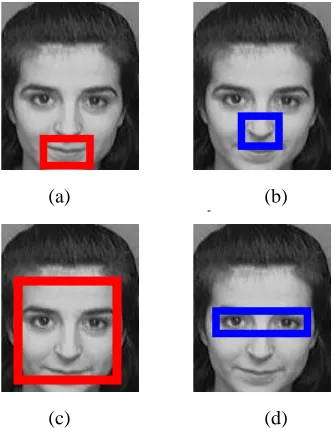
From the given input image, the different parts of the sequence are to be produced given below.
(a) (b)
(c) (d)
Fig. 3 Segmented Images (a) Mouth part (b) Nose part (c) Face part (d) Eye part
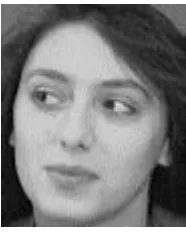
The second input image with dull intensity is to be segmented with different requirements by the user. The input image with dull intensity is shown in Fig. 4.
Fig.4 Input Image
From the given input image, the segmented images are shown in Fig. 5.
Mouth Detection Nose Detection
© 2014, IJCSMC All Rights Reserved 24
(a) (b)
(c)
Fig.5 Segmented Images(a) Nose part (b) Eye part (c) Face part
The third input image with crossed view. From that image, the algorithm worked very well for the users requirement. The crossed view of the image is shown in Fig. 6.
Fig. 6 Input Image
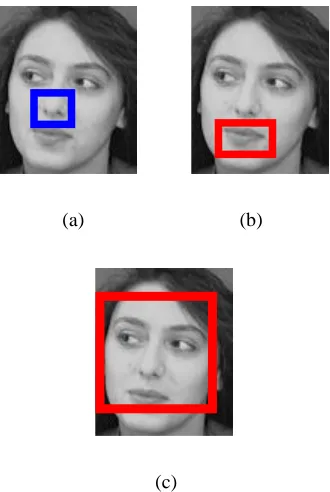
The segmented part of the crossed image is shown in Fig. 7.
Nose Detection Eyes Detection
© 2014, IJCSMC All Rights Reserved 25
(a) (b)
(c)
Fig. 7 Segmented Images (a) Nose part (b) Mouth part (c) Face part
The recognition rate of the algorithm with accuracy is shown in the below diagram.
Fig 4. Recognition rate between Euclidean and Manhattan distance.
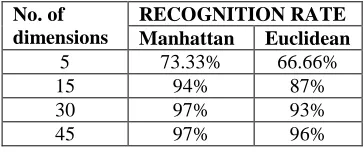
From the above recognition rate diagram shows that the number of dimensions in x axis and recognition rate is in y axis. Based on the dimensions, the recognition rate to be increased by both Manhattan and Euclidean distance. The recognition rate percentage for the Manhattan distance is 97% and the Euclidean distance is 96%. It is shown below by Table 1.
Nose Detection Mouth Detection
Face Detection
0 50 100 150 200 250 300 350 400
0 10 20 30 40 50 60 70 80 90 100
Recognition Percentage vs Number of Dimensions
Number of Dimensions
R e c o g n it io n P e rc e n ta g e Recognition Percentage
Maximum Recogntion :97% Using Manhattan Recognition Percentage
© 2014, IJCSMC All Rights Reserved 26
No. of dimensions
RECOGNITION RATE
Manhattan Euclidean
5 73.33% 66.66%
15 94% 87%
30 97% 93%
45 97% 96%
Table 1. Result of Face Recognition rate
The False Acceptance Rate and the False Rejection Rate for Manhattan and Euclidean is in Table 2.
Distance FAR (%) FRR (%)
Manhattan 25.9 24.3
Euclidean 26.2 24.5
Table 2. FAR and FRR
This algorithm also reduces the noise level of the image and it produced visibly.
5. Conclusion
The Segmented part of the given input image is recognized. Compared with the Euclidean, the Manhattan segmented recognition rate is accurately with 97% with less level of dimensions. It is observed that Manhattan was the best recognition rate and also calculated the FAR and FRR. The sample data are used in the ORL2 database. In future work, the algorithm is to modify or update with the enhanced recognition rate of 100% accuracy. The modified algorithm also to support color images with better accuracy. It develops further for the 3D face recognition and also to produce the segment part from the video image.
References
[1] SezinKaymak “Face Detection, Recognition and Reconstruction using Eigen faces”, Technical Report Eastern Mediterranean university, Turkey, Spring 2003.
[2] Anil K. Jain, “Fundamental of Digital Image processing”, Prentice-hall, ISBN 978-81-203- 0929-6.
[3] ShubhenduTrivedi “face Recognition using Eigen faces and Manhattan distance Classifiers: A tutorial”, Feb 2009, face-recognition-using-eigen faces-and-distance- classifiers-a-tutorial/
[4] Beecks C. Uysal M.S. Seidl.T , “Signature Quadratic Form Distances for content–Based Similarity,” in Proceding of ACM International Conference on multimedia, 2009,pp. 697-700.
[5] Beecks C. Uysal M.S. Seidl.T , “Signature Quadratic Form Distances for Content-Based Similarity”, ACM CVIR 2010. [6] Beecks.C, Uysal M.S, Seidl.T , “A Comparative Study of Similarity Measures for Content-Based Multimedia Retrieval”, International Proceeding, IEEE International Conference on Multimedia & Expo, Pages 1552-1557, 2010.
[7] Srinivasa Murthy H N, Roopa.M , “Efficient Face Recognition Algorithm by using DWT and FFT”, International Journal of Advanced Research in Computer Science and Software Engineering (IJARCSSE) ISSN: 2277 128X, Volume 3, Issue 6, June 2013. [8] Sourav Paul, Mousumi Gupta, “ Image Segmentation by Self Organizing Map with Mahalanobis Distance”, International Journal of Emerging Technology and Advanced Engineering, Volume 3, Issue 2, February 2013.
[9] Vadivel. A. Majumdar A.K.Shamik Sural, “Performance comparison of distance metrics in content-based Image retrieval applications”.
[10] Sanjay Kr Singh, Ashutosh Tripathi, Ankur Mahajan, Dr S Prabhakaran, “Analysis of Face Recognition in MATLAB”, International Journal of Scientific & Engineering Rsearch, ISSN 2229-5518, Vol. 3, Issue 2, February 2012.
[11] Abul Hasnat, Santanu Halder, D. Bhattacharjee, M. Nasipuri, D. K Basu, “Comparative study of Distance metrics for finding skin color similarity of two color facial images”, CS&IT-CSCP 2013 PP 99-108.
© 2014, IJCSMC All Rights Reserved 27
[13] Archana Singh, Avantika Yadav, Ajay Rana, “K-means with three different Distance Metrics”. International Journal of Computer Applications, Volume 67, No.10, April 2013.
[14] Luh Yen, Denis Vanvyve, Fabien Wouters, Francois Fouss, “Clustering using a random walk based distanc measure”, European Sympossium on Artificial Nural Networks Bruges, ISBN 2930307-05-6, April 2005
[15] Sourav Paul, Mousumi Gupta,”Image Segmentation by Self Organizing Map with Mahalanobis Distance”. International Journal of Emerging Technology and Advanced Engineering, Volume 3, Issue 2, February 2013.
[16] Mohamed Jafar O.A., Sivakumar. R, “A Comparative Study of Hard and Fuzzy Data Clustering Algorithms with Cluster Validity Indices”, Proceedings of International conference on Emerging research in computing, Information, Communication and application, Elsevier Publications, 2013.
[17] Hsiang-Chuan Liu, Bai-Cheng Jeng, Jeng-Ming Yih, and Yen-Kuei Yu, “Fuzzy C-Means Algorithm Based on Standard Mahalanobis Distances”, Proceedings of the International Symposium on Information processing (ISIP’09), August 21-23, 2009, pp. 422-427.