Hybrid Image Compression Using DCT
Khushi Khanchandani1, Divyam Bhatt2, Dhaval Shah3, Parth Bagaria4, Chirag Shah5
Assistant Professor, Department of Information Technology, K. J. Somaiya College of Engineering, Mumbai, India.1 UG Students, Department of Information Technology, K. J. Somaiya College of Engineering, Mumbai, India.2,3,4,5
ABSTRACT: Image compression is used to reduce redundancy and irrelevance of the image data, it is also used for archiving the data which has a very broad usage in various fields like compressing medical images. Image compression may be lossy or lossless. In this paper, we introduce a system for hybrid image compression where the lossy and the lossless techniques are combined to get a better compression ratio. This hybrid technique will be used to compress a set of grayscale medical images. First a lossy technique is applied on the image followed by lossless technique to compress the image and the results obtained for various combinations are compared. The results comprises of the compression ratio and the percent of compression of the medical images. For lossy we are using Discrete Cosine Transform (DCT)and for lossless we will be using Run Length Encoding (RLE), Huffman and Lempel-Ziv-Welch (LZW). For Hybrid image compression, the first hybrid technique is a combination of DCT followed by RLE and Huffman and the second hybrid technique is DCT followed by RLE and LZW.
KEYWORDS: Image Compression; Lossy; Lossless; DCT; RLE; Huffman; LZW; Hybrid Compression
I. INTRODUCTION
Image compression is minimizing the size in bytes of a graphics file without degrading the quality of the image to an unacceptable level. The reduction in file size allows more images to be stored in a given amount of disk or memory space. It also reduces the time required for images to be sent over the Internet or downloaded from Web pages.
Image contains large amount of data hidden in them, which is highly correlated and therefore contain redundant information. This project presents algorithms for image compression consisting of a combination of lossy and lossless methods.
Hybrid image compression includes a combination of Lossy and Lossless methods [1]. The lossy compression method includes the Discrete Cosine Transform (DCT) algorithm whereas the lossless compression method will include Huffman[1], LZW and RLE[2] algorithms and the output will be the compressed image. This hybrid compression is applied on grayscale medical images. The algorithms will be differentiated based on statistical parameters (CR, Space Saving and Time).
It provides a system in which the user can select the medical images that he/she wants to compress and the combination of the compression algorithms (either DCT+RLE+Huffman or DCT+RLE+LZW) that the user wants to apply on those images. Firstly it will compress the input images according to the hybrid technique selected by the user. Secondly, all the statistical parameters of the compressed image will be recoded and thus the various combinations of compression techniques can be compared for efficiency with different types of medical images.
II. RELATED WORK
with pruning proposal based on discrete wavelet transformation (DWT).The effectiveness of the algorithm has been justified over some real images, and the performance of the algorithm has been compared with other common compression standards. In [4] a research on a new and very competent image compression scheme is proposed by the authors which is based on discrete cosine transform that results less computational complexity with no sacrifice in image quality. The performance of the proposed algorithm has been compared with some other common compression standards.
III.HYBRID COMPRESSION
A. Discrete Cosine Transform (DCT) Method:
In our proposed method, DCT is used to compress the image. DCT is a technique for converting a signal into elementary frequency components and is widely used in image compression. DCT helps to separate the image into parts (or spectral sub-bands) of differing importance (with respect to the image's visual quality). DCT is applied to every non overlapping block of the image. It is described in the following equation:
This can be explained with the help of this figure.
Figure 1.a) Original Image b) Corresponding DCT compressed image of the original image
B. Run Length Encoding (RLE):
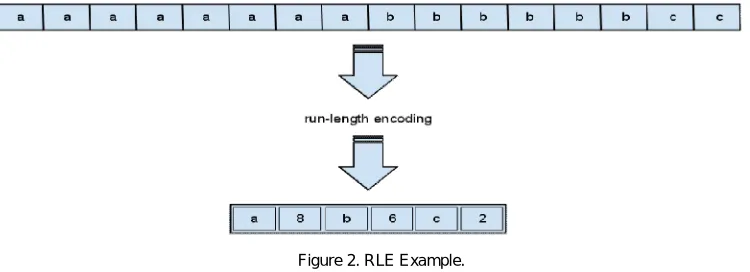
The Run Length Encoding (RLE)[2]is one of the two lossless methods which is used for compressing the image. RLE or Run Length Encoding is also called as recurrence coding[2]. It is very effective for the data sets which contain a lot of long sequences of repeated data and hence it can be used for compressing the grayscale images efficiently yielding good results. This algorithm consists of replacing large sequences of repeating data with only one item of this data followed by a counter showing how many times this item is repeated. For Example:
Figure 2. RLE Example.
C. Huffman:
The Huffman coding[1, 4] is the second lossless compression method which will be applied to compress the image after RLE and this will be our first hybrid technique which is implemented to compress the grayscale medical images. Huffman coding was proposed by Dr. David A. Huffman in 1952. It is applicable to many forms of data transmission. Huffman coding is a form of statistical coding and works well for text and fax transmissions. Huffman coding is a lossless data compression algorithm.[4] The idea is to assign variable-length codes to input characters, lengths of the assigned codes are based on the frequencies of corresponding characters. The most frequent character gets the smallest code and the least frequent character gets the largest code. The variable-length codes assigned to input characters are Prefix Codes, means the codes (bit sequences) are assigned in such a way that the code assigned to one character is not prefix of code assigned to any other character[4]. This is how Huffman Coding makes sure that there is no ambiguity when decoding the generated bit stream.
There are mainly two major parts in Huffman Coding: 1)Build a Huffman Tree from input characters.
2) Traverse the Huffman Tree and assign codes tocharacters.
D. Lempel-Ziv-Welch (LZW):
character set. It then reads data 8 bits at a time (e.g.,’t’, 'r', etc.) and encodes the data as the number that represents its index in the dictionary. Everytime it comes across a new substring (say, "tr"), it adds it to the dictionary; everytime it comes across a substring it has already seen, it just reads in a new character and concatenates it with the current string to get a new substring. The next time LZW revisits a substring, it will be encoded using a single number. Usually a maximum number of entries (say, 4096) is defined for the dictionary, so that the process doesn't run away with memory. Thus, the codes which are taking place of the substrings in this example are 12 bits long (2^12 = 4096). It is necessary for the codes to be longer in bits than the characters (12 vs. 8 bits), but since many frequently occuring substrings will be replaced by a single code, in the long haul, compression is achieved.
IV.PROPOSED ALGORITHM
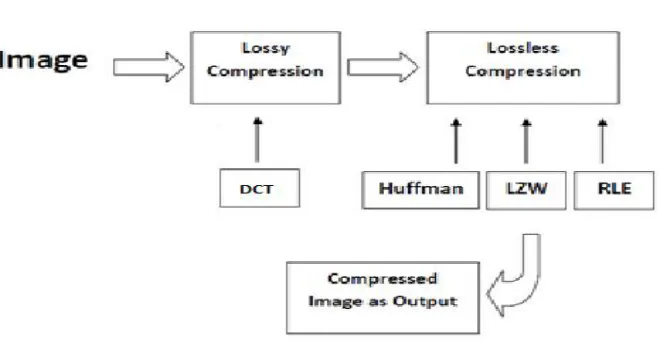
Figure 3. Block Diagram of Proposed Algorithm.
In this paper, we propose two hybrid methods which combines lossy and lossless compression to reduce the redundancy of the grayscale medical images, the first hybrid method combines DCT followed by RLE and Huffman and the second hybrid method combines DCT followed by RLE and LZW.
The algorithm steps for the proposed hybrid technique proposed in this paper are as follows:
Input: Original Image(in .bmp format)
Output: Compressed Image.
Step 1: Read the set of input grayscale medical images.
Step 2: If images are colored images then convert them to grayscale.
Step 3: Now, Thresholding is done using a threshold value which is selected and applied for wavelet transformed values. In this, the values which are less than or equal the threshold value is set to zero[2].
Step 4: Next, the DCT algorithm is implemented by using quantization of the DCT coefficients. This is done by rounding the coefficients. This completes the lossy part of compression using DCT.
Step 5: Now, we implement the lossless part of the hybrid technique in which first we will apply the Run Length Encoding (RLE)[2].
Step 6: After RLE, Huffman is applied to the output of the RLE to finally complete the first hybrid technique. For, the second hybrid technique, LZW is applied to the output of the RLE. This completes the process of hybrid compression and a compressed image is obtained as the output.
Step 7: The Compression Ratio and the Percentage of compression is calculated for each image. Step 8: End.
Here, the effectiveness and the efficiency of the two proposed hybrid compression techniques has been illustrated by the various experimental results which are obtained. The proposed hybrid compression has been implemented in MATLAB and the grayscale medical images are used to evaluate each of the proposed technique. The compression ratio (CR)[1, 3] and the percentage of compression is calculated for each image and the results can be seen in the following table where the two proposed techniques can be compared and evaluated for compressing grayscale medical images.
Table 1. Compression Ratio for 30 Images.
Figure 5. Chart Showing Average CR for 30 Images.
The table above shows the compression ratio of the two proposed techniques for each image and also, it shows the compression ratio of other compression techniques which are DCT and DCT+RLE but you can observe in the table that the proposed hybrid techniques are showing better results. The figure is the graphical representation of the results table and you can compare the efficiency of the various techniques by referring to the graph.
VI.CONCLUSION
REFERENCES
1. A.H.M. Jaffar Iqbal Barbhuiya , Tahera Akhtar Laskar , K. Hemachandran ,“An Approach for Color Image Compression of JPEG and PNG Images using DCT And DWT” ,Computational Intelligence and Communication Networks (CICN), 10.1109/CICN, 2014 Assam, India. 2. Rawsam Abdaladheem Hasan ,“COMBINATION OF LOSSY AND LOSSLESS FOR IMAGE COMPRESSION”, European Scientific
Journal,edition vol.10, No.33 pp 230-242 ,2014 Baghdad,Iraq.
3. M. Mozammel Hoque Chowdhury and Amina Khatun ,“Image Compression Using Discrete Wavelet Transform”, IJCSI International Journal of Computer Science Issues, Vol. 9, Issue 4, No 1, pp 327-330, 2012 Dhaka, Bangladesh.
4. Padmavati S, Vaibhar Mesharam, ”DCT Combined With Fractal Quadtree Decomposition and Huffman Coding for Image Compression” International Conference on Condition Assessment Techniques in Electrical Systems (CATCON), 10.1109/CATCON,.
5. A. Alarabeyyat , S. Al-Hashemi , T. Khdour , M. Hjouj Btoush , S. Bani-Ahmad , R. Al-Hashemi, “Lossless Image Compression Technique Using Combination Methods” Journal of Software Engineering and Applications, vol. 5, pp 752-76, 2012..
6. M.Sundaresan, E.Devika, “Lossy and Lossless Compression using various Algorithms” 2013 International Journal of Computer Applications (0975 – 8887) Volume 65– No.20, March 2013.
7. Robina Asraf, Muhammad Akbar, Noman Jafri, “Statistical Analysis of Difference image for Absolutely Lossless Compression of Medical Images”, Engineering in Medicine and Biology Society, 2006. EMBS '06. 28th Annual International Conference of the IEEE, 2006.
8. Salam Benchikh, Michael Corinthios, “A hybrid image compression technique based on DWT and DCT transforms” Advanced Infocom Technology 2011 (ICAIT 2011), International Conference, 2011.
9. Ms. Pallavi M. Sune, Prof. Vijaya K. Shandilya, “Image Compression Techniques based On Wavelet and Huffman Coding” International Journal of Advanced Research in Computer Science and Software Engineering,2013
10. Uday Joshi Associate Professor, Bhakti Palkar Associate Professor, Khushi Khanchandani PG student, University of Mumbai K.J. Somaiya College of Engineering “A Memory-Assisted Lossless Compression using Combination Methods” Volume 115 – No. 18, International Journal of Computer Applications (0975 – 8887), April 2015