ABSTRACT
AKSIT, OSMAN. Enhancing Science Learning through Computational Thinking and Modeling in Middle School Classrooms: A Mixed Methods Study. (Under the direction of Dr. Eric N. Wiebe).
Computational thinking and modeling are authentic practices that scientists and engineers use frequently in their daily work. Advances in modern computing technologies over the past couple of decades have further emphasized the centrality of modeling in science by making computationally-enabled model use and construction more accessible to scientists. For this reason, it is important for students to get exposed to these practices in K-12 science classrooms. This mixed-methods study investigated how a one-week intervention in regular middle school science classrooms that introduced computational thinking practices and simulation-based model building through a visual block-based programming environment influenced students’ understanding of computational thinking concepts and practices as well
as their conceptual understanding of a physical science topic, force and motion. The study also examined whether and how seventh-grade students’ attitudes towards programming changed as a result of participating in the intervention course. Eighty-two seventh-grade students from a public middle school in the southeastern United States participated in the study. Quantitative data sources included pre- and post-tests of students’ knowledge of computational thinking concepts and practices, force and motion concepts, and their attitudes towards programming. Qualitative data sources included classroom observation notes,
simulation-engaging in building computational models through Scratch programming environment in regular science classrooms resulted in significant conceptual learning gains for the sample of this study. The affordances of the dynamic nature of computational models let students both “observe” and “interact” with the target phenomenon in real time while the generative
dimension of model construction promoted a rich classroom discourse facilitating conceptual learning. The results also indicated that students had more favorable attitudes towards
programming on the post-test compared to the pre-test. This study contributes to the nascent literature on integrating computational modeling into K-12 science curricula by emphasizing the affordances and generative dimension of model construction through block-based
Enhancing Science Learning through Computational Thinking and Modeling in Middle School Classrooms: A Mixed Methods Study
by Osman Aksit
A dissertation submitted to the Graduate Faculty of North Carolina State University
in partial fulfillment of the requirements for the degree of
Doctor of Philosophy
Science Education
Raleigh, North Carolina 2018
APPROVED BY:
_______________________________ _______________________________
Dr. Eric N. Wiebe Dr. M. Gail Jones
Committee Chair
_______________________________ _______________________________
DEDICATION
BIOGRAPHY
ACKNOWLEDGMENTS
TABLE OF CONTENTS
LIST OF TABLES ... ix
LIST OF FIGURES ... xi
CHAPTER ONE: INTRODUCTION ... 1
Theoretical Frameworks ... 9
Constructionism ... 9
Learning through Constructing Representations ... 11
Purpose of the Study ... 13
Summary ... 14
CHAPTER TWO: REVIEW OF THE LITERATURE ... 16
Historical Background of Computational Thinking ... 16
Defining Computational Thinking ... 18
Computational Thinking Practices ... 21
Computational Thinking in K-12 STEM Education ... 25
Assessment of Computational Thinking ... 27
Models and Modeling in Science ... 29
Models and Modeling in Science Education ... 30
Computational Thinking and Modeling ... 32
Learning about Force and Motion Concepts ... 35
Summary ... 38
CHAPTER THREE: METHODOLOGY ... 39
Research Design ... 40
Research Setting ... 43
Participants ... 44
Intervention ... 45
Data Sources ... 52
Pre-test and Post-test ... 52
Reflective Statement Questions ... 57
Interviews with Students ... 57
Classroom Observations ... 58
Data Analysis ... 59
Research Question 1 ... 62
Research Question 2 ... 62
Research Question 3 ... 63
Summary ... 63
CHAPTER FOUR: RESULTS ... 64
Pre-test/Post-test. ... 64
Student Interviews. ... 69
Reflective Statement Responses. ... 77
Research Question 2. ... 79
Pre-test/Post-test. ... 79
Student Interviews. ... 83
Reflective Statement Responses. ... 85
Research Question 3. ... 88
Pre-test/Post-test. ... 88
Student Interviews. ... 93
Reflective Statement Responses. ... 94
Summary ... 96
CHAPTER FIVE: DISCUSSION AND IMPLICATIONS ... 97
Research Question 1. ... 97
Research Question 2. ... 111
Research Question 3. ... 120
Limitations of the Study ... 127
Conclusion and Future Work ... 129
APPENDICES ... 153
Appendix A ... 154
Appendix B ... 161
Appendix C ... 160
Appendix D ... 154
LIST OF TABLES
Table 3.1 Computational thinking practices and modeling activities covered during
the intervention ...48
Table 3.2 State Science Standards addressed during the modeling activities ...48
Table 3.3 A sample question from the Force and Motion Assessment ...55
Table 3.4 The list and descriptions of the data sources ...59
Table 4.1 Descriptive statistics for students’ scores on the Force and Motion Assessment ...65
Table 4.2 Results of the paired-samples t-test analysis comparing students’ pre- and post-test scores on the Force and Motion Assessment ...67
Table 4.3 Results of the paired-samples t-test analysis comparing students’ pre- and post-test scores on the Force and Motion Assessment by gender ...68
Table 4.4 Results of the independent-samples t-test analysis comparing the change in pre- and post-test scores for the Force and Motion Assessment between male and female students ...69
Table 4.5 Themes from student interview responses regarding their conceptual understanding of force and motion concepts ...70
Table 4.6 Themes from student interview responses regarding their understanding and use of models ...72
Table 4.7 Themes from student interview responses regarding their conceptual understanding of the nature of models in science ...74
Table 4.8 Themes from student interview responses regarding their views on how models that they built helped them better understand force and motion concepts ... ...76
Table 4.9 Themes from student reflective statement responses regarding their conceptual understanding of force and motion concepts ...78
Table 4.11 Results of the paired-samples t-test comparing students’ pre- and post-test scores on the CTt ...82 Table 4.12 Results of the paired-samples t-test analysis comparing students’ pre- and
post-test scores on the CTt by gender ...82 Table 4.13 Results of the independent-samples t-test analysis comparing the change in pre- and post-test scores for the CTt between male and female students ...83 Table 4.14 Themes from student reflective statement responses regarding their
understanding of computational thinking concepts and practices ...86 Table 4.15 Descriptive statistics for students’ scores on the attitudinal survey ...89 Table 4.16 Descriptive statistics for students’ average scores on each survey item ...91 Table 4.17 Results of the paired-samples t-test analysis comparing students’ pre- and
post-test scores on the attitudinal survey ...92 Table 4.18 Results of the paired-samples t-test analysis comparing students’ pre- and
post-test scores on the attitudinal survey by gender ...92 Table 4.19 Results of the independent-samples t-test analysis comparing the change in
pre- and post-test scores for the attitudinal survey between male and
female students ...93 Table 4.20 Quotes from student interview responses regarding their positive attitudes
towards programming ...94 Table 4.21 Themes from student reflective statement responses regarding their attitudes
LIST OF FIGURES
Figure 1.1. Block-based versus traditional text-based programming ...7
Figure 3.1. Convergent mixed methods design of the study ...43
Figure 3.2. User interface of the Scratch programming environment ...46
Figure 3.3. Screenshot of the first modeling activity in Scratch ...50
Figure 3.4. Screenshot of the second modeling activity in Scratch ...51
Figure 3.5. A sample question from the CTt ...54
Figure 4.1. Histogram of the pre-test scores of the Force and Motion Assessment ...66
Figure 4.2. Histogram of the post-test scores of the Force and Motion Assessment ...66
Figure 4.3. Histogram of the pre-test scores of the CTt ...80
Figure 4.4. Histogram of the post-test scores of the CTt ...81
Figure 4.5. Histogram of the pre-test scores of the Attitudinal Survey ...89
Figure 4.6. Histogram of the post-test scores of the Attitudinal Survey ...90
Figure 5.1. Mathematical formula versus block-based code on Scratch ...108
Figure 5.2. Calculating velocity using block-based code ...109
CHAPTER ONE: INTRODUCTION
The advancement of computing and computer science has greatly influenced how science is practiced by scientists today. This has resulted in computational thinking becoming an increasingly important skill and core competency in all science, technology, engineering, and mathematics (STEM) fields (National Research Council [NRC], 2010). Scientists today use computer technologies to conduct experiments, create complex models of physical phenomena, collect and analyze very large data sets, and identify patterns and relationships in a rapid and efficient way that was not possible in the past without computers. The Next Generation Science Standards (NGSS) identifies computational thinking as one of the eight science and engineering key practices that are essential for all students to master in K-12 education (NGSS Lead States, 2013). A growing body of studies has shown that the effective use of computational thinking concepts and practices in science classrooms can support and promote conceptual science learning (Basu et al., 2016; diSessa, 2000; Sengupta et al., 2013; Weintrop et al., 2016; Wilensky, Brady, & Horn, 2014).
Computational thinking has received extensive attention from a broad range of communities including computer scientists, educational researchers, disciplinary experts, policymakers, and K-12 educators over the last decade. The term “computational thinking” was first introduced by Wing (2006) to refer to “a universally applicable attitude and skill set everyone, not just computer scientists, would be eager to learn and use” (p. 33). Although
computational thinking is a necessary skill to acquire for all students (Barr & Stephenson, 2011; K-12 Computer Science [CS] Framework, 2016; NRC, 2012; Wing, 2014). As computational tools and technologies have become an important part of everyday life in the 21st century, computational thinking can help students become not just consumers but also producers of technology by fostering creativity (Mishra & Yadav, 2013).
Computational thinking can be simply defined as the “thought processes involved in
formulating problems so their solutions can be represented as computational steps and algorithms” (Aho, 2012, p. 832). This definition draws on the idea that computational solutions are produced in forms that can be executed by an “information-processing agent”
(Cuny, Snyder, & Wing, 2010). Computational thinking requires an understanding of the potential and limitations of computers, approaching and formulating problems that can be addressed by computing, and developing abstractions and algorithms that can be carried out by computers (K-12 CS Framework, 2016). Barr and Stephenson (2011) identified nine core concepts and practices pertaining to computational thinking which include data collection, data analysis, data representation, problem decomposition, abstraction, algorithms and procedures, automation, parallelization, and simulation.
Despite the apparent consensus on computational thinking as a key set of concepts and practices central to STEM disciplines, research shows that computational thinking has not been well integrated into K-12 science curricula nor addressed properly in science
formal instruction in computational thinking (Wilson, 2013). For example, only about 12% of high schools nationwide offer AP Computer Science Principles course (College Board, 2016). Likewise, middle schools in the United States face a significant shortage of teachers to teach introductory computer science which can help foster learning about computational thinking across subject areas (Grover, Pea, & Cooper, 2015). Existing R&D efforts have mostly focused on introducing computational thinking in open-ended contexts including game design and storytelling with programming, or in informal settings through
extracurricular activities (e.g., robotics; Bers, 2010; Bers, Flannery, Kazakoff, & Sullivan, 2014; Denner, Werner, & Ortiz, 2012).
Science education researchers have long argued that science learning should not only focus on learning well-established scientific theories, discoveries, and facts but also engage students in authentic practices that scientists use in their professions (Marx et al., 2004; NRC, 1996). Specifically, the practice of modeling has not been incorporated extensively into K-12 science curricula although it is an essential part of the scientific inquiry today (Lehrer & Schauble, 2006; Schwarz et al., 2009). Similar to computational thinking, modeling is one of the eight science and engineering key practices identified by the NGSS (Lead States, 2013). Modeling can be defined as the practice of creating a simplified, external representation of a system to explain a scientific concept such as the particle model of matter (Schwarz et al., 2009), and can help students link observed scientific phenomena and underlying abstract conceptual underpinnings (Harrison & Treagust, 1998; Leenaars, van Joolingen, & Bollen, 2013). Previous research suggests that students who engage in developing and using models end up having a more robust understanding of natural phenomena (Clement, 2000; Oh & Oh, 2011).
physical phenomenon would behave or change under different conditions in real time
(Boulter & Buckley, 2000; Delgado & Krajcik, 2010). Constructing simulation-based models requires students to articulate on their understanding of different variables included in
defining a system, and explicitly identifying the relationships (i.e., the causal mechanisms) among these variables (de Jong & van Joolingen, 1998; diSessa, 2000; Papert, 1980). Previous research has shown that engaging students in computational thinking through computer programming to build simulation-based models that explain and predict the
behavior of physical phenomena can be an effective modeling strategy which can foster both computational thinking and science learning in K-12 science classrooms (Klopfer et al., 2009; Sengupta et al., 2013; Sherin, diSessa, & Hammer, 1993; Wilensky & Resnick, 1999; Wilensky et al., 2014).
Although computers and computational tools are becoming increasingly ubiquitous in today's classrooms, the use of computers as a medium of inquiry in science classrooms has been very limited. Since students do not have much exposure to computational thinking and computer programming in K-12, engaging in developing models through programming can be particularly challenging for students (Basu et al., 2016; Foley, 2012). First of all, in order to build computer models of scientific phenomena, students need to have both conceptual understanding (e.g., conditionals, loops, algorithms) and operational knowledge (e.g., user interface, syntax, semantics) of a particular programming language, in addition to the domain knowledge of the science topic being studied. Previous research suggests that learning
semantics of a programming language is one of the common and most frustrating challenges for new learners (Guzdial, 2004; Kelleher & Pausch, 2005; Mannila et al., 2006).
Specifically, learners usually struggle with "remembering the names of commands, the order of parameters, whether or not they are supposed to use parentheses or braces, and so on" (Kelleher & Pausch, 2005, p. 90). In order to address the challenges related to learning syntax and semantics, and also make it easier for novice programmers to focus on the essential programming concepts without getting distracted by the mechanics of programming, a number of visual block-based programming environments have been developed to serve as introductory tools for programming (Shapiro & Ahrens, 2016; Weintrop & Wilensky, 2015).
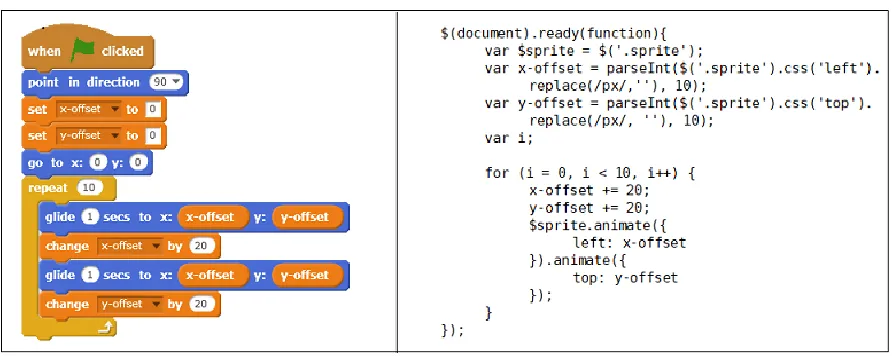
Block-based programming is a relatively new paradigm compared to the traditional text-based programming and was specifically designed to introduce programming to beginners. Block-based programming environments feature a visual graphic user interface where learners can drag and drop pre-existing code blocks (i.e., built-in functions and statements) and snap them together to create a computer program rather than writing a text-based code (Lye & Koh, 2014; Weintrop & Wilensky, 2015). Figure 1.1 shows a piece of code written in a block-based programming language on the left, and its equivalent of
traditional text-based code written in JavaScript programming language on the right. A visual comparison of the two representations readily shows the syntactic simplicity of the block-based code versus the JavaScript code. Blocks in these programming environments generally have unique shapes and different colors based on their functions and are allowed to be
any syntax-related mistakes during the construction of the program. Also, in these
environments blocks with similar functions are usually grouped into categories, which makes it easier for learner to browse and find a particular block (Weintrop & Wilensky, 2015). All of these embedded scaffoldings in block-based environments serve to reduce cognitive overload that would result from having to memorize and recall the syntax of programming language and enable learner to focus on constructing algorithms and practicing
computational thinking (Lye & Koh, 2014). Some of the well-known environments that utilize block-based programming include Scratch (Resnick et al., 2009), Alice (Cooper, Dann, & Pausch, 2000), StarLogo TNG (Klopfer, Scheintaub, Huang, Wendel, & Roque, 2009), and Blockly (Trower & Gray, 2015).
Figure 1.1. Block-based versus traditional text-based programming
promote conceptual science learning. A limited number of studies have shown that students from middle grades to high school were able to successfully construct computer models with visual programming environments and improved their understanding of science content (Basu et al., 2012, 2016; Sengupta & Farris, 2012).
Finally, integrating computational thinking practices into science curricula and instruction instead of teaching in only informal, after-school settings is important for addressing the issues related to gender and social equity (Harlow et al., 2016). Although research shows promise for introducing computational thinking through informal learning experiences (e.g., robotics clubs), this approach often results in a population consisting of self-selected male students, or students who are already interested in computers, or those from families with higher socioeconomic status involve in these informal programs
exposed to authentic science practices such as computational thinking and modeling and have favorable attitudes towards STEM fields.
Theoretical Frameworks Constructionism
Constructionism is a learning theory developed by Seymour Papert (1980) and builds upon the constructivist ideas of learning. The constructivist approach to learning argues that knowledge is actively constructed by the learner, and learner’s prior knowledge and personal
experiences have an important role in the learning process (Piaget, 1965, 1971).
Constructivism rejects the idea of learning by transmission of knowledge and suggests that learning is a contextualized process of constructing knowledge rather than acquiring it from a source. Based on his studies on how children understand the world, Piaget (1965) identified mechanisms which include assimilation and accommodation to explain how learner
constructs knowledge by building on past experiences. Papert worked with Piaget in Geneva in the late 1950s and later expanded on Piaget's ideas by focusing on the ways of how internal knowledge construction can be supported by real-world objects, particularly computers (Kafai, 2006). Constructionism differs from constructivist framework by
emphasizing the importance of externalizations and argues that learning is particularly robust when learners project out their inner ideas by constructing tangible and shareable artifacts (Papert, 1990):
further idea that this happens especially felicitously when the learner is engaged in the construction of something external or at least shareable…a sand castle, a machine, a computer program, a book. This leads us to a model using a cycle of internalization of what is outside, then externalization of what is inside and so on. (Papert, 1990, p. 3)
Similar to Piaget's constructivist framework, constructionism underlines the "learning by doing" approach, particularly using new technologies to help individuals learn by actively inquiring (Bers, 2010). Constructionist learning theory emphasizes providing learners with opportunities to build external and shareable artifacts, and highlights the personal and social dimensions of knowledge construction (Kafai & Resnick, 1996). According to Piaget (1971), abstract thinking and reasoning is the last stage in the cognitive development of children. However, constructionism suggests that concrete thinking can be as advanced as abstract thinking (Turkle & Papert, 1990). In constructionism, physical or digital objects—as Papert calls "objects-to-think-with"—play a central role for supporting the concrete thinking about abstract phenomena (Kafai, 2006).
Constructionism also places primacy on the situated nature of learning by
acknowledging learning as the knowledge construction process in the context of social and cultural participation (Ackermann, 2001; Kafai, 2006). Constructionism is interested in how learners engage in a conversation with their own or other people’s artifacts, and how these
communicate their ideas in the classroom and further their understanding of science concepts.
Learning through Constructing Representations
A large body of research indicates that engaging in constructing external
representations of scientific phenomena in the classroom facilitates conceptual understanding of science (Greeno & Hall, 1997; Kozma, 2003; Tytler, Prain, & Peterson, 2007). Different representational systems have different affordances and may emphasize different aspects of a phenomenon. For example, building diagrams can be useful to illustrate the components of a system and show how these components are related spatially, while constructing simulation-based computer models can describe the processes in the system such as how the components of the system change across time and space (Wilkerson-Jerde, Gravel, & Macrander, 2015). Constructing representations is important in science classroom not only as a product that reflects student understanding and alternative conceptions, but also as a process that furthers student learning (Carolan, Prain, & Waldrip, 2008).
Prain and Tytler (2012) proposed a framework called Representational Construction Affordances (RCA) to explain how and why students learn by constructing representations. By building on previous research (Bransford & Schwartz, 1999; Pickering, 1995), the researchers recognize the idea that by constructing representations “students were
dimensions which consist of semiotic, epistemic, and epistemological. The researchers argued that “each dimension is linked by its focus on the way representations productively
constrain meaning-making practices in science and in science education, taking into account the interplay of diverse cultural and cognitive resources students use to achieve this meaning-making.” (p. 2757). In this framework, semiotic dimensionfocuses the use of semiotic or
cultural tools applicable to constructing representations and developing competence to
recognize and use these tools. This is consistent with sociocultural perspectives which place a primacy on the use of cultural tools in mediating learning (Vygotsky, 1981). The epistemic dimension emphasizes the knowledge-building practices such as constructing models, and making, justifying and communicating claims based on the constructed models. Lastly, the epistemological dimension points out that students’ reasoning in science can be improved by the process of constructing and interpreting their own representations.
Prain and Tytler (2012) argued that participating in activities to generate representations in science classrooms leads to high learning gains because building
representations: “1) develops students’ cognitive and reasoning strategies relevant to science
learning, 2) provides a meaningful, focused context for student development of
representational competence, 3) promotes classroom context that engender meaningful communication of science understanding, and 4) is highly engaging for students” (p. 2769).
Purpose of the Study
The goal of this study was to investigate how attending a one-week intervention course that introduced computational thinking practices and simulation-based model building through a visual block-based programming environment in regular middle school science classrooms influenced seventh-grade students’ understanding of computational thinking concepts and practices as well as their conceptual understanding of a physical science topic, force and motion. The study also examined whether and how seventh-grade students’
attitudes towards programming changed as a result of participating in the intervention course. Since there is a dearth of research on how to integrate computational thinking practices into science curricula and instruction in K-12 education, the findings of this study provided insights on how students’ computational thinking practices and science learning develop by
engaging in block-based programming and modeling. Specifically, this study aimed to answer the following research questions:
1. How does building simulation-based computer models of physical phenomena through a visual block-based programming environment in a one-week intervention course influence middle school students’ conceptual understanding of force and motion concepts?
a. Is there a differential impact of the classroom intervention on students’
conceptual understanding of force and motion concepts according to students’
2. How does participating in a one-week intervention course introducing computational thinking practices and simulation-based model building through a visual block-based programming environment influence middle school students’ understanding of
computational thinking concepts and practices?
a. Is there a differential impact of the classroom intervention on students’ understanding of computational thinking concepts and practices according to students’ gender?
3. How do middle school students’ attitudes towards programming change as a result of participating in a one-week intervention course introducing computational thinking practices and simulation-based model building through a visual block-based
programming environment?
a. Is there a differential impact of the classroom intervention on students’ attitudes towards programming according to students’ gender?
Summary
In Chapter Two, the literature pertaining to computational thinking, modeling, and learning science through constructing representations is reviewed. This chapter also includes relevant studies that have investigated the use of computational thinking practices in both formal and informal learning environments.
Chapter Three describes the methodology that was employed for this study. Details on the research design as well as the description of the data sources and analyses are presented.
Chapter Four presents the results of the study that are organized around the research questions.
CHAPTER TWO: REVIEW OF THE LITERATURE
This chapter presents a review of the relevant literature. First, a historical background of computational thinking given, followed by the sections on definition and practices of computational thinking. Next, the research pertinent to the current state of computational thinking in K-12 education as well as the proposed assessment tools and strategies are discussed.
Since computational thinking was investigated in the context of modeling in this study, a review of the research on the practice of modeling in science and science education was provided, followed by a discussion of studies that investigated modeling as a medium to introduce computational thinking concepts and practices in K-12 science classrooms. Then, the research on learning and reasoning with representations was examined. Lastly, the literature on student learning about force and motion concepts was highlighted.
Historical Background of Computational Thinking
The term “computational thinking” has been introduced by Wing (2006) in her
seminal work to refer to a new competency—an analytic ability—that every child should acquire during their formal education in addition to reading, writing, and arithmetic. However, the idea of introducing computation and programming to every student in K-12 education dates back to Seymour Papert’s work at MIT in the 1980s (Grover & Pea, 2013;
Powerful Ideas”, Papert reported his early efforts to teach what he called “procedural thinking” through programming with Logo (Papert, 1980). Procedural thinking included
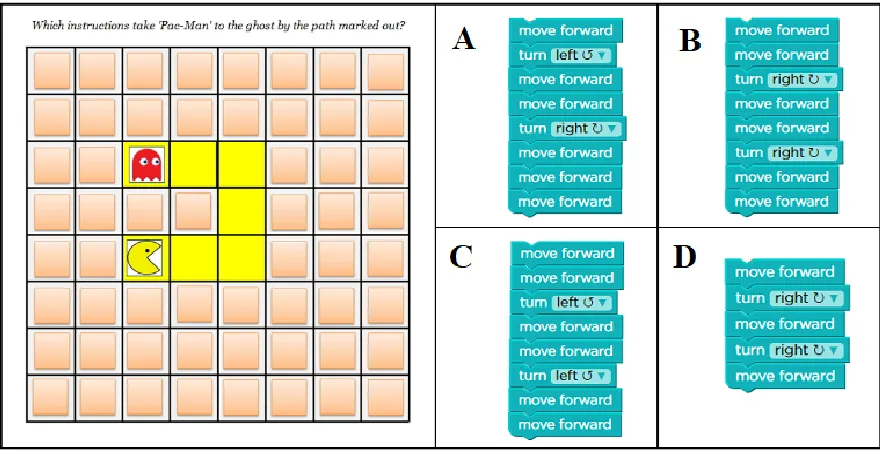
developing, representing, testing, and debugging procedures, which are step-by-step instructions that can be interpreted and carried out by a specified agent such as a computer (Papert, 1980). Logo included a visual output interface in the form of a graphical turtle and a pen attached to it, in addition to a simple and intuitive programming syntax (Guzdial, 2004). Students manipulated the graphical turtle on the computer screen by giving commands in their programs such as “forward 1” (i.e., move one unit forward), “right” (i.e., turn right), and “pendown” (i.e., put the pen down attached to the turtle to draw when the turtle is moving).
Papert argued that engaging in programming with Logo helped students think about their own thinking and gain higher-order thinking skills (Papert, 1991).
Papert (1991) claimed that programming is “reflexive” with other domains; i.e.,
learning programming in the context of other domains (such as mathematics and science) can be easier than learning them separately. Early studies demonstrated how challenging
Another important historical perspective on computational thinking comes from the work of Andrea diSessa in 1990s. Building on his experiences with Logo, diSessa developed another programming environment called Boxer to introduce “computational literacy” in K-12 settings (diSessa et al., 1991; Sherin et al., 1993). diSessa (2000) argued that computers can be a vehicle for a new form of literacy—a digital age competency—that has the potential to provide a universal access to “powerful ideas” and has applications across domains. Although the idea of computational literacy has similarities with computational thinking (Wing, 2006), diSessa emphasized the use of “computing as a medium” in exploring other
domains such as mathematics and science (Grover & Pea, 2013). Boxer was used in classroom settings to teach mathematics and science concepts (Sherin et al., 1993; Sherin, 2001). While the use of Boxer showed potential to support mathematics and science learning, research showed that integrating Boxer programming into teaching was challenging (Sherin et al., 1993).
Defining Computational Thinking
There has been an ongoing discussion in the research community about the definition of computational thinking, and its relationship with other types of analytical competencies such as mathematical and engineering thinking (Grover & Pea, 2013; Sneider et al., 2014). Wing (2006) defined computational thinking as a 21st century competency which “involves
solving problems, designing systems, and understanding human behavior, by drawing on the concepts fundamental to computer science” (p. 33). Many researchers found Wing’s
p. 38). For instance, Denning (2009) defined computational thinking as “thinking with many
levels of abstractions, use of mathematics to develop algorithms, and examining how well a solution scales across different sizes of problems” (p. 28). Lu and Fletcher (2009) argued that computational thinking is not about thinking like a computer, but it is about “developing the
full set of mental tools necessary to effectively use computing to solve complex human problems” (p. 260).
In order to address the confusion about the definition of computational thinking, National Research Council (NRC) organized two workshops by bringing together leading experts and researchers from a broad range of disciplines in 2010 and 2011. In the first workshop, participants discussed “the nature of computational thinking and its cognitive and educational implications” (NRC, 2010, p. viii). Participants’ definitions of computational
thinking fell into a number of categories, from more abstract to fully operationalized. For instance, one participant defined computational thinking “as a way of formulating precise methods of doing things” (p. 11), while another participant characterized it as “the use of
computation-related symbol systems (semiotic systems) to articulate explicit knowledge and to objectify tacit knowledge, to manifest such knowledge in concrete computational forms, and to manage the products emerging from such intellectual efforts” (p. 11). What was
was held in 2011, focused on exploring the pedagogical aspects of computational thinking in the context of K-12 education (NRC, 2011). In this workshop, most of the participants agreed on the idea that the power of computational thinking can be best utilized within domain-specific applications. The workshop report highlighted that computational thinking is pervasive in all STEM disciplines, and in order to develop expertise in computational thinking one needs to learn and recognize its applications and uses across domains (NRC, 2011).
According to the recently introduced K-12 Computer Science Framework (2016), computational thinking is “essentially a problem-solving process that involves designing solutions that capitalize on the power of computers” (p. 69). The Framework emphasized that
the use of computers in the classroom does not necessarily constitute computational thinking and provided scenarios to distinguish computational thinking from general computer use. For instance, a student who enters data into a spreadsheet and creates a chart does not necessarily use computational thinking. However, this action can require computational thinking if “the
student creates algorithms to automate the transformation of the data or to power an interactive data visualization” (p. 70).
As part of a nationwide initiative to introduce computing in K-12 education in the UK, the Royal Society (2012) defined computational thinking as “the process of recognising
definition: “computational thinking is the thought processes involved in formulating a
problem and expressing its solution(s) in such a way that a computer—human or machine— can effectively carry out.” (p. 1).
Computational Thinking Practices
In addition to defining computational thinking, researchers have also worked to identify the key concepts and practices pertaining to computational thinking. While some researchers have focused on recognizing the practices of computational thinking in particular disciplines such as computer science, others have tried to provide a more comprehensive list of these practices applicable across domains. Approaching from a perspective of a problem-solving skill in computer science, Wing (2006) suggested that computational thinking involves thinking recursively, using abstraction and decomposition when solving a complex problem, and judging the solution for both its efficiency and aesthetics. Along the same lines, Denning (2009) proposed that computational thinking involves “thinking with many levels of
abstractions, use of mathematics to develop algorithms, and examining how well a solution scales across different sizes of problems” (p. 28). Grover and Pea (2013) have argued that
abstraction is the keystone of computational thinking, a characteristic that distinguishes computational thinking from other types of thinking. Other researchers have also underscored the central role of abstraction in computational thinking (Aho, 2012; Barr & Stephenson, 2011; Sengupta et al., 2013).
Csizmadia et al. (2015) defined abstraction as the process of designing a
by reducing the unnecessary details. Selby (2015) argued that abstraction is the ability to decide what details of a problem are important, and what details can be ignored when solving the problem. As the problems become more complex, the use of abstraction becomes
increasingly important in solving those problems (Aho, 2011). According to Wing (2008), computational thinking involves dealing with abstractions in the following ways: “defining
abstractions, working with multiple layers of abstraction, and understanding the relationships among the different layers.” (p. 3718).
Abstraction requires generation of a representation that contains only the necessary information in characterizing the problem or idea (Csizmadia et al., 2015). For example, a world map showing the political borders of the states is an abstraction because its primary purpose is to display boundaries of the states, and in doing that it omits several geographical details such as mountains and other landforms. Similarly, building a physical or computer model of the solar system to show the relative sizes and distances of the planets to the Sun would be an example of abstraction in science classroom. In building this model of the solar system, one can safely ignore the smaller celestial bodies including moons, asteroids, and comets. Wing (2014) argued that a computer algorithm is an abstraction “that takes inputs,
executes a sequence of steps, and produces outputs to address a desired goal” (p. 2).
is a critical mental ability that is applicable in any problem-solving situation. In the context of computation and computer programming, algorithmic thinking involves using the key concepts in computer science such as sequences, conditionals, and loops (Grover, Cooper, & Pea, 2014).
The two important organizations in the United States, the Computer Science Teachers Association (CSTA) and the International Society for Technology in Education (ISTE), have recently worked jointly to form a steering committee and identify computational thinking practices for K-12 education (Barr & Stephenson, 2011). They identified nine essential practices pertaining to computational thinking which include “data collection, data analysis, data representation, problem decomposition, abstraction, algorithms, automation,
parallelization, and simulation” (Barr & Stephenson, 2011). The steering committee also
provided pedagogical strategies for embedding computational thinking practices across the K-12 subject areas including science, mathematics, social studies, and language arts. For example, the practice of data analysis may be used in statistically analyzing data from an experiment in a science classroom, and in identifying patterns for different sentence types in a language art classroom (Barr & Stephenson, 2011).
studies, Grover and Pea (2013) suggested that computational thinking encompasses the following list of concepts and practices (p. 40):
• Abstractions and pattern generalizations • Systematic processing of information • Symbol systems and representations • Algorithmic notions of flow of control • Structured problem decomposition • Iterative, recursive, and parallel thinking • Conditional logic
• Efficiency and performance constraints • Debugging and systematic error detection
It is important to point out that computational thinking is not only about being able to learn programming and create computer programs. Some researchers even suggested that
computational thinking practices can be taught without the use of computers (Lu & Fletcher, 2009; Voogt et al., 2015). However, others have argued that programming is not only a fundamental skill in solving computational tasks, but also a necessary tool to demonstrate computational thinking competencies (Grover & Pea, 2013; NRC, 2010). The NRC report on computational thinking described programming as “an essential aspect of computational thinking” (p. 7). Mitchel Resnick—a leading scholar in computer science and one of the participants of the workshop—stated that “computational thinking is more than
introducing computational thinking without the use of computers—by arguing that these efforts “may be keeping learners from the crucial computational experiences involved in CT’s common practice.” (p. 40).
Computational Thinking in K-12 STEM Education
Despite the growing importance of computational thinking in STEM disciplines, its inclusion into K-12 science curricula and instruction has been very limited in the United States (Grover & Pea, 2013; Voogt et al., 2015). There is a large research base for computer science education in undergraduate settings; however, research on how students learn about computational thinking and computer programming in K-12 settings is under investigated (Voogt et al., 2015). Likewise, little is known about how K-12 students can engage in computational thinking as part of their science learning in formal classroom settings (Grover & Pea, 2013). Existing studies mostly investigated computational thinking in contexts such as game design or storytelling using visual programming environments, or in informal after-school settings through extracurricular activities such as robotics (Bers, 2010; Bers, Flannery, Kazakoff, & Sullivan, 2014; Denner, Werner, & Ortiz, 2012).
Repenning, Webb and Ioannidou (2010) investigated how game development with block-based programming can be used to introduce computational thinking in a one-week course targeted at middle school students. The researchers reported only anecdotal evidence, but the course seemed to have a positive impact on students’ attitudes and engagement
minorities from 4th to 12th grade, Ericson and McKlin (2012) investigated how an 8-week summer camp program can increase students’ knowledge of computing concepts as well as students’ attitudes towards computing. Students interacted with a variety of computing
environments including Lego NXT, Scratch, Alice, and WeDo robotics kits. The researchers administered a pre- and post-test consisted of an 8-item Likert-scale survey to measure students’ attitudes, and a 10-item multiple-choice assessment to measure students’
understanding of computer programming concepts such as loops and conditionals. The results showed that there was a statistically significant increase in both students’ attitudes towards computing and students’ knowledge of programming concepts (Ericson & McKlin, 2012).
In another study with middle school students, Wolz et al. (2011) investigated the integration of computational thinking practices into a journalism course, which was offered in a summer camp followed by an after-school club. The researchers examined the impact of their intervention on students’ attitudes and confidence towards computing and
programming. During the intervention, students engaged in writing news stories and developing animations in Scratch visual programming environment to support their stories. The researchers administered surveys, held focus groups, and made observations to assess the effectiveness of the intervention. The results showed that students developed positive
attitudes towards computational thinking and programming. At the end of the intervention, students were able to understand that one does not need to be “math type” to do
Computational thinking has been introduced to students in elementary and
kindergarten schools too (Bers, 2010; Bers et al., 2014; Flannery et al., 2013). For instance, Bers et al. (2014) investigated kindergarten students’ exposure to computational thinking
practices in the context of robotics in a classroom intervention study. The goal of the study was “to describe young children’s learning trajectories in computational thinking and capacity to understand computer programming and robotics concepts” (p.147). Students
engaged in building robots using commercially available robotics construction kits and used a graphical programming interface to program their robots to do specific tasks. The results showed that the activities were “generally engaging and developmentally appropriate”
(p.154), and students were able to learn the key concepts and practices in robotics and computational thinking.
Assessment of Computational Thinking
Assessment plays an important role in education. Assessments can provide evidence of student learning and can help teachers make informed decisions in the classroom
(Werner, Denner, Campe, & Kawamoto, 2012; Koh, Basawapatna, Bennett, & Repenning, 2010; Dagiene & Sentance, 2016).
Werner et al. (2012) developed a performance assessment called the “Fairy Assessment” to evaluate students’ understanding of abstraction, conditional logic,
algorithmic thinking, and other computational thinking concepts in the context of a visual programming environment called Alice. The assessment was designed as open-ended programming tasks in Alice where students were given a storyline and followed the instructions to complete the tasks. A total of 311 middle school students completed the assessment. Students’ work in the form computer programs was graded by two raters using a
scoring rubric. The researchers did not conduct a psychometric validation process, but the preliminary results suggested that the assessment was “successful in picking up a range of
CT across students, and a variety of types of CT across the three tasks” (p. 218).
Other researchers have proposed and developed similar assessment strategies that are highly context-dependent and not validated using a rigorous psychometric validation process (Basawapatna et al., 2011; Brennan & Resnick, 2012; Moreno-Leon & Robles, 2015). In a recent study, Roman-Gonzalez et al. (2017) developed a general and relatively
results indicated that the test can be used for collecting quantitative data in pre- and post-assessment of student knowledge of computational thinking practices.
Models and Modeling in Science
Models and modeling play a central role in the conduct of scientific research (Gilbert, 1991; Schwarz & White, 2005). Scientists spend a great deal of their time in building,
testing, studying and revising models, often using computational tools. Models are used ubiquitously in the physical and biological sciences to describe natural phenomena and explain causal relationships (Bailer-Jones, 2003). Some examples of well-known models in science include the double helix model of DNA, the Bohr model of the atom, and the Lotka-Volterra model of predator-prey interaction. Advancements in computing and technology have further emphasized the centrality of modeling in science by making model construction more accessible to scientists today (Schwarz & White, 2005).
A scientific model can be defined as a simplified representation of a natural
(Gilbert & Watt-Ireton, 2003). Bailer-Jones (2003) described the models in science as
“purely heuristic devices” (p. 60). Models can be used to make abstract scientific entities and
concepts visible (Francoeur, 1997), and provide descriptions as well as predictions of
complex systems (Gilbert, Boulter, & Rutherford, 1998). Models can allow scientists to carry out experiments that would otherwise be too long, expensive or dangerous to investigate (NRC, 2011b).
Models and Modeling in Science Education
Since modeling is a key practice in science, researchers and policymakers have long advocated the inclusion of modeling into K-12 science curricula and instruction (Harrison & Treagust, 1996; Clement, 2000; Gilbert, Reiner, & Nakhleh, 2008; NRC, 1996). It is
important that students should learn about both the ideas and the practices of science. National science education standards have consistently included modeling as an essential practice to engage for all students in K-12 science classrooms (AAAS, 1994; NRC, 1996, 2007; NGSS Lead States, 2013). A Framework for K-12 Science Education report prepared by the NRC identified “developing and using models” as one of the eight key science and
engineering practices in K-12 science education (NRC, 2012). The recent introduction of the NGSS, which was based on the NRC’s Framework, emphasized a new vision of integrating these practices with disciplinary core ideas in science to provide students with a meaningful learning context in the classroom (NGSS Lead States, 2013).
Khan, 2007; Schwarz & Gwekwerere, 2007; Wu, Krajcik, & Soloway, 2001). For instance, Wu et al. (2001) investigated how high school students developed their understanding of chemical representations as a result of participating in a six-week classroom intervention where students built both physical and 3-D computer models of molecular compounds using physical model kits and a visualization software called eChem. The researchers collected multiple sources of data including classroom video recordings, pre- and post-tests, modeling artifacts, and student interviews. The results showed that students’ conceptual understanding of chemical representations and concepts improved significantly. The results also suggested that “computerized models can serve as a vehicle for students to generate mental images” (p.
821).
Enabling students to engage in modeling practices, which include constructing, evaluating, and revising models, can promote conceptual as well as epistemological
understanding of science in the classroom (Schwarz et al., 2009). However, teaching about and learning with models may pose some challenges in the classroom. For example, students may not interpret the models accurately, or find it difficult to understand multiple and
Computational Thinking and Modeling
K-12 Computer Science Standards, which was developed jointly by the Computer Science Teachers Association (CSTA) and the Association for Computing Machinery (ACM), recommends integrating computational thinking with curricular domains such as science and mathematics, rather than teaching it as a separate topic in primary and secondary schools (Tucker et al., 2011). In the context of K-12 science education, the development of students’ computational thinking practices can be synergistically supported by scientific
modeling in the classroom (Basu et al., 2016; Sengupta et al., 2013). Wilensky et al. (2014) argued that integrating computational thinking practices into science courses in the context of modeling can help expose all students in a school to computational thinking practices as well as promote a more authentic science learning.
ecology unit (Basu et al., 2012). The researchers did not investigate how the intervention influenced students’ understanding of computational thinking concepts and practices.
In another study targeting middle and high school students, Sengupta et al. (2012) designed a series of learning activities, which included constructing simulation-based scientific models with a visual programming environment called ViMAP, and investigated how engaging in these activities supported students’ learning of kinematics concepts. The researchers were interested in “integrating programming and computational modeling seamlessly with classroom physics instruction in the particular domain of kinematics” (p. 24). In the beginning of the activities, students learned about basic programming concepts such as loops, conditionals, and debugging in ViMAP environment. Then, they engaged in creating models of physical phenomena relating to kinematics such as objects rolling down on inclined planes, or being pushed on a horizontal surface. The results based on
observational data indicated that students need both teacher-led and software-embedded scaffolds when they engage in modeling activities using ViMAP in the classroom. The researchers also suggested that the activities helped students “develop new meanings and
ways of generating inscriptions, and use them to represent kinematic phenomena in non-canonical ways” (p. 40).
Learning and Reasoning with Representations
practice of constructing external representations (e.g., written, verbal, visual) can
significantly facilitate conceptual science learning (Prain & Tytler, 2012; Schnotz & Bannert, 2003; Tytler, Prain, Hubber, & Waldrip, 2013). Generating representations is valuable both as a process and a product because it makes one’s mental structures visible and explicit (Ainsworth, Prain & Tytler, 2011). Students learn science better when they engage in the design and consequential use of external representations in the classroom (Kolodner et al., 2003). Representations can be either dynamic (e.g., animation, simulation) or static (e.g., plots, diagrams). Dynamic representations have distinct advantages over static
representations (Ainsworth & Van Labeke, 2004). In particular, generating external representations in terms of simulation-based dynamic computer models can be a powerful strategy to facilitate conceptual learning (Basu et al., 2016; Sengupta et al., 2013; Van Labeke & Ainsworth, 2002).
Representations in science are built using a wide range of semiotic tools and
resources, and can provide semantically rich information, which can be utilized for scientific reasoning and problem solving (Giere, Bickle, & Mauldin, 2006). While representations are products of scientific inquiry, the construction and use of representations refer to the
epistemic processes that promote the development of new understanding (Carolan, Prain, & Waldrip, 2008; Kozma, 2003). From a constructionist perspective (Papert, 1993), there is an important distinction between constructing one’s own external representation (e.g., drawing
representations is crucial for conceptual science learning (Ainsworth, 2008; Greeno & Hall, 1997; Hubber, Tytler, & Haslam, 2010). Cox (1999) argued that the effectiveness of a particular representation in a specific context depends on a 3-way interaction between “(a) subject factors (e.g. prior knowledge, cognitive style), (b) the semantic properties of the representation, and (c) the demands of the task” (p. 360).
From a sociocultural perspective, external representations play an important role in the learning process (Vygotsky, 1980; Ford & Forman, 2006). Representations can be constructed for exclusively personal use, for communicating ideas and information with others, or both. In classroom settings, learners construct representations usually for both personal and social use. Students often share their representations with others (i.e., teachers and students) in the classroom. They compare, comment and critique each other’s
representations. This process can greatly facilitate epistemic knowledge construction in science classrooms by enabling students to externalize their mental structures, comparing and contrasting them with others’, and adjusting and modifying their understanding in the process
(Tytler & Hubber, 2016).
Learning about Force and Motion Concepts
governed by the Newton’s second law of motion which states that the net force acting on an object is directly proportional to its acceleration (net force = mass x acceleration).
Students’ conceptual understanding of force and motion concepts has been extensively studied in the literature (Alonzo & Steedle, 2009; Eryilmaz, 2002; Hestenes, Wells, & Swackhamer, 1992; Kozhevnikov & Thornton, 2006; Reiner, Slotta, Chi, & Resnick, 2000; Yuruk, Beeth, & Andersen, 2009). Previous research repeatedly showed that students from primary school to college hold several misconceptions about force and motion concepts, which are quite robust and persistent (Eryilmaz, 2002; Neumann, Fulmer, & Liang, 2013). For example, students tend to think that there should be a force acting on an object if the object is moving (Halloun & Hestenes, 1985), or that force is property of a single object rather than a feature of the interaction between two objects (Reiner et al., 2000). Some students confound acceleration with velocity, thinking that when two objects have the same velocity they should have the same acceleration (Eryilmaz, 2002). Students often have difficulty conceptualizing a frictionless environment, and think that a continuously applied force is necessary for the motion of an object at constant velocity even on a frictionless medium (Halloun & Hestenes, 1985). Some students think that velocity of an object is directly proportional to the applied force, therefore constant force means constant velocity (Sequeira & Leite, 1991). Another common misconception among students is that they believe heavier objects fall faster in free fall, which is related to students’ difficulty
identified four well-defined and internally consistent interpretation of the term force, and none of these interpretations aligned with its actual scientific meaning. The researchers also found that students’ understanding of the term force varied by age, with younger students
considered it as an internal property of all objects while older students interpreted the term force as “an internal property of objects that move, as the result of an agent pushing or pulling them” (p. 2).
It is important to note from a theoretical perspective that some researchers identified students’ prior knowledge and preconceptions that are not consistent with expert
understanding as “intuitive” and “useful” cognitive resources (diSessa, 1993) instead of referring them as misconceptions or alternative conceptions. In this model, students’ intuitive knowledge (i.e., prior knowledge) is made up of smaller and fragmentary cognitive
structures, which diSessa called phenomenological primitives, or p-prims for short (diSessa, 1988; 1993). diSessa (1993) argued that students use or “activate” different p-prims to
interpret their observations about physical phenomena. For example, when students are asked why they think it is hotter during the summer compared to the winter, they may respond that it is because the Earth is closer to the Sun during the summer (Hammer, 1996). diSessa (1993) argued that in this example students are activating a particular p-prim called “closer means stronger”. This idea that closer means stronger is not totally wrong because it can be
instruction. Instead of trying to eliminate the p-prim, teacher can help students figure out when to use certain p-prims to explain physical phenomena.
Summary
CHAPTER THREE: METHODOLOGY
The purpose of this study was to investigate how participating in a week-long
classroom intervention that was designed to introduce computational thinking practices in the context of scientific model building through a visual block-based programming environment influenced middle school students’ understanding of computational thinking practices as well as conceptual understanding of force and motion concepts. The study also examined how middle school students’ attitudes towards programming changed as a result of participating in
the intervention course. A convergent mixed methods research design (Creswell, 2015) was used to collect both quantitative (i.e., pre- and post-test) and qualitative data (i.e., interviews with students, reflection statement responses, classroom observation notes) to address the following research questions of this study:
1. How does building simulation-based computer models of physical phenomena through a visual block-based programming environment in a one-week intervention course influence middle school students’ conceptual understanding of force and
motion concepts?
a. Is there a differential impact of the classroom intervention on students’
conceptual understanding of force and motion concepts according to students’
gender?
computational thinking concepts and practices?
a. Is there a differential impact of the classroom intervention on students’ understanding of computational thinking concepts and practices according to students’ gender?
3. How do middle school students’ attitudes towards programming change as a result of participating in a one-week intervention course introducing computational thinking practices and simulation-based model building through a visual block-based
programming environment?
a. Is there a differential impact of the classroom intervention on students’ attitudes towards programming according to students’ gender?
This chapter begins with a discussion of the research design, followed by a description of the research setting and participants. Next, the details about the intervention, data sources
including the validity and reliability of the data collection instruments, and data analysis procedures are given.
Research Design
This study employed a convergent mixed methods research design, using a
combination of quantitative and qualitative research approaches (Creswell, 2015). The mixed methods design was chosen to provide a richer and deeper understanding of how middle school students’ understanding of computational thinking practices and force and motion
environment. Creswell and Clark (2011) defined mixed methods research design as a procedure for collecting, analyzing, and mixing both quantitative and qualitative research techniques in a single study or a series of studies to address a research problem. The basic intention for the use of quantitative and qualitative approaches in combination is to provide a more complete understanding of the research problem than either method alone (Teddlie & Tashakkori, 2009).
A convergent design was chosen for this mixed methods study (Creswell, 2015). The motivation for the use of convergent design in mixed methods research is that it combines the strengths of both quantitative and qualitative approaches: “quantitative data provide for generalizability, whereas qualitative data offer information about the context or setting”
(Creswell, 2012, p. 542). In convergent design, the researcher collects both qualitative and quantitative data separately during the course of the study with the intent to merge the results of the quantitative and qualitative data analyses to address a research problem as “both forms
of data provide different insight, their contribution to seeing the problem from multiple angles and multiple perspectives” (Creswell, 2015, p. 36). After the results are merged from
There are several approaches to merge and compare the results of both quantitative and qualitative data analysis in a convergent mixed methods design (Creswell, 2012). A popular approach is to provide a description of both qualitative and quantitative results next to each other, and interpret whether and how qualitative findings align with the statistical results, or vice versa (Creswell, 2012). Another approach includes transforming one of either dataset, so that qualitative and quantitative datasets can be directly compared with each other (Creswell, 2012). For example, qualitative themes that emerge from interviews can be quantified by giving a score for their frequency, and then the quantitative measures assessing the same construct or idea can be compared with these scores (Creswell, 2012). In this study, the first approach was used; the researcher provided the results of quantitative and qualitative data analyses together, and interpreted how they—individually and in combination—address the research questions.
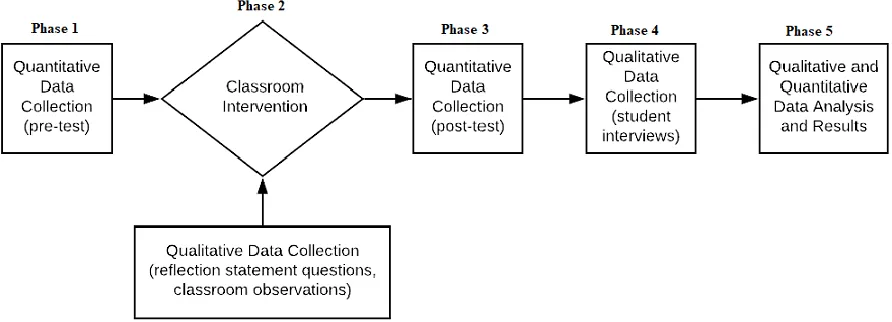
written responses to reflection statement questions at the end of each class period and
detailed classroom observation notes were collected. The intervention was completed on Day 6. Students completed the post-test (Phase 3), which was identical to the pre-test, on Day 7. During the next two weeks after the post-test, the researcher conducted structured interviews with a subset of students (n = 12), which took place in the school library (Phase 4). After the data collection was completed, the researcher started working on data analysis using both quantitative and qualitative methods, and generated the results (Phase 5).
Figure 3.1. Convergent mixed methods design of the study
Research Setting
This study took place in a public middle school in the southeastern U.S. during the spring semester of 2017. The school was recently designated by the school district as a “magnet school for the digital sciences” and offers elective classes on basic computer science topics. The school was selected for this study because of the researcher’s familiarity with the
& Borg, 2006). The intervention was conducted by the researcher himself in one of the computer labs in the school during the regular seventh-grade science class periods. One class period was about 50 minutes.
Participants
A seventh-grade science teacher who was teaching five different classes was recruited to participate in this study. The total number of students in the teacher’s classrooms was 132. After receiving an IRB approval, the researcher visited the recruited teacher’s classrooms.
After introducing himself and explaining the purpose of the study, the researcher invited all students to participate in the study. The researcher distributed to the students the hard copies of the Parent Consent Form (Appendix A), and Student Assent Form (Appendix B), and requested written consent from parents as well as written assent from students who were interested and wanted to participate in this study. The researcher strongly emphasized that participation in the study is voluntary, and participation or nonparticipation to the study will not affect students’ school grades in any way. In addition, the researcher stated that students
will be doing the same learning activities in the classroom during the intervention regardless of their participation to the study, but only participating students’ data will be collected for
research purposes.
Latino-Hispanic, 5% were Asian-American, 4% were Indian-American, and the rest of the students (50%) was non-Hispanic White. While no data was available nor was collected regarding participating students’ socioeconomic backgrounds, about 53% of students in the school received free or reduced lunch.
Intervention
The purpose of the classroom intervention designed for this study was to introduce seventh-grade students to computational thinking concepts and practices in the context of building simulation-based models of physical phenomena through a visual block-based programming environment in formal classroom settings. The intervention aimed to further students’ knowledge of computational thinking practices as well as conceptual understanding
of force and motion concepts. The intervention was carefully designed by the researcher using his past experience as a physics teacher as well as his experience in teaching introductory programming when he was running an after-school robotics club. Scratch
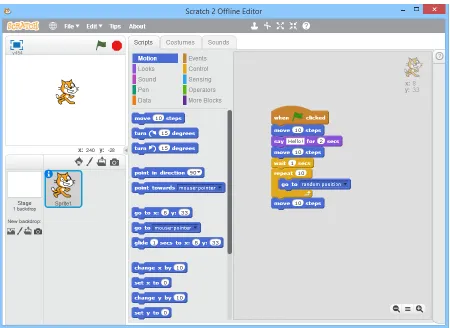
(https://scratch.mit.edu) was chosen as the visual block-based programming environment that students worked with during the course of the classroom intervention. Scratch was developed at the Massachusetts Institute of Technology (MIT) as a freely available open source
Scratch was chosen as the programming environment for the intervention of this study for several reasons. First, several studies identified ways Scratch can be used as an effective tool to build simulation-based models for middle and high school students (Balouktsis, 2016; Lopez & Hernandez, 2015). Second, Scratch can work both online and offline, which makes it suitable for classroom settings where the internet connection is often not reliable. Lastly, Scratch is one of the most popular visual programming environments today with over 17 million registered users (Scratch Statistics, 2017), and as a result provides extensive documentation for both students and educators on its website (Scratch Wiki, 2017).
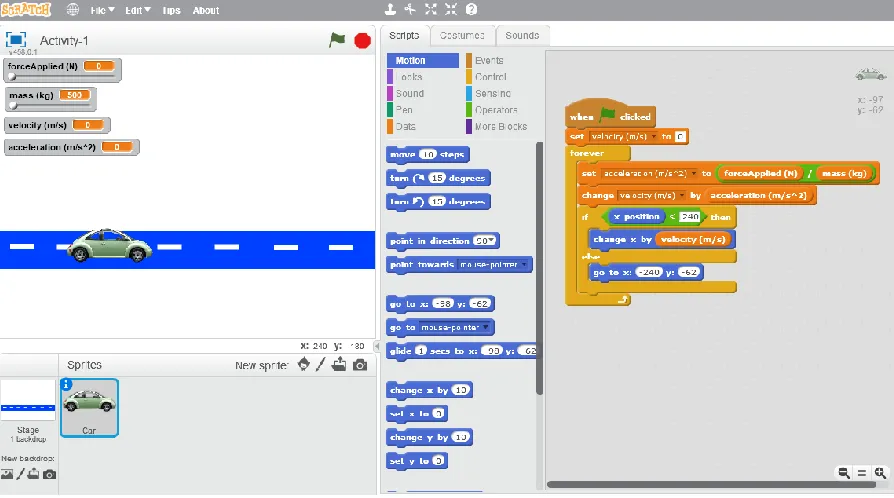
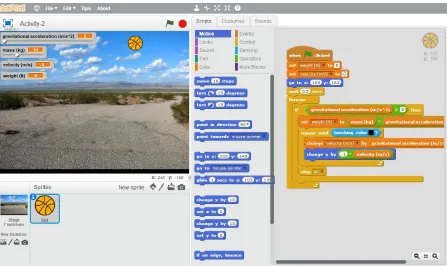
The classroom intervention took five days (i.e., one class period at each day) to complete. During the first three days of the intervention, students learned about basic computational thinking practices (e.g., abstraction, algorithms) as well as the fundamental concepts in computer programming (e.g., variables, conditionals, loops) using the Scratch programming environment. In the next two days, students engaged in simulation-based model building activities in Scratch to demonstrate and further their conceptual
understanding of force and motion concepts. It is important to note here that students studied force and motion unit in the previous semester (i.e., Fall, 2016), so the purpose of the