Division IX (include assigned division number from I to X)
EVALUATION OF AN ALTERNATIVE APPROACH FOR
INCORPORATING GROUND MOTION INCOHERENCE
IN STRUCTURE RESPONSE
Siavash Dorvash1, Frederic F. Grant2, David K. Nakaki2, Robert P. Kennedy3, Barbara Owens4, and Richard S. Drake5
1
Staff II, Simpson Gumpertz & Heger, Inc, Newport Beach, CA, USA
2
Senior Project Manager, Simpson Gumpertz & Heger, Inc, Newport Beach, CA, USA
3
Principal, RPK Structural Mechanics Consulting, Oceanside, CA, USA
4
Senior Project Manager, Absolute Consulting, Inc, Navarre, FL, USA
5
Civil/Structural Design Engineering Supervisor, Entergy Nuclear, Buchanan, NY, USA
ABSTRACT
Effects of spatial ground motion incoherence (GMI) on the seismic response of structures are of significant interest in analysis of nuclear structures. That is because GMI improves realism in the seismic analysis and generally lowers the high-frequency response. Several approaches are currently available for considering ground motion incoherence in SSI programs such as SASSI and CLASSI. While reasonably accurate, these approaches are computationally intensive. An alternative approximate approach was presented in EPRI 1013504, which is based on scaling the Fourier amplitude spectrum of the free-field input motion by incoherence transfer functions (ITFs). This approach can be very cost-effective, particularly for structures expected to have minimal inertial SSI effects. This approach does not account for rotational effects of GMI, but recommends applying a generic scale factor of 1.25 to the ITFs to simply compensate for the un-conservatism in the results. The recommended scaling approach for the GMI induced rotational effect is, however, overly conservative. This paper presents a cases study implementing the simplified approach of the EPRI 1013504 on an example structure. To address the concerns about over-estimation of the GMI-induced rotational response, an alternative structure-specific method is utilized, which more realistically approximates those effects. Seismic responses of the example structure are extracted using the simplified EPRI method and the structure-specific method for approximating the GMI-induced rotational responses. This implementation demonstrates the efficiency of the simplified method of scaling the Fourier amplitude spectrum of the free-field input motion. Results indicate that GMI-induced rotational effects are structure-specific and generic scaling of the input motion can excessively overestimate the response.
INTRODUCTION
The spatial variation of ground motion in horizontal and vertical directions, namely ground motion incoherence, may influence the building soil structure interaction (SSI) response during an earthquake. Sources of GMI are
Spatial variation from scattering of waves due to the heterogeneous nature of the soil or rock along the propagation paths of the incident wave fields (i.e. local wave scattering)
Several approaches are currently available for considering ground motion incoherence in SSI programs such as SASSI and CLASSI. Examples are CLASSInco-SRSS, SASSI-SRSS, SASSI-Simulation Mean and SASSI-Algebric Sum. These methods are reviewed and validated by Short, Hardy, Merz and Johnson (2007a and 2007b) in a study conducted by for Electric Power Research Institute (EPRI). A recent study by Tabatabaie (2015) summarizes the limitations in some of these approaches and proposes enhancements to the studied methods. These methods are directly implemented in the SSI analysis procedures in either CLASSI or SASSI programs. While reasonably accurate, these approaches are complex and computationally intensive, particularly those implemented in SASSI. Although availability of advanced computing technology facilitates application of such complex GMI approaches in SSI analysis, there are still practical situations where a quick and approximate approach for evaluation of GMI effects is necessary. A quick estimation of the GMI effects can be of interest for making decision regarding the type of the SSI analysis.
Prior to development of more advanced GMI approaches (such as those discussed above), NUREG/CR-3805 (Chang et al., 1986) recommended a simplified approach modifying the response spectra using reduction factors to account for GMI effects. These factors were developed as a function of the foundation plan dimension and frequency. The NUREG/CR-3805 recommendations were incorporated into EPRI NP-6041 (EPRI, 1991), ASCE Standard 4 (ASCE, 2000), and DOE Standard-1020 (U.S. DOE, 2002). During a later research into GMI effects, Task S2.1 of the EPRI/DOE New Plant Seismic Issues Resolution Program, it was demonstrated that the published spectral reductions are very approximate and may be overly conservative in certain cases. An alternative, still simplified, approach was then proposed in EPRI 2007b that is based on scaling the Fourier amplitude spectrum of the free-field input motion by the incoherence transfer function (ITF).
The ITFs define the relationship between the power spectral density (PSD) function of the free-field ground motion and the PSDs of the motion of the reference point of the rigid massless foundation. ITFs are frequency-dependent, complex-valued functions defined as diagonal terms of the scattering functions in CLASSI Program.
In the simplified method proposed in EPRI 2007, the scaled free-field input ground motions can be used as inputs to estimate incoherent seismic response of the structure. This is different from direct implementation of the GMI in CLASSI as only diagonal terms of the scattering matrix are considered in the procedure and estimates the GMI effects at the input level. In this approach, the Fourier phase spectrum is unchanged. This approach is very cost-effective and computationally less intensive compared to the complex methods implemented in CLASSI and SASSI. In situations where the SSI inertia effects are negligible and GMI is the only reason for considering SSI, this simplified method can be used to modify the input motion and then, the seismic response of the structure can be computed using any SSI or non-SSI capable structure analysis programs. However, while simple and efficient, this approach does not capture the rotational components of the GMI.
This paper presents implementation of the simplified approach of EPRI 1013504, using the seismic response of an example structure. Responses obtained from this implementation are compared with the results from direct incorporation of GMI using SSI program CLASSI. This implementation demonstrates the efficiency of the simplified method of scaling the Fourier amplitude spectrum of the free-field input motion. This paper also introduces a structure-specific method for approximating rotational response scale factors to capture the GMI-induced rotational effects on the example structure. It is shown that for this example structure, the generic rotational scale factors recommended by EPRI 1013504 result in significant over-estimation of the response.
EXAMPLE STRUCTURE
The building in this case study is a reinforced concrete structure that is combined with steel framings at higher elevations. The building is approximately 154 ft long in the north-south direction and approximately 64 ft long in the east-west direction. The building has varying height from 85 ft in the western portion to 50 ft height in the eastern portion. The gravity load-resisting system is composed of the reinforced concrete slabs, beams, columns, and walls, as well as steel beams and columns. The lateral load-resisting system is a combination of reinforced concrete shear walls, concrete diaphragms, and horizontal bracing and vertical bracing at higher elevations.
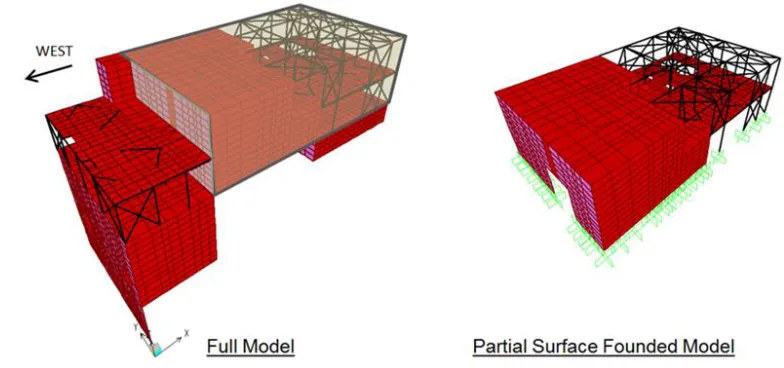
The foundation of the building overlays a step in the ground surface profile on a rock site such that it is supported at multiple substantially different elevations. The elevation of the base of the foundation changes by about 65 ft from one side of the building to the other side. The foundation consists of a concrete base mat whose thickness changes at different elevations. Figure 1 presents a 3-dimentional view of the model in the computer program SAP2000 (Version 14.2.2 advanced).
Both SASSI and CLASSI are used to evaluate the SSI effects on the seismic response of this building. The location of the building on a stepped rock profile makes an irregular underlying site for the SSI analysis of the building. SASSI was used to capture the effects of the cliff underneath the building on the seismic response of the structure. These effects are in addition to the GMI effects. However, the focus of this paper is only on the GMI effects of the building SSI analysis.
Figure 1. A 3-Dimensional View of the Study Building.
SSI ANALYSIS WITH GMI USING SIMPLIFIED APPROACH
The GMI effects on the seismic response of this building are evaluated through two soil-structure interaction analyses of the surface-founded model of the building using CLASSI. The first analysis incorporates the simplified approach of modifying the free-field input ground motion to account for GMI, as described in EPRI 1013504 and does not account for GMI-induced rotations. The second analysis includes incoherence by direct incorporation of GMI in CLASSI, which includes GMI-induced rotations. Comparison of the results of these two analyses is used to assess the simplified approach of modifying the free-field input ground motion. This comparison also provides an estimate of the scale factors required to account for the GMI-induced rotations.
The simplified approach of EPRI 1013504 modifies the free-field input ground motion using incoherency transfer functions (ITF). ITFs define the relationship between the PSD function of the free-field ground motion and the PSDs of the motion of the foundation reference point (FRP). The ITF may be interpreted as the diagonal terms of the scattering matrix accounting for the effects of seismic wave incoherence over the dimensions of the foundation. For this application, the ITF is evaluated by taking the square root of the diagonal terms of the 6x6 complex cross PSD matrix of the foundation motion to unit PSD input for each direction of the translational input. Calculation for the six diagonal terms of the ITF matrix (one for each degree of freedom) per frequency uses the foundation impedance and scattering matrices. ITFs can be obtained using CLASSI. Figure 2 presents the ITFs for the horizontal and vertical directions.
The computed ITFs are applied to the Fourier amplitude spectrum of the free-field input motions to modify the time histories for the GMI effects. The five sets of free-field time histories are used in this study that closely matched the uniform hazard response spectra of the building’s site. Each set of time histories consists of two horizontal ground motions and one vertical ground motion (H1, H2, and V). The following steps are taken to generate the modified free-field input motions:
The time histories are transformed into Fourier domain using the Fast Fourier Transform (FFT) functions.
The Fourier amplitudes of each of the time histories are scaled by the corresponding ITFs – one ITF in each direction. The Fourier phases are retained unchanged.
Figure 2. Incoherency Transfer Functions for the Example Building.
The result of these steps is five sets of modified time histories, each having two horizontal (H1 and H2) and one vertical component (V). These time histories are used in CLASSI to develop incoherent response spectra, which are based on the simplifying approach of modifying the free-field ground motion.
GMI-INDUCED ROTATIONAL EFFECTS
GMI effects induce rotations (rocking and torsion) of the structure. These rotations generate translational in-structure responses whose amplitudes depend on the structure’s dynamic properties and the location and elevation of the nodes in the structure. Locations at the higher elevations or closer to the corners are more influenced by GMI-induced rotational inputs, compared to the nodes in the center and at the lower elevations. That is due to the increased distances between the node’s location and the center of foundation rocking.
As discussed earlier, the simplifying approach of modifying the free-field ground motion does not account for these GMI-induced rotational responses. Comparison of the horizontal in-structure response spectra (ISRS) from the SSI analysis using the modified free-field ground motions with the ISRS from the SSI analysis with direct incorporation of GMI in CLASSI is shown for an example node in Figures 3. The difference between the ISRS indicates the significance of the missing GMI-induced rotational responses at each of the different directions at the particular location of the selected node. This confirms that the simplified ITF approach underestimates the seismic responses to different degrees depending on frequency of the response and the location of the nodes.
Figure 3. 5% Damped Response Spectra in N-S and E-W Directions, Coherent, Direct Incoherent, and ITF-Based Incoherent (with no GMI-Induced Rotational Responses).
In this implementation, it was of interest to capture the GMI effects on the response from SASSI analysis of the full structural model (see Figure 1) to be able to account for both GMI and other SSI effects related to the stepped rock site of the structure. Therefore, the modified time-histories are simply used as input in the SSI analysis using SASSI. However, the 1.25 ITF scale factor is not used due to the excessive over-estimation of the rotational effects. Instead, the GMI-induced rotational effects on the SSI response of the building are captured using an approximate, but structure specific approach.
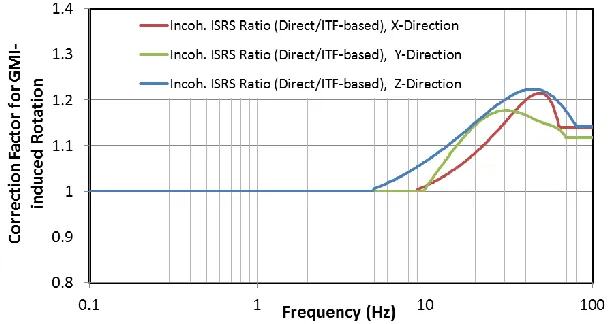
In developed structure specific approach, a set of frequency- and direction-dependent scale factors is developed to reflect the GMI-induced rotational effects on the response level. These scale factors are then applied to the response spectra obtained from SASSI analysis. The scale factors are determined based on the ratio of ISRS from the SSI analysis using the ITF approach over the ISRS from the SSI analysis with direct incorporation of GMI in CLASSI. The ratios are obtained for nodes at multiple locations: at approximately four corners and at the center of the floor at higher elevations. Figure 4 shows the ISRS ratios for the 5 nodes in E-W direction. The following overall characteristics are observed in these ISRS ratios:
At the low frequency range, the ISRS ratios are approximately constant and close to one. This range spans 0 Hz to approximately 10 Hz for the X - and Y-directions, and 0 Hz to 5 Hz for the Z-direction. This indicates that at low frequency range, the GMI-Induced rotational response is insignificant.
At the mid frequency range, the ISRS ratios change with frequency and peak at approximately 50 Hz for the X-direction, 30 Hz for the Y-direction, and 80 Hz for the Z-direction. This range spans 10 Hz to 65 Hz for the X-direction, 10 Hz to 70 Hz for the Y-direction and 5 Hz to 80 Hz for the Z-direction.
At the high frequency range, the ISRS ratios remain essentially constant and do not change with frequency.
Figure 4. The ratio of Incoherent Response from Direct GMI in CLASSI over ITF-Based GMI.
SCALING RESPONSE TO CORRECT FOR GMI-INDUCED ROTATIONS
As mentioned earlier, the objective in developing rotational scale factors is to apply them on the response obtained from SASSI analysis of the full structural model (see Figure 1) with modified input motions. So the analysis can account for both GMI and other SSI effects related to the stepped rock site of the structure. To develop scale functions to correct the ISRS for GMI-induced rotational effects, the ISRS ratios from five locations in the building are averaged (over five locations) and smoothed by fitting polynomial functions. Figure 5 shows the smoothed scale factors for GMI-Induced rotational responses for the two horizontal and the vertical directions. The selection of the five locations, where the ISRS ratios are obtained (i.e. one node at the center and four nodes near the corners), is such that the average ratio is conservatively biased toward locations with higher GMI-induced rotational effects. This conservatism is, however, small compared to the conservatism in using the 1.25 scaling approach recommended by EPRI 1013504. This can be noted from the variation of the ISRS ratios illustrated in Figure 4.
Figure 5. Smoothed Scale Factors for GMI-Induced Rotational Responses.
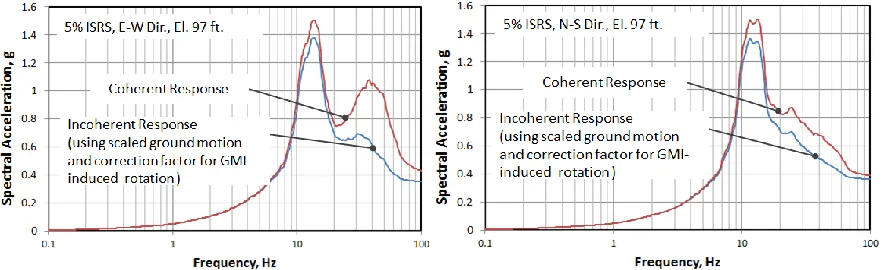
required to be repeated for capturing GMI. Figure 6 shows the ISRS in the two horizontal directions obtained from this approach.
The approximation inherent in the GMI-induced rotational effects is not significant and is accounted for by considering an extra uncertainty in the seismic evaluation of the equipment housed in this building. The uncertainty is presented by calculating lognormal standard deviation based on variation of the ISRS ratios. A lognormal distribution is considered to be represented by five samples (i.e., five ISRS ratios). The envelope of the five ISRS ratios is judged to represent the 90th percentile. The smoothed mean curves for the five ratios are used as an approximation to the median. The resulting lognormal standard deviation is recommended for use in subsequent seismic fragility analyses.
Figure 6. 5% Damped ISRS in N-S and E-W Dir for an Example Node, Coherent vs. ITF-based Incoherent with corrections for GMI-Induced Rotational Responses.
CONCLUSION
The paper presented a case study in which the alternative simplified approach for GMI, presented in EPRI 1013504, is implemented. The approach is used on an example structure and results are compared with those obtained from direct incorporation of GMI using SSI program CLASSI. It is illustrated that the simplified EPRI 1013504 approach, without correction for the GMI-induced rotational effects, can be un-conservative in certain frequency ranges. It is also shown that the scale factors recommended for capturing the GMI-induce rotational effects can excessively overestimate the response, particularly for 0-12 Hz frequency range. Results of this case study indicated that at low frequency range, the GMI-induced rotational response is insignificant for the example structure. A structure-specific method is developed for approximating the GMI-induced rotational effects on the response of the structure. Using this approach the GMI-induced rotational effects are captured by applying scale functions to the ISRS from the SSI analysis using the modified input motions. The approach is shown to be very efficient as the computationally extensive analyses for SSI with GMI consideration were not required.
REFERENCES
EPRI (2006), “Program on Technology Innovation: Effect of Seismic Wave Incoherence on Foundation and Building Response”, Electric Power Research Institute 1013504, Palo Alto, CA, Nov. 2006. H.L. Wong and J.E. Luco (1980), “Soil Structure Interaction: A Linear Continuum Mechanics Approach
(CLASSI)”, Dept. of Civil Engineering, Univ. of Southern California, CE79-03, CA, USA.
EPRI (2007b). “Program on Technology Innovation: Validation of CLASSI and SASSI Codes to Treat Seismic Wave Incoherence in Soil-Structure Interaction (SSI) Analysis of Nuclear Power Plant Structures,” Electric Power Research Institute TR-1015111, Palo Alto, USA.
The Math Works Inc. (1997), MATLAB and Simulink, Natick, MA, USA.
ASCE (2013), Seismic Analysis of Safety-Related Nuclear Structures and Commentary, Draft ASCE/SEI 4-13, American Society of Civil Engineers, Reston, VA, USA.
Tabatabaie, M. (2015), “New Methodology For Incorporating Ground Motion Incoherency In SSI Analysis Using SASSI”, 23rd Conference on Structural Mechanics in Reactor Technology,
Manchester, United Kingdom.
U.S. Nuclear Regulatory Commission (2013). “Standard Review Plan for the Review of Safety Analysis for Nuclear Power Plants: LWR Edition – Seismic System Analysis,”
NUREG-0800, Section 3.7.2, Revision 4, Washington, DC, USA.
EPRI (1991). “A Methodology for Assessment of Nuclear Power Plant Seismic Margin (Rev 1),” Electric Power Research Institute, Report NP-6041-SL, Palo Alto, CA. August.
ASCE (2000). “Seismic Analysis of Safety-Related Nuclear Structures and Commentary,” American Society Civil Engineers, Report. ASCE 4-98.