LEARNING OBJECTIVES
After completing this chapter, you will be able to:● Calculate maturity value, future value, and present value in com-pound interest applications, by both the algebraic method and the preprogrammed financial calculator method
● Calculate the maturity value of compound interest Guaranteed Investment Certificates (GICs) ● Calculate the price of strip
bonds
● Calculate the redemption value of a compound interest Canada Savings Bond
● Adapt the concepts and equa-tions of compound interest to cases of compound growth ● Calculate the payment on any
date that is equivalent to one or more payments on other dates ● Calculate the economic value of
a payment stream
Compound Interest:
Future Value and
Present Value
CHAPTER OUTLINE
8.1
Basic Concepts
8.2
Future Value (or Maturity Value)
8.3
Present Value
8.4
Using Financial Calculators
8.5
Other Applications of Compounding
*
8.6
Equivalent Payment Streams
*
Appendix 8A: Instructions for Specific
Models of Financial Calculators
285
a loan to purchase a car, interest will be compounded monthly. The
advertised interest rates on mortgage loans are semiannually
com-pounded rates. Interest is always comcom-pounded in long-term
finan-cial planning. So if you wish to take control of your personal
financial affairs or to be involved in the financial side of a
busi-ness, you must thoroughly understand compound interest and
its applications. The remainder of this textbook is
devoted to the mathematics and applications of
compound interest.
You will be able to hit the ground running! In Chapters
6 and 7, you learned the concepts of maturity value, time
value of money, future value, and present value for the case of
simple interest. These ideas transfer to compound interest. Now
we just need to develop new mathematics for calculating future value and
pres-ent value when interest is compounded. And there is good news in this regard!
Most compound interest formulas are permanently programmed into
financial calculators. After you become competent in the algebraic method
for solving compound interest problems, your instructor may allow you to use a
financial calculator to automate the computations. Before long, you will be impressed at the
types of financial calculations you can handle!
8.1
BASIC CONCEPTS
The simpleinterest method discussed in Chapter 6 is restricted primarily to loans and investments having terms of less than one year. The compound interest method is employed in virtually all instances where the term exceeds one year. It is also used in some cases where the duration is less than one year.
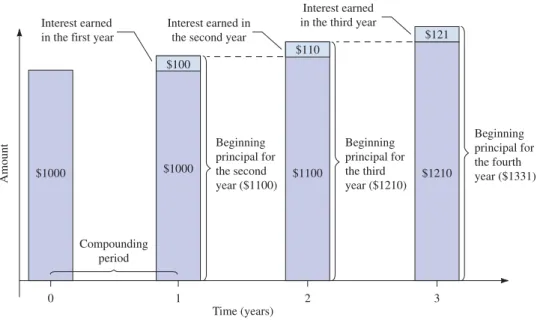
In the compound interest method,interest is periodicallycalculated and convertedto principal. “Converting interest to principal” means that the interest is added to the prin-cipal and is thereafter treated as prinprin-cipal. Consequently, interest earned in one period will itself earn interest in all subsequent periods. The time interval between successive interest conversion dates is called the compounding period. Suppose, for example, you invest $1000 at 10% compounded annually. “Compounded annually” means that “interest is compounded once per year.” Therefore, the compounding period is one year. On each anniversary of the investment, interest will be calculated and converted to principal. The process is indicated in Figure 8.1. The original $1000 investment is represented by the col-umn located at “0” on the time axis. During the first year, you will earn $100 interest (10% of $1000). At the end of the first year, this $100 will be converted to principal. The new principal ($1100) will earn $110 interest (10% of $1100) in the second year. Note that you earn $10 more interest in the second year than in the first year because you have $100 more principal invested at 10%. How much interest will be earned in the third year? Do you see the pattern developing? Each year you will earn more interest than in the preced-ing year—$100 in the first year, $110 in the second year, $121 in the third year, and so on. Consequently, the growth in value of the investment will accelerate as the years pass.
Amount 0 $1000 Time (years) 1 $1000 2 $1100 Beginning principal for the second year ($1100) Beginning principal for the third year ($1210) Compounding period $110 $100 Interest earned in the second year Interest earned
in the first year
3 $1210 Beginning principal for the fourth year ($1331) $121 Interest earned in the third year
Figure 8.1 Converting Interest to Principal at the End of Each Compounding Period
In contrast, if the $1000 earns 10% per annum simpleinterest, only the original principal will earn interest ($100) each year. A $1000 investment will grow by just $100 each year. After two years, your investment will be worth only $1200 (compared to $1210 with annual compounding).
A compound interest rate is normally quoted with two components: ● A number for the annual interest rate (called the nominal1interest rate). ● Words stating the compounding frequency.
For example, an interest rate of 8% compounded semiannually means that half of the 8% nominal annual rate is earned and compounded each six-month compounding period. A rate of 9% compounded monthly means that 0.75% (one-twelfth of 9%) is earned and compounded each month. We use the term periodic interest ratefor the interest rate per compounding period. In the two examples at hand, the periodic inter-est rates are 4% and 0.75% respectively. In general,
If we define the following symbols:
jNominal interest rate
mNumber of compoundings per year iPeriodic interest rate
the simple relationship between the periodic interest rate and the nominal interest rate is:
(8-1) i j
m
PERIODIC INTEREST RATE
Periodic interest rate Nominal interest rate Number of compoundings per year
Compounding Number of Compounding
frequency compoundings per year period
Annually 1 1 year
Semiannually 2 6 months
Quarterly 4 3 months
Monthly 12 1 month
Table 8.1 Compounding Frequencies and Periods
What is the value of m for quarterly compounding? Sometimes students incorrectly use m3 with quarterly compounding because year 3 months. But mrepresents the number of compoundings per year (4), not the length of the compounding period.
1 4
“m” for Quarterly
Compounding
1As you will soon understand, you cannot conclude that $100 invested for one year at 8% compounded semi-annually will earn exactly $8.00 of interest. Therefore, we use the word “nominal,” meaning “in name only,” to describe the numerical part of a quoted rate.
In many circumstances, interest is compounded more frequently than once per year. The number of compoundings per year is called the compounding frequency.
The commonly used frequencies and their corresponding compounding periods are listed in Table 8.1.
Example 8.1A CALCULATING THE PERIODIC INTEREST RATE
Calculate the periodic interest rate corresponding to:
a. 10.5% compounded annually. b. 9.75% compounded semiannually.
c. 9.0% compounded quarterly. d. 9.5% compounded monthly.
Solution
Employing formula (8-1), we obtain:
a. (per year) b. (per half year)
c. (per quarter) d. (per month)
Example 8.1B CALCULATING THE COMPOUNDING FREQUENCY
For a nominal interest rate of 8.4%, what is the compounding frequency if the periodic interest rate is:
a. 4.2%?
b. 8.4%?
c. 2.1%?
d. 0.70%?
Solution
The number of compoundings or conversions in a year is given by the value ofmin formula (8-1). Rearranging this formula to solve for m,we obtain
a. which corresponds to semiannual compounding.
b. m 8.4% which corresponds to annual compounding. 8.4% 1 m 8.4% 4.2% 2 m j i i 9.5% 12 0.7916% i 9.0% 4 2.25% i 9.75% 2 4.875% i j m 10.5% 1 10.5%
Whenever you are asked to calculate or state a nominal interest rate, it is understood that you should include the compounding frequency in your response. For example, an answer of just “8%” is incomplete. Rather, you must state “8% compounded quarterly” if interest is compounded four times per year.
Give the Complete
Description of an
Interest Rate
c. which corresponds to quarterly compounding.
d. which corresponds to monthly compounding.
Example 8.1C CALCULATING THE NOMINAL INTEREST RATE
Determine the nominal rate of interest if:
a. The periodic rate is 1.75% per quarter.
b. The periodic rate is per month.
Solution
Rearranging formula (8-1) to solve for j,the nominal interest rate, we obtain jmi
a. j4(1.75%) 7.0% b.
The nominal interest rates are 7.0% compounded quarterly and 10.0% compounded monthly, respectively.
Concept Questions
1. What does it mean to compound interest?
2. Explain the difference between “compounding period” and “compounding frequency.”
3. Explain the difference between “nominal rate of interest” and “periodic rate of interest.”
E X E R C I S E
8 . 1
Answers to the odd-numbered problems are at the end of the book.Calculate the missing values in Problems 1 through 9. j1210.83%2 10.0% 0.83% m 8.4% 0.7% 12 m 8.4% 2.1% 4
Nominal Compounding Periodic
Problem interest rate (%) frequency interest rate (%)
1. 10.8 Quarterly ? 2. 11.75 Semiannually ? 3. 10.5 Monthly ? 4. ? Semiannually 4.95 5. ? Monthly 0.91667 6. ? Quarterly 2.9375 7. 9.5 ? 2.375 8. 8.25 ? 4.125 9. 13.5 ? 1.125
8.2
FUTURE VALUE (OR MATURITY VALUE)
Calculating Future Value
Remember from our study of simple interest in Chapter 6 that the maturity valueor
future valueis the combined principal and interest due at the maturity date of a loan or investment. We used SP(1 rt) to calculate future value in the simple interest case. Now our task is to develop the corresponding formula for use with compound interest.
Financial calculators, spreadsheet software (such as Excel, Quattro Pro, and Lotus 1-2-3), and the majority of finance textbooks employ the following symbols in com-pound interest functions:
FVFuture value (or maturity value)
PVPrincipal amount of a loan or investment; Present value The general question we want to answer is:
“What is the future value,FV,after ncompounding periods of an initial princi-pal,PV,if it earns a periodic interest rate,i?”
Before we answer this question, let’s be sure we understand the distinction between the new variable
nTotal number of compoundings and the variable (from Section 8.1)
mNumber of compoundings per year
Our intuition usually works better if we put numbers to the variables. Suppose a $1000 investment earns 8% compounded semiannually for three years. From this given information, we can “attach” numbers to variables as follows:
PV$1000 j8% compounded semiannually Term 3 years
m2 compoundings per year per half year
“n” represents the total number of compoundings in the entire termof the investment. In our example,nis the number of compoundings in three years. Since there are two compoundings per year, then n2 3 6. In general,
(8-3) nm(Number of years in the term)
How can we calculate the future value of the $1000 investment? Think of the periodic interest rate as the percentage changein the principal in each compounding period. To cal-culate the future value of the initial $1000, we must compound a series of six percentage changes of 4% each. Do you remember encountering this sort of question before?
In Section 2.7, we learned how to compound a series of percentage changes. If an initial value,Vi, undergoes a series of npercentage changes,c1,c2,c3, . . .,cn, the final
value,Vf, is: (2-3) ↑ ↑ ↑ ↑ ↑ ↑ FV PV i i i i VfVi11c1211c2211c32 . . . 11cn2 TOTAL NUMBER OF COMPOUNDING PERIODS i j m 8% 2 4%
The corresponding compound interest variables are indicated under formula (2-3). Making the substitutions, we obtain
Since the factor (1 i) occurs ntimes, then
(8-2) FV PV(1 i)n
In the particular case we have been considering,
FV$1000(1 0.04)6$1265.32
Example 8.2A CALCULATING THE MATURITY VALUE OF AN INVESTMENT
What will be the maturity value of $10,000 invested for five years at 9.75% compounded semiannually? Solution
Given:PV$10,000, Term of investment 5 years,j9.75%,m2 The interest rate per six-month compounding period is
nmTerm (in years) 2(5) 10 The maturity value will be
FVPV(1 i)n
$10,000(1 0.04875)10 $10,000(1.6096066) $16,096.07
The investment will grow to $16,096.07 after five years.
Example 8.2B COMPARING TWO NOMINAL RATES OF INTEREST
Other things being equal, would an investor prefer an interest rate of 10.5% compounded monthly or 11% compounded annually for a two-year investment?
Solution
The preferred rate will be the one that results in the higher maturity value. Pick an arbitrary initial invest-ment, say $1000, and calculate the maturity value at each rate.
With PV$1000, , and nm(Term) 12(2) 24,
FVPV(1 i)n$1000 (1.00875)24$1232.55
With , , and nm(Term) 1(2) 2,
FVPV(1 i)n$1000(1.11)2$1232.10
The rate of 10.5% compounded monthly is slightly better. The higher compounding frequency more than offsets the lower nominal rate.
imj 11%1 11% PV$1000 imj 10.5% 12 0.875% imj 9.75%
2 4.875% 1per half year2
FUTURE VALUE OR MATURITY VALUE (COMPOUND INTEREST)
Example 8.2C CALCULATING THE MATURITY VALUE WHEN THE INTEREST RATE CHANGES
George invested $5000 at 9.25% compounded quarterly. After 18 months, the rate changed to 9.75% com-pounded semiannually. What amount will George have three years after the initial investment?
Solution
For the first 18 months,
For the next 18 months,
Because of the interest rate change, the solution should be done in two steps, as indicated by the following diagram.
The future value,FV1, after 18 months becomes the beginning “principal,”PV2, for the remainder of the
three years.
Step 1: Calculate the future value after 18 months.
Step 2: Calculate the future value,FV2, at the end of the three years (a further 18 months later).
George will have $6615.44 after three years.
Example 8.2D THE BALANCE OWED AFTER PAYMENTS ON A COMPOUND
INTEREST LOAN
Fay borrowed $5000 at an interest rate of 11% compounded quarterly. On the first, second, and third anniversaries of the loan, she made payments of $1500. What payment made on the fourth anniversary will extinguish the debt?
Solution
At each anniversary we will first calculate the amount owed (FV) and then deduct the payment. This differ-ence becomes the principal balance (PV) at the beginning of the next year. The periodic interest rate is
imj 11% 4 2.75% FV2PV211i2n$5735.1211.0487523$6615.44 FV1PV11i2n$500011.02312526$5735.12 0 $5000 i = 2.3125%, n = 6 36 Months 18 FV1 = PV2 i = 4.875%, n = 3 FV2 imj 9.75%2 4.875% 1per half year2 and nm1Term2 211.52 3 PV$5000,imj 9.25%4 2.3125% 1per quarter2 and nm1Term2 411.52 6
The sequence of steps is indicated by the following time diagram. FV1PV(1 i)n$5000(1.0275)4$5573.11 PV2FV1$1500 $5573.11 $1500 $4073.11 FV2PV2(1 i)n$4073.11(1.0275)4$4539.97 PV3FV2$1500 $4539.97 $1500 $3039.97 FV3PV3(1 i)n$3039.97(1.0275)4$3388.42 PV4FV3$1500 $3388.42 $1500 $1888.42 FV4PV4(1 i)n$1888.42(1.0275)4$2104.87 A payment of $2104.87 on the fourth anniversary will pay off the debt.
Graphs of Future Value versus Time
A picture is worth a thousand words, but a graph can be worth more. The best way to develop our understanding of the nature of compounding and the roles of key vari-ables is through the study of graphs.
The Components of Future Value Let us investigate in greater detail the con-sequences of earning “interest on interest” through compounding. In Figure 8.2, we compare the growth of two investments:
● $100 invested at 10% compounded annually (the upper curve)
● $100 invested at 10% per annum simple interest (the inclined straight line) For the compound interest investment,
FVPV(1 i)n$100(1 0.10)n$100(1.10)n
The upper curve was obtained by plotting values ofFVfor nranging from 0 to 10 com-pounding periods (years).
For the simple interest investment,
SP(1 rt) $100(1 0.10t)
This gives an upward sloping straight line when we plot values ofSfor tranging from 0 to 10 years. In this case, the future value increases $10 per year because only the original
– $1500 = – $1500 = FV1 – $1500 = PV2 FV2 PV3 FV3 FV4 PV4 0 $5000 i = 2.75% n = 4 4 Years 1 2 3 i = 2.75% n = 4 i = 2.75% n = 4 i = 2.75% n = 4
principal of $100 earns 10% interest each year. At any point, the future value of the sim-ple interest investment has twocomponents:
1. The original principal ($100)
2. The interest earned on the original principal. In the graph, this component is the vertical distance from the line (at $100) to the sloping simple interest line.
Returning to the compound interest investment, we can think of its future value at any point as having three components: the same two listed above for the simple interest investment, plus
3. “Interest earned on interest”—actually interest earned on interest that was pre-viously converted to principal. In the graph, this component is the vertical dis-tance from the inclined simple interest line to the upper compound interest curve. Note that this component increases at an accelerating rate as time passes. Eventually, “interest on interest” will exceed the interest earned on the original principal! How long do you think this will take to happen for the case plotted in Figure 8.2?
The Effect of the Nominal Interest Rate on the Future Value Suppose Investment A earns 10% compounded annually, while Investment B earns 12% com-pounded annually. B’s rate of return (12%) is one-fifth larger than A’s (10%). You might think that if $100 is invested in each investment for say, 25 years, the invest-ment in B will grow one-fifth or 20% more than the investinvest-ment in A. Wrong! Let’s look into the outcome more carefully. It has very important implications for long-term financial planning.
Figure 8.2 The Components of the Future Value of $100
Future v alue $0 $50 $100 $150 $200 $250 $300 Time (years) 0 1 2 3 4 5 6 7 8 9 10 Interest “on interest” Original principal Interest on original principal FV = PV(1 + i)n S = P(1 + rt)
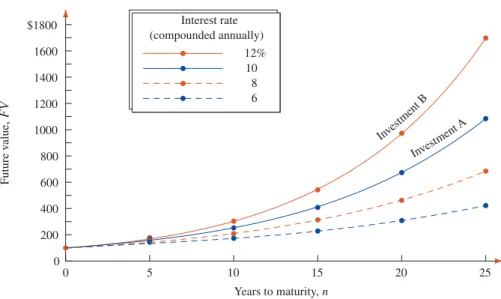
In Figure 8.3, the future value of a $100 invest-ment is plotted over a 25-year period for four annu-allycompounded rates of interest. The four rates are at 2% increments, and include the rates earned by Investments A (10%) and B (12%). We expect the separation of the curves to increase as time passes— that would happen without compounding. The most important observation you should make is the dis-proportionateeffect each 2% increase in interest rate has on the long-term growth of the future value. Compare the future values after 25 years at the 10% and 12% rates. You can see that the future value at 12% compounded annually (Investment B) is about 1.5 times the future value at 10% compounded annually (Investment A). In comparison, the ratio of the two interest rates is only !
The contrast between long-term performances of A and B is more dramatic if we compare their growthinstead of their future values. Over the full 25 years, B grows by FVPVPV(1 i)nPV $100(1.12)25 $100 $1600.01 while A grows by FVPVPV(1 i)nPV $100(1.10)25 $100 $983.47 12% 10% 1.2
Figure 8.3 Future Values of $100 at Various Compound Rates of Interest Inves tme nt B $1800 Future v alue , FV 1600 1400 0 25 Years to maturity,n 20 15 10 5 0 1200 1000 800 600 400 200 Investm ent A 12% 10 8 6 Interest rate (compounded annually)
NET
@
ssets
An interactive Future Value Chart is available at our online Student Centre. Go to the textbook’s home page
(www.mcgrawhill.ca/college/jerome/)and select the 4th Edition. On the 4th Edition’s home page, click on “Student Centre.” Then select “Future Value Chart” from the list of resources.
The chart has data boxes in which to enter values for key variables. The “Starting amount” is the initial investment (PV). “Years” is the term of the investment. It must be an integer number of years. Values for these two variables may be entered directly in the boxes or they may be selected by moving the sliders located to the right of the boxes.
Enter “0” in the “Annuity payments” box for the type of calcula-tions we are doing in Chapter 8. The “Rate of return” is the nominal annual rate. Select its compounding frequency from the drop-down list on the right.
For terms up to 15 years, you will get a bar chart. The bar for each year represents the future value of the initial investment at the end of the year. If you move the cursor over a bar, the numerical amount of the future value will appear.
For terms exceeding 15 years, the chart presents a continuous curve like those in Figure 8.3. In fact, you can easily duplicate (one at a time) each of the curves in Figure 8.3. (The vertical scale of the chart automatically adjusts to accommodate the range of the future value.) You can view a table listing the interest earned each year and the future value at the end of each year by clicking on the “View Report” button.
You can get a “feel” for the influence of each variable by changing its value while leaving the other variables unchanged.
In summary, B’s growth is 1.63 times A’s growth, even though the interest rate earned by B is only 1.2 times the rate earned by A. What a difference the extra 2% per year makes, especially over longer time periods! The implications for planning and managing your personal financial affairs are:
● You should begin an investment plan early in life in order to realize the dramatic effects of compounding beyond a 20-year time horizon.
● You should try to obtain the best available rate of return (at your acceptable level of risk). An extra 0.5% or 1% added to your annual rate of return has a disproportion-ate effect on investment growth, particularly in the long run.
The Effect of the Compounding Frequency on the Future Value
What difference will it make if we invest $100 at 12% compounded monthlyinstead of 12% compounded annually? In the first case, the $1 interest (1% of $100) earned in the first month gets converted to principal at the end of the month. We will then have $101 earning interest in the second month, and so on. With annual compounding, the $1 interest earned in the first month is not converted to principal. Just the original principal ($100) will earn interest in the second through to the twelfth month. Only then will the $12 interest earned during the year be converted to principal. Therefore, the original $100 will grow faster with monthly compounding.
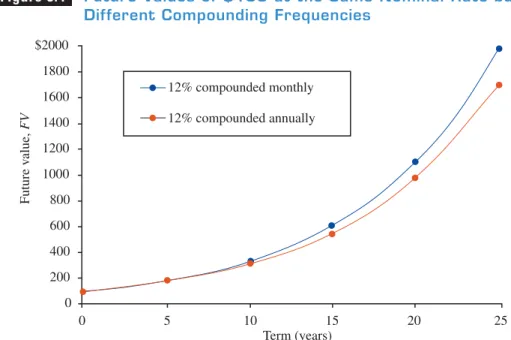
The long-run effect of more frequent compounding is shown in Figure 8.4. As time passes, the higher compounding frequency produces a surprisingly large and ever-increasing difference between the future values. After 15 years, the future value with monthly compounding is about 10% larger than with annual compounding. Thereafter, the gap continues to widen in both dollar and percentage terms. After 20 years, it is almost 13% and after 25 years, it is 16.4%!
Where do you think the curves for semiannual and quarterly compounding would lie if they were included on the graph?
Figure 8.4 Future Values of $100 at the Same Nominal Rate but Different Compounding Frequencies
12% compounded monthly 12% compounded annually $2000 1800 1600 1400 1200 1000 800 600 400 200 0 Future v alue, FV Term (years) 0 5 10 15 20 25
Equivalent Payments Recall from Section 6.4 that equivalent payments are alternative payments that enable you to end up with the same dollar amount at a later date. The concepts we developed in Section 6.4 still apply when the time frame exceeds one year. The only change needed is to use the mathematics ofcompoundinterest when calculating a present value (an equivalent payment at an earlier date) or a future value (an equivalent payment at a later date). The rate of return employed in equivalent pay-ment calculations should be the rate of return that can be earned from a low-risk investment. In real life, the prevailing rate of return2on Government of Canada bonds is the customary standard.
Example 8.2E CALCULATING THE ECONOMIC VALUE OF TWO PAYMENTS
A small claims court has ruled in favour of Mrs. Peacock. She claimed that Professor Plum defaulted on two payments of $1000 each. One payment was due 18 months ago, and the other 11 months ago. What is the appropriate amount for the court to order Plum to pay immediately if the court uses 6% compounded monthly for the interest rate money can earn?
Solution
The appropriate award is the combined future value of the two payments brought forward from their due dates to today. The periodic rate of interest is
The solution plan is presented in the diagram below.
The amount today that is equivalent to the payment due 11 months ago is FV1PV(1 i)n$1000(1.005)11$1056.40
Similarly,
FV2$1000(1.005)18$1093.93
FV1FV2$1056.40 $1093.93 $2150.33
The appropriate amount for Plum to pay is $2150.33.
–18 0 Months $1000 $1000 FV1 FV2 i = 0.5%,n= 11 i= 0.5%,n = 18 –11 Sum imj 6%12 0.5% per month
2This rate of return can be found any day of the week in the financial pages of major newspapers. Government of Canada bonds will be covered in detail in Chapter 15.
Concept Questions
1. What is meant by the future value of an investment?
2. For a given nominal interest rate (say 10%) on a loan, would the borrower prefer it to be compounded annually or compounded monthly? Which compounding frequency would the lender prefer? Give a brief explanation.
3. For a six-month investment, rank the following interest rates (number one being “most preferred”): 6% per annum simple interest, 6% compounded semiannually, 6% compounded quarterly. Explain your ranking.
“I don’t know the names of the Seven Wonders of the World,
but I do know the Eighth Wonder: Compound Interest.”
Baron Rothschild
Many books and articles on personal financial planning write with similar awe about the “mira-cle” or “magic” of compound interest. The authors make it appear that mysterious forces are involved. The Wealthy Barber,a Canadian bestseller, says that “it’s a real tragedy that most people don’t under-stand compound interest and its wondrous pow-ers.” Another book states that “one of the greatest gifts that you can give your children is a compound interest table” (which you will be able to construct by the end of this chapter).
These books do have a legitimate point, even if it seems overstated once you become familiar with the mathematics of compound interest. Most people really do underestimate the long-term growth of compound-interest investments. Also, they do not take seriously enough the advice to start saving and investing early in life. As we noted in Figure 8.3, compound growth accelerates rapid-ly beyond the 20-year horizon.
The reason most people underestimate the long-term effects of compounding is that they tend to
think in terms of proportional relationships. For example, most would estimate that an investment will earn about twice as much over 20 years as it will earn over 10 years at the same rate of return. Let’s check your intuition in this regard.
Questions
1. How do you think the growth of a $100 investment over 20 years compares to its growth over 10 years? Assume a return of 8% compounded annually. Will the former be twice as large? Two-and-a-half times as large? Make your best educated guess and then work out the actual ratio. Remember, we want the ratio for the growth,not the ratio for the future value.
2. Will the growth ratio be larger, smaller, or the same if we invest $1000 instead of $100 at the start? After making your choice, calculate the ratio.
3. Will the growth ratio be larger, smaller, or the same if the rate of return is 10% compounded annually instead of 8% compounded annually? After making your choice, calculate the ratio.
4. From a simple inspection,is it possible to rank the four interest rates in each of parts (a) and (b)? If so, state the ranking. Take an investor’s point of view. Give a brief explanation to justify your answer.
a. 9.0% compounded monthly, 9.1% compounded quarterly, 9.2% compounded semiannually, 9.3% compounded annually.
b. 9.0% compounded annually, 9.1% compounded semiannually, 9.2% compounded quarterly, 9.3% compounded monthly.
5. If an investment doubles in nine years, how long will it take to quadruple (at the same rate of return)? (This problem does not require any detailed calculations.)
6. Suppose it took xyears for an investment to grow from $100 to $200 at a fixed compound rate of return. How many more years will it take to earn an additional
a. $100? b. $200? c. $300?
In each case, pick an answer from:
(i) more than xyears, (ii) less than xyears, (iii) exactly xyears.
7. John and Mary both invest $1000 on the same date and at the same compound interest rate. If the term of Mary’s investment is 10% longer than John’s, will Mary’s maturity value be (pick one):
(i) 10% larger (ii) less than 10% larger (iii) more than 10% larger? Explain.
8. John and Mary both invest $1000 on the same date for the same term to maturity. John earns a nominal interest rate that is 1.1 times the rate earned by Mary (but both have the same compounding frequency). Will John’s total interest earnings be (pick one):
(i) 1.1 times (ii)less than 1.1 times (iii)more than 1.1 times Mary’s earnings? Explain.
9. Why is $100 paid today worth more than $100 paid at a future date? Is inflation the fundamental reason?
E X E R C I S E
8 . 2
Answers to the odd-numbered problems are at the end of the book.Note:In Section 8.4, you will learn how to use special functions on a financial calcula-tor to solve compound-interest problems. Exercise 8.4 will suggest that you return to this Exercise to practise the financial calculator method.
Calculate the maturity value in Problems 1 through 4.
Nominal Compounding
Problem Principal ($) Term rate (%) frequency
1. 5000 7 years 10 Semiannually 2. 8500 years 9.5 Quarterly 3. 12,100 years 7.5 Monthly 4. 4400 634years 11 Monthly 314 512
5. Calculate the maturity amount of a $1000 RRSP3contribution after 25 years if it earns a rate of return of 9% compounded:
a. Annually. b.Semiannually. c.Quarterly. d.Monthly.
6. Calculate the maturity amount of a $1000 RRSP contribution after five years if it earns a rate of return of 9% compounded:
a. Annually. b.Semiannually. c.Quarterly. d.Monthly.
7. By calculating the maturity value of $100 invested for one year at each rate, determine which rate of return an investor would prefer.
a. 8.0% compounded monthly.
b. 8.1% compounded quarterly.
c. 8.2% compounded semiannually.
d. 8.3% compounded annually.
8. By calculating the maturity value of $100 invested for one year at each rate, determine which rate of return an investor would prefer.
a. 12.0% compounded monthly.
b. 12.1% compounded quarterly.
c. 12.2% compounded semiannually.
d. 12.3% compounded annually.
9. What is the maturity value of a $3000 loan for 18 months at 9.5% compounded semiannually? How much interest is charged on the loan?
10.What total amount will be earned by $5000 invested at 7.5% compounded monthly for years?
11.How much more will an investment of $1000 be worth after 25 years if it earns 11% compounded annually instead of 10% compounded annually? Calculate the differ-ence in dollars and as a percentage of the smaller maturity value.
12.How much more will an investment of $1000 be worth after 25 years if it earns 6% compounded annually instead of 5% compounded annually? Calculate the differ-ence in dollars and as a percentage of the smaller maturity value.
13.How much more will an investment of $1000 earning 9% compounded annually be worth after 25 years than after 20 years? Calculate the difference in dollars and as a percentage of the smaller maturity value.
14.How much more will an investment of $1000 earning 9% compounded annually be worth after 15 years than after 10 years? Calculate the difference in dollars and as a percentage of the smaller maturity value.
15.A $1000 investment is made today. Calculate its maturity values for the six combi-nations of terms and annually compounded interest rates in the following table.
312
3
Some features of Registered Retirement Savings Plans (RRSPs) will be discussed in Section 8.5. At this point, simply view an RRSP contribution as an investment.
Interest Term
rate (%) 20 years 25 years 30 years
8 ? ? ?
16.Suppose an individual invests $1000 at the beginning of each year for the next 30 years. Thirty years from now, how much more will the first $1000 investment be worth than the sixteenth $1000 investment if both earn 8.5% compounded annually? In Problems 17 through 20, calculate the combined equivalent value of the scheduled payments on the indicated dates. The rate of return that money can earn is given in the fourth column. Assume that payments due in the past have not yet been made.
Scheduled Date of Money can Compounding
Problem payments equivalent value earn (%) frequency
17. $5000 due years ago years from now 8.25 Annually 18. $3000 due in 5 months 3 years from now 7.5 Monthly
19. $1300 due today, 4 years from now 6 Quarterly
$1800 due in years
20. $2000 due 3 years ago, years from now 6.8 Semiannually $1000 due 112years ago
112
134
212
112
21. What amount today is equivalent to $2000 four years ago, if money earned 10.5% compounded semiannually over the last four years?
22. What amount two years from now will be equivalent to $2300 at a date years ago, if money earns 9.25% compounded semiannually during the intervening time?
•23. Jeff borrowed $3000, $3500, and $4000 from his father on January 1 of three successive years at college. Jeff and his father agreed that interest would accumulate on each amount at the rate of 5% compounded semiannually. Jeff is to start repaying the loan on the January 1 following graduation. What consolidated amount will he owe at that time?
•24. You project that you will be able to invest $1000 this year, $1500 one year from now, and $2000 two years from today. You hope to use the accumulated funds six years from now to cover the $10,000 down payment on a house. Will you achieve your objectives, if the investments earn 8% compounded semiannually? (Taken from ICB course on Wealth Valuation.)
•25. Mrs. Vanderberg has just deposited $5000 in each of three savings plans for her grandchildren. They will have access to the accumulated funds on their nine-teenth birthdays. Their current ages are 12 years, seven months (Donna); 10 years, three months (Tim); and seven years, 11 months (Gary). If the plans earn 8% compounded monthly, what amount will each grandchild receive at age 19?
•26. Nelson borrowed $5000 for years. For the first years, the interest rate on the loan was 8.4% compounded monthly. Then the rate became 7.5% compounded semiannually. What total amount was required to pay off the loan if no payments were made before the expiry of the -year term?
•27. Scott has just invested $60,000 in a five-year Guaranteed Investment Certificate (GIC) earning 6% compounded semiannually. When the GIC matures, he will reinvest its entire maturity value in a new five-year GIC. What will be the maturity value of the second GIC if it yields:
a. The same rate as the current GIC?
b. 7% compounded semiannually? c. 5% compounded semiannually? 412 212 412 112
Calculating PV using FV(1 i)n leads to a more efficient calculation than using . To illustrate, we will evaluate FV(1 i)n for the values
FV$1000, n5, and i6% (from the question posed at the beginning of this section). We obtain PV $1000(1.06)5. The number of keystrokes is minimized if we reverse the order of multiplication and evaluate 1.065$1000. Enter the following keystroke sequence.
1.06 5 1000
The key must be pressed immediately after entering the number whose sign is to be reversed. After the key is pressed, the value of 1.065appears in the display. The final keystroke executes the multipli-cation, giving $747.26 in the display.
FV 11i2n
•28. An investment of $2500 earned interest at 7.5% compounded quarterly for years, and then 6.8% compounded monthly for two years. How much interest did the investment earn in the years?
•29. A debt of $7000 accumulated interest at 9.5% compounded quarterly for 15 months, after which the rate changed to 8.5% compounded semiannually for the next six months. What was the total amount owed at the end of the entire 21-month period?
•30. Megan borrowed $1900, years ago at 11% compounded semiannually. Two years ago she made a payment of $1000. What amount is required today to pay off the remaining principal and the accrued interest?
•31. Duane borrowed $3000 from his grandmother five years ago. The interest on the loan was to be 5% compounded semiannually for the first three years, and 9% compounded monthly thereafter. If he made a $1000 payment years ago, what is the amount now owed on the loan?
•32. A loan of $4000 at 12% compounded monthly requires three payments of $1000 at six, 12, and 18 months after the date of the loan, and a final payment of the full balance after two years. What is the amount of the final payment?
••33. Dr. Sawicki obtained a variable-rate loan of $10,000. The lender required payment of at least $2000 each year. After nine months the doctor paid $2500, and another nine months later she paid $3000. What amount was owed on the loan after two years if the interest rate was 11.25% compounded monthly for the first year, and 11.5% compounded quarterly for the second year?
8.3
PRESENT VALUE
What amount must you invest today at 6% compounded annually for it to grow to $1000 in five years? In other words, what initial principal will have a future value of $1000 after five years? To answer the question, we need only rearrange FVPV(1 i)nto isolate PV,and then substitute the values for FV, i,and n.Division of both sides by (1 i)nwill leave PVby itself on the right side. We thereby obtain a second version of formula (8-2):
PV FV 11i2nFV11i2 n 212 312 312 112
Efficient Use of the
Sharp EL-733A and
Texas Instruments
BA-35 Calculators
yxConsider a second question. If money can earn 6% compounded annually, what amount todayis equivalent to $1000 paid five years from now? This is an example of determining a payment’s present value—an economically equivalent amount at an earlier date. In this instance, the present value is the (principal) amount you would have to invest today in order to end up with $1000 after five years. In sum-mary,PVFV(1 i)napplies to two types of problems:
● Calculating the initial principal, and ● Calculating the present value.
The present value of a future payment will, of course, always be a smaller number than the payment. This is why the process of calculating a payment’s present value is sometimes described as discounting a payment.The interest rate used in the present value calculation is then referred to as the discount rate.
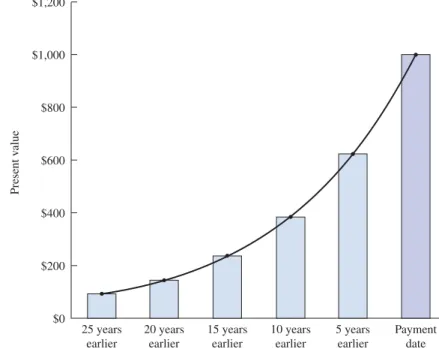
The longer the time period before a scheduled payment, the smaller the present value will be. Figure 8.5 shows the pattern of decreasing present value for longer peri-ods before the payment date. The decline is rapid in the first ten years, but steadily tapers off at longer periods. With a discount rate of 10% compounded annually, the present value seven years before the payment is about half the numericalvalue of the payment. Twenty-five years prior to the payment, the present value is less than one-tenth of the payment’s size! In practical terms, payments that will be received more than 25 years in the future have little economicvalue today.
How would Figure 8.5 change for a discount rate of 8% compounded annually? And how would it differ for a discount rate of 12% compounded annually?
Figure 8.5 The Present Value of $1000 (Discounted at 10% Compounded Annually) Present v alue $0 $200 $400 $600 $800 $1,000 $1,200 25 years earlier 20 years earlier 15 years earlier 10 years earlier 5 years earlier Payment date
Example 8.3A THE PRINCIPAL NEEDED TO PRODUCE A SPECIFIED MATURITY VALUE
If an investment can earn 4% compounded monthly, what amount must you invest now in order to accu-mulate $10,000 after 3 years?
Solution
Given:j4%,m12,FV$10,000, and Term 3.5 years
Then per month and nm(Term) 12(3.5) 42
Rearranging formula (8-2) to solve for PV,
PVFV(1 i)n$10,000(1.00333333)42$8695.61 A total of $8695.61 must be invested now in order to have $10,000 after 3 years.12
imj 4%12 0.3%
1 2
In terms of numerical values, present value is smaller than the payment, and future value is larger than the payment. However, these numerically different amounts all have the same economic value. For example, suppose a $100 payment is due one year from now, and money can earn 10% compounded annually. Today’s present value is $100(1.10)1$91.91. The future value two years from now is $110.00. The three amounts all have the same economic value, namely the value of $91.91 currentdollars.
Numerical Values
vs. Economic Values
If you use any fewer than six 3s in the value for iin Example 8.3A, you will have some round-off error in the calculated value for PV. For the fewest keystrokes and maximum accuracy in your answer, avoid manual re-entry of calculated values. The most efficient sequence of keystrokes resulting in the highest accuracy of PVin Example 8.3A is
0.04 12 1 42 10000
When you employ the calculated value of i in this way, the calculator actually uses more than the seven 3s you see in the display (after pressing the first in the preceding sequence). The calculator maintains and uses two or three more figures than are shown in the display. In subsequent example problems, this procedure will be assumed but will not be shown.
Efficient Use of
Your Calculator
yx
Example 8.3B CALCULATING AN EQUIVALENT PAYMENT
Mr. and Mrs. Espedido’s property taxes, amounting to $2450, are due on July 1. What amount should the city accept if the taxes are paid eight months in advance and the city can earn 6% compounded monthly on surplus funds?
Solution
The city should accept an amount that is equivalent to $2450, allowing for the rate of interest that the city can earn on its surplus funds. This equivalent amount is the present value of $2450, eight months earlier. Given:FV$2450,j6% compounded monthly,m12, and n8.
Then
and Present value,PVFV(1 i)n$2450(1.005)8$2354.17
The city should be willing to accept $2354.17 on a date eight months before the scheduled due date.
Example 8.3C CALCULATING THE EQUIVALENT VALUE OF TWO PAYMENTS
Two payments of $10,000 each must be made one year and four years from now. If money can earn 9% compounded monthly, what single payment two years from now would be equivalent to the two sched-uled payments?
Solution
When more than one payment is involved in a problem, it is helpful to present the given information in a time diagram. Some of the calculations that need to be done may be indicated on the diagram. In this case, we can indicate the calculation of the equivalent values by constructing arrows from the scheduled payments to the date of the replacement payment. Then we write the relevant values for iand non each arrow.
The single equivalent payment will be PVFV.
FVFuture value of $10,000, 12 months later $10,000(1.0075)12
$10,938.07
PVPresent value of $10,000, 24 months earlier $10,000(1.0075)24
$8358.31 The equivalent single payment is
$10,938.07 $8358.31 $19,296.38 0 4 Years $10,000 $10,000 PV FV i= 0.75% n = 12 1 i= 0.75%, n = 24 2 imj 6% 12 0.5% 1per month2
Example 8.3D DEMONSTRATING ECONOMIC EQUIVALENCE
Show why the recipient of the payments in Example 8.3C should be indifferent between receiving the scheduled payments and receiving the replacement payment.
Solution
If the recipient ends up in the same economic position under either alternative, then he should not care which alternative is used.
We will calculate how much money the recipient will have four years from now under each alternative, assuming that any amounts received are invested at 9% compounded monthly.
The two alternatives are presented in the two following time diagrams.
With the scheduled payments, the total amount that the recipient will have after four years is FV1$10,000 $10,000(1.0075)36$10,000
$13,086.45 $10,000 $23,086.45
With the single replacement payment, the recipient will have
FV2$19,296.38(1.0075)24$23,086.45
Under either alternative, the recipient will have $23,086.45 after four years. Therefore, the replacement pay-ment is economically equivalent to the scheduled paypay-ments.
A General Principle Regarding the Present Value of Loan Payments
Let us work through a problem that will illustrate a very important principle. We will use the data and results from Example 8.2D. In that example, we were told that three payments of $1500 each were made on a $5000 loan at one-year intervals after the date of the loan. The interest rate on the loan was 11% compounded quarterly. The prob-lem was to determine the additional payment needed to pay off the loan at the end of the fourth year. The answer was $2104.87.
We will now calculate the sum of the present values of all four payments at the date on which the loan was granted. Use the interest rate on the loan as the discount rate. The calculation of each payment’s present value is given in the following table.
0 4 Years $19,296.38 FV2 i= 0.75%, n= 24 2 0 4 Years $10,000 $10,000 FV1 i = 0.75%, n = 36 1
Note that the sum of the present values is $5000.00, precisely the original principal amount of the loan.This outcome will occur for all loans.The payments do not need to be equal in size or to be at regular intervals. The fundamental principle is highlighted below because we will use it repeatedly in later work.
Payment Amount, FV n i PVFV(1i)n First $1500.00 4 2.75% PV1$1500(1.0275)4$1345.75 Second $1500.00 8 2.75% PV2$1500(1.0275)8$1207.36 Third $1500.00 12 2.75% PV3$1500(1.0275)12$1083.20 Fourth $2104.87 16 2.75% PV4$2104.87(1.0275)16$1363.69 Total: $5000.00
Present Value of Loan Payments
The sum of the present values of all of the payments required to pay off a loan is equal to the original principal of the loan. The discount rate for the present-value calculations is the rate of interest charged on the loan.
Example 8.3E CALCULATING TWO UNKNOWN LOAN PAYMENTS
Kramer borrowed $4000 from George at an interest rate of 7% compounded semiannually. The loan is to be repaid by three payments. The first payment, $1000, is due two years after the date of the loan. The second and third payments are due three and five years, respectively, after the initial loan. Calculate the amounts of the second and third payments if the second payment is to be twice the size of the third payment.
Solution
In Example 8.2D, we solved a similar problem but only the last of four loan payments was unknown. In this problem, two payments are unknown and it would be difficult to use the Example 8.2D approach. However, the fundamental principle developed in this section may be used to solve a wide range of loan problems (including Example 8.2D). Applying this principle to the problem at hand, we have
Sum of the present values of the three payments $4000
The given data are presented on the time line below. If we let xrepresent the third payment, then the sec-ond payment must be 2x.Notice how the idea expressed by the preceding word equation can (and should) be indicated on the diagram.
0 + PV3 PV1 PV2 3 5 Years x 2x 2 $1000 n = 4, i = 3.5% n = 6, i = 3.5% n = 10, i = 3.5% $4000
Maturity Nominal Compounding
Problem value ($) Term rate (%) frequency
1. 10,000 10 years 9.9 Annually
2. 5437.52 27 months 8.5 Quarterly
3. 9704.61 42 months 7.5 Semiannually
4. 8000 18 months 5 Monthly
The second and third payments must be of sizes that will make PV1PV2PV3$4000 ➀
We can obtain a numerical value for PV1, but the best we can do for PV2and PV3is to express them in
terms ofx.That is just fine—after we substitute these values into equation ➀, we will be able to solve for x. PV1FV(1 i)n$1000(1.035)4$871.44
PV22x(1.035)61.6270013x
PV3x(1.035)100.7089188x Now substitute these values into equation ➀and solve for x.
$871.44 1.6270013x0.7089188x$4000 2.3359201x$3128.56
x$1339.33
Kramer’s second payment will be 2($1339.33) $2678.66, and the third payment will be $1339.33.
Concept Questions
1. What is the meaning of the term discount rate?
2. Does a smaller discount rate result in a larger or a smaller present value? Explain.
3. The process of discounting is the opposite of doing what?
4. Why does $100 have less economic value one year from now than $100 has today? What do you need to know before you can determine the difference between the economic values of the two payments?
5. If the present value of $Xdue eight years from now is 0.5$X,what is the present value of $Xdue 16 years from now? Answer without using formula (8-2).
6. Suppose the future value of $1 after xyears is $5. What is the present value of $1,xyears before its scheduled payment date? (Assume the same interest rate in both cases.)
E X E R C I S E
8 . 3
Answers to the odd-numbered problems are at the end of the book.Note:In Section 8.4, you will learn how to use special functions on a financial calcu-lator to solve compound-interest problems. Exercise 8.4 will invite you to return to this Exercise to practise the financial calculator method.
In Problems 1 through 4, calculate the original principal that has the given maturity value.
5. What amount must be invested for eight years at 7.5% compounded semiannually to reach a maturity value of $10,000?
6. Ross has just been notified that the combined principal and interest on an amount that he borrowed 27 months ago at 11% compounded quarterly is now $2297.78. How much of this amount is principal and how much is interest?
7. What amount today is equivalent to $3500, years from now, if money can earn 9% compounded quarterly?
8. What amount 15 months ago is equivalent to $2600, years from now, if money earns 9% compounded monthly during the intervening time?
9. If you owe $4000 at the end of five years, what amount should your creditor accept in payment immediately, if she could earn 6% compounded semiannually on her money? (Source: ICB course on Wealth Valuation.)
10.Gordon can receive a $77 discount if he pays his property taxes early. Alternatively, he can pay the full amount of $2250 when payment is due in nine months. Which alternative is to his advantage if he can earn 6% compounded monthly on short-term investments? In current dollars, how much is the advantage?
11.Gwen is considering two offers on a residential building lot that she wishes to sell. Mr. Araki’s offer is $58,000 payable immediately. Ms. Jorgensen’s offer is for $10,000 down and $51,000 payable in one year. Which offer has the greater economic value if Gwen can earn 6.5% compounded semiannually on funds during the next year? In current dollars, how much more is this offer worth?
12.A lottery winner is offered the choice between $20,000 paid now, or $11,000 now and another $11,000 in five years. Which option should the winner choose, if money can now earn 5% compounded semiannually over a five-year term? How much more is the preferred choice worth in current dollars?
13. You have been offered $100 one year from now, $600 two years from now, and $400 three years from now. The price you are asked to pay in today’s dollars for these cash flows is $964. If the rate of interest you are using to evaluate this deal is 10%
compounded annually, should you take it? (Source: ICB course on Wealth Valuation.) In Problems 14 through 21, calculate the combined equivalent value of the scheduled payments on the indicated dates. The rate of return that money can earn is given in the fourth column. Assume that payments due in the past have not yet been made.
112
312
Scheduled Date of Money can Compounding
Problem payments equivalent value earn (%) frequency
14. $7000 due in 8 years years from now 9.9 Semiannually 15. $1300 due in years 9 months from now 5.5 Quarterly
16. $1400 due today, 3 years from now 6 Quarterly
$1800 due in 5 years
17. $900 due today, 18 months from now 10 Monthly
$500 due in 22 months
18. $1000 due in 3 years, 1 year from now 7.75 Semiannually $2000 due in 5 years
19. $1500 due 9 months ago, 2 years from now 9 Quarterly $2500 due in 4 years
20. $2100 due 1 years ago, 6 months from now 4.5 Monthly $1300 due today,
$800 due in 2 years
21. $750 today, 18 months from now 9.5 Semiannually
$1000 due in 2 years, $1250 due in 4 years 1 2 1 2 1 4 1 2 1 2 312 112
22. What single payment six months from now would be equivalent to payments of $500 due (but not paid) four months ago, and $800 due in 12 months? Assume money can earn 7.5% compounded monthly.
23. What single payment one year from now would be equivalent to $2500 due in three months, and another $2500 due in two years? Money is worth 7% compounded quarterly.
24. To motivate individuals to start saving at an early age, financial planners will sometimes present the results of the following type of calculation. How much must a 25-year-old individual invest five years from now to have the same maturity value at age 55 as an immediate investment of $1000? Assume that both investments earn 8% compounded annually.
•25. Michelle has just received an inheritance from her grandfather’s estate. She will be entering college in 3 years, and wants to immediately purchase three compound-interest investment certificates having the following maturity values and dates: $4000 at the beginning of her first academic year, $5000 at the start of her second year, and $6000 at the beginning of her third year. She can obtain interest rates of 5% compounded semiannually for any terms between three and five years, and 5.6% compounded quarterly for terms between five and seven years. What principal amount should she invest in each certificate?
26. Daniel makes annual payments of $2000 to the former owner of a residential lot that he purchased a few years ago. At the time of the fourth from last payment, Daniel asks for a payout figure that would immediately settle the debt. What amount should the payee be willing to accept instead of the last three payments, if money can earn 8.5% compounded semiannually?
•27. Commercial Finance Co. buys conditional sale contracts from furniture retailers at discounts that provide a 16.5% compounded monthly rate of return on the purchase price. What total price should Commercial Finance pay for the
following three contracts: $950 due in four months, $780 due in six months, and $1270 due in five months?
•28. Teresita has three financial obligations to the same person: $2700 due in 1 year, $1900 due in 1 years, and $1100 due in 3 years. She wishes to settle the obliga-tions with a single payment in 2 years, when her inheritance will be released from her mother’s estate. What amount should the creditor accept if money can earn 6% compounded quarterly?
•29. A $15,000 loan at 11.5% compounded semiannually is advanced today. Two payments of $4000 are to be made one and three years from now. The balance is to be paid in five years. What will the third payment be?
•30. A $4000 loan at 10% compounded monthly is to be repaid by three equal payments due 5, 10, and 15 months from the date of the loan. What is the size of the payments?
•31. A $10,000 loan at 8% compounded semiannually is to be repaid by three equal payments due 2 , 4, and 7 years after the date of the loan. What is the size of each payment? 1 2 1 4 1 2 1 2
•32. A $6000 loan at 9% compounded quarterly is to be settled by two payments. The first payment is due after nine months and the second payment, half the amount of the first payment, is due after 1 years. Determine the size of each payment.
•33. A $7500 loan at 9% compounded monthly requires three payments at five-month intervals after the date of the loan. The second payment is to be twice the size of the first payment, and the third payment is to be double the amount of the second payment. Calculate the size of the second payment.
•34. Three equal payments were made two, four, and six years after the date on which a $9000 loan was granted at 10% compounded quarterly. If the balance immediately after the third payment was $5169.81, what was the amount of each payment?
••35. Repeat Problem 27 with the change that each contract accrues interest from today at the rate of 12% compounded monthly.
••36. Repeat Problem 28 with the change that each obligation accrues interest at the rate of 9% compounded monthly from a date nine months ago when the obliga-tions were incurred.
••37. If the total interest earned on an investment at 8.2% compounded semi-annually for 8 years was $1175.98, what was the original investment?
••38. Peggy has never made any payments on a five-year-old loan from her mother at 6% compounded annually. The total interest owed is now $845.56. How much did she borrow from her mother?
8.4
USING FINANCIAL CALCULATORS
The formulas for many compound interest calculations are permanently programmed into financial calculators. These calculators allow you to enter the numerical values for the variables into memory. Then you select the appropriate financial function to auto-matically perform the calculation.
Ideally, you should be able to solve compound-interest problems using both the algebraic method and the financial functions on a calculator. The algebraic approach strengthens your mathematical skills and provides more flexibility for handling non-standard cases. It helps prepare you to create spreadsheets for specific applications. Financial calculators make routine calculations more efficient and reduce the likeli-hood of making arithmetic errors. Most of the example problems from this point onward will present both algebraic and financial calculator solutions.
Key Definitions and Calculator Operation
The financial calculator instructions and keystrokes shown in the main body of this text are for the Texas Instruments BA II PLUS. General instructions for three other models are provided in the Appendixes 8A and 13A.
The icon in the margin at left will appear next to the solutions for some Example problems. These Examples are also solved in Part G of the textbook’s CD-ROM using the Texas Instruments BA-35 calculator. In Part H of the CD-ROM, the same Example problems are again solved using the Sharp EL-733A calculator.
1 2
1 2
The basic financial keys of the Texas Instruments BA II PLUS calculator are in the third row of its keyboard. The calculator’s manual refers to them as the TVM (Time-Value-of-Money) keys. The definitions for these keys are as follows.
N represents the number of compounding periods I/Y represents the nominal (annual) interest rate PV represents the principal or present value
PMT represents the periodic annuity payment (not used until Chapter 10) FV represents the maturity value or future value
The key labels N, I/Y, PV, and FV correspond to the algebraic variables n, j, PV,and FV, respectively. Each of the five keys has two uses:
1. Saving to memory a numerical value for the variable.
2. Computing the value of the variable (based on previously saved values for all other variables).
As an example, let us compute the future value of $1000 invested at 8% com-pounded semiannually for 3 years. We must first enter values for , ,
, and . They may be entered in any order. To save $1000 in the memory, just enter the digits for 1000 and press . The display then shows “PV 1,000.”4Next enter values for the other variables in the same manner. (You do not need to clear your display between entries.) Note that the nominal interest rate must be entered in percent form(without the % symbol) rather than in its decimal equivalent form. For all compound interest problems in Chapters 8 and 9, the value “0” must be stored in the memory. This tells the calculator that there is no regular annuity payment. In summary, the keystrokes for entering these four known values are:
1000 6 8 0
Do you think the calculator now has enough information to compute the future value? Note that we have not yet entered any information about the compounding fre-quency. To enter and save the value for the number of compoundings per year, you must first gain access to a particular list of internal settings. The calculator’s Owner’s Manual refers to this list as the “P/Y settings worksheet.” Note the P/Y symbol above the I/Y key. This indicates that the P/Y settings worksheet is the second function of the I/Y key. To open this worksheet, press the key labelled “2nd” followed by the key labelled “I/Y.” Hereafter, we will represent this keystroke combination by
(We will always show the symbol abovethe key rather than the symbol onthe key when presenting the keystrokes for a second function.)
After pressing these two keys, you will see something like “P/Y 12” in your cal-culator’s display. (You may see a number other than 12 — 12 is the factory-set default value.) This displayed item is actually the first in a list of just two items. You can scroll down to the second item by pressing the key. The calculator will then display something like “C/Y 12”. When you are at the bottom of any list, pressing the key again will take you to the top of the list. The definitions for these new symbols are:
N I/Y N↓ N 2nd P/YN N PMT N I/Y N N PV PV PV PMT PV 4
The assumption here is that the calculator has previously been set for “floating-decimal format.” See the Appendix to this chapter for instructions on setting this format on the “Format worksheet.”
N↓ PMT
P/Y represents the number of annuity payments per year C/Y represents the number of compoundings per year Therefore, C/Y corresponds to the algebraic symbol m.
If the calculation does not involve an annuity, P/Y must be given the same value as C/Y.5This requirement applies to all problems in Chapters 8 and 9. In the current example, we have semiannual compounding. Therefore, we need to set both P/Y and C/Y equal to 2. To do that, scroll back to “P/Y 12” in your calculator’s display. Press
2
The calculator display now shows “P/Y 2”. Next, scroll down to C/Y. Observe that its value has automatically changed to 2. Entering a new value for P/Y alwayscauses C/Y to change automatically to the same value. So for all problems in Chapters 8 and 9, we need only set P/Y m.That will produce the desired result of making C/Y P/Y m.6 Before we can compute the future value of the $1000, we must close the P/Y settings worksheet. Note that the second function of the key labelled CPT is QUIT. Pressing
will close any worksheet you have opened. Then, to execute the future value calcula-tion, press
The calculator will display “FV 1,265.319018.” Rounded to the nearest cent, the future value of the $1000 investment is $1265.32. The significance of the negative sign7 will be discussed in the next subsection.
Let’s summarize the complete sequence of keystrokes needed for the future value cal-culation. 1000 6 8 0 2 N PV NN I/YN PMTN N
2nd P/YN ENTERN 2ndN QUITN CPTN FVN
N QUIT N FV N 2nd N CPT N ENTER 5
This requirement does not come from any logic or line of reasoning. It is just a result of the particular way Texas Instruments has programmed the calculator.
6
Later in Chapter 10, P/Y and C/Y will have differing values in some annuity problems. We will deal with this matter when needed.
7
The Texas Instruments BA 35 does not display a negative sign at this point.
You can operate your calculator more efficiently if you take advantage of the following features.
1. After any computation, all internal settings and numbers saved in memory are retained until you change them or clear them. Therefore, you do not need to re-enter a variable’s value if it is unchanged in a subsequent calculation. 2. Whenever you accidentally press one of the five financial keys, the number
in the display at that moment will be saved as the value of that financial variable. At any time, you can check the value stored in a financial key’s memory by pressing followed by the key.
3. When you turn the calculator off, it still retains the internal settings and the values in memory. (When the calculator’s battery becomes weak, this feature and other calculator operations are unreliable.)
Efficient Use of
Your Calculator
N RCL