Linear-Time Encodable Rate-Compatible Punctured
LDPC Codes with Low Error Floors
Seungmoon Song, Daesung Hwang, Sunglock Seo, and Jeongseok Ha
School of Electrical and Computer EngineeringInformation and Communications University (ICU) 119, Munjiro, Daejeon, 305-732, Korea
Email: smsong, gohihihigo, bassboy86 and [email protected]
Abstract—We consider Efficiently Encodable Rate-Compatible (E2RC) punctured Low-Density Parity-Check (LDPC) codes and show that punctured LDPC codes of the E2RC structure have high error floors at their base code rates. Efficient type-II hybrid Automatic Repeat reQuest (ARQ) protocols are possible with punctured LDPC codes since punctured LDPC codes can support a wide range of code rates with incremental redundancy transmissions. However, such high error floors may result in excessive number of retransmission requests and end up with poor efficiency of hybrid ARQ protocols. We find that the problem of the E2RC structure stems from dispersive right degree distribution and high maximum right degree which is an indis-pensable element in the E2RC structure. In this paper, we propose a modification to E2RC structure which eliminates the error-floor problem without compromising any of important advantages of the E2RC structure such as linear-time encodability and good bit-error rate (BER) performance over a wide range of code rates. Our claims will be verified with BER and frame error rate (FER) simulation results.
I. INTRODUCTION
Over time-varying channels, error correction coding systems are required to be flexible with respect to their code rates based on channel state information (CSI). That is, to maximize data rates, channel coding systems decrease their code rates until they overcome the channel impairment, often referred to as
rate adaptability [1]. Rate adaptability can be realized with several pairs of encoders and decoders for the desired code rates. However, systems with multiple pairs of encoder and decoder are sometimes unacceptable due to their complexity. We can also realize the rate-adaptability by puncturing a low rate channel code (mother codeorbase code). Punctured codes need only one encoder and decoder for each mother code. It is assumed that the decoder knows the locations of punctured coded symbols. If a rate-adaptive channel code has another restriction such that the parity bits of higher rate codes in a sequence of rates are embedded in those of lower rate codes, the sequence of codes are called rate-compatible [1]–[3]. It is an equivalent way to define the rate-compatibility with punctured codes that punctured parity bits in a lower rate code must be punctured in higher rate codes.
Rate-compatible punctured channel codes have another ad-vantage with type-I and II hybrid Automatic Repeat reQuest (ARQ) protocols. Here, a transmitter sends partial redundan-cies by puncturing redundanredundan-cies in a mother code based on CSI. If the receiver fails to recover the message, the receiver
requests additional redundancies which are punctured and not transmitted. In the receiver, the additional redundancies can be efficiently combined with the previously received codeword.
The coding gain of a punctured code at each code rate is usually poorer than that of the corresponding dedicated code for the code rate, i.e. optimized code for the rate. Thus, punctured bits must be chosen to minimize performance gap between dedicated and punctured codes. A selection of punctured symbols is called a puncturing distribution for a code rate in this paper.
Rate-compatible punctured convolutional codes were intro-duced in [1]. Haet al.showed that puncturing can be success-fully applied to LDPC codes by showing that it is possible to design capacity-approaching rate-compatible punctured LDPC (RCP-LDPC) codes at very long block lengths [2], [4]. Soon afterward puncturing methods for RCP-LDPC codes at short block lengths were presented in [5], [6]. These results served as a foundation for the work in [7]–[10], where the focus was on improving the performance of codes at high rates and designing codes with linear-time encoders.
Especially, Kim et al. [9] proposed a class of efficiently encodable rate-compatible (E2RC) LDPC codes whose parity-check matrices have a favorable structure for puncturing and linear-time encoding. They showed that the E2RC LDPC codes
have superior performance to other punctured LDPC codes [5], [8]. In the E2RC LDPC codes, the parity bits are assumed to
be only degree-2 variable nodes, and the sub-matrix of the degree 2 nodes is designed in a deterministic way. In such a way, all parity bits are encoded in a recursive way which can be implemented with shift registers. In addition to the simple encoder structure, the puncturing locations and order are easily identified by investigating the structure of the sub-matrix of parity bits.
Although the E2RC LDPC codes have good performance over a wide range of code rates and the advantage of linear-time encodability, they have relatively high error floors at their base code rates. In this paper, we explain why the E2RC LDPC codes have such high error floors and propose a
modified E2RC LDPC codes to solve the error floor problem
without compromising any of important advantages of the E2RC LDPC codes such as the linear-time encodability and
good performance over a wide range of code rates.
describe the puncturing algorithm in [2] which is necessary to understand the E2RC LDPC codes summarized in Section III. In this section we also explain why the high error floors are unavoidable in the E2RC LDPC codes. As a solution to the
problem, a modified structure will be proposed in Section IV. The performance of the proposed LDPC codes is compared with that of E2RC LDPC codes in Section V, and we finally
conclude our work in Section VI.
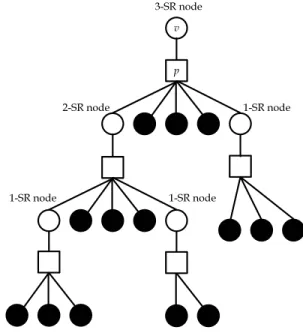
II. PUNCTURINGALGORITHM FORSHORTLDPC CODES In this section we summarize the design rule for punctured LDPC codes at short block lengths in [6]. It is based on the level of recoverability of the punctured nodes. In general, a punctured node will be recovered with a reliable message when it has 1) more neighboring (check) nodes, and 2) each of the check nodes has reliable neighbors (variable nodes), not counting the punctured node in question. To clarify this idea further, imagine a punctured variable node. In the first iteration that node will receive nonzero messages from all neighboring check nodes whose other neighboring variable nodes are all unpunctured. This event, when a punctured node receives at least one non-zero message from its neighboring check nodes, is called recovery by analogy with the one over binary-erasure channels. The punctured node in the preceding example will be called one-step-recoverable (1-SR) since it is recovered in the first iteration. The recovered 1-SR nodes and unpunctured nodes will help recover some of the remaining punctured nodes in the second iteration, and so on. In general, the punctured nodes recovered in the k-th iteration are called k-SR nodes. An example of a 3-SR node is depicted in Fig. 1. According to the results in [6] it can be assumed that the more iterations a punctured node needs for its recovery, the less statistically reliable the recovery message is. Thus, it is preferable to puncture nodes such that they will be recovered as fast as possible, which results not only in less required iterations for decoding but also in a better performance at a given code rate. Based on this, the design rule can be defined as follows. First, the group containing 1-SR nodes, denoted by G1, should be maximized. Subsequently, the group with
2-SR nodes G2 should be maximized, and so on. The groups G1,G2. . . ,Gk are used to determine the puncturing patterns
for various rates in a rate-compatible fashion. Namely, the variable nodes from G1 are punctured first, followed by the
nodes from G2, etc. In this manner a set of rate-compatible
punctured code can easily be derived from a given mother code.
III. E2RC LDPC CODES
In the E2RC LDPC codes, a parity-check matrix consists of
two sub-matrices which are denoted as Hp andHsin (1).
H=Hp Hs
m×n (1)
where m and n are the number of rows and columns, re-spectively. Hp is an m×m sub-matrix and whose columns
correspond to parity-bits. The m×(n−m) sub-matrix Hs
is for message bits. We consider only the case that m is a
v
p
3-SR node
2-SR node 1-SR node
1-SR node 1-SR node
Fig. 1. A recovery tree of a3-SR node; the squares are survived check nodes, the filled circles are unpunctured variable nodes, and the unfilled circles are punctured variable nodes.
power of 2 (2d, for d > 0) due to limited space. However,
the choice of m does not change the structural features of E2RC LDPC. The interested reader is referred to [9], [10] for
details of general case. The sub-matrix Hp is constructed in
a recursive way in (2), and the recursion ends when m/2∗
becomes 1. That is,∗=d sincem= 2d.
Hp=T(1) and T()= Im 2 0m2 Im 2 T (+1) , (2)
where Ik and 0k are the k×k identity and zero matrices,
respectively, andI1and01are defined as 1 and 0, respectively.
In the last recursion, =d, it terminates as T(d)= 1 0 1 1 .
The sub-matrix Hp is designed to make the columns in the
upper left identity matrixIm
2 ofT
()are all-SR nodes. Thus,
G1has the column indexes from 1 tom/2, and in generalG
has the column indexes fromj−=11m/2j+ 1to
j=1m/2j
which implies the size of-SR node group,|G|to bem/2.
The structure of the E2RC LDPC codes also makes the order of puncturing simpler, which is to puncture lower indexed columns first since a node with a lower index is a lower-SR node.
For the encoding, the parity bits on Im/2 in T(1) are
determined only with the message bits. Afterward, the parity bits onIm/2 will be determined by the message bits and all
previously determined parity bits on Im/2∼Im/2−1. Due to the sparseness of the parity-check matrix, the encoding needs linear complexity. It is possible to implement the encoder with shift registers, which is well described in [10].
Although the columns of Hp have only degree of 2 except
that the degree of the last column of Hp is 1 the right degree
distribution is dispersive, which is ρ(x) = d+1 i=1 ρixi−1, (3) where ρi= 2i mj 2m−1 for 1≤i≤d, ρd+1= d+ 1 2m−1 and d= log2m.
When constructing the sub-matrix Hs of an E2RC LDPC
code, the authors in [9], [10] use the progressive edge growth (PEG) algorithm [11] which needs only a left de-gree distribution and automatically generates a right dede-gree distribution for maximizing girth distribution of the resulting parity-check matrix. Such automatically generated right degree distributions are usually highly concentrated which empirically substantiates the well-known belief [12], [13] that good LDPC codes have right degree distributions in the concentrated form. However, when we use the PEG algorithm to design an E2RC
LDPC code, the right degree is lower bounded by the structure ofHpin (3) since the degree of each row ofHmust be larger
than that ofHp. Thus, the PEG algorithm generates a
parity-check matrix with a very dispersive right degree distribution. In [9], the authors design an E2RC LDPC code with a left degree distribution
λ(x) = 0.30780x+ 0.27287x2+ 0.41933x6 (4) which shows good threshold performance at its designed code rate, 0.5 with the right degree distribution in the concentrated form:
ρ(x) = 0.4x5+ 0.6x6.
However, in the case of E2RC LDPC code, the right degree distribution becomes very dispersive due to the structure of Hp. When the code lengthnis 1024 and the number of parities
m is 512, the right degree distribution in [9] is
ρ(x) =0.41147x5+ 0.54626x6+ 0.01892x7+ 0.01064x8+ 0.00592x9+ 0.00325x10+ 0.00354x11.
Moreover, the maximum right degree grows with increasing number of rows as shown in (3), which means the right degree distribution will be more dispersive with larger block lengths or lower rates. The dispersive right degree distributions in the E2RC structure result in high error floors in BER evaluations
at their base code rates. If the error floors are due to decoding failures, it is less serious than decoder errors since the decoder can request retransmissions. However, we find that decoder errors significantly contribute to the error floors of the E2RC
LDPC codes, which makes hybrid AQR protocols useless due to the undetected errors.
In Section IV, we propose a modified E2RC structure which
has concentrated right degree distributions without losing any of important advantages of the E2RC structure.
IV. PROPOSEDLDPC CODES
To address the dispersive right degree distributions in the E2RC structure, we propose a modified E2RC structure which includes the E2RC structure as a special case. In the proposed structure, the sub-matrix Hp is constructed as shown in (5).
Hp= E(1) b,1 0b · · · · 0b Cb E(1)b,2 . .. · · · 0b 0b Cb . .. ... ... .. . . .. . .. ... 0b 0b · · · 0b Cb E(1)b,mb , (5) E() b,j= I2b 02b Ib 2 E (+1) b,j ,E(δ) b,j = 1 0 1 1 , for 1≤j≤mb, and Cb= 0 · · · 0 1 0 . .. 0 0 .. . . .. ... ... 0 · · · 0 0 , where m= 2d,b= 2δ,0< δ < d,m b =m/b= 2d−δ,E(1)b,j,
Cb are b ×b rectangular matrices, and E(1)b,j is recursively
constructed with the termination E(b,jδ). If δ = d, E(1)m,1 will be Hp, and the proposed structure becomes the same as the
E2RC structure. In each E()
b,j, the columns of the upper left
identity matrixIb/2 are all -SR nodes.
The right degree distribution of the sub-matrix Hp in (5) from the node perspective is derived as in (6).
˜ ρi = 1 2i + −mb m i for i= 1,2, ˜ ρi = 1 2i for 3≤i≤δ, and ρ˜δ+1 = mb m = 2 −δ. (6)
The right degree distribution from the edge perspective,ρi has
a relation with ρ˜i as
ρi= 2 mi
m−1ρ˜i.
In the E2RC structure, the maximum right degree is directly proportional to the number of rows m but in the proposed structure, we can control the maximum right degree by choos-ingδ. Thus, if we have a small value ofδ, the PEG algorithm will generate the sub-matrixHs to make a concentrated right
degree distribution ofH.
The order of puncturing was the column index in the ascending order in the E2RC LDPC codes. However, in the
proposed structure, the column indexpj of thej-th punctured
parity bit is computed as
where r = (j −1) modmb, and q = (j − 1)/mb.
Although the equation of the puncturing order seems to be involved, it simply takes one lower indexed -SR node from Eb,((j modmb)+1) and take the next -SR node from Eb,(((j+1) modmb)+1) and so on.
We have to note that in (7), the maximum number of punctured symbols is limited up to m−mb since we do not
punctured the last column in Eb,j for all j, which limits the highest code rate to
rhighest= k n−m+mb = k k+mb = 1 1 + 2dk−δ. (8)
We show that concentrated right degree distribution is possible with a choice of a small δbut due to the limit of the highest code rate in (8),δcannot be arbitrary small. However, a small loss of the highest rate (rhighest = 0.9412 when k = 512,
m = 512, and δ = 4) provides a highly concentrated right degree distribution.
Since all the parity bits in (5) are determined in a recursive way, encoding will be done with a linear complexity as we did in the E2RC structure.
V. SIMULATIONRESULTS
We verify our claim by evaluating and comparing per-formances of punctured LDPC codes with the E2RC and
the proposed structures. For the performance evaluations, we design LDPC codes at length 2048 and rate 0.5 with the degree distribution in (4). For the linear-time encoding, both the E2RC and the proposed structure need one degree 1 parity bit on the last column ofHp, which slightly changes the left degree
distribution to
λ(x) = 0.00015 + 0.30235x+ 0.27126x2+ 0.42624x6. (9) For the left degree distribution we have a dispersive right degree distribution of the E2RC LDPC code,
ρ(x) = 0.390784x5+ 0.576872x6+ 0.017723x7 + 0.006646x8+ 0.002954x9+ 0.003249x10 + 0.001772x11
from the PEG algorithm with the “best effort sense” to maximize local girths. However, the right degree distribution of the proposed LDPC code looks highly concentrated
0.355339x5+ 0.639935x6+ 0.004726x7, where we set δin (5) to 4.
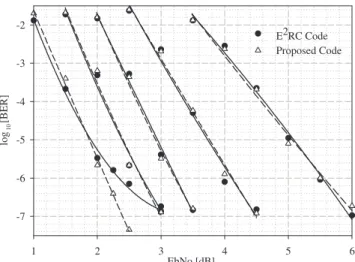
The BER1 performances of the punctured LDPC codes are
evaluated at rates 0.5, 0.6, 0.7, 0.8, and 0.9 and depicted in Fig. 2 where the proposed punctured LDPC codes have the same performances as those of the E2RC LDPC codes. However,
the proposed LDPC code shows a much lower error floor at it base code rate 0.5, which is due to the concentrated right degree distribution. Such performance improvement at the base rate becomes more distinctive in the comparisons of the frame
1For each BER, we watched more than 50 unsuccessful decodings.
EbNo [dB] 1 2 3 4 5 6 log 10 [BER] -7 -6 -5 -4 -3 -2 E2RC Code Proposed Code
Fig. 2. Comparison between BERs of the punctured LDPC codes at block length 2048 with the E2RC (circles) and the proposed (triangles) structures; the left degree distribution of the base code is in (9) and the code rates are 0.5, 0.6, 0.7, 0.8 and 0.9 from the left to the right.
error rate (FER) in Fig. 3. Here, FER means the rate of the number of decoding failures and errors to the total number of transmitted codewords. EbNo [dB] 1 2 3 4 5 6 log 10 [FER] -5 -4 -3 -2 -1 0 E2RC Code Proposed Code
Fig. 3. Comparison between FERs of the punctured LDPC codes at block length 2048 with the E2RC (circles) and the proposed (triangles) structures; the left degree distribution of the base code is (9) and the code rates are 0.5, 0.6, 0.7, 0.8 and 0.9 from the left to the right.
We also verify our claims with different degree distribution pair from [12]:
λ(x) = 0.30780x+ 0.27287x2+ 0.41933x6 and ρ(x) = 0.4x5+ 0.6x6,
which is for rate 0.5 LDPC codes.
Again, we design LDPC codes at length 2048 and introduce one degree 1 parity bit to make them linear-time encodable, which slightly changes the left degree distribution to
For the left degree distribution we have two right degree distributions, ρ(x) = 0.441899x5+ 0.521797x6+ 0.017854x7 + 0.012052x8+ 0.002976x9+ 0.001637x10 + 0.001785x11, and ρ(x) = 0.400833x5+ 0.596786x6+ 0.002381x7. from the PEG algorithm for the E2RC and proposed struc-tures, respectively. By changing the random seed in the PEG algorithm, we design 10 different parity-check matrices for each structure and compare their performances at the base code rate, 0.5. The comparisons are depicted in Fig. 4 where the proposed structure consistently outperforms the E2RC
structure, which confirms our claims.
EbNo [dB] 1.0 1.5 2.0 2.5 3.0 log 10 [FER] -5 -4 -3 -2 -1 E2RC Code Proposed Code
Fig. 4. Comparison between FERs of the 10 LDPC codes at block length 2048 with the E2RC (circles) and the proposed (triangles) structures; the left degree distribution of the base code is in (10).
Since type-II hybrid ARQ protocol can ask for retransmis-sions only if it detects errors, error control codes in hybrid ARQ protocols must have good error detecting capability. In other words, the decoding error rate (DER), i.e. the number of decoding errors/the number of transmitted codeword, must be minimized. In Table I, we summarize DERs of the E2RC and the proposed LDPC codes whose left degree distribution is from (4). In this comparison, the proposed LDPC code shows 10 times lower DERs than those of the E2RC codes. Thus,
the LDPC codes with the proposed structure provide not only better performance in forward error controls but also in the hybrid ARQ protocols.
VI. CONCLUSIONS
Although the E2RC punctured LDPC codes provide good
performances over a wide range of code rates, they have high error floors at their base code rates. We show that this is due to the dispersive right degree distributions which come from the structure of the parity-check sub-matrix in the E2RC LDPC
codes. We propose a modified E2RC structure with which we
TABLE I
DECODING ERROR RATES OF THEE2RCAND THE PROPOSEDLDPC
CODES AT THEIR BASE CODE RATE, 0.5WITH THE LEFT DEGREE DISTRIBUTION IN(4).
Decoding Error Rates
Eb/N0 1.00 1.50 2.00 2.25 2.50
E2RC 1.15E-2 2.81E-3 7.16E-4 3.74E-4 2.25E-4 Proposed 0 1.67E-4 3.26E-5 2.39E-5 9.41E-6
can have both good performance over the range of code rates and lower error floors. We also investigate the decoder error rate (DER) and show that the proposed LDPC codes have 10 times lower DERs in our experiment.
The work was supported by in part by Samsung Electronics, Korea.
REFERENCES
[1] J. Hagenauer, “Rate-compatible punctured convolutional codes (RCPC codes) and their applications,”IEEE Trans. Commun., vol. 36, pp. 389– 400, Apr. 1988.
[2] J. Ha, J. Kim, and S. W. McLaughlin, “Rate-compatible puncturing of low-density parity-check codes,”IEEE Trans. Inform. Theory, vol. IT-50, pp. 2824– 2836, Nov. 2004.
[3] J. Li and K. Narayanan, “Rate-compatible low density parity check codes for capacity-approaching ARQ scheme in packet data communicaitons,” inInt. Conf. on Comm., Internet and Info. Tech. (CIIT), 2002. [4] J. Ha and S. W. McLaughlin, “Optimal puncturing of irregular
low-density parity-check codes,” inIEEE Int. Conf. Commun., Anchorage, Alaska, May 2003, pp. 3110–3114.
[5] J. Ha, J. Kim, and S. W. McLaughlin, “Puncturing for finite length low-density parity-check codes,” in Proc. Int. Symp. Information Theory, Chicago, USA, 2004, p. 151.
[6] J. Ha, J. Kim, D. Klinc, and S. W. McLaughlin, “Rate-compatible punctured low-density parity-check codes with short block lengths,”
IEEE Trans. Inform. Theory, vol. IT-52, pp. 728 – 738, Feb. 2006. [7] E. Choi, S.-B. Suh, and J. Kim, “Rate-compatible puncturing for
low-density parity-check codes with dual-diagonal parity structure,” in16th Int. Symp. on Personal Indoor and Mobile Radio Commun. (PIMRC), Berlin, Germany, 2005.
[8] G. Yue, X. Wang, and M. Madihian, “Design of rate-compatible irregular repeat accumulate codes,” IEEE Trans. Commun., vol. 55, no. 6, pp. 1153 – 1163, June 2007.
[9] J. Kim, A. Ramamoorthy, and S. W. McLaughlin, “Design of efficiently-encodable rate-compatible irregular LDPC codes,” in IEEE Int. Conf. Commun., Istanbul, Turkey, June 2006, pp. 1131–1136.
[10] ——, “The design ofefficiently-encodable rate-compatible ldpc codes,”
IEEE Trans. Commun., submitted.
[11] X. Hu, E. Eleftheriou, and D. M. Arnold, “Progressive edge-growth Tanner graphs,” inProc. IEEE GLOBECOM, San Antonio, Texas, Nov. 2001, pp. 995–1001.
[12] S.-Y. Chung, T. J. Richardson, and R. L. Urbanke, “Analysis of sum-product decoding of low-density parity-check codes using a Gaussian approximation,”IEEE Trans. Inform. Theory, vol. IT-47, pp. 657–670, Feb. 2001.
[13] T. J. Richardson, A. Shokrollahi, and R. L. Urbanke, “Design of capacity-approaching irregular low-density parity-check codes,” IEEE Trans. Inform. Theory, vol. IT-47, pp. 619–637, Feb. 2001.