Refining Incomplete Planning Domain Models Through Plan Traces
Hankz Hankui Zhuo
a, Tuan Nguyen
b, and Subbarao Kambhampati
ba
Dept. of Computer Science, Sun Yat-sen University, Guangzhou, China
[email protected]
b
Dept. of Computer Science and Engineering, Arizona State University, US
{
natuan,rao
}
@asu.edu
Abstract
Most existing work on learning planning models assumes that the entire model needs to be learned from scratch. A more realistic situation is that the planning agent has an incomplete model which it needs to refine through learning. In this paper we propose and evaluate a method for doing this. Our method takes as input an incomplete model (with missing preconditions and effects in the actions), as well as a set of plan traces that are known to be correct. It outputs a “refined” model that not only captures additional precondition/effect knowledge about the given actions, but also “macro actions”. We use a MAX-SAT framework for learning, where the constraints are derived from the executability of the given plan traces, as well as the precondi-tions/effects of the given incomplete model. Unlike traditional macro-action learners which use macros to increase the efficiency of planning (in the con-text of a complete model), our motivation for learn-ing macros is to increase the accuracy (robust-ness) of the plans generated with the refined model. We demonstrate the effectiveness of our approach through a systematic empirical evaluation.
1
Introduction
Most work in planning assumes that complete domain models are given as input in order to synthesize plans. However, there is increasing awareness that building domain models at any level of completeness presents steep challenges for domain creators. Indeed, recent work in web-service composition (c.f.
[Bertoliet al., 2010; Hoffmannet al., 2007]) and work-flow
management (c.f. [Blytheet al., 2004]) suggest that
depen-dence on complete models can well be the real bottle-neck inhibiting applications of current planning technology.
Incomplete models present two challenges: how to pro-duce robust plans despite partial knowledge
[Kambham-pati, 2007; Nguyen et al., 2011; Weber and Bryce, 2011;
Garland and Lesh, 2002] and how to improve the models over time through learning. It is this later challenge–refining in-complete models, that is the focus of the current paper. Al-though there has been some work on learning planning
mod-els from plan traces (c.f. [Yanget al., 2007; Zhuoet al., 2010;
Zettlemoyeret al., 2005]), most of it is aimed at learning
plan-ning models from scratch. In contrast, we are interested in the problem of refining an incomplete model through learn-ing. In this paper we propose and evaluate a novel method for doing this. Our method takes as input a partially specified domain model (with missing preconditions and effects in the actions), as well as a set of plan traces that are known to be correct. It outputs a “refined” model that not only captures ad-ditional precondition/effect knowlege about the given actions, but also “macro actions.” In the first phase, we mine candidate macros mined from the plan traces, and in the second phase we learn precondition/effect models both for the primitive ac-tions and the macro acac-tions. Finally we use the refined model to do planning (where the planner is biased towards using the learned macro actions where possible).
We use the MAX-SAT framework for learning, where the constraints are derived from the executability of the given plan traces, as well as the preconditions/effects of the given
incomplete model [Yanget al., 2007; Zhuoet al., 2010].
Un-like traditional macro-action learners which use macros to in-crease the efficiency of planning (in the context of a complete model), our motivation for learning macros is to increase the accuracy (robustness) of the plans generated with the refined model. We demonstrate the effectiveness of our approach,
calledRIMwhich stands for RefiningIncomplete planning
domainModels through plan traces, and present a systematic
empirical evaluation that demonstrates howRIMexploits the
incomplete models as well as learned macro actions. We organize the paper as follows. We first review related work, and then present the formal details of our framework.
After that, we give a detailed description ofRIMalgorithm.
Finally, we evaluateRIMin three planning domains and
con-clude our work with a discussion on future work.
2
Related Work
As we mentioned, there has been prior work on action model
learning [Yanget al., 2007; Zhuoet al., 2010; Zettlemoyer
et al., 2005], but much of it focuses on from-scratch learn-ing. We focus on learning in the presence of an existing
in-complete model. Starting from STRIPS [Fikeset al., 1972],
macro-operator learning has been a staple in automated plan-ning (c.f. [Korf, 1985; Iba, 1989; Coles and Smith, 2007;
Botea et al., 2005; Newton et al., 2007]). All these efforts
however assume that the learner has access to a complete do-main model, and are motivated do-mainly by the desire to
duce the time taken for planning. In contrast, we cull and use macro-operators to increase the accuracy of the incom-plete model. In this sense, our work is similar in spirit to the original case-based planning systems such as CHEF [Ham-mond, 1989], and PLEXUS [Alterman, 1986] that try to use plan traces (“cases”) to make-up for the lack of complete do-main models. The do-main difference is that while case-based planners focussed on case-level transfer, our approach takes a more global view of first refining the incomplete model using the learned models of primitive and macro actions.
3
Preliminaries and Problem Definition
A complete STRIPS domain is defined as a tuple M =
R,A, where R is a set of predicates with typed objects
and A is a set of action models. Each action model is a
quadruplea,PRE(a),ADD(a),DEL(a), whereais an
ac-tion name with zero or more parameters, PRE(a) is a
pre-condition list specifying the pre-conditions under whichacan be
applied, ADD(a)is an adding list and DEL(a)is a deleting
list indicating the effects ofa. We denoteRO as the set of
propositions instantiated fromRwith respect to a set of typed
objectsO. GivenMandO, we define a planning problem as
P =O, s0, g, wheres0 ⊆ ROis an initial state,g ⊆ RO
are goal propositions. A solution plan toP with respect to
modelMis a sequence of actionsp=a1, a2, . . . , anthat
achieves goalgstarting froms0.
An action modela,PRE(a),ADD(a),DEL(a)is
consid-ered incompleteif there are predicates missing in PRE(a),
ADD(a), or DEL(a). We denote Aas a set of incomplete
action models,R the set of predicates used in the
specifica-tion ofA, and thusM =R,A the corresponding
incom-plete STRIPS domain. Note that although action models inA
might have incomplete preconditions and effects, we assume
that no action model inAis missing, and that preconditions
and effects specified inAare correct.
We denoteT as a set of plan traces, where each provides
a successful planpifor problemPi=Oi, si
0, gi. A
macro-operator, a set of which is denoted byO, is defined by a
tu-pleo, α(o),PRE(o),ADD(o),DEL(o), whereois its name
with zero or more parameters,α(o)is an action sequence that
constituteso, PRE(o), ADD(o), and DEL(o)respectively are
the precondition, add and delete lists ofo. A tupleo, α(o)
is called amacro-operator schema.
In this work, we are given a tripleP,M,T of planning
problemP = O, so, g, incomplete domainMand set of
successful plan tracesT. Our algorithm first refines the
do-mainMwith more complete action models and new
macro-operators, resulting in the refined domainMR, and then use
it to solve the problemP. We note that the model refinement
needs to be done only once, and the refined domain model
MRcould be used to solve new planning problems.
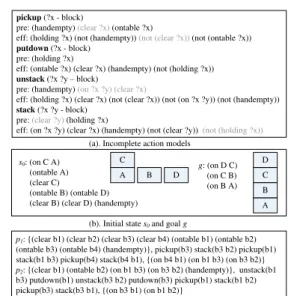
An example input of our planning problem in blocks1
is shown in Figure 1, which is composed of three parts:
incomplete action models (Figure 1(a)), initial state s0 and
goalg(Figure 1(b)), and a plan example set (Figure 1(c)). In
1
http://www.cs.toronto.edu/aips2000/
Figure 1(a), the dark parts indicate the missing predicates. In
Figure 1(c),p1andp2are two plan traces, where initial states
and goals are bracketed. An example output is a solution to the planning problem given in Figure 1, i.e., “(unstack C A)(putdown C)(pickup B)(stack B A)(pickup
C)(stack C B)(pickup D)(stack D C)”.
pickup(?x - block)
pre: (handempty)(clear ?x)(ontable ?x)
eff: (holding ?x) (not (handempty))(not (clear ?x))(not (ontable ?x))
putdown(?x - block) pre: (holding ?x)
eff: (ontable ?x) (clear ?x) (handempty) (not (holding ?x))
unstack(?x ?y block) pre: (handempty)(on ?x ?y) (clear ?x)
eff: (holding ?x) (clear ?x) (not (clear ?x)) (not (on ?x ?y)) (not (handempty))
stack(?x ?y - block)
pre:(clear ?y)(holding ?x)
eff: (on ?x ?y) (clear ?x) (handempty) (not (clear ?y))(not (holding ?x))
p1: {(clear b1) (clear b2) (clear b3) (clear b4) (ontable b1) (ontable b2) (ontable b3) (ontable b4) (handempty)}, pickup(b3) stack(b3 b2) pickup(b1) stack(b1 b3) pickup(b4) stack(b4 b1), {(on b4 b1) (on b1 b3) (on b3 b2)} p2: {(clear b1) (ontable b2) (on b1 b3) (on b3 b2) (handempty)}, unstack(b1 b3) putdown(b1) unstack(b3 b2) putdown(b3) pickup(b1) stack(b1 b2) pickup(b3) stack(b3 b1), {(on b3 b1) (on b1 b2)}
p3: g: (on D C) (on C B) (on B A) C A B D s0: (on C A) (ontable A) (clear C) (ontable B) (ontable D) (clear B) (clear D) (handempty)
C
A B D
(a). Incomplete action models
(b). Initial states0and goalg
(c). Plan examples
Figure 1: An input example ofRIMfor theblocksdomain
4
The
RIM
Approach
OurRIMapproach consists of two phases. In the first phase,
we learn macro-operators and action models with the given
plan traces T and the incomplete domain M. In the
sec-ond phase, we exploit the learned macro-operators and action models in solving new planning problems. In the subsequent subsections, we first address the learning phase in detail, and then describe the planning phase briefly.
Our learning framework (the first phase) can be found in Algorithm 1. It begins with the step of collecting sets of
pred-icatesP, action schemasA and macro-operator schemasO
from incomplete action modelsAand plan tracesT. In the
next two steps, it constructs sets of soft and hard constraints to ensure that the learned domain model can best explain the input plan traces and incomplete action models. Finally, we solve these constraints using a weighted MAX-SAT solver to obtain sets of macro-operators and (refined) action models.
Algorithm 1Phase I: refining domain models
Input:incomplete action modelsA, and plan tracesT.
Output:macro-operatorsOand action modelsA.
1: build sets of predicates, action schemas and
macro-operator schemas:(P, A,O)=build schemas(A,T);
2: build soft constraints:state constraints,pair constraints;
3: build hard constraints: macro constraints, action
con-straints,plan constraintsandincompleteness constraints;
4: solve all constraints, and buildOandA;
4.1
Generating Predicates, Action and
Macro-operator Schemas
It is straightforward to construct the set of predicatesP. We
first collect all predicates R used in the given incomplete
action modelsA, and view them as the initial set of
predi-catesP. We then scan each proposition in plan traces and put
its corresponding predicates (by replacing parameters of the
proposition with variables) inPif it is not inP. Likewise, we
build a set of action schemasAby scanning all the incomplete
action models and plan traces.
There are no easy ways to construct macro-operator schemas, since they neither exist in the plan traces nor in the incomplete action models. We propose to construct macro-operator schemas with the help of frequent pattern mining techniques and incomplete action models. In partic-ular, we consider an action subsequence that satisfies the following two conditions to be a macro-operator schema: (1) it frequently occurs in plan traces, the insight of which implicitly suggests they are more likely to be used in fu-ture problem solving; (2) its actions have strong connec-tions with each other with respect to incomplete action mod-els, which suggests these actions are more likely to be suc-cessfully executed (i.e., with respect to the complete
do-main model). Note that we define the strength θ(o) of a
macro-operatoroasθ(o) = #supported preconditions#
preconditions , where
#supported preconditionsis the number of preconditions
supported by some actions ino, and#preconditionsis the
total number of preconditions of actions ino.
Any action subsequence can be considered a operator schema. However, learning too many macro-operators is costly. We thus choose to eliminate those with low frequency or strength by setting a support constant
δ0 for frequency and a threshold θ0 for strength.We
bor-row the notion of frequent patterns defined in [Zaki, 2001; Pei et al., 2004] to mine the frequent plan fragments. The problem of mining sequential patterns can be stated as fol-lows. LetI ={i1, i2, . . . , in}be a set ofnitems. We call a
subsetX ⊆ Ian itemset and|X|the size ofX. A sequence is
an ordered list of itemsets, denoted bys=s1, s2, . . . , sm,
wheresjis an itemset. The size of a sequence is the number
of itemsets in the sequence, i.e.,|s| =m. The lengthl of a
sequences = s1, s2, . . . , smis defined asl = mi=1|si|.
A sequencesa = a1, a2, . . . , anis a subsequenceof
an-other sequencesb = b1, b2, . . . , bmif there exist integers
1 ≤ i1 < i2 < . . . < in ≤ msuch that a1 ⊆ bi1, a2 ⊆ bi2, . . . , an ⊆bin, denoted bysa sb. A sequence database
Sis a set of tuplessid, s, wheresidis a sequenceidands
is a sequence. A tuplesid, sis said tocontaina sequence
a, ifais a subsequence ofs. The support of a sequenceain
a sequence databaseSis the number of tuples in the database
containinga, i.e.,supS(a) =|{sid, s|(sid, s ∈S)∩(a
s)}|. Given a positive integerδas the support threshold, we
callaafrequentsequence ifsupS(a)≥δ. Given a sequence database and the support threshold, frequent sequential pat-tern mining problem is to find the complete set of sequential patterns whose supports are larger than the threshold.
We convert the set of plan traces to a sequence database in order to make use of the frequent pattern mining algorithm for extracting macro-operators. Given that different action
instances with the same action name share the same model description (i.e., preconditions/effects), we view each action name (parameters omitted) in plan traces as an itemset, which has only one element, and a plan trace as a sequence. The set of plan traces can now be viewed as a sequence database. In addition, we restrict the indices of itemsets of the mined frequent subsequence to be continuous. In this way, we can exploit a frequent pattern mining algorithm, such as SPADE [Zaki, 2001], to mine a set of frequent subsequences.
Furthermore, after mining a set of frequent action subse-quences, we consider the parameter constraints of actions. For example, consider frequent action subsequence “putdown
unstack stack ”. There may be two scenarios in two
different plan traces, which are “(putdown A)(unstack
B C)(stack B A) ” and “(putdown a)(unstack b
c)(stack b d) ”. These two subsequences should not
be seen as the same macro-operator, since they represent different meanings. Specifically, the first scenario produces
an effect “(on B A)”, while the second scenario produces
an effect “(clear a) ”. Note that objects “A” and “a”
are two instances of the same variable, likewise for other objects. As such, we consider these two scenarios as two macro-operator schemas, as shown in Table 1.
Table 1: The example macro-operator schemas (:macro macro1
(:parameters ?x - block ?y - block ?z - block) (:actions (putdown ?x) (unstack ?y ?z) (stack ?y ?x))) (:macro macro2
(:parameters ?x - block ?y - block ?z - block ?w - block) (:actions (putdown ?x) (unstack ?y ?z) (stack ?y ?w))) To sum up, we perform the following three steps to gener-ate macro-operator schemas:
1. We first mine a set of subsequencesF fromT, whose
frequencies are larger than the preset support constant
δ0, neglecting the parameters of actions inT.
2. We then take the parameters of actions inFinto
consid-eration, obtaining a new set of action subsequences with corresponding parameters. We eliminate parameterized
subsequences whose frequencies are smaller thanδ0and
whose strengths are larger than the preset constant θ0,
resulting in a new set of frequent subsequencesF.
3. Finally, we build macro-operator schemas O from
action subsequences in F with all corresponding
parameters. As mentioned above, Table 1 shows example macro-operator schemas constructed from action subsequences “(putdown ?x)(unstack ?y
?z)(stack ?y ?x)” and “(putdown ?x)(unstack
?y ?z)(stack ?y ?w)”.
4.2
Building Soft Constraints
The next step inRIMenforces several constraints on all
pos-sible complete precondition and effect descriptions of actions and macro-operators using the inputted incomplete action models. These constraints are designed to be soft, directing the MAX-SAT algorithm towards learning the most probable complete description of actions and macro-operators.
State Constraints
We first build soft constraints encoding possible precondi-tions and effects of acprecondi-tions and macro-operators implied by state transitions in plan traces. We preprocess plan traces using incomplete action models to obtain more state infor-mation for building state constraints. To do this, we sim-ply “execute” each plan trace starting from its initial state, and calculate (incomplete) states between actions using in-complete action models. In particular, given a plan trace
t=s0, a1, . . . , sn−1, an, g, we executetfroms0using the
incomplete action modelsA, and calculate states si as
fol-lows:si=ADD(ai)∪PRE(ai+1)∪DEL(ai+1).
Note that in defining si we do not consider information
from previous statessj (j < i) due to the incompleteness
of models (i.e., we cannot determine whether propositions in previous states are deleted by their next actions when
propo-sitions are not in the delete lists of these actions).2 We also
assume that actions do not delete propositions that are nonex-istent, i.e., ifp∈DEL(ai+1),pshould be inai+1’s previous
statesi. We denote the resulting set of plan traces byT.
By observation, inTwe find that if a predicate frequently
appears before an action or macro-operator is executed, and its parameters are also parameters of the action or operator, then the predicate is likely to be its precondition. Similarly, if a predicate frequently appears after an action or operator is executed, it is likely to be one of its effects. We encode this
information in the form ofstate constraintsas follows:3
1. For each predicatepin the statewhereactionais
exe-cuted and PARA(p)⊆PARA(a), we havep∈PRE(a).
2. For each predicatepin the statewhereoperatorois
ap-plied and PARA(p)⊆PARA(o), we havep∈PRE(o).
3. For each predicatepin the stateafteractionais executed
and PARA(p)⊆PARA(a), we havep∈ADD(a).
4. For each predicatepin the stateafteroperatorois
ap-plied and PARA(p)⊆PARA(o), we havep∈ADD(o).
We denote the set of the above constraints by SC. We scan
all plan traces inT and count the occurrences of each
con-straint in T. We assign the number of occurrences as the
weight of the corresponding constraint.
Pair Constraints
It is likely that actions that frequently occur together have in-timate relationships, such as one action providing conditions for its next action. We would like to capture this information to help learn action models.
Letα(o) =a1, . . . , anbe an action sequence of
macro-operator o ∈ O. Since a1, . . . , an frequently occur
to-gether, as presented in Step 1 of Algorithm 1, ai is likely
providing conditions for ai+1 (0 < i < n), whose
pa-rameters are included by both ai and ai+1. We formulate
the idea with the following constraints: for each predicate
2
An alternative approach that more fully exploits the partial model, that we hope to investigate in future, is to allow previous state information, but make the weight of the persisting conditions to be lower than the immediate conditions
3
We denote PARA(p), PARA(a)and PARA(o)as the set of pa-rameters involed in predicatep, actionaand macro-operatoro.
p, if PARA(p) ⊆ (PARA(ai)∩ PARA(ai+1)), then p ∈
ADD(ai)∧p∈PRE(ai+1).
We call these constraints pair constraints. The weights
of these constraints are the frequencies the macro-operators, computed when building macro-operator schemas.
4.3
Building Hard Constraints
In this subsection, we enforce a set of hard constraints that must be satisfied by action models and macro-operators.
Macro Constraints
Given action sequenceα(o) =a1, . . . , anofoand models
of each actionai, we require that preconditions ofoshould
provide sufficient conditions for executing all actionsai;
ef-fects ofoshould include those that are created and not deleted
by the action sequence. That is to say, the following con-straints should hold:
1. For each actionaiand predicatep, ifp∈PRE(ai)and
there is no action aj prior toai that adds p, thenp ∈
PRE(o)holds.
2. For each action ai and predicate p, if p ∈ ADD(ai)
and there is no action aj after ai that deletes p and
p∈PRE(o), thenp∈ADD(o)holds.
3. For each actionai and predicatep, ifp∈DEL(ai)and
there is no actionajafteraithat addspandp∈PRE(o),
thenp∈DEL(o)holds.
Action Constraints
To make sure that the learned action models are consistent with the STRIPS language, we further enforce some con-straints, called action concon-straints, on different actions. We
formulate the constraints as follows [Yanget al., 2007] and
denote them by AC:
1. An action may not add afact(instantiated atom) which
already exists before the action is applied. This
con-straint can be encoded as:p∈ADD(a)⇒p∈PRE(a).
2. An action may not delete afactwhich does not exist
be-fore the action is applied. This constraint can be encoded
as:p∈DEL(a)⇒p∈PRE(a).
Plan Constraints
We require that the action models learned do not violate the correctness of plan traces. This requirement is imposed on the relationship between ordered actions in plan traces, ensuring that the causal links in the plan traces are not broken. That is,
for each preconditionpof an actionajin a plan trace, eitherp
is in the initial state, or there is an actionai(i < j) prior toaj
that addspand there is no actionak(i < k < j) betweenai
andajthat deletesp. We formulate the constraints as follows
and denote them by PC:
p∈PRE(aj)∧(p∈s0∨(p∈ADD(ai)∧ ¬p∈DEL(ak))),
wherei < k < j.
Incomplete Model Constraints
Finally, we enforce constraints ensuring that preconditions and effects in the given action models, though incomplete,
are correctly specified. In other words, for each actiona∈A
and predicatep, we have
and
p∈ADD(a)→p∈ADD(a),
and
p∈DEL(a)→p∈DEL(a).
To make sure these constraints are hard, we assign a large
enough weight, denoted bywmax, to these constraints. In our
experiment, we simply chose the maximal weight of state
constraints and macro constraints as the value ofwmax.
4.4
Solving Constraints
We put all constraints together and solve them with a
weighted MAX-SAT solver [LI et al., 2007]. We exploit
MaxSatz [LIet al., 2007] to solve all the hard constraints,
and attain a true or false assignment to maximally satisfy
the weighted constraints. Given the solution assignment, the
construction of macro-operators O and action models Ais
straightforward; e.g., if “p∈ADD(a)” is assignedtruein the
result of the solver,pwill be converted into an effect ofa.
4.5
Phase II: Solving Planning Problems
With the macro-operators and action models learned, we can easily solve new planning problems using planners, such
as FF.4 We view each macro-operator as a special action
model during planning, neglecting its corresponding action sequence. We make a minor modification to FF to make it prefer applying macro-operators during searching. Macros in the plan returned will then be replaced by corresponding
ac-tion subsequences, resulting in the soluac-tion for problemP˜.
5
Experiments
5.1
Dataset and Criterion
We evaluate RIM algorithm in three planning domains:
blocks2,driverlog5 anddepots4. In each domain, we gener-ate from 30 to 150 plan traces for learning domain models and 50 new planning problems for testing the learnt domain models.
We define the accuracyAccas the percentage of correctly
solved planning problems. Specifically, we employRIM to
generate solutions to planning problems, and execute these
solutions from the initial states using ground truth action
models which are assumed to be correct. In other words, we assume that we possess a set of ground truth action models
for testingRIM. If a solution can be successfully executed,
achieving the corresponding goals, then it is considered to be
correct. We denote byNc the number of planning problems
solved by these correct solutions, and byNtthe number of
all testing problems. As a result, the accuracy ofRIMcan be
defined byAcc=Nc
Nt.
5.2
Experimental Results
We evaluateRIMin the following aspects. We first compare
the accuracies of solving planning problems using domain
models learnt by RIM and ARMS, to see the advantage of
the learnt macro-operators in solving planning problems. We
then test the variation of accuracies ofRIMwith respect to
4http://fai.cs.uni-saarland.de/hoffmann/ff.html 5
http://planning.cis.strath.ac.uk/competition/
different percentages of completeness of domain models and different thresholds of frequencies forming macro-operators. Finally, we show the running time to see the efficiency of
RIM. In all experiments, we set the threshold for strength of
all macro-operatorsθ0= 0.25.
Comparison betweenRIMandARMS
To see the benefit we get from the learnt macro-operators,
we compareRIMandARMSlike this: we first learn
macro-operators and action models using RIM and solve 50 new
planning problems using the learnt models; we then learn
action models usingARMS and solve the same 50 planning
problems with the learnt action models. Note that sinceARMS
constructs action models from only plan traces, we also
as-sume empty action models in usingRIM. Thus, the only
dif-ference is that RIM learns both action models and
macro-operators to further support robust plan synthesis. The
thresh-oldδ0is set to be 15. 30 60 90 120 150 0 0.2 0.4 0.6 0.8 1
number of plan traces
Acc blocks ARMS RIM 30 60 90 120 150 0 0.2 0.4 0.6 0.8 1
number of plan traces
Acc driverlog ARMS RIM 30 60 90 120 150 0 0.2 0.4 0.6 0.8 1
number of plan traces
Acc
depots
ARMS RIM
Figure 2: Comparison betweenARMSandRIM
Figure 2 shows the accuracies of the two approaches. We
can see that the accuracies ofRIMare generally better than
ARMS, which suggests that the learned macro-operators
in-deed help solve new planning problems. This is because macro-operators with high frequencies contribute helpful in-formation for searching correct actions. We can also find that as expected, when the number of plan traces increases, the accuracies are also getting higher. This is consistent with our intuition, since the more plan traces we have, the more infor-mation is available for learning high-quality domain models (including both macro-operators and action models), and thus helpful for solving new planning problems. It is likely that
RIMmay produce longer solutions because of its preferences
for using macro-operators. However, in the experiments we
observe that the average length of solutions ofRIMis not
sig-nificantly higher, compared to not using macro-operators. For example, consider using 150 plan traces for learning in the
blocksdomain. The average length of solutions is 18 when
using action models learnt byARMS; while the average length
of solutions (to the same problems as solved byARMS) is 21
when using preferences of macro-operators learnt byRIM.
This is reasonable given that the plans with macro-operators have higher quality.
Accuracies with respect to incomplete action models
We also would like to see the impact of the input incomplete
action models. We vary the percentage ofknown
precondi-tions or effects of action models from 20% to 100%, and run
RIMthree times to calculate the average for accuracies. We
fix the number of plan traces to be 90 and keep the same
20 40 60 80 100 0 0.2 0.4 0.6 0.8 1 percentage (%) Acc blocks 20 40 60 80 100 0 0.2 0.4 0.6 0.8 1 percentage (%) Acc driverlog 20 40 60 80 100 0 0.2 0.4 0.6 0.8 1 percentage (%) Acc depots
Figure 3: Accuracies w.r.t. completeness of action models. The result is shown in Figure 3. We find that in all three do-mains the accuracies generally get higher when the percent-ages for model completeness increase. The results indicate that the input incomplete action models encoded as hard
con-straints inRIMare helpful for acquiring high-quality
macro-operators and action models. As an extreme case, when the in-put action models are complete, i.e., the percentage is 100%, all test problems can be correctly solved given the learned
do-main models.6 This is because the macro-operators learned
are also complete based on the hard macro constraints, which suggests that we can solve the test problems correctly using the learnt macro-operators.
Accuracies with respect to frequency thresholds
We also studied the impact of different frequency thresholds
δ0, which is used in mining macro-operators, in synthesizing
correct plans. We set the number of plan traces to be 90, and the percentage of known preconditions and effects of action models to be 60%. The result is shown in Figure 4.
5 10 15 20 25 0 0.2 0.4 0.6 0.8 1 threshold Acc blocks 5 10 15 20 25 0 0.2 0.4 0.6 0.8 1 threshold Acc driverlog 5 10 15 20 25 0 0.2 0.4 0.6 0.8 1 threshold Acc depots
Figure 4: Accuracies w.r.t. different thresholds of frequencies. We find that the accuracies in all three domains go up at the
beginning and then go down after the thresholdδ0reaches a
large value (e.g., 15). This indicates that the threshold should neither be too low nor too high, since many noisy macro-operators will be learned when the threshold is too low, and many high-quality macro-operators will be missed when it is too high. The correctness of solution plans decreases in both cases. For our experiment data, we empirically observe the best threshold should be 15 with respect to 90 plan traces.
The plots in Figure 4 also shed light on whether macros provide additional benefit when learning in conjunction with partial models. For a given partial model, when we increase the threshold for macro frequency too high–thereby effec-tively eliminating macros from the learned model–the plan-ner accuracy reduces. This demonstrates that even with par-tial models (domain knowledge), macros do help in improv-ing the planner accuracy. Part of the reason is that the learned macro actions improve the learned primitive actions too. This synergy happens because we build pair constraints based on macro actions as well as partial model to improve the learning of primitive actions.
6
We use only solvable test problems in the experiment.
Running time
To study the efficiency ofRIM, we ran RIM over 50
plan-ning problems and calculated the average solving time with
respect to different number of plan traces in thedriverlog
do-main. The result is shown in Figure 5. As can be seen from the figure, the running time increases polynomially with the number of input plan traces. This can be verified by fitting the relationship between the number of plan traces and the running time to a performance curve with a polynomial of order 2 or 3. For example, the fit polynomial in Figure 5 is
−0.0289x2+ 14.62x−39.6. The results for the other two
domains are similar todriverlog, i.e., the running time also
polynomially increases as plan traces increase.
30 60 90 120 150 200 400 600 800 1000 1200 1400 1600
number of plan traces
cpu time (seconds)
Figure 5: The running time ofRIMfor domaindriverlog.
6
Conclusion
In this paper, we presented a system calledRIMfor learning
domain models for planning with incomplete models.RIM
is able to integrate knowledge from both incomplete domain models and a set of plan traces to produce solutions to new planning problems. With the incomplete domain models and plan traces, we first learn a set of macro-operators as well as a set of updated action models, and then solve new plan-ning problems using the learned models. Our approach is well suited for scenarios where the planner is limited to incom-plete models of the domain, but does have access to a set of plan traces that are correct with respect to the complete (but unknown) domain theory. Although in the current paper we focused on incomplete but correct initial models, our ap-proach can also handle incorrect initial models. All that is needed is to make the precondition and effect constraints also be soft constraints rather than hard as they are in the current setup. Another optional solution to our problem is to directly
mine a set of frequent (i.e., highly related to the problem)
plan fragments and “concatenate” these fragments with the help of incomplete models to form the final solution, rather than refining incomplete domain models, as presented in our
parallel workML-CBP[Zhuoet al., 2013]. In the future we
are interested in comparingRIMandML-CBP.
Acknowledgements: Hankz Hankui Zhuo thanks Natural Science Foundation of Guangdong Province of China (No. S2011040001869), Research Fund for the Doctoral Program of Higher Education of China (No. 20110171120054) and National Natural Science Foundation of China (61033010) for the support of this research. Kambhampati’s research is supported in part by the ARO grant W911NF-13-1-0023, the ONR grants N00014-13-1-0176, N00014-09-1-0017 and N00014-07-1-1049, and the NSF grant IIS201330813.
References
[Alterman, 1986] Richard Alterman. An adaptive planner. In
Proceedings of AAAI, pages 65–71, 1986.
[Bertoliet al., 2010] Piergiorgio Bertoli, Marco Pistore, and
Paolo Traverso. Automated composition of web services
via planning in asynchronous domains. Artificial
Intelli-gence Journal, 174(3-4):316–361, 2010.
[Blytheet al., 2004] J. Blythe, E. Deelman, and Y. Gil.
Au-tomatically composedworkflows for grid environments.
IEEE Intelligent Systems, 19(4):16–23, 2004.
[Boteaet al., 2005] Adi Botea, Markus Enzenberger,
Mar-tin Muller, and Jonathan Schaeffer. Macro-ff: Improving ai planning with automatically learned macro-operators.
Journal of Artificial Intelligence Research, 24:581–621, 2005.
[Coles and Smith, 2007] Andrew Coles and Amanda Smith. Marvin: A heuristic search planner with online
macro-action learning.Journal of Artificial Intelligence Research,
28:119–156, 2007.
[Fikeset al., 1972] Richard E. Fikes, Peter E. Hart, and
Nils J. Niisson. Learning and executing generalized robot
plans. Artificial Intelligence, 3:251–288, 1972.
[Garland and Lesh, 2002] Andrew Garland and Neal Lesh. Plan evaluation with incomplete action descriptions. In
Proceedings of AAAI, pages 461–467, 2002.
[Hammond, 1989] K. J. Hammond. Case-Based Planning:
Viewing Planning as a Memory Task. Academic Press, San Diego, CA, 1989.
[Hoffmannet al., 2007] Joerg Hoffmann, Piergiorgio
Bertoli, and Marco Pistore. Web service composition
as planning, revisited: In between background
theo-riesandinitial state uncertainty. In Proceedings of AAAI,
2007.
[Iba, 1989] Glenn A. Iba. A heuristic approach to the
discov-ery of macro-operators. Machine Learning, 3:285–317,
1989.
[Kambhampati, 2007] Subbarao Kambhampati. Model-lite planning for the web age masses: The challenges of plan-ning with incomplete and evolving domain theories. In
Proceedings of AAAI, 2007.
[Korf, 1985] Richard E. Korf. Macro-operators: A weak
method for learning. Artificial Intelligence, 26:35–77,
1985.
[LIet al., 2007] Chu Min LI, Felip Manya, and Jordi Planes.
New inference rules for Max-SAT. Journal of Artificial
Intelligence Research, 30:321–359, October 2007.
[Newtonet al., 2007] M.A. Hakim Newton, John Levine,
Maria Fox, and Derek Long. Learning macro-actions for
arbitrary planners and domains. InProceedings of ICAPS,
pages 256–263, 2007.
[Nguyenet al., 2011] Tuan Nguyen, Subbarao
Kambham-pati, and Minh Do. Synthesizing robust plans under
in-complete domain models. InAAAI Workshop on
General-ized Planning, 2011.
[Peiet al., 2004] Jian Pei, Jiawei Han, Behzad Mortazavi-Asl, Jianyong Wang, Helen Pinto, Qiming Chen,
Umesh-war Dayal, and Mei-Chun Hsu. Mining sequential
patterns by pattern-growth: The prefixspan approach.
IEEE Transactions on Knowledge and Data Engineering, 16(11):1424–1440, 2004.
[Weber and Bryce, 2011] Christopher Weber and Daniel Bryce. Planning and acting in incomplete domains. In
Proceedings of ICAPS, pages 274–281, 2011.
[Yanget al., 2007] Qiang Yang, Kangheng Wu, and Yunfei
Jiang. Learning action models from plan examples
us-ing weighted MAX-SAT. Artificial Intelligence Journal,
171:107–143, February 2007.
[Zaki, 2001] Mohammed J. Zaki. Spade: An efficient
algo-rithm for mining frequent sequences. machine learning,
42:31–60, 2001.
[Zettlemoyeret al., 2005] Luke S. Zettlemoyer, Hanna M.
Pasula, and Leslie Pack Kaelbling. Learning planning
rules in noisy stochastic worlds. InProceedings of AAAI,
2005.
[Zhuoet al., 2010] Hankz Hankui Zhuo, Qiang Yang,
Derek Hao Hu, and Lei Li. Learning complex action
models with quantifiers and implications. Artificial
Intelligence, 174(18):1540 – 1569, 2010.
[Zhuoet al., 2013] Hankz Hankui Zhuo, Tuan Nguyen, and
Subbarao Kambhampati. Model-lite case-based planning. InProceedings of AAAI, 2013.