Violent Video Game Effects on Aggression, Empathy, and Prosocial
Behavior in Eastern and Western Countries: A Meta-Analytic Review
Craig A. Anderson
Iowa State UniversityAkiko Shibuya
Keio UniversityNobuko Ihori
Ochanomizu UniversityEdward L. Swing
Iowa State UniversityBrad J. Bushman
VU University and University of Michigan
Akira Sakamoto
Ochanomizu UniversityHannah R. Rothstein
City University of New YorkMuniba Saleem
Iowa State UniversityMeta-analytic procedures were used to test the effects of violent video games on aggressive behavior, aggressive cognition, aggressive affect, physiological arousal, empathy/desensitization, and prosocial behav-ior. Unique features of this meta-analytic review include (a) more restrictive methodological quality inclusion criteria than in past meta-analyses; (b) cross-cultural comparisons; (c) longitudinal studies for all outcomes except physiological arousal; (d) conservative statistical controls; (e) multiple moderator analyses; and (f) sensitivity analyses. Social– cognitive models and cultural differences between Japan and Western countries were used to generate theory-based predictions. Meta-analyses yielded significant effects for all 6 outcome variables. The pattern of results for different outcomes and research designs (experimental, cross-sectional, longitudinal) fit theoretical predictions well. The evidence strongly suggests that exposure to violent video games is a causal risk factor for increased aggressive behavior, aggressive cognition, and aggressive affect and for decreased empathy and prosocial behavior. Moderator analyses revealed significant research design effects, weak evidence of cultural differences in susceptibility and type of measurement effects, and no evidence of sex differences in susceptibility. Results of various sensitivity analyses revealed these effects to be robust, with little evidence of selection (publication) bias.
Keywords:media violence, aggression, video games, empathy and desensitization, prosocial behavior Supplemental materials:http://dx.doi.org/10.1037/a0018251.supp
You know what’s really exciting about video games is you don’t just interact with the game physically—you’re not just moving your hand on a joystick, but you’re asked to interact with the game psycholog-ically and emotionally as well. You’re not just watching the characters on screen; you’re becoming those characters.
—Nina Huntemann,Game Over
People of all ages in most modern countries get a heavy dose of violent media, especially in TV programs, films, and video games (e.g., Comstock & Scharrer, 2007; Gentile, 2003; Gentile, Saleem, & Anderson, 2007; Kirsh, 2006; Singer & Singer, 2001). Potential harmful effects of media violence have been scrutinized for over six decades, and considerable consensus has been reached on several of the most important issues. As stated by a recent panel of experts assembled by the U.S. Surgeon General, “Research on violent television and films, video games, and music reveals un-equivocal evidence that media violence increases the likelihood of aggressive and violent behavior in both immediate and long-term contexts” (Anderson et al., 2003, p. 81). Numerous reports by professional health associations (e.g., American Academy of Pe-diatrics, American Psychological Association, Australian College of Paediatrics, Canadian Paediatric Society) and government health agencies (e.g., U.S. Office of the Surgeon General, U.S. Department of Health and Human Services) have reached the same conclusion after reviewing the available scientific evidence (Gen-tile et al., 2007; Ontario Office for Victims of Crime, 2004). Craig A. Anderson, Edward L. Swing, and Muniba Saleem, Center for
the Study of Violence, Department of Psychology, Iowa State University; Akiko Shibuya, Institute for Media and Communications Research, Keio University, Tokyo, Japan; Nobuko Ihori and Akira Sakamoto, Department of Psychology, Ochanomizu University, Tokyo, Japan; Brad J. Bushman, Vrije Universiteit, Amsterdam, the Netherlands, and Institute for Social Research, University of Michigan; Hannah R. Rothstein, Department of Management, Baruch College, City University of New York.
Correspondence concerning this article should be addressed to Craig A. Anderson, Department of Psychology, W112 Lagomarcino Hall, Iowa State University, Ames, IA 50011. E-mail: [email protected]
The majority of media violence studies have focused on violent television and film effects, and most have been conducted in Western countries, especially the United States. There are theoret-ical reasons to expect that type of media (e.g., newspapers, liter-ature, comic books, graphic novels, television, film, video games, music) and culture will moderate violent media effects. For exam-ple, watching theLord of the Ringsfilms should increase aggres-sive tendencies more than reading the books because of the higher concentration and glorification of violence in the films.
Similarly, cultural factors may either exacerbate or reduce vio-lent media effects for both statistical and psychological reasons. For example, the context of violence on Japanese television is very different from that on U.S. television, even though the total amount of violence shown is similar (Kodaira, 1998). Japanese TV tends to portray violent actions and their consequences much more vividly, with a particular emphasis on the suffering of the victims. This might explain why the effects of TV violence on aggression sometimes appear smaller in Japan than in the United States.
Other multinational research has found considerable variation in access to and content of “violent television” and a few differences in observed effects (Huesmann & Eron, 1986; Huesmann, Lager-spetz, & Eron, 1984). For example, within Israel there were significant correlations between TV violence viewing and chil-dren’s aggression for urban children but not for rural children being raised on a kibbutz, where socialization is conducted in a communal manner (Bachrach, 1986). What is currently unclear is the extent to which the occasional cross-cultural differences in media violence effects result from cross-cultural differences in the content of their violent media (a type of artifact), true differences in media violence effects (perhaps communal, collectivist, or po-litically unstable countries are less susceptible), or a combination of the two.
Video Game Violence
Past Findings
Video game violence is the new kid on the media violence block, having emerged in the late 1980s and early 1990s. Cur-rently, one can play video games on computers, consoles (e.g., Xbox 360, PlayStation, Wii), handhelds (e.g., Nintendo DS), com-puters, iPods, personal digital assistants, and mobile telephones. Because video game technology is relatively new, there are fewer empirical studies on video game violence than on TV and film violence. Nonetheless, several meta-analytic reviews have re-ported significant harmful effects of exposure to violent video games, both in short-term experimental studies and in cross-sectional correlational studies (Anderson, 2004; Anderson & Bushman, 2001; Anderson et al., 2004; Sherry, 2001). Briefly, these reviews found that across these two research designs, expo-sure to violent video games is associated with higher levels of aggressive behavior, aggressive cognition, aggressive affect, and physiological arousal and with lower levels of prosocial behavior. The earliest meta-analyses reported average effects on aggressive behavior ofr⫹ ⫽.15 (K⫽ 25,N ⫽2,722; Sherry, 2001) and r⫹ ⫽.19 (K ⫽ 33, N ⫽ 3,033; Anderson & Bushman, 2001). Anderson (2004) found an average effect size ofr⫹ ⫽.20 (K⫽ 32, N ⫽ 5,240) when all relevant studies were included and a larger effect when more stringent methodological criteria were
applied,r⫹ ⫽.26 (K⫽17,N⫽2,731).1In general, the violent
video game research mirrors findings from the violent TV and film research, with some evidence that the violent video game effects may be somewhat larger (Anderson, Gentile, & Buckley, 2007; Polman, Orobio de Castro, & Van Aken, 2008).
Recent Skepticism
However, three recent meta-analyses by the same author, each using a very small set of available studies, have suggested that the effects of violent video games on aggression have been substan-tially overestimated because of publication bias (Ferguson, 2007a, 2007b; Ferguson & Kilburn, 2009) and that therefore there is little-to-no evidence of a violent video game effect on aggression. However, these three meta-analyses have numerous problems that call into question their results and conclusions. For example, counter to widely accepted procedures for reducing the impact of publication bias, only published articles were included in the analyses and then procedures for addressing publication bias were misinterpreted. Also, studies published prior to 1995 were ignored and a large number of studies published since that time apparently were missed.
The text on publication bias cited by Ferguson (2007a; Roth-stein, Sutton, & BorenRoth-stein, 2005) specifically recommends that the primary way to assure that meta-analytic results will not be affected by publication bias is to conduct a search for relevant studies that is thorough, systematic, unbiased, transparent, and clearly documented. Authors are told to include book chapters, dissertations, conference papers, and unpublished manuscripts that meet the inclusion criteria for the meta-analysis, because this is widely viewed as the best way to ameliorate publication bias.
Ferguson (2007a, 2007b; Ferguson & Kilburn, 2009) used the trim and fill method to estimate the “true” effect size corrected for publication bias. The originators of the trim and fill method (Duval, 2005; Duval & Tweedie, 2000a) have cautioned that the “adjusted” estimate of an effect using imputed studies provided by trim and fill should not be taken as the “true” effect, because it is based on imputed data points (that do not really exist). Trim and fill provides a useful sensitivity analysis that assesses the potential impact of missing studies on the results of a meta-analysis by examining the degree of divergence between the original effect-size estimate and the trim and fill adjusted effect-effect-size estimate.
It has also been widely cautioned that because trim and fill and some other techniques for assessing publication bias are based on an association between effect size and sample size, other explana-tions of this association should be considered. For example, effect sizes in experimental studies may be larger than those in cross-sectional or longitudinal studies due to the reduced error variance that results from tight experimental controls; researchers may know this and therefore may intentionally plan to use larger sample sizes when conducting nonexperimental studies. Similarly, in some research contexts with very large sample sizes (e.g., national surveys) a researcher may have to use less precise mea-sures (e.g., fewer items) that result in smaller effect sizes. In sum,
1The Anderson et al. (2004) analysis differed only slightly from
Ander-son (2004) and yielded an almost identical effect for the methodologically better studies,r⫹ ⫽.27 (K⫽18,N⫽3,537).
it is possible that the effects in the studies with small samples really are larger than those in the studies with large samples (cf. Sterne and Egger, 2005).
In addition, the meta-analyses published by Ferguson are not independent of each other because they use highly overlapping subsets of the same small sample of studies, which includes at least one study that does not even have a valid measure of aggressive behavior (i.e., Williams & Skoric, 2005). For example, the Fergu-son (2007b) meta-analysis used data from 17 articles, 14 of which were used in Ferguson (2007a), making the two meta-analyses largely redundant.2The average effect-size estimates computed by
Ferguson (rs⫽.29, .14, and .15 for Ferguson 2007a, 2007b, and Ferguson & Kilburn, 2009, respectively) before “correcting” for publication bias are very similar in magnitude to those computed by other researchers.
Need for a New Meta-Analysis
Thus, there is some inconsistency between the recent meta-analyses conducted by Ferguson (2007a, 2007b; Ferguson & Kil-burn, 2009) and most of the published research and earlier, more comprehensive meta-analyses on media violence effects. Clearly, all agree that prior meta-analyses have not answered all relevant questions about violent video game effects. Furthermore, there has been an explosion of research on violent video game effects since the last comprehensive meta-analysis was published in 2004. For example, none of the prior meta-analytic reviews of violent video game effects included longitudinal studies because none existed, but now several such studies are available. Past meta-analyses also frequently included cross-sectional studies in which sex differ-ences were not statistically controlled. Although there are both theoretical and methodological reasons for not using partial cor-relations, it certainly is of interest to know whether the average effect size is reliably different from zero when sex has been controlled. A sufficient number of studies now exists to allow meaningful tests of this question.
Other important questions could not be tested in prior meta-analyses because of the small number of available studies. For example, does player perspective (first person vs. third person) influence the magnitude of violent video game effects? Does killing human targets yield larger effects than killing nonhuman targets? Are younger game players more affected than older ones? Furthermore, almost all of the studies reviewed in prior meta-analyses came from U.S. samples or from similar Western individualistic-culture samples (e.g., Australia, Germany, the Netherlands, United Kingdom). Thus, the possibility that video game violence effects might be smaller (or larger) in collectivistic societies than in individualistic societies has never been explored. Indeed, it was the combination of availability of Japanese studies (following a visit to Japan in 2003 by Craig A. Anderson), the explosion of research in this domain, and the publication of several longitudinal studies that inspired us to begin the present meta-analysis.
Cultural Differences in Aggression
Aggression rates differ greatly across countries and cultures; cross-national comparisons have implicated various cultural vari-ables as possible contributors to these differences. For example, an
analysis of peer-directed aggression in 28 countries found that “in general, cultures characterized by collectivistic values, high moral discipline, a high level of egalitarian commitment, low uncertainty avoidance, and which emphasize values that are heavily Confucian showed lower levels of aggression than their counterparts” (Bergeron & Schneider, 2005, p. 116).3
However, the rank order of countries by aggression rates varies from one measure of aggression to another. The United States has a higher homicide rate than do many industrialized countries in Europe and Asia but similar or lower rates of other forms of violent crime, such as assault. For example, the average annual homicide rate per hundred thousand for 1998 –2000 was almost 400% larger in the United States than in England and Wales (5.87 vs. 1.50; Barclay & Tavares, 2002). But in this time period, the rate for all violent crimes was almost 250% greater in England and Wales than in the United States (1,295 vs. 536; computed from data reported in Barclay & Tavares, 2002).4
Japan is generally considered to be a relatively peaceful society. It has lower rates of homicide (1.06) and violent crime (39) than does the United States or most Western countries (Barclay & Tavares, 2002). Japan is also a more collectivistic society, empha-sizing high moral discipline, egalitarian values, and Confucian values of peace and nonviolence.
One argument frequently offered by those who claim that media violence doesn’t increase aggressive tendencies is that Japan has high levels of media violence but low overall levels of violent crime. If media violence is truly a causal risk factor for violence and aggression, so the argument goes, Japan should have a high violent crime rate. There are multiple problems with this argument, of course. Perhaps the most obvious problem is that exposure to violent media is not the only important risk factor (DeLisi, 2005). Japan differs from the United States and other Western nations on many known causal risk factors for aggression and violence, such as easy access to firearms.
There are at least five reasons to expect smaller media violence effect sizes in Japan (and similar Eastern societies) than in Western societies. First, a relatively smaller effect size may result from differences in how violence is contextualized in Japanese versus U.S. media. Today, global boundaries do not exist when it comes to video games. The most popular video games are played in many countries, under different titles and with different languages. Nonetheless, the contexts of violence in video games played most frequently in Japan can be different from the contexts in video games played most frequently in the United States. Whereas action and sports games are the most popular genre in the United States and Western countries, role-playing games are the most popular
2We thank Christopher Ferguson for providing the list of articles used
in his three meta-analyses.
3Note that of the violent video game studies we located from Eastern
cultures, the vast majority came from Japan. Indeed, there were only two studies from other Eastern cultures, one from Singapore and the other from China.
4Differences in crime definitions and reporting method may account for
some portion of this reversal, but most scholars in the field agree that violence rates in the United Kingdom are higher than in the United States, with the exception of that for homicide, which is considerably higher in the United States. A common explanation for the high homicide rate in the United States is the easy availability of guns, especially handguns.
genre in Japan (Yahiro, 2005). Japanese role-playing games often involve text reading, patience, and cooperative fights against computer-controlled characters, and the contexts of the violent video games that children and adolescents are exposed to in Japan are not the same as those in the West. Second, people in Japan are more likely to pay attention to situational contexts than are people in Western countries (e.g., Masuda & Nisbett, 2001; Nisbett, Peng, Choi, & Norenzayan, 2001). A third reason concerns cultural differences in the meaning, experience, and processing of emo-tions and their emotion–action linkages. As noted by Mesquita and Leu (2007), “Whereas people in independent contexts view emo-tional situations mainly from their own perspective . . . people in interdependent contexts assess the emotional meaning from the perspective of other people or a generalized other” (p. 739). One result of this difference in perspective is that people from Japan report being less likely to respond aggressively to an offense or insult than do people in Western cultures. Other research similarly suggests that Japanese culture tends to foster socially engaging emotions, whereas Western culture tends to foster socially disen-gaging emotions (e.g., Kitayama, Mesquita, & Karasawa, 2006). Similarly, research on ideal affect (what one typically would like to feel) suggests that easterners are more likely to have adjustment goals, whereas westerners are more likely to have influence goals (Tsai, Knutson, & Fung, 2006). A fourth difference concerns the context in which video games are played. One unpublished study (Kodomo no taiken katsudo kenkyukai, 2000) found that consid-erably fewer Japanese and South Korean fifth graders had their own TV sets (14% and 11%, respectively) than did American, British, and German fifth graders (39%, 69%, and 29%, respec-tively). Similar results were obtained for eighth graders (28% and 10% vs. 63%, 68%, and 62%). This suggests that Japanese youths may be more likely than Western youths to play their video games in public space, where parents can watch and monitor what they play. Research shows that parental involvement may reduce vio-lent video game effects (e.g., Anderson et al., 2007). Research has also found that the number of friends was not different for frequent versus infrequent gamers in Japan, but that in the United Kingdom frequent gamers had fewer friends than did infrequent gamers (Colwell & Kato, 2003). Again, this suggests important context differences between East and West that might moderate video game effect sizes. Thus, violent video game effects on aggression and related outcome variables may be smaller and more complex in Japan than in Western countries.
On the other hand, most basic emotion and behavior processes are universal. For example, Frijda, Markam, Sato, and Wiers (1995) studied the action readiness after emotional experiences in Dutch, Indonesian, and Japanese participants and found that five factors were quite similar across cultures, including a factor la-beledmoving against. (There were some nonuniversal factors as well.) Similarly, there are numerous cross-cultural differences in average Big Five personality traits, some of which suggest that Eastern collectivist cultures might be more susceptible to media violence effects, others of which suggest the opposite (Schmitt, Allik, McCrae, & Benet-Martinez, 2007). Thus, there also are reasons to believe that media violence effects may well be fairly similar across cultures or even larger in Japan and Eastern cultures. In the present meta-analysis, we investigated the possibility that effect sizes might differ between Western cultures (primarily the United States) and Eastern cultures (primarily Japan).
Additional Theoretical Considerations
Over the last 45 years, an array of social– cognitive models of aggression has systematically improved the field’s understanding of the processes involved in the instigation of aggressive behavior and the development of individuals prone to aggression and vio-lence (e.g., Bandura, 1973; Berkowitz, 1984, 1993; Geen, 2001; Huesmann, 1988, 1998). The two most detailed current models are Huesmann’s (1998) script model and Crick and Dodge’s (1994) social information processing model. Recently, the general aggres-sion model was developed to provide a simplified overview of the common elements among prior models of the development and expression of aggressive behavior (Anderson & Bushman, 2002; Anderson & Carnagey, 2004; Anderson & Huesmann, 2003).
Explicating and comparing these various models lies well out-side the scope of this article, but these social– cognitive models allow several important predictions concerning the likely short-term and long-short-term effects of exposure to violent video games. In general, both short-term and long-term effects of environmental variables (e.g., insult, physical pain, violent media) on aggressive behavior operate by affecting cognitive, emotion, and/or arousal systems.
Aggression Facilitation and Inhibition
Social– cognitive models of aggression distinguish between fac-tors that facilitate the emergence of aggression from those that inhibit it (e.g., Anderson & Huesmann, 2003; Bandura, Bar-baranelli, Caprara, & Pastorelli, 1996; Berkowitz, 1984). Common facilitating factors in the immediate situational context include aggression cues (e.g., weapons, violent media) and unpleasant situational events that put people in a bad mood (e.g., provocation, frustration, hot temperatures, loud noises, unpleasant odors, pain). Inhibiting factors include fear of retaliation, negative emotional reactions to images and thoughts of violence, moral beliefs oppos-ing violence, and pleasant situational events that put people in a good mood.
Short-Term Versus Long-Term Effects
Short-term effects are those in which a person plays a video game for a brief time (e.g., 15 min) before relevant measures are obtained. Usually, short-term effects are assessed in experimental studies conducted in labs or in schools. Long-term effects are those that accrue from repeated exposures over a relatively long period of time, such as months or years. Long-term effects typically are assessed in cross-sectional and longitudinal studies.
For theoretical reasons, the effects of video game violence might differ as a function of whether one is discussing short- or long-term effects. This is because the same stimulus can have multiple effects on several factors that facilitate or inhibit aggression. For example, playing a video game with sanitized violence versus a bloody version of the same game may lead to similar levels of aggressive behavior in the immediate situation, whereas repeated exposure to one or to the other version may lead the bloody version to have larger long-term effects. This could happen if both versions equally prime aggressive scripts while being played but lead to differential changes in more stable, long-term factors, such as emotional desensitization to violence, after the game has been
turned off. On the other hand, if the bloody version not only primes aggressive behavioral scripts but also increases arousal, it might lead to more aggression in the immediate situation than does the sanitized version.
Immediate, short-term effects are mainly the result of priming existing knowledge structures, such as various types of schemata and scripts (see Bushman & Huesmann, 2006). Priming processes require only (a) a person who already has at least a few well-developed aggression scripts and (b) brief exposure to a video game that requires violent action. There need be no surface-level similarity between the violence in the video game and the aggres-sion measure, as long as the person’s aggresaggres-sion scripts have been activated. That is, the game characters do not need to be similar to the player or the player’s later real-world target, and the violence in the game does not need to be similar to the player’s real-world aggression options. Once aggressive scripts have been activated, additional exposure to the violent video game is unlikely to have more than a minimal impact on later aggressive behavior. If priming of existing knowledge structures is the main process underlying an observed increase in aggression following video game play, playing the randomly assigned games for 15 min versus 30 min should make little difference, all else being equal.
Short-term effects might also reflect mimicry or observational learning of new behaviors and of new beliefs about their likely success. If the main process underlying an observed short-term violent video game effect is such mimicry/observational learning, greater exposure to the violent game (e.g., 30 vs. 15 min) should lead to better learning of the new aggression script and, in the right circumstance, to larger increases in aggression. The context most likely to favor this type of short-term effect is when the partici-pants do not already have well-learned aggression scripts (e.g., very young children); when the aggressive behavior being mod-eled in the game is novel; and when the aggressive behavior test situation closely resembles the video game in terms of the char-acters, the provocation, and the possible aggressive action that is available to the participants. Such conditions are rarely (or never) encountered in the existing violent video game experiments, which is why most video game violence researchers believe that the existing short-term effects are mainly the result of priming effects (e.g., Anderson et al., 2003, 2007; Bushman & Huesmann, 2006; Kirsh, 2006; Krahe´, 2001).
Long-term effects mainly result from relatively permanent changes in beliefs, expectancies, scripts, attitudes, and other re-lated person factors that are brought about by repeated exposure to video game violence. Because these person factors are relatively stable, repeated exposure to video game violence (or to other environmental risk factors) is required to create significant change. Playing a violent video game one time for 20 min will not change a well-adjusted adolescent into a potential school shooter, with all of the anger, hostile beliefs, expectations, and personality traits that go along with such extreme behavior. But repeated exposure to violent media is expected to lead to measurable changes in the chronic accessibility of aggression-related knowledge structures (e.g., aggression scripts, attitudes and beliefs that support aggres-sive action) and in relatively automatic reactions to scenes or thoughts of violence (e.g., lack of empathy, physiological desen-sitization). Another factor important in understanding long-term effects of exposure to violent media is whether the person’s environment encourages or discourages aggression. For example,
some cultures are relatively supportive of certain types of violence, whereas other cultures condemn them. Similarly, different families within a culture may respond differently. This may be why it appears that having parents who are very involved in one’s media usage sometimes acts as a protective factor (e.g., Anderson et al., 2007). Of course, if the highly involved parents actively encourage violent behavior, they are likely to exacerbate the media violence effect.
Aggressive Cognition Versus Affect and Arousal
Video games can be exciting, fun, frustrating, exhilarating, and boring. Being the target of potential harm, even in the virtual world of video games, is likely to prime aggressive cognitions and emotions and to increase physiological arousal. The aggressive cognition aspect is of particular interest for two reasons. First, many situational factors can increase arousal and anger, even certain nonviolent video games. For instance, race driving video games, sports video games, and even perceptual/motor skills games that require intense concentration and rapid responses (e.g., Tetris, Bejeweled) can increase heart rate and blood pressure. Similarly, video games that are too fast paced or too difficult for the player are likely to increase frustration and anger, which in turn might activate aggressive thoughts. But violent video games, by their nature,requirethe activation of aggressive thoughts, whereas nonviolent games do not require it. Second, the repeated activation of aggressive thoughts, both novel ones (especially in children) and well-practiced ones, is the most likely route to relatively permanent changes in the person, because the activation of aggression-related knowledge structures becomes more automatic and chronic with repetition and eventually becomes part of the person’s personality (Strack & Deutsch, 2004; Wegner & Bargh, 1998). The negative affect and physiological arousal instigated by a video game (violent or nonviolent) likely dissipate fairly quickly and are less likely to leave long-term traces in the brain than are the cognitive learning and overlearning of aggression-related per-ceptual and social schemata (including aggressive behavioral scripts) that are rehearsed constantly while playing violent games.Predictions
Before spelling out our specific predictions, we want to raise two key points. First, predicting the pattern of all the possible combinations of variables in video game studies requires a thor-ough knowledge of which processes are engaged by the video game. Will a third-person shooter have a different impact on immediate aggression than a first-person shooter? Will gorier games have a bigger impact than less gory games? Without knowl-edge of how well each specific game activates aggressive thoughts, feelings, and physiological arousal, any prediction is risky at best. Second, the importance of assessing a host of potential short-term and long-term effects of different types of violent video games becomes obvious. Nonetheless, a number of broader scale predic-tions are possible. For example, all else being equal, participants randomly assigned to play a violent video game should tend to behave more aggressively for a short period of time afterward than those randomly assigned to play an equally fun and equally chal-lenging nonviolent video game. We next offer additional predic-tions, grouped by outcome variable.
Aggressive behavior. We expected to find that playing a violent video game would increase aggressive behavior in a short-term experimental context, relative to playing a nonviolent video game that is equally exciting, arousing, and enjoyable. We ex-pected similar effects in long-term contexts, that is, in cross-sectional correlation studies and in longitudinal studies. We ex-pected the largest effects in short-term experimental studies and the smallest effects in longitudinal studies, once sex has been controlled. This is because experimental studies generally are better at controlling for effects of extraneous variables that in-crease the error variance and therefore dein-crease the effect-size magnitude.
Aggressive cognition. The predictions for aggressive cogni-tion were the same as for aggressive behavior.
Aggressive affect and physiological arousal. Brief exposure to violent video games should, on average, increase physiological arousal and aggressive affect. An important methodological caveat is warranted, however. Studies based on violent and nonviolent video games that have been preselected to be equally arousing obviously are not appropriate tests of the short-term arousal- and affect-inducing effects of violent video games. Thus, they should be excluded from the analyses designed to test this specific hy-pothesis. The same is true when comparison games have been preselected to create equivalent affective states.
It is less clear what to expect in long-term contexts, but the temporary nature of moods and of physiological arousal leads us to expect either very weak long-term effects or none at all. Weak long-term effects might occur on aggressive affect indirectly through habitual increases in aggressive thinking or through prob-lems engendered by habitual aggressive behavior. Weak long-term effects on arousal might occur in young people through changes to brain regions that control cardiovascular and other arousal-related functions. Unfortunately, there are no long-term studies of physi-ological arousal with which to test this hypothesis.
Empathy/desensitization. It is unclear whether playing a vi-olent video game for a brief period of time should have a detect-able impact on measures of desensitization to violence or of empathy for violence victims. Systematic desensitization therapies suggest that repeated exposures to gory scenes of violence and to pain and suffering of others will have some impact on a person’s physiological reactions to new scenes of violence (desensitization) and on empathetic responses to victims, but such therapies typi-cally take place over a period of days or even weeks. Thus, we expected brief exposure to a violent video game would have a relatively small impact on desensitization and empathy. However, we expected larger effects in long-term studies and in experimental studies that involve longer desensitization procedures. Unfortu-nately, there are no long-duration experimental desensitization studies of violent video game effects.
Prosocial behavior. Social– cognitive models of social be-havior suggest that briefly playing a violent video game should reduce prosocial or helping behavior in the immediate situation. The temporary increase in aggressive cognition and affect might be incompatible with, or might interfere with, empathic thoughts and emotions that frequently underlie helping behavior. Similarly, short-term desensitization effects could reduce helping victims of violence in several ways (Bushman & Anderson, 2009; Carnagey, Anderson, & Bushman, 2007). We therefore expected that video
game violence would produce short-term decreases in some forms of prosocial behavior.
On the other hand, many violent video games involve the use of violence to help others, such as saving the princess, one’s team-mates, or all of humanity from enemies that need to be killed. Thus, it is possible that playing certain types of violent video games might prime a type of “hero” script and thereby lead to an increased likelihood of certain limited types of helping behav-ior. No studies covered by our search period tested this hypoth-esis, though we are aware of several such studies currently in progress.
We did not expect to find strong long-term decreases in proso-cial behavior, because the types of situations that inspire helping behavior are relatively unlikely to be of the ambiguous kind that allow spontaneous priming of aggressive thoughts and feelings. One exception to this latter prediction concerns helping victims of violence or injury. Because emotional desensitization to injury-related cues (expressions of pain, presence of blood) reduces the perceived need for help by violence victims, repeated exposure to violent video games should yield long-term declines in this spe-cific type of prosocial behavior (Carnagey et al., 2007). Unfortu-nately, there have not been enough direct tests of helping victims of violence, and there are no longitudinal studies testing this specific hypothesis.
In sum, theory suggests that violent video game effects on prosocial behavior should be very context specific. However, the specific contexts used in existing prosocial behavior studies are of the type that lead to predictions of a significant decrease in short-term experimental studies and a small effect (or no effect) in long-term studies.
The Present Meta-Analysis
We undertook the present meta-analysis for four related reasons. First, the video game violence research literature is expanding rapidly, with new studies being reported almost monthly. An updated meta-analysis is badly needed to take into account the new research. Second, many of the newer studies are of better methodological quality than some of the earlier studies (see the meta-analysis in Anderson et al., 2004). With this larger sample of higher quality studies, one can use stricter inclusion criteria for the main analyses of potential moderators and still have a sufficient sample of studies to yield meaningful results. In essence this larger set of high-quality studies allows tests of theoretical propositions that could not be tested in prior years. Third, there is a growing body of research using Japanese samples, a literature that has gone largely unnoticed by scholars in the West. This body of research not only adds to the total body of studies available for an updated meta-analysis but also allows examination of whether video game violence effects occur in a low violence society that differs from the West in so many important ways. Fourth, the larger body of studies in this domain allows tests of a number of potentially important mod-erator variables. For example, in experimental studies the video game violence effect size may differ as function of whether the violent game is played from a first-person or third-person perspective.
Method
Literature Search Procedures
Outcome variables. We focused on six outcome variables, the first five of which have been used in prior meta-analyses. The outcome variables were physically aggressive behavior, aggressive cognition, aggressive affect, physiological arousal, prosocial (help-ing) behavior, and a combined empathy/desensitization variable. All are described more fully in the Results section.
Western studies literature search. We searched PsycINFO and MEDLINE for all entries through 2008 using the following terms: (video*orcomputerorarcade) and (game*) and (attack*or fight* or aggress* or violen* or hostil* or ang* or arous* or prosocial or help* or desens* or empathy). In addition, we searched the reference sections of prior meta-analytic and narrative reviews. We included dissertations, book chapters, and unpub-lished papers.
Japan studies literature search. There is no search engine comparable to PsycINFO for psychological research in Japan. Therefore, we searched CiNii (NII Scholarly and Academic Infor-mation Navigator) and Magazine Plus (Nichigai Associates, Inc.) for all entries through 2008 using the following terms: (terebigemu [TV game] or konpuutaagemu [computer game]) or bideogemu [video game]).
From these two searches we retrieved over 130 research reports that contained some potentilly relevant original data, with over 380 effect-size estimates based on over 130,000 participants. As shown in Table 1, this is a huge increase since the last comprehensive analysis (Anderson et al., 2004) as well as the most recent meta-analyses by Ferguson (2007a, 2007b; Ferguson & Kilburn, 2009).
Outcome Variable Details
Aggressive behavior. High-quality experimental studies typ-ically measure aggressive behavior using noise blasts, electric shocks, or hot sauce given to an ostensible partner (in the last case, the partner is known to hate spicy food; for discussions and studies of validity, see Anderson, Lindsay, & Bushman, 1999; Bushman & Anderson, 1998; Carlson, Marcus-Newhall, & Miller, 1989; Giancola & Parrott, 2008). High-quality nonexperimental studies typically measure aggressive behavior using standardized
ques-tionnaires (e.g., Buss & Perry, 1992), self-reports, peer reports, teacher reports, or parent reports. Whenever possible, we used measures of physical aggression, because that is the type of ag-gression most frequently modeled and rewarded in violent video games. In many of the nonexperimental studies, the aggression measure was a composite of physical and verbal aggression.
Aggressive cognition. Aggressive cognition has been as-sessed in numerous ways. Short-term experimental studies have used reading reaction time, story completion, word fragment com-pletion, Stroop interference, speed to recognize facial emotions, and hostile attribution bias measures. Occasionally, more traitlike measures of aggressive cognition (such as attitudes toward vio-lence) have been used in short-term experimental studies; these are inappropriate because they measure stable thoughts and beliefs that develop over a lifetime and should not be influenced by playing a video game for a few minutes. Nonexperimental studies have used measures of trait hostility, hostile attribution bias, atti-tudes toward violence, hypothetical aggression statements, aggres-sion vignettes, implicit association tests, and normative beliefs about aggression. A few measures, such as variants of the Implicit Association Test, have been found to be sensitive to short-term experimental manipulations as well as to reflect longer term atti-tudes and so have properly been used in both short-term and long-term studies (Lane, Banaji, Nosek, & Greenwald, 2007).
Aggressive affect. Aggressive affect measures used appropri-ately in short-term experimental studies include self-report mea-sures of state hostility, state anger, and feelings of revenge. One experimental study assessed brain function in regions of the brain known to be affected by anger. Most measures for nonexperimen-tal studies were self-reported trait anger scales.
Physiological arousal. Physiological arousal was assessed with measures of heart rate, blood pressure, or skin conductance.
Empathy/desensitization. Empathy refers to the degree to which a person subjectively identifies and commiserates with a victim and feels emotional distress. Empathy measures are almost always based on self-report scales in which participants indicate the extent to which they empathize with, feel sympathy for, or feel sorry for a particular person or group of people. In high-quality studies, state measures are used in short-term experimental con-texts, whereas trait measures are used in nonexperimental contexts. The termdesensitizationhas been used to cover a wide range of measures, including shorter recommended jail terms for persons convicted of a violent crime to longer latency to intervene in a violence episode (e.g., Carnagey et al., 2007). Theoretically, how-ever, desensitization refers to a reduction in negative emotional response to scenes of violence. The best measures of such effects are negative emotion-related measures, such as heart rate, skin conductance, or other physiological indicators of emotion-related reactions to scenes of violence. In the present article, desensitiza-tion specifically refers to a reducdesensitiza-tion in physiological reactivity to scenes of violence. Most other measures that have been called desensitization are actually theoretical sequelae of reduced nega-tive emotional reactions.
Empathy and desensitization are similar in that both refer to automatic emotional reactions to harm befalling someone else. They differ in directionality and in type of measurement (physio-logical vs. self-report). We combined these two outcome variables into one category because of their conceptual similarity and be-cause there were too few studies to warrant separate meta-Table 1
A Comparison of the Sizes of Recent Meta-Analyses of Violent Video Game Effects to That of the Current Meta-Analysis
Meta-analysis
Violent video game studies
No. papers K N
Anderson et al., 2004 44 97 16,534
Ferguson, 2007a 24 25 4,205
Ferguson, 2007b 17 21 3,602
Ferguson & Kilburn, 2009 14 15 Unknown
Present article 136 381 130,296
Note. It was not possible to deriveNfor violent video game effects for Ferguson and Kilburn (2009) because the reportedNs included studies that had TV and film effects confounded with video game effects.K⫽number of effects sizes;N⫽number of participants.
analyses. We reverse scored the desensitization effects, so that negative effects indicated that high exposure to video game vio-lence was associated with high desensitization or low empathy. In other words, theory predicts negative effect sizes.
Prosocial behavior. Experimental studies used donating of jelly beans or money, helping someone succeed at a task, or helping a victim of a staged violent episode. Nonexperimental studies used self- and other reports of helping behavior.
Methodological Criteria Assessment
Many of the effect-size estimates are from high-quality studies that used well-established and theoretically appropriate measures or manipulations of exposure to violent video games and well-established, theoretically appropriate outcome measures. However, other studies suffer from one or more serious weaknesses relative to the specific hypothesis. For example, some experimental studies used violent and nonviolent video games that were chosen on the basis of pilot testing because they yielded equal states of arousal; obviously, such studies do not provide appropriate tests of the effect of violent content on arousal. Usually, this type of piloting procedure was done by the original authors to demonstrate that the selected video games did indeed yield similar arousal states, so that other hypotheses could be more accurately tested in the main study (e.g., Anderson et al., 2004; Anderson & Dill, 2000).5
Other studies used weak or inappropriate measures of exposure to video game violence, such as the amount of time spent playing any type of video game rather than time spent playing violent video games. Indeed, many studies report the correlations of both the time on violent games and the time on all games with physical aggression in order to test whether the more theoretically appro-priate measure yields larger effects (e.g., Anderson & Dill, 2000; Anderson et al., 2007).
Of course, meta-analysis researchers always face the dilemma of dealing with studies of widely varying quality and characteristics. The common solution is to establish a set of methodological criteria and then exclude studies that fail to meet these criteria. In some domains this works well, but in more controversial domains the inclusion/exclusion decisions themselves become the focus of extended debate, thus decreasing the value of the meta-analysis itself. We dealt with this issue in multiple ways. First, we divided studies into two broad categories, those whose methods reflected the best practices in the manipulation and measurement of theo-retically appropriate independent and dependent variables versus those that did not.6 The main analyses (including the moderator
analyses) were performed on this set of high-quality studies. Sec-ond, we contacted the authors of reports that appeared to have additional unpublished data that could be used to compute effect-size estimates that met the best practice criteria. In this way, we were able to obtain several best practice effect-size estimates that were not in the original reports.7Third, we conducted several types
of sensitivity analyses. As has been done in other recent meta-analyses (e.g., Chida & Hamer, 2008), the average effect was estimated for each outcome variable on both the full sample and on the best practice sample. If both types of effect-size estimates could be computed from the same study, we kept only the one based on best practices. The full sample analysis reduces the plausibility of claims of selection bias, because all potentially relevant studies are included. The full sample may either
under-estimate or overunder-estimate the true effect sizes, because it includes studies whose methods might artifactually inflate or deflate the reported effect size. We therefore also report a comparison of best practice versus other studies. As a final type of sensitivity analysis, we used the trim and fill procedure to see how much various effect-size estimates changed as a result of potential selection (publication) bias.
Best practice inclusion criteria. The inclusion criteria for best practice studies are listed in Table 2, which also gives exam-ples of criteria violations. A more detailed listing of the specific violations for specific studies is too lengthy for inclusion in this article but can be downloaded at the following web page: http:// www.psychology.iastate.edu/faculty/caa/abstracts/2010-2014/ NotBestViolations.pdf. Two independent raters examined each effect and judged whether it met all six criteria. Initial agreement was over 93%. Discrepancies were examined and discussed with a third judge until consensus was reached.
Correlated data. For the longitudinal studies we included both a longitudinal effect size and a cross-sectional effect size. The latter was the average of the two cross-sectional effects, one measured at Time 1 and the other at Time 2.
For studies that reported multiple effects on the same conceptual outcome variable, we took one of two actions. In those cases where one measure was clearly better than the others, based on theoretical relevance (e.g., physical aggression is more relevant to violent video game effects than is verbal aggression), established validity (e.g., use of a well-validated multiple item measure of trait phys-ical aggression vs. a new single item measure of trait aggression), or other empirical evidence offered in the study, we used the best measure. For example, if a study reported two new outcome measures of aggressive behavior, and only one of them correlated significantly with a third variable known to be related to physical aggression (e.g., trait irritability), we used that measure (e.g., Ander-son & Dill, 2000, Study 2). In those cases in which there was not a clear best measure, we used the average effect size (Bartholow, Bushman, & Sestir, 2006). Note that we also repeated the main analyses, always using the average effect, and found essentially the same results. For all analyses, we used fixed effects models, although random effects models yielded very similar results.
Coding frame: Moderator variables.
All studies. We coded the following information for each effect size: research design (experimental, cross-sectional, longitudinal);
av-5Of course, the quality of that study relative to tests of violent video
game effects on aggressive cognition would be very high.
6Study quality also varies within each of these two broad categories.
Although one might attempt a more fine-grained, multilevel assessment of quality, such an attempt would require more studies than presently exist in this domain.
7As should be clear, many of the not best practices effects were never
intended by the original authors as tests of the specific hypothesis for which they earned not best practices status. In many cases, the not best practices effects were the result of high-quality procedures used to improve the precision of the main hypothesis test. In other cases, the not best practices effect was not part of the main study at all but was simply reported in a correlation matrix that included other variables that were the main focus of the article. Thus, neither readers nor authors of original reports should interpret a not best practices listing as a negative judgment about the author’s methodological skills or the overall value of the study that included the not best practices effect.
erage age (when only “college students” was reported, we assigned an age of 20); culture (East [Japan, China, Singapore] vs. West); and sex of participants. We also coded a number of other characteristics specific to a research design and/or an outcome variable.
Experimental studies. For experimental studies we coded the following features: violent game player’s perspective (first or third person); violent game player’s role (hero, criminal, neither); vio-lent game targets (human, nonhuman, both); and duration of time spent playing the assigned video game immediately prior to as-sessment of the dependent variable. There are no obvious theory-based predictions for these four moderators for most dependent variables in short-term experimental studies. For example, if the short-term effect of playing a violent game on aggressive behavior is a priming phenomenon, playing the game for 30 min is unlikely to have a greater impact than playing it for 15 min, unless the content or difficulty changes a lot in the last 15 min.
Many experimental studies of aggressive behavior used some version of the competitive reaction time (CRT) task. In this task participants are told that they are competing against another person on a series of reaction time trials, that the loser of each trial will receive a punishment immediately after losing the trial, and that before each trial participants set the punishment level that their opponents will receive. The punishment settings are used to assess physical aggression. Original versions used electric shocks (Tay-lor, 1967), but in more recent years the punishments usually involve blasts of white noise. The CRT is one of the most widely used laboratory techniques for measuring physical aggression and has been shown to have good external validity (Carlson et al., 1989; Giancola & Chermack, 1998; Giancola & Parrott, 2008). Thus, for aggressive behavior studies we also coded whether or not the CRT task was used.
For experimental studies of aggressive cognition, we coded whether or not the outcome variable was some type of rapid automatic cognitive response task (e.g., reaction times) or some type of more thoughtful measure, such as hostile attributional style.
Nonexperimental studies. Nonexperimental studies included several different ways of measuring exposure to violent video games. We created a dichotomous code that distinguished between studies in which the amount of time spent playing violent games was specific to each game or game type (and then summed or
averaged across games or game type), and studies that used some other measures of exposure to violent video games. An example of the former type of measure is the one reported by Anderson and Dill (2000). Their video game violence (VGV) exposure measure has participants list their five most frequently played games. Par-ticipants then indicate for each game how frequently they play that game, how violent the graphics are, and how violent the content is. The two violence ratings are averaged and then multiplied by the frequency. This is done for each game listed, and then these five scores are averaged. We refer to this as the VGV-specific type of measure. The second type of measure was used in most of the Japanese studies. Participants rate how frequently they see violent scenes in the games they play. In some studies, this violent scenes rating was then multiplied by a measure of how many hours per week the participant played video games of any type. We refer to this as the VGV-general measure.
For nonexperimental studies of aggressive behavior we coded whether the measure was of physical aggression versus a mixture of physical and some other type (most commonly verbal). We also coded whether or not the measure was primarily composed of more extreme physical aggression that is illegal (violence, such as assault).
For nonexperimental studies of aggressive cognition we coded whether the measure was of trait hostility versus some other type of aggressive cognition, such as attitudes toward violence or hos-tile attributional style. We did this because a large number of studies used the Hostility subscale of the Aggression Question-naire (Buss & Perry, 1992) and because that measure is very similar to trait anger, which is not theoretically expected to yield strong cross-sectional or longitudinal effects.
For longitudinal studies we coded the length of time between the initial and the final assessment period. This ranged from 3 to 30 months.
Partial correlations. Normally, partial correlations are not used in meta-analyses because the statistical theory underlying meta-analytic procedures assumes that one is working with raw (zero-order) correlations. This was not an issue for experimental studies, even when separate effects were not reported by sex, because random assignment removes any unwanted correlation between the independent variable and sex.
Table 2
Inclusion Criteria for Determining Whether a Study Qualifies as a “Best Practices” Study
Criteria Examples of inclusion criterion violations
1. The compared levels of the independent variable were appropriate for testing the hypothesis.
In a short-term experiment, participants in the “nonviolent” condition played a video game that contained considerable violence. 2. The independent variable was properly operationalized. In a nonexperimental study, total video game play rather than violent
video game play was used as the predictor variable.
3. The study had sufficient internal validity in all other respects. Participant retention was substantially lower in one experimental condition than another, indicating potential self-selection of participants.
4. The outcome measure used was appropriate for testing the hypothesis.
The hypothesis specifies an effect on aggressive behavior, but the outcome measure assessed behavior directed toward an inanimate object rather than a person.
5. The outcome measure could reasonably be expected to be influenced by the independent variable if the hypothesis was true.
A measure of personality trait aggression was used as the measure of aggressive behavior in a short-term experimental study.
6. The outcome variable was properly computed. Pre- and postmanipulation scores were averaged but were not reported separately.
As noted earlier, however, a number of nonexperimental studies in this domain either ignored sex or reported finding no Sex ⫻ Video Game Violence (VGV) interaction and then reported an overall VGV effect that combined across sex. Theoretically this could inflate the VGV effect, because males tend to play more violent video games and tend to be more physically aggressive than females. Of course, if violent video games actually do in-crease physical aggression (and other aggression-related outcome variables), controlling for sex could lead to artificially low effect-size estimates. Our solution to these issues was to contact research-ers with a request for additional data that would allow us either to get separate estimates for males and females or to statistically partial out the effect of sex. We then created two overlapping data sets. One, labeled the “best raw” data set, consisted of all best practices studies with effects in their rawest form.8 The other,
labeled the “best partials” data set, contained only effects that had been corrected for sex, either by separate estimates for males and females or by use of partial correlations.
For longitudinal studies, the best raw data set contained the correlations between Time 1 VGV exposure and Time 2 outcomes. For the best partials data set, the effect sizes were partial correla-tions with both sex and Time 1 outcomes partialed out. The main analyses and all of the moderator analyses were carried out on the best partials data set. Thus, results from the best partials data set are very conservative estimates and may well underestimate the true video game effects. However, comparing these effects to the corresponding best raw effects gives another indication of the strength (or weakness) of the overall effects of violent video games.
Our final sample consisted of 381 effect-size estimates based on 130,296 participants. Of these, over half (221 effects) met the best practice inclusion criteria. Table 3 illustrates the breakdown by outcome variable and, for the best partials data set (the one on which subsequent analyses focus), by research design and culture. Appendix A lists the sources that contributed at least one best practice effect. Appendix B lists additional studies that contributed effects that did not meet the best practice criteria. (The Appendices can be found in the online supplemental materials.)
About one third of the best practice effects and over half of the participants were from Eastern cultures, mainly Japan. The major-ity of the remaining best practice effects were from U.S. samples, but samples also came from Australia, Germany, Italy, the Neth-erlands, Portugal, and the United Kingdom.9
Meta-analytic procedures. All effects sizes were converted to the correlation coefficient, denoted byr.We used the software program Comprehensive Meta-Analysis and used a fixed effects model so that we could assess the heterogeneity in various subsets of studies. For each outcome variable we first computed the overall average effect size and then computed a moderator analysis based on type of study. This was done for both the best raw and the best partials data sets. We then conducted more detailed moderator analyses on the best partials data.
We also conducted analyses to address the possibility that results might be affected by selection bias (also called publication bias) in the sample of studies included in the meta-analyses. The concern is based on the premise that studies that fail to “work” are less likely to be published, which might bias the results of a meta-analysis. To assess the possibility that publication bias af-fected our results, we used the trim and fill procedure (Duval & Tweedie, 2000a). Trim and fill is based on the assumption that in the absence of publication bias, the studies will be distributed symmetrically about the mean effect size (plotted on thex-axis) relative to standard error (plotted on the y-axis), because the sampling error is random. In the presence of publication bias, studies are expected to be systematically missing in a manner that can be identified by the trim and fill analysis. In the case of positive effect data, if low-effect nonsignificant studies are miss-ing, we would expect a gap on the left-bottom quadrant in the plot, where the nonsignificant studies would have been if we had located them. If, based on other selection mechanisms, high-effect studies are selectively missing, the gap would be on the right side of the mean effect. If asymmetry is detected, trim and fill uses an iterative procedure to remove the most extreme small studies from the specified side of the funnel plot, re-computing the effect size at each iteration until the funnel plot is symmetric about the (new) effect size. In theory, this will provide an unbiased estimate of the effect size. Although trimming yields an adjusted effect size, it also reduces the variance of the effects, resulting in a too-narrow confidence interval. Therefore, the algorithm then adds the original studies back into the analysis and imputes a mirror image for each. This fill has no impact on the point estimate but produces a better estimate of the variance (Duval and Tweedie, 1998, 2000a, 2000b). The major advantage of this approach is that it addresses an important question, What is the best estimate of the unbiased effect size? But, as noted earlier, this estimate should not be interpreted as the true effect size, because it is based on imputed data. Furthermore, if there is a true, theoretically meaningful relationship between effect size and sample size (e.g., researchers use larger samples when conducting longitudinal studies because
8For several studies, the only estimates possible were some type of
partial correlation. Rather than discard potentially useful information, we kept these in both of the best practices analyses.
9The totals across outcome variables in the table are not all independent
samples, because many studies reported multiple outcome variables for the same sample.
Table 3
Characteristics of the Samples
Variable
Full sample Best raw Best partials
K N K N K N Category Aggressive behavior 140 68,313 79 21,681 75 18,751 Aggressive cognition 95 24,534 59 16,271 53 12,598 Aggressive affect 62 17,370 37 9,191 35 7,543 Prosocial behavior 23 9,645 16 6,906 16 6,905 Empathy/desensitization 32 8,528 15 6,580 14 6,268 Physiological arousal 29 1,906 15 969 15 969 Total 381 130,296 221 61,598 208 53,034 Culture East 64 32,436 West 144 20,598 Research design Experimental 92 8,705 Cross-sectional 82 28,788 Longitudinal 34 15,541
they know longitudinal effects are smaller than cross-sectional ones), the trim and fill procedure can erroneously adjust the average effect sizes. Ideally, the trim and fill procedure is used on appropriate subsets of studies, and the difference between the original effect size and the trim and fill adjusted effect size should be used to get a feel for the possible biasing effect of publication or selection bias, not as an estimate of the true effect size.
Results
Analysis Plan
Main and moderator analyses were done separately for each outcome variable. In other words, we conducted six independent meta-analyses. We first present results of analyses on the best practice effects, for both the best raw and the best partials data sets. These are the effects that met the inclusion criteria. We then present more detailed moderator analyses on the best partials data. Finally, we present results from several sensitivity analyses for all outcome variables, including analyses of methodological quality as a moderator of effect size. Note that in this section, “study” refers to a sample on which an effect size was computed.
Violent Video Game Effects on Aggressive Behavior
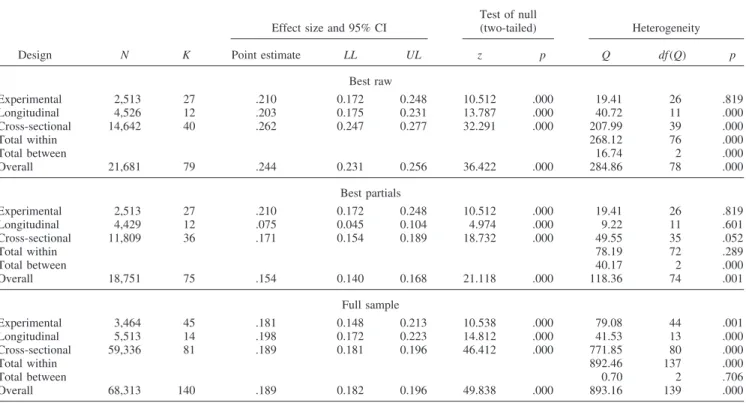
Main analyses. Table 4 presents the results of the main anal-yses on aggressive behavior for both the best raw and the best partials data.10Figure 1 illustrates several main points from these
analyses. First, regardless of research design and regardless of whether the standard zero-order correlation approach or the much more conservative partial correlation approach was used, VGV exposure was significantly related to higher levels of aggressive behavior. Most notably, in longitudinal studies even when sex and Time 1 aggressive behavior were controlled, amount of violent video game play at Time 1 significantly predicted an increase in aggressive behavior at Time 2.
Second, partialing out sex effects (in cross-sectional and tudinal studies) and Time 1 aggressive behavior effects (in longi-tudinal studies) greatly reduced the average effect size of VGV. Third, in the best partials data, experimental studies yielded the largest effects whereas longitudinal studies yielded the smallest effects. Fourth, ignoring research design led to very large hetero-geneity effects. Fifth, when research design, sex, and Time 1 effects were controlled, none of the heterogeneity effects were significant. In sum, this much larger meta-analysis, with over 70 independent effects involving over 18,000 participants from mul-tiple countries, ages, and culture types, yielded strong evidence that playing violent video games is a significant risk factor for both short-term and long-term increases in physically aggressive behav-ior.
Additional moderator tests— best partials data. We con-ducted additional moderator tests within each research design, even though the heterogeneity test results yielded little evidence that the studies within design type came from different popula-tions. There were two reasons for doing these additional tests. First, there are several specific comparisons that are of special interest for theoretical (e.g., culture), methodological (e.g., how to
measure VGV exposure), or public policy reasons (e.g., player perspective). Second, the heterogeneity tests are omnibus tests; it is possible that more focused tests will yield significant differ-ences.
Culture. The effect of culture (Eastern vs. Western) was not significant in any of the research designs. The average effect in experimental studies was slightly larger in Eastern than in Western studies but not significantly so,Q(1)⫽0.28,p⬎.50. In cross-sectional studies, the VGV effect was slightly larger in Western than in Eastern studies but not significantly so,Q(1)⫽1.08,p⬎ .20. In longitudinal studies the VGV effect size was somewhat larger in Western (r⫹ ⫽.126,K⫽5,N⫽1,037) than in Eastern studies (r⫹ ⫽.059,K⫽7,N⫽3,392). This effect was marginally significant,Q(1)⫽3.52,p⬍.07.
Sex. There was no evidence that the VGV effect on aggressive behavior differed for males and females (ps ⬎ .10). The VGV effect was slightly larger for females in experimental and longitu-dinal studies and was slightly larger for males in the cross-sectional studies, but none of these differences were significant.
Age. Average age of the participants was not significantly related to the VGV effect sizes in experimental or longitudinal studies (ps⬎.50). However, it is important to note that there were no longitudinal studies on participants older than 16. For cross-sectional studies there was a marginally significant effect of age (b⫽ ⫺.005,Z⫽ ⫺1.82,p⬍.07). Studies with older participants tended to yield slightly smaller effect sizes than did those with younger participants.
Moderators specific to experiments. Of the moderators spe-cific to experiments, the only one with at least a marginally significant effect was the CRT variable, Q(1)⫽ 2.90,p⬍ .09. Experimental studies that used some version of the CRT task (r⫹ ⫽.188,K⫽15,N⫽1,724) yielded slightly smaller effects than did those with some other measure of aggression (r⫹ ⫽.259, K⫽12,N⫽789). None of the other moderators associated with experimental design approached significance (i.e., player perspec-tive, player role, target type, time on game).
Moderators specific to nonexperimental studies. In the cross-sectional studies, one of the additional moderators was marginally significant. Studies with a pure physical aggression measure (r⫹ ⫽ .184,K ⫽ 28,N ⫽ 7,137) yielded slightly larger VGV effects than did studies that used some mixed aggression measure (r⫹ ⫽.153,K⫽8,N⫽4,672),Q(1)⫽2.82,p⬍.10. The method of measuring VGV exposure did not approach significance (p⬎ .20), but the average effect was slightly larger when VGV-specific measures were used than when VGV-general measures were used. The violence moderator (violent behavior vs. aggressive but not violent behavior) also did not approach significance (p⬎.30).
For longitudinal studies, the method of measuring violent video game exposure was significantly related to the magnitude of the effect size,Q(1)⫽6.81,p⬍.01. Studies that used VGV-specific type measures (r⫹ ⫽.152,K⫽4,N⫽902) yielded significantly larger VGV effects than did those that used VGV-general type measures (r⫹ ⫽ .055, K ⫽ 8, N ⫽ 3,527). However, this moderator was somewhat confounded with the East/West
mod-10For completeness, we also included results from the full sample, but