Looking for trouble: A multilevel analysis of disagreeable contacts in online social networks.
Sarah L. Buglass
Jens F. Binder
Lucy R. Betts
Jean D. M. Underwood
Nottingham Trent University, UK
POST PRINT
Corresponding author
Sarah Buglass
School of Social Sciences
Nottingham Trent University
Burton Street, NG1 4BU
Looking for trouble: A multilevel analysis of disagreeable contacts in online social networks.
Abstract
Identifying characteristics of troublemakers in online social networks, those contacts who violate norms via disagreeable or unsociable behaviour, is vital for supporting preventative strategies for undesirable, psychologically damaging online interactions. To date
characterising troublemakers has relied on self-reports focused on the network holder, largely overlooking the role of network friends. In the present study, information was obtained on 5113 network contacts from 52 UK-based Facebook users (age range 13 – 45; 75% female) using digitally derived data and in-depth network surveys. Participants rated their contacts in terms of online disagreement, relational closeness and interaction patterns. Characteristics of online troublemakers were explored using binary logistic multilevel analysis. Instances of online disagreement were most apparent in the networks of emerging adults (19 to 21 years). Contacts were more likely to be identified as online troublemakers if they were well
connected within the network. Rates of offline and Facebook exchanges interacted such that contacts known well offline but with low rates of Facebook communication were more likely to be identified as troublemakers. This may indicate that users were harbouring known troublemakers in a bid to preserve offline relationships and reputational status. Implications are discussed in terms of an individual’s susceptibility to undesirable encounters online.
Keywords: online vulnerability; online social networks; binary logistic multilevel analysis; network disagreement; online risk.
1. Introduction
Online social network sites (SNS; boyd & Ellison, 2008) are a ubiquitous presence in today’s digitally driven society. With 24/7 accessibility they provide multimedia rich environments in which individuals can connect, communicate, and share content within their social spheres. SNS provide a plethora of social and psychological benefits ranging from increases in social support and connectivity to increases in self-esteem (Burke & Kraut, 2014; Ellison, Steinfield & Lampe, 2007; Gonzales & Hancock, 2011). SNS, however, also harbour a dark side. Reports of an increasing number of associated risks and vulnerabilities, including incidents of data misuse, online harassment and exposure to inappropriate content (boyd & Ellison, 2008; Brandtzaeg, Luders & Skjetne, 2010; Kwan & Skoric, 2013; Lenhart, Madden, Smith, Purcell, Zickuhr & Rainie, 2011; Staksrud, Ólafsson & Livingstone, 2013), have the capacity to lead to impairments in a user’s psychological, reputational and/or physical wellbeing (Davidson & Martellozzo, 2012).
SNS, such as Facebook, offer guidance regarding what is deemed appropriate online behaviour and content (Facebook, 2016), violations of which can result in suspension from the network. However, what individual users deem to be acceptable differs not only from individual to individual, but also between networks (Fox & Moreland, 2015), making the identification of potential online victims and troublemakers fraught with complexity.
Attempts to identify the characteristics of likely online victims and troublemakers have been discussed extensively in the cyber-bullying and harassment literature (Kokkinos, Baltzidis &Xynogala, 2016; Pabian, De Backer & Vandebosch, 2015; Ybarra & Mitchell, 2004), but an over-reliance on self-report data has seen the role of ‘friends’ within these networks largely overlooked. In addition, self-reports on online relationships and friend networks inevitably raise the question of social desirability and impression management on the
side of users. Advances in digital data collection methods (Hogan, 2008; Rieder, 2013), have led to an increased interest from social and behavioural scientists in the structural and social characteristics of both the network holders and their connections, obtained directly from internet services. The present study examines how such characteristics provide a means of identifying individuals who are at risk and those connections who might provide this risk. To this end, we will present a multi-level approach that allows for the appropriate statistical modelling of such network data.
Our focus is on ‘friend’-based networks, i.e., on online connections that have been mutually agreed between two users. While there are numerous other instances of severe online disagreements and clashes between unknown parties, such as trolling (Coles & West, 2016), mutually agreed contacts are relevant for several reasons. They form networks that most users will feel are essential for their day-to-day socialising and therefore imply routine online connectivity. Such networks have been found to contain a wider variety of contacts, not all of which are well known to a user (Buglass, Binder, Betts & Underwood, 2016). As a consequence, the generation of disagreement has previously been identified as a side-effect of SNS use due to the collapse of established spatial and temporal boundaries (Binder, Howes, & Smart, 2012).
1.1 Online Vulnerability on ‘Friend’-based Networks
Online SNS provide a platform for users to create personal networks, in which the network holder (the ego) connects with other users (alters) via a process of online ‘friending’ (Arnaboldi, Guazzini & Passerella, 2013). Concerns have been raised about the detrimental impact of encountering online troublemakers on SNS (Debatin, Lovejoy, Horn, & Hughes, 2009). Online troublemakers, contacts who are involved in a range of social disturbances ranging from social blunders to damaging gossip, provide a source of tension that promotes
undesirable and potentially psychologically damaging online interactions (Binder et al., 2012; Debatin et al., 2009). Here we focus on identifying characteristics of online troublemakers and the networks on which they reside. Factors including SNS network size, ego and alter demographics, network popularity and communication rates are discussed.
For many users, SNS provide a means of maintaining pre-existing relationships (Ellison et al., 2007) with significant individuals, past and present. However, with the average network size now routinely numbering upwards of 155 (as a conservative estimate; see Best, Taylor, & Manktelow, 2015; Dunbar, 2016; Pew Research, 2014), these networks are increasingly being used to maintain relationships with a diverse array of individuals and even the loosest of social connections (Binder et al., 2012; Buglass et al., 2016).
Large, socially diverse networks increase the potential for experiencing online risk (Buglass et al., 2016), as the mingling of different social spheres presents the ego and their network connections with a melting pot of differing social norms and expectations which are ripe for violation (McLaughlin & Vitak, 2011; Vitak, 2012). In this context, appropriateness of comment and content can provide a source of online tension and disagreement (Fox & Moreland, 2015), which may ultimately impinge on the reputational and psychological wellbeing of the individuals in the network. We thus hypothesised that:
H1: Online troublemakers will be more prominent in larger online networks.
Some 13 – 15% of online users report being the target of negative behaviour (Lenhart et al., 2011). Reporting of these experiences is more prominent amongst females. A review study by Jones, Mitchell and Finkelhor (2013) found that the rate of females reporting online harassment had significantly increased, over that of reporting from males, in a ten year period. Furthermore, increased rates of reporting have also been observed amongst adolescents and young adults (Annenberg Public Policy Centre, 2010; Sengupta & Chaudhuri, 2011). In
contrast, studies offering demographics of troublemakers have indicated that males are marginally more likely to cause problems online than females (Aricak et al., 2008), especially during the transition from adolescence to adulthood (Annenberg Public Policy Centre, 2010).
The current study sought to explore demographic (age and gender) attributes of both alters and egos. On the basis of the above findings we predicted that:
H2: Egos reporting incidents of online trouble will likely be female and younger in age.
H3: Alters exhibiting troublesome behaviour will likely be male and younger in age.
The study also examined the degree to which potentially troublesome alters could be viewed as socially competent individuals. Whilst troublesome online behaviour might allude to social incompetency, a recent body of research has suggested that such individuals might in fact possess highly developed social skills that are being used to manipulate and control others (Arsenio & Lemerise, 2001; Volk et al., 2015), in a bid to increase their social connectivity (Postigo et al., 2012). This means that troublesome contacts may actually come across as highly popular, holding central places in an ego-network with numerous connections to others. We therefore predicted that:
H4: Online popularity will be positively associated with instances of negative online behaviour.
While demographic factors can provide an overview of the likely characteristics of an online troublemaker, consideration should also be given to the impact of behavioural characteristics in the form of communication patterns.
For an alter to be identified as a ‘troublemaker’ the ego needs to be aware of their online indiscretions. Both incidents directed at ego or witnessed by ego among alters carry the potential of destabilising the network and increase the demands on ego in terms of network
management (Binder et al., 2012). Openly noticeable behaviours, such as using social media to insult or threaten, or posting inappropriate materials (Vandebosch & Van Cleemput, 2009), are most obvious to the ego user if such incidents appear on their newsfeed or within private chat facilities. On sites such as Facebook, users only automatically see a small percentage (20%) of the posts that have been made by their contacts each day (Time Online, 2015). Complex algorithms are employed to determine newsfeed salience on behalf of the users, taking into account their personal preferences and rate of online interaction. Alters who do not engage with the ego on a regular basis are likely to lose newsfeed prominence, and therefore their indiscretions may go unnoticed. For this reason, it may be logical to assume that for an ego to readily witness, or indeed be targeted by, such incidents, they must engage in some degree of Facebook communication with the alters in question.
Conversely, should alters direct inappropriate behaviour towards a mutual ‘friend’ with whom the ego communicates online, interactions between the mutual friend and the troublesome alter may be visible via the ego’s newsfeed. Negative impressions of the alter will thus be formed without the need for direct online communication between the ego and troublesome alter. Infrequent online communication with troublesome alters would for many provide good grounds for ‘unfriending’. However, with studies suggesting that individuals who experience negative online behaviour know their perpetrators offline (Ybarra & Mitchell, 2004; Wolak et al., 2007), social norms and offline relationship preservation (Bevan, Pfyl & Barclay 2012; Bevan, Ang, & Fearns, 2014 ) might prevent egos from taking such direct action, instead resulting in online interactions with the alter being largely avoided. It was therefore expected that:
H5: Offline interactions will moderate the relationship between Facebook interactions and instances of online disagreement.
While communication patterns may affect the noticeability of disagreements, the degree of acquaintance between egos and alters has the potential to influence how the ego ultimately interprets alter behaviour on the network. When an alter is known to the ego user in both online and offline contexts, their online actions are more likely to be judged according to norms of behaviour relating to offline social boundaries. Expectancy Violations Theory (EVT; Burgoon, 1993; McGlaughlin & Vitak, 2011) postulates that individuals will react differently to unexpected norm violations by others depending on their relationship with those involved.
A US focus-group study by McGlaughlin and Vitak (2011), in which 26 participants discussed Facebook norms, indicated that negative behaviour attributed to significant connections routinely leads to direct confrontation amongst those involved in a bid to resolve conflict, preserve relationships and communicate the norm expectations of the network to the perpetrator(s). Norm violations by significant others are more salient to the ‘victim’ as the ‘troublemaker’ has crossed known and established relational boundaries. In contrast, negative
behaviour exhibited by looser connections, such as acquaintances, often goes unchallenged (Fox & Moreland, 2015). We therefore, hypothesis that:
H6: Increased instances of online disagreement will be attributed to significant known contacts.
2. Method
The aim of the study was to identify factors related to social network site users’ perceptions of disorderly behaviour online. Specifically, the research sought to investigate the potential impact that network size, ego-alter relationships, alter popularity and rate of communication might have on a SNS user’s appraisal of potentially problematic individuals on their network.
The ego and alter characteristics discussed represented the independent variables in the study, with perceived instances of disagreement representing the dependent variable.
2. 1 Sample
An alter-level sample of 5113 (53% female) Facebook alters were obtained from 52 UK-based Facebook users (M = 21 years 11 months, SD = 7 years 8 months, 75% female) using a combination of digitally derived data and in-depth surveys on a maximum of 100 alters per user. Almost all (97%) of the sampled alters had been given full profile access to their respective ego network, enabling them to see and interact with all of the content available. Egos reported a mean duration of Facebook membership of 5 years 7 months (SD = 2 years 1 month).
Sampling methods employed in this study endeavoured to limit the potential impact of relational overlap (Snijders et al., 1995) in the ego networks through the use of three UK-based ego populations stratified by age:
(1) Secondary school aged children (N = 10) between 13 and 17 years from a mixed
secondary academy in the East Midlands region of the UK. School and parental consent were obtained prior to the study.
(2) Undergraduate students (N = 27) from a large UK university. Participants responded to advertisements placed on student bulletin boards and also via a departmental participant pool. Research credits were awarded for participation in the study.
(3) Online adult users (N = 15) recruited via online advertisements. Permissions were gained from the administrators of the online message boards and communities prior to any
Eligibility for the study was based on the egos’ prior completion of an online social networking survey and submission of digital network data. Appropriate ethical procedures were observed for all three sub samples. In return for their time, all ego participants were eligible for entry into a prize draw to win online vouchers.
2.2 Procedure
Prior to the study participants provided their digitally derived network data via the completion of a fully integrated secure online survey (REFERENCE OMITTED FOR REVIEW). Network data were obtained using an embedded link to Netvizz (Rieder, 2013), an application that enabled
Facebook profile holders to download their network friendship lists and all interconnections via the Facebook API (application programmer interface). Network data files were then sent by individual users to the researchers. Files included unique identifiers, names and gender information for each connection on the network. In addition, information on links among all connections was provided. Data were collected before Netvizz changed its functionality following changes to the Facebook API in 2015.
In order to keep study duration and task complexity manageable, a random sample of Facebook alters (M = 98.44, SD = 21.07) from each digitally derived ego network was used to create ego-specific social network surveys. Additional network metrics (network size and alter degree) pertinent to each ego-network were calculated using NodeXL, a network analysis tool developed by the Social Network Research Group (Hansen, Shneiderman & Smith, 2011).
Surveys with school and undergraduate participants were conducted in the form of structured face-to-face interviews with the researcher. To maximise response rate, online
participants were permitted to complete the study using a secure online form. Common survey templates were used for all participants.
The term network disagreement was defined to participants as being indicative of “any instances of disagreeable or unsociable behaviour directed towards self or others on the
network”. This definition was read out loud to the participants prior to their engaging in the survey. For online participants, this definition was displayed on their computer-based survey form.
2.3 Measures
2.3.1 Dependent Variable
Self-reported perception of alter network disagreement: One item assessing rate of online disagreement exhibited by each alter (“How often does this person cause disagreement in your network with yourself or others?”). Responses were positively anchored and ranged from 1 (Never) to 5 (Very Often). Overall, a low rate of reported alter disagreement (M = 1.20, SD = .60) was found, with only 617 (12%) alters exhibiting any rate of disagreement. The purpose of the study was to determine characteristics of any troublesome individual, regardless of rate, therefore a recoded binary variable (coded as 0 for no instances of disagreement; 1 for disagreement scores of 2 or more) was deemed appropriate.
2.3.2 Alter Specific Independent Variables
Age: An estimation of alter age provided by the ego users. Coded as 0 for don’t know; 1 for under 16’s; 2 for older adolescents (16-18 years); 3 for emerging adults (18 – 21 years); and 4 for adults (over 22 years).
Alter Gender: A digitally derived indication of the Facebook friend’s gender (coded as 0 for unknown, 1 for male and 2 for female). The number of unknown gender alters represented
1% of the sample (33 alters), all of which were not identified as perpetrators of disagreement. In order to provide parity between the ego and alter demographic indicators, only alters identified as male or female were used in the analysis (N = 5080).
Network Privacy: ego-reported indication of individual alters’ profile access rights to the ego’s network (coded as 0 for filtered access to ego content, 1 for full unfiltered access to ego
content).
Ego-Alter Relationship: Participants were asked to identify the nature of their relationship with each identified Facebook ‘friend’ using 25 possible relationship types (e.g. ‘Parent’, ‘Child’, ‘Classmate’ – see Table 1 for full list of possible relationships). The categories were
adapted from common relationship categories previously attributed to ego-centric social network structures (Binder et al., 2012; McCarty et al., 2001). To simplify the analysis these relationship categories were regrouped into a three-level variable ‘Relationship Type’: present significant connections (coded as 0; e.g. parent, sibling); past significant connections (coded as 1; e.g. previous colleague, previous classmate); and loose connections (coded as 2; e.g. friend of friend, casual acquaintance).The definition of these levels was informed by previous distinctions of the types of social capital found on Facebook (Ellison et al., 2007).
Frequency of communication, offline and online: Two items addressed the rate of offline (M = 1.77, SD = 1.07) and Facebook communication (M = 1.70, SD = .94) between the ego and alter. Responses to each item were positively anchored and ranged from 1 (Never) to 5 (Daily).
Closeness: One item measuring the perceived closeness (M = 2.16, SD = .99) between the ego and the Facebook ‘friend’. Responses to each item were positively anchored and ranged from 1 (Not at all close) to 5 (Very close).
Alter Popularity. Digitally derived from alter degree, a measure of mutual connectivity between alters, it provides an estimate of the social popularity of an individual Facebook friend on the network. To counter the effect of differing ego network sizes, each alter degree was transformed into a percentage proportion of popularity in terms of the respective ego network (M = 14.85, SD = 15.54).
2.3.3 Ego Specific Independent Variables
Ego Demographics: Self-reported items addressing age (in years); gender (coded as 0 for male, 1 for female).
Following data collection, ego age was coded into a new variable ‘Ego Age Group’ (coded as 0 for under 16; 1 for older adolescent (16 – 18 years); 2 for emerging adult (19 – 21 years) and 3 for adult (22 years +). The categorised variable better reflected the sampling methods employed by the study and increased consistency with the alter-level information.
Ego Network Size. An estimate of digitally derived network size was gained by summing the total number of network contacts listed in the digitally derived data. Ego network sizes ranged from 4 to 1371 (M = 475.27, SD = 353.15). As with other digitally derived network datasets (Brooks, Hogan, Ellison, Lampe, & Vitak, 2014; Buglass et al., 2016), network size was positively skewed. In order to reduce the impact of this on the data analysis, network size was recoded into three groups. Grouping was based on the median and quartiles, such that networks with less than 227 connections were categorised as “Low Network Size”, networks with between 227 and 633 connections were categorised as “Medium Network Size” and networks with more than 633 connections, “High Network Size”.
2.4 Data Analysis
The hierarchical structure of the data (5113 alters in 52 ego networks) lent itself to multilevel modelling. For this analysis two-level binary logit models were used. Analysis of the dataset was conducted using MLWin V2.33 (Browne, Goldstein, Yang, Plewis, Healy et al., 2000) and the MCMC estimation method with chain length of 15000 iterations to increase the robustness of the estimations (Browne & Rasbash, 2009). All continuous variables included in the analysis were grand mean centred in order to maximise model stability (Kreft and deLeeuw, 1998).
In standard multilevel linear regression, comparison between different models can be made through the consideration of variance components. However, in logit-based multilevel logistic regression, such as those discussed here, these comparisons are rendered
inappropriate due to a rescaling of the model coefficients and variance components (Hox, 2010; p. 134). Pseudo R2 statistics can be used as a possible means of comparing the substantive worth of the models. However, they are prone to underestimation and unlike traditional measures of R2 do not provide a means of adequately assessing the variance explained (Hox, 2010; p.135). In this analysis, comparisons between the models were made using the Cox and Snell R2 with Nagelkerke (1991) adjustment (to correct the upper bound
limit to 1), with higher R2values indicating a more preferable model. In addition, a further mode of comparison, the DIC (Deviance Information Criterion), a goodness of fit statistic (Browne & Rasbash, 2009), was calculated for each model. Decreases in DIC values between models of more than 5 points indicate a better model fit to the data (MRC, 2015).
Random intercept models tested disagreement as the dependent variable, alter data (age group; gender; relationship type; Facebook communication; offline communication; closeness and popularity) as level 1 variables and ego data (age group; gender and network
size) as level 2 variables. A level 2 interaction term between offline communication and Facebook communication was also tested, in line with our hypotheses.
3. Results
3.1 Preliminary Analysis
Descriptive statistics and bivariate correlations for the main study variables are provided in Table 1. Older adolescents and emerging adults were the most prominent age groups in both the ego (M = 1.73, SD = 1.06) and alter (M = 2.71, SD = 1.25) samples. Age groups of both samples were highly correlated (r = .65, p < .001), indicating that egos tended to hold
networks of similarly aged alters. Ego age was negatively correlated with ego network size (r = -.10, p < .001), suggesting that network size was lower amongst the older egos.
In terms of ego to alter relationships (M = 2.03, SD = .81) the alter sample was distributed quite evenly, approximately a third of all alters being attributed to each category (loose, significant past, significant present). The network popularity of the alters ranged from 0 (network isolate) to 86.78%, with a mean of 14.85% (SD = 15.54%). This indicated that the average Facebook ‘friend’ was connected to approximately 15% of all of the alters on their respective ego network.
Rate of ego-alter communication was generally low for both Facebook (M = 1.70, SD = .94) and offline communication (M = 1.77, SD = 1.07). Frequency data for both forms of ego-alter communication indicated that approximately 80% of the Facebook ‘friends’ had little or no communication with their respective egos. Perceived closeness to the alters was also generally low (M = 2.16, SD = .99), with 72% of the Facebook ‘friends’ being rated as not being close to their respective egos.
3.1.1 Descriptive overview of network troublemakers
The mean level of identified network disagreement across the alter sample was low (M = .12, SD = .33), with only 617 (12%) of the alters identified as network troublemakers. Whilst this is a low proportion of the sample, it is sufficient for a characterisation of troublemakers, the core aim of the present work. Further, it was not an unexpected finding, as for selective online ‘friend’ based networks to remain a popular pastime, they would not routinely be expected to harbour large numbers of troublesome individuals. Of the 617 troublesome contacts, 345 were rated as 2, 187 as 3, 56 as 4, and 29 as 5 (equivalent to “very often” disagreeable) on the initial response scale. Further descriptive statistics and correlations are provided in Table 2.
Due to the large sample size at the level of alters (df = 5078) only bivariate
correlations at p < .01 are highlighted in our analyses. Perception of alter disagreement was significantly correlated with ego age group (r = -.10, p < .001), network size (r = .13, p < .001), alter age group (r = -.04, p < .001), alter-to-ego offline communication (r = .06, p < .001) and alter network popularity (r = .11, p < .001). In terms of the egos, this provided some support for the hypotheses (H1 and H2) stating that increased identification of disagreement was associated with younger egos and egos with larger networks. For alters, consistent with hypothesised predictions (H3, H4 and H6), increases in being identified as a troublesome connection were associated with alters that were in the younger or unknown age categories, in offline contact with the ego and/or relatively popular on the ego network.
A detailed overview of the alter characteristics of the 617 network ‘troublemakers’ can be found in Table 3. Identified in 371 of the 52 ego networks (9 male, 28 female), only 4% of the 617 (309 male, 308 female) disagreeable alters (N = 26) were from adult ego networks, the vast majority (80%) of disagreement being identified in networks of emerging
adult egos (N = 493). The majority (73.4%) of the troublemakers identified were between the ages of 16 and 21 years of age, supporting H3. Disagreeable alters ranged in network
popularity, in terms of the respective ego networks, from 0 to 67.87%. The mean ‘friend’ popularity was 19.51% (SD = 15.77%), this was indicative of an average disagreeable ‘friend’ being connected to approximately one fifth of network connections on a network.
Interestingly, this was higher than the mean popularity of the non-disagreeable ‘friends’ which was 14.21% (SD = 15.40%), and thus lends support to H4.
The proportion of disagreeable nodes in larger networks was 26.4%, compared to approximately 10% of nodes in networks of medium and low sizes. In line with H1, a z-score comparison indicated that higher networks harboured a significantly higher proportion of disagreeable nodes than both medium (z = 9.76, p < .05) and low sized networks (z = 12.31, p < .05). Seventy-three percent of the disagreeable alters had a significant connection (either past or present) with the egos. A comparison of z-scores indicated that overall the proportion of significant past disagreeable connections was higher than disagreeable loose connections (z = 2.58, p < .05). This provided some support for H6 when the data were considered over a single level of analysis. In addition, communication with disagreeable ‘friends’ was low both on Facebook (M = 1.75, SD = .95) and offline (M = 1.95, SD = 1.13), with approximately 67% of the disagreeable ‘friends’ rated as being not close to their respective egos.
3.2 Multilevel Analyses
Results from the binary logistic random intercept multilevel models are presented in Table 4. Models illustrate the role of all tested predictors, irrespective of significance. An initial comparison of the DIC scores between a two-level null model and a single level model of the dataset indicated that the two-level model (DIC = 306.46) provided a substantially better fit than the single-level model (DIC = 3767.91). Additionally, significant between-ego variance
(σ2
u0= 3.25, SE = .74, p < .001) indicated that the occurrence of network disagreement varied significantly between egos. A VPC (variance partition coefficient) of .49, calculated using the approach by Snijders and Bosker (1999; see also Goldstein, Browne & Rasbash, 2002)
indicated that both ego and alter levels played an equal role in predicting online disagreement. This combined evidence suggested that the 2-level model was a more appropriate fit for the data and provided good grounds for further multilevel investigation.
3.2.1 Modelling Alter Characteristics
The next phase in modelling built on the null model with the inclusion of all alter level variables (Model 2) and an interaction term between alter level offline communication and Facebook communication (Model 3). Between ego variance remained significant for both models (Model 2 σ2u0 = 5.79, SE = 1.80, p < .001; Model 3 σ2u0 = 5.86, SE = 1.79, p < .001). In both models the DIC statistic was substantially lower than the null model, inferring that the inclusion of alter-level variables provided a better model fit. The inclusion of the
significant interaction term in model 3, along with the subsequent reduction in DIC points by 31.11, rendered the model preferable to model 2 despite there only being a marginal increase in the R2 statistic.
3.2.2 Modelling Ego Characteristics
The final model contained all of the main study variables (alter level and ego level). Between-ego variance remained significant (β = 3.81, SE = 1.28, p < .001), but the
coefficient was markedly lower. The DIC statistic was 4.47 points lower than the DIC for the null model and the R2 value remained constant. Ideally DIC differences of above 5 points are preferable in terms of steering model selection (MRC, 2015). However, it should be noted that on this occasion the level 2 variables inlcude a number of significant ego characteristics
of practical and theoretical importance. It is for this reason that model 4 was selected for further inspection and analysis.
3.2.3 Final Model Outcomes
At the ego level, females were 4.02 times as likely to identify an alter as causing disagreement than males. Significant differences were also found in terms of ego age.
Emerging adult egos (aged 19 – 21) were significantly more likely to report disagreement on their networks than both adolescent and adult egos (p < .001). While the results for gender are fully in line with H2, this hypothesis also postulated that younger egos would be more likely to experience disagreement, which is only partially supported by the results for age. In contrast, H1 was not supported by the multi-level analyses since ego network size was not a significant indicator of online disagreement.
At the alter level, females were .81 times as likely to be disagreeable that male alters. This can be interpreted as females being 19% less likely to be identified as a troublemaker than male alters. All known age groups of Facebook ‘friends’ were significantly more likely to be identified as disagreeable than contacts whose age was unknown to the ego. This ranged from 3.18 times as likely for older adolescent alters to 4.51 times as likely for adult alters. No significant differences were found between the known age groups in terms of their propensity for disagreement (p > .05). H3 was therefore only partially supported by the multi-level model. Consistent with H4, alter network popularity was identified as a significant predictor of alter disagreement, with a 1% increase in alter network popularity signifying a 3% increase in the likelihood of the alter being disagreeable.
In terms of perceived communication between the ego and alters, offline
communication was the only significant predictor across all models. In all models, consistent with H6, increases in the rate of offline communication between ego and alter indicated that
the alter was more likely to be identified as disagreeable. Importantly, H5 postulated that offline communication would act as a moderator for the relationship between online
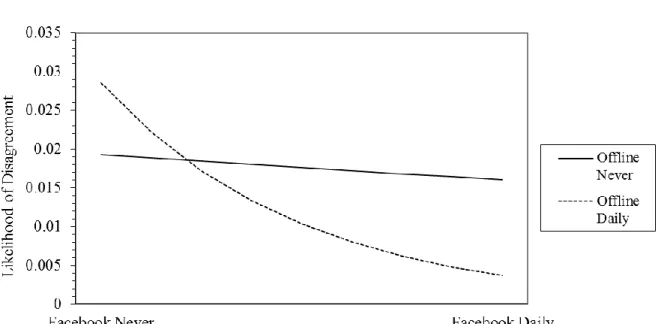
interactions and disagreements. In support of H5, a significant negative interaction between offline communication and Facebook communication (β = -.25, SE = .04, p < .001) was found for the multi-level models, while Facebook communication was consistently non-significant (p > .05). To explore this interaction further, a logistic simple slope analysis was carried out. The likelihood of disagreement was plotted against the rate of online
communication for two different settings of offline communication rates (“daily” or “never”), which resulted in the illustration provided in Figure 1. For alters who communicated
infrequently with the egos offline, the likelihood of them causing disagreement was unrelated to their rate of Facebook communication. In contrast, for high frequencies of offline
communication, disagreement was more likely in case of infrequent Facebook communication compared to frequent communication.
4. Discussion
The present study explored the influence of socio-demographic factors, communication patterns and structural network characteristics on sources of disagreement within an online network. Considering both ego level and alter level variables, including network metrics, the results offer a comprehensive multilevel perspective on the characteristics of troublesome networks. The main findings can be summarised in brief as follows. First, the network size hypothesis (H1) was partially supported. While network size was not a significant multilevel indicator of network disagreement, a significantly higher distribution of disagreeable nodes was evident in larger networks across the ego sample. Second, consistent with the ego demographics hypothesis (H2), younger female egos were more likely to report troublesome
network alters. Further, partial support was found for alter demographics (H3 and H4) with popular, male alters being more likely to be identified as troublesome. Marked differences between known alter age-groups were not evident, although actually knowing an alter’s age did statistically increase the likelihood of an alter being identified as troublesome. This suggests that when an alter is more salient to an ego their indiscretions may be more apparent. Thirdly, a significant interaction between Facebook communication and offline communication (H5) suggested that alters exhibiting low Facebook communication and frequent offline communication were statistically more likely to be troublesome on a network. Finally, a combination of offline communication patterns and frequency of
relationship types provided support for H6, with known offline contacts presenting a greater likelihood of disagreeable behaviour.
The influence of ego network size (H1) rendered mixed results. Larger networks exhibited a significantly higher proportion of troublesome alters, with correlational data supporting the notion that increases in network size were indicative of increased reports of trouble. Theories derived from literature on social spheres postulate that larger networks harbour contacts from a wide range of heterogeneous social spheres (Buglass et al., 2016), rendering it more difficult for ego and alters to moderate their communication and content to suit all audiences (Fox & Moreland, 2015). In this context the visibility of interactions facilitates heightened awareness of tension-inducing social faux-pas by alters and egos alike (Binder et al., 2012).
The non-significant multilevel influence of ego network size on disagreement was unexpected, but may indicate, as in previous work, the secondary importance of network size once more information on network structure and composition is considered (Buglass et al., 2016). From a statistical perspective, the categorical interpretation of ego-network size in
size and stability (Snijders, 2005). The mixed results offered by ego network size indicate that further research is required.
In line with previous studies, female ego’s in non-adult age groups tended to be more prone to report instances of online disagreement (H2). This would suggest that younger females might experience more negative experiences online. Prior research, however, has been quick to demote any theories pointing towards females being a victimised gender, instead suggesting that increases in negative experiences are in part due to younger females being relationally more active online and therefore more likely to experience such instances due to statistical frequency (Pujazon-Zazik & Park, 2010). Further, in line with our findings, experiencing online tensions has previously been linked to transitional ages between
adolescence and adulthood, an age when relationships, both online and offline, become more sophisticated and complex (Patchin & Hinduja, 2008).
As predicted, male alters were more likely to be identified as network troublemakers (H3). Whilst there is marginal support for this finding in previous reports of online behaviour (Annenburg Public Policy Center, 2010), research into offline behaviours has postulated that troublesome males often partake in more direct forms of disagreement, with females adopting more indirect and potentially less visible means (Wyckoff & Kirkpatrick, 2016). Tension and disagreement caused by male alters might therefore be more noticeable to ego users and therefore reported more frequently. This however, raises questions over whether female alters are less likely to cause trouble, or whether they merely adopt different behaviours in order for their indiscretions to go undetected.
Increased popularity was also found to play a significant role in determining whether an individual alter was reported as a troublemaker (H4). Complementing research which has suggested that troublemakers tend to be highly connected individuals with well-honed social
skills (Arsenio and Lemerise, 2001; Volk et al., 2015), this indicates that online
troublemakers have a greater degree of mutual connections in the ego’s network. It is likely that remaining ‘friends’ with such a popular troublemaker might be due to social necessity. Being seen to exclude a popular social figure, regardless of their online behaviour, could have a detrimental impact on an ego’s social reputation (Bevan et al., 2012; The Telegraph, 2015). From a structural point, the removal of a popular, central figure would alter network characteristics more substantially than the removal of a peripheral contact. Such changes in network structure are likely to have other negative psychological consequences, such as a weakened, less dense interaction pattern, and are therefore best avoided by users.
Next to structural and demographic characteristics, several findings emerged for communication patterns between ego and alters. Rate of Facebook communication on its own was not a significant indicator of network disagreement. Egos ‘friend’ alters for a variety of reasons, including active relationship maintenance, passive observation (nosiness) and social necessity. The degree to which an ego communicates online with an alter will therefore not necessarily reflect the alter’s online behaviour. The significant interaction between Facebook communication and offline communication supported this argument (H5). Alters who were known and in frequent offline contact with ego were more likely to be identified as
troublesome on a network when communication on Facebook was low. Complementing the role found for network popularity, this suggests that egos may have known and socially significant individuals residing on their online networks who they find digitally unappealing, yet cannot afford to disconnect from. It may be that in some instances these are genuine friends of ego that do not possess the necessary digital interaction skills, but merit an online presence due to emotional attachment to ego. We find it more plausible, however, that the rate of offline interaction is not brought about by friendship, but dependent on routine daily
interaction (as in the case of work colleagues or study group members) or interaction caused by third parties (as in the case of a friend’s friend or a relative’s partner).
Next to popularity and interaction patterns, further support for the overall relevance of troublesome alters came from the fact that a large and significant proportion of problematic alters were categorised as possessing meaningful relational links to the ego. Conducive with expectations derived from norm violations theory (McLaughlin & Vitak, 2012), it is quite possible that indiscretions by such individuals might be more noticeable due to their flagrant disregard for known and established offline social boundaries. However, this notion was not further supported by the inclusion of relationship type in the multilevel models. The mixed results suggest that further detailed research is required, for example to determine whether alters from specific social spheres might be more problematic than others.
A few caveats should be raised regarding our findings. First of all, as with many nested data structures, the degrees of freedom were substantially different for ego and alter levels, and significant correlations were obtained at the alter level, even where these
coefficients were small in size. As such, we would caution against an over-interpretation of correlations and give more weight to the regression outcomes since the logistic multi-level modelling allowed for more stringent hypothesis testing. At the same time, in light of the overall variance explained, we see good potential to improve the diagnostic value of our models by including more factors on network structure and composition.
In terms of ego sample size, while the networks allowed for a comparison across age groups and were drawn from panels characteristic of UK online user communities, a modest 52 networks cannot represent the enormously large and diverse user population as such. Further, low rates of disagreement reported by the sample, while complementing prior
necessarily reflect the behavioural intricacies of the networks in question. The use of digitally derived characteristics may have enabled us to gain an accurate overview of the size,
diversity and relational structures present on the networks, however, the behavioural outcomes have relied on participant self-report. As such, what constitutes disagreeable or disturbing behaviour for one user will not necessarily be consistent across the ego sample. With this in mind further large scale, in-depth analysis is recommended with a representative ego sample. This would provide a sufficient number of troublesome contacts to analyse particular disagreeable behaviours separately and to shed further light on how specific user characteristics, such as gender differences, both on the side of ego and alter, might impact the interpretation of incidents and sanctions used (e.g. unfriending) on online networks. Further, content analyses, automated or non-automated, of disagreeable profile elements and online exchanges can serve to improve the overall accuracy and predictive power of any procedure used to identify troublemakers.
To conclude, this present study provides significant multilevel support for the association between sociodemographic factors, communication patterns and structural network characteristics on one side, and troublesome contacts in online networks on the other. These findings increase our understanding of the types of individuals that might be more likely to become involved with or perpetrate, or indeed report, trouble on a network. Social disagreement online can, at best, make the use of social network sites less enjoyable and, in more extreme cases, lead to detrimental psychological consequences for both egos and alters. Our findings therefore also carry implications for online interventions, either as part of SNS design and development or in the form of information campaigns targeting specific users. One decisive advantage of including structural network information lies in the potential for automated, large-scale diagnosis. To the extent that the present analyses can be refined, it may be possible to quantify propensities to experiencing disagreement for each
SNS user. Using available digital data for automated assessment of individual user characteristics is becoming more widespread in the areas of expert knowledge and professional skills (Álvarez-Rodríguez, Colomo-Palacios, & Stantchev, 2015; Stantchev, Prieto-González, & Tamm, 2015). This could feed into support tools available to users suffering from online turbulence. Whether the aim is to change the architecture of an SNS platform, to implement additional apps or to provide communication to specific, potentially vulnerable users, our findings help to build a perspective on how this can possibly be done.
Footnotes
1 Multilevel analyses on the 37 networks reporting instances of online trouble were run as a
comparison to the full 52 network sample. Comparable findings across all models emerged. This provided support for the use of the full data sample in the models.
References
Álvarez-Rodríguez, J. M., Colomo-Palacios, R., & Stantchev, V. (2015). Skillrank: towards a hybrid method to assess quality and confidence of professional skills in social
networks. Scientific Programming, 2015, 3. doi: 10.1155/2015/451476.
Annenberg Public Policy Center (2010) “Adolescent and young adult victims of cyber-bullying at increased risk of suicide” Available at:
http://www.annenbergpublicpolicycenter.org/adolescent-and-young-adult-victims-of-cyberbullying-at-increased-risk-of-suicide-female-youth-especially-at-risk Accessed on: 18/01/2016
Aricak, T., Siyahhan, S., Uzunhasanoglu, A., Saribeyoglu, S., Ciplak, S., Yilmaz, N., & Memmedov, C. (2008). Cyberbullying among Turkish adolescents. CyberPsychology & Behavior, 11(3), 253-261. doi: 10.1089/cpb.2007.0016
Arnaboldi, V., Guazzini, A., & Passarella, A. (2013). Egocentric online social networks: Analysis of key features and prediction of tie strength in Facebook. Computer Communications, 36(10), 1130-1144. doi:10.1016/j.comcom.2013.03.003.
Arsenio, W. F., & Lemerise, E. A. (2001). Varieties of childhood bullying: Values, emotion processes, and social competence. Social Development, 10(1), 59-73. doi:
10.1111/1467-9507.00148
Best, P., Taylor, B., & Manktelow, R. (2015). I’ve 500 friends, but who are my mates? Investigating the influence of online friend networks on adolescent wellbeing. Journal of Public Mental Health, 14(3), 135-148. doi: 10.1108/JPMH-05-2014-0022.
Bevan, J. L., Pfyl, J., & Barclay, B. (2012). Negative emotional and cognitive responses to being unfriended on Facebook: An exploratory study. Computers in Human Behavior, 28(4), 1458-1464. doi:10.1016/j.chb.2012.03.008
Bevan, J. L., Ang, P. C., & Fearns, J. B. (2014). Being unfriended on Facebook: An
application of expectancy violation theory. Computers in Human Behavior, 33, 171-178. doi:10.1016/j.chb.2014.01.029
Binder, J. F., Howes, A., & Smart, D. (2012). Harmony and tension on social network sites: Side-effects of increasing online interconnectivity. Information, Communication & Society, 15(9), 1279-1297. doi: 10.1080/1369118x.2011.648949.
boyd, D., & Ellison, N. B. (2008). Social network sites: Definition, history, and scholarship. Journal of Computer-Mediated Communication, 13(1), 210-230. doi: 10.1111/j.1083-6101.2007.00393.x.
Brandtzæg, P. B., Lüders, M., & Skjetne, J. H. (2010). Too many Facebook “friends”? Content sharing and sociability versus the need for privacy in social network sites. Intl. Journal of Human–Computer Interaction, 26(11-12), 1006-1030. doi:
10.1080/10447318.2010.516719
Brooks, B., Hogan, B., Ellison, N., Lampe, C., & Vitak, J. (2014). Assessing structural correlates to social capital in Facebook ego networks. Social Networks, 38, 1-15. doi: 10.1016/j.socnet.2014.01.002
Browne, W., Goldstein, H., Yang, M., Plewis, I., Healy, M., Woodhouse, G., ... & Lewis, T. (2000). A user's guide to MLwiN. Centre of Multilevel Modelling, University of Bristol.
Browne, W. J., & Rasbash, J. (2009). MCMC estimation in MLwiN. Centre of Multilevel Modelling, University of Bristol.
Buglass, S. L., Binder, J. F., Betts, L. R., & Underwood, J. D. (2016). When ‘friends’ collide: Social heterogeneity and user vulnerability on social network sites. Computers in Human Behavior, 54, 62-72. doi:10.1016/j.chb.2015.07.039.
Burgoon, J. K. (1993). Interpersonal expectations, expectancy violations, and emotional communication. Journal of Language and Social Psychology, 12(1-2), 30-48. doi: 10.1177/0261927X93121003.
Burke, M., & Kraut, R. E. (2014, April). Growing closer on Facebook: changes in tie strength through social network site use. In Proceedings of the 32nd annual ACM Conference on Human Factors in Computing Systems (pp. 4187-4196). ACM. doi:
10.1145/2556288.2557094.
Coles, B. A., & West, M. (2016). Trolling the trolls: Online forum users constructions of the nature and properties of trolling. Computers in Human Behavior, 60, 233-244. doi: 10.1016/j.chb.2016.02.070.
Davidson, J., & Martellozzo, E. (2013). Exploring young people's use of social networking sites and digital media in the internet safety context: A comparison of the UK and Bahrain. Information, Communication & Society, 16(9), 1456-1476. doi:
10.1080/1369118X.2012.701655.
Debatin, B., Lovejoy, J. P., Horn, A. K., & Hughes, B. N. (2009). Facebook and online
privacy: Attitudes, behaviors, and unintended consequences. Journal of Computer‐ Mediated Communication, 15(1), 83-108. doi: 10.1111/j.1083-6101.2009.01494.x
Dunbar, R. I. M. (2016) Do online social media cut through the constraints that limit the size of offline social networks? R. Soc.opensci.3:150292. doi: 10.1098/rsos.150292
Ellison, N. B., Steinfield, C., & Lampe, C. (2007). The benefits of Facebook “friends:” Social capital and college students’ use of online social network sites. Journal of
Computer‐Mediated Communication, 12(4), 1143-1168. doi: 10.1111/j.1083-6101.2007.00367.x
Facebook (2016) “Facebook Community Standards” Available at:
https://www.facebook.com/communitystandards/ Accessed on 8/01/2016
Fox, J., & Moreland, J. J. (2015). The dark side of social networking sites: An exploration of the relational and psychological stressors associated with Facebook use and
affordances. Computers in Human Behavior, 45, 168-176. doi:10.1016/j.chb.2014.11.083.
Goldstein, H., Browne, W., & Rasbash, J. (2002). Partitioning variation in multilevel models. Understanding Statistics: Statistical Issues in Psychology, Education, and the Social Sciences, 1(4), 223-231.
Gonzales, A. L., & Hancock, J. T. (2011). Mirror, mirror on my Facebook wall: Effects of exposure to Facebook on self-esteem. Cyberpsychology, Behavior, and Social Networking, 14(1-2), 79-83. doi: 10.1089/cyber.2009.0411
Hansen, D. L., Shneiderman, B., & Smith, M. A. (2011). Social Network Analysis. Analyzing Social Media Networks with NodeXL, 31–50. doi:10.1016/b978-0-12-382229-1.00003-5
Hogan, B. (2008). Analysing Social Networks via the Internet. In: N. Fielding, R. Lee and G. Blank (eds) The Handbook of Online Research Methods. Thousand Oaks, CA: Sage. doi: 10.4135/9780857020055.n8.
Hox, J. (2010). Multilevel analysis: Techniques and applications. Routledge.
Jones, L. M., Mitchell, K. J., & Finkelhor, D. (2013). Online harassment in context: Trends from three Youth Internet Safety Surveys (2000, 2005, 2010). Psychology of Violence, 3(1), 53. doi: 10.1037/a0030309
Kokkinos, C. M., Baltzidis, E., & Xynogala, D. (2016). Prevalence and personality correlates of Facebook bullying among university undergraduates. Computers in Human
Behavior, 55, 840-850. doi:10.1016/j.chb.2015.10.017
Kreft, I. G. G., & De Leeuw, J. (1998). Introducing multilevel modeling. Thousand Oaks, CA: Sage.
Kwan, G. C. E., & Skoric, M. M. (2013). Facebook bullying: An extension of battles in school. Computers in Human Behavior, 29(1), 16-25. doi:10.1016/j.chb.2012.07.014.
Lenhart, A., Madden, M., Smith, A., Purcell, K., Zickuhr, K., & Rainie, L. (2011). Teens, Kindness and Cruelty on Social Network Sites: How American Teens Navigate the New World of" Digital Citizenship". Pew Internet & American Life Project.
McLaughlin, C., & Vitak, J. (2012). Norm evolution and violation on Facebook. New Media & Society, 14(2), 299-315. doi: 10.1177/1461444811412712.
MRC (2015) “DIC: Deviance Information Criterion” Available at: http://www.mrc-bsu.cam.ac.uk/software/bugs/the-bugs-project-dic/ Accessed on 18/12/2015
Pabian, S., De Backer, C. J., & Vandebosch, H. (2015). Dark Triad personality traits and adolescent cyber-aggression. Personality and Individual Differences, 75, 41-46. doi:10.1016/j.paid.2014.11.015.
Hinduja, S., & Patchin, J. W. (2008). Cyberbullying: An exploratory analysis of factors related to offending and victimization. Deviant Behaviour, 29(2), 129-156. doi: 10.1080/01639620701457816
McCarty, C., Killworth, P.D., Bernard, H.R., Johnsen, E.C., Shelley, G.A. (2001).
Comparing two methods for estimating network size. Human Organization, 60, 28– 39.
Pew Research (2014) “Six new facts about Facebook” Available at:
http://www.pewresearch.org/fact-tank/2014/02/03/6-new-facts-about-facebook/ Accessed: 18/03/2015
Postigo, S., González, R., Mateu, C., & Montoya, I. (2012). Predicting bullying:
maladjustment, social skills and popularity. Educational Psychology, 32(5), 627-639. doi: 10.1080/01443410.2012.680881
Pujazon-Zazik, M., & Park, M. J. (2010). To tweet, or not to tweet: gender differences and potential positive and negative health outcomes of adolescents’ social internet
use. American journal of men's health, 4(1), 77-85. doi: 10.1177/1557988309360819
Rieder, B. (2013). Studying facebook via data extraction: The netvizz application. Proceedings of the 5th Annual ACM Web Science Conference, 346-355. doi: 10.1145/2464464.2464475
Sengupta, A., & Chaudhuri, A. (2011). Are social networking sites a source of online harassment for teens? Evidence from survey data. Children and Youth Services Review, 33(2), 284-290. doi: 10.1016/j.childyouth.2010.09.011
Snijders, T., Spreen, M., & Zwaagstra, R. (1995). The use of multilevel modeling for analysing personal networks: Networks of cocaine users in an urban area. Journal of quantitative anthropology, 5(2), 85-105. doi:
Snijders, T. A. (2005). Power and sample size in multilevel linear models. In: B.S. Everitt and D.C. Howell (eds.), Encyclopaedia of Statistics in Behavioural Science. Volume 3, 1570–1573. Chichester: Wiley.
Staksrud, E., Ólafsson, K., & Livingstone, S. (2013). Does the use of social networking sites increase children’s risk of harm? Computers in Human Behavior, 29(1), 40-50. doi: 10.1016/j.chb.2012.05.026
Stantchev, V., Prieto-González, L., & Tamm, G. (2015). Cloud computing service for knowledge assessment and studies recommendation in crowdsourcing and
collaborative learning environments based on social network analysis. Computers in Human Behavior, 51, 762-770. doi: 10.1016/j.chb.2014.11.092.
The Telegraph (2015) “Facebook 'unfriending' can constitute workplace bullying, Australian tribunal finds” Available at:
http://www.telegraph.co.uk/news/worldnews/australiaandthepacific/australia/1189027 5/Facebook-unfriending-can-constitute-workplace-bullying-Australian-tribunal-finds.html Accessed: 18/01/2016
Time Online (2015) “Here’s How Facebook’s News Feed Actually Works” Available at: http://time.com/3950525/facebook-news-feed-algorithm/ Accessed: 18/12/2015
Vandebosch, H., & Van Cleemput, K. (2009). Cyberbullying among youngsters: Profiles of bullies and victims. New media & society, 11(8), 1349-1371. doi:
10.1177/1461444809341263
Volk, A. A., Dane, A. V., Marini, Z. A., & Vaillancourt, T. (2015). Adolescent Bullying, Dating, and Mating Testing an Evolutionary Hypothesis. Evolutionary Psychology, 13(4). doi: 10.1177/1474704915613909.
Wolak, J., Mitchell, K. J., & Finkelhor, D. (2007). Does online harassment constitute bullying? An exploration of online harassment by known peers and online-only contacts. Journal of adolescent health, 41(6), S51-S58. doi:
10.1016/j.jadohealth.2007.08.019
Wyckoff, J. P., & Kirkpatrick, L. A. (2016). Direct and indirect aggression tactics as a function of domain-specific self-esteem. Personality and Individual Differences, 92, 135-142. doi:10.1016/j.paid.2015.12.038
Ybarra, M. L., & Mitchell, K. J. (2004). Online aggressor/targets, aggressors, and targets: A comparison of associated youth characteristics. Journal of child Psychology and
Table 1: Frequency data for ego-alter relationship types (N = 5113) Alter Frequency (% Total
N)
Disagreeable Alters (% Total Alter Frequency)
Present Significant Connection 1745 (34.0) 212 (12.1)
Parent 20 (<1.0) 2 (10.0) Child 0 (0.0) 0 (0) Spouse/Partner 4 (<.1.0) 0 (0) Sibling 18 (<.1.0) 2 (11.1) Grandparent 2 (<1.0) 0 (0) Other Family 175 (3.0) 22 (12.6) Best Friend 90 (2.0) 18 (20.0) Friend 788 (15.0) 88 (11.2) Teacher (Present) 14 (<1.0) 1 (7.0) Classmate (Present) 269 (5.0) 34 (12.6) Co-worker (Present) 110 (2.0) 16 (14.5) Neighbour 25 (<1.0) 8 (32.0)
Interest Group Member 221 (4.0) 21 (9.5)
Past Significant Connection 1769 (35) 237 (13.3%) Teacher (Past) 6 (<1.0) 1 (16.7) Classmate (Past) 1507 (29.0) 227 (15.1) Co-worker (Past) 174 (3.0) 1 (<1.0) Childhood Friend 74 (1.0) 6 (<.10) Ex-Partner 8 (<1.0) 2 (25.0) Loose Connection 1599 (31) 168 (10.5) Friend of Friend 598 (12.0) 89 (14.9) Casual Acquaintance 587 (11.0) 62 (10.6)
Online Only Friend 40 (1.0) 1 (<1.0)
Celebrity / Public Figure 11 (<1.0) 0 (0)
Other 148 (3.0) 6 (<1.0)
Table 2. Descriptive statistics and bivariate correlations for the main study variables (N = 5113)
Mean SD Correlations
1 2 3 4 5 6 7 8 9 10 11
1 Disagreement .12 .33 -.092** -.003 .132** -.037* -.029 .020 .017 .063** .032* .110**
Ego Level IVs
2 Age Group 1.73 1.06 .079** -.097** .648** .001 .031* -.061** -.063** .023 -.461**
3 Gender .76 .43 -.085** .004 .115** .009 -.001 .034* -.013 -.065**
4 Network Size 1.05 .68 -.131** -.048** -.152** -.263** -.134** -.255** -.106**
Alter Level IVs
5 Age Group 2.71 1.25 .015 .154** .050** .063** .177** -.379** 6 Gender .54 .50 .055** .076** .069** .053** .037* 7 Relationship Type 2.03 .81 .439** .369** .490** .042* 8 Facebook Communication 1.70 .94 .604** .679** .064** 9 Offline Communication 1.77 1.07 .642** .092** 10 Closeness 2.16 .99 .046* 11 Popularity 14.91 15.56 d.f. = 5078, *p<.01; p<.001
Table 3. Descriptive characteristics of network ‘troublemakers’
Mean (SD)
Range Frequency Data (%)
Gender Male Female Unknown
309 (50.1) 308 (49.9) 0 (0.0)
Age Group Don’t Know Under 16 16-18 years EA Adult
18 (2.9) 39 (6.3) 232 (37.6) 221 (35.8) 107 (17.3) Relationship Type Loose Past Significant Present Significant 168 (27.2) 237 (38.4) 212 (34.4) Facebook Communication 1.70 (.94) 1 - 5 1 Never 2 3 4 5 Daily 333 (54.0) 149 (24.1) 99 (16.0) 31 (5.0) 5 (0.8) Offline Communication 1.77 (1.07) 1 – 5 1 Never 2 3 4 5 Daily 295 (47.8) 149 (24.1) 105 (17.0) 45 (7.3) 23 (3.7)
Closeness 2.16 (.99) 1 – 5 1 Not at all
close 2 3 4 5 Very Close 169 (27.4) 242 (39.2) 118 (19.1) 62 (10.0) 26 (4.2) Popularity 19.51 (15.77) 0 – 67.87
Table 4. Multilevel models of network disagreement
Model 2 Model 3 Model 4
β (SE) Wald e [95% CI] P β (SE) Wald e [95% CI] P β (SE) Wald e [95% CI] P Intercept -4.57 (.43) 115.34 ** -4.14 (.47) 78.50* * -5.93 (.99) 35.91* * Alter Level Variables Gender (Female) -.19 (.10) 3.60 0.83 [.69, 1.01] 0.45 (.10)-.21 4.45* 0.81 [.67, .99] 0.45 (.10)-.21 4.54* 0.81 [.66, .98] 0.45 Age (Under 16) 1.51 (.38) 15.73* * 4.50 [2.14, 9.49] 0.82 1.29 (.38) 11.61* * 3.61 [1.73, 7.57] 0.78 1.44 (.38) 14.38* * 4.23 [2.01, 8.93] 0.81 Age (Older Adolescent) 1.22 (.28) 19.42* * 3.38 [1.97, 5.82] 0.77 1.05 (.29) 13.26* * 2.85 [1.62, 5.01] 0.74 (.26)1.16 19.53** 3.18 [1.90, 5.32] 0.76 Age (Emerging Adult) 1.27 (.27) 22.10* * 3.57 [2.10, 6.08] 0.78 1.10 (.28) 14.85* * 2.99 [1.72, 5.22] 0.75 (.26)1.19 20.95** 3.29 [1.97, 5.47] 0.77 Age (Adult) 1.59 (.31) 26.77* * 4.89 [2.68, 8.92] 0.83 1.31 (.31) 17.54* * 3.72 [2.01, 6.89] 0.79 1.51 (.29) 26.34* * 4.51 [2.54, 8.01] 0.82 Network Popularity .03 (.00) 41.08* * 1.03 [1.02, 1.03] 0.51 .027 (.004) 45.83* * 1.03 [1.02, 1.04] 0.51 (.00).03 44.04** 1.03 [1.02, 1.04] 0.51 Connection (Past Significant) -.06 (.14) .20 0.94 [.72, 1.23] 0.48 -.07 (.14) .23 0.94 [.71, 1.23] 0.48 (.14)-.09 .37 0.92 [.70, 1.21] 0.48 Connection (Present Significant) .11 (.15) .54 1.11 [.84, 1.48] 0.53 .10 (.15) .40 1.10 [.82, 1.48] 0.52 (.15).10 .48 1.11 [.83, 1.48] 0.53 Facebook Communication -.09 (.08) 1.19 0.92 [.78, 1.07] 0.48 .15 (.09) 2.98 1.16 [.98, 1.37] 0.54 (.09).15 3.29 1.17 [.99, 1.38] 0.54
Offline Communication .18 (.07) 5.61* 1.19 [1.03, 1.38] 0.54 .29 (.07) 15.03* * 1.33 [1.15, 1.54] 0.57 (.08).28 13.54** 1.33 [1.14, 1.54] 0.57 Closeness .100 (.08) 1.42 1.10 [.94, 1.30] 0.52 .06 (.08) .49 1.06 [.90, 1.24] 0.51 (.08).06 .43 1.06 [.90, 1.25] 0.51 Facebook Communication * Offline Communication . . . . (.04)-.25 31.21** 0.78 [.72, .85] 0.44 (.04)-.25 32.53** 0.78 [.72, .85] 0.44 Ego Level Variables Female 1.39 (.68) 4.15* 4.02 [1.05, 15.34] 0.80 Age (Emerging Adult) . . . . 2.30 (.79) 8.42** 9.99 [2.11, 47.34] 0.91 Age (Adult) . . . -1.55 (.96) 2.62 0.21 [.03, 1.39] 0.18 Network Size (Medium) . . . . -.84 (.84) 1.01 0.43 [.08, 2.24] 0.30 Network Size (Large) . . . . .178 (1.02) .03 1.19 [.16, 8.84] 0.54 Between Ego Variance 5.79 (1.80) 10.35* * 5.86 (1.79) 10.74* * 3.81 (1.28) 8.85** Deviance (pD) 2860.1 5 (54.18 ) 2827.6 0 (55.63 ) 2825.5 9 (53.16 ) DIC 2914.3 3 2883.2 2 2878.7 5 R2 .07 .08 .08
Figure 1. Illustration of the Interaction Between Rate of Facebook Communication and Rate of Offline Communication Between Ego and Alter When Predicting Likelihood of Online Disagreement.