i
USERS’ TRUST IN OPEN
LEARNER MODELS
NORASNITA AHMAD
A thesis submitted to
The University of Birmingham for the degree of
DOCTOR OF PHILOSOPHY
Computer Engineering
College of Engineering and Physical Sciences The University of Birmingham
School of Electronic, Electrical and Computer Engineering
College of Engineering and Physical Sciences The University of Birmingham
University of Birmingham Research Archive
e-theses repository
This unpublished thesis/dissertation is copyright of the author and/or third parties. The intellectual property rights of the author or third parties in respect of this work are as defined by The Copyright Designs and Patents Act 1988 or as modified by any successor legislation.
Any use made of information contained in this thesis/dissertation must be in accordance with that legislation and must be properly acknowledged. Further distribution or reproduction in any format is prohibited without the permission of the copyright holder.
ii
ABSTRACT
This thesis is to investigate learner trust in an open learner model. Issues of trust become more important in an open learner model (OLM) because the model is available for learners to inspect and this may increase their perceptions of how a system evaluates their knowledge and updates the model. It is important to provide learners with a trustworthy environment because it can engage them to continue to use the system.
In this thesis we investigate learner trust in two main perspectives: from the perspective of the system as a whole and from the perspective of OLM features. From the perspective of the system as a whole, we investigate the extent to which learners trust and accept the OLM system on their first use, the extent to which learners continue using the OLM optionally after their initial use, and the extent to which learner trust and accept the OLM after long term of use. From the perspective of OLM features in the OLM environment, we investigate learner trust based on most common features: (i) complexity of model presentation; (ii) level of learner control over the model; (iii) the facility to view peer models and release one's own model to peers.
Learners appear to have a different level of trust in the OLM. Learners trust the system more in the short period of time. Learners also trust the different
iii view of model presentation and the different level of learner control in OLM. In terms of peer models, the named peer model is trusted more than the anonymous model. Based on the findings, a set of requirements is established to help the designer in OLM to design a more trustable OLM.
i
ACKNOWLEDGEMENTS
Special thanks to Dr. Susan Bull for her never ending help and patience.
Thank you to my beloved family especially to my husband: Azlihan b. Abd. Aziz, children: Nurin Umairah, Nurhan Danish Haikal & Ahmad Nukman Ukail, and parents: Hj. Ahmad b. Hj. Salleh & Hjh. Supina bt. Musa and Hj. Abd. Aziz b. Hj. Tosiran & Hjh. Sarmah bt. Hj. Satir for never ending support and love.
Thank you to Diana Perez-Marin, Andrew Mabbott, Vania Dimitrova for allowing screenshots of their OLM to be included in this thesis. Thank you to Alice Kerly, Rashidi Johan and Matthew Johnson for suggestions, ideas and assistance in this project. Thank you to Hj. Roslan bin Mohamed Ali for checking the spelling and grammar of this thesis.
ii
TABLE OF CONTENTS
LIST OF TABLES ... v
LIST OF FIGURES ... viii
Chapter 1 ... 1
INTRODUCTION... 1
1.1 Open Learner Model ... 2
1.2 Trust in Open Learner Model ... 3
1.3 Objectives of the Research ... 5
1.5 Structure of the Thesis ... 6
Chapter 2 ... 7
USER TRUST ... 7
2.1 Understanding Trust ... 7
2.2 Trust in Online and Adaptive Systems ... 16
2.3 Discussions ... 28
2.4 Summary ... 31
Chapter 3 ... 33
OPEN LEARNER MODEL (OLM) ... 33
3.1 Intelligent Tutoring Systems ... 33
3.2 Learner Models ... 34
3.3 Open Learner Models ... 36
3.4 Discussion: Trust in OLMs ... 63
iii
Chapter 4 ... 67
INVESTIGATING TRUST IN OPEN LEARNER MODELS ... 67
4.1 The OLM Systems ... 67
4.2 The Study ... 75 4.3 Implications ... 83 4.4 Summary ... 86 Chapter 5 ... 87 tOLMlets ... 87 5.1 Why OLMlets? ... 87 5.2 Extensions to OLMlets ... 92 5.3 Summary ... 103 Chapter 6 ... 105
EVALUATION: USER TRUST IN OLM ... 105
6.1 Users’ Trust in OLMs ... 106
6.2 Discussions ... 130
6.3 Conclusions ... 133
Chapter 7 ... 135
EVALUATION: USER TRUST IN OLM FEATURES ... 135
7.1 User Trust in Externalisation of Learner Models ... 135
7.2 User Trust in Learner Control over the Learner Model ... 146
7.3 User Trust in Releasing Own Model and Viewing Peer Models ... 157
iv
Chapter 8 ... 174
CONCLUSIONS AND FUTURE WORKS ... 174
8.1 Context ... 174
8.2 Findings ... 175
8.3 Limitations and Future Work ... 180
List of References ... 181
Appendix: List of Publications ... 191
Appendix: Questionnaire1 ... 192
Appendix: Questionnaire2 ... 196
Appendix: Questionnaire3 ... 198
v
LIST OF TABLES
Table 2.1: Domain of trust definition ... 9
Table 2.2: Most related words of trust in three conditions of trust (Jian et al., 2000) ... 13
Table 2.3: Differences in definition of trust ... 15
Table 2.4: Mapping trust characteristics (Wang & Emurian, 2005) with OLM environment ... 29
Table 3.1: SMILI Framework: HOW is the model presented? (Bull & Kay, 2007) ... 39
Table 3.2: Externalisation of learner models ... 48
Table 3.3: Learner control over the learner model ... 58
Table 3.4: OLMs open to other users ... 62
Table 4.1: Learner trust in open learner models (in percentage) ... 77
Table 5.1: Comparison between OLMlets, Flexi-OLM and tOLMlets features ... 102
Table 6.1: Number of questions attempted for the first time ... 108
Table 6.2: Number of models viewed for the first time ... 109
Table 6.3: Frequency of questions attempted between inspections ... 109
Table 6.4: Number of logins per student ... 110
vi
Table 6.6: Feeling of attachment to the model (in percentage) ... 115
Table 6.7: Actions when information in tOLMlets is lower than expectations (in percentage) ... 117
Table 6.8: Users’ definitions of trust in OLM ... 119
Table 6.9: User opinions in tOLMlets (in percentage) ... 120
Table 7.1: Usage of each view ... 137
Table 7.2: Usefulness of each view (in percentage) ... 138
Table 7.3: User opinions on understanding, perceived accuracy and trust of the learner model presentations (in percentage) ... 140
Table 7.4: Number of edits ... 148
Table 7.5: Edit Level – current knowledge and the new level ... 148
Table 7.6: Number of persuasion ... 149
Table 7.7: Persuasion Level – current knowledge and the proposed level ... 149
Table 7.8: Outcome of persuading ... 150
Table 7.9: Edit the model when believed information accurate and inaccurate (in percentage) ... 151
Table 7.10: Edit the model when trust and distrust the information (in percentage) ... 151
Table 7.11: The usefulness and trust in editing the model (in percentage) ... 151
vii Table 7.12: Tried to persuade the model when believed information
accurate and inaccurate (in percentage) ... 153
Table 7.13: Tried to persuade the model when believed information trust and distrust (in percentage) ... 153
Table 7.14: Usefulness and trust for feature persuading the model (in percentage) ... 154
Table 7.15: Users trust the persuasion functions in certain situations (in percentage) ... 155
Table 7.16: Number of students who closed and open the model ... 159
Table 7.17: Users released their models ... 159
Table 7.18: Users interactions with peer models ... 159
Table 7.19: Release the model to peers (in percentage) ... 161
Table 7.20: Believed and preferences in opening the model (in percentage) ... 161
Table 7.21: Trust and release the model to peers (in percentage) ... 162
Table 7.22: Opinions on releasing the model to everybody or selected peers... 162
Table 7.23: Features of comparing the model to peers (in percentage) .. 163
Table 7.24: Trust in peer models – named and anonymous (in percentage) ... 166
Table 7.25: Opinions of why trust the named and anonymous peer models ... 167
viii
LIST OF FIGURES
Figure 2.1: The relationship between the three components to generate
recommendations ... 24
Figure 3.1: Examples of simple views: (a) ranked list (Bull et al., 2006); (b) smiley faces (Kerly et al., 2008); (c) growth of trees (Lee & Bull, 2008) .... 42
Figure 3.2: Examples of concept map used in OLMs: (a) Comov (Pérez-Marín, 2007); (b) Flexi-OLM (Mabbott & Bull, 2006); (c) STyLE-OLM (Dimitrova, 2003) ... 44
Figure 3.3: Multiple views in OLMLA (Xu & Bull, 2010): index (upper left), function (lower left), example (upper right) and skill meter (lower right) .... 46
Figure 3.4: Misconception information in animation text and step-by-step text in AniMis (Johan & Bull, 2009) ... 50
Figure 3.5: Learner models in MusicaLM (Johnson & Bull, 2009) ... 50
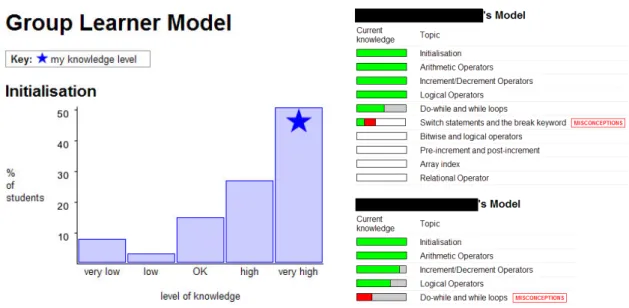
Figure 3.6: The OLMlets group comparison view, and individual peer models view (Bull & Britland, 2007) ... 60
Figure 4.1: Individual learner model views in OLMlets ... 69
Figure 4.2: Set model access and identity ... 70
Figure 4.3: Select peers model ... 70
Figure 4.4: Multiple views in Flexi-OLM (Mabbott & Bull, 2006) ... 72
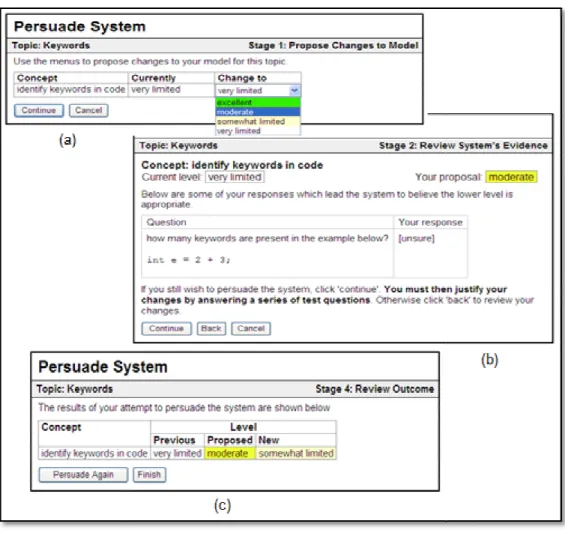
ix Figure 4.6: Persuading the learner model in Flexi-OLM (Mabbott & Bull,
2006) ... 74
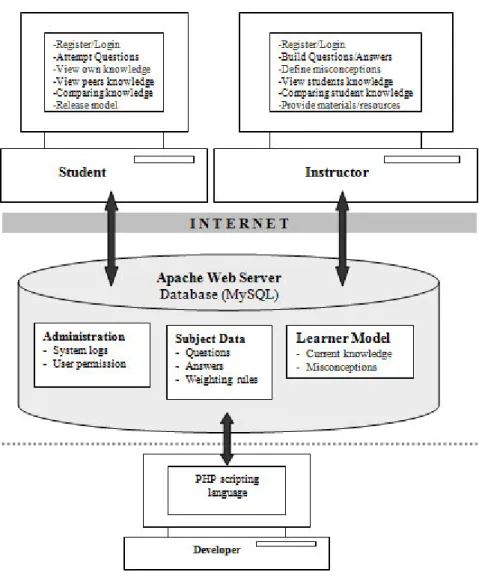
Figure 5.1: General architecture of OLMlets ... 88
Figure 5.2: Structured view in tOLMlets ... 95
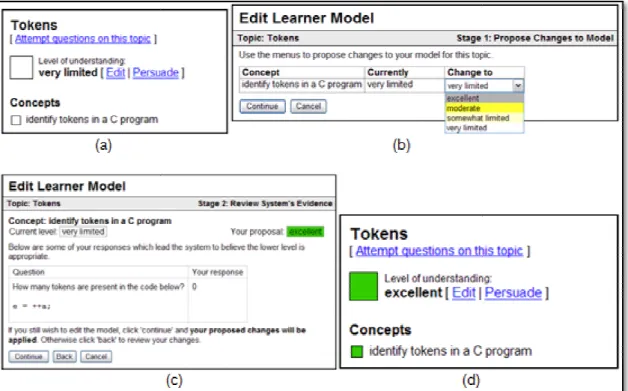
Figure 5.3: Learner selects the topic to edit ... 96
Figure 5.4: Interface showing current level of knowledge and some evidences ... 97
Figure 5.5: The knowledge level after learner edit the model content showed in skill meter (left); and in edit page (right) ... 98
Figure 5.6: Interface for select which topic to persuade ... 99
Figure 5.7: Interface for select a new level of knowledge ... 99
Figure 5.8: The evidence of current knowledge ... 100
Figure 5.9: Short test to convince tOLMlets ... 101
Figure 5.10: Reviews the outcome after the attempt to convince tOLMlets ... 101
Figure 5.11: The level after learner persuade the model displayed in skill meter (left); and in persuade page itself (right) ... 102
Figure 6.1: Relationship between trust and ease of use of tOLMlets. ... 123
Figure 6.2: Relationship between trust and understanding the system behaviour ... 124
x Figure 6.3: Relationship between trust and interest to see the knowledge information in tOLMlets ... 125 Figure 6.4: Relationship between trust and like to use tOLMlets ... 127 Figure 6.5: Relationship between trust and understanding information displayed in OLM ... 128 Figure 6.6: Relationship between trust and perceived accuracy of information displayed in OLM ... 129 Figure 7.1: Relationship between trust and understanding of information by using the skill meter view. ... 141 Figure 7.2: Relationship between trust and understanding of information by using the structured view. ... 142 Figure 7.3: Relationship between trust and perceived accuracy of the information using the skill meter view. ... 143 Figure 7.4: Relationship between trust and understanding of information by using the structured view. ... 143 Figure 7.5: Relationship between usefulness and trust in editing the information. ... 152 Figure 7.6: Relationship between usefulness and trust in persuasion. .... 154 Figure 7.7: Relationship between trust and usefulness in comparing models in a group. ... 164 Figure 7.8: Relationship between trust and usefulness in comparing the model to named peers. ... 165
xi Figure 7.9: Relationship between trust and usefulness in comparing the model to anonymous peers. ... 166 Figure 8.1: Main significant correlations coefficients in laboratory study . 176 Figure 8.2: Main significant correlations coefficients in OLM features ... 177
1
Chapter 1
INTRODUCTION
Intelligent Tutoring Systems (ITS) are computer-based instructional systems that provide adaptive (individualised) teaching, guidance or tutoring. An ITS assesses each learner's actions in the interactive environments and develops a model of user knowledge, user expertise and skills. The ITS then tailors instructional strategies that best suit the learner, based on their inferred learner model. The learner model in most adaptive teaching systems exists as a machine view and is hidden from the student. However, in open learner models (OLMs), the learner model is available for learners to view. Open learner models externalise a computer-based learning environment inferences about the users’ knowledge according to their recent interaction with the environment. Opening the model to the learners may increase their perception of how the system evaluates their knowledge and updates the models. This raises questions of trust related to whether the learners believe the evaluations are correct or whether they trust the system as a whole. Therefore, issues of trust in OLM are the main purpose in this research. In this chapter we introduce the fields that motivate us into this research, describe the research questions and provide the structure of the thesis.
2
1.1 Open Learner Model
Open learner model is the extension of learner modelling that enables learners to access their inferred knowledge or understanding. It is an interactive learning where learners can view their knowledge model, difficulties and misconceptions. Open learner model has often been argued to support reflection and an active learning environment (Bull et al., 2003). This is in line with Kay’s argument that student self-knowledge is crucial especially for life-long and self-directed learning. She further suggests that giving learners accountability for their learning may lead to more effective learning (Kay, 1997). Opening the model to the learners can direct them to explore their knowledge and keep track of their progress in a specific domain. OLMs can also promote independent learning by offering the learners information about their knowledge state that they would not usually see (e.g. a breakdown of understanding of concepts at a fine-grained level; descriptions of misconceptions held).
Learner models can be externalised using simple or more detailed representations of understanding. Simple representations often display learner knowledge using skill meters that show achievements as a set of progress bars for a set of domain concepts (Mitrovic & Martin, 2007; Weber & Brusilovsky, 2001). Simple model views are more limited in information, though they may take different forms, they are often similar in content to skill meters. Detailed presentations of learner models use different methods of showing the model contents, for example: hierarchical tree structures (Kay, 1997); textual
3 descriptions of knowledge and misconceptions (Bull & Pain, 1995); conceptual graphs (Dimitrova et al., 2001); Bayesian networks (Zapata-Rivera, 2004).
There are different levels of control over learner access to their models. For instance, users may simply inspect the model contents (Mitrovic, 2003); directly provide information to the model (Kay, 1997); be required to demonstrate their knowledge or skills in order to change the model (Mabbott & Bull, 2006); and jointly negotiate the model with the system (Bull & Pain, 1995). Learners may also be able to release their model to peers and instructors (Bull et al., 2007).
1.2 Trust in Open Learner Model
In OLM, learners may have more or less control over their learner model contents. Some OLMs are inspectable, without allowing more direct user contributions to the model information (Mitrovic, 2003, Bull & Britland, 2007); some allow or encourage users to contribute additional information to be used together with system inferences (Kay, 1997); some allow direct editing (overwriting) of model attributes (Mabbott & Bull, 2006); some allow user challenges to the model in an attempt to persuade it to change representations if they can demonstrate their knowledge (e.g. by attempting a short diagnostic test) (Mabbott & Bull, 2006); and some are maintained through student-system negotiation of the represented beliefs (Dimitrova, 2003; Kerly, Ellis, & Bull, 2008). Kay (2001) identified several risks when control is given to learners,
4 which includes when learners enter incorrect information to their model, or underestimate or overestimate their knowledge in self-assessments. Tanimoto (2005) also suggests the risk of tampering with the model by the student, which could affect the validity of the learner model; and the potential of biased design where designers avoid modelling the components that are problematic for transparency, and thus weaken the model's pedagogical value. Therefore, while control may help increase learner trust since they have the opportunity to influence the model contents if they disagree with them, such control may also reduce system effectiveness. Furthermore, previous research suggests that students may be uncomfortable with direct editing of their model, but prefer an OLM that offers less direct control as in persuaded and negotiated OLMs (Mabbott & Bull, 2006). This would suggest that students can have trust in an OLM or, at least, they may have greater confidence in the system to judge their knowledge, than in their own self-assessment skills.
Designing trustable open learner models may be a critical factor in the success of the next generation of open learner models (Dimitrova et al., 2007). In addition to having confidence in adaptation, this also relates to the right of access to personal data and learner control over this data (Kay, 2001). Some students are keen to release their learner model to peers, suggesting a level of trust not only in their learner model, but also in the manner in which other users might use their model data – for example, to help students identify their comparative progress, to promote competition amongst peers to increase motivation and goal setting, and to facilitate collaborative learning (Bull et al.,
5 2007). Therefore, to investigate trust in an open learner model, the definition of trust in a learner model has been establish as “the individual user's belief in, and acceptance of the system's inferences; their feelings of attachment to their model; and their confidence to act appropriately according to the model inferences” (Ahmad & Bull, 2008).
1.3 Objectives of the Research
The objectives of this research are:• To investigate issues of trust in open learner models
• To identify the features that engender learner trust in open learner models
• To provide a set of requirements for designing an open learner model that can incorporate a variety of issues that may enhance trust for a range of users.
Based on the research objectives, this research will contribute a set of requirements for designing open learner models that are trustable to the learners. The requirements can be one of the useful resources for OLM developers in designing trustable OLM system. The requirements also can be used together with the existing OLM framework (SMILI☺)(Bull & Kay, 2007) in order to increase user trust in the system.
6
1.5 Structure of the Thesis
This thesis is organised into 8 chapters. Chapter 1 introduces the fields that motivate this research, the research questions and the importance of the study. Chapter 2 explores the literature related to user trust and its characteristics in various fields especially in online and adaptive systems. We discussed how trust is also relevant in open learner modelling. Chapter 3 describes open learner models, their features and issues of trust that are associated in the environment. Chapter 4 presents the initial study of trust in OLM systems. From here we focus on three features to be included in the investigation of user trust in OLM which are (i) the presentation of the learner model; (ii) the learner control over the learner model; and (iii) the use of peers models in the environment. Chapter 5 describes the system that we used in this research. Chapter 6 focuses on the evaluation of the definition of trust in learner models and user trust in the system as a whole. We investigate the extent to which learners trust (and accept) the OLM in the short-term and long-term use of the system and present the relationship between learners trust and several criteria that may influence trust in OLM. Chapter 7 describes the evaluations of trust in three features of OLM that were identified from Chapter 4. Finally, in Chapter 8 we illustrate the key findings of this research, the contribution and points to directions for future research opportunities.
7
Chapter 2
USER TRUST
Trust is a subject that covers many aspects of daily life especially the inter-personal relationship. It is a common term used in everyday language, but each person has a slightly different view of its meaning. Trust has been widely studied and a keen interest in many fields including socio-psychology, education, e-commerce, automated systems and online transactions. In this chapter, we consider trust in various fields by looking into different elements and characteristics of trust. Then, we will focus on the study of trust in online and adaptive systems which covers adaptive news systems, recommender systems and adaptive educational systems. We end the chapter with a discussion of how trust is relevant in open learner modelling.
2.1 Understanding Trust
Trust is a multidimensional concept that can be studied from a viewpoint of many disciplines including social psychology (Deutsch 1960; Rotter 1980; Koller, 1988), sociology (Lewis and Weigert, 1985), e-commerce and online systems (Gefen, 2000; Kim, Ferrin, & Rao, 2008; Corritore, Kracher, & Wiedenbeck, 2003) and human-computer interaction (Madsen & Gregor, 2000).
8 Multidimensional concept means that trust is built from a relationship between different trust-building mechanism, and these mechanisms will influence the specific trust constructs (McKnight, Choudhury, & Kacmar, 2002). Therefore, each discipline offers different perspectives into the condition, its definition, the process through which it develops and the ways of utilizing it. This is because the term trust itself is quite vague (McKnight & Chervany, 2000) and so far, scholars have yet to find a universal definition of trust acceptable in all fields (Rousseau, Sitkin, Burt, & Camerer, 1998; Mcknight & Chervany, 2002). Trust becomes a weak concept because it is always seen as context-matters. However, there are several necessary conditions that lead to the existence of trust, as describes in the following section.
2.1.1 Pre-condition of Trust
Trust in certain situation only becomes relevant when the condition of risks exists. Several authors found that risk is required for the state of trust (Mayer, Davis, & Schoorman, 1995; Rousseau, Sitkin, Burt, & Camerer, 1998). Risk can be seen as the expected harm due to errors in the system or an attack on the system, and it can be measured as a result of this event (Jøsang & Presti, 2004). Trust has also been defined in terms of acceptance of risks (Sheppard & Sherman, 1998). For example, in order to obtain useful information in an online health system (Luo & Najdawi, 2004), users have to disclose highly sensitive personal information of their medical conditions. Users are also taking a big risk if they trust online medical information especially if the information provided is
9 incorrect. Users have to deal with a lot of risks to their health, and their lives may be threatened.
Trust is identified based on the components of risks which are uncertainty and vulnerability (Lee & See, 2004). Uncertainty arises from the inability to verify the integrity, efficiency, and other actions (Blomqvist, 1997; Mayer et al., 1995), while vulnerability refers to the exposure of a person to physical or emotional harm. Trust with the components of uncertainty and vulnerability can be seen in e-commerce because trust often relates to user uncertainty concerning vendor activities, and overcoming the perceptions of the risk of sharing personal information (McKnight & Chervany, 2002). According to Friedman, Kahn, & Howe (2000), customers are vulnerable to certain violations of trust in online commercial transactions, such as the loss of money and privacy. Therefore, since customers lack direct contacts with the company and have to hand over sensitive information in order to complete the transaction, purchasing online is considered risky. Table 2.1 summarises the domain of trust definition.
Table 2.1: Domain of trust definition
Domain
Blomqvist (1997) Uncertainty Fogg & Tseng (1999) Credibility Friedman et al. (2000) Vulnerability Gambetta (1998) Interdependence
Lee & See, (2004) Uncertainty, vulnerability McKnight & Chervany (2002) Uncertainty
Mayer et al. (1995) Vulnerability Rousseau et al. (1998) Interdependence
10 Other than risk and its components, interdependence is also required for the state of trust (Rousseau et al., 1998; Gambetta, 1988). Interdependence refers to the situation where one party (X) needs something from another party (Y) to satisfy its desire, and that party (Y) has the potential to meet the needs. In other words, the relationship between the two parties (party who trust (trustor) and the trusted party (trustee)) is very important in trusting relationship. The two parties may be humans (Rempel, Holmes, & Zanna, 1985), organisations (Blomqvist, 1997), computer systems (Dhaliwal & Benbasat, 1996), objects like products (Wang & Emurian, 2005) and others. The trustor may conceptualise trustor’s beliefs and attitudes (Rempel et al., 1985; Blomqvist, 1997), faith (Rempel et al., 1985), confidence (Tintarev & Masthoff, 2007), intention behaviours and the disposition to trust others (McKnight, Cummings, & Chervany, 1998). On the other hands, trustee may conceptualise characteristics held by trustee. Mayer et al. (1995) suggest that trustee characteristics include ability, integrity, and benevolence. Trustees may also possess characteristics like predictability, honesty and competency (McKnight et al., 1998) and credibility (Fogg & Tseng, 1999).
Therefore, trust can be characterised by the existence of risk conditions that involves uncertainty and vulnerability, and the existence of dependency relationship between trustor and trustee. Similarly, Wang & Emurian (2005) have proposed four characteristics that are accepted by most researchers studying trust in both offline and online trust:
11 • There must be a trustor (trusting party) and a trustee (party to be trusted)
in any trust relationship - these two parties might be persons, organisations, or products. The trust will be developed based on the ability of the trustee to act and be confident with the trustor, and the degree of trust between the trustor and the trustee
• Trust involves vulnerability – Trust exists in uncertain and risky environments. Trustor relies on the trustee not to exploit vulnerability and will take the risk of losing something and put themselves in vulnerable situation.
• Trust will affect actions (mostly risk taking behaviours) – the forms of actions produced will differ based on the situation. For example A lends his money to B because he trusts B will pay back the money.
• Trust is a subjective matter – the roles of trust are viewed differently by different people/discipline in different situations. This is due to individual differences and situational factors.
It is known that trust is the interest of researchers from various disciplines as mentioned earlier. In general, studies of trust can be categorised into the interactions that involve human, machine and human-to-human mediated by machines. The description of each category can be found in the following section.
12
2.1.1.1 Human-to-human
Trust in human-to-human interactions is the focus of researchers in the field of socio-psychology. From a sociological perspective, trust may be considered as a cooperative relationship which based on cognitive, emotional and behavioural aspects (Lewis & Weigert, 1985). Trust is also interpreted as observed agent behaviour in potentially risky situations (Worchel, 1979) or as agent characteristic perceived by others as trustworthy (Cook & Wall, 1980; Dasgupta, 1990). However, trust in psychology is more focused on personal traits that deal with belief, expectation and feelings. The expectation on another party to behave appropriately (with positive consequences) will affect the degree of trust. The higher the expectation individuals have in another party, the higher their degree of trust in that party (Koller, 1988). Trust between humans is the dynamic expectation that will change dynamically as the results of experience in the relationship (Rempel et al., 1985). Trust is an important concept in psychology because it is crucial for personality development (Erikson, 1993) and social life (Rotter, 1980).
2.1.1.2 Human-to-machine
Trust between human-to-machine focuses on interactions between human operators with automated systems. Lee & See (2004) define automation as technology that actively selects data, transforms information, makes decisions, and controls processes. Trust in automated systems can be defined as ‘the attitude that an agent will help achieve an individual’s goals in a situation
13 characterised by uncertainty and vulnerability’ (Lee & See, 2004). Basically, studies on trust between human-to-machine have been drawn from earlier work on trust between humans (Rempel et al., 1985). Muir (1987) in his study suggested, trust that exists between humans may also be used to trust the automated systems. To prove Muir’s statement empirically, Jian, Bisantz, & Drury (2000) have done a series of experiments on three conditions of trust: general trust, trust between people, and trust between human and automated systems. The results obtained reveal that words related to trust are very similar among the three conditions of trust (see Table 2.2).
Table 2.2: Most related words of trust in three conditions of trust (Jian et al., 2000)
Words Conditions Tru s tw o rt h y H o n e s ty L o y a lt y R e lia b ili ty H o n o u r In te g ri ty F a m ili a ri ty General trust / / / / /
Trust between people / / / / /
Trust between human and automated systems
/ / / / /
Trust in a human-machine relationship is essential if operators decide whether to use automatic or manual control (e.g. Lee & Moray, 1992,1994; Muir & Moray, 1996). Previous findings related to trust in process–control systems showed that operators’ performance was affected significantly by their degrees of trust towards the machines (Sheridan, 1988; Lee & Moray, 1992; Muir & Moray, 1996; Jian et al., 2000). Operators’ trust focuses on the automatic
14 control device and is defined as the expectation that the automatic device will function properly (Muir 1987, 1994; Jian et al., 2000). However, if the operator considers to continue using manual controls when choosing automated controls, it proves that self-confidence is a component of trust between humans and machines (Lee & Moray 1992, 1994; Riley, 1996).
2.1.1.3 Human-to-computer
Trust between human-to-computer focuses on interactions between user and computer systems. According to Corritore et al., (2003), trust in e-commerce often cited the trust definition by Mayer et al. (1995) which describe trust as "the willingness of a party to be vulnerable to the actions of another party based on the expectation that the other will perform a particular action important to the trustor, irrespective of the ability to monitor or control that other party". Trust in e-commerce also referred to as confidence held by a person to what others will do (Gefen, 2000). Similarly in recommender systems, trust is referred to as increase of confidence (Tintarev & Masthoff, 2007). On the other hands, Cramer et al., (2008) refer to trust in recommendation as “user’s willingness to depend on a system and its recommendations in the specific context of the user and his or her task(s), even though the system might make mistakes.” In a more general context, Schmidt-Belz (2005) defines trust in adaptive systems as “the believe that in interacting with another party or system, one is vulnerable but one’s own interests are adequately respected and protected by the other party or system, and the other party or system is capable of performing”. This definition clearly shows the relationship of a party who trusts, a party who is
15 being trusted, the vulnerability and the expectation of one party to another. In the context of decision aid systems Madsen & Gregor (2000) define trust as "the extent to which a user is confident in, and willing to act on the basis of the recommendations, actions, and the decisions of an artificial intelligence decision aid". This covers both users’ confidence in the system and their willingness to act on the system's decisions and advice. Table 2.3 summarises the differences on the focus for each definition of trust quoted above.
Table 2.3: Differences in definition of trust Focus Mayer et al. (1995) vulnerability
Cramer et al., (2008) dependability
Schmidt-Belz (2005) vulnerability
Madsen & Gregor (2000) confidence
2.1.2 Measurement of trust
Jian et al. (2000) have provided empirical evidence that the concept of trust and distrust can be measured using the same rating scale. The questionnaires with twelve items incorporate seven points rating scale in the range from ‘not at all’ to ‘extremely’. Three-phased experimental studies have been done before the trust questionnaires were developed. The first phase of the study involved the collection of the various words related to concepts of trust and distrust. The second phase involved a questionnaire study to examine how close these words related to trust or distrust, and the third phase was a study to compare pairs of words. Participants were asked to rate the similarity of words that are
16 paired. A multidimensional measurement scale for trust was then constructed based on data obtained from the second and third phase of studies.
Apart from Jian et al. (2000), the subjective measurement of trust using multiple rating scales has also been proposed by Muir & Moray (1996) and Madsen & Gregor (2000). Muir & Moray (1996) use rating scale to examine the level of operator’s trust in a process control pump. The rating scale is between ‘not at all’ and ‘extremely high’. Madsen & Gregor (2000) have built a trust measure called the Human-Computer Trust (HCT) scale. This scale has been drawn from earlier work including Rempel et al. (1985) and Muir & Moray (1996). The HCT scale consists of five main constructs which are perceived reliability, perceived technical competence, perceived understandability, faith and personal attachment. Each main construct has five items, bringing the total to 25 items. In this research, we adapt some questions from Jian et al. (2000) and Madsen & Gregor (2000).
2.2 Trust in Online and Adaptive Systems
The growth of internet technology has changed the way people interact. According to Marsh & Dibben (2003), trust between users and technology is vital in human-computer interactions because without it, efficiency and productivity will not be maximised. Furthermore, the increasing market demand, current trend of automation, and intelligent systems make trusting automation
17 an important issue for systems researchers, developers and users (Lee & See, 2004). Yahoo! Inc., (2006) reported that the internet has become a trusted shopping information sources where most customers purchase online at the trusted and familiar sites. Customer trust in the web vendor also influences the intention to purchase products online (Gefen, 2000; Kim et al., 2008; McKnight, Choudhury, & Kacmar, 2002). Moreover, a lack of customer trust is a major obstacle in the success of e-commerce (Dayal et al., 2001). Therefore, consumer trust has indeed become a crucial factor influencing the success of e-commerce (Hoffman et al., 1999; Gefen, 2000).
Literature shows that trust in online systems may be influenced by several elements. Among these elements are the experience of using the internet (Corbitt et al., 2003; Metzger, 2006; Aiken & Bousch, 2006), perceived ease of use of a website (Sillence et al., 2004; Luo & Najdawi, 2004), quality of information (Sillence et al., 2004; Luo & Najdawi (2004), reputation of the organisation (Sillence et al., 2004, 2007; McKnight et al 2004 ), privacy and security (Hoffman et al., 1999; Luo & Najdawi, 2004; Aiken & Bousch, 2006), and experience and familiarity (Gefen, 2000; Yoon, 2002; Pavlou, 2003). On the other hand, Briggs et al (2002) suggested that users were likely to trust online advice systems based on three factors: source credibility, advice personalisation and advice predictability. Source credibility refers to the completeness of information provided in the site including where the information comes from, while advice personalisation refers to whether information provided is tailored to user needs. Advice predictability refers to whether information
18 presented reflects user’s knowledge and prior experience. This situation leads to trust in adaptive systems.
Adaptive systems can personalise to users based on the activities they have done in the environment. Systems are able to adjust their behaviour to the expectations of users’ requirement based on the current situation of users (user model). It begins by observing and modelling users and this model will be updated in accordance with current behaviours. From the user model, systems will infer system behaviour that is suited to the users’ current situation. This will benefit users because they will get information based on their needs, and avoid information that is not relevant to them. In short, an adaptive system is capable of matching the appropriate output, using the implicit inferences based on interaction with the user. Because of these advantages, adaptive systems have been developed and implemented in different areas. Each area applied different techniques in terms of user modelling and adaptation.
Despite the advantages gained from adaptive systems, there are issues that need to be considered. The modelling process may provoke a user to question the issue of privacy as every action is recorded and noted by the system without their permission. The adaptation process may produce questions of whether user will follow the system’s recommendation, as this may relate to user trust in the system. Schmidt-Belz (2005) suggested that user trust in adaptive systems not only relates to privacy issues but also user control, consistency, and system competence. Based on qualitative empirical methods, Schmidt-Belz (2005)
19 provides a set of user requirements as guidelines to design a trustworthy adaptive system. The requirements are:
• Users need access to inspect their model as well as the ability to switch off the inspections.
• Users should be allowed to inspect and have the ability to edit the model • Users sometimes want to be free from being personalised and filtered.
System may provide the option to switch off the adaptive behavior and offer relevant feedback to users.
• Users should be allowed to understand the modelling and reasoning of the system.
• Adaptivity is not provided to substitute bad usability design in the system but rather users should be helped to understand the adaptivity.
• The pro-active services (e.g. spam) must be unobtrusive, easy to switch off and only provided upon user subscription.
• Users should be provided with clear benefits from the personalisation implemented in a system designed with a high level usability.
From the above requirements, we can see that user trust in adaptive systems is closely related to user understanding of the system and level of control provided for them. The following subsections describe trust in several areas in adaptive systems.
20
2.2.1 Adaptive News Systems
The internet is widely known as a source of information that is accessible anywhere. Information increases continuously and this causes information overload to the reader. Yet the reader does not like to read the entire news items which are displayed daily. Therefore adaptive news systems have been developed as a mechanism to filter the news based on user requirements. Personalisation in adaptive news is to help users reach the content of the news that relevant to them. Identification of this relevant information for each user is identified by the system through model of user interest. This model is built based on user interaction with the system. The system will then recommend or categorise related information for a user to reach easily. User modelling and adaptation techniques for personalised news have been used in the systems such as SeAN (Ardissono, Console, & Torre, 2001) and Daily Learner (Billsus & Pazzani, 2000). SeAN is an adaptive system using multi-agents for accessing online electronic news. It has three main objectives: first, to select topics and news in the server that are highly relevant to users, second to adapt detail level of news items to user characteristics, and third to select the most appropriate advertising for each page and user. Daily Learner offers nine different categories of news which are Top Stories, Politics, World, Business, Technology, Science, Health, Entertainment and Sports. Users can select stories under the intended category and leave comments or rate the stories, whether they are interesting or not. Users can also notify the agent about the topic that was known or request more information about the stories. In general,
21 users can rate the story as interesting, not interesting or known. Users are not forced to rate the news story but rather it is the user’s own choice. After this initial training phase, the system is capable of producing a story according to user interest based on categories selected by the user. A list of related titles will be displayed in accordance with the current user model.
Personalised adaptive news is becoming increasingly important because most of the portal available in World Wide Web provides access to news and this is not limited to company related communications only. For instance, for companies that operate primarily through the web, they provide news related to companies and news that may be of interest to their clients. The main purpose of this personalised news is to attract web users and to gain their loyalty (Ardissono et al., 2001). Recently, adaptive news systems have been expanded to provide a more transparent system (Wongchokprasitti & Brusilovsky, 2007; Ahn, Brusilovsky, Grady, He, & Syn, 2007). This means that the content of models is opened to the user for inspection.
NewsMe (Wongchokprasitti & Brusilovsky, 2007) makes itself transparent by allowing users to rate news stories. Users may label news of interest as ‘Tracked News’ and news to be avoided as ‘Blacklist’. Users may choose not to leave any feedback for the articles that have been read and the system will assume users do not have a clear view of the articles. Feedback received from users is used to build the user model and influence the way the recommendation is given to users. NewsMe also allows users to update their
22 profile by moving the articles to another label or remove articles directly from their profile. Wongchokprasitti & Brusilovsky (2007) found that excessive manipulations of the user model may degrade system performance and that system feedback is efficient enough to match explicit feedback (from the user).
Adaptive news systems also provide user control where they can edit their models and improve the adaptation process. YourNews (Ahn et al., 2007) is an adaptive personalised news system that allows users not only to view their interest profiles in the news but also to edit them. YourNews constructs user models based on user reading behaviour, and recommends the most relevant news story to users based on this model. In terms of user control, the system allows users to remove or add new keywords related to the articles. Users can see the effects of adding and removing the keyword as soon as it is done. Therefore, users can expect which news will be affected from the changes made. In addition, users can see the importance of keywords related to the article when the cursor is placed on the title of the article. Keywords that are important for an article will appear larger than the other keywords. Ahn et al. (2007) suggested that the trust will be higher in a system that is transparent and allows users to control the system by editing their profile. However such control should be used with caution as it may harm the performance of the system. Trust in adaptive news systems is examined using time spent reading the articles and the average rank of items clicked by the subjects (Ahn et al., 2007).
23
2.2.2 Recommender Systems
Recommender systems aim to provide users with items or information that might match their preferences, and prevent users from serving one that is not relevant to them. The system will build a user model (user profile) for all users during their interaction with the system. User profiles are built by collecting data obtained either through explicit or implicit data collection. Explicit data collection is done by asking users to rate items they like or dislike, while implicit data collection is done by observing user behaviors in the system and these behaviors are recorded in the system to be analysed. Users will then receive items or information that may be off interest based on their profiles. Burke (2002) classified three main components that work together to predict recommendations for users. They are background data, input data and algorithm. Background data is the existing information held by the system and input data is the information that should be contributed by users of the systems. This information is then combined and compared to the algorithm to generate recommendations. Figure 2.1 shows the relationship between these three components in order to produce recommendations.
24 Figure 2.1: The relationship between the three components to generate
recommendations
The recommendation techniques applied in an algorithm could be based on collaborative filtering, content-based, or a hybrid of these approaches to gain better performance (Burke, 2002, Adomavicius & Tuzhilin, 2005). Previous research showed that the accuracy of the recommendation algorithm could determine the users trust in the recommender system (McNee, Lam, Konstan, & Riedl, 2003). User trust in recommender systems is essential because research indicates that users plan to return to trustworthy systems (Chen & Pu, 2005).
Herlocker, Konstan, & Riedl (2000) found that most users wanted an explanation feature added to the system. This is because explanations in recommender systems help users make precise decisions (Bilgic & Mooney, 2005). In addition, the ability of the system to explain why items were recommended to the users is likely to increase user trust (Sinha & Swearingen, 2002). Explanations provided in the system must be good because bad explanations prevent users from accepting individual recommendations (Herlocker et al., 2000). Sinha & Swearingen (2002) found that users gave a higher rate to a system that provides understandable recommendations.
Background
Input data
25 Therefore explanation made the system more transparent and increased the probability of trust in the recommender system (Sinha & Swearingen, 2002).
Sinha & Swearingen (2001) found that more people prefer the recommendations made by friends than the systems. Other studies found that users prefer to accept recommendation from trusted recommendation systems (Swearingen & Sinha, 2001). To meet these preferences, Golbeck (2006) had built a recommender system that combines both of them which deployed in a system known as FilmTrust. The recommendations are made based on explicit trust contributed by users through social networks (social-trust). Therefore instead of presenting a list of items to users, FilmTrust suggests the extent of possibility that users may be interested in the items they have been found. Result shows that the accuracy of prediction based on trust is significantly better, and users prefer to use the recommender system with this approach.
2.2.3 Adaptive Educational Systems
An adaptive educational environment provides support and enhances learning by personalising the materials and teaching environment to the learner. Education can be used to tailor information presented to the current state of learners’ knowledge, provide navigation support and guide learners in their learning process (Brusilovsky & Eklund, 1998).
26 InterBook (Brusilovsky & Eklund, 1998) is an example of an adaptive electronic textbook that provides adaptive navigation support. Adaptive navigation support provides a suitable learning path by adapting link based on the user’s individual characteristics. The characteristics involve the learner’s goal and knowledge. In InterBook, colours are used to represent different meanings of adaptive links. A white bullet means there is no new topic to be learned, a green bullet means the topic is recommended for learners to learn, a red bullet means the topic is not ready to be learned, while a checked bullet means the topic has been visited by learners. Evaluation of the system shows that participants prefer to use non-sequential paths with adaptive link annotations, and this reflects their trust in annotations. Participants are found more confident using the relevant materials under the annotated link. Participants are also willing to allocate more time to read a page that appears not ready for them, and this indicates participants understand the system’s behaviour and trust the annotations’ integrity (Brusilovsky & Eklund, 1998).
In designing and building future adaptive learning system, Zliobaite et al. (2012) have identified six key challenges. One of the challenges is to improve usability and trust in the system. Similar to other areas in adaptive systems as describe previously, transparency is needed in order to obtain user trust in adaptive learning system. The way of how learning and adaptation process implemented in the system should be disclosed to the users. Zliobaite et al. (2012) suggested that wide deployment of learning systems can improve users trust in the
27 system, and trusting the system relates to users’ understanding of the system behaviour.
Learner control is important if co-operation with the learner is needed in the learning. As discussed above, Kay (2001) highlights several risks may occur if some control of the model is giving to learners. The risks include inaccurate information entered by learners and they may over or under estimate their performance in self-assessment. Tanimoto (2005) also suggests the risk of tampering with the model by students, which could affect the validity of the learner model. However, being in control of their models in adaptive educational system can build user trust in the system (Vogiatzis, Tzanavari, Retalis, Avgeriou, & Papasalouros, 2005). Therefore, while control may help increase learner trust when they have the opportunity to influence the model contents if they disagree such control may also reduce system effectiveness. Furthermore, previous research suggests that students may be uncomfortable with direct editing of their model, but prefer a system that offers less direct control (Mabbott & Bull, 2006).
All three areas of adaptive systems described previously have shown that transparency is an important element to build user trust in the system. System should allow users to access information on how to implement the process of adaptation in the system. For example, in recommender systems they provide explanations on how an item is recommended to the users. Therefore, users can understand the underlying process involved and thus increase user trust.
28 Schmidt-Belz (2005) also includes transparency as one of the trust elements in adaptive systems. However, the elements of trust in adaptive systems are mostly drawn from the perspective of user models that is slightly different with learner models in adaptive educational systems. User models usually model user interest while in an educational context learner models usually model user knowledge. Very little research has been made to study user trust in adaptive educational systems. This thesis will therefore explore user trust in the context of adaptive education specifically for open learner models (OLMs). The next section will discuss why trust is relevant in OLMs.
2.3 Discussions
In Section 2.1.1 we presented four characteristics of trust accepted by most researchers as identified by Wang & Emurian (2005). In order to investigate trust in an open learner model (OLM)(described in Chapter 3), we map these characteristics to the environment as shown in Table 2.4.
29 Table 2.4: Mapping trust characteristics (Wang & Emurian, 2005) with OLM
environment
Characteristics OLM environment
There must be a trustor
(trusting party) and a trustee
(party to be trusted) in any trust relationship.
Trustor in OLM is learners or students. Trustee is OLM systems that infer learner knowledge.
Trust involves vulnerability. In OLM, learners may be uncertain about their knowledge level and rely on the system to infer it. They also face a risky situation in terms of their knowledge level hence put them in vulnerable situation. For example:
• OLM infers learner knowledge based on learners’ interactions with the system and if the system makes mistakes, the accuracy of the model inferred will be affected. Learners will be exposed to a vulnerable situation due to this incorrect inference.
• facility to edit their learner model may also put them in the incorrect level of knowledge
Trust will affect actions
(mostly risk taking behaviours)
In situation where learners trust the system inference about the model, they may form either positive or negative actions. For example learners may study hard if they find the knowledge level is low, or they may do nothing because they become demotivated due to the system inference.
Trust is a subjective matter Different learners will have different trust over their learner models in OLMs. It may result from their attitudes towards machine and technology, confidence in their self-assessment skills, etc.
The mapping of trust characteristics to OLMs shows that each characteristic is appropriate with OLM environment and this indicates that a study of trust is also relevant in OLMs.
30 The potential risks in using OLM are when control is given to learners as described in Section 1.2. Other than that, learners can continue to answer the questions until the system shows that they have high knowledge in a particular topic, and then stop answering questions on that topic. This can happen because of concerns that the system’s presentation of their knowledge will decrease if they continue to answer the questions. Thus, this situation can give a wrong presentation of knowledge to the instructors and also to other students especially when they are using the peer models (Section 4.1.1).
From the perspective of human-machine interaction, a theory of how trust can be built by users in automated systems has been produced (Muir, 1987,1994). This may also be applicable to OLMs. The following points seem particularly relevant:
• the level of trust will affect user decisions such as the choice of manual or automated control and whether they follow the system’s advice;
• a minimum system performance is necessary for user trust.
If learners can recognise that their OLM is sufficiently accurate, and if they understand the overall purpose of the learner model for adaptation, they will likely maintain a higher trust in the system. This is particularly important where the learner can see, but not challenge the learner model contents. When users have greater control over their model contents, their level of trust in the system may help determine the extent to which they accept the system's
31 representations. Learner models that can be challenged by the learner can be useful where it is accepted that the model may not always be entirely accurate. If learners recognise an incomplete or possibly partially inaccurate model as still useful in adaptive tutoring, their trust may be raised if they are allowed to change or challenge it in cases where they consider the representations are below the minimum level required for effective adaptation. Therefore, trust in this context may not necessarily be dependent on the accuracy of the system's inferences. A minimum system performance may still be achieved for the development of trust by involving the learner in the learner modelling process in systems where the modelling can benefit from direct input from the learner, as long as the learner accepts this role.
While primarily applied to other fields, the definition of trust by Madsen & Gregor (2000) can also be relevant in open learner modelling. The evaluation for this definition will be described in Chapter 6.
2.4 Summary
This chapter has introduced the concept of user trust and its importance to the success of the relationship. We have presented trust research in various field and come out with pre-condition that makes trust relevant in the situation. Then we focus on trust in online and adaptive systems. We mapped characteristics of trust accepted by most researchers who study trust to an open learner model
32 (OLM) environment. It shows trust is relevant in an OLMs environment. In OLM, learners are allowed to see their learner model, and more importantly, learners can see system’s inferences about their knowledge in the environment. Therefore, user trust may be even more important than in an environment that keeps the model hidden from learners. Next chapter will describe OLMs environment and issue of trust that may involve the environment.
33
Chapter 3
OPEN LEARNER MODEL (OLM)
Open Learner Models (OLM) can help learners to see their models and keep track of their progress in a specific domain as described in Section 1.1. In this chapter, we consider the motivations of open learner models, the environment of OLM and its features. We then focus to look at the trust issues in OLMs.
3.1 Intelligent Tutoring Systems
Intelligent Tutoring System (ITS) is a computer-based teaching system that provides adaptive (individualised) teaching or tutoring. In order to provide instructional feedback to learners, ITS requires and depends on several components - the domain model (the knowledge of the expert); the student model (the knowledge of the learner); the tutoring model (the knowledge of teaching strategies); and the user interface (Nwana, 1990; Nkambou, Bourdeau, & Mizoguchi, 2010). The domain model represents subject-matter expertise. It comprises all knowledge of a particular domain to be delivered to students including the concepts, rules and problem-solving ability. The student model is the dynamic representation of the learner’s knowledge, skills and expertise in a domain. The tutoring model is the part that designs and regulates
34 instructional interaction with the learner. In other words, it is the method of teaching or coaching learners in a system. ITS assesses each learner's action in interactive environments and develops a model of their knowledge, skills, and expertise. ITS tailors the best instructional strategies to the learner based on the learner model inferred.
3.2 Learner Models
In an adaptive learning system like ITS, the learner modelling process plays an important roles in order to achieve the adaptability and personalisation in the system. The learner model is inferred by diagnosing learners’ knowledge during their interactions with the ITS (Wenger, 1987; VanLehn, 1988). The interaction in the modelling process requires learners to answer a series of questions or problem solving on a particular domain. The term learner model (or student model) is used to describe an abstract representation of the learner within the computer program (Holt, Dubs, Jones, & Greer, 1994), which represents the learner’s current state of knowledge.
The learner model is used to track any changes in student knowledge by not only observing the interactions but also engaging in various learning situations. Wenger (1987) suggested that the learner model has three tasks:
35 • In terms of information, the data gathered must be from learners and
about learners. It can be in two forms: explicit (by asking students to solve specific problems) and implicit (by tracking student interactions with the system).
• In terms of representation, the data gathered must be used to create the representation of the student’s knowledge and learning process.
• In terms of accountability, the data must be accounted by performing some types of diagnosis. The diagnosis includes the state of student’s knowledge.
Previously, the learner model was hidden from learners and has been kept and used exclusively by the system to affect appropriate adaptation to the learner. However, it has been argued that allowing learners to view and access their models can encourage learners to be responsible in their learning process especially on the awareness of developing knowledge and its difficulties (Kay, 1997; Bull & Pain, 1995). Opening the model to learners can direct them to explore their current state of knowledge and promote independent learning. In addition, learners’ knowledge is crucial particularly for life-long and self-directed learning, and giving learners accountability for their learning may lead to more effective learning (Kay, 1997).
36
3.3 Open Learner Models
Open learner models (OLM) is a field of research that promotes independent learning by externalising the learner model contents to the learner (Bull & Kay, 2007). The aims of OLM are to encourage reflection, independent learning and formative assessment/progress monitoring (Bull, Quigley, & Mabbott, 2006). Through the OLM, learners may access information about their current state of knowledge, difficulties in the subject area and any possible misconceptions where this information is modelled.
In recent years, there has been an increasing interests in opening the learner model as a means to support meta-cognitive processes such as planning, reflection and self-evaluation (Kay, 2001; Dimitrova, McCalla, & Bull, 2007; Kerly, Hall, & Bull, 2007; Mitrovic & Martin, 2007). Other than supporting the meta-cognitive skills, Bull & Kay (2007) identified purposes for opening the learner model to the learner. This includes improving learner model accuracy, promoting learner reflection, helping learners with planning and/or monitoring their learning, facilitating collaboration and/or competition between learners, supporting navigation, giving the learner right of access to their information, supporting learner control, increasing the learner trust in the system by showing the learner model contents, and used the learner model as assessment.
Bull & Kay (2007) mapped the above purposes with 11 elements that should be considered in open learner modelling, and established a framework for OLM
37 known as SMILI☺ (Student Models that Invite the Learner In). The elements are divided into three categories indicating: What is available? How is the model presented? and Who controls access?
What is available?
• Extent of model accessible – defines the extent of learner model available to the user
• Match underlying representation – defines the extent of similarity between the OLM and the underlying representation of the learner model • Access to uncertainty – defines whether the learner model represent
uncertainty and whether the user can access the information
• Role of time – defines whether the user can access historical, current or predicted future information
• Access to sources of input – defines the level of access for various sources of input used to infer the learner model, and whether users can access where the data for inferring comes from.
• Access to model effect on personalisation - defines whether users know the effect of the learner model on their personalised interaction
How is the model presented?
• Presentation of the learner model – defines how the learner model is presented to the learner, and the level of detail that can be accessed • Access methods – defines how the learner model can be accessed,
38 (e.g through edit, provide additional information or negotiate the learner model)
• Flexibility of access – defines whether the learner model can be viewed in different formats and whether the user can choose the level of details.
Who controls access?
• Who initiates access to the learner model – whether it is the system or the learner
• Controls the accessibility to other users – defines the extent of control that the users have over their learner model
Table 3.1 shows the example how the elements are mapped to purposes of opening the model. Three indicators are used in this framework to indicate the significant of row elements for the purpose in that column. Indicator ‘X’ means the row element is critical, ‘=’ means its importance is questionable and a blank indicates the element does not play a significant role for that purpose.
39 Table 3.1: SMILI Framework: HOW is the model presented? (Bull & Kay, 2007)
The elements included in