W&M ScholarWorks
W&M ScholarWorks
Dissertations, Theses, and Masters Projects Theses, Dissertations, & Master Projects
Summer 2018
Promoting Student Success: A Program Evaluation of A Ninth
Promoting Student Success: A Program Evaluation of A Ninth
Grade Transition Program
Grade Transition Program
Micah Lonae SmithCollege of William and Mary - School of Education, [email protected]
Follow this and additional works at: https://scholarworks.wm.edu/etd Part of the Secondary Education Commons
Recommended Citation Recommended Citation
Smith, Micah Lonae, "Promoting Student Success: A Program Evaluation of A Ninth Grade Transition Program" (2018). Dissertations, Theses, and Masters Projects. Paper 1530192452.
http://dx.doi.org/10.25774/w4-jr4p-f612
PROMOTING STUDENT SUCCESS:
A PROGRAM EVALUATION OF A NINTH GRADE TRANSITION PROGRAM ________________________________________________________________________
A Dissertation Presented to
The Faculty of the School of Education The College of William and Mary in Virginia
________________________________________________________________________
In Partial Fulfillment
Of the Requirements for the Degree Doctor of Education
________________________________________________________________________
by
Micah Lonae Smith November 2017
PROMOTING STUDENT SUCCESS:
A PROGRAM EVALUATION OF A NINTH GRADE TRANSITION PROGRAM
by
Micah Lonae Smith
________________________________________________________________________
Approved December 2017 by
Megan Tschannen-Moran, Ph.D. Chairperson of Doctoral Committee
Leslie Grant, Ph.D.
Dedication
First and foremost, I would like to give honor to God for watching over me and giving me the strength and determination to complete this process. There were some difficult days and nights, but through prayer and my faith, my God made it possible for me to finish my work.
To my husband, Schuyler, you are my rock. You have supported my journey since the beginning, and for that I am so grateful. You have encouraged me time and time again. You have always stood by my side and made sure I didn’t give up on my dream. I love you so much for putting up with me throughout this entire process.
To my children, Ian and Taylor, I appreciate all of your love and words of encouragement throughout my journey. I was able to pursue my dream because you two have been the best children a mother could ask for. You have never given me one ounce of trouble, and for this I say thank you.
To the rest of my family, thank you for your love, your words of encouragement, and support. Thank you for pushing me and telling me I could do this.
To my grandmother, Frances, you left this world last year and did not get a chance to see me complete my journey, but you have always been right by my side. It is finished grandma. I hope I have made you proud.
Table of Contents
Acknowledgements ... vii
List of Tables ... viii
List of Figures ...x
Abstract ... xi
Chapter 1: Introduction ...2
Statement of the Problem ...3
Reasons for Concern ...4
Transition to High School ...6
Morrison High School Freshman Academy Program Description ...8
Ninth Grade Academy Logic Model...9
Program Inputs ...9
Program Elements ...12
Intended Program Outcomes...14
Evaluation Questions ...15
Significance of the Study ...16
Definitions of Terms ...17
Chapter 2: Review of Literature ...19
Components of Effective Transition Programs ...20
Providing Information ...21
Starting in middle school ...………...21
Understanding student concerns about high school ...23
Supporting Social Success ...26
School connectedness ……….….…………...………...…26
Graduation coaches and mentors ...30
School size ...31
School organization ...32
Addressing Academic Preparation ...35
Purpose of transition programs ...35
Smaller Learning Communities ...37
Chico High School ...38
Twilight Academy ...38
Transition Strategies ...39
Maryland high schools ...39
Valley Stream High School ...40
Fillmore High School ...41
Collaboration Among Stakeholder Groups ...44
Transition concerns among stakeholder ...45
School counselors as gatekeepers ...46
Parental involvement ...47
Summary ...48
Chapter 3: Methods ...50
Program Evaluation of the Freshman Academy Transition Program ...50
Research Design...52 Context ...53 Evaluation Questions ...54 Participants ...55 Teachers ...56 School counselors ...56 Administrators...56 Data Sources ...57
Student outcome data ...57
Teacher, school counselor, and administrator interviews ...57
Data Collection ...58
Interview protocol ...59
Data Analysis ...61
Analysis of Student Outcome Data ...61
Analysis of Interviews ...61 Ethical Considerations ...62 Propriety ...63 Utility ...63 Feasibility ...63 Accuracy ...64
Role of the Researcher ...64
Summary ...65
Chapter 4: Results ...67
Student Outcome Data ...67
Evaluation Question 1 ...70 GPA...70 Attendance ...71 Discipline referrals ...72 SOL scores ...73 Credits earned ...75
GPA...77 Attendance ...78 Discipline referrals ...79 SOL scores ...80 Credits earned ...83 Evaluation Question 3 ...84
Emergent themes and codes from interviews ...85
Prior concerns ...86
Student failure ...87
Goals, priorities, and values ...89
Student success ...89
Specific activities or strategies...91
Strong foundation...91 Academic outcomes ...93 Critical indicators ...93 Contributions to success ...95 Positive relationships ...95 Barriers ...97 Low expectations ...97 Positive effects ...100 Student improvement ...100
Areas for improvement ...102
Communication and collaboration ...102
Fidelity of implementation ...105 Consistency ...105 Monitoring ...106 Reviewing information ...106 Student feedback ...107 Meaningful feedback ...107
Teacher and administrator feedback ...108
Data driven ...108
Summary ...109
Chapter 5: Conclusions ...110
Discussion of Findings ...112
Freshman Academy Achievement and Behavior Outcomes ...112
Perceptions of Freshman Academy Team ...115
Other Emergent Findings ...119
Recommendations for Future Evaluation and Research ...125
Conclusion ...126
Appendix A: Email invitation requesting participation in the teacher\school counselor\administrator interview ...128
Appendix B: Teacher\School Counselor\Administrator Informed Consent Form ...129
Appendix C: Interview Questions ...131
References ...132
Acknowledgements
There are many individuals who have supported me along my doctoral journey and this dissertation would not have been completed without your guidance, love, and continuous support. I thank my friends and colleagues who checked on me and provided encouraging words throughout my course work and writing. My friends and colleagues told me that they wanted to see me finish and told me not to give up because I had come so far. Several of my colleagues have completed their doctoral degree and have shown me that if I stayed the course, I too, could call myself doctor one day. Thank you for lifting me up every day.
I especially want to acknowledge and thank my dissertation chair, Dr. Megan Tschannen-Moran for challenging me and leading me through the process of writing a program evaluation. Your support and guidance have helped me to understand that hard work and commitment definitely pay off and dreams do come true. I could not have completed this journey without you. I also want to acknowledge and thank my two dissertation committee members, Dr. Leslie Grant and Dr. Kyung-Hee Kim. Thank you for your support and all of your input towards my dissertation. I appreciate the efforts and accommodations you have made in getting me to the finish line.
List of Tables
Table 1 Participants Represented in Interviews ...56 Table 2 Program Evaluation Questions, Data Sources, and Data Analysis ...60 Table 3 Percentage of Freshman Academy and Non-Freshman Academy Students
Meeting GPA Benchmark Intended Outcome 2013-2014, 2014-2015, & 2015-2016 ...68 Table 4 Percentage of Freshman Academy and Non-Freshman Academy Students
Meeting Attendance Benchmark Intended Outcome 2013-2014, 2014-2015, & 2015-2016 ...68 Table 5 Percentage of Freshman Academy and Non-Freshman Academy Students
Meeting Discipline Benchmark Intended Outcome 2013-2014, 2014-2015, & 2015-2016 ...69 Table 6 Percentage of Freshman Academy and Non-Freshman Academy Students
Meeting SOL Benchmark Intended Outcome 2013-2014, 2014-2015, & 2015-2016 ...69 Table 7 Percentage of Freshman Academy and Non-Freshman Academy Students
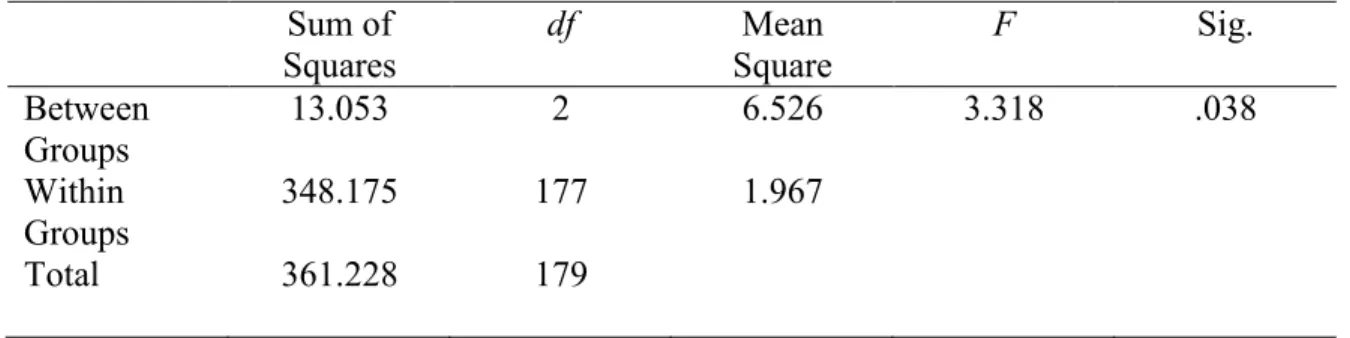
Meeting Credits Benchmark Intended Outcome 2013-2014, 2014-2015, & 2015-2016 ...70 Table 8 ANOVA Results for GPA of Freshman Academy Students 2013-2014,
2014-2015, & 2015-2016 ...71 Table 9 ANOVA Results for Attendance of Freshman Academy Students
2013-2014, 2014-2015, & 2015-2016 ...72 Table 10 ANOVA Results for Discipline of Freshman Academy Students
2013-2014, 2014-2015, & 2015-2016 ...73 Table 11 ANOVA Results for Algebra I SOL Scores of Freshman Academy
Students 2013-2014, 2014-2015, & 2015-2016 ...74 Table 12 ANOVA Results for World Geography SOL Scores of Freshman
Academy Students 2013-2014, 2014-2015, & 2015-2016 ...75 Table 13 Tukey Post-hoc Results for World Geography SOL Scores of Freshman
Academy Students 2013-2014, 2014-2015, & 2015-2016 ...75 Table 14 ANOVA Results for Credits Earned of Freshman Academy Students
Table 15 Tukey Post-hoc Results for Credits Earned of Freshman Academy
Students 2013-2014, 2014-2015, & 2015-2016 ...77 Table 16 Descriptive Statistics and t-test Results Comparing GPA of Freshman
Academy and Non-Freshman Academy Students ...78 Table 17 Descriptive Statistics and t-test Results Comparing Attendance of
Freshman Academy and Non-Freshman Academy Students...79 Table 18 Descriptive Statistics and t-test Results Comparing Discipline of Freshman Academy and Non-Freshman Academy Students ...80 Table 19 Descriptive Statistics and t-test Results Comparing Algebra I SOL Scores
of Freshman Academy and Non-Freshman Academy Students ...81 Table 20 Descriptive Statistics and t-test Results Comparing Biology SOL Scores of Freshman Academy and Non-Freshman Academy Students...82 Table 21 Descriptive Statistics and t-test Results Comparing Earth Science SOL
Scores of Freshman Academy and Non-Freshman Academy Students...82 Table 22 Descriptive Statistics and t-test Results Comparing World Geography SOL Scores of Freshman Academy and Non-Freshman Academy Students...83 Table 23 Descriptive Statistics and t-test Results Comparing Credits Earned by
Freshman Academy and Non-Freshman Academy Students...84 Table 24 Themes and Codes for Perceived Influence of Transition Program on
List of Figures
Abstract
The purpose of this mixed-methods study is to evaluate the impact of Morrison High School’s ninth grade transition program, the Freshman Academy, on student outcomes. Based on the outcomes, decisions will be made to determine if the Freshman Academy is meeting students’ needs or if the program elements need to be revisited to improve student achievement.
Participants included teachers, school counselors, and administrators at Morrison High School in southeastern Virginia. The study employed the product component of the CIPP model of program evaluation to guide the data collection and to determine the merit, worth, and significance of the program. Quantitative data were collected using student outcome data based on GPA, attendance rates, number of discipline referrals, pass rates on Virginia Standards of Learning End of Course tests, and credits earned. Qualitative data were collected based on teacher, school counselor, and administrator interviews.
Successes and challenges of the program as well as areas of recommended improvement are detailed in this study. Analysis of student outcome data revealed that students participating in the program are consistently meeting the benchmark intended outcomes for attendance, discipline, and credits earned and most students are passing the Algebra I and World Geography SOLs during the last year included in this study.
Continuous monitoring and evaluation of the program elements can only assist teams in providing stronger transition programs to help students achieve the intended outcomes.
eighth grade teachers and administrators at the feeder middle schools, developing a summer bridge program to target at-risk students, and increasing parental involvement and seeking their feedback on the Freshman Academy.
PROMOTING STUDENT SUCCESS:
Chapter 1 Introduction
Ensuring student success after high school has become more important than ever. The two most recent iterations of the Elementary and Secondary School Act, the No Child Left Behind Act of 2002 (NCLB, 2001) and Every Student Succeeds Act of 2016 (ESSA, 2016), have changed the focus of how educators view student achievement. In preparing students to graduate from high school, teachers, school counselors, and administrators are held accountable for measures of student proficiency in reading and math. They are also held to account for student graduation rates within four years.
Ultimately, the expected goal for all schools is to promote academic success and advance students from one grade level to the next by developing and implementing evidence-based strategies. High school leaders have a serious obligation to support the learning of all of their students; however, the responsibility of providing students with avenues for success begins with ninth graders.
Attending high school for the first time can be an exciting, yet difficult transition period for many students. Most United States high school students enter a school that is generally much larger than the middle school they attended. The transition from middle school to high school can be a time in a young person’s life when many become
overwhelmed by experiencing feelings of anxiety, isolation, disconnection, and an immeasurable sense of loneliness. Research shows this is particularly difficult for
Graham, 2009; Legters & Kerr, 2001; Roderick & Camburn, 1999; Warren, Fazekas, Rennie-Hill, Fancsali, & Jaffe-Walters, 2011). It is this shift from middle school to high school that causes many students to struggle academically and fall behind, reducing the likelihood they will graduate from high school or graduate on time (Warren et al., 2011).
Statement of the Problem
Most freshmen enter high school looking for some sort of support system to guide them over the next four years. Support systems for students may include their parents, teachers, school counselors, administrators, and their peers. Becker and Luthar (2002) found that dropout rates are directly related to students not having positive relationships with other students and staff members. Ninth grade has the highest enrollment among all grades in high school and also has some of the most concerning statistics. Ninth graders have been found to have the lowest grade point average, the most missed classes, the majority of failing grades, and more misbehavior referrals than any other high school grade level (Fritzer & Herbst, 1996). Additionally, Dailey, Kemple and Cavanna (2006) cited several key problems in ninth grade that can be found in high schools across the United States:
Ninth grade can be large, anonymous, “chaotic” places for early adolescents; it may have low levels of literacy and basic math skills; it may consist of mixed expectations that promote and reinforce tracking; the ninth grade has limited capacity for teachers and staff to address diverse student needs; and there is a lack of relevance and connection to community, employers, and higher education. (p. 18)
It is for these reasons that high schools across the country have begun providing transition programs for their ninth grade students.
Reasons for Concern
Research has demonstrated how numerous measures of student performance decline following the transition into high school (Weiss & Bearman, 2007). The ninth grade year is where students tend to have lower attendance rates than students in other grade levels, and that attendance is a predictor of academic performance (Kennelly & Monrad, 2007). Moreover, about 30% of students nationwide, fail one or more classes in the ninth-grade. Further, the ninth grade students in their study had the highest number of discipline incidents. Finally, ninth graders who repeated the grade were found to be at greater risk of dropping out of high school and only 10-15% ever graduated.
Researchers have found that freshman retention, attendance, discipline problems, core class failures, and failures from mandated state assessments are issues plaguing many school systems in the U.S. (Weiss & Bearman, 2007). Because ninth graders are three to five times more likely to fail a class than students in any other grade, researchers have suggested that schools should support the transition to ninth grade (Bottoms, 2008; Gibson, 2006; Habeeb, 2013; Kennelly & Monrad, 2007; Uvaas & McKevitt, 2013).
U.S. high schools have long been aware of the anxiety and confusion associated with starting ninth grade (Cooper & Liou, 2007; Neild, 2009). The failure rate for
students in ninth grade remains higher than any other grade level (Bottoms, 2008; Isakson & Jarvis, 1999). In a study of one cohort of entering ninth graders in Chicago Public Schools, Roderick and Camburn (1999) found that over 40% of students failed one or more major subjects during the first semester of high school. There are a number of
potential reasons for this. High school students typically have more assignments than students were used to in middle school. There can be also more distractions due to the increasing complexity in peer relations. Finally, their overall participation in school may decline after their transition to high school (Newman, Myers, Newman, Lohman, & Smith, 2000). Students perceived similar concerns. They conveyed a decrease in perceived support from teachers every year after Grade 6. Ninth graders also reported being less involved in school activities and feeling the need for more school organization (Barber & Olsen, 2004).
Academic failure during the transition to high school has been directly linked to the probability of dropping out (Legters & Kerr, 2001). In addition, Habeeb (2013) noted that ninth grade students in general, must make decisions with long-term consequences, but they often lack the maturity and foresight to make those decisions well. Neild (2009) examined four theories about why ninth grade can be difficult for some students:
1. Ninth grade coincides with life-course changes, such as reduced parental supervision and increased peer influence.
2. Students have to attend a new school and must break the bonds they have formed with their middle-school teachers and peers.
3. Some students are inadequately prepared for high school.
4. The organization of some high schools is itself a major source of students’ difficulty.
During this time in their lives, ninth graders are exploring who they are and who they hope to become. When students are able to cope well with school transitions they are able to sustain high levels of academic motivation, knowledge, and skills that are
necessary for their progression toward college or the workplace (Newman et al., 2000). Given these and related factors, transition to high school is an important issue for
educators to examine to improve student academic performance and foster a positive high school experience for students.
Transition to High School
Schools need to provide a smooth transition to help students cope with some of their developmental issues, feel supported, and, ultimately, be successful in high school. School transitions can be developmentally disruptive for students as a result of the mismatch between their stage of development and the demands of the school environment (Benner & Graham, 2009; Cauley & Jovanovich, 2006). Cauley and Jovanovich (2006) noted several developmental changes and challenges students face in ninth grade including skills needed to think and solve problems, concerns about physical and sexual changes, and making and keeping friends. The school environment frequently increases adolescents’ concerns. Therefore, an effective transition process must be sensitive to these changes and support students and parents as they deal with them
Transition support efforts seek to change the experience of ninth grade for all incoming students. These efforts combine environmental changes to make the school more welcoming and responsive with academic changes to improve the quality of
instruction and increase students’ academic achievement (Warren et al., 2011). In a study of schools that included Smaller Learning Communities (SLCs), the majority of schools had not implemented a comprehensive, systematic response to the challenge of helping students move into high school successfully (Warren et al., 2011). However, many of the SLCs did focus on a number of promising strategies that provided some student success.
Many schools’ emphasis on ninth grade transition involves mostly tinkering around the edges, focusing on isolated activities or programs (Donegan, 2008). Schools seem to design their freshman transition programs as a series of events rather than a process that they must maintain before, during, and after the ninth grade year. Research suggests that high schools need to have full, comprehensive transition programs where ninth graders receive continuous focus on academics, strategies, and personalized support (Warren et al., 2011).
Reform efforts have tended to address high school organization, with or without a focus on instructional quality or helping students to catch up on academic skills. Neild (2009) noted that school districts and state departments of education also are addressing the problem by creating accountability indicators of how well high schools are keeping ninth graders on track. States are helping districts to develop their capacity to maintain and analyze data on ninth-grade progress, including “early warning indicator systems” that identify students who are falling off track to graduation. One study found that compared the outcomes of middle school transitional programs, students who had access to a transitional program in middle school had an average grade point average (GPA) of 2.43 in high school, while those students who did not have a transitional program in place in their middle school had an average GPA of 2.0 (Smith, 1997). Kerr (2002)
recommended that schools implement a variety of programs to target areas of concern in order to prevent failures, alleviate student fears regarding high school, and promote student achievement.
Morrison High School Freshman Academy Program Description
Morrison High School, a comprehensive high school in the southeastern region of Virginia, has made a concerted effort to ensure a successful transition for students from middle to high school by implementing a freshman transition program. The goal of the Freshman Academy is to ensure that first-time ninth grade students who have struggled in middle school experience both academic and behavioral success throughout their high school experience. Since 2009, approximately 420 students have been identified to participate in the program prior to coming to high school based on having low grades in Language Arts and/or math; having five or more absences during a marking period; having three or more discipline referrals; and having low SOL performance in reading, math, or science in the ranges of 350-374. The Standards of Learning (SOL) is a standardized testing program administered in the state of Virginia. These standards establish the minimum expectations for student learning in Virginia's Public Schools K-12 core classes (VDOE, 2016).
Ninth Grade Academy Logic Model
A logic model provides a clear and practical layout of how a program will work under certain conditions to solve identified problems (Bickman, 1987, as cited in McLaughlin & Jordan, 1999). Some of the benefits of using the logic model tool identified by McLaughlin and Jordan (1999) include that it builds a common understanding of the program and expectations, it is helpful for program design or improvement, identifying projects that are critical to goal attainment, redundant, or have inconsistent or implausible linkages among program elements, and it points to key
performance measurement points and evaluation issues, thus improves data collection and usefulness.
The Morrison High School Freshman Academywas designed to capture and monitor ninth grade experiences and successes. Its elements are described in the logic model in Figure 1.
INPUTS PROGRAM ELEMENTS INTENDED OUTCOMES
Staff, Time, Students, Money Activities and Participation 9th Grade Successes Teachers Administrators School Counselors Graduation Coach Double-block classes Peer tutoring Homework Club Dream Girls/Men on the
Move
Town Hall meetings IOU Café
FLEX Grade Recovery
Students have a GPA of at least 2.0
Students have 90% attendance or higher Students have fewer than 3
discipline referrals Students pass SOL
assessments
Students earn at least 5 units of credit
Students are on track for graduation
Time
Common course preps Planning Smaller class sizes
Students Juniors Seniors Money Budget Teacher allocations
Figure 1. A logic model of ninth grade transition.
Program Inputs
Morrison High School has invested in staff members and students to assist with the academic transition of its ninth grade students through the Freshman Academy. The Freshman Academy is staffed by three core English, math, science, and social studies
teachers, including a freshman lead teacher. There are three school counselors who each have ninth graders as part of their caseload. There is one administrator, a freshman lead teacher, and a graduation coach who work specifically with ninth graders. The teachers are provided with common planning time as part of their daily schedule. They are also provided with professional development at least four times throughout the school year. Habeeb (2013) noted that schools should ensure that the teachers of freshmen grow professionally and use the latest research-based strategies in pedagogy and technology. Ninth grade teachers are provided with professional development that addresses the needs of the ninth grader and how to address them. Professional development workshops are provided by the ninth grade administrator, freshman lead teacher, and various teachers and school counselors. Some of the topics include student interventions, flexible learning environments, academic rigor, and parental involvement. All teachers have laptops and a SMART Board in their classroom. They are equipped with technology tools to help them plan and provide for high-quality instruction.
During their common planning time, Freshman Academy teachers discuss students’ progress to include grades, attendance, and discipline. Hertzog and Morgan (1997) found that transition programs had the most impact on students when middle and high school teachers and administrators organized a “transition team” that meets monthly to plan and conduct transition activities for the school year. All ninth grade teachers at Morrison meet once a month after school with the freshman lead teacher to discuss strategies for ninth grade success, concerns they may have, or to discuss a book they are reading to help them improve as ninth grade teachers. As a ninth grade lead team, the teachers, school counselors, graduation coach, and administrator meet once a month to
discuss the overall progress of the ninth grade students and plan the activities throughout the year. Expectations for students should be standardized so they know what
expectations teachers have for them and can create classroom cultures where excellence occurs (Habeeb, 2013). The ninth grade team promotes consistency regarding ninth grade students. Teachers, school counselors, ninth grade administrator, and the graduation coach believe that consistency in the way they approach all students is important, but even more critical for the achievement of the ninth grade student.
Junior and senior students who have a GPA of 2.8 or higher, have missed no more than one day of school per semester, have no discipline referrals, and have passed all of their SOL assessments when school begins in September are provided with an
opportunity to volunteer to work with ninth grade students after school. In particular, teachers recommend juniors and seniors to work with the students in the Freshman Academy. The ninth grade administrator and freshman lead teacher select at least 10 juniors and seniors to work with the students in the Freshman Academy.
During the summer, the Freshman Academy lead team reviews data on the incoming freshmen to include grades, attendance, discipline, and SOL scores. This information is used to determine the appropriate course placement for each student. The students participating in the Freshman Academy are enrolled in double-block English, or regular ninth grade English, a Biology or Earth Science core or elective class, World Geography, double-block Algebra, health and P.E., and another elective of their choice if enrolled in a regular ninth grade English class. Class sizes for students in the Freshman Academy have a maximum of 20 students as compared to the average ninth grade class of 25-28 students.
Program Elements
Morrison High School implemented several strategies as part of its freshman transition program to ease the move from middle to high school, alleviate many of the students’ concerns, and promote an overall positive experience. These strategies were particularly designed and implemented to increase promotion, attendance, and SOL performance, and to decrease discipline referrals. The Freshman Academy included the following strategies:
1. Double-block classes: Students who need additional support in English and/or math are placed in classes that meet every day. Placement is based on either the Grade 8 SOL performance in English and math or on the Grade 8
Diagnostic Online Reading Assessment (DORA). Students receive two credits based on successful completion of the course.
2. Peer tutoring: Ninth grade students are assigned to upperclassmen (eleventh and twelfthgrade students) to receive tutoring. Ninth grade students are identified to receive tutoring after the first Interim period.
3. Homework Club: All ninth grade students are invited to attend after school tutorial sessions with their teachers on Tuesdays and/or Thursdays. Students are expected to sign up to receive additional support.
4. Dream Girls/Men on the Move: Once a month, students are invited to attend mentorship meetings (at the school or on a field trip) where they listen to a guest speaker, engage in activities that promote leadership skills or
serve as mentors to students who are struggling academically, socially, and/or behaviorally.
5. Town Hall meetings: Each quarter, all ninth grade students attend a meeting where they receive an overview of ninth grade expectations; data for overall performance in English, math, science, and social studies classes; attendance; and discipline referrals. Students also hear from a number of speakers
including their grade-level administrator, class sponsor, school counselors and the graduation coach. This helps to keep them abreast of critical information and provides support for the students’ academic and behavioral needs.
6. IOU Café: Students are provided with an opportunity to make up assignments twice a month. A list of students who have missing work is sent to the
freshman lead teacher and the ninth grade graduation coach. A list of missing assignments is compiled and passes are provided to the students to make up work during an elective class. Completed assignments are submitted to the corresponding teacher and students receive a certain percentage of credit for their completed work.
7. FLEX: Students are provided with a pass twice a month to receive additional remediation in a subject or time to make up assignments or a test. FLEX always occurs during first period on a Friday.
8. Grade Recovery: Students are provided with an opportunity to recover their grade in either English, Biology, or Algebra I. Students are identified based on their first marking period grade of “F” in one or more subjects. Teachers are identified to teach the recovery sessions after school. Students must attend 5
out of the 6 sessions and complete 80% of the assignments to receive a passing grade.
It is critical to evaluate the program’s effectiveness to determine the best way to meet the academic and behavioral needs of freshmen. This program evaluation extends the existing body of knowledge on the effectiveness of a ninth grade transition program, the Freshman Academy, by examining the results of its intervention efforts. Other high schools that are experiencing high numbers of freshmen failure, retention, and dropout may consider the results of this study in planning their own transition efforts.
Intended Program Outcomes
The Freshman Academy was designed to help at-risk ninth grade students be successful throughout high school. The program focuses on helping students achieve a GPA of at least a 2.0 by the end of the school year; attend school at least 90% of the time throughout the school year; receive less than three discipline referrals by the end of the year; pass all of their SOL assessments; and earn at least 5 credits. Each outcome, a high-yield indicator, is critical to the overall success of each student in the Freshman
Academy. The ninth grade administrator and freshman lead teacher observe classes and meet with the students and teachers to discuss student progress. Meetings are also held each quarter with the parents of the students in the Freshman Academy to keep them abreast of their student’s progress and keep them involved. The Freshman Academy administrator, freshman lead teacher, and graduation coach maintain data that includes the progress reports on each student throughout the year. Progress reports are used to monitor students’ grades, attendance, and discipline.
During May, the Freshman Academy administrator and freshman lead teacher monitor the SOL performance of the students in the Freshman Academy. Some students will score in the expedited range of 375-399 and will need to retake their SOL in June during the expedited retake window. These students will attend remediation to address categories and/or skills in which they are deficient. Once the testing administration is complete, the administrator, lead teacher, school counselors, and graduation coach meet to discuss next steps for students who did not pass their SOL. All students are encouraged to attend summer school remediation to be able to retake the SOL before school begins in the fall. Students receive a summer remediation letter that explains the test (s) and the process for registration. One of the goals is to be sure students are on the right track toward graduation by completing the required amount of verified credits from passing SOL assessments.
Evaluation Questions
The three evaluation questions below guide the evaluation of the Freshman Academy program. Each evaluation question is designed as an indicator that will seek to determine the efficacy of the implementation of the Freshman Academy. This formative program evaluation will answer the following questions pertaining to the Freshman Academy:
1. How are students in the Freshman Academy performing according to the
benchmark intended outcomes of a GPA of at least 2.0, 90% attendance or higher, fewer than three discipline referrals, passing scores on the Algebra I, Biology or Earth Science, and World Geography EOC assessments, and the completion of at least five standard units of credit?
2. Is there a statistically significant difference between the proportion of Freshman Academy students and non-Academy ninth grader students in terms benchmark intended outcomes, including GPA of at least 2.0, 90% attendance or higher, fewer than three discipline referrals, passing scores on the Algebra I, Biology or Earth Science, and World Geography EOC assessments, and the completion of at least five standard units of credit?
3. What are the perceptions of teachers, school counselors, and administrators regarding the influence of the transition program on students’ GPA, attendance, discipline, SOL scores, and credits earned?
Significance of the Study
Educators have recognized the need to provide academic support and enrichment to improve ninth grade attendance, classroom behavior, social skills and overall academic performance. Multiple strategies are necessary to address transition issues (Mizelle & Irvin, 2000; Smith, 1997). Through continued research that specifically addresses
successful strategies, it will be possible to increase awareness for educators and lessen the difficulties that students have during the transition process.
Previous research has captured students’ and teachers’ perceptions related to ninth grade transition programs (Akos & Galassi, 2004; Benner & Graham, 2009; Butts & Cruzeiro, 2005; Gibson, 2006; Kerr, 2002). These perceptions were used to develop transition programs, but they did not include perceptions of how the transition programs improved educational outcomes of students. This current study will examine indicators of students’ success as well as offer a qualitative component that was not presented in extant transition research. Teacher, school counselor and administrator perceptions were limited
in previous research. The viewpoints of teachers, school counselors, and administrators will make up the qualitative data of this study.
Definitions of Terms
The following terms and definitions are listed to provide uniformity of understanding and meaning in this study.
Academic transition: “a process during which institutional and social factors influence
which students’ educational careers are positively or negatively affected by this movement between organizations” (Schiller, 1999, p. 216).
Comprehensive high school: a high school that serves the needs of all its students, including the offer of advanced courses and magnet programs (Newport News Public Schools, 2014).
Double dosing: catch-up courses in math and reading are offered, using the block
schedule, so that ninth graders can then complete freshman English and Algebra I in the second semester of freshman year (Kennelly & Monrad, 2007).
High-yield indicators: measures that are strong early warning signs displayed in the first year of high school that predict whether students will graduate or dropout; that is, grades, standardized test scores, and so forth. (Heppen & Therriault, 2009).
Intervention: a new strategy for instruction, system organization, or behavior modification intended to help a student or a group of students improve performance (Howell, Patton & Deiotte, 2008).
Smaller learning communities (SLCs): A team of teachers work together in smaller learning units to provide instruction, closely monitor students’ academic progress, and improve instruction as needed (Warren et al., 2011).
Transition programs: programs designed to help students have a smoother transition
Chapter 2 Review of Literature
Ninth grade is a time when students are often faced with challenges and obstacles, but it is also a time that is critical to student success. Ninth grade provides the foundation for how well students will perform in subsequent grades. Warren et al. (2011) noted the importance of the ninth grade year for students:
The ninth grade both reflects and reinforces the values that shaped the modern American high school. The effort to reshape the ninth grade, as part of a larger effort to transform secondary education, thus challenges deeply held assumptions about what high schools are supposed to do as well as how they function. (p. 5) Educators and policymakers play a critical role in ensuring that all students graduate from high school on time. When students do not complete high school, they have little chance of sustaining themselves or a family in today’s economy (Turner, 2007). Schools that have a fully operational transition program have an average dropout rate of 8% compared to schools that do not have a transition program, which have an average dropout rate of 24% (Kennelly & Monrad, 2007). The purpose of this chapter is to examine available literature regarding the components of effective ninth grade transition programs to include providing information, supporting social success, addressing academic preparation, and collaboration among stakeholder groups (Bottoms, 2008).
Components of Effective Transition Programs
Transition is considered a process that includes multiple activities throughout the year to promote student success. A quality high school transition program has a number of components that would help not only ease student anxiety about attending high school, but also prepare students with a strong foundation for academic success. Teachers, school counselors, and administrators play an important role in creating a positive impression for ninth graders even before they begin high school. Specific and targeted activities at the high school can have an impact that helps yield success over the next four years.
The most effective transition programs are comprehensive. They involve
continuous planning among teams of teachers and school leaders; they target activities to students, parents, and teachers; and they attend to students who are likely to have
difficulty with achievement, behavior problems, and low socioeconomic status (Anderson, Jacobs, Schramm, & Splittgerber, 2000). MacIver (1990) noted that if a school has a large number of poor or at-risk students, then typically fewer transition activities exist. The Freshman Academy bucks that trend. It is a comprehensive transition program where the transition team, including teachers, the ninth grade administrator, and freshman lead teacher meet and plan regularly to provide a structured program for students including a number of sessions to introduce students and parents to the school. It offers opportunities for students and parents to meet and become familiar with school staff. The Freshman Academy arranges a number of opportunities to participate in mentorship activities throughout the year such as Dream Girls and Men on the Move; and provides continuous monitoring of student progress throughout the year.
Providing Information
Starting in middle school. A successful transition program begins while students are still in middle school. Middle school students are curious about high school. They want to know the answers to their questions about specific information that will affect them. They want to know who their teachers are going to be. They want to know about their classes. They want to know where their locker will be located. Students also want to know if they will make new friends when they get to high school. Providing students and parents the answers to these and many other questions should be a central component of a high school transition program (Mizelle & Irvin, 2000). Research shows it is important for the transition team to communicate information about its building, programs, services, policies, and expectations to the incoming students and their parents (Cauley &
Jovanovich, 2008; Mizelle & Irvin, 2000). Specific feedback about the effectiveness of programs needs to be shared among the stakeholders and with parents as well. Mac Iver and Epstein (1991) examined middle school transition programs and student services. They established that the three most common transition approaches for students included touring a new school; having educators from both middle and high school to meet; and having counselors in the new school to meet with staff in the old school.
The Freshman Academy includes two of the three common transition approaches examined in the research. Incoming eighth graders tour Morrison High School the spring before they will enroll. This visit provides students with a visual of what high school looks like. School counselors from Morrison coordinate the visit with the feeder middle schools. Feeder middle schools are the schools where students are zoned to attend a particular high school. Morrison has three feeder middle schools. During the middle
and a typical schedule, and extracurricular activities such as clubs and sports. After the presentation, students take a tour of Morrison. Hertzog and Morgan (1997) noted that transition programs had the most impact on students when middle and high schools coordinated an eighth-grade student field trip to the high school to include a building tour, an overview of courses, and a snapshot of what high school can look like.
The school counselors at Morrison visit the middle schools to discuss high school expectations including curriculum, courses, exams, graduation requirements, block scheduling, lunch periods, class changes, and clubs and activities. Communication between the school levels helps to prepare students and alleviate any concerns they may have. Hertzog and Morgan (1997) found that transition programs had the most impact on students when high school counselors met with eighth grade students to discuss high school expectations such as courses and schedules.
The educators from the four feeder middle schools and Morrison do not meet to discuss and plan for students’ transition to high school. This could prove to be beneficial in preparing ninth graders for the upcoming school year, however. Middle and high school teachers could benefit from planning vertically to provide a seamless transition for the ninth grade students.
Hertzog and Morgan (1997) suggested that high schools establish an
adviser/advisee program where ninth grade students act as advisers for eighth grade students to discuss “life in high school,” the curriculum, scheduling, and registration. This is a component that is lacking in the Freshman Academy. Ninth graders can provide a critical voice for what eighth graders can expect based on real-life experiences in high
school. Students want to hear from other students. This is an opportunity that the Freshman Academy will need to explore.
Butts and Cruzeiro (2005) indicated from their study of 495 freshmen that new ninth graders needed to know more about their classes and directions for finding their way through the building, and locating classes in a new setting. The Freshman Academy provides rising ninth graders with three opportunities to visit Morrison High School to find out more about the building, teachers and their classes, and meet their school
counselors and administrators. During the spring, eighth grade students and their teachers visit Morrison for an overview of their classes and a tour of the school. Hertzog and Morgan (1997) also found that transition programs had the most impact on students when schools held a “parent night” to discuss courses, school registration, scheduling, special summer programs, and academic preparation. Rising ninth grade students and the parents are invited to attend Freshman Welcome Night at Morrison to participate in a variety of sessions that provide them with schedule information, clubs and activities, program offerings, and a tour of the school. Each year in August, all freshman and their parents are invited to attend student orientation. Students attend an opening session in the school auditorium where they meet the teachers and administrators, watch and listen to the band and cheerleaders, watch a welcome presentation from the school district’s superintendent, and are given a copy of their schedule, so they can attend classes for 15 minutes each. These opportunities are provided to set students up with early success in high school.
Understanding student concerns about high school. Research regarding students’ perception about high school transition is limited; however, Letrello and Miles (2003) conducted individual interviews of six ninth grade special education and six ninth
grade non-special education students about their transition to high school in a suburban school district. The researchers analyzed the data for emerging themes or concepts and found that both groups, as eighth graders, expressed they were fearful of high school, especially of the size of the school, of older students, of not having enough friends, and of not being able to find all their classes. Both groups expected that high school would be “hard,” that they would not see their friends, they would have difficult classes, they would have difficult and demanding teachers, and that high school students would be more mature than those in middle school.
Once in high school, the students described their high school as being bigger, that they had more freedom in high school, that they participated in more extracurricular activities, and that high school students were more accepting of student differences. The students said that the most difficult aspects of moving to high school included getting accustomed to the block schedule, high expectations of the teachers, managing time, and lack of time for social activities because of the demands of homework. Students with learning disabilities indicated that they relied more heavily on help from peers and teachers to be successful in the ninth grade year than did students without learning disabilities. Students in both groups found it easy to make friends, get involved in
extracurricular activities, and have more fun and freedom. Both groups of students stated that talking to their academic counselors and friends helped them get acquainted with the high school. Some of the advice that the students in both groups provided to future ninth graders included using good study habits, getting involved in extracurricular activities, completing homework, and being prepared to meet new and different people. Interviews
with both groups of students revealed that social interaction, particularly with peers, was important for them during their transition to high school.
Smith, Akos, Lim, and Wiley (2008) conducted a study of 172 students who transitioned from two middle schools (Grades 6-8) to a Freshmen Center (ninth grade only) in a large public school district in the Midwest. Pre- and post-transition surveys were administered. Of the 172 students, 119 completed the post-transition survey in the ninth grade measuring students’ feelings about academic, social, and organizational aspects of high school Each item was scored on a 4-point Likert response format ranging from 1 (strongly disagree) to 4 (strongly agree). The researchers found that students had a significantly more positive outlook on “freedom to choose academic plan” and “freedom to choose some classes.” Students also expressed they “worried about having too much homework,” “having difficult teachers,” and “getting good grades.” Based on the social subscale, students expressed concerns about “being around more students,” “being
around older students,” “being bullied,” “not fitting in,” “not feeling safe,” “peer pressure to do things I don’t want to,” and “not feeling accepted by other students.” Students looked forward to being in a large school and having more choices for lunch, but expressed concern about getting lost and finding their way around school.
Student concerns regarding ninth grade transition is an area of research that continues to be investigated. Research regarding the role student concerns play in ninth grade transition and effective school programs is limited. Letrello and Miles (2003) suggested that student concerns about school transitions and how transitions affect school performance is an important first step in developing an effective transition program. Student concerns are an area that the Freshman Academy touches on, but has not yet
explored in depth. It may be beneficial to provide students with an opportunity to give feedback about the Freshman Academy throughout the course of their ninth grade year, especially before they are promoted to tenth grade. The information that students can share regarding their transition to high school and if they believe the Freshman Academy is helpful to them can be used to make adjustments to only improve the components of the program.
Supporting Social Success
School Connectedness. Researchers have suggested the more students feel connected to their teachers, peers, and school environment, the greater their chances of success (Mac Iver, 1990; Kerr, 2002; Blum, 2005; Bottoms, 2008; Uvaas & McKevitt, 2013). Blum (2005) described school connectedness as the following: “an academic environment in which students believe that adults in the school care about their learning and about them as individuals” (p. 16).
Habeeb (2013) specifically established from working with schools across the country that high schools should provide a more nurturing environment where it is difficult for students to slip through the cracks and provide support services for students who fall behind. School counselors at Morrison provide classroom visits each quarter to provide insight about various topics such as graduation requirements, transcripts, standardized testing (SOL and PSAT), organizational and time management skills, and evening workshops for parents. Students are also made aware that they can schedule a time to meet with their counselor at any time for additional support. Teachers,
administrators, and graduation coaches are also available to meet with students and parents as needed.
Monitoring student progress is a priority for the staff at Morrison. High-yield indicators including grades, assessments, attendance, and behavior are monitored at various levels beginning with the teachers. If a student is not performing in the
classroom at the expected level, teachers make sure to include the student and parent in the conversation to determine next steps for success. Teachers are required to maintain a contact log to have documentation that steps were taken to assist the student. The
student’s counselor and administrator may need to be included in the conversation as well. From this conversation, a success plan is created. The overall goal is to ensure that all students are progressing and graduating on time.
Benner and Graham (2009) examined the transition to high school as a
developmental process and noted how much the respondents from an ethnically diverse sample of 1,979 students in Grades 7-10 liked school and how much they felt like they belonged. In their findings, students increased their school liking across middle school, and students reported liking school more than at the end of middle school. However, this positive trend of increased school liking did not continue across high school. Instead, school liking declined from fall of ninth to spring of 10th grade. Although school liking did decline across high school, it began to stabilize by 10th grade. Students’ feelings of belonging increased across middle school. In contrast to school liking, students did not experience any change in their general feelings of school belonging immediately after the high school transition or across high school.
Based on data from a national survey of practices and trends in middle-grade education conducted by the Johns Hopkins University Center for Research on Elementary and Middle Schools (CREMS), Mac Iver (1990) noted that as a result of having multiple
class changes and teachers, students may feel that their teachers and other school staff do not really know them, care about them, or are not available to assist them with problems they may have. For these reasons, student learning is likely to decrease and they may seek attention and rewards outside school.
Researchers continue to show three school characteristics that help young people feel connected to school while also encouraging student achievement (Blum, 2005; Uvaas & McKevitt, 2013):
1. high academic standards coupled with strong teacher support;
2. an environment in which adult and student relationships are positive and respectful; and
3. a physically and emotionally safe school environment.
In the age of accountability where there are mandates to increase standardized test performance and graduation rates, schools will need to include strategies to assist
students and teachers with building relationships as part of the transition process. School connectedness can have a significant effect on the measures of student achievement for which schools are currently being held accountable (Uvaas & McKevitt, 2013).
Connecting students to school is particularly important during the adolescent years. Blum (2005) found educators and school health professionals have increasingly identified school connectedness as an important factor in reducing the likelihood that adolescents will engage in health-compromising behaviors. Students are likely to succeed in a school environment where the adults care about them as individuals and care about their learning (Blum, 2005). Lastly, Uvaas and McKevitt (2013) recommended that school
counselors and administrators can provide opportunities for students to become part of an advisory or mentorship group to help improve social and academic performance.
The Freshman Academy helps students to feel connected with their teachers, administrator, school counselor, and peers through their classes and various activities: a “schools within a school” approach. Double-block classes allow students to meet with their teachers every day and build relationships with them. Peer-tutoring provides students with an opportunity to work with upperclassmen who have already had the experience of being a ninth grader and can relate to some of the academic concerns and needs that students may have. Homework club is another opportunity for teachers to support students with their academic performance students are encouraged to stay after school for tutoring; however, teachers may make tutoring a requirement for students as needed. Dream Girls/Men on the Move mentorship help students to connect with their peers and teachers during engaging activities that help students focus on building leadership and relationship skills. Town hall meetings are led by students’ ninth grade peers and school staff and help students feel connected by keeping them informed of school related activities and events that pertain to just ninth graders. The IOU Café, FLEX, and grade recovery keeps students connected by providing them with
opportunities for academic improvement. In addition to these program elements, the principal sends a weekly phone message to the homes of all students to keep them
informed of upcoming school events, report cards, after school tutorials, and SOL testing. Students should be equipped with belief systems they need to learn and succeed, recognized for their accomplishments, and made to feel welcomed and supported
Morrison’s vision is stated on its website, proclaiming in part the intention “to empower students to reach their full potential through a safe and positive learning environment.” School staff are focused on empowering students every day through daily
announcements, recognitions at Town Hall meetings, acknowledgements in the classrooms and the cafeteria, and during after school and evening events. Another important example of recognizing and empowering students occurs during the Tenth Grade Promotion ceremony. The freshman lead teacher, ninth grade administrator and graduation coach provide a ceremony during the school day for those students who earn enough credits to become a tenth grader by the end of the first semester. Each student is called to come up to the front of the room to receive a certificate and an achievement pin that demonstrates their commitment to improving their achievement. These are just a few examples of how the staff at Morrison help students feel welcomed, supported, and connected to their school.
Graduation coaches and mentors. Graduation coaches and mentors are a critical component of the ninth grade transition program (Bottoms, 2008). A large part of their responsibility is meeting with students who are demonstrating disengagement from school. Ninth grade students may experience disengagement and will need to be provided with the support needed to keep them from dropping out (Anderson et al., 2000). Graduation coaches and mentors call parents and guardians when students are absent; they ensure students’ work is meeting course standards; they connect students to extra help and, if necessary, to trained counselors for emotional, behavioral or social problems. Established relationships with a graduation coach or mentor can provide them with contact options when problems arise (Bottoms, 2008).
The Freshman Academy has one graduation coach who works with ninth grade students. As an important member of the ninth grade lead team, the graduation coach collects data on the ninth graders throughout the year. The graduation coach tracks and monitors the attendance, discipline, and academic progress of ninth grade students and keeps them on track through a variety of interventions including meeting with students; meeting with teachers, and meeting with parents. The graduation coach implements specific strategies for each student in developing a graduation and achievement plan to help students progress toward graduation. In essence, the graduation coach plays an integral role in helping ninth grade students feel connected. All adults who are part of the Freshman Academy serve as mentors to the 60 students in the program. Not one person is specifically assigned to students. This is an area that could be improved. Each student should be assigned a specific mentor as another way to support their success.
School size. The size of a classroom or school can influence student learning and experience (Alspaugh, 1998; Lee & Smith, 1993, 1995, 1997; Weiss & Bearman, 2007). The average Virginia high school has an enrollment of three hundred more students than the average Virginia middle school (NCES, 2002). This number is similar when
comparing Virginia middle school enrollment to elementary school enrollment. Elementary schools in Virginia have an average enrollment of 482 students; middle schools have an average enrollment of 734 students; and high schools have an average enrollment of 1,057 students. When elementary students transition to middle school, and then transition to a high school with a much larger enrollment, it can be overwhelming.
Lee and Smith (1993, 1995, 1997) examined the relationship between school size and student outcomes and found that there is a negative relationship between a large
number of students in a school and student learning. Smaller class sizes can have a positive impact on student achievement; however, according to Hattie (2015), the effect is very small. Teachers do not necessarily adjust their teaching based on class size. If a teacher’s professional practice is poor, then class size will not matter and students’ academic outcome can be affected negatively. Teachers will need to modify their
instruction and provide ongoing and consistent feedback to improve student performance (Hattie, 2015).
The moves from elementary to middle and middle to high school can be quite challenging for students. In a study that examined achievement loss associated with transition, Alspaugh (1998) explored the relationship between school-to-school transitions and high school dropout rates. He found that school size had a differential effect on the relationship between socioeconomic status (SES) and education outcomes. As school size increased, the relationship between SES and education outcomes also increased. As the number of students per grade increased, achievement loss associated with transition also increased (Alspaugh, 1998). Alspaugh (1998) also discovered that larger high schools tend to have higher dropout rates. Further research is needed to explore the relative influence of SES, school size, and transition on high school dropout (Alspaugh, 1998).
School organization. The structure of the school and its environment has been a focus for districts and state agencies in recent years. Overall, the goal is to increase personalized support for students and create improved conditions for teaching and learning (Warren et al., 2011). Common features of American high schools increase the challenge of students making a successful transition (Herlihy, 2007). Because high
schools are typically larger and more bureaucratic than elementary and middle schools, this can lead to depersonalization and a lack of sense of community (Lee & Smith, 1997). Lee and Bryk (1989) found that most large public high schools have curricular tracks and sort students into different groups. Furthermore, the transition may be more difficult for low-income African American students who tend to show a decline in academic
motivation and performance once they enter high school (Cooper & Liou, 2007; Newman et al., 2000). Lee and Smith (1995, 1997) suggested that the challenge for these students may be due to the quality and climate of a school reflecting the larger community in which it is located. In a study of 22 high and low performing African American students’ transition to high school, Newman et al. (2000) found that organization of classes and length of class periods were two important aspects of whether or not these students were successful in school. Newman et al. (2000) also found that school transition can also be challenging for Latino students, especially if they are English language learners, and for students with disabilities (Akos & Galassi, 2004).
It is important for school districts to be aware that multiple transitions have an effect on student learning (Uvass & McKevitt, 2013). School districts should work to minimize multiple transitions. Implementation of these changes can increase student academic and social success. To help ease transition, Lee and Smith (1995) and Uvass and McKevitt (2013) suggested a “schools-within-a school” approach. A core group of students and staff is kept together for most classes within a school setting. A “schools-within-a school” approach can minimize transitions and also assist with building relationships among the students and staff. This type of reform is embraced by 15% of U.S. high schools and is considered feasible and cost-effective (Lee & Smith, 1995;
Uvass & McKevitt, 2013). The Freshman Academy does provide a version of a “schools-within-a school” approach for the students and staff. English and math teachers teach classes and meet together upstairs at Morrison and the science and social studies teachers teach classes and meet together downstairs. The Freshman Academy has two core
classrooms next door to each other and one core class is directly across the hall. For example, there are two English classes next door and one class directly across the hall. This approach allows teachers and students to be in close proximity, helps teachers to keep a closer watch on these students, and helps to build relationships. Students are also able to move to their classes with fewer distractions during class changes.
Changes in the organization of instruction often create difficulties for students. High schools can have a variety of structured schedules, which may or may not fit the needs of individual students. Some schools have 4x4 scheduling, block scheduling, or a traditional seven period day. The schedule drives the daily operation of the school and impacts a number of decisions for students including when they attend classes, change classes, interact with the teachers, peers, and other staff, eat lunch, go to their locker, and ride the bus. The Freshman Academy provides students with a double-block Algebra I course because of low Grade 8 math grades and SOL performance. Students have this class each day with the same teacher for 1.5 hours to help strengthen their math skills and “catch up” with the ninth grade students who demonstrate strong enough skills to take traditional Algebra I. Students in the Freshman Academy may also be enrolled in a double-block ninth grade English class because of low English grades coupled with low Reading SOL scores. If students are placed in both block Algebra I and double-block ninth grade English classes, this limits their opportunities to take an additional
elective class. Course recommendations from the middle school teachers and counselors are provided to the high school in February to assist the high school counselors with early scheduling. The high school counselors are responsible for placing the students in the appropriate classes. Adjustments to schedules are made based on students’ spring SOL performance.
Addressing Academic Preparation
Purpose of transition programs. Researchers have indicated that adolescents need programs that can facilitate and specifically address their transition from middle to high school (Butts & Cruzeiro, 2005; Gibson, 2006; Hertzog & Morgan, 1997; Mac Iver, 1990; Warren et al., 2011). When schools made a concerted effort to develop effective transition programs for ninth graders, there was an increase in promotion rates, a decrease in the number of dropouts, an increase in pass rates on statewide achievement tests, and an increase in on-time graduation rates (Bottoms, 2008; Gibson, 2006; Kerr, 2002; Legters & Kerr, 2001; Smith, 1997).
Smith (1997) found that full transition programs work for students when the school provides complete support in which school staff and parents fully commit to students’ successful transition. Researchers have shown that interventions, even for students who are just below average, have an impact on high school graduation rates (Legters & Kerr, 2001; Gibson, 2006, Metzger, 2006).
Morrison High School has decreased its dropout rate over the last three years from 3.9% to 3.1% and has increased its cohort completion rate over the last three years from 89.8% to 95.6% (VDOE, 2017). The Freshman Academy has been able to help keep students from dropping out of school and graduating on time. Several components of the