Abstract
Background There is no validated assessment of an older person’s risk of falling that is easily applied in primary care. We aimed to develop a two-part tool for use in primary care or the community. Part 1 includes a rapid assessment of the individual’s risk of falling for administration by clinical or non-clinical staff. Part 2 (for clinical staff) includes guidance on further assessment, referral and interventions. We assessed the predictive validity of part 1.
Methods The tool was developed by an expert panel follow-ing the updatfollow-ing of an existfollow-ing systematic review of community-based prospective studies identifying risk fac-tors for falling and modified in accordance with the feedback from extensive piloting. We assessed predictive validity by a questionnaire survey sent at baseline and 6 months to a random sample of 1000 people aged over 65 in one Primary Care Group area.
Results Five items were included in part 1: history of any fall in the previous year, four or more prescribed medications, diagnosis of stroke or Parkinson’s disease, reported prob-lems with balance, inability to rise from a chair without using arms. The presence of three or more risk factors had a posi-tive predicposi-tive value for a fall in the next 6 months of 0.57 (95 per cent confidence interval 0.43–0.69). Less than three risk factors had a negative predictive value of 0.86 (0.82–0.89), and a specificity of 0.92 (0.88–0.94).
Conclusion The tool may be useful for identifying people who would benefit from further assessment of their risk of falling and appropriate intervention.
Keywords: falls, older people, risk assessment
Introduction
Falls in older people are common. The consequences of falls include fear of falling, fracture and death. Falls are costly in terms of both individual suffering and health service utilization. Two sets of guidelines for the prevention of falls in older people published in 2000 and 20011,2 recommend that interventions
should be targeted at high-risk groups. However, there is no easily applied and validated tool to assess risk of falling among older people in the community. The tools, scales and instru-ments included in a review by Perell and colleagues3are valid for hospital in-patient and out-patient populations, but many are not practical for screening in primary care.
As part of a pilot study to test a multi-agency model of falls prevention4we developed an assessment of falls risk for older people outside hospital that could be used by health or social care workers. The tool had two parts: part 1 for identification of those at higher risk of falling and part 2 for guidance with regard to further assessment, referral options and intervention for those identified as high risk.
Development and preliminary examination of
the predictive validity of the Falls Risk
Assessment Tool (FRAT) for use in primary care
Sudip Nandy, Suzanne Parsons, Colin Cryer, Martin Underwood,
Elaine Rashbrook, Yvonne Carter, Sandra Eldridge, Jacqueline Close,
Dawn Skelton, Stephanie Taylor and Gene Feder on behalf of the
Falls Prevention Pilot Steering Group
DOI: 10.1093/pubmed/fdh132 Printed in Great Britain
Journal of Public Health 26(2) © Faculty of Public Health 2004; all rights reserved. 1Department of General Practice and Primary Care, Queen Mary’s School of
Medicine and Dentistry, London.
2Centre for Health Services Studies, University of Kent, Canterbury, Kent. 3Romford Primary Care Group, St George’s Hospital, Hornchurch, Essex. 4King’s College Hospital, Dulwich, London.
5UCL Institute of Human Performance, Royal National Orthopaedic Hospital,
Stanmore, Middlesex.
Sudip Nandy,1Clinical Research Fellow Suzanne Parsons,1Research Officer Colin Cryer,2Senior Research Fellow
Martin Underwood,1Professor of General Practice Elaine Rashbrook,3Falls Prevention Facilitator Yvonne Carter,1Professor of General Practice Sandra Eldridge,1Senior Lecturer in Statistics Jacqueline Close,4Consultant Physician Dawn Skelton,5Senior Research Fellow
Stephanie Taylor,1Senior Lecturer in Health Services Research and Development Gene Feder,1Professor of Primary Care Research and Development
Address correspondence to Gene Feder. E-mail: [email protected]
Methods
Development of the Fall Risk Assessment Tool
Previous reviews5,6 of studies identifying risk factors for falls among elderly persons living in the community found four observational studies7–10 of good methodological quality. We updated the review of Stalenhoef et al.5with studies published between 1994 and 2000 that met the following inclusion criteria: original investigations of falls in older people living in the community and falls or falls-related injury as an outcome. A MEDLINE search was conducted using the same keywords: accidental falls, aged, elderly, incidence, risk factors and morbid-ity. Abstracts of potentially relevant studies were assessed against the inclusion criteria. The search yielded 606 English language references; 29 potentially met the inclusion criteria.
One investigator (S.N.) appraised these 29 papers using qual-ity criteria proposed by Stalenhoef et al.5(Table 1). Uncertainty about the application of one or more criteria in one-third of these papers was resolved by discussion with a second investiga-tor (G.F.). Five studies11–15 met seven or more criteria, as did the four studies previously identified by Stalenhoef et al.5
We grouped into six categories the risk factors identified in all nine high quality prospective studies published between 1981 and 2000: demographic, physical functioning related to legs/ strength/balance and gait, physical functioning related to other measures, medication, mental functioning, history and co-morbidity. The different studies measured different risk factors, different combinations of risk factors and were different sizes. In order to quantitatively identify the factors that were likely to be most highly associated with falls we ranked risk factors
within each category in two ways, first, according to the odds ratio, and secondly, by the value of the lower limit of the 95 per cent confidence interval (CI). These two rankings were then averaged to obtain a composite ranking within a category.
We convened a panel consisting of three general practition-ers (Y.C., G.F., S.N.) and a statistician with expertise in the subject (C.C.), to choose, through informal consensus, the risk factors for inclusion in part 1 of the tool. As well as considering the rank of each item, the panel discussed overlap with other items and the feasibility of measurement in a primary or social care setting by someone without clinical training. For part 2 of the tool the panel worked with an exercise physiologist special-izing in falls (D.S.) and also considered the results of two randomized controlled trials of multi-faceted interventions for falls prevention16,17which had undergone further analysis.18,19A second panel meeting was held after extensive piloting of the draft risk assessment tool by health and social care workers to take into account their views about practical aspects of individ-ual items, focusing particularly on the comprehensibility and feasibility of the guidance.
The Falls Risk Assessment Tool (FRAT) was piloted amongst primary healthcare workers, social care workers (including social workers and a home from hospital team), physio-therapists, occupational therapists and residential home carers. Training sessions were held prior to piloting and all participat-ing professionals were asked to comment on the tool and on the feasibility of the suggested referral pathways. We obtained further comments from staff after they had used the draft tool with several patients or residents.
Examination of predictive validity of part 1
To examine the predictive validity of the FRAT we included the items in part 1 in a postal questionnaire survey to a random sample of 1000 people aged over 65 years living in one Primary Care Group area. Ethical approval for the study was obtained from Barking and Havering Local Research Ethics Committee. A second questionnaire, with up to two reminders was sent 6 months later to all those who had responded to the baseline questionnaire. Each questionnaire included questions incorpor-ating the five items in part 1, some demographic questions and the Euroqual quality of life measure. Respondents were also asked if they had ‘fallen in the last 6 months’. With an endpoint of one or more falls during the 6 month period, we calculated the sensitivity, specificity and positive and negative predictive values of part 1 over a 6 month period. We used Youden’s index20[(sensitivity specificity) – 1] for rating diagnostic tests to inform final recommendations for screening cut-off points.
Results
Risk factors
We identified nine high quality prospective cohort studies with falls, recurrent falls or injurious falls as their outcome. The Table 1 Criteria for assessing methodological quality of
cohort studies of risk factors for falls among older people, after Stalenhof et al.5
A clear definition of falling had been given
An adequate sample size had been chosen (minimum 100) and sampling procedures had been carried out and described in a proper manner
The outcomes were applicable to the elderly population in general practice
The design was prospective rather than retrospective An adequate assessment had been made with the usual techniques, e.g. questionnaires, interviews and/or clinical
examinations during home visits with standardized procedures and measurements
The duration of follow-up was at least 6 months The loss during follow-up had been <20%
The data analysis, data interpretation and data presentation were appropriate, i.e. (i) all relevant outcomes were reported,
(ii) the outcome parameters were presented in an appropriate way and (iii) the data were analysed using methods for multivariate analysis
The study could be reproduced by other investigators on the basis of description of methods and outcomes
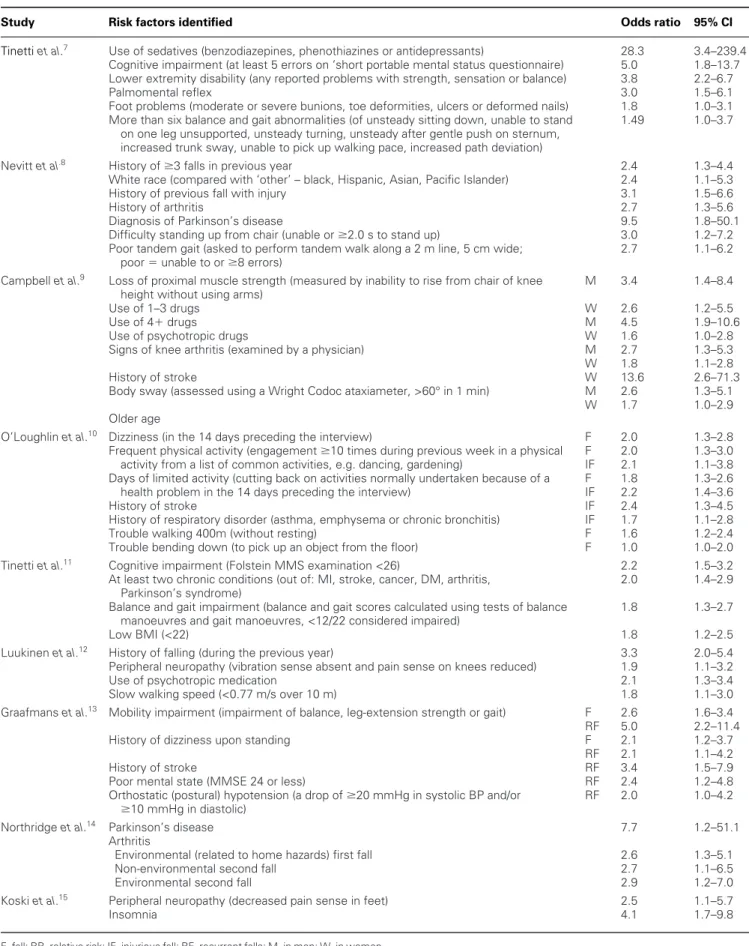
significant risk factors after multivariable analysis (e.g. logistic regression) for each of the included studies are listed in Table 2. The risk factors were ranked (see Methods) within six broad categories (details available from the author). The final items included in part 1 of the FRAT were: history of falling in the previous year, taking four or more prescribed medications, history of stroke or Parkinson’s disease, reported problems with balance and loss of proximal muscle strength (Table 4). History of falling is simple to ascertain and a significant predictor of future falls. Use of four or more medications was associated with a high relative risk of falling in one study. History of stroke or Parkinson’s disease was included as an item because each is a strong independent predictor of falls. The question ‘are there any problems with balance?’ and asking the person being assessed to rise from a chair of knee height without using their arms (used in two of the studies), covered most of the other significant items in the physical functioning category.
Factors that were also identified from the nine prospective cohort studies, but which were subsequently dropped or modi-fied after review were: lower extremity disability (any reported problems with strength, sensation or balance), use of sedatives, history of arthritis and cognitive impairment. The main criteria for exclusion were overlap between risk factors and limited evidence (i.e. significant risk factor in only one study) (details available from the authors).
Part 2 of the FRAT includes guidance on further referral and interventions for those with the following risk factors: (i) history of falling in the previous year, (ii) taking four or more medica-tions per day, (iii) balance and gait problems, (iv) postural hypotension. These were supported by trials of multi-faceted intervention.16–19Additional risk factors that were part of the original candidate list of factors for part 2, but subsequently dropped on review were: diagnosis of stroke, diagnosis of Parkinson’s disease, poor visual acuity and peripheral neuro-pathy. The first two were removed because, although they con-tribute to risk, they are largely addressed by assessing balance and gait; assessment of vision was removed since associations between poor vision and falls in the cohort studies were weak; peripheral neuropathy was removed because, in the pilot study, nurses were not confident about testing sensation.
The first two items in part 2 are the same as in part 1, although in part 2 further methods of assessment are recom-mended for both items. Balance and gait assessment is covered in greater depth. Asking an older person to talk while they walk is a sensitive predictor of future falls in the hospital setting21and is currently under investigation in ambulatory care. The assess-ments of balance and gait were altered after comassess-ments from district nurses who tried to use the draft tool. The ‘timed up and go’ test was originally included because of the association of slower times with poor balance,22but then removed because of difficulties implementing the test within the confines of patients’ homes. It was replaced by the ‘one-leg stand’ test, which is moderately good at predicting falls.23Testing for postural hypo-tension was feasible for part 2 as assessment is by a doctor or
nurse. Guidance on the use of hip protectors in frail ambulatory older people was included in part 2 because of evidence that risk of hip fracture can be reduced by the use of an external hip protector.24 Parts 1 and 2 of the FRAT are presented in the Appendix.
Examination of the positive predictive value of part 1
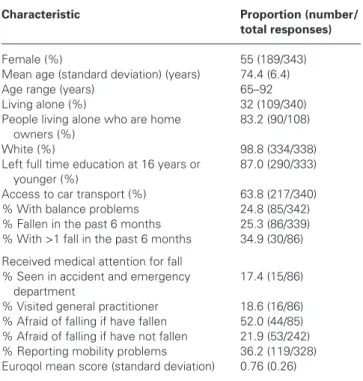
A total of 510 people (51 per cent) responded to the baseline survey. Of these, 345 (67.6 per cent) responded to the second survey 6 months later. The characteristics of these respondents are shown in Table 3. The tool’s ability at baseline to predict falls within the following 6 months which were reported by the respondents in the 6 month questionnaire is summarized in Table 4. The sensitivity ranged from 0.59 (95 per cent CI 0.48–0.70) to 0.15 (0.09–0.26) and the specificity ranged from 0.80 (0.74–0.84) to 0.97 (0.94–0.99), respectively, depending on whether two, three or four or more risk factors were used as the cut-off for increased risk. Youden’s index was similar for two and three risk factors (0.39 and 0.34, respectively), but much lower for four or more risk factors (0.13) (Table 4).
Discussion
The UK National Service Framework for Older People25 rec-ommends identification of those most at risk of falls to prioritize further management. We have developed a pragmatic falls risk assessment tool that can be used by a wide range of care pro-fessionals to identify a group of older people in primary and residential care at high risk of falling.
The presence of three or more of these risk factors may be the most appropriate cut-off point for this screening tool. It has a high specificity (0.92, 95 per cent CI 0.88–0.94) and a positive predictive value of 0.57 (0.43–0.69). That is, over half of those identified as high risk fell during the subsequent 6 months. The positive predictive value is acceptable as the consequences of intervention for those identified as high risk who will not fall in the next 6 months are likely to be beneficial in other ways, although health service resources would be consumed in further assessment. The low sensitivity (0.42, 95 per cent CI 0.32–0.54) and negative predictive value (0.86, 0.83–0.89) means that a negative screen does not exclude risk of falling; 14 per cent of those who were screen negative reported falls compared with 57 per cent who were screen positive.
This preliminary estimation of predictive validity has several limitations. First, part 1 is designed for direct administration by clinicians or social care staff, whereas the validation used data from self-completed postal questionnaires. This is likely to have led to some error in the reporting of the absence or presence of risk factors. Secondly, the high proportion of respondents living alone who own their own homes and the lack of ethnic minori-ties means this sample is not representative of older people throughout the United Kingdom. Thirdly, recall does not neces-sarily measure the true occurrence of falls.26However, in our survey, 6 month recall of falls was comparable with diary card
Table 2Statistically significant risk factors in the nine included studies
Study Risk factors identified Odds ratio 95% CI
Tinetti et al.7 Use of sedatives (benzodiazepines, phenothiazines or antidepressants) 28.3 3.4–239.4
Cognitive impairment (at least 5 errors on ‘short portable mental status questionnaire) 5.0 1.8–13.7 Lower extremity disability (any reported problems with strength, sensation or balance) 3.8 2.2–6.7
Palmomental reflex 3.0 1.5–6.1
Foot problems (moderate or severe bunions, toe deformities, ulcers or deformed nails) 1.8 1.0–3.1 More than six balance and gait abnormalities (of unsteady sitting down, unable to stand 1.49 1.0–3.7
on one leg unsupported, unsteady turning, unsteady after gentle push on sternum, increased trunk sway, unable to pick up walking pace, increased path deviation)
Nevitt et al.8 History of 3 falls in previous year 2.4 1.3–4.4 White race (compared with ‘other’ – black, Hispanic, Asian, Pacific Islander) 2.4 1.1–5.3 History of previous fall with injury 3.1 1.5–6.6
History of arthritis 2.7 1.3–5.6
Diagnosis of Parkinson’s disease 9.5 1.8–50.1 Difficulty standing up from chair (unable or 2.0 s to stand up) 3.0 1.2–7.2 Poor tandem gait (asked to perform tandem walk along a 2 m line, 5 cm wide; 2.7 1.1–6.2
poor unable to or 8 errors)
Campbell et al.9 Loss of proximal muscle strength (measured by inability to rise from chair of knee M 3.4 1.4–8.4 height without using arms)
Use of 1–3 drugs W 2.6 1.2–5.5
Use of 4drugs M 4.5 1.9–10.6
Use of psychotropic drugs W 1.6 1.0–2.8
Signs of knee arthritis (examined by a physician) M 2.7 1.3–5.3 W 1.8 1.1–2.8
History of stroke W 13.6 2.6–71.3
Body sway (assessed using a Wright Codoc ataxiameter, >60° in 1 min) M 2.6 1.3–5.1 W 1.7 1.0–2.9 Older age
O’Loughlin et al.10 Dizziness (in the 14 days preceding the interview) F 2.0 1.3–2.8 Frequent physical activity (engagement 10 times during previous week in a physical F 2.0 1.3–3.0 activity from a list of common activities, e.g. dancing, gardening) IF 2.1 1.1–3.8 Days of limited activity (cutting back on activities normally undertaken because of a F 1.8 1.3–2.6 health problem in the 14 days preceding the interview) IF 2.2 1.4–3.6
History of stroke IF 2.4 1.3–4.5
History of respiratory disorder (asthma, emphysema or chronic bronchitis) IF 1.7 1.1–2.8 Trouble walking 400m (without resting) F 1.6 1.2–2.4 Trouble bending down (to pick up an object from the floor) F 1.0 1.0–2.0 Tinetti et al.11 Cognitive impairment (Folstein MMS examination <26) 2.2 1.5–3.2 At least two chronic conditions (out of: MI, stroke, cancer, DM, arthritis, 2.0 1.4–2.9
Parkinson’s syndrome)
Balance and gait impairment (balance and gait scores calculated using tests of balance 1.8 1.3–2.7 manoeuvres and gait manoeuvres, <12/22 considered impaired)
Low BMI (<22) 1.8 1.2–2.5
Luukinen et al.12 History of falling (during the previous year) 3.3 2.0–5.4 Peripheral neuropathy (vibration sense absent and pain sense on knees reduced) 1.9 1.1–3.2 Use of psychotropic medication 2.1 1.3–3.4 Slow walking speed (<0.77 m/s over 10 m) 1.8 1.1–3.0 Graafmans et al.13 Mobility impairment (impairment of balance, leg-extension strength or gait) F 2.6 1.6–3.4 RF 5.0 2.2–11.4 History of dizziness upon standing F 2.1 1.2–3.7
RF 2.1 1.1–4.2
History of stroke RF 3.4 1.5–7.9
Poor mental state (MMSE 24 or less) RF 2.4 1.2–4.8 Orthostatic (postural) hypotension (a drop of 20 mmHg in systolic BP and/or RF 2.0 1.0–4.2
10 mmHg in diastolic)
Northridge et al.14 Parkinson’s disease 7.7 1.2–51.1 Arthritis
Environmental (related to home hazards) first fall 2.6 1.3–5.1 Non-environmental second fall 2.7 1.1–6.5
Environmental second fall 2.9 1.2–7.0
Koski et al.15 Peripheral neuropathy (decreased pain sense in feet) 2.5 1.1–5.7
Insomnia 4.1 1.7–9.8
recording.4Full validation requires a prospective study where
the tool is administered to older people in the same contexts in which it will be used in practice.
Limitations of cohort studies used to identify predictive
factors
The main source of evidence for our choice of risk factors in our tool was cohort studies and these have limitations when used to develop a falls risk assessment tool. These studies have hetero-geneous population bases, a variety of outcomes (falls, recur-rent falls, injurious falls) and included differecur-rent risk factors. Even when risk factors were ostensibly the same between studies, they were often assessed using different methods, which partly accounts for the inconsistency in results between some of the studies. In addition, none of the studies reported multi-variable analyses using all the factors we finally chose for the assessment tool, so we are not certain that our tool contains the most efficient combination of factors. In eight of the nine prospective cohort studies identified in our review, the
partici-pants lived at home. Consequently, use of the tool in residential care populations is less justified.
The wider trial literature as systematically reviewed in guide-lines1,2supports our choice of factors for part 2 of the tool:
● Falls history: trials of exercise targeting older people with a history of falls resulted in reduced rates of falling.
● Medicine review: reduction in total number of medications or in prescribing of psychotropic drugs is an important com-ponent of multi-faceted interventions in positive falls pre-vention trials.
● Balance and gait problems: trials targeting older people with these and other mobility problems that offered individual-ized exercise programmes showed a reduction in falls. ● Postural hypotension: management of postural hypotension
was part of an effective intervention in two trials.
We believe that following further evaluation, the FRAT may prove useful in the single assessment of older people, as recom-mended in the National Service Framework for Older People.25 Recent Department of Health guidance gives examples of assessment tools and scales.27Three of the recommended tools, Camberwell Assessment for the Needs of the Elderly (CANE), EASY-Care 2002–2005, Functional Assessment Care Environ-ment (FACE), only elicit a falls history or a clinical judgeEnviron-ment of falls risk without guidance on further assessment or manage-ment for people at risk of falling. The fourth (MDS-Home Care) uses a range of risk factors in the initial screen and recommends detailed specialist assessment if any are present.
Impaired vision has traditionally been considered an import-ant risk factor for falls in older people, but our review did not find strong evidence that visual impairment was independently associated with falling. A more recent review,28 with a wider search strategy, found 20 studies that satisfied their selection criteria. The review found that older people with decreased visual acuity and other visual deficits are more likely to have a fall compared with fully sighted populations and more likely to have recurrent and injurious falls. No single intervention studies were identified that developed and evaluated vision-related interventions to reduce the risk of falls or falls injuries, and the effects of vision testing and appropriate referral/treatment in multifactorial interventions could not be isolated. On the basis of this evidence, visual impairment could be included in an assessment tool, probably in the equivalent of our part 2.
In summary, our tool is designed for use by clinical and non-clinical care professionals and is particularly suited to primary Table 3Baseline characteristics of responders to
questionnaire survey used to validate the FRAT
Characteristic Proportion (number/
total responses)
Female (%) 55 (189/343) Mean age (standard deviation) (years) 74.4 (6.4) Age range (years) 65–92 Living alone (%) 32 (109/340) People living alone who are home 83.2 (90/108)
owners (%)
White (%) 98.8 (334/338) Left full time education at 16 years or 87.0 (290/333)
younger (%)
Access to car transport (%) 63.8 (217/340) % With balance problems 24.8 (85/342) % Fallen in the past 6 months 25.3 (86/339) % With >1 fall in the past 6 months 34.9 (30/86) Received medical attention for fall
% Seen in accident and emergency 17.4 (15/86) department
% Visited general practitioner 18.6 (16/86) % Afraid of falling if have fallen 52.0 (44/85) % Afraid of falling if have not fallen 21.9 (53/242) % Reporting mobility problems 36.2 (119/328) Euroqol mean score (standard deviation) 0.76 (0.26)
Table 4Sensitivity, specificity and predictive values of the FRAT
Sensitivity Specificity Positive predictive Negative predictive Youden’s index Threshold for high risk (95% CI) (95% CI) value (95% CI) value (95% CI) (95% CI)
Two or more risk factors 0.59 (0.48–0.70) 0.80 (0.74–0.84) 0.43 (0.34–0.53) 0.88 (0.84–0.92) 0.387 (0.263–0.511) Three or more risk factors 0.42 (0.32–0.54) 0.92 (0.88–0.94) 0.57 (0.43–0.69) 0.86 (0.83–0.89) 0.339 (0.185–0.493) Four or more risk factors 0.15 (0.089–0.26) 0.97 (0.94–0.99) 0.58 (0.37–0.77) 0.82 (0.77–0.86) 0.126 (0.040–0.212)
care. Based on longitudinal studies of falls risk, we prioritized risk factors that can be quickly assessed. Social care workers, primary care professionals, occupational therapists and physio-therapists who piloted the tool found it easy to use routinely. Part 1 of the tool takes at most a few minutes to administer and can be incorporated into other assessments such as primary care health checks or residential home admission assessments, and used opportunistically during a general practice consultation. Preliminary validation suggests the tool has an acceptable positive predictive value and this pragmatic, simple tool may help to identify patients who would benefit from further investi-gation and intervention.
Acknowledgements
Thanks to the people who responded to our questionnaire, colleagues who piloted early drafts of the FRAT, the support of the Romford Primary Care Group and Social Services, as well as to other members of the Falls Guidelines Implementation Steering Group: Anne Spencer, June Crown and Sheila Donovan. Funding by PPP Healthcare Medical Trust.
References
1 Feder G, Cryer C, Donovan S, Carter Y on behalf of the Guidelines’ Development Group. Guidelines for the prevention of falls in people over 65. Br Med J 2000; 321:1007–1011.
2 American Geriatrics Society, British Geriatrics Society and American Academy of Orthopaedic Surgeons Panel on Falls Prevention. Guideline for the prevention of falls in older persons. J Am Geriatr Soc
2001; 49: 664–672.
3 Perell KL, Nelson A, Goldman RL, Luther SL, Prieto-Lewis N, Rubenstein LZ. Fall risk assessment measures: an analytic review.
J Gerontol A Biol Sci Med Sci2001; 56:M761–M766. 4 Falls Implementation Pilot Group. Implementation of
multi-disciplinary guidelines for the prevention of falls in older people: a pilot study.London: Bart’s and The London, Queen Mary’s School of Medicine and Dentistry, 2001.
5 Stalenhoef P, Crebolder H, Knotterus J, Van der Horst F. Incidence, risk factors and consequences of falls among elderly subjects living in the community. Eur J Public Health 1997; 7:328–334.
6 King M, Tinetti M. Falls in community-dwelling older persons.J Am Geriatr Soc 1995; 43:1146–1154.
7 Tinetti M, Speechley M, Ginter S. Risk factors for falls among elderly persons living in the community. N Engl J Med 1988; 319:1701–1707. 8 Nevitt M, Cummings S, Kidd S, Black D. Risk factors for recurrent
non syncopal falls. J Am Med Assoc 1989; 261:2663–2668. 9 Campbell A, Borrie M, Spears G. Risk factors for falls in a
community-based prospective study of people 70 years and older.
J Gerontol 1989; 44:M112–M117.
10 O’Loughlin J, Robitaille Y, Boivin J, Suissa S. Incidence of and risk factors for falls and injurious falls among the community-dwelling elderly. Am J Epidemiol 1993; 137:342–354.
11 Tinetti M, Doucette J, Claus E, Marottoli R. Risk factors for serious injury during falls by older persons in the community. J Am Geriatr Soc 1995; 43:1214–1221.
12 Luukinen H, Koski K, Laippala P, Kivela S. Predictors for recurrent falls among the home-dwelling elderly. Scand J Prim Hlth Care 1995;
13:294–299.
13 Graafmans W, Ooms M, Hofstee H, Bezemer P, Bouter L, Lips P. Falls in the elderly: a prospective study of risk factors and risk profiles.
Am J Epidemiol 1996; 143:1129–1136.
14 Northridge M, Nevitt M, Kelsey J. Non-syncopal falls in the elderly in relation to home environments. Osteoporos Int 1996; 6:249–255. 15 Koski K, Luukinen H, Laippala P, Kivela S. Risk factors for major
injurious falls among the home-dwelling elderly by functional abilities.
Gerontology1998; 44:232–238.
16 Tinetti M, Baker D, McAvay G et al.A multifactorial intervention to reduce the risk of falling among elderly people living in the
community. N Engl J Med 1994; 331:821–827.
17 Close J, Ellis M, Hooper R, Glucksman E, Jackson S, Swift C. Prevention of falls in the elderly trial (PROFET): a randomised controlled trial. Lancet 1999; 353:93–97.
18 Tinetti M, McAvay G, Claus E. Does multiple risk factor reduction explain the reduction in fall rate in the Yale FICSIT trial? Am J Epidemiol 1996; 144:389–399.
19 Close J, Ellis M, Hooper R, Glucksman E, Jackson S, Swift C. Predictors of falls – results from prevention of falls in the elderly trial (PROFET). Age Ageing 1999; 28:S1–S14.
20 Youden WJ. Index for rating diagnostic tests.Cancer1950; 3:32–35. 21 Lundin-Olsson L, Nyberg L, Gustafson Y. ‘Stops walking when
talking’ as a predictor of falls in elderly people. Lancet 1997; 349:
617.
22 Podsiadlo D, Richardson S. The timed ‘up & go’ test: a test of basic functional mobility for frail elderly persons.J Am Geriatr Soc 1991;
39:142–148.
23 Vellas BJ, Wayne SJJ, Romero Let al. One-leg balance is an
important predictor of injurious falls in older people. J Am Geriatr Soc
1997; 45:735–738.
24 Parker MJ, Gillespie LD, Gillespie WJ. Hip protectors for preventing hip fractures in the elderly (Cochrane Review) In: The Cochrane Library, Issue 2, 2002. Oxford: Update Software, 2002.
25 Department of Health. National Service Framework for Older People: modern standards and service models.London: Department of Health, 2001.
26 Cummings SR, Nevitt MC, Kidd S. Forgetting falls. The limited accuracy of recall of falls in the elderly. J Am Geriatr Soc1988; 36:
613.
27 Department of Health. Single assessment process. Assessment tools and scales.London: Department of Health, 2002.
28 Legood R, Scuffham P, Cryer C. Are we blind to injuries in the visually impaired? A review of the literature. Inj Prev2002; 8:155–160.