Automated
chemical
synthesis.
Part
2:
Interfacing strategies
Daniel
F. Chodosh,
Francis
E.
Wdzieckowski,
Julius Schainbaum
and Charles
E.
Berkoff
Smith Kline
&
FrenchLaboratories,Inc.,
PreclinicalResearch&
Development, 1500 Spring GardenStreet,
Philadelphia, Pennsylvania 19101, USA.
Researchfocusedlargelyondevelopingnew, highly automated
tools for theprocessdevelopment laboratoryiscarried out in the
authors’ laboratory. The abilityto evaluate, characterize and
optimizesynthetic routes, bothquicklyandcomprehensively,is
especially important in the pharmaceuticalprocessdevelopment
laboratory, where typically in a complex synthetic sequence
manyreactionparametersmustbeexamined.Furthermore,the
rapidelucidation ofprocess routes details and idiosyncrasies
will allowthe synthesis ofnewmaterialsintendedforextensive preclinical and clinicaltesting toproceed by ’final. chemistry’, whereevenslightchangesinprocessconditionscanaffecttrace
impurity profiles. Increasing attention is being given to the
opportunities generated by computers to enhance the
pro-ductivity of these laboratories
[1-2].
On the pilot and production scale, batch-reaction auto-mation instrumentation and technology employing fully and semi-distributedcontrol schemes arewidelyavailable
[3-6].
Onthe laboratory scale, however,most researchers havepursued
automation of continuous-flow techniques
[7-9].
The automated chemical synthesis project described here entailsdesigning and constructingacomputer-controlled,bench-scale
batch-typereactor, whichiscapableofself-directing
experimen-tation andoptimization
[9-15].
Such a systemwould permit extensive, and often tedious, examination of chemical reactions in quiteearlystages of theirdevelopment. Experimentationon the bench-scale in batch-type reactors will allow chemical reactionandprocesscontrol data tobe obtained,subsequentlythis willbe directly applicabletothepilotand production scales.
Further, byminimizing the size of the vessel, scarce
develop-mental quantities of chemical intermediatescanbeconservedas automation technologyis appliedatthe veryearlieststagesof
processdevelopment programmes.
A
prototype unitwas constructed topermita closeevalu-ation of various automation parameters: reactor design,
temperature control, reagent delivery, chemical analysis.and
computer interfacing. The unit consisted of a 100ml glass
(jacketed) vessel with ports for a condenser, stirrer bearing,
temperaturesensor,reagentinlet,reactionsampling andadrain.
Reagent
and solventwereintroduced intothe vesselbypositivedisplacement pumps; temperaturewascontrolled by mixinghot
andcoldfluidsandcirculatingthe mixturethrough the vessel jacket; sampleswereremoved and diluted (usingaTechnicon AutoAnalyser pumpingsystem)forsubsequenton-line analysis
by HPLC.
A
timesharecomputing system(a
Digital EquipmentCorporation
PDP11/34 RSTS)was
usedtocalculatethe various operational parameters (stoichiometry, temperature, reactiontime)accordingto asimplex experimental design. The chemical
analysis results were reported back to the RSTS resident
programwhichthen calculatednewreaction parameters.
For
adetailed description of these systems the readerisreferred to the
preceding paperin this series
[-16].
Throughthispreliminary effort the projectwasshown to be
suitably viable andasystem-by-systemevaluation and redesign wasinitiated.Instrumentreliabilitywasofparticularconcern;
self-checking and fail-safe features also became fundamental
considerations in the redesign efforts.
To
achieve greater reliability andmoreprecise"control the transfer of informationbetweenthecomputationalsystem and theautosynthesis system
wasalso scrutinized
[17-19].
Theprototypeunitemploysa timesharedcomputerto
calcu-late reaction operating parameters. TheRSTSresidentprogram
(in this case, a simplex optimization algorithm
[10
and14])
communicatesvia asingleseriallink
(modem)
tothelaboratory(see
figure1).
This timeshare environmentdoesnotsupportreal-time functions, so it is not possible to place time-dependent
instrument-controldemands on the computing system. Once
reaction parameters(time, temperatureset-point,stoichiometry)
are calculated they are passed to local digital controllers for
execution.Theflowof informationisunidirectional,fromRSTS
tothe controller. Each controller must be ’hardwired’ toaccepta
parameter and independently actuate the requisite control
function.For example,thereagent deliverycontrolleracceptsa serial string ofASCIIcharacterscorrespondingtothe number of
required pumprevolutions. Thecontroller then activates the
indicatedpumpuntilahardwiredfeedback loopcounts off the
appropriatenumber ofpumprevolutions.The controllerthen
deactivates the pump. The delivery rate of the pump, once
manually set, remains fixed throughout the course of the
experimental run. The computer system does not access
in-formation regarding the overall integrity of the synthesis
apparatus
(for
example, reagentreservoirdepletion,line fatigueor rupture, viscosity
effects),
or the completion status oftheoperation itself.
In
each casethe instrument-controlalgorithmis fixed by the electronic design of the controller device. Each controller must be designed to communicate, albeitunidirec-tionally,with thecomputerinthe identicalmanner(viaserial
modem),
regardless ofitscontrol function or signalcomplement.Whilemoresophisticatedlocal controllers can beconstructed,
CPU PDP11 RSTS
Figure
1. system. O C e Temperature control unit Pump controlunit Sensor *-Actuator LCdetector controlunit Sensor *-Actuator Sensor ModemAnalogue information transfer Digital informationtransfer
Prototype
unit:interface
totimeshare computerD.F. Chodoshetal.Automatedchemicalsynthesis.Part2
this timeshare automation approach constrains the overall
system bylimiting the computer-synthesis systems to strictly non-timecriticalordependentinteractionsandtoamodestdata
collection.
By
abandoning timesharingfor real-timecomputing,signifi-cantadvantagescanbe realized both in instrumentdesignand
performance.
In
recent years well-packagedmicroprocessor-based systems, complete with signal-acquisition interfaces
(analogue-to-digital, digital-to-analogue, parallel
I/O, etc.),
have become available at reasonable cost. The capability to
directly coupledata signals between the synthesisapparatusand
the computing system,through appropriate interfaces, totally
redefines theautomation problem
(see
figure2).
Whereas,formerly,elementsofdecision-makingwere
hard-wired inthevariouscontrollers
(for
example,P
versusPI
versusPID
temperaturecontrol),
decision-makingcan nowbe softwareresident. Changes to automation-control strategies can be implementedthroughfacilesoftwaremodification,asopposed
tohardware modifications
and/or
redesignoftheautosynthesiselectronics.
However,
semi-distributedcontrol elements arenot necessarily avoided--indeed, certainaspectsof thetemperaturecontrol and fail-saferecoveryautomation in this systemrelyon semi-distributed control functionality. Rather, various auto-synthesis systems can be selectively engineered through the
range ofnon-distributed to semi-distributed--dictatedonly by
thespecificcontrolproblemathand.
In
this computing environment, substantially greaternumbers of signalsareavailableto themicroprocessorfordata
collectionandinstrumentcontrol. With suitablemass-storage
devices, the dedicated microcomputer is capable of extensive
data collection whichisinaccessibletothe time-share environ-ment.Thusdata become available forarange of administrative and scientific tasks: for example, report writing, instrument activity logs, kinetic modelling studies, response surface mapping, cost analysis and impurity profiling.
By
choosinga real-time computing environment precise instrument controlwithauto-calibratingauto-correcting featuresisachievable. The
experimentation can be self-directing, where the chemical
analysis results of experimentNareused to calculate theN
+
setof experimental conditions to be evaluated.Further, by
real-timemonitoringofthe autosynthesis,electromechanical
hard-ware system integrity can be assured allowing unattended
operation;thisprovidesbetteruseofstaff and costsavings.
Parallel interface
Decoder Actuator Actuator Sensor
Decod;r
SensorFail-saferecoveryprocedureswereof fundamentalconcern
throughout the re-evaluation. Assuming that the requisite
automation hardware is present, verification of proper
operation can bedesigned into theautomation software. For
example signals from flow monitors can be used to verify
pump/syringeoperations.Powerfailuresand computer
drop-outsituationspresentadditionalchallengestothedesigner. To
avoid a catastrophe in the laboratory the apparatus should
defaultto aquiescentstateuntil either automatic(i.e. computer)
ormanual recovery stepscanbe executed.
A
general-purposeinterfacewasconstructed to providefail-safeprotections.
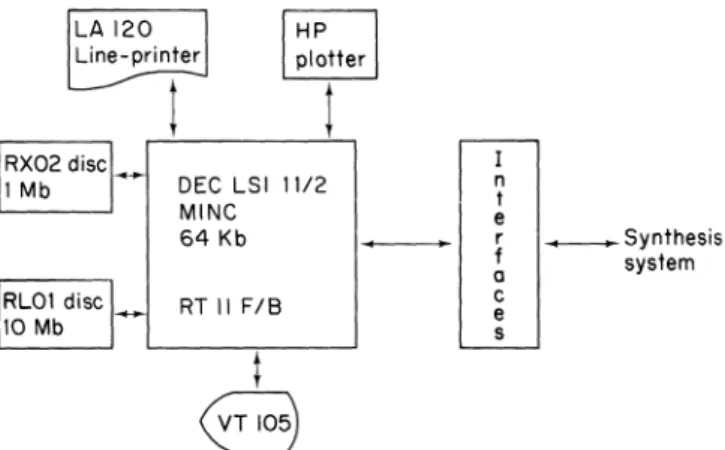
A
Digital Equipment Corporation MINC LSI11/2
com-puter and associated interfaces were selected for the authors’
application. Thesystemconfigurationincludesadualharddisc
storage system
(RLO 1),
floppydiscs(RXO2),
aVT105 graphicsCRT andaline-printer
(shown
infigure3).
TheMINCinterfacesprovide excellent signal-handling capabilities:
A/D
(12
bit,successiveapproximation),
D/A
(12
bit, uni-and bipolar), digitalinput andoutput (16-bitregisters) andaprogrammableclock. Thereal-time
foreground/background
operatingsystem(RTll
V4
F/B)
providesreal-timecomputing capacityand accesstoasetofcomprehensivescientific programlibraries.
Instrument-control anddata-acquisitionsoftwareiswritten inFortranwith real-time extensions
(REAL-11/MNC).
To utilize the digitalinput andoutputinterfaces itwasnecessaryto augmenttheir functions. To protect the computer system from electrical anomalies(induction effects, sparking)thesesignallinesmustbe optically decoupled from the synthesis apparatus. The
TTL
signals availablethrough the digital output interfaces
(2
x16bits),whilecapableof interfacing to semiconductor logic, cannot
directlycoupletodevicessuch as motorsorsolenoids. The
opto-LA120 Line-printer I/
plotter
DEC LSI 11/2 MINC 64 Kb RTII F/B Synthesis systemFigure
3.
Dedicated
real-time computerconfiguration.
CPU Analogue-to-digital interface
Oecoderl
Sensor Sensor LS1 11/2 RT11 Digital interface-t-nalguell
Decder Serial interfaceRsTs
Actuator ActuatorAnalogue informationtransfer Digital informationtransfer
Figure 2.
Autosynthesis
system:interface
todedicated
computer system. TTLinput CPU Figure
4.
diagram.
Auto Manual H/L switch Voltage ADd TTL VAC VDC HI TTL HIILO
TTLLO HI[
12o VAC 0 VAC HI[
O-28VDC 0 VDCOpto-isolator
interface:
single channel block
isolator interface wasdesignedtoaddnewfunctions to these
I/O
interfacesandprovidemany of thedefaultsafeguards required.
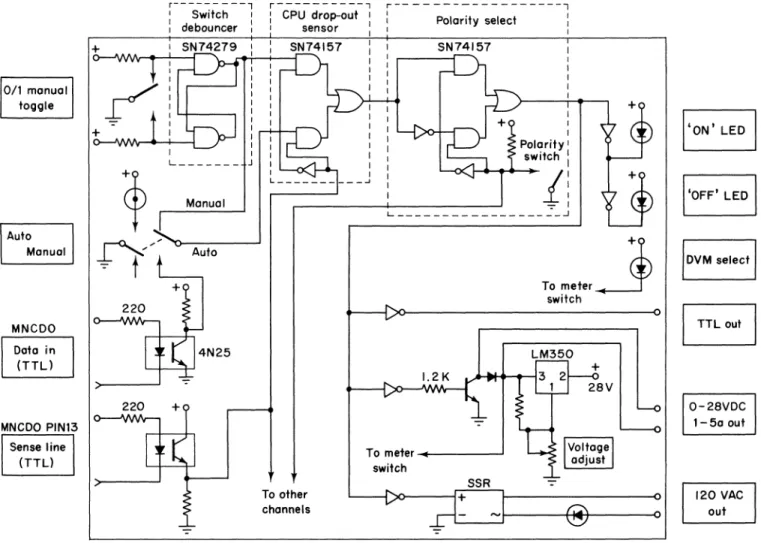
As
shown infigure4,theopto-isolatorinterface acceptsTTL
signalsfroma 16-bitparalleloutput interface. Eachsignal line
(i.e.
bit)
is electrically decoupled via an opto-isolatorsemi-conductor and propagated through the interface
simul-taneously, making available three signals for the synthesis
apparatus:
TTL,
VACandVDC.When theTTL
inputislow theoutputsonthe indicatedchannelareall low:
TTL
low, O VACand OVDC.
A TTL
input high produceshigh outputstates:TTL
high, 120VACandVDC.The d.c.voltagelevel in thehighstateismanually selected by adjustingapotentiometeroneach
channel.
(The
interfacehas a panelmeter for voltageadjust-ments.)
To operatea24VDCsolenoidtheusersetsthe indicatedinterface channel to 24
VDC;
when the computer system generatesaTTL
high signaltheoutput oftheselectedchannelchanges from 0 to 24 VDC driving the solenoid. Thevoltage
range,0-28
VDC,
allowsawide variety of direct current devicestobe interfaced easily and quickly. The individual channels have
AUTO/MANUAL
switches that select the channel inputsource.
In
the AUTO mode, the computer-generated signaldrives the channel and determines the output state.
In
theMANUAL
mode atoggle switchon each channel allows theuser toselecttheoutputstate; with thisarrangementsomeof the
channels can be driven by the computer while others are
manually operated--thisisusefulduringthetesting and
devel-opmentof the automationsoftware.To address the problemof
computer drop-out, a ’sense line’ couples the interface to a
computer-generated
TTL
source.As
long as the ’sense line’remainshightheopto-isolatorinterfaceoperatesas described
above. Should the ’senseline’ go low, the
AUTO/MANUAL
switch isoverriddenandtheoutputsare setbythepositionofthe
toggleswitches.Thisprovidessubstantialdefaultprotections for
the system. For example, the power-supplies for the heater systemsaredrivenviathe 120VAC outputsof the interface. The
operator leaves the appropriate toggle switches in the OFF
position and selects the AUTO mode for normal computer
operation.Should thecomputer dropout(i.e.the’senseline’go
low),
the interface defaults to turn off thepower-supplieswhichin turn prevents uncontrolled heating.
In
a similar fashion,defaultsettings for thevalves,motors andsolenoidsprotectsthe
synthesis apparatus from catastrophe.
An
additional 16-bitparallel output register is optically isolated and propagated
(TTL
output),as is a 16-bitparallelinputregister
(signalsfromthe apparatus to the computer system) making available
additional 16
TTL
input and 16TTL
outputsignals. Finally,atrue-positivetrue-negative switch forlogic polarityinversionis
provided to assuregeneral compatibilitywithother computer
systems.
A
schematic diagram of one channel is shown asfigure 5.
This computer environment and the interfaces described
have sufficient signal- and data-handling capabilities for the automationexperiment.Withthe addition of theopto-isolator
interface, sufficient safeguards can be engineered into the
laboratory apparatustopermitreliableunattendedoperation.
Thedesignof the synthesisapparatusitself, its interfaces to the
computer and the automation software, will be described in future papers. 0/1 manual toggle Auto Manual MNCDO Data in (TTL) MNCDOPIN13 Senseline (TTL} r
Switch CPU drop-out
debouncer sensor
+
Manual+
22014N25
220+q
SN74279 SN74157 Polarity select SN741571
+
Toother channels To meter switch LM550--TOswitchmeter
-.__
adjust SSR---’ON’
LED’OFF’
LED DVMselect TTLout O-28VDC 50out 120VAC outD.F.Chodoshetal.Automatedchemicalsynthesis.Part2
References
11. 12. 13.
1. WALSER,P.E.andBARTELS, H.A.,AmericanLaboratory(1982), 113.
2. FRAZER,J.W., Accounts
of
ChemicalResearch, 7(1974),141. 3. BRODMANN,M. T.andSMITH,C. L.,Chemical Engineering, 83(1976), 191.
4. KENNEDY, J. P.,Chemical EngineeringProgress,77(1981),33. 5. MERRITT, R.,Inst.Cont.Sys. (1981),34.
6. GARTON,R.D.,Chemical EngineeringProgress,77,(1981),44. 7. NAGY, G., FEHER, Z.andPUNGOR,E.,Analytica ChimicaActa,52
(1970),47.
8. SPELLMAN, R. A. and QUINN, J. B., AIChE Workshop in IndustrialProcessControl,Tampa,Florida(November 1974). 9. FRAZER, J.W., RIGDON, L. P., BRAND, H. R.andPOMERNACKI,
C.L.,Analytical Chemistry,51(1979), 1739.
10. DEAN, W. K., HEALD, K.J. andDEMNG,S.N.,Science,189(1975), 805.
DEMING,S.N.,AmericanLaboratory(1981),42. Box, G. E.P.,Biometrics, 10(1964),16.
FRAZER,J.W., KRAY, A. M., SELIG, W.and LIM, R.,Analytical Chemistry47 1975), 869.
14. DEMrNG, S.N. and MORGAN, S. L., Analytical Chemistry, 45 (1973),278A.
15. WATSON,M.W.andCARR, P.W.,AnalyticalChemistry,51(1979), 1835.
16. WrNICOV, H., SCHAINBAUM, J.,BUCKLEY,JR.,J.T.,LONGINO,G., HILL, J.andBERKOFF, C.E.,AnalyticaChimicaActa,103(’1978), 469.
17. CHODOSH, D. F., WINICOV, H.,BUCKLEY,JR.,J. T. and BERKOFF, C.E., Computers
at’the
bench (BelgianPharmaceuticalSociety International Conference on Computers in Pharmaceutical Research,Namur,Belgium, November 1979).18. CHODOSH, D. F.,1979FallD.E.C.U.S. Symposium, Workshop onLaboratoryAutomation,SanFrancisco(November 1978). 19. CHODOSH, D. F., BUCKLEY, JR., J. T., LONGINO, G.,
SCHAINBAUM, J., WDZIECZKOWSKI, F. E., WINICOV, H. and BERKOFF, C.E.,MINC interfacing(1981 D.E.C.U.S.Symposium, Los Angeles,December1981).
READER
ENQUIRY
SERVICE
Each advertisement and each editorial item in the
Product News section in Journal
of
AutomaticChemistrycarriesanumber whichcorrespondswith a
numberontheReader EnquiryCardboundintoevery
issue.
Ifthere are anyitems on which you would like
furtherinformation,circle therelevant numberonthe
card,indicatethevolumeandissuenumber,fill inyour
nameandfulladdress,and return the card toTaylor
&
Francis Ltd.
Your
cardwillthenbe forwarded tothecompany/ies concerned foraction.
Through using the Reader Enquiry Service, you can
obtain
information
on a varietyof
products throughone simpleoperation.GAS
RESEARCH
CONFERENCE
More than100papersonavarietyof topics involving
gasresearch will be
presehted
anddiscussedduringthe 1983 InternationalGas
Research Conference whichwilltake placeatthe LondonHilton Hotelfrom13-16
June.
Thisisthefirsttimethat thisconferencehasbeenheld outside the United States.
Sponsors
of theconference arethe Gas ResearchInstitute, the
Inter-nationalGas Union, the American Gas Association
and the United States
Department
ofEnergy.
The British Gas Corporation and the Institution ofGasEngineers will act as hosts.
The five broad categories into which papers
are divided cover: distribution and transmission; substitute natural gas; domestic and commercial utilization; industrial utilization;andthermophysical
properties and processes.
In
additiontherewill beanopening address bythe Chairman ofthe BritishGas
Corporation,SirDenisRooke;andkeynote speeches
by Christoph Brecht
(FR
ofGermany),PresidentoftheIGU; George
H. Lawrence(USA),
President of theAGA;
andHenry
R.Linden(USA),
President of theGRI. Other speakers will include Ulf Lantzke
(France),
Director General of theInternationalEnergy
Agency;
SirHermann Bondi(UK),
Chairman of the Environment Research Council; and JohnKean
(USA),
Vice-President oftheIGU.English andFrench will be the officiallanguages of
theconference,with simultaneoustranslation facilities
for all technicalpapers.
Registration feefordelegatesis290;an
accompany-ing
persons’
programme isavailablefor 80.Full details
of
the technical programme, tours, hotelinformation
andregistrationforms
are availablefrom:
InternationalGasResearchConference, e/o
Conference
Services Ltd, 3-5 Bute
Street,
London SW7 3EY. Tel.: 01 584 4226.EDITORIAL NOTE
The Editor ispleasedto receive newbooksonchemical automationandmechanization. Reviewcopiesshould be sent to:
Dr Peter Stockwell, Plasma-Therm Ltd, Unit 3,
2/3
Kangley Bridge Road, Lower Sydenham, LondonSE265AR.
Submit your manuscripts at
http://www.hindawi.com
Hindawi Publishing Corporation
http://www.hindawi.com Volume 2014
Inorganic Chemistry International Journal of
Hindawi Publishing Corporation
http://www.hindawi.com Volume 2014
Photoenergy
Hindawi Publishing Corporation
http://www.hindawi.com Volume 2014
Carbohydrate
Chemistry
International Journal of
Hindawi Publishing Corporation
http://www.hindawi.com Volume 2014
Journal of
Chemistry
Hindawi Publishing Corporation
http://www.hindawi.com Volume 2014 Advances in
Physical Chemistry
Hindawi Publishing Corporation http://www.hindawi.com Analytical Methods in Chemistry Journal of Volume 2014 Bioinorganic Chemistry and Applications
Hindawi Publishing Corporation
http://www.hindawi.com Volume 2014
Spectroscopy
International Journal of Hindawi Publishing Corporationhttp://www.hindawi.com Volume 2014
The Scientific
World Journal
Hindawi Publishing Corporationhttp://www.hindawi.com Volume 2014
Medicinal ChemistryInternational Journal of
Hindawi Publishing Corporation
http://www.hindawi.com Volume 2014
Chromatography Research International Hindawi Publishing Corporation
http://www.hindawi.com Volume 2014
Applied ChemistryJournal of
Hindawi Publishing Corporation
http://www.hindawi.com Volume 2014
Hindawi Publishing Corporation
http://www.hindawi.com Volume 2014 Theoretical Chemistry Journal of
Hindawi Publishing Corporation
http://www.hindawi.com Volume 2014
Journal of
Spectroscopy
Analytical Chemistry
International Journal of
Hindawi Publishing Corporation
http://www.hindawi.com Volume 2014
Journal of
Hindawi Publishing Corporation
http://www.hindawi.com Volume 2014
Quantum Chemistry
Hindawi Publishing Corporation
http://www.hindawi.com Volume 2014
Organic Chemistry International
Electrochemistry
International Journal ofHindawi Publishing Corporation
http://www.hindawi.com Volume 2014
Hindawi Publishing Corporation
http://www.hindawi.com Volume 2014