Secure Cloud Storage Hits Distributed String
Equality Checking: More Efficient, Conceptually
Simpler, and Provably Secure
Fei Chen
∗¶, Tao Xiang
†, Yuanyuan Yang
‡, Cong Wang
§, Shengyu Zhang
¶∗Department of Computer Science and Engineering, Shenzhen University. Email:[email protected]. †College of Computer Science, Chongqing University. Email: [email protected].
‡Department of Electrical and Computer Engineering, Stony Brook University. Email: [email protected]. §Department of Computer Science, City University of Hong Kong. Email: [email protected].
¶Department of Computer Science and Engineering, The Chinese University of Hong Kong. Email:[email protected].
Abstract—Cloud storage has gained a remarkable success in recent years with an increasing number of consumers and enterprises outsourcing their data to the cloud. To assure the availability and integrity of the outsourced data, several pro-tocols have been proposed to audit cloud storage. Despite the formally guaranteed security, the constructions employed heavy cryptographic operations as well as advanced concepts (e.g., bilinear maps over elliptic curves and digital signatures), and thus are inefficient to admit wide applicability in practice. In this paper, we design a novel secure cloud storage protocol, which is conceptually and technically simpler and significantly more efficient than previous constructions. Inspired by a classic string equality checking protocol in distributed computing, our protocol uses only basic integer arithmetic (without advanced techniques and concepts). As simple as the protocol is, it supports both randomized and deterministic auditing to fit different applications. We further extend the proposed protocol to support data dynamics, i.e., adding, deleting and modifying data, using a novel technique. As a further contribution, we find a systematic way to design secure cloud storage protocols based on verifiable computation protocols. Theoretical and experimental analyses validate the efficacy of our protocol.
I. INTRODUCTION
With the increasing popularity of cloud computing, the security of cloud storage has recently drawn considerable attention from the research community [1]–[7]. Various pro-tocols with different strengths and weaknesses which can check the integrity of outsourced data have been proposed for securing cloud storage [1]–[7]. One can categorize the existing protocols from different perspectives. When functionality is concerned, some protocols do not support full data dynamics [1]–[3], [7], while the others do [4]–[6]. From the security perspective, some protocols rely their security on standard model [1], [2], [6], while others assume the random oracle model (ROM) [3]–[5]. From the technical perspective, some protocols employ only basic number theoretic operations [1]– [3], [7], while others build heavily on bilinear parings over
The corresponding author is Tao Xiang ([email protected]).
elliptic curves [4], [5]; these different techniques incur differ-ent efficiency.
For practical applicability of cloud storage with protection for users against potentially malicious clouds, one desires protocols without heavy cryptographic operations yet still efficient and able to support data dynamics and third-party auditing. In this paper, we provide a provably secure cloud storage protocol with conceptual and technical novelty. At the same time, the protocol does not need any heavy cryptographic operation, yet supports data dynamics under a malicious cloud. Our protocol is inspired by a classic protocol solving the string equality checking problem in communication com-plexity of distributed computing [8], [9]. Our protocol runs basically as follows: 1) we model the data as a vector in some vector space; 2) when the user checks the availability and integrity of the outsourced data, the user asks the cloud to compute an inner product of the data with some challenge vector in a “verifiable” way; 3) the verifiability of the inner product ensures the integrity of the cloud storage.
Our protocol enjoys several merits. First, it is veryefficient
because it involves only integer additions and multiplications, which enables a fast implementation. Besides, our protocol is conceptually and technically very simple and does not rely on heavy cryptograhic operations. The proposed protocol only uses inner product of the input string and some randomly chosen strings together with pseudorandom functions. Further-more, our protocol isprovably secureunder a formal definition with real-world motivations of security.
We further propose a novel method for supporting data dynamics. In the protocol design, we associate with each data block a unique sequence number to ensure verifiability of outsourced data in the cloud. Supporting data insertion and deletion is pretty challenging when modeling the cloud as malicious. To solve the data dynamics problem, we employ two ideas: the first is to increase the sequence number all the time whenever new data is inserted; the second is to re-normalize the sequence number periodically such that no
sequence number gap exists when data blocks are deleted. The re-normalization operation is achieved by sending carefully designed update messages. This method for supporting data dynamics is novel and efficient.
Next, we step further and find a generic framework for designing secure cloud storage protocols in a systematic way based on verifiable computation protocols [10]. This can be used to automatically transform previous protocols to new ones with desirable security properties.
To summarize, we make the following contributions: 1) We propose a novel and efficient secure cloud storage
protocol which enjoys both conceptual and technical simplicity. We connect the secure cloud storage problem to the canonical distributed string equality checking problem.
2) We introduce a new technique to support data dynamics, including adding, deleting and modifying data blocks, which only requires constant-size user-side cache. The communication cost incurred can be amortized for fre-quent data updates.
3) We formally prove the security of the our protocol under a practical security definition. More importantly, we find a systematic framework to construct secure cloud storage protocols based on verifiable computation proto-cols. Theoretical and experimental analyses validate the efficacy of our protocol.
The remaining of the paper proceeds as follows. Section II first models the secure cloud storage problem, and then proposes a solution framework and a formal security defini-tion. Section III details the design of the secure cloud storage protocol, which is followed by the security and performance analysis in Section IV. Section V shows how to extend the protocol to support data dynamics. Section VI shows a systematic way to design secure cloud storage protocols based on verifiable computation protocols. Section VII presents the experimental evaluation of the proposed protocol. Section VIII reviews related work. Finally, Section IX concludes the paper.
II. PROBLEMFORMULATION A. System Model & Threat Model
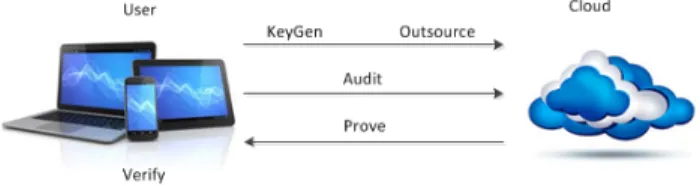
Abstracting from the real-world usage of a cloud, we model the secure cloud storage problem as in Fig. 1. Two entities are involved: user and cloud. A secure cloud storage system runs as follows: The user outsources the data to the cloud. Later, to verify whether the outsourced data remains intact on the cloud, the user may send audit queries any time to the cloud to verify the integrity of the outsourced data. On each audit query, the cloud is supposed to “prove” to the user compactly that the data is well stored in the cloud. Then, the user verifies whether the cloud’s “proof” is indeed correct to know whether the data is damaged.
Similar to previous work [1]–[3], [6], [7], we model the cloud as malicious due to internal/external attacks, aiming at stronger security and wider applicability. A malicious cloud can deviate the protocol in arbitrary ways. We focus
Fig. 1. System Model for Verifiable Cloud Storage.
on integrity of the outsourced data. For confidentiality and authentication, we assume they are well protected using other mechanisms, e.g., secure encryption algorithms and MACs. Our main goal is to devise novel, efficient, elementary, and provably secure protocols to ensure the integrity of the out-sourced data.
B. Solution Framework & Security Definition
We employ the same framework and security definition for a basic secure cloud storage protocol as previous work [1]–[7]. Let an integer λ denote the security level and D denote the data to be outsourced. A secure cloud storage protocol, denoted asSCS, comprises five algorithm components (Key-Gen, Outsource, Audit, Prove, Verify). It runs as follows:
• KeyGen(1λ)7→K: On input a security levelλ, the user
runs this algorithm to generate a secret keyK.
• Outsource(D;K) 7→ D0: On input the data D to be outsourced and the secret key K, the user runs this algorithm to obtain the outsourced dataD0.
• Audit(K)7→χ: The user runs this algorithm to generate
an audit query χand sends it to the cloud.
• Prove(D0, χ) 7→ Γ: On receiving an audit query χ, the
cloud runs this algorithm to output a “proof” Γ, which was then sent to the user, with the aim to convince the user that the data is well stored in the cloud.
• Verify(χ,Γ;K)7→ {0,1}: On receiving a proof Γ from the cloud, the user runs this algorithm to check whether the returned proof is correct. The algorithm is supposed to output 1 if the data remains intact, and to output 0 otherwise.
We now formally define the security for a SCS protocol. We say a pair(χ∗,Γ∗)is a forgery ifΓ∗is not computed using D0 for the query χ∗. A forgery models the malicious cloud’s behavior. Let A denote a malicious cloud and Pr[Cheat]
denote the probability of a malicious cloud that successfully finds a forgery after sufficient learning of the protocol. Then,
Pr[Cheat]can be computed as
Pr KeyGen(1λ)→K Outsource(D;K)→D0 Audit(K)→χi Prove(D0, χi)→Γi Verify(χi,Γi;K)→δi i= 1, . . . ,poly(λ) : A(D0, χi,Γi, δi) outputs a forgery(χ∗,Γ∗) (1)
where poly(λ) is an arbitrary but fixed polynomial in the security level λ. The left part before the colon ”:” of Eq. (1) denotes the capability of the cloud and the right part captures a malicious cloud’s malicious behavior. LetB be a user that
wants to recover the original data from the interaction with the malicious cloud. Let Pr[Recover] denote the probability of a successful recovery of the data. Then, Pr[Recover] can be computed similarly Pr KeyGen(1λ)→K Outsource(D;K)→D0 Audit(K)→χi Prove(D0, χi)→Γi Verify(χi,Γi;K)→δi i= 1, . . . ,poly(λ) : B(K, χi,Γi, δi) outputsF∗ andF∗=F (2)
where the left part before ”:” denotes the interaction between the user and the malicious cloud and the right part models a successful data recovery. We introduce a useful concept before presenting the formal security definition. A function f(λ) is negligible in λif f(λ)< 1
poly(λ) for every polynomial in λ
as λtends to positive infinity, denoted asf(λ) = negl(λ). Definition 1. A secure cloud storage protocol SCSis secure if Pr[Cheat] = negl(λ)and Pr[Recover] = 1−negl(λ). C. Preliminary
In the design of our secure cloud storage protocol, we use a tool pseudorandom functionswhich is the only cryptographic tool employed in this paper. Let PRF={FK(·)} be a set of deterministic functions indexed by K, mapping some input domain X to output image Y. Intuitively, a deterministic function PRF={FK(·)} is said to be pseudorandom if any polynomial time algorithm cannot distinguish it from a truly random function. Please refer to [11] for more details on security definition of pseudorandom functions. In practice, a secure encryption algorithm or a keyed hash function can be used as a pseudorandom function.
We also fix some notations for use later. Let p denote a prime number andZp denote the set{0,1, . . . , p−1}andZ∗p the set {1, . . . , p−1}. For anyg∈Z∗p, it holds that gp−1=
1 modp, which is a basic fact in number theory. LetDdenote the data to be outsourced and FK(·) denote a pseudorandom function mapping integers toZp.
III. DISTRIBUTEDSTRINGEQUALITYCHECKINGBASED
PROTOCOL
In this section, we detail the design of an efficient, simple, and provable secure cloud storage protocol by leveraging a traditional distributed string equality checking protocol. By efficiency, we seek that the user’s and cloud’s computation and communication cost should be as small as possible. By simplicity, we aim that all the operations in the protocol should be elementary and no bilinear parings or digital signatures are needed. Most importantly, we expect a protocol with confident security guarantee. We first present the basic idea of the proposed protocol; then we show the details of the protocol.
A. The Basic Idea
The basic idea of our protocol design is to model the secure cloud storage problem as a variant of the distributed string equality checking problem, and then transform a classical solution for the latter to a solution for secure cloud storage.
1) Distributed String Equality Checking Primitive: A dis-tributed string equality protocol can enable two parties pos-sessing two strings (e.g., messages) in a network to find whether their strings are equal [8] with minimum communica-tion cost. The problem setup is as follows. Alice and Bob are two entities in a distributed network. Alice has ann-bit string x∈ {0,1}n and Bob also has such a string y ∈ {0,1}n. To complete a distributed computation task cooperatively, Alice and Bob want to know whether their two stings are equal by communicating to each other. The question is that how many communication bits are at least needed to finish the task.
We now present a classical protocol for enabling distributed string equality checking. This protocol is very simple since it only involves inner product computations. Suppose there is a public random string pool Z ⊆ {0,1}n with size O(n). A classical protocol withO(logn)communication bits works as follows [9]:
• Alice chooses a random string z ∈ Z in the pool and
sends the index to Bob. Alice also sends the inner produce
hx, zimod 2.
• Bob also computes hy, zimod 2 and checks whether
Bob’s result is equal to Alice’s resulthx, zimod 2. If not, Bob tells Alice that the two strings are not equal and the protocol aborts. Otherwise, the protocol continues.
• Alice and Bob repeat this process 100 times. Ifhx, zi=
hy, zi all the time, Bob reports that the two strings are equal and the protocol stops.
The basic rationale of the above protocol is as follows: If x = y, then hx, zi = hy, zi always holds and the protocol is correct. If x 6= y, in a single run we have Prz[hx, zi =
hy, zi] = 12. After running 100 times, we can find that x is not equal to y if hx, zi 6= hy, zi for some z. We can only make a mistake whenhx, zi=hy, zifor all 100z’s. However, this bad even only occurs with probability 21001 , which is very small.
2) Adaptation: In this subsection, we construct a secure cloud storage protocol by adapting the above distributed string equality checking protocol. Our idea is as follows: we take the user as Alice possessingxand the cloud as Bob possessingy; then cloud storage checking can be modeled as and solved by distributed string equality checking. The cloud can compute
hy, zistraightly. Nonetheless, one challenge remains: the user does not know how to computehx, zisince the user does not possessxanymore which is outsourced to the cloud.
Before solving the remaining challenge, we first make two improvements in order to achieve good efficiency: 1) instead of working over{0,1}n, we model the dataD= (d
1, . . . , dn)
to be outsourced as a vector inZnp where di ∈Zp is a data block and n is the total number of data blocks, which can decrease false positive probability significantly and promote efficiency; 2) instead of using a public random string pool, we send a random string directly to the cloud which can be generated by a pseudorandom function to save communication cost.
We now solve the remaining challenge by leveraging the cloud to compute hx, zi for the user in a verifiable way.
It works as follows: when outsourcing D = (d1, . . . , dn),
the user also outsources an integer si = gr·di+FK(i)modp using some secret information for each data block di, where g, r ∈Z∗p are randomly chosen andFK(i) is the output of a pseudorandom function FK(·) on input i. The values r and FK(i)are kept secret from the cloud. Let ei be the random sequence sent to the cloud for computing the inner product. The cloud computes
α=X i di·eimod (p−1) (3) and β=Q is ei i =g r·(P idiei)+PieiFK(i)modp. (4)
Equivalently, αcontains the inner product of the cloud side, which is similar to hy, zi for distributed string equality; and β contains the information on the inner production of the user side, which is similar to the functionality of hx, zi for distributed string equality. We can check whether the inner products are equal by checking whether β =grα+P
ieiFK(i)
holds, where r, ei, FK(i)are known by the user.
We present some intuition on why our adaptation is correct and secure. Please refer to Section IV for more strict argument. Suppose a data block dj∗ for some j∗ is damaged. When the user audits this block, the cloud needs to return the inner producesαandβ. When the user checksβ =grα+P
ieiFK(i),
the secret information FK(j∗) is only known to the user. If the cloud wants to cheat the user that the data is not damaged, the cloud needs to know the secret value ofFK(j∗), for which we employ a pseudorandom function here to keep it private.
B. Detailed Protocol Design
In this section, we combine the basic ideas above to design a secure cloud storage protocolSCS = (KeyGen, Outsource, Audit, Prove, Verify) in detail by showing all the design choices for each algorithm in SCS.
KEY GENERATION. In the key generation algorithm, we choose parameters for the protocol according to a security level; we also generate secret keys. The parameters include p, g, r andFK(·). The primepis public and can be generated randomly. However, the bit length of pshould be at least the same as the security demand, the reason of which can be found in the security analysis in Section IV. For example, if the security level is 128 bit, then p should be a prime number whose bit length is greater or equal to 128. Afterpis chosen, the numbers g and r can be chosen as any random number inZ∗p. The pseudorandom function FK1(·)can be any secure one in the pseudorandom function family {FK1(·)} indexed by a secret key K1 [11]. Thus, the public key is (p, g); and
the private key is (r, K1).
OUTSOURCE. To outsource the data D to the cloud, we first divide it into blocks (d1, . . . , dn) wheredi ∈ Zp andn is the total number of blocks. In order to enable future audit queries that can check the integrity of the outsourced data, we embed some secret information in the data using the secret key
(r, K1). For each di, we compute si = gr·di+FK1(i)modp and outsource (di, si) to the cloud, where FK1(i) is the
output by the pseudorandom function on input i. Implicitly, we contain an index information in the outsourced data. This index information is very important for the security of the secure cloud storage protocol since it can prevent a malicious cloud from cheating the user.
AUDIT. Our protocol supports two types of auditing mech-anisms: deterministic and randomized. For deterministic au-diting, the user can send a challenge sequence(e1, . . . , en)to
ask the cloud for computing the inner product as in Eq. (3) and its proof as in Eq. (4). The challenge sequence can be generated using a pseudorandom function with a new secret keyK2. The user only needs to send a constant-length string
K2 to the cloud and the challenge sequence can be obtained
as ei=FK2(i).
For randomized auditing, the user can send a much shorter challenge sequence (ei1, . . . , eiL) and their indices (i1, i2, . . . , iL), where i1, i2, . . . , iL ∈ {1,2, . . . , n} are
ran-domly chosen andLis far smaller than n. In the randomized setting, the cloud only retrieves small parts of the data, which may not touch the damaged data blocks. In order to achieve a good accuracy, the user may repeatedly send multiple independent queries.
PROVE. After the cloud receives the challenge se-quence, the cloud simply computes the inner product α = P
idi · eimodp − 1 and β = Qis ei
i which equals gr·(Pidiei)+PieiFK(i)modp. Then (α, β) is sent back as a
proof.
VERIFY. After the cloud returns a proof (α, β), the user simply checks whether β = grα+P
ieiFK1(i). It is easy to
find thatgrα+P
ieiFK1(i)can be computed efficiently by first
computingt=rα+P
ieiFK(i) modp−1and then comput-ing the exponent gtmodp. All operations are very efficient. Especially, pcould be as small as a 128-bit prime. The user accepts the proof if all returned (α, β)’s are correct for both randomized and deterministic audits, i.e., the outsourced data remains intact and available. Otherwise, the outsourced data is damaged and then the user needs to take further actions which is out of the scope of the current paper and thus is a future research direction.
C. Protocol Specification
We summarize our protocol in a compact form. The pro-posed secure cloud storage protocol SCS = (KeyGen, Out-source, Audit, Prove, Verify) based on distributed string equality checking runs as follows:
• KeyGen(1λ)→K: On input a security levelλ, the user
generates a prime pwith bit length at least λ. The user also generates two integersg, r∈Z∗
p, and aλ-bit keyK1
for the pseudorandom functionFK1(·)with input domain integers and output image Zp. We require that g is a generator of the groupZ∗p. The secret key isK= (r, K1)
and the public key is (p, g).
• Outsource(D;K) → D0: On input the data D to be
outsourced, the user divides D into blocks (d1, . . . , dn)
each i, the user also computessi =gr·di+FK1(i)modp. The user sends all (di, si)’s to the cloud.
• Audit(K) → χ: The user can audit the cloud’s storage
either in a deterministic way or a randomized way. – For deterministic auditing, the user generates a new
secret λ-bit key K2 for the pseudorandom function
FK2(·)and then the user sendsK2to the cloud. The
audit query is χ=K2.
– For randomized auditing, the user generates L in-dices (i1, i2, . . . , iL) in {1,2, . . . , n} and a vector (ei1, . . . , eiL)overZLp to the cloud. The audit query isχ= [(i1, i2, . . . , iL),(ei1, . . . , eiL)].
• Prove(D0, χ)→Γ: Depending on whether it is a deter-ministic audit or a randomized one, there are two cases. – For deterministic auditing, the cloud uses χ = K2
to generate a vector(e1, . . . , en)overZnp. The cloud computes α = Pn
i=1di ·eimod(p−1) and β = Q
is ei
i modp. The cloud sends Γ = (α, β) back to the user as a proof.
– For randomized auditing, the cloud computes
α = PL
j=1dij · eijmodp − 1 and β = QL
j=1s
eij
ij modp using the audit query χ = [(i1, i2, . . . , iL),(ei1, . . . , eiL)]. The cloud also sends Γ = (α, β)back as a proof.
• Verify(χ,Γ;K) → {0.1}: On receiving a proof Γ = (α, β), the user checks whether β =grα+P
ieiFK1(i) is true using the audit queryχand the secret keyK. If yes, the user accepts the proof; otherwise, rejects it.
IV. CORRECTNESS, SECURITY ANDPERFORMANCE
ANALYSIS A. Correctness
Our protocol is correct if both parities follow the protocol. The user checks whether β = grα+P
ieiFK1(i) holds on a proof (α=P idi·eimodp−1, β= Q is ei
i )from the cloud. Note that β = Q is ei i = Q i(g r·di+FK(i))ei, which is exactly grα+P
ieiFK1(i). Thus, an honest cloud with intact data can always proves to the user that the data remains undamaged.
B. Security
We now show a cloud cannot cheat the user on any data damage. We analyze security in two steps, focusing on two probabilities according to Definition 1, respectively. We first argue Pr[Cheat] is negligible by showing a cloud with damaged data cannot compute the inner product correctly. The proof idea is similar to the the Cramer-Shoup public-key encryption algorithm [12]. We then arguePr[Recover]is close to 1 by proposing a data reconstruction algorithm.
Theorem 2. The protocol SCS = (KeyGen, Outsource, Audit, Prove, Verify) specified in Section III-C is secure if the pseudorandom function is secure.
Proof Sketch. We show the basic idea of our security argu-ment. The detailed proof will be shown in an extended paper in future, due to page limits.
TABLE I
THEORETICALPERFORMANCE OF THEPROPOSEDPROTOCOL Computation Communication Storage User O(l) O(l) O(1) Cloud O(l) O(1) O(n)
Step I. We show a cloud with damaged data cannot cheat with a non-negligible probability. First, suppose we use a truly random function in our protocol and let Pr[Unbound]
be the probability of a successful cheating by a cloud. Then we can show Pr[Unbound] = negl(λ)using a linear algebra argument. Second, we return to the original protocol using a pseudorandom function. The only difference lies in the pseu-dorandom function. Thus, we haveAdv[PRF]≥ |Pr[Cheat]−
Pr[Unbound]| because the malicious cloud can be employed to distinguish a pseudorandom function from a truly random function. Therefore, Pr[Cheat]≤Adv[PRF] + negl(λ).
Step II. We show if Pr[Cheat] is non-negligible, the user can reconstruct the data with probability Pr[Recover] = 1−
negl(λ) by proposing a reconstructing algorithm. The basic idea is that the user can obtain a linear system of equations of the inner products of the outsourced data and the challenge vectors, and then solve it to recover the outsourced data. We remark that such similar treatment has also been used in earlier proofs of storage works, e.g. [4], [13].
C. Performance
Tables I and II list the theoretical performance of our protocol and comparisons with previous work. Let n denote the total number of blocks of the outsourced data, λ denote the security parameter, and l denote the length of the audit query.
Theoretical Performance. For the user, four algorithms are involved, i.e. SCS.KeyGen, SCS.Outsource, SCS.Audit,
and SCS.Verify. The key generation algorithm and the data outsourcing algorithm are only executed once when the data is outsourced. Thus, all computation in them can be amortized in the following many audit queries. When the user audits the cloud for data integrity and availability, generating the audit query takesO(l)computation and O(l)communication as well. When the user verifies the proof from the cloud, it also takes O(l) computation to compute P
ieiFK1(i) and checkβ =grα+P
ieiFK1(i). Thus, the total computation cost
isO(l). For communication, the user sends an audit challenge to the cloud. Since the audit challenge has length O(l), the communication cost is then also O(l). For storage, the user only needs to store the secret keyK = (r, K1). The random
r is just a random element in Zp and the key K1 is only a
constant-length bit string. Thus, the storage cost isO(1). The same analysis also applies to the cloud.
Performance Comparison. We compare the performance of the our protocol with recent protocols [1], [2], [4]–[7], [14] in Table II to show their strength and their advantages. For computation, storage, and communication cost, we account
TABLE II
COMPARISON OFDIFFERENTPROTOCOLS
Protocols Computation Storage Communication Heavy Crypto Data Dynamics Security Model
Juels and Kaliski [1] O(λl)/O(λl) O(λ)/O(n) O(l)/O(λl) NO NO Standard
Ateniese et al. [2] O(λl)/O(λl) O(λ)/O(n) O(l)/O(λl) YES NO ROM
Shacham and Waters [14] O(λl)/O(λl) O(λ)/O(n) O(l)/O(λl) YES NO ROM
Yang and Jia [5] O(λl)/O(λl) O(λ), O(n)/O(n) O(l)/O(λl) YES YES ROM
Wang et al. [4] O(λl)/O(λl) O(λ)/O(n) O(l)/O(λl) YES YES ROM
Shi et al. [6] O(λl), O(n)/O(λl), O(n) O(λ)/O(n) O(l), O(n)/O(λl), O(n) YES YES
-Chen et al. [7] O(λl)/O(λl) O(λ)/O(n) O(l)/O(λl) YES NO Standard
This Work O(λl), O(n)/O(λl) O(λ+ 1)/O(n) O(l), O(n)/O(λl) NO YES Standard
for both the user and the cloud by dividing the cost in two parts, e.g., O(l) /O(λl)in the second row of Table II where O(l) is for the user and O(λl) is for the cloud. When data dynamics is supported, the cost may be different between auditing and supporting data dynamics, e.g., O(λl), O(n) in the seventh row of Table II where O(λl) is for auditing and O(n)is for supporting data dynamics. We find that different protocols are designed with different theoretical foundations; thus different protocols may fit different application scenarios depending on the requirement of the user and the cloud. Most of the protocols employ heavy cryptography [2], [4]– [7], [14], e.g., RSA signatures, elliptic curve cryptography, etc. In contrast, our work only employs light-weight cryp-tographic operations. The asymptotic performance is roughly the same as the protocols in terms of O(λ), O(l)and O(n). It is worth noting that the big-O notation hides different constants depending on the block size of different protocols. Our protocol has a small constant in the big-O notation for the computation cost because no heavy crypto is employed; thus our protocol is also very efficient. Our protocol can employ a moduluspwith 128 bits, which is much smaller and thus more efficient than RSA and other signatures. The works [4]–[6] and this work all support data dynamics; however, they differ in assumptions and efficiency when supporting data dynamics, which is discussed in detail in Section V. Some protocols also base on their security on the random oracle model (ROM) while ROM is not needed for other protocols, including the protocol in this paper. The main advantage of our protocol in this work includes: 1) its simplicity both in techniques and concepts and its functionalities; 2) its efficiency due to simplicity; 3) supporting simple yet efficient data dynamics; and 4) no ROM assumption is needed. Finally, we stress that different protocols may fit different applications.
V. SUPPORTINGDATADYNAMICS
We show our technique to support data dynamics in this sec-tion. Data dynamics include three different types of operations: deleting a data block, inserting a data block and modifying a data block. The difficulty when handling data dynamics lies in the fact that the secret information accompanying each data block is correlated with the index of the block. If we modify a data block while not changing the index, the cloud can replay previous data blocks to avoid detecting of any data loss. Adding a new data block and deleting a data block both requires to tackle the embedded secret information and the indices. To solve this challenge, we keep assigning new indices
whenever a data block is changed, either inserted, deleted or modified and we keep a local cache recording the changes. This idea is similar to the approach in [5], but requires a smaller cache since we only cache the necessary updated information but not all information on all the data blocks. However, the challenge is not solved completely. When there are considerable data dynamic operations, the local cache in the user side may increase to a very large size. In order to solve this cache size issue, we propose an algorithm to dynamically empty the cache, which is achieved by re-normalizing all the data blocks and sending new secret embedded information with consecutive indices.
Therefore, we support data dynamics as follows:
• The user keeps a state recording the total number of data blocks n, the maximal index max index, the current index current index, the deleted indices del index array. Initially, it holds thatmax index =
current index=n anddel index array is empty.
• When a data block is deleted, the user adds the corre-sponding index to del index array and decreases the total number of blocks nby 1.
• When a data block is inserted, the user assigns its index as current index+ 1and embeds the secret information as scurrent index+1 =gr·di+FK1(current index+1). The user also increasescurrent index, max indexand the total number of blocksnby 1.
• When a data block is modified, the user first deletes this data block and insert the modified value as a new data block using the methods described above.
• When the local state of the cache achieves to a threshold,
the user resets all the secret information through an algorithm as discussed later such that the data blocks have consecutive indices from 1 tonagain. The threshold for user’s local cache can be set according to the data access patterns of a particular application scenario. After resetting, we have max index = current index = n and empty del index array again. This procedure is executed periodically whenever the cache exceeds the threshold.
User auditing still works after data dynamics happens. When the user sends an audit query to the cloud, the challenged data blocks are with indices in [1, max index]. Since we know those indices that are invalid from del index array, the proposed protocol can still work.
embed new secret information in the outsourced data using another independent secret key for a pseudorandom function. The user knows both secret keys for the pseudorandom func-tions; thus, the user can send update messages to modify the embedded secret information. Details are as follows: Suppose when the cache is full, the cloud hasndata blocks and they are
(dj, sj = gr·dj+FK1(ij)modp) where ij ∈ [1, max index] and j = 1, . . . , n. We have max index is much larger than n and the indices ij’s could not be consecutive. However, the user indeed knows the detailed indices for all data blocks since the user keeps all the state information locally. In order to reset all the indices for the data in the cloud from 1 to n, the user can choose a new secret key K3 for the
pseu-dorandom function and then change each secret information from sj = gr·dj+FK1(ij)modp to sj = gr·dj+FK3(j)modp for j = 1, . . . , n. This is achieved by sending a reset message gFK3(j)−FK1(ij) for j = 1, . . . , n to cloud. The
cloud can obtain the new embedded secret information using sj =gr·dj+FK1(ij) andgFK3(j)−FK1(ij) by multiplying them
together. The security proof still holds in this case since the cloud doesn’t get new information due to the pseudorandom-ness ofgFK3(j)−FK1(ij). In this way, the cache is emptied and
the state current index, max index, del index arraycan return to the initial values.
Our technique advances the design of secure cloud storage protocols that can support data dynamics foruntrustedclouds. To the best knowledge of the authors, three techniques sup-porting data dynamics have been employed in the community for secure cloud storage [4]–[6]. However, a challenge still remains, i.e., how to support data dynamics in a scalable and efficient way in front of a malicious cloud. The technique in [4] avoids the use of an index to identify a data block when supporting data dynamics assuming asemi-honest cloud. The technique in [5] requires the user to store a cache with size
Ω(n)wheren is the size of the total number of data blocks. The technique in [6] instead requires the cloud to store a cache with sizeΩ(n); the cache is later emptied periodically. Further, [6] requires the user to download authentication information of the updated data blocks and verify the correctness of the data updates by the cloud. We solve the scalable data dynamics challenge partially using aconstantsize cache in the user side and a special technique. Compared with [6], the computation cost of data updates in our approach is much lower both for the user and the cloud by trading off some communication cost.
VI. SECURECLOUDSTORAGE FROMVERIFIABLE
COMPUTATION
In this section, we propose a detailed framework to design secure cloud storage protocols in a systematic way based on any verifiable computation protocol, which is inspired by reconciling our protocol proposed in this paper. We find that the core of our protocol is the ability to compute inner products verifiably, which turns to be a special case of a much broader area, i.e.,verifiable computation. The areas of the secure cloud storage [1], [2], [4], [5] and verifiable computation [10], [15]
are currently being developed independently. We hope our work here can make both areas benefit from each other. One advantage of our systematic design is we automatically have many secure cloud storage protocols based on previous work on verifiable computation. In contrast, the previous ad-hoc approaches designing secure cloud storage protocols [1], [2], [4], [5] are more time-consuming and require good intuitions. Another advantage of the systematic design is that we can have a better and more in-depth understanding of the secure cloud storage problem. Furthermore, many previous secure cloud storage protocols can be modeled using the proposed framework.
A verifiable computation protocol VC = (KeyGen, Prob-Gen, Compute, Verify)contains a computationally weak user and a powerful worker and runs as follows:
• KeyGen(1λ, f)→(P K, SK): On input a security level λand the functionf to be computed, the user generates a public keyP K and a secret keySK. The public key, which is given to the worker, contains the information about the function to be outsourced and the secret key is only known by the user.
• ProbGen(x;SK)→x0: On input a pointxon which the user wants to evaluate f, the user generates an input x0 using the secret key SK.
• Compute(P K, x0)→Γ: On input the processed inputx0, the worker computesf onx0 and outputs a valuey0 and a proof σy. The valuey0 contains the information about f(x) which is wanted by the user. The worker returns
Γ = (y0, σ
y) to the user.
• Verify(x,Γ;SK) → {y,⊥}: On receiving the computa-tion resultΓ = (y0, σy), the user finds the valuey=f(x) through y0. Then, the user verifies whether this value y is correct using x, y, σy, SK. If it is indeed correct, the user outputsy; else outputs ⊥denoting that the answer is not accepted.
We now show how to design a secure cloud storage protocol
SCS = (KeyGen, Outsource, Audit, Prove, Verify)from any verifiable computation protocol VC = (KeyGen, ProbGen, Compute, Verify). First, the user determines a function using the data blocks to be outsourced. Later, the user asks the cloud to compute some output of the determined function in a verifiable way using a verifiable computation protocol. The function is chosen in a way that the data blocks can be reconstructed from the many outputs of the function on many inputs. For example, the function could be an inner product function as our protocol in Section III. The detailed design, in parallel to our proposed protocol, is thus as follows:
• KeyGen(1λ, D) → K: On input a security level
λ, the user divides the data to be outsourced into blocks (d1, . . . , dn) and determines a func-tion fd1,...,dn(·) on these blocks. The user invokes VC.KeyGen(1λ, fd
1,...,dn) to generate (P K, SK). The
user keepsSK as the secret key and K=SK.
• Outsource(D;K) → D0: On input the data D to be outsourced, the user gives D0 =P K to the cloud. The
TABLE III
WIKIPEDIADATASET ANDSTORAGECOST Benchmark File Size Randomized Deterministic
#1 2.27KB 3.35KB 3.35KB
#2 1.45MB 2.0MB 2.0MB
#3 23.5MB 32.7MB 32.7MB
#4 121MB 162.7MB 162.8MB
value P K is generated in the key generation algorithm and it contains the information about all data blocks as infd1,...,dn.
• Audit(K) → χ: To audit the availability and
in-tegrity of the outsourced data, the user first generates an input x in the domain of fd1,...,dn, then invokes VC.ProbGen(x;SK)to generate a processed value x0. The user sends χ=x0 as the audit query. The user also keepsxlocally as a part of the secret keyK. The value of x determines whether the auditing is deterministic or randomized.
• Prove(D0, χ) → Γ: On input an audit query, the cloud invokes VC.Compute(P K, x0)to compute Γ = (y0, σy)
for the value fd1,...,dn(·) on input x
0, where D0 = P K
andχ=x0. The cloud returns Γ.
• Verify(χ,Γ;K) → {0.1}: On receiving a proof Γ = (y0, σ
y), the user invokesVC.Verify(x,Γ;SK)to check whether the returned result is correct. If yes, the user accepts the proof and the outsourced data remains intact; else reject the returned result and report the damage of the outsourced data.
VII. EXPERIMENTALEVALUATION
Methodology. We prototype the proposed both the deter-ministic and randomized protocols in Section III to evaluate its performance. The user side and the cloud side are both implemented using Java 1.7. We focus on the storage, com-putation and communication cost of the proposed protocol for performance evaluation. For each performance indicator, we carry out the experiment for 20 times and then average the results to get a stable performance result. We employ a public data set [16] as in Table III for performance evaluation. We also open-source our prototype for potential follow-up works [17].
Results. We employ four test cases [16] using data ’*-oldimage.sql.gz’, articles-multistream-index.txt.bz2’, ’*-stub-meta-current.xml.gz’, and ’*-pages-meta-current.xml.bz2’ respectively, where ’*’ denotes ’simplewiki-20130608’. The bit length of the big-integer arithmetic is set to be 1024 and the challenge length is set to be 10. The experimental results are detailed as follows.
Storage Cost. For both the randomized protocol and the deterministic protocol, the storage cost is shown as in Table III. The cost is roughly the same for both randomized and deterministic protocols. The maximal difference is 33232 bytes for test case 4, which is 0.026% of the size of the outsourced data. This is as expected since the two protocols only differ in the way how the data is audited.
TABLE IV
COMPUTATIONCOST FORRANDOMIZEDAUDITING INMILLISECONDS Benchmark KeyGen Outsource Audit Prove Verify
#1 2108 331 0.05 170 17.6
#2 331 211679 0.12 178 18.1
#3 842 3516962 0.08 191 20.3
#4 297 17038286 5.97 168 17.0
TABLE V
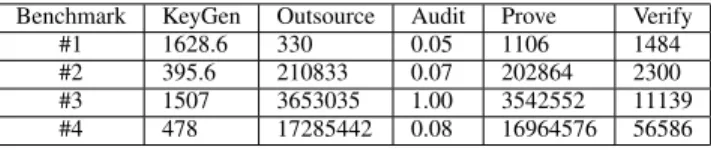
COMPUTATIONCOST FORDETERMINISTICAUDITING INMILLISECONDS Benchmark KeyGen Outsource Audit Prove Verify
#1 1628.6 330 0.05 1106 1484
#2 395.6 210833 0.07 202864 2300
#3 1507 3653035 1.00 3542552 11139 #4 478 17285442 0.08 16964576 56586
Communication Cost. For the randomized protocol, the communication consists of two parts: one is the indices and coefficients of the challenged data blocks; the other is the proof returned from the cloud. The former depends on the challenge length, which is 10 in the experiments; the latter is just two big integers. The total cost is roughly 2000bytes. For the deterministic protocol, it is much smaller: the size of the audit query is just a key for the pseudorandom function and the size of the proof is just two big integers. The total cost is about 400bytes in the experiments.
Computation Cost. Tables IV and V contain the detailed computation cost for the randomized protocol and the deter-ministic protocol. For key generation, the computation cost is very small. The maximal time is 2.1 seconds and the average cost is smaller than 1 second. For outsourcing, it takes considerable computation cost; however, this is a one-time cost and it can be amortized in the following audit and proof interactions. For auditing, the time is quite small. The computation cost for the cloud answering a query is quite different for the randomized and deterministic protocols. For the former, the time cost only depends on the length of the audit query. The maximal time cost is 0.2 seconds, which is very small. For the deterministic protocol, the time cost is very large. It is roughly the same time as that of outsourcing, which is as expected since all the data in the cloud needs to be processed as in the theoretical analysis. The same observation also holds for the verification process. The verification time is also very small for both the randomized protocol and the deterministic protocol.
It is worth noting that the most frequent operations are
SCS.Audit, SCS.Prove and SCS.Verify for data auditing. These operations cost very small time as proved in Tables IV and V. Therefore, the experimental results suggest that the proposed protocol is effective in practice.
VIII. RELATEDWORK
This section reviews the most relevant work. Juels et al. [1] and Ateniese et al. [2] first proposed the secure cloud storage problem for a malicious cloud. These two initial attempts however cannot support data dynamics. Shacham et al. also
proposed two protocols based on MACs and bilinear parings [14]. Xu et al. [3] also improved these protocols by suggesting to use polynomial computations. The data dynamics is also not well solved. Wang et al. and Yang et al. [4], [5] also employed bilinear maps to audit cloud storage. Wang. et al. also reviewed several cloud storage auditing protocols in [18]. Wang et al. [19] proposed a protocol to support fast user revocation. Chen et al. [7] found a general design of secure cloud storage protocols based on secure network coding protocols. Shi et al. [6], [13], [20] showed how to support data dynamics using skip lists, B+ trees, etc. Researchers also extend single cloud storage auditing to multiple cloud auditing to further ensure data availability [21]–[23].
It is worth noting that Benabbas et al. [24] studied spe-cial verifiable polynomial computation delegation protocols. Indeed, such a protocol can be applied to cloud storage auditing. While this protocol is pretty beautiful in theory, the resulting cloud storage auditing protocol is not useful at all and is rather inefficient, mainly because only deterministic auditing is supported and too many big-integer operations are required. Besides, data dynamics is also not supported while this property is highly expected by cloud storage users, and the security foundation highly depends on the DDH assumption.
Compared with previous work, the proposed protocol in this paper supports data dynamics, and furthermore is efficient, provably secure, and especially pretty simple both concep-tually and technically. More importantly, our protocol shows the connection between cloud storage auditing and distributed string equality checking; our protocol also gives insights on designing cloud storage auditing protocols systematically from any verifiable computation protocols.
IX. CONCLUSION
In this paper, we propose an efficient protocol for verifying the integrity and availability of outsourced data on a cloud. The proposed protocol is designed from a classic protocol checking whether two strings are equal in distributed computing. Com-pared with previous protocols, the proposed protocol is simple both technically and conceptually with no heavy cryptography required. The proposed protocol employs a new technique to support data dynamics, including adding, deleting and modifying data. Further, we generalize the idea of the proposed protocol. As a result, we propose a general framework to design a secure cloud storage protocol systemically from a verifiable computation protocol. We thus can have many secure cloud storage protocols automatically. Experimental results validate the effectiveness of the proposed protocol. The connections of distributed string equality checking, secure cloud storage, and verifiable computation are very interesting and may find more applications in other problems related to cloud storage. To design secure cloud storage protocols based on such connections is a very interesting future work.
ACKNOWLEDGEMENT
The authors are thankful to the reviewers for their insightful comments. Tao Xiang’s research was partially supported by
the Natural Science Foundation Project of CQ CSTC (No. cstc2013jcyjA40001) and the Fundamental Research Funds for the Central Universities (No. CDJZR13185501); Yuanyuan Yang’s research was partially supported by the National Nat-ural Science Foundation of China (No. 61373178); Cong Wang’s research was partially supported by Research Grants Council of Hong Kong (Project no. CityU 138513); and Shengyu Zhang’s research was partially supported by Re-search Grants Council of the Hong Kong S.A.R. (Project no. CUHK419413).
REFERENCES
[1] A. Juels and B. Kaliski Jr, “Pors: Proofs of retrievability for large files,” inProc. of ACM CCS, 2007.
[2] G. Ateniese, R. Burns, R. Curtmola, J. Herring, L. Kissner, Z. Peterson, and D. Song, “Provable data possession at untrusted stores,” inProc. of ACM CCS, 2007.
[3] J. Xu and E.-C. Chang, “Towards efficient proofs of retrievability,” in
Proc. of ACM ASIACCS, 2012.
[4] C. Wang, S. S. Chow, Q. Wang, K. Ren, and W. Lou, “Privacy-preserving public auditing for secure cloud storage,”IEEE Transactions on Computers, vol. 62, no. 2, pp. 362–375, 2013.
[5] K. Yang and X. Jia, “An efficient and secure dynamic auditing protocol for data storage in cloud computing,” IEEE Transactions on Parallel and Distributed Systems, vol. 24, no. 9, pp. 1717–1726, 2013. [6] E. Shi, E. Stefanov, and C. Papamanthou, “Practical dynamic proofs of
retrievability,” inProc. of ACM CCS, 2013.
[7] F. Chen, T. Xiang, Y. Yang, and S. S. M. Chow, “Secure cloud storage meets with secure network coding,” inProc. of IEEE INFOCOM, 2014. [8] A. C.-C. Yao, “Some complexity questions related to distributive
com-puting (preliminary report),” inProc. of ACM STOC, 1979.
[9] Wikipedia, “Communication complexity,” http://en.wikipedia.org/wiki/ Communication complexity, 2014.
[10] R. Gennaro, C. Gentry, and B. Parno, “Non-interactive verifiable computing: Outsourcing computation to untrusted workers,” Proc. of CRYPTO, pp. 465–482, 2010.
[11] O. Goldreich, “Foundation of cryptography (in two volumes: Basic tools and basic applications),” 2001.
[12] R. Cramer and V. Shoup, “A practical public key cryptosystem provably secure against adaptive chosen ciphertext attack,” inProc. of CRYPTO. Springer, 1998, pp. 13–25.
[13] C. Erway, A. K¨upc¸¨u, C. Papamanthou, and R. Tamassia, “Dynamic provable data possession,” inProc. of ACM CCS, 2009.
[14] H. Shacham and B. Waters, “Compact proofs of retrievability,” inProc. of ASIACRYPT, 2008, pp. 90–107.
[15] B. Parno, C. Gentry, J. Howell, and M. Raykova, “Pinocchio: Nearly practical verifiable computation,” inProc. of IEEE S&P, 2013. [16] Wikipedia, “Wikipedia dump service,” http://dumps.wikimedia.org/
simplewiki/20130608/, 2013.
[17] F. Chen, “Source code,” https://sites.google.com/site/chenfeiorange/ secure-cloud-storage-hits-distributed-string-equality-checking, 2014. [18] C. Wang, K. Ren, W. Lou, and J. Li, “Toward publicly auditable secure
cloud data storage services,”IEEE Network Magazine, vol. 24, no. 4, pp. 19–24, 2010.
[19] B. Wang, B. Li, and H. Li, “Public auditing for shared data with efficient user revocation in the cloud,” inProc. of IEEE INFOCOM, 2013. [20] Z. Mo, Y. Zhou, and S. Chen, “A dynamic Proof of Retrievability (PoR)
scheme withO(logn)complexity,” inProc. of IEEE ICC, 2012. [21] T. Schwarz and E. Miller, “Store, forget, and check: Using algebraic
signatures to check remotely administered storage,” inProc. of IEEE ICDCS, 2006.
[22] K. Bowers, A. Juels, and A. Oprea, “Hail: A high-availability and integrity layer for cloud storage,” inProc. of ACM CCS, 2009. [23] C. Wang, Q. Wang, K. Ren, N. Cao, and W. Lou, “Toward secure and
dependable storage services in cloud computing,”IEEE Transactions On Services Computing, vol. 5, no. 2, pp. 220–232, 2012.
[24] S. Benabbas, R. Gennaro, and Y. Vahlis, “Verifiable delegation of computation over large datasets,”Proc. of CRYPTO, pp. 111–131, 2011.