Submission to Business Modeling and Integration Domain Taskforce
Production Rule Representation
Ver. 1.01
Submitted by
Fair Isaac Corporation
ILOG SA
Copyright 2007 Fair Isaac Corporation Copyright 2007 ILOG SA
Fair Isaac Corporation and ILOG SA hereby grant a royalty-free license to the Object
Management Group, Inc. (OMG) for a world-wide distribution of this document or any derivative works thereof, so long as the OMG reproduces the copyright notice and the following paragraphs on all distributed copies.
The material in this document is submitted to the OMG for evaluation. Specification of this document does not represent a commitment to implement any portion of this specification in the products of the submitter.
WHILE THE INFORMATION IN THIS PUBLICATION IS BELIEVED TO BE ACCURATE, THE COMPANIES LISTED ABOVE MAKE NO WARRANTY OF ANY KIND WITH REGARD TO THIS MATERIAL INCLUDING BUT NOT LIMITED TO THE IMPLIED WARRANTIES OF THE MERCANTABILITY AND FITNESS FOR A PARTICULAR PURPOSE. The companies listed above shall not be liable for errors contained herein or for incidental or consequential damages in connection with the furnishing, performance or use of this material. The information contained in this document is subject to change without notice.
This document contains information that is protected by copyright. All rights are reserved. Except as otherwise provided herein, no part of this work may be reproduced or used in any form or by any means-graphic, electronic, or mechanical, including photocopying, recording, taping or information and retrieval systems-without the permission of the copyright owners. All copies of this document must include the copyright and other information contained on this page.
The copyright owners grant member companies of the OMG permission to make a limited number of copies of this document (up to fifty copies) for their internal use as part of the OMG evaluation process.
RESTRICTED RIGHTS LEGEND. Use, duplication, or disclosure by government is subject to restrictions as set forth in subdivision (c) (1) (ii) of the Right in Technical Data and Computer Software Clause at DFARS 252.227.7013.
CORBA, CORBAfacilities, CORBAservices, OMG, OMG IDL, Object Request Broker, are trademarks of the Object Management Group.
Content
1 PREFACE ...5 1.1 SUBMITTERS...5 1.2 CONTACT POINTS...5 1.2.1 Submitters ...5 1.2.2 Supporters...51.3 GUIDE TO THE SUBMISSION...5
1.4 HOW TO READ THIS DOCUMENT...6
1.5 STANDARDS BODIES INVOLVED...6
1.6 COMMERCIAL AVAILABILITY...7
1.7 EDITS SINCE LAST VERSION...7
2 OVERVIEW...8
2.1 SCOPE...8
2.2 OBJECTIVES...8
2.3 OMGMDACONTEXT...8
2.3.1 Class of Platform ...9
2.3.2 MDA layers...9
2.4 UML AND BUSINESS RULES...9
2.5 RESOLUTION OF RFP REQUIREMENTS AND REQUESTS...10
2.5.1 Execution Modes...10
2.5.2 XMI Schema...10
2.5.3 Ruleset Aggregation ...10
2.6 TABLE OF RFPCOMPLIANCE ITEMS...11
3 PRODUCTION RULE REPRESENTATION ...17
3.1 INTRODUCTION TO PRR-CORE AND PRR-OCL ...17
3.2 PRODUCTION RULES...18
3.2.1 Production Rule definition...18
3.2.2 Production Ruleset definition ...18
3.2.3 Rule Variable definition...18
3.2.4 Semantics of Rule Variables ...19
3.2.5 Semantics of Production Rules ...19
3.3 OVERVIEW OF PRR-CORE...22
3.4 PRR-CORE METAMODELS...22
3.4.1 Overview of PRR-Core concept classes...22
3.4.2 Overview of PRR-Core Production Ruleset...23
3.4.3 Overview of PRR-Core Production Rule ...24
3.4.4 Overview of PRR-Core RuleVariable ...25
3.4.5 Classes used in PRR Core ...25
3.4.6 Computer Executable Rule ...26
3.4.7 Computer Executable Ruleset...26
3.4.8 Variable ...27 3.4.9 ProductionRuleset ...27 3.4.10 ProductionRule...28 3.4.11 RuleCondition...29 3.4.12 RuleAction ...29 3.4.13 RuleVariable...30 3.5 OVERVIEW OF PRROCL ...31 3.6 PRROCLMETAMODEL...31
3.6.1 Classes used in PRR OCL...34
3.6.2 RuleVariable ...35
3.6.3 RuleCondition ...37
3.6.5 Class ImperativeExp...40 3.6.6 Class AssignExp ...40 3.6.7 Class InvokeExp ...41 3.6.8 Class UpdateStateExp ...42 3.6.9 Class AssertExp ...42 3.6.10 Class RetractExp ...42 3.6.11 Class UpdateExp ...43
3.7 PRROCL:STANDARD LIBRARY...44
3.7.1 The OclAny, OclVoid types...44
3.7.2 OclType...45 3.7.3 Primitive Types ...45 3.7.4 Real...45 3.7.5 Integer...46 3.7.6 String ...46 3.7.7 Boolean...47 3.7.8 Collection-Related Types...47 3.8 CONFORMANCE ...51
4 COMPARISON WITH OTHER OMG STANDARDS...52
4.1 UML...52
4.1.1 UML Activities ...52
4.1.2 UML Events ...52
4.2 ALIGNMENT WITH MDA-MODEL DRIVEN ARCHITECTURE...52
4.3 ALIGNMENT WITH OCL-OBJECT CONSTRAINT LANGUAGE...52
4.4 ALIGNMENT WITH ACTION SEMANTICS...53
4.5 SEMANTICS OF BUSINESS VOCABULARY AND BUSINESS RULES (SBVR)...53
4.6 BUSINESS PROCESS DEFINITION METAMODEL (BPDM) ...54
4.7 ONTOLOGY DEFINITION METAMODEL (ODM) ...54
4.8 ENTERPRISE DISTRIBUTED OBJECT COMPUTING (EDOC) AND ENTERPRISE COLLABORATION ARCHITECTURE (ECA)...55
5 REFERENCES ...56
5.1 REFERENCES SPECIFIC TO THE PRR ...56
5.2 GENERAL REFERENCES...56
A COMPLETE METAMODEL...57
B GLOSSARY ...58
C GUIDANCE FOR USERS ...59
D RELATIONSHIP WITH W3C RULE INTERCHANGE FORMAT...61
E ABSTRACT SYNTAX EXAMPLES ...63
E.1 CLASS DIAGRAM...63
E.2 PRODUCTION RULES WITH OCL TRANSLATIONS...63
F OTHER RULE TYPES ...71
Deleted: Deleted:
1 Preface
This document contains a revised joint submission to a Request for Proposal titled Production Rule Representation (br/2003-09-03).
1.1 Submitters
This initial submission in response to the Production Rule Representation RFP is made by Fair Isaac Corporation and ILOG SA.
1.2 Contact points
Questions about this submission should be addressed to: James Taylor
1.2.1
Submitters
• James TaylorFair Isaac Corporation [email protected] • Christian de Sainte Marie
ILOG SA [email protected]
1.2.2
Supporters
• Representing the RuleML Initiative:
Said Tabet of RuleML: [email protected]
Gert Wagner of RuleML: [email protected] . • Representing commercial rule development vendors:
Silvie Spreeuwenberg of LibRT: [email protected]
James Taylor of Fair Isaac Corporation: [email protected] Christian de Sainte Marie of ILOG SA: [email protected]
Jon Pellant of Pega Systems: [email protected] David Springgay of IBM: [email protected] Pedram Abrari of Corticon: [email protected] Paul Vincent of Tibco [email protected]
• Representing associated tool vendors for UML and BPM: Jim Frank of IBM: [email protected]
Mark Linehan of IBM: [email protected] Jacques Durand of Fujitsu: [email protected]
Sridhar Iyengar of IBM [email protected]
1.3 Guide to the Submission
The Production Rule Representation (PRR) standard was first proposed as the first technology-based rule-related standards in the OMG Business Rules Working Group, now part of the
Business Modeling and Integration (BMI) domain task force. PRR addresses the requirement for a common production rule representation, as used in rule engines from a variety of vendors today. Although OMG standards are traditionally associated with “software modeling” tasks, the BMI task force (as well as many vendors represented in OMG) is associated with more “business-oriented” approaches to system automation, such as business rule automation and business process automation. This is fully compliant with the OMG Model Driven Architecture, and production rules provide an alternative, convenient representation for the many business rules that define behavior (ie actions). Many of the vendors involved in this standard all provide their own production rule representations, and these have been used as the basis for this standard.
As noted in the RFP, production rules in this context should not be confused with XMI production rules as defined in XMI 1.1 specification (formal/2000-11-02), production rules as defined in OCL 2.0, or other model or grammar transformation rules specified by the OMG standards such as SVBR.. With respect of production rules, the RFP solicited proposals for the following:
• A MOF2 compliant metamodel with precise dynamic semantics to represent production rules, where “production rules” refers to rules that are executed by an inference engine. This metamodel is intended to support a language that can be used with UML models for explicitly representing production rules as visible, separate and primary model elements in UML models.
• An XMI W3C XML Schema Description (xsd) for production rules, based on the proposed metamodel, in order to support the exchange of production rules between modeling tools and inference engines.
• An example of a syntax that is compliant with the proposed metamodel for expressing production rules in UML models. This syntax will be considered non-normative. 1.4 How to read this document
This submission is organized as follows.
Chapter 2 - Overview of the PRR and its relationships
Chapter 3 - PRR Proposal – definition, semantics and metamodel, scope, UML diagram notation examples and compliance requirements.
Chapter 4 – Comparison to, and interactions with, OMG Standards such as SBVR, BPDM, ODM. Chapter 5 – References
Appendix A – Complete Metamodel
Appendix B – Glossary – definitions used in this document. Appendix C – Guidance for Users
Appendix D – Relationship with: W3C Rule Interchange Format Appendix E – Abstract Syntax Examples
Appendix F - Other Rule Types – Notes on how other rule types would relate to PRR 1.5 Standards Bodies Involved
There are currently a number of standards bodies and other initiatives involved with defining domain-independent production rule representations:
• OMG – represented by the Business Modeling Integration group and developers of the RFP to which this proposal responds.
• W3C - http://www.w3.org/2005/rules/ - has chartered a working group to define a rule interchange format for rule-driven systems. See also “Relationship with W3C Rule Interchange Format” on page 61.
• RuleML – http://www.ruleml.org/ - a family of related rule markup initiatives, with specific focus on W3C and the Semantic Web
The PRR is developed in collaboration with these bodies, with the goal that other standards in this area should be related for maximum standard interoperability and minimal vendor and user cost. 1.6 Commercial availability
The Letter of Intents states companies’ intentions regarding commercial availability of this submission.
1.7 Edits since last version
1. IBM changed from submitter to supporter 2. Revised discussion of relationship with W3C RIF 3. Updated example syntax
2 Overview
This chapter provides an overview of the scope and objectives of this specification, and describes the resolution to RFP requirements and compliance points.
2.1 Scope
The PRR fulfils a number of requirements related to business rules, software systems, OMG standards, and other rule standards.
a. It provides a standard production rule representation that is compatible with rule engine vendors’ definitions of production rules. It can therefore be used for interchange of
business rules amongst rule modeling tools (and other tools that support rule modeling as a function of some other task).
b. It provides a standard production rule representation that is readily mappable to business rules, as defined by business rule management tool vendors.
c. It provides a standard production rule definition that supports and encourages system vendors to support production rule execution.
d. It provides an OMG MDA PIM model with a high probability of support at the PSM level from the contributing rule engine vendors and others, and can be included to add
production rule capabilities to other OMG metamodels.
e. It provides examples of how the OMG UML can be used to support production rules in a standardized and useful way.
f. It provides a standard production rule representation that can be used as the basis for other efforts such as the W3C Rule Interchange Format and a production rule engine focused version of RuleML.
2.2 Objectives
The Production Rule Representation is proposed as a new OMG standard in order to:
• improve the modeling of production rules, especially with respect to the UML and MDA; • allow interoperability across different vendors who define production rules in models. • Support traceability of production rules to and from other UML and MDA artifacts The development and adoption of this standard will encourage:
• accelerated adoption of production rule components and/or the business rules approach in everyday software systems;
• improved confidence in the use of production rule execution mechanisms such as rule engines.
2.3 OMG MDA Context
The Model-Driven Architecture (MDA) defines a model-driven approach to software
development. An MDA specification consists of a definitive platform-independent base “UML model”, plus one or more platform-specific models (PSM) and interface definition sets, each
describing how the base model is implemented on a different “platform”. The MDA also allows for an optional Business Model known as a CIM, or computation-independent model, which can be used as guidance to specify the PIM. It is expected that PRR will both be mappable to and from other OMG metamodels in conformance with the principles of the MDA, and embeddable in new metamodels that require production rule support.
2.3.1
Class of Platform
The target implementation platform for the PRR is the “forward chaining rule engine” or
“inference engine”, hereafter described as “production rule engine”. The execution semantics are respectively referred to as "sequential rule processing" and "forward chaining” or “inferencing". The PRR defines a PIM for a “production rule engine class of platform”, that can be subsequently transformed to a vendor-specific model (PSM) executable by a vendor-specific rule engine.
2.3.2
MDA layers
The PRR assumes the following usage of the MDA in business rule driven software systems: • The Business Model (or CIM): non-ambiguous representation of business policies,
procedures, constraints as business rules in natural language and independent of assumptions regarding the platform on which an information system will be delivered. • PIM: representation of production rules in UML targeted to the production rule engine
class-of-platform that is independent of a vendor specific engine.
• PSM: representation of production rules in proprietary form executable by vendor-specific production rule engine.
The PRR scope includes only the PIM layer of this vision, and is limited to specifying
requirements for representing production rules targeted at the forward chaining procedural and inferencing engine class-of-platform.
Production rule engine vendors will be able to provide a mapping from the PRR PIM to the PSM specific to their products, depending on whether procedural or Inferencing rules are specified and whether they support those types. The means to implement the PSM models is provided by such production rule engine products.
The Business Model (CIM) layer – representation of business rules – is addressed by a separate RFP requesting business rule semantics for business users, OMG document br/03-06-03, Business Semantics of Business Rules RFP. This standard is being finalized as the Semantics of Business Vocabularies and Rules (SBVR).
Section 4 below has a discussion of PRR’s relationship with other standards related to the MDA layers.
2.4 UML and Business Rules
Modeling business rules in UML is a broad topic. For example:
• Business rules defined as formal texts for documentation or requirements purposes would be covered by the SBVR standard;
• Business rules such as simple data relationships and constraints have simple counterparts within a UML model. For example, the business rule that “orders must have at least one line item” would typically be represented as a multiplicity constraint on an association. Other rules easily translate into constraint expressions. For example, the rules that “a
birthday must be equal to or earlier than the current date” or that “an account can never have a negative balance” are easily expressed as invariants using OCL (see below). • Process-oriented business rules define conditional action / behavior / state changes as
production rules that are not handled by OCL. Business rules that are expressed by
production rules are very common and the representation (modeling) of production rules in UML is not standardized.
The two UML mechanisms for defining constraints and behavior are the Object Constraint Language (OCL) and action semantics (AS). However, neither of these provides an “out-of-the-box” solution for representing production rules. More details on the differences between PRR and these mechanisms is given in section 4.
2.5 Resolution of RFP requirements and requests
2.5.1
Execution Modes
Note that this specification is a change over the RFP, which specified inference rule engines only (not procedural rules as specified in this version of PRR), and both forward and backward chaining rules (where backward chaining rules are not specified in this version of PRR). This change is in order to accommodate industry requirements:
• many vendors that do not use inferencing technologies use instead procedural rules, and PRR accommodates these simple semantics
• few vendors use backward chaining techniques at this time, and in particular this is not used by the vendors involved in PRR.
The authors expect that future extensions of PRR may accommodate backward chaining inference engines.
2.5.2
XMI Schema
Note that an XMI W3C XML Schema Description (xsd) for the production rule metamodel is not provided in this submission. This is deliberate so as to allow the W3C Rule Interchange Format (RIF) to become the standard format for interchange of production rules between modeling tools and inference engines. The RIF standard is still under development (see Appendix D) and includes members of the PRR submission team as well as a number of PRR supporters.
2.5.3
Ruleset Aggregation
Ruleset aggregation is not supported in the submission to avoid complications involving different signatures and execution modes of rulesets.
2.6 Table of RFP Compliance Items RFP requirement
Par. # Description
Compliance
6.2
Required deliverables
A MOF2 compliant metamodel for production rules that are executed by typical inference engines using standard processing algorithms for forward and backward chaining This metamodel is intended to support a language that can be used with UML models for explicitly representing production rules as visible, separate and primary model elements in UML models.
3.4,3.6, Appendix A
An XMI W3C XML Schema Description (xsd) for the production rule metamodel in order to support interchanging of production rules between modeling tools and inference engines.
See 2.5.2
An example of a transformation from an instance of the
metamodel to a current implementation of a Production Rule
language
See Appendix E
Definition of Production Rule
Production rules are statements of programming logic of the
general form;
IF Conditions THEN Actions
3.2 3.4.10
The Conditions clause may be any (possibly complex) Boolean
expression; the Actions clause may be any arbitrary action or
collection of actions.
3.2.3, 3.2.4,3.2.5 3.4.11, 3.4.12, 3.4.13
Production rules are executed by means of an inference engine,
specifically their Actions clause is executed only when an
inference engine evaluates the Conditions clause and determines
that the conditions are true. Different types of production rule
inference engines provide different algorithms for determining
when a production rule is to be evaluated.
3.2.5 6.5
The inference engine handles the execution, or firing, order the
rules based on run-time conditions and its own internal algorithms.
The rule modeler does not specify this order.
3.2.5
Reuse of existing UML metamodels 6.5.1
The proposed production rule metamodel shall use relevant packages of the UML 2.0 Superstructure for all static modeling constructs (see section 6.5.2.1 for the types of static modeling constructs to which production rules need to be able to reference
RFP requirement Par. # Description
Compliance
It is anticipated that the production rule metamodel will define new behavioral constructs (see section 6.1.3.3.2). The proposed metamodel shall align with the behavioral modeling constructs of the UML 2.0 Superstructure where appropriate. (See section 6.7.1 for discussion of the issue of metamodel alignment.)
3.4.1, 3.4.2
The production rule metamodel shall extend the UML metamodel as appropriate per this RFP (see sections 6.5.6.4 and 6.6.2)
3.4.5, 3.6.1
6.5.2.1 Model element reference
Proposals shall provide a means for production rules to specify access to the types of model elements that can be used in UML Class models including, but not necessarily limited to, instances of classes (typically through quantifier expressions), the values of attributes of classes and instances, the operations/methods of classes and instances.
3.5
6.5.2.2 Collections
Proposals shall provide a means to specify a collection of instances matching conditions. Once defined, a collection shall be treatable as an object instance. For example, collections may be referenced in
production rule conditions as objects and tested for their properties (e.g., sizeOf(collection)) and manipulated as sets.
3.2.3
6.5.2.3 Condition part structure
Proposals shall provide the means to express conditions of production rules with, but not limited to, arithmetic tests (<, ≤, =, ≥, >, ≠), comparison tests (=, ≠), set membership tests (is member of) and arithmetic expressions (+, -, /, *).
3.6.2
6.5.2.4 Logical operators
Proposals shall provide the ability to use the AND, OR and NOT logical operators to combine the conditions, and nest logical operations.
3.6.3
6.5.2.5 Action part structure
Proposals shall provide a means to express arithmetic expressions (+, -, /, *) and execution structures (loops, conditional expressions, nested expressions) in the actions of the production rule
3.6.4, 3.7.4, 3.7.5
6.5.2.6 Rule scoping
Proposals shall provide an optional mechanism of scoping a rule to a namespace or a specific namespace element such as a class. A rule’s scope provides a context in which the rule is evaluated. Scoped rules support the use of the notion of self. If scoping production rules to a namespaces other than classes is defined, appropriate semantics must be provided.
RFP requirement Par. # Description
Compliance
6.5.3 Precise dynamic semantics
Proposals shall explicitly state the computational semantics of the elements in the proposed metamodel in an appropriate manner to specifying rule behavior with respect to an inferencing algorithm under which the rules are intended to be executed. The description of an inferencing algorithm should be sufficiently general that the prescribed algorithm is applicable across different implementations of the algorithm in specific inference engines. The semantics must be sufficient to
describe which behaviors can be guaranteed across inference engines and which ones cannot
3.2.5
6.5.3.1 Inference modes
The dynamic semantics of production rules must support both forward chaining and backward chaining algorithms. Support for the Rete algorithm is required Forward Chaining: 3.2.5.1, Backward Chaining Omitted see: 2.5 6.5.4 XML schema
Submitters shall supply an XMI W3C XML Schema Description (xsd) for the production rules constructed according to the proposed
metamodel.
Omitted, see 2.5.2
6.5.5 Compliance points
Submitters shall specify points at which vendor inference engines can be considered compliant with the production rule metamodel. It is possible that a proposal may permit partial fulfillment of the metamodel to constitute a degree of compliance.
3.8
6.5.6 RuleSet
Proposals shall provide a means to specify a collection of production rules. Such a collection is typically called a ruleset. From a user’s perspective, a ruleset typically contains rules that serve a specific
functional purpose. From the modeler’s perspective, the rules in a ruleset share semantic properties, for example, reasoning mode
3.2.2 3.4.7, 3.4.9
6.5.6.1 Reasoning mode
Proposals shall provide a means to specify the reasoning mode for a ruleset. The reasoning mode can be either forward chaining or backward chaining. To support backward chaining, proposals shall provide the means to specify the condition (or “goal”), usually an attribute, whose value is to be determined through inferencing over the ruleset. (A goal is optional for forward chaining.)
3.4.9.1
6.5.6.2 Ruleset aggregation
Proposals shall provide a means to aggregate rulesets in the sense that one ruleset may be included in another (set inclusion).
RFP requirement Par. # Description
Compliance
6.5.6.3 Ruleset invocation
Proposals shall provide a means of indicating methods that invoke rulesets as their (principal) behavior and of indicating what rulesets are so invoked by the method. NOTE: No assumption should be made regarding the precise invocation mechanisms, as this is an engine specific (i.e., a PSM and code level consideration). For example, a Java-based inference engine that is compliant with the JSR-94 specification will require different ruleset invocation mechanisms at the code level than a language that provides inferencing as a native feature.
3.4.7
6.5.6.4 UML activities
Proposals shall provide a means to associate production rules to UML activities in order to model a ruleset as being invoked within an activity. For further discussion, see 6.6.2.
3.4.7
6.5.7 Naming
Proposals shall provide a means to identify production rules and ruleset using a name. That is, rules and rulesets must be NamedElements
3.4.6, 3.4.7
6.5.8 Example of a concrete syntax
Submitters shall include, as a non-normative element, at least one example of a concrete syntax for the production rule metamodel that supports the language elements described in section 6.5.2.
Examples in text and Appendix E
6.6 Optional requirements
6.6.1 Ordering Rules Consideration with Priorities
Programming with production rules occasionally encounters situations in which pre-specifying the order in which the rules are considered by the inference engine may be desirable. Typically, specifying the order in which rules are considered is done through assigning priorities to production rules. (NOTE: Although rule priorities are a feature of most commercial production rule inference engines, they compromise the declarative status of production rules. Therefore, specification of rule priority at the PIM level is considered to be optional requirement.) The execution semantics of rule priorities should be described as part of the dynamic semantics of production rules (see section 6.5.3)
RFP requirement Par. # Description
Compliance
6.6.2 UML Metamodel Extensions: UML Profile
To diagrammatically represent the relationships of rules and
rulesets to model elements other than those to which the rules
explicitly refer (see section 6.5.2.1) or are scoped (see section
6.5.2.6), new UML stereotypes and/or notations may be proposed
through a UML Profile.
An example of such an extension is the requirement to model the relationship of rulesets to action states in Activity Diagrams in a semantically significant manner (see section 6.5.6.4). Submitters may suggest further mechanisms to relate rules and rulesets to other model elements in other diagrams
Not in this release
6.7 Issues to be discussed
6.7.1 Alignment with Other Metamodels
When developing the Production Rule metamodel, submitters will need to use metamodel elements that need to align with metamodel concepts of other metamodels, specifically the action semantics and the OCL metamodel. Points of agreement and disagreement as well as points of extension should be identified.
This discussion should be conducted from the perspective of unifying the production rule metamodel with actions semantics. Specifically, the production rule metamodel may be discussed in terms of (1) an
extension of the UML Superstructure, or (2) integrated into the UML Superstructure, or (3) a “child” of a parent metamodel from which it is also possible to derive other elements of the UML Superstructure.
See Section 4
6.7.2 Integration of UML Events and Inferencing
During modeling at the PIM level, it may be necessary for the modeler to refer to an event that occurred in the past within the conditions of a production rule (i.e., prior the current time at which the rule is being evaluated by the inference engine). Submitters are encouraged to present an approach for modeling the relationship of UML events to inferencing and for integrating such UML events into inferencing at the PIM level. NOTE: To pursue this topic it will be necessary to discuss the semantics of such references and to integrate this semantics into the semantics of the inference engine (see section 6.5.3).
Alternatively, submitters may make some simplifying assumptions about modeling UML events within an object model, for example as instances of special "event" classes. In this case, there would be nothing special about referring to "events" within rules because the events would appear to the inference engine is standard instances.
UML events may also have the role of invoking rulesets as opposed to methods that invoke rulesets (as described in section 6.5.8.2). An integrated view of UML events and inferencing may also be explored in submissions.
This submission assumes UML events are handled within an object model, for example as instances of special "event" classes
RFP requirement Par. # Description
Compliance
6.7.3 Production Rule Transformation from the Business Rules Metamodel
To the extent that is possible, submitters should discuss technical and methodological issues regarding how production rules might be transformed from business rules at the CIM level to production rules at the PIM level. A standard for business rules at the CIM level is currently being formulated through proposals to the Business Semantics for Business Rules RFP (br/2003-06-03). This standard will also include a standard for representing business vocabulary, which would map to classes and attributes. In principle, there should also be a mapping from (a subset of) business rules into (a subset of) production rules expressed in the UML model. Submitters are required to discuss, as far as possible at the time of submission, mapping issues for constructing production rules on the basis of business rules in the CIM.
3 Production Rule Representation
3.1 Introduction to PRR-Core and PRR-OCLThe following MOF2 compliant metamodel defines the PRR. It features:
• A definition of production rules for forward chaining inference and procedural processing. • A definition for an interchangeable expression language (PRR OCL) for rule condition and
action expressions, so they can be replaced by alternative representations for vendor-specific usage or in other standards.
• A definition of rulesets as collections of rules for a particular class of platform (procedural or inference rule engine).
The metamodel is composed of:
• a core structure referred to as PRR Core
• an abstract OCL-based syntax for PRR expressions, defined as an extended PRR Core metamodel referred to as PRR OCL.
Future extensions of PRR may address:
• rule metamodels for other classes of rules, such as Event-Condition-Action (ECA), backward chaining, and constraints
• rule representations that are specific to graphical notations, such as decision tables and decision trees
• representations of sequences of rulesets within larger decisions • transformations between PRR and other MDA models such as SBVR.
Other concrete syntaxes may be applied to PRR Core in future. To this end, the PRR is designed to be extensible.
Production Rules fit into the following rule classification scheme (supplied by the RuleML Initiative), although they are a subclass of Computer Executable Rule rather than Rule to avoid confusion with other uses of “Rule” as a metamodel class.
DerivationRule ReactionRule IntegrityRule SQL:1999 Assertion ProductionRule ECARule SQL:1999 Trigger SQL:1999 View OCL 2.0 Invariant XSB 2.6 Prolog
Rule Jess 3.4 Rule ECAPRule TransformationRule XSL 1.0 Rule MS Outlook 6 Rule Oracle 10g SQL View
ILOG JRule BlazeAdvisorRule Rule
InferenceRule ProdeduralRule {OR}
Rule classification per Gerd Wagner, RuleML
3.2 Production Rules
3.2.1
Production Rule definition
A production rule1 is a statement of programming logic that specifies the execution of one or more actions in the case that its conditions are satisfied. Production rules therefore have an operational semantic (formalizing state changes, e.g., on the basis of a state transition system formalism).
The effect of executing production rules may depend on the ordering of the rules, irrespective of whether such ordering is defined by the rule execution mechanism or the ordered representation of the rules.
The production rule is typically2 represented as: if [condition] then [action-list]
Some implementations extend this definition to include an “else” construct as follows: if [condition] then [action-list] else [alternative-action-list]
although this form is not considered for PRR; all rules that contain an “else” statement can be reduced to the first form without an “else”, and the semantics for interpreting when “else” actions are executed may be complex in some Inferencing schemes. Note that this implies that a
conversion from a PSM to a PIM might be complete but not reversible. Rules with “else” statements in a PSM would result in multiple PIM rules which could not then be translated back into the original rules. The new rules would be functionally equivalent, however.
3.2.2
Production Ruleset definition
The container for production rules is the productionruleset. The production ruleset provides • a means of collecting rules related to some business process or activity as a functional unit, • a runtime unit of execution in a rule engine together with the interface for rule invocation. From an architecture and framework perspective, a ruleset is a Behavior in UML terms,
The rules in a ruleset operate on a set of objects, called the "data source" in this document. The objects are provided by the ruleset’s:
• parameters
• context at invocation time.
The changed values at the end of execution represent the result or "output" of a ruleset invocation.
3.2.3
Rule Variable definition
The condition and action lists contain expressions (Boolean for condition) that refer to 2 different types of variables (which we term as standard variables and rule variables).
At definition time:
1
From the [RFP].
2
• a standard variable has a type and an optional initial expression. In some systems, there may also be a constraint applied to the variable, but the latter is outside the scope of PRR. Standard variables are defined at the ruleset level.
• a rule variable has a type and a domain specified optionally by a filter applied to a data source. With no filter, its domain defaults to all objects conforming to its type that are within scope / in the data source. Rule variables may be defined at the rule level, or at the ruleset level; in the latter case the rule variable definitions are available to all rules.
3.2.4
Semantics of Rule Variables
At runtime:
• standard variables are bound to a single value (that could itself be a collection) within their domain. The value may be assigned by an initial expression, or assigned or reassigned in a rule action.
• rule variables are associated with the set of values within their domain specified by their type and filter. Each combination of values associated with each of the rule variables for a given rule is a tuple called a binding. It binds each rule variable to a value (object or collection) in the data source. These bindings are execution concepts: they are not modeled explicitly but are the result of referencing rule variables in rule definitions.
This means that a production rule is considered for instantiating against ALL the rule variable values. The use of rule variables means that the definition of a production rule is in fact:
for [rule variables] if [condition] then [action-list]
Note that there is an implied product of rule variables when multiple rule variables are defined e.g.:
for [rule variable 1] for [rule variable 2] if [condition] then [action-list]
3.2.5
Semantics of Production Rules
The operational semantics of production rules in general for forward chaining rules (via a rule engine) are as follows:
i. Match: the rules are instantiated based on the definition of the rule conditions and the current state of the data source
ii. Conflict resolution: select rule instances to be executed, per strategy
iii. Act: change state of data source, by executing the selected rule instances' actions However, where rule engines are not used and a simpler sequential processing of rules takes place, there is no conflict resolution and a simpler strategy for executing rules.
3.2.5.1 Operational Semantics for Forward-chaining production rules
A forward chaining production ruleset is defined withoutconsideration of the explicit ordering of the rules; execution ordering is under the control of the inference engine that maintains a stateful representation of rule bindings.
The operational semantics of forward-chaining production rules extend the general semantics as follows:
1. Match: bind the rule variables based on the state of the data source, and then instantiate rules using the resulting bindings and the rule conditions. A rule instance consists of a binding and the rule whose condition it satisfies. All rule instances are considered for further processing
2. Conflict resolution: the rule instance for execution is selected by some means such as a rule priority, if one has been specified
3. Act: the action list for the selected rule instance is executed in some order
This sequence is repeated for each rule instance until no further rules can be matched, or an explicit end state is reached through an action.
It is important to note that:
• In the case where more than one binding satisfies the condition, there is one separate rule instance per binding.
• An action may modify the data source, which can affect current as well as subsequent bindings and condition matches. For example, an existing rule instance may be removed because the match is no longer valid or an additional rule instance may be added due to a newly valid match.
One popular algorithm for implementing such a forward chaining production rules is the Rete algorithm [RETE]1.
3.2.5.2 Operational Semantics for Sequential production rules
A sequential production rule is a production rule defined without re-evaluation of rule ordering during execution.
The operational semantics of sequential production rules extends the general semantics by separating the match into bind and evaluate steps, where the bind step is once-only step, as follows:
1. Bind: bind the rule variables based on the state of the data source at invocation time, and instantiate rules using the bindings.
2. Evaluate: evaluate the rule conditions based on the current state of the data source. Each instance is treated as a separate rule. If the condition evaluates to false then the rule instance is not considered.
3. Act: execute the action list of the current rule instance
This sequence 2-3 is repeated for one rule instance at a time until all the rules are processed, or an explicit end state is reached through an action.
It is important to note that:
1
Charles Forgy, "Rete: A Fast Algorithm for the Many Pattern/Many Object Pattern Match Problem", Artificial Intelligence, 19, pp 17-37, 1982
• The processing order is defined per rule, not per rule instance. It is specific to the engine what is the ordering of the rule instances.
• The instances to be executed are defined on the initial state of the data source. Side effects from the execution of one instance will not affect the eligibility of other instances for execution. Side effects may affect the whether specific conditions of those rules are satisfied.
3.3 Overview of PRR-Core
PRR Core is a set of classes that allow for production rules and rulesets to be defined in a purely platform independent way without having to specify OCL to represent conditions and actions. As such all conditions and actions are “opaque” and simply strings. While this limits the ability to transform rules from one production environment (PSM) to another, it would allow for sharing of rules between all tools that understand the basic structure of production rules.
3.4 PRR-Core Metamodels
This section specifies the PRR-Core Metamodel.
3.4.1
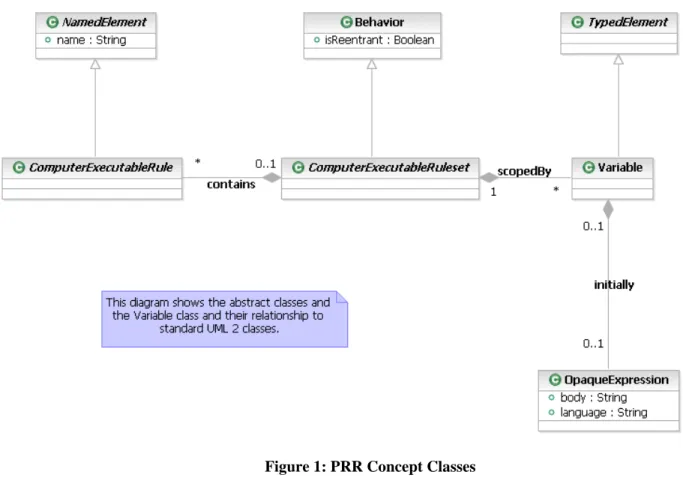
Overview of PRR-Core concept classes
The following is a partial model showing the concepts of general rules and rulesets for future extension to other rule types.
3.4.2
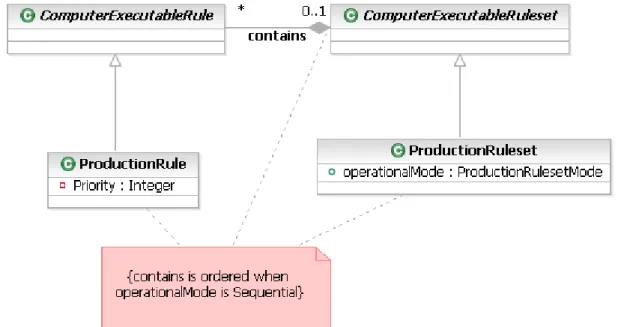
Overview of PRR-Core Production Ruleset
The following is a partial model showing the ProductionRuleset class and its relationship to other model elements.
3.4.3
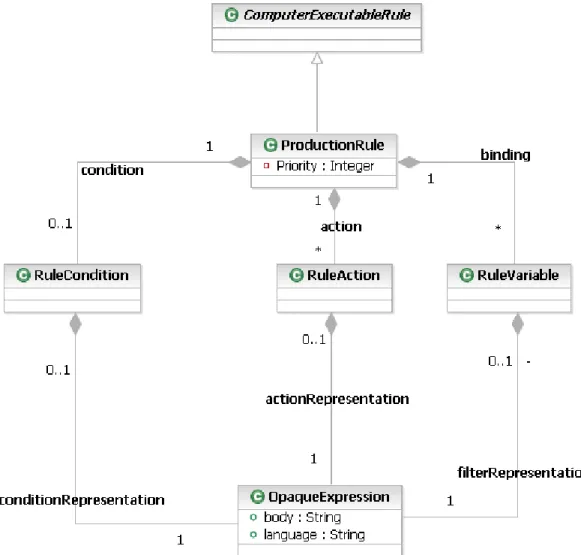
Overview of PRR-Core Production Rule
The following is a partial model showing the ProductionRule class and its relationship to other model elements.
3.4.4
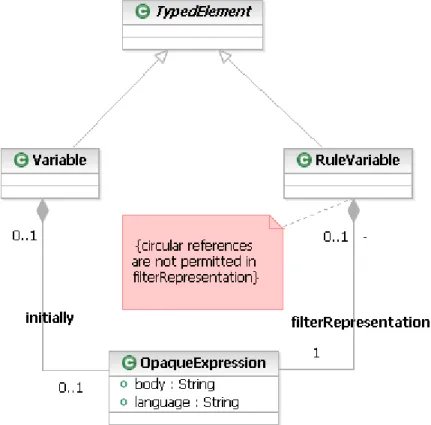
Overview of PRR-Core RuleVariable
The following is a partial model showing the RuleVariable class and its relationship to other model elements.
Figure 4: PRR RuleVariable Classes
3.4.5
Classes used in PRR Core
The following classes are used in these models. Each is defined below the table
Name Description RuleCore::ComputerExecutableRule The computer executable rule represents a conditional
piece of programmatic logic, including production rules. Future OMG standards may address other computer executable rule types such as event-condition-action rules, which would be derived from this class. RuleCore::ComputerExecutableRuleset The computer executable ruleset is a container for
computer executable rules, and provides an execution context. In addition, a computer executable ruleset defines the interface for rule invocation, and the unit of execution in a rule engine; it is a Behavior in UML terms (or a service implementation in SOA terminology). ProductionRule::RuleVariable The variable represents a programming construct to hold
values for use in executing a rule. The values must conform to the variable's type.
ProductionRule::ProductionRule A ProductionRule is a statement of programming logic that specifies the execution of one or more actions in the case that its conditions are satisfied. See section below. ProductionRule::ProductionRuleset The ProductionRuleset represents a ruleset for production
rules
ProductionRule::RuleCondition The condition represents a Boolean expression that is matched against available data to determine whether a ProductionRule can be instantiated
ProductionRule::RuleAction The action association defines an ordered list of actions. UML2::Kernel::NamedElement See UML2
UML2::Kernel::TypedElement See UML2
UML2::BasicBehaviors::Behavior See UML2
3.4.6
Computer Executable Rule
The rule represents a conditional piece of programmatic logic, including production rules. Future OMG standards may address other rule types such as event-condition-action rules, which would be derived from this class. A Computer Executable Rule is a Named Element.
3.4.6.1 Attributes None 3.4.6.2 Associations
partOf:ComputerExecutableRuleset[0..1] A rule may be part of a ruleset
3.4.6.3 Constraints None 3.4.6.4 Semantics
The semantics for computer executable rules are determined by their subtypes such as production rules.
3.4.7
Computer Executable Ruleset
The ruleset is a container for rules, and provides an execution context for rule execution. In addition, a ruleset defines the interface for rule invocation, and the unit of execution in a rule engine; it is a Behavior in UML terms (or a service implementation in SOA terminology) and so a Named Element.
3.4.7.1 Attributes None 3.4.7.2 Associations
contains:ComputerExecutableRule[*] The rules contained in the ruleset.
scopedBy:Variable[*]
The variables defined in the ruleset 3.4.7.3 Constraints
None 3.4.7.4 Semantics
The semantics for computer executable rulesets are determined by their subtypes such as production rulesets.
3.4.8
Variable
The variable represents a programming construct to hold values for use in executing a rule. The values must conform to the variable's type.
3.4.8.1 Attributes None 3.4.8.2 Associations
initially:OpaqueExpression[0..1]
An optional expression specifying an initialization on the variable. scopes:ComputerExecutableRuleset[0..1]
The variable may be part of the scope of a ruleset 3.4.8.3 Constraints
None 3.4.8.4 Semantics
The variable represents a typed element that is used in rule expressions as a substitute for an explicit object reference.
3.4.9
ProductionRuleset
The ProductionRuleset represents a ruleset for production rules. 3.4.9.1 Attributes
operationalMode:enumeration{ProductionRulesetMode}
The operational semantics of the ruleset are described in its operationalMode attribute. The domain is open, but each model consumer (rule engine) will only understand a limited set of operational modes: this specification of PRR defines the semantics of rulesets with operation modes "Sequential" or "Forward Chaining".
3.4.9.2 Associations None 3.4.9.3 Constraints
3.4.9.4 Semantics
The ProductionRuleset defines the operational semantics of the production rules it contains via the operationalMode attribute. Generally rule execution cycle is defined in 3 stages, and is repeated until some state is met:
1. Match: identify eligible rules
2. Conflict resolution: rule selection per strategy 3. Act: change state per rule definition
The eligible rules are identified during the match step by binding their rule variables and
checking their conditions’ OpaqueExpression against specified data. All the instances of eligible rules, obtained by substituting the rule variables with the values within their domain, are
considered for further processing. See section 3.2.5 “Semantics of Production Rules” on page 19 for further detail.
3.4.10
ProductionRule
A ProductionRule is a statement of programming logic that specifies the execution of one or more actions in the case that its conditions are satisfied.
The execution of a production rule will depend on the type of rule engine and the other rules in the ruleset in which it is contained.
The production rule is represented as:
for [rule variables] if [condition] then [action-list] 3.4.10.1Attributes
priority:integer
An optional attribute specifying the priority of a rule for use in determining the sequence of execution of Production Rules in Production Rulesets. Rules with higher priority values have higher priority than those with lower priority values.
3.4.10.2Associations
condition:RuleCondition[0..1]
The rule condition that is required to be satisfied for the rule to be triggered. action:RuleAction[*]
The ordered list of actions that are executed when the rule is fired. binding:RuleVariable[*]
The list of RuleVariables that define the bindings in rule instantiation. 3.4.10.3Constraints
There must be at least one RuleVariable or one RuleCondition specified. 3.4.10.4Semantics
The operational semantics of production rules is defined in relation to the execution of the containing ruleset:
1. Given a set of objects assigned to its RuleVariables, the condition specifies whether the rule is eligible for execution / can be instantiated.
2. An instantiated rule can be chosen for execution (criteria being conflict resolution, strategy for execution sequencing, etc.), and if so, its actions are executed in order.
3.4.11
RuleCondition
The condition1 represents a Boolean expression that is matched against available data to
determine whether a ProductionRule can be instantiated. A tuple of RuleVariable values, known as a binding, defines a ProductionRule instance provided that with the binding the rule condition is satisfied. ProductionRule instances may be executed, subject to the operational mode of the containing ruleset. The condition filters the bindings that satisfy its expression, and then these values are used in the rule actions.
3.4.11.1Attributes None 3.4.11.2Associations
conditionRepresentation:OpaqueExpression[1] The expression specifying the rule condition. 3.4.11.3Constraints
The OpaqueExpression evaluates to a Boolean result. 3.4.11.4Semantics
The condition is used in the match step in the ProductionRuleset semantics, and gates the instantiation of the rules and the execution of the actions.
3.4.12
RuleAction
The action association defines an ordered list of actions. These actions may affect objects within the domain of a ruleset invocation (data source) or some external invocation.
3.4.12.1Attributes None 3.4.12.2Associations
actionRepresentation:OpaqueExpression[*] The expression used to specify an action. 3.4.12.3Constraints
The actions form an ordered list. 3.4.12.4Semantics
When a rule is executed, the list of actions is executed in sequential order.
1
Note that production rules are popularly defined in terms of multiple conditions (eg a set of Boolean expressions that include ANDs and ORs to create a single logical expression). For the purposes of PRR, we define that a condition in a ProductionRule is a single Boolean expression.
3.4.13
RuleVariable
The RuleVariable defines a domain to be used in rule execution. If nothing else is specified, its domain is the contents of the data source conforming to this type. Oftentimes, however, it is necessary to further restrict the domain of a rule variable (for example, if the data source contains different sets of objects with the same type, such as applicant: Person [*], landlord: Person [*], tenant: Person [*], a rule variable with type Person would likely be restricted to one of these sets). The range of values that a rule variable can take may be further constrained by a filter
expression.. 3.4.13.1Attributes
None 3.4.13.2Associations
FilterExpression: OpaqueExpression [*] The expression used to specify a collection and/or filter for the domain represented by the RuleVariable
3.4.13.3Constraints
The filter expression for a Rule Variable must not create circular references through references to other Rule Variables.
3.4.13.4Semantics
At runtime, RuleVariables are used to specify the bindings that define applicable rule instances for specified values from the data source.
3.5 Overview of PRR OCL
PRR OCL makes use of the OCL metamodel to represent the expressions attached to the RuleVariable, Condition and Action parts of the production rules.
The version of the OCL specification that has been used in this document is OCL 2.0 ptc/2005-06-06 (issues for OCL 2.0 can be found here http://www.omg.org/issues/ocl2-ftf.open.html). The subset of OCL metaclasses that is used in PRR comes exclusively from BasicOCL. Metaclasses coming from complete OCL are not used.
PRR OCL is composed of:
- a selection of classes from the BasicOCL package (and consequently EssentialOCL) and a set of specific constraints that define the use of OCL classes in the context of PRR OCL - a PRRActionOCL package that extends the BasicOCL package and provide the classes to
represent the action part of the production rules.
- a PRR OCL Standard Library based on the OCL Standard Library that gives the predefined types and operations that any implementation of PRR OCL must support.
3.6 PRR OCL Metamodel
The following is a model of the classes involved in PRR OCL
Figure 5 –Metamodel for PRR OCL
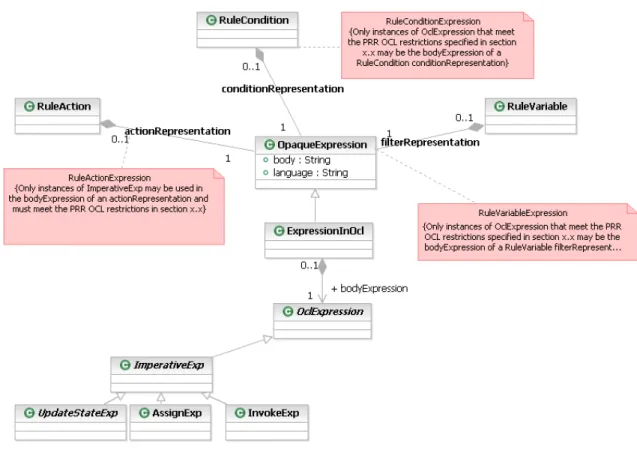
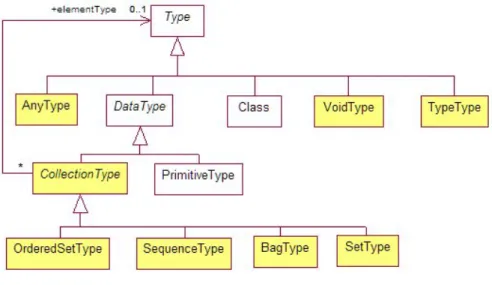
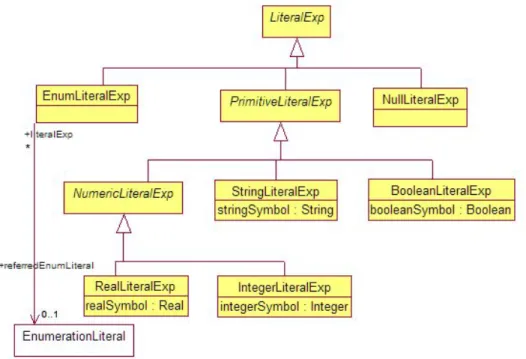
Figure 6, Figure 7, and Figure 8 show the subset of BasicOCL package that is used by PRR OCL. The classes that are not part of OCL are shown with a transparent fill color.
Deleted: Deleted: Deleted:
Figure 6: Types
The following types are not used:
- TupleType: TupleType (informaly known as record type or struct) combines different types into a single aggregate type
- InvalidType: In OCL, the only instance of InvalidType is Invalid, which is further defined in the OCL standard library. Furthermore Invalid has exactly one runtime instance called OclInvalid. In OCL, the invalid value is returned when invalid expressions are evaluated, such as division of zero for instance. In PRR OCL, the result of the evaluation of an invalid expression is not specified and is specific of the implementation.
Figure 7: OCL Expressions
The following OCL expressions are not used:
- IfExp: the semantic of if-then-else expression is redefined by the rule structure itself. - IterateExp: IteratorExp is sufficient for the PRR OCL use
- LetExp: RuleVariable must be used to define variable - TupleLiteralExp: the tuple type is not used
- InvalidLiteralExp. The invalid type is not used
- UnlimitedNaturalExp: this expression is used to encode the upper value of a multiplicity specification. It is not used in the production rule expression.
Figure 8: Literals
3.6.1
Classes used in PRR OCL
Name Description ProductionRule::RuleVariable The variable represents a programming construct
to hold values for use in executing a rule. The values must conform to the variable's type. ProductionRule::RuleCondition The condition represents a Boolean expression
that is matched against available data to determine whether a ProductionRule can be instantiated ProductionRule::RuleAction The action association defines an ordered list of
actions.
ProductionRuleOCL::ImperativeExp A rule action expression, abstract class.
ProductionRuleOCL::AssignExp A subclass of ImperativeExp that assigns a value to an expression
ProductionRuleOCL::InvokeExp A subclass of ImperativeExp that invokes an operation and passes values in as parameters ProductionRuleOCL::UpdateStateExp An abstract subclass of ImperativeExp that
updates the state of the rules engine only
ProductionRuleOCL::AssertExp A subclass of UpdateStateExp that adds an object to the execution context of the engine
ProductionRuleOCL::RetractExp A subclass of UpdateStateExp that removes an object from the execution context of the engine
Name Description ProductionRuleOCL::UpdateExp A subclass of UpdateStateExp that changes an
object in the execution context of the engine UML2:: BasicBehaviors::Operation See UML2
UML2:: OCL::OclExpression See UML2
3.6.2
RuleVariable
A RuleVariable is associated to a FilterExpression used to specify a collection and/or filter for the domain represented by the RuleVariable. This section describes how PRR OCL can be used to define the FilterExpression.
The general structure of the FilterExpression, written in an OCL like syntax, is: dataSource Æ operator ( iterator | body )
The components are:
- dataSource: the source of data on which the filter must be applied. - operator: there are two possible values
• any: return one element of the dataSource for which body is true. At runtime, the rule variable will be bound to all the possible elements. The type of the return value must be compatible with the type of the rule variable.
• select: return the subset of the dataSource for which body is true. The return value is a Set.
- iterator: the iterator variable. This variable is bound to every element value of the source collection while evaluating the body expression
- body: a boolean expression
The following example defines, in an OCL like syntax, a ruleset with an input parameter and a rule with an item rule variable, no condition and a simple action that print out the name of the type of the filtered items.
ruleset ruleset1(in scart : ShoppingCart) :
rule r1
ruleVariable :
item : Item = scart.items->any(e: Item | e.type=ItemType.CD);
action:
Util.println(item.name);
Although this looks like valid OCL syntax, it would not be executable as such. The term “any” here has a different execution over what would be expected in pure OCL. In PRR OCL this means “each in turn”.
At runtime, the item rule variable will be associated with each Item found on the ShoppingCart that match the test. If the items associated to the shopping cart instances given as input to the
ruleset are for instance: cd1 [CD], book1 [Book], cd2[CD] then the result of the execution will be:
cd1 cd2
The following example defines a ruleset with an input parameter and a rule with an items rule variable that is bound to the collection of shopping cart items that match the given test and with an action that prints out the size of the collection.
ruleset ruleset2(in scart : ShoppingCart) :
rule r1
ruleVariable :
items : Set = scart.items->select(e: Item | e.type=ItemType.CD);
action:
Util.println(items.size());
At runtime, the items rule variable will be associated to the set of items found on the ShoppingCart and that match the given test. If the items associated to the shopping cart instances given as input to the ruleset are for instance: cd1 [CD], book1 [Book], cd2[CD] then the result of the execution will be:
2
In the PRR OCL metamodel, a FilterExpression maps to an IteratorExp instance. The following restrictions apply:
- the IteratorExp must have at most one iterator variable.
• The type of the iterator variable must be the same at the type of the rule variable when the “any” operator is used.
• When the “select” operator is used, it is assumed that the type of the elements of the collection is the same as, or included in, the type of the rule variable.
- No CallExp can be applied on IteratorExp in the RuleVariable part
• the IteratorExp is exclusively used to represent binding. The RuleVariable
definition needs to be simple to allow the rule engine, at runtime, to update its state when the instances of the collection are modified.
• Operation on collection are therefore not authorized on rule variable. It if for instance not possible to write shoppingCarts->collect(items) or its implicit form shoppingCarts.items.
- No CallExp can use an IteratorExp
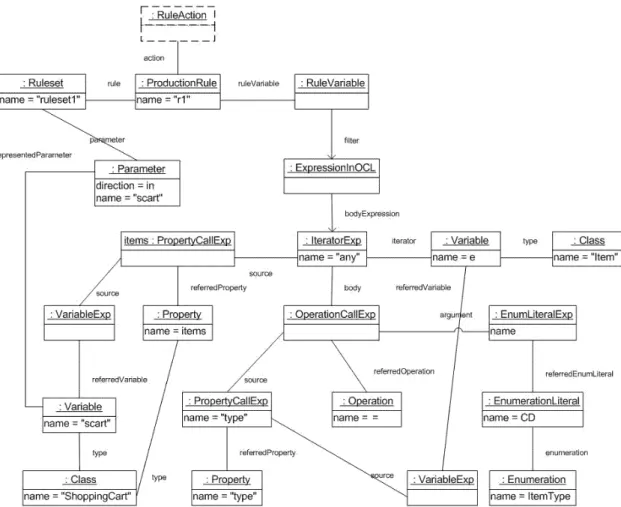
Figure 9 shows the abstract syntax of the first example above (the rule action part is not detailed).
Figure 9 An example of Rule Variable abstract syntax
In OCL, the operators ‘+’, ‘-’, ‘*’. ‘/’, ‘<‘, ‘>’, ‘<>’ ‘<=’ ‘>=’ are used as infix operators. It means, for instance, that the expression a < b is conceptually equivalent to the expression
a.<(b).
This explains why the “e.type” expression is used as source in the Figure 9.
3.6.3
RuleCondition
The Rule condition represents a Boolean expression that is matched against available data to determine whether a production rule’s actions can be executed.
In PRR OCL, rule conditions are defined using a BooleanLiteralExp. The following restrictions apply:
- IteratorExp cannot be used in RuleCondition: IteratorExp are only used to represent rule variables.
PRR OCL does not provide special operations on collections. Collections are treated as instances like any other objects.
Collections in production rules are handled in a different way than in OCL. For instance, the test to check that the city of at least one address of one of the customers of a company is “Paris” could be written like this in OCL, assuming a forward-chaining implementation:
context Company
inv : self.customers.addresses->exists(p : Address | p.city = 'Paris'
)
In PRR OCL this could be modelled as follows:
ruleset ruleset3(in company : Company) :
variable:
parisCust : List = Util.createList();
rule r1
ruleVariable :
customer : Customer = company.customers->any();
addresses : Set = customer.addresses->select(p : Address | p.city =
'Paris');
condition :
addresses.size() > 0 and not parisCust.contains(customer);
action:
parisCust.add(customer);
rule r2
ruleVariable :
customer : Customer = company.customers->any();
addresses : Set = customer.addresses->select(p : Address | p.city =
'Paris');
condition :
addresses.size() = 0 and parisCust.contains(customer);
action: parisCust.remove(customer); rule r3 condition : parisCust.size() = 0; action:
Util.sendMessage(“There is no customer of company with an address in Paris”);
r1 and r2 maintain the list of customers that have at least one address in Paris. r3 sends a message when there is no customer that has an address in Paris. With this design the check is performed when the number of customer change, the number of address change or an address is modified.
3.6.4
RuleAction
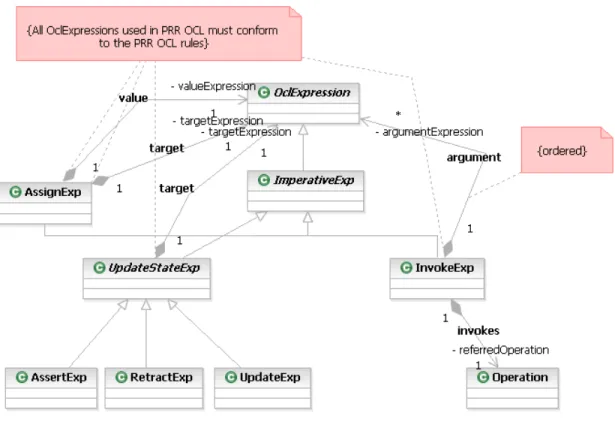
Figure 10: PRR OCL Actions
The rule action part defines an ordered list of actions. These actions may update objects within the domain of a ruleset invocation (data source) or make some external invocation.
The metamodel needed to represent actions must be simple. Three different actions have been selected:
- Update State Expression
An abstract class of actions that impact the scope of the engine. • Assert: Add an object to the scope of the engine
The only behavior that can we can be sure of and so the only semantic we can describe is that an object is added to the engine. This object maybe newly created or already existing into the system but this is not in the scope of the rule engine. • Retract: remove an object from the scope of the engine
Again the only semantic that we can describe and that is meaningful to the engine is that an object is or is not in the scope of the engine.
• Update: notification of an object change
Some operations modify the state of objects and others do not. If the modified objects are in the scope of the engine, the engine must be notified that the objects state has been modified to be able to compute the list of eligible rules. It is not possible from the operation call to determine automatically what objects will be modified so it may
be necessary in the rule to explicitly notify the engine.
We can assume that the notification is done by the application but in that case: - It is intrusive on the application: the method definition must integrate
notification code
- The definition of the rule is not complete: the semantic and so the execution effect depends on code that exists outside of the rule.
- Invoke: operation call – may require associated add, remove, update actions.
- Assign: assign a value to a variable or a property value – includes any relevant update action. The assign operation handle both single valued and multi valued properties. BasicOCL is extended to provide new types of expression for PRR OCL. This extension is consistent with the way conditions are defined and is similar to the solution that has been chosen in QVT Specification (ptc/05-11-01). Later we can extend the action part by supporting other operations as required.
Note: Some BasicOCL extensions used below are similar to the extensions of the same name specified in the OMG MOF QVT specification.
3.6.5
Class ImperativeExp
3.6.5.1 DescriptionThe imperative expression is an abstract concept serving as the base for the definition of all side-effect oriented expressions defined in this specification. Its superclass is OCLExpression. 3.6.5.2 Attributes
No additional attributes defined. 3.6.5.3 Associations
None. 3.6.5.4 Constraints
No additional constraints defined. 3.6.5.5 Semantics
None.
3.6.6
Class AssignExp
3.6.6.1 DescriptionAn assignment expression represents the assignment of a variable or the assignment of a Property.
3.6.6.2 Attributes None. 3.6.6.3 Associations
• value : OclExpression [1]
• target : OclExpression [1]
The “left hand side” expression of the assignment. Should reference a variable or a property that can be updated.
3.6.6.4 Constraints
The target expression must be a either a VariableExp or a PropertyCallExpr. The target expression must NOT be a RuleVariable.
The value type must conform to the type of the target. The value expression must be a PRR OCLExpression. 3.6.6.5 Semantics
In this description we refer to "target field" the referred variable or property.
If the variable or the property is monovalued, the effect is to reset the target field with the new value. If it is multivalued, the effect is to reset the field with the value of the new collection. An assignment expression returns the assigned value.
3.6.7
Class InvokeExp
3.6.7.1 DescriptionAn InvokeExp refers to an operation defined in a Classifier. The expression may contain an ordered list of argument expressions if the operation is defined to have parameters. In this case, the number and types of the arguments must match the parameters.
3.6.7.2 Attributes
None
3.6.7.3 Associations
• argument : OclExpression [*]
The arguments denote the arguments to the invoke expression. This is only useful when the invoked operation is related to an Operation that takes parameters.
• referredOperation : Operation [1]
The Operation to which this InvokeExp is a reference. This is an Operation of a Classifier that is defined in the UML model.
3.6.7.4 Constraints
No additional constraints defined. 3.6.7.5 Semantics
In this description we refer to "target field" the referred variable or property.
If the variable or the property is monovalued, the effect is to reset the target field with the new value. If it is multivalued, the effect is to reset the field with the value of the new collection. An assignment expression returns the assigned value.