Any correspondence concerning this service should be sent
to the repository administrator: [email protected]
This is an author’s version published in:
http://oatao.univ-toulouse.fr/22504
Official URL
DOI : https://doi.org/10.1007/978-3-319-91473-2_22
Open Archive Toulouse Archive Ouverte
OATAO is an open access repository that collects the work of Toulouse
researchers and makes it freely available over the web where possible
To cite this version:
Brabant, Quentin and Couceiro, Miguel and
Dubois, Didier and Prade, Henri and Rico, Agnés Extracting
Decision Rules from Qualitative Data via Sugeno Utility
Functionals. (2018) In: 17th International Conference, Information
Processing and Management of Uncertainty in Knowledge-based
Systems (IPMU 2018), 11 June 2018 - 15 June 2018 (Càdiz, Spain).
Extracting Decision Rules from Qualitative Data via Sugeno
Utility Functionals
Quentin Brabant∗1, Miguel Couceiro1,
Didier Dubois2, Henri Prade2, Agn`es Rico3
(1) LORIA, (Inria Nancy Grand Est & Universit´e de Lorraine), Campus scientifique, BP 239, 54506 Vandoeuvre-ls-Nancy
(2) IRIT, CNRS & Universit´e Paul Sabatier, 118 route de Narbonne 31062 Toulouse (3) ERIC & Universit´e Claude Bernard Lyon 1,
43 bld du 11-11, 69100 Villeurbanne
e-mails: [email protected],[email protected], [email protected],[email protected],[email protected]
Abstract
Sugenointegralsarequalitativeaggregationfunctions.Theyareusedinmultiplecriteriadecisionmaking anddecisionunderuncertainty,forcomputingglobalevaluationsofitems,basedonlocalevaluations.The combinationofaSugenointegralwithunaryorderpreservingfunctionsoneachcriterioniscalledaSugeno utilityfunctionals(SUF).AnoteworthypropertyofSUFisthattheyrepresentmulti-thresholddecisionrules, whileSugenointegralsrepresentsingle-thresholdones.However,notallsetsofmulti-thresholdrulescanbe representedbyasingleSUF.Inthispaper,weconsiderfunctionsdefinedastheminimumorthemaximumof severalSUF.Thesemax-SUFandmin-SUFcanrepresentallfunctionsthatcanbedescribedbyasetof multi-thresholdrules,i.e.,allorder-preservingfunctionsonfinitescales.Westudytheirpotentialadvantagesasa compactrepresentationofabigsetofrules,aswellasanintermediarystepforextractingrulesfromempirical datasets.
1
Introduction
Sugeno integrals [12]are aggregation functionsthat are usedin multiple criteria decisionmaking and indecision underuncertainty [7, 9]. Theyare qualitative aggregationfunctions becausethey canbedefined on non-numericalscales(more preciselyon distributivelattices [5]). In this paper weonlyconsiderSugenointegralsdefinedoncompletelyorderedscales,anddenotesuchascaleby
L. AnoteworthypropertyofSugenointegralsisthattheiroutputisalwayscomprisedbetweenthe minimumand themaximum oftheirparameters. Moreover, Sugenointegralson Lare asubclass of lattice polynomials on L. More precisely, they correspond to all idempotent functions from
Ln to Lthat can be formulated using min and max operations, variables and constants. From a
decision making point of view, they also can be regarded as functions whose result depends on an importance value assigned to each subset of criteria. Sugeno integrals are known to represent any set of single-threshold if-then rules [8, 10] of the form
x1≥α andx2≥α . . . andxn≥α⇒y≥α(selection rules), or
x1≤α andx2≤α . . . andxn≤α⇒y≤α(deletion rules).
Sugeno utility functionals (SUF) are a generalization of Sugeno integrals [6] where each criterion value is mapped to an element of L by an order preserving function. They allow to represent multi-threshold rules of the form:
x1≥α1andx2≥α2. . . andxn≥αn⇒y≥δ (selection rules), or
x1≤α1and x2≤α2. . . andxn≤α1⇒y≤δ (deletion rules).
However, although any single multi-threshold rule can be represented by a SUF, not all sets of multi-thresholdrulescanberepresented byasingleSUF [3].
In this paper, we consider functionsdefined as disjunctionsor conjunctionsof SUF, recently introducedin[3]. Theycaptureallorder-preservingpiecewiseunaryfunctionsonfinitescales,this is to say, all functions that can be represented by means of a set of multi-threshold rules. We studythepotential advantagesofthisrepresentationbasedoncombinationsofSUF.Inparticular, weinvestigatewhetheritispossibletorepresentalargesetofrulesbymeansofonlya fewSUF, and whethercombinationsofSUF canhelplearning modelswhichoffera goodtrade-offbetween simplicityandpredictiveaccuracy.
InthenextsectionwepresentcombinationsofSUFasaframeworkwithequivalentexpressivity tothatofdecisionrules. InSection3,wedealwiththeproblemoffindingaminimalcombinationof SUFthatrepresentsasetofrules. InSection4,weproposeamethodforapproximatelyrepresenting realdatasetsbymeansofadisjunctionofSUF.Weshowthatitachievespredictiveaccuracyscores similartotherule setslearned bytherough set-basedmethod VC-DomLEM[1]. Wealso lookat thecompactnessoftheobtainedmodel, andattherelationbetweenthecompactnessofthemodel anditspredictiveaccuracy. Weomittheproofofmostresultsbecauseofspacelimitation.
2
Preliminaries
We use the terminology of multiple criteria decision-making where some objects are evaluated accordingtoseveralcriteria. WedenotebyC={1,...,n}asetofcriteria,by2C itspowerset,and
by X1,...,Xn and L totallyorderedscales withtop 1X1, ..., 1Xn and 1L and bottom 0X1, ...,
0Xn and0L,respectively. Wedenoteby ν the orderreversingoperationonL(ν isinvolutiveand
suchthatν(0)=1andν(1)=0. WedenotetheCartesianproductX1×···×XnbyX. Anobject
isrepresented bya vectorx=(x1,...,xn)∈Xwhere xi isthe evaluationofx w.r.t. criterion i.
Letf :X→Lbean evaluationfunction.
2.1
Decision
Rules
Order-preserving functionsfrom X toL canalwaysbe described by a set ofselection rulesor of deletionrules[3]. Forthesakeofsimplicity,inthispaperwemainlyfocusonselectionrules. When
there is no risk of ambiguity, we simply refer to selection rules as rules. Since any selection rule
r∈Rhas the form
x1≥αr1, . . . , xn≥αrn⇒f(x)≥δr,
we will use the following abbreviation for defining a rule
r:αr
1, . . . , αnr ⇒δr.
Moreover, the left hand side of a rule r will be denoted by αr = (αr
1, . . . , αrn). We say that a
functionf :X→L iscompatible with a selection rule rif f(x)≥δr for all xsuch thatx i≥ αri
for eachi∈C. For any selection ruler, we will denote byfr the least function fromXtoLthat
is compatible withr, i.e., the function defined by
fr(x) =δr if [xi≥αri ∀i∈C], 0 otherwise,
for all x∈X. We say that a criterioni∈C is active in rif αr
i > 0Xi. Moreover, we denote by Ar the set of criteria active in a ruler. For any set of rulesR, we denote byfRthe least function
compatible with all rules inR, defined by
fR= max r∈Rfr(x)
for allx∈X. We say that a functionf :X→Lrepresentsa set of selection rulesR(or equivalently, thatR represents f) if f = fR. We say that a set of selection rules is redundant if there exists
r, s∈Rsuch thatr6=s,
αri ≥α s
i for alli∈C and δ s ≥
δr, (1)
or, equivalently, if there existsr∈Rsuch thatfR=fR\{r}.A set of rules that is not redundant is
said to beirredundant. We define theequivalence classof a set of rulesRas [R] ={R′|f
R=fR′}.
Lemma 1 The equivalence class ofRhas one minimal element, which is
Rmin={r∈R|6 ∃s∈R:fr≤fs}=
\
R′∈[R]
R′, (2)
and is the only irredundant element of[R].
2.2
Sugeno Integrals and Their Generalizations
A Sugeno integral is defined with respect to a capacity which is a set functionµ : 2C →L that
satisfies µ(∅) = 0, µ(C) = 1 and µ(I)≤ µ(J) for all I ⊆ J ⊆ C. The conjugate capacity of µ
is defined byµc(I) = ν(µ(Ic)), where Ic is the complement of I. The capacity can be seen as a
function assigning an importance level to each subset of criteria. The Sugeno integralSµassociated
toµcan be defined in two ways:
Sµ(x) = max
I⊆Cmin(µ(I),mini∈I(xi)) = minI⊆Cmax(µ(I c
),max
i∈I (xi)),
for allx∈Ln[11]. The inner qualitative M¨obius transform of a capacityµis a mappingµ
#: 2C →L
defined by
µ#(I) =µ(I) ifµ(I)>max
A set I ⊆ C such that µ(I) > 0 is called a focal set. The set of focal sets of µ is denoted by
F(µ). Since µ(A) = maxI⊆Aµ#(I) for all A ⊆ C, the set function µ# contains the minimal
amount of information needed to reconstruct µ. The qualitative M¨obius transform provides a concise representation of the Sugeno integral as:
Sµ(x) = max
I∈F(µ)min(µ#(I),mini∈I(xi)),= minI∈F(µc)max(ν(µ
c
#(I)),maxi ∈I (xi)).
A Sugeno utility functional (SUF) is a combination of a Sugeno integral and unary order preserving maps on each criterion [3, 10]. Formally, a SUF is a functionSµ,ϕ defined by
Sµ,ϕ(x) = max
I∈F(µ)min(µ(I),mini∈I ϕi(xi)), for allx∈X,
where µis a capacity, ϕ= (ϕ1, . . . , ϕn) and, for all i∈C, ϕi: Xi →L is order preserving, with
ϕ(0Xi) = 0L andϕ(1Xi) = 1L.
It is shown in [10] that any SUF can be represented in terms of single-thresholded rules of the form ”ϕ1(x1)≥α, . . . , ϕn(xn)≥α⇒f(x)≥α” (in other words, for all SUFSµ,ϕ there is a set of
rulesRsuch thatfR=Sµ,ϕ). On the contrary, some sets of rules cannot be represented by a SUF.
This justifies the use of combinations of SUF. A max-SUF (resp. min-SUF) is defined by
f(x) = max i∈{1,...,k}S i (x) resp. f(x) = min j∈{1,...,ℓ}S j (x) ,
for allx∈X, whereS1, . . . , Sk, S1, . . . Sℓ are SUF.
Remark 1 It is shown in [3] that min-SUF and max-SUF can represent any set of deletion or selection rules, respectively. In other words, any order-preserving function from X to L can be
expressed by a max-SUF and by a min-SUF. Also, since any SUF is such thatSµ,ϕ(0X1, . . . ,0Xn) =
0L and Sµ,ϕ(1X1, . . . ,1Xn) = 1L, note that no combination of SUF from Xto L can represent a
set of rules Rsuch that fR(0X1, . . . ,0Xn)>0L orfR(1X1, . . . ,1Xn)<1L. However, one can take L′={y∈L| ∃x∈X:fR(x) =y}and find a combination of SUF from XtoL′ that representsR.
Based on these results, we can try to model any order-preserving function defined on finite scales by means of max-SUF or min-SUF. Moreover, datasets that can be conveniently approximated by means of rules could also be approximated by means of a max-SUF or min-SUF. In the next section, we focus on the exact representation of an order-preserving function.
3
Representing a Set of Rules by a (max-)SUF
In this section we will address the following problems. Given a set of rulesR:
1. Determine whetherRisSUF-representable, i.e., whether there is a SUF such thatfR=Sµ,ϕ.
2. Find such a SUF if it exists.
3. In the case it does not exist, find a max-SUF that represents R while involving the least possible number of SUFs.
3.1
From a SUF to a Rule Set and Back
We already know that any SUF can be represented by a set of rules. Let us denote byRµ,ϕthe set
of rules defined from focal sets inF(µ) as
[
F∈F(µ)
[
δr≤µ(F)
{r|Ar =F and∀i∈Ar :αri = min{xi∈Xi|ϕi(xi)≥δr}}.
As it will be shown in Lemma 2, this set of rules is equivalent toSµ,ϕ.
Although it is not always possible to find a SUF that represents a given set of rules, we can give a method for constructing such a SUF, when it exists. For any set of rulesR, letSRmax be the SUF
defined bySmax
R =Sµ,ϕ, whereµ(C) = 1L,
∀I⊂C such thatI 6=∅: µ(I) = max
r∈R, Ar⊆I
δr, (3)
∀i∈[n], ∀x∈Xsuch thatxi6= 1Xi : ϕi(xi) = max
r∈R,
0<αr i≤xi
δr, (4)
andϕi(1Xi) = 1L for alli∈C. From this definition, we easily see that we always haveS
max
R ≥fR.
However it can be the case thatSmaxR > fRas shown in the following example.
Example 1 Consider a set of three criteria C = {1,2,3}, the scales X1 = X2 = X3 = L =
{0, a, b,1}, with0< a < b <1, and the rule setR={r1, r2, r3}, with
r1: 0, b,1⇒1, r2:a, a,0⇒a, r3:a,0, b⇒b.
LetSµ,ϕ=SRmax. The functionµis such that
µ#({1,2}) =a µ#({1,3}) =b, µ#({2,3}) = 1.
and, for all otherI ⊂C,µ#(I) = 0. Moreover, we have
ϕ1(a) =ϕ1(b) =b, ϕ2(a) =a, ϕ2(b) = 1, and ϕ3(a) = 0, ϕ3(b) =b.
One can check thatSµ,ϕ(0, b, b) =b, whilefR(0, b, b) = 0.
We will show that, whenSmax
R > fR, there exists no SUF that representsR(see Proposition 4).
Lemma 2 For any SUFSµ,ϕ, we have Sµ,ϕ=fRµ,ϕ=S
max
Rµ,ϕ.
Proof 1 LetSµ,ϕbe a SUF, and letµ∗andϕ∗be such thatSRmaxµ,ϕ=Sµ∗,ϕ∗. First, take any
x∈X,
y∈Lsuch thatSµ,ϕ(x)≥y. Necessarily, there is F ∈ F(µ)such that
min(µ(F),min
i∈F ϕi(xi)))≥y.
Thereforeµ(F)≥y and∀i∈F :ϕi(xi)≥y. From the definition ofRµ,ϕ it follows that there is
r∈Rµ,ϕ such thatδr =µ(F)≥y, Ar =F and∀i∈Ar :αri ≤xi. So we have fr(x)≥y and thus
fRµ,ϕ(x)≥y. Now, from the definition ofS
max
Rµ,ϕ, it follows thatµ
∗(Ar)≥yand∀i∈Ar :ϕ∗
i(xi)≥
y. ThereforeSmax
Rµ,ϕ ≥y. Summing up, we have provenSµ,ϕ≤S
max
Now we will prove Sµ,ϕ≥ fRµ,ϕ. Let x∈X, y ∈Lsuch that fRµ,ϕ(x)≥y. Necessarily there
is r∈Rµ,ϕ such thatfr(x)≥y. Thereforeδr ≥y, and from the definition ofRµ,ϕ it follows that
µ(Ar)≥δr. Moreover for alli∈Ar we have
xi≥αri = min{zi∈Xi|ϕi(zi)≥δr},
and thusϕ(xi)≥δr. Finally we get that for all y s.t. fRµ,ϕ(x)≥y: Sµ,ϕ(x)≥min(µ(Ar),min
i∈Arϕi(xi))≥δ
r≥
y.
ThereforeSµ,ϕ≥fRµ,ϕ.
We still have to proveSRmaxµ,ϕ≤Sµ,ϕ. Let
x∈Xandy∈Lbe such thatSmax
Rµ,ϕ(
x)≥y. Necessarily
there isF ∈ F(µ∗)such that
min(µ∗(F),min
i∈F ϕ
∗
i(xi))≥y (5)
Thusµ∗(F)≥y and from the definition of Smax
Rµ,ϕ it follows that there is r∈R such that A
r ⊆F
and δr ≥ y. From the definition of R
µ,ϕ we obtain that µ(Ar) ≥ y. From (5) we also get that
∀i∈F :ϕ∗
i(xi)≥y. Again, from the definition ofSRmaxµ,ϕ, it follows that, for each i∈F, there is ri∈R
µ,ϕ such thatδr
i
≥y and0< αri
i ≤xi. So, for each i∈F:
xi≥αr i i = min{zi∈Xi|ϕi(zi)≥δr i }, and thusϕi(xi)≥δr i . Therefore we get min(µ(Ar),min i∈Arϕi(xi))≥y.
We have shown thatSmax
Rµ,ϕ ≤Sµ,ϕ, and the proof is complete.
Lemma 3 Let R and R′ be two sets of selection rules belonging to the same equivalence class.
NecessarilySRmax=SRmax′ .
Lemma 4 For any set of selection rules R, if there exists a SUF S such that S = fR, then
S=Smax
R .
Relying on Proposition 4, we are able to identify sets of rules that can be represented by a single SUF, and to define such a SUF if it exists. A simple procedure for doing so, starting fromR, is to computeµandϕsuch thatSmax
R =Sµ,ϕand then to computeRµ,ϕ. IfRµ,ϕandRare in the same
equivalence class, thenSmaxR is the SUF equivalent toR, otherwise there is no such SUF.
3.2
From a Rule Set to a max-SUF
Now consider the case where R cannot be represented by a SUF, but we want to find a max-SUF that involves the least possible number of max-SUF for representing R. In order to find such an “optimally parsimonious” max-SUF, one has to build the smallest partition (in terms of number of subsets) where each subset P is SUF-representable. All such partitions cannot be enumerated in reasonable time. Moreover note that, although in Example 1,r1andr3are responsible for the fact
thatSRmax > fR, whether R is SUF-representable or not depends on larger combinations of rules.
There are cases where each A⊂ R of size atmost n isSUF-representable, while R is not. One exampleofsucha caseisthefollowing.
Example 2 Let n = 4. Consider L= {0, a, b,1} and the set of selection rulesR = {r1, . . . , r5}
with domainL4 and codomainL, where
r1:a, a,0,0⇒b, r2:a,0, a,0⇒b, r3:a,0,0, a⇒b, r4: 0, a, a, a⇒a, r5: 0, b, b, b⇒1.
One can check thatSmax
R > fR, while each subset of Rof size4 is SUF-representable.
Algorithm 1 presents a greedy method for extracting the max-SUF representing a set of rules. Although the resulting max-SUF is not necessarily minimal, it constitutes a first approximation.
Algorithm 1:Builds a set of SUFS that represents a given set of rulesR
1 P ← {} 2 for eachr∈Rdo 3 covered←false 4 for eachP∈P do 5 if fP∪{r}=Smax P∪{r}then 6 addrtoP 7 covered←true 8 break foreach 9 if covered =falsethen
10 add {r}toP
11 S ← {SmaxP |P∈P}
Remark 2 In Algorithm 1, one does not have to computeSPmax∪{r} from scratch each time a ruler
is added toP; the functionSmax
P can be updated iteratively.
In order to get an idea of the number of SUFs required to represent a set of rules, we randomly generated sets of rules, and used Algorithm 1 to find their representations in terms of max-SUF.
Algorithm 2:Random generation of a set of rules R, for a given domain X, codomain L, and real numberp <<1
1 R← {}
2 forifrom 1 to|X| ∗pdo 3 pick a randomαr = (αr
1, . . . , αrn)∈X\D
4 V ={δr ∈L| such that (1) holds for alls∈R}
5 if V 6=∅then
6 pick a randomδr inV
Our aim was to approximate the number of utility functionals necessary to represent a set of rules, depending on the size of the set. Algorithm 2 describes the random generation of a rule set. The number of rules depends on the number of criteria and on the size ofL. For the sake of simplicity, for our test we setX=Ln.
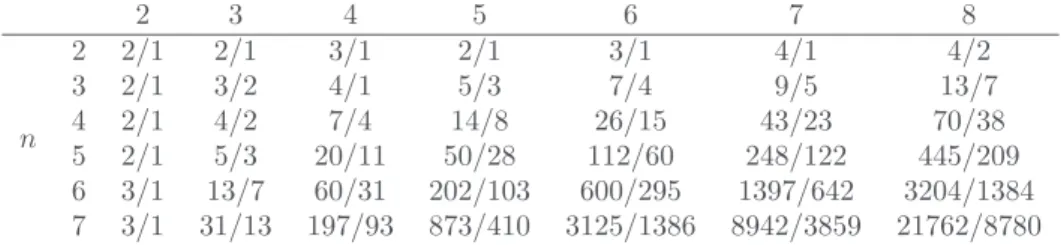
Table 1 displays the variation of the number of rules and Sugeno-utility functionals obtained, depending on nand the size of L. These results suggest that in general, the representation of a
Table 1: Number of rules/Sugeno-utility functionals Size ofL 2 3 4 5 6 7 8 n 2 2/1 2/1 3/1 2/1 3/1 4/1 4/2 3 2/1 3/2 4/1 5/3 7/4 9/5 13/7 4 2/1 4/2 7/4 14/8 26/15 43/23 70/38 5 2/1 5/3 20/11 50/28 112/60 248/122 445/209 6 3/1 13/7 60/31 202/103 600/295 1397/642 3204/1384 7 3/1 31/13 197/93 873/410 3125/1386 8942/3859 21762/8780
set of selection rules in terms of a max-SUF is not very compact, since many SUFs have to be involved. However, these results only concern randomly generated rule sets. In the next section, we use combination of SUFs for empirical study on real datasets.
4
Modeling Empirical Data
Formally, we represent a dataset by a multisetD, whose elements belong toX×L. Elements ofD
are calledinstances, and values ofLare referred to asclasses. In this section we present a method for representing an empirical dataset by the mean of a max-SUF. This method is then applied on 12 datasets, the characteristics of which are given by Table 2. The process by which we extract a
Table 2: Description of the datasets. Further information can be found in [1].
Id Name Instances Criteria Classes Id Name Instances Criteria Classes
1 breast-c 286 8 2 7 denbosch 119 8 2 2 breast-w 699 9 2 8 ERA 1000 4 9 3 car 1296 6 4 9 ESL 488 4 9 4 CPU 209 6 4 10 LEV 1000 4 5 5 bank-g 1411 16 2 11 SWD 1000 10 4 6 fame 1328 10 5 12 windsor 546 10 4
max-SUF from a dataset can be divided into four steps. 1. Select an order-preserving subset of data.
2. Associate a rule to each instance. 3. Group rules into a max-SUF.
Step 1. Selection of an order-preserving subset of data. Real life datasets often contain pairs of instances that areorder-reversing, i.e, instances (x, y) and (x’, y′) such thatx≤ x’ and
y > y′. In this step, we build a graph where the set of vertices isD, and the set of edges contains each order-reversing pair of instances. Then, we iteratively remove fromDthe node with the largest number of neighbors, until no edge remains in the graph. In the next steps, we refer asD− to the
data remaining after Step 1. Table 3 presents the ratio of instances which are removed in each of the 12 datasets.
Table 3: Average ratio of data that is removed during Step 1, for each dataset.
1 2 3 4 5 6 7 8 9 10 11 12
.176 .008 .001 .0 .003 .025 .046 .657 .198 .333 .356 .237
Step 2. Associate a rule to each instance. A naive way to proceed would be to return the following set of rules: R={r| ∃(x, y)∈ D−: [δr =
y and∀i∈C :αri =xi]}.However, with most
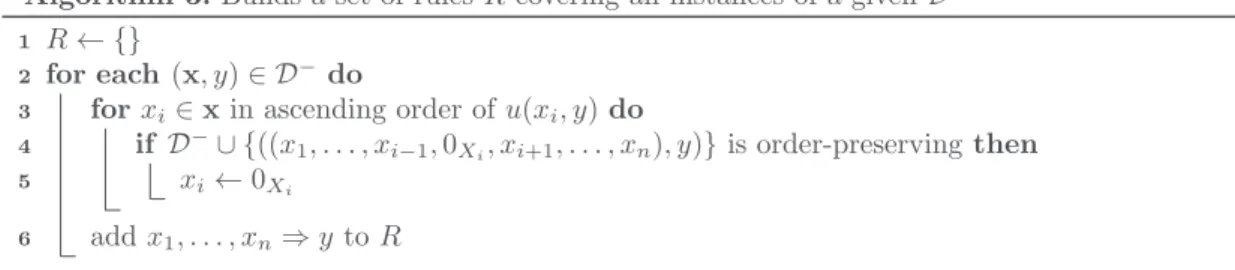
datasets, this would lead to all criteria being active in most rules. This is problematic because SUFs that will be learned by grouping such rules will only have focal sets of great size. Algorithm 3 provides an alternative solution, in which some criteria are set to 0 before rules are extracted. Its principle is that theith criterion value of an instance can be set to 0 if by doing so the data are still
order-preserving. Since the order in which criteria are considered can influence the result of the algorithm, we define this order w.r.t. the discriminative power of each criterion in each instance. A rough estimation of this feature is given by the functionu:S
i∈CXi×L→Ndefined by u(xi, y) = {(x’, y′)∈ D−|[y > y′ andxi> x′i] or [y < y′ andxi< x′i]} .
Intuitively, for any (x, y)∈ D−, u(x
i, y) represents the number of other instances (x’, y′)∈ D−
such that the relation betweeny andy′ could be explained (at least partially) by theith criterion.
Algorithm 3:Builds a set of rules Rcovering all instances of a givenD−
1 R← {}
2 for each(x, y)∈ D− do
3 forxi∈xin ascending order ofu(xi, y)do
4 if D−∪ {((x1, . . . , xi−1,0Xi, xi+1, . . . , xn), y)}is order-preservingthen
5 xi←0X
i
6 addx1, . . . , xn⇒y toR
Step3. Grouprules into a max-SUF. Inthis stepwesimplyexploit avariantofAlgorithm 1,wheretheconditioninline6isreplacedby“SPm
∪ax{r}(x)≤yforall(x,y)∈D−”. Thisguarantees
thatthemax-SUF obtainedisgreater thanorequal tofR anddoes notmissclassifyanyinstance
ofD−.
Step 4. Simplify the model. In this step,weremove someoftheSUFs from the model(see Algorithm 4). The algorithm depends on a parameter ρ ∈ [0,1], usually set close to 1, which representsthe ratio ofaccuracy thathas tobepreserved when removinga SUF from the model.
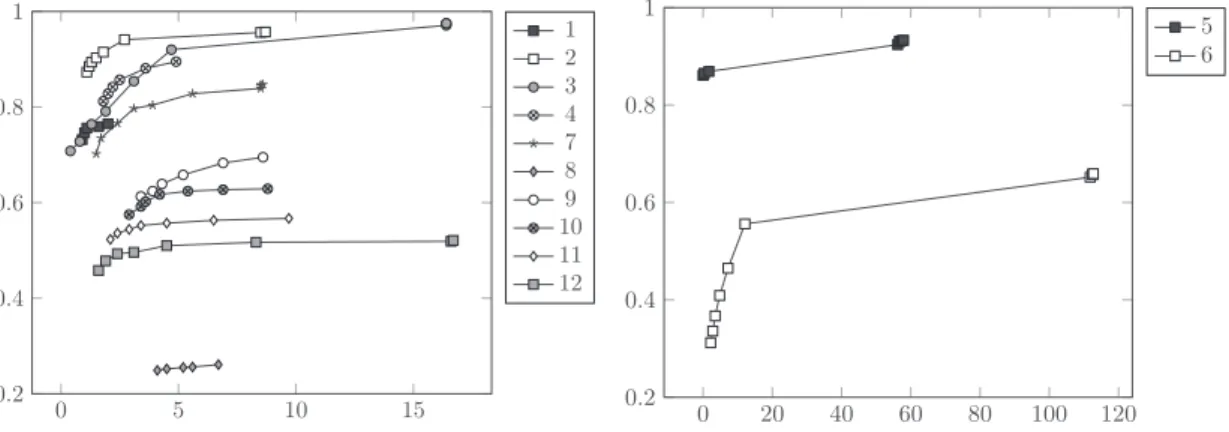
0 5 10 15 0.2 0.4 0.6 0.8 1 1 2 3 4 7 8 9 10 11 12 0 20 40 60 80 100 120 0.2 0.4 0.6 0.8 1 5 6
Figure 1: Average accuracy (in ordinate) and number of SUF (in abscissa) of selected results. Each curve corresponds to one data set.
A lower value of ρ therefore allows to sacrifice more of the accuracy on the training data while removing a SUF from the model. We denote by accuracy(S,D) the accuracy obtained by the model S on the dataD.
Algorithm 4:Removes useless SUF fromS, for givenD− andρ∈[0,1]
1 end←false
2 whileend =falsedo
3 end←true
4 forS∈S do
5 if accuracy(S\S,D−)≥ρ∗accuracy(S,D−)then 6 removeS fromS
7 end←false
Foreachdatasetandeachvalueofρ∈{0.95,0.96,...,1.},wetestedthisfour-stepprocessusing ten-foldcrossvalidationrepeatedseveraltime. Foreachtest,wecomputedtheaverageaccuracy(on validationdata)andtheaveragenumberofSUFsofthemodel. Wethenselectedthebesttrade-offs betweena high accuracy anda low numberofSUFs involvedinthe model; thoseare represented inFigure1. Wecanseethat,althoughinvolvingmoreSUFssinthemodelcanincreaseaccuracy, afewSUFsareoftenenoughtoreachan accuracyclosetothatobtainedbythebestmax-SUF.
In order to get an idea of the accuracy thatcan be reached by our method, we selected the bestaccuracy obtainedoneachdataset. The12datasetsconsideredinthis paperhavebeenused in [1] for evaluating the predictive accuracy of monotonic VC-DomLEM,which is a method for extractingdecisionrulesbasedontheDominance-basedRoughSetApproach. Itsoverallaccuracy onthe12datasetsishigherthanthoseofseveralmethods,suchasSVM,OSDL[2](instancebased) orC4.5(decisiontrees). Table4displaysaccuracy scoresobtainedby ourmethod(withstandard deviation)andthoseobtainedbymonotonicVC-DomLEM,reportedfrom[1]. Bothmethodsyield similaraccuracyscores.Tofinish,Table5showsthedistributionofrulelengthsofthemodelswith
Table 4: Accuracy of VC-DomLEM and our method on each dataset.
1 2 3 4 5 6 7 8 9 10 11 12 avg.
Ours 76 95.3 97.2 89.3 92.4 65.2 84.5 26.4 69.4 63 56.7 53.2 72.4 ± .57 .27 .19 1.33 0.52 .34 1.48 .75 .66 .53 .71 .75
VC-DL 76.7 96.3 97.1 91.7 95.4 67.5 87.7 26.9 66.7 55.6 56.4 54.6 72.7
Table 5: Rule length distributions, given as percentage. The number of criteria in each dataset is indicated by double vertical bars.
Rule length 1 2 3 4 5 6 7 8 9 10 11 12 13 14 15 16 d a ta set 1 1 64 23 11 1 2 13 72 13 1 1 1 1 1 3 3 24 41 32 4 38 47 10 3 1 1 5 3 25 31 13 5 2 3 2 1 1 3 5 3 1 1 6 2 20 37 22 6 2 1 1 1 9 7 20 21 21 12 9 15 3 8 6 62 16 16 9 6 26 36 32 10 5 26 42 27 11 6 2 25 45 9 5 4 1 3 12 3 24 44 21 5 1 2
thebestaccuracy. Rulelengthdistributionisan interestingfeatureformeasuringinterpretability. Indeed,eachdecisionofaclassifierbasedonselection(ordeletion)iscausedby oneorafew rules only. Theshortertheserules,theeasieritisforausertounderstandtheclassifierdecision. Again, the rule lengths distributions we obtained can be compared to those obtained by VC-DomLEM in [1]. None of the two methods provides strictly better result than the other in terms of rule length. However,adrawbackofourapproachisthatitproducesverylongrules(albeitinasmall percentage)onseveraldatasets(e.g.,5,6,11,12). Such longrulesarelesscognitivelyappealing.
5
Conclusion
Keepingin mindthatthe resultsoftheprevioussectionare dependentofouralgorithmicchoices, we candraw the following conclusions: it seems that a single Sugeno integral, even with utility functions,isnot enoughto givean accurate representationofmonotonic datasets. In our experi-ments,thenumberofSUFs requiredtoachievean accuracysimilartodecision rule-basedmodels cangreatlyvary from onedatasettoanother. Moreover,Table5 showsthatrule length distribu-tionsare quite uneven, even if Step 2 tries toprivilege short rules. Progressmay beachieved in twodirections. On theonehand wecouldputarestrictionon thecapacities,limitingourselvesto
k-maxitivecapacities. Ontheotherhand,onemaystartbyconstructing adecisiontreeoflimited depthfromadataset,and useSUFsatits leaves.
Acknowledgements. This work has been partially supported by the Labex ANR-11-LABX-0040-CIMI (Centre International de Math´ematiques et d’Infor-matique) in the setting of the pro-gram ANR-11-IDEX-0002-02, subproject ISIPA (Interpolation, Sugeno Integral, Proportional Anal-ogy).
References
[1] J. Blaszczynski, R. Slowinski, M. Szelag. Sequential covering rule induction algorithm for vari-able consistency rough set approaches,Inf. Sci., 181: 987–1002, 2011.
[2] K. Cao-Van.Supervised ranking from semantics to algorithms, Ph.D. thesis, Ghent University, CS Department, 2003.
[3] M. Couceiro, D. Dubois, H. Prade, A. Rico. Enhancing the Expressive Power of Sugeno Inte-grals for Qualitative Data Analysis. Proc. 10th Conf. of the Europ. Soc. for Fuzzy Logic and Technology (EUSFLAT 2017), Springer, 534-547, 2017.
[4] M. Couceiro, D. Dubois, H. Prade, T. Waldhauser. Decision making with Sugeno integrals. Bridging the Gap between Multicriteria Evaluation and Decision under uncertainty. Order, 33 (3) 517-535, 2016.
[5] M. Couceiro, J.-L. Marichal. Characterizations of discrete Sugeno integrals as polynomial func-tions over distributive lattices.Fuzzy Set. Syst.161 (5), 694–707, 2010.
[6] M. Couceiro, T. Waldhauser. Pseudo-polynomial functions over finite distributive lattices.Fuzzy Set. Syst., 239, 21-34, 2014.
[7] D. Dubois, J.-L. Marichal, H. Prade, M. Roubens, R. Sabbadin. The use of the discrete Sugeno integral in decision making: A survey. International Journal of Uncertainty, Fuzziness and Knowledge-Based Systems, 9:539–561, 2001.
[8] D. Dubois, H. Prade, A. Rico. The logical encoding of Sugeno integrals.Fuzzy Sets and Systems, 241: 61-75, 2014.
[9] M. Grabisch, T. Murofushi, M. Sugeno (Eds.)Fuzzy Measures and Integrals. Theory and Appli-cations. Physica-verlag, Berlin, 2000.
[10] S. Greco, B. Matarazzo, R. Slowinski, Axiomatic characterization of a general utility function and its particular cases in terms of conjoint measurement and rough-set decision rules,European Journal of Operational Research 158: 271-292, 2004.
[11] J.-L. Marichal. On Sugeno integrals as an aggregation function.Fuzzy Set. Syst., 114(3):347-365, 2000.
[12] M. Sugeno. Fuzzy measures and fuzzy integrals: a survey.Fuzzy Automata and Decision Pro-cesses, (M. M. Gupta et al., eds.), North-Holland, 89-102, 1977.