Boardroom, the Enhanced Structural Adjustment Facility, and the Intersection of Material
Power and Norm Change in Global Politics
.
White Rose Research Online URL for this paper:
http://eprints.whiterose.ac.uk/64176/
Version: Submitted Version
Article:
Clegg, Liam Simon orcid.org/0000-0002-0773-5988 (2012) Global Governance Behind
Closed Doors : The IMF Boardroom, the Enhanced Structural Adjustment Facility, and the
Intersection of Material Power and Norm Change in Global Politics. Review of International
Organizations. pp. 285-308. ISSN 1559-744X
https://doi.org/10.1007/s11558-011-9133-6
[email protected] https://eprints.whiterose.ac.uk/
Reuse
Items deposited in White Rose Research Online are protected by copyright, with all rights reserved unless indicated otherwise. They may be downloaded and/or printed for private study, or other acts as permitted by national copyright laws. The publisher or other rights holders may allow further reproduction and re-use of the full text version. This is indicated by the licence information on the White Rose Research Online record for the item.
Takedown
If you consider content in White Rose Research Online to be in breach of UK law, please notify us by
Global governance behind closed doors: The IMF
boardroom, the Enhanced Structural Adjustment Facility,
and the intersection of material power and norm
stabilisation in global politics
Liam Clegg
#Springer Science+Business Media, LLC 2011
Abstract Up on the 12th floor of its 19th Street Headquarters, the IMF Board sits in active session for an average of 7 hours per week. Although key matters of policy are decided on in the venue, the rules governing Boardroom interactions remain opaque, resting on an uneasy combination of consensual decision-making and weighted voting. Through a detailed analysis of IMF Board discussions surrounding the Enhanced Structural Adjustment Facility (ESAF), this article sheds light on the mechanics of power in this often overlooked venue of global economic governance. By exploring the key issues of default liability and loan conditionality, I demonstrate that whilst the Boardroom is a more active site of contestation than has hitherto been recognized, material power is a prime determinant of both Executive Directors’
preferences and outcomes reached from discussions. And as the decisions reached form the backbone of the ‘instruction sheet’ used by Fund staff to guide their
everyday operational decisions, these outcomes—and the processes through which
they were reached—were factors of primary importance in stabilizing the operational
norms at the heart of a controversial phase in the contemporary history of IMF concessional lending.
Keywords IMF. International organizations . Executive board . Executive directors . Concessional lending
JEL Codes D73 . F33 . F55 DOI 10.1007/s11558-011-9133-6
The article draws on research undertaken at the IMF Archives whilst working as a Visiting Scholar at the American Political Science Association Centennial Centre, Washington DC, in June 2010. I owe particular thanks to Dorota Wyganowska and Premela Isaacs of the IMF Archives, and to Alison Desrosiers of APSA. I also acknowledge the support provided by the UK Economic and Social Research Council (PTA-026-27-2807).
L. Clegg (*)
1 Introduction
As an institution, the IMF seems to be at its most comfortable when operating behind the scenes. Whether negotiating loans or engaging in more routine technical assistance and training activities, Fund staffs have historically sought to maintain a low profile. And in keeping with this approach the IMF Boardroom has remained a hidden corner of global economic governance, with meetings taking place behind firmly closed doors and records of discussions being embargoed for a minimum of 10 years.1 As a consequence, our knowledge of how this arena functions has remained highly circumscribed, and even the official accounts of governance processes in the Fund provide only the briefest glimpses into how the balance between consensual decision-making and weighted voting operates in practice.2 By using detailed archival research to explore the mechanisms through which the power of money was mediated through the power of words in IMF Boardroom discussions of the Enhanced Structural Adjustment Facility, this article contributes to the project of enhancing our understanding of how, on an everyday level, this key site of international economic governance functions.
Launched in 1988, ESAF marked the confirmation of the IMF’s controversial
shift into the realm of structural adjustment. And while much analysis of the impact of IMF concessional lending operations has been undertaken (e.g., Dreher 2009; Steinwand and Stone 2008; Vreeland 2006; Barro and Lee 2005; Joyce2004; Vreeland2003; Kolko1999; Bird1995; Killick1995; Conway1994), less attention has been placed on the internal dynamics that led operations to take shape as they did. It is towards this issue that this article is ultimately directed, a task that I approach through the analysis of recorded minutes of Executive Board Meetings (EBMs) at which the establishment of, and reforms to, ESAF were discussed from 1987 to 1998.3 The records of Executive Board discussions preceding the launch of ESAF and reviewing its early years of operation are an intrinsically important series of historical documents,4 whose contents reveal important lessons about the way in which policy decisions are taken inside the IMF. In particular, Directors representing creditor states argued in favor of both using IMF gold to minimize their capital risk and of implementing more stringent conditionality, and Directors representing lower-income states argued against both of these propositions. Moreover, throughout the extended series of Board meetings examined, there was an overwhelming stability in Directors’
preferences. And in place of converging opinions on appropriate policy reforms, the Managing Director’s Summing Up became the key mechanism through
1Following a recent change to the Fund’s disclosure policy, this embargo time has been reduced to five
years. On the broader‘transparency drive’at the Fund, see Weaver (2010).
2
In the most recent‘official history’of the Fund, James Boughton (2001: 1031–3) provides only a general
account of how a combination of ex ante canvassing and‘scorekeeping’during Executive Board Meetings
of Directors’positions by the Secretary serve to enable the institution to function without regular recourse
to formal votes.
3
Pre-launch discussions of the form and function of ESAF took place in late 1987, and in 1999 the concessional lending window was transformed into the Poverty Reduction and Growth Facility.
4
which the preferences of materially powerful actors were translated into operational guidance for staff, as these Summing Up statements—which provide
guidance on policy matters to operational staff—served to endorse the policy
shifts advocated by rich-country Directors. In highlighting the links between material power and ideational change in global economic governance, the case examined demonstrate the close inter-relationship between the mechanisms upheld by the rationalist and constructivist approaches in shaping the evolution of operational change at the IMF.5
In presenting this argument, I begin in the following section by exploring the conceptual lessons that can be drawn out of the current case study regarding the politics of control in International Organizations (IOs). In this first section I also outline the methodological innovations underpinning this research, particularly regarding the application of quantitative coding techniques to the analysis of Executive Board Meetings. In the second section I provide a historical contextualization of the ESAF discussions at the IMF, and review the broad dynamics revealed by my analysis. I then in the third section explore the emergence of the norm of collective insurance against default in detail. The contingencies laid down reflected the wishes of key creditor states, and represented a subtle reframing of the overriding legal norm of pacta sunt
servanda(pacts must be respected) in international financial arrangements. In the
fourth section, I review the dynamics surrounding discussions of conditionality. Here, in the face of significant opposition, materially powerful Directors’advocacy
for the use of prior actions and structural performance criteria led to a significant erosion in the norm of low conditionality in the Fund’s concessional operations.6In
the final, concluding section of the article, I review the central lessons that can be drawn regarding the politics of norm emergence, which serve to highlight the need for further research into the influence of decisions taken at the ‘top
table’ on the operations of this institution of global economic governance.
2 Bargaining and Arguing in International Organizations
The importance of discussion and debate in resolving interstate disputes is well recognized by the canonical texts at the heart of academic International Relations (IR). Since the publication of Schelling’s (1963) seminal work on
bargaining in conflict situations, it has been increasingly widely accepted that the analysis of communication forms a core component of the terrain of the subject field. However, despite the impressive lineage of the debates, our knowledge of the mechanics of discussion in particular arenas of global governance remains limited. The field remains divided between constructivist and rationalist research agendas, each offering competing assumptions about the nature of interstate interactions. It
5
In this article I side-step the epistemological issues raised over the commensurability of the rationalist and constructivist models (e.g., Weiner2003; Johnson2002), and follow the approach advocated by Jeffrey Checkel of engaging in‘middle range theory building’(Checkel and Moravcsik2001: 243).
6
remains unclear as to whether key actors engage in arguments, exchanging information relating to mutually agreed points of reference with a view to updating preferences, or in processes of bargaining, with conflicting preferences being adjudicated according to the material power of actors involved. Exploring this issue is particularly important in institutions of economic governance, where the tension between the roles played by material and ideational power is particularly prominent. By showing that materially powerful states are able to employ rationalist-type mechanisms to reshape the norms at the heart of the Fund’s bureaucratic culture, I demonstrate that there is a pressing need to revisit
ongoing attempts to bridge between the rationalist and constructivist approaches to the analysis of change in IOs.
It remains unclear as to whether we should expect to see bargaining or arguing as the prevalent pattern of interaction in the IMF Boardroom. Whilst is has been suggested that the Boardroom is something of a sterile environment, heavily managed through backstage negotiations to ensure that sufficient key players are happy to ‘sing from the same song sheet’ to pass decisions under
review (Boughton 2001: 1031), it has also been found that when broader policy issues (such as the establishment and subsequent reforms to ESAF) are up for discussion, this high degree of order is disrupted. Indeed, the very rare occasions when formal votes have been called in the IMF Boardroom have been to resolve disputes over these more general policy issues (Stone2011: 70). What’s more, the
investigation of how the Board functions has implications beyond the purely academic; with their inconsequential share of voting, persuading fellow Directors through the strength of their arguments appears to be the only potential form of influence available to a number of developing-country representatives (Woods and Lombardi 2006: 482). By analyzing an extended series of Executive Board Meeting minutes from the late 1980s through to the late 1990s, I demonstrate that the behavioral assumptions of the rationalist approach capture the pattern of Boardroom interaction most closely, and that material power is a key determinant of both preferences and outcomes. More broadly, though, in order to develop a deeper understanding of the institutional mechanics through which these outcomes shape operational practice, it is necessary to situate the decisions in the wider
‘norm lifecycle’to which they contribute.
It is generally agreed that the rationalist approach provides the dominant framework for the study of IR, particularly so within the US (Frieden and Martin2003). At its most general, rationalism has been said to encompass theories based on the assumption that‘when faced with several courses of action, people
usually do what they believe is likely to have the best overall outcome’ (Elster
1989: 22).7 Within this very broad umbrella, common assumptions regarding agents’ preference formation, processes of interaction, and outcomes from
interaction provide the points of contrast to constructivism that are particularly apposite to this investigation. Preferences are held to be exogenous within the rationalist analytic framework. A priori assumptions hold that as utility-maximizing agents, interests are determined by cost-benefit calculations, made by reference to strict material parameters (Brams 1990; Elster 1982). Applied to IR, state
7
actors are thereby seen to ‘come to the table’ of international forums with
pre-existing preference sets (Moravcsik 1993). Whilst international institutions do shape cost-benefit analyses (Keohane1998: 386), in lieu of significant shifts in background material conditions we should expect to see relative stability in preferences over time. Complex models drawing heavily on game theory have been developed to explore how, under given informational and contextual constraints, actors attempt to achieve optimal outcomes (Camerer 2003; Lipson
1986; Oye 1986). In these games, processes of interaction are characterized largely as mechanisms through which material power is strategically deployed in order to maximize individual payoffs. Discussions are essentially conflictual, in which side payments or credible threats are used to maximize self-interest (Fearon 1998; Moravcsik1993).
Recent rationalist literature has sought to explore in detail how institutional structures impact on these processes of interaction. Building on the principal-agent approach, the overcoming of information asymmetries and establishment of appropriate incentive frameworks are viewed as key mechanisms through which states ensure that their preferences are reflected in IO behavior (Lake and McCubbins2006; Kassim and Menon2003). In addition, the patterns of structural power that are‘locked in’to an IO are seen as vitally important in overcoming
disputes amongst states; where materially powerful states have succeeded in shaping the rules of the game in their favor, procedures can be effectively used to ensure that decisions taken reflect their interests (Hawkins et al. 2006). Such mechanisms, which include the granting of veto powers or special voting rights to key players, serve to routinize the efficacy of material power as a determinant of outcomes in international arenas. It is widely acknowledged that, at the Fund, the distribution of voting power on the basis of financial contribution to the institution serves to enhance the capacity of a handful of European and North American states to shape the organization’s operations—
although the extent to which this is the case remains unclear (c.f. Stone 2011: 52–60; Copelovitch2010: 46). The following analysis demonstrates that not only
is there a tight correlation between material power and preferences in the IMF Boardroom, but also that the preferences of materially powerful actors are effectively realized through the Executive Board. However, for a more compre-hensive picture ofhowBoard outcomes shape operational change, it is necessary to turn to the constructivist approach to the study of IOs.
In contrast to the core assumptions of the rationalist bargaining model, the increasingly prominent constructivist approach has concentrated on exploring the role of arguing in international politics. Situated at the heart of attempts to get ideas taken seriously in IR scholarship, the constructivist research agenda aims to explore the mechanisms through which norms emerge and are transmitted across international arenas (Finnemore and Sikkink 1998; Risse
2000; Schimmelfennig 2000; Barnett and Finnemore 2004; Seabrooke 2007a; Weaver and Park 2007; Chweiroth 2010). Norms are held to be the defining characteristics of a regime around which actors’expectations converge in a given
issue area (Krasner1982), and although strong criticisms were made of the failure of early attempts to adequately theorize processes of norm transfer (e.g., Checkel
economic governance has begun to address this shortcoming. This work has served to produce a characterization of Bank and Fund staff as being, in ontological terms, something akin to technocratic‘truth seekers’,8 with the dominant ‘bureaucratic
culture’serving to fix the‘points of reference’around which discussions of policy
reform take place. So, for example, governance reform began to be increasingly accepted as an appropriate aim in the World Bank when it was presented as a demonstrably ‘economic’issue, with the links between domestic institutions and
economic growth presented according to accepted standards of macroeconomic proof by the Bank’s Research Department (Weaver 2008). This ability to frame
ideas within accepted points of reference has been found to be a key determinant of the extent to which new ideas gain traction in global economic governance (e.g., Clegg 2010a; Momani 2010b; Tsingou 2010; Broome 2009; Chweiroth 2008; Weaver 2007; Vetterlein 2006). However, rather than seeing evidence of the constructivist ideal-type, the Executive Board discussions examined provide little evidence of ‘truth-seeking’ type behavior.9 Preferences stated by Directors
remained tightly aligned with material interest, and there was little overlap between the terms of reference used by competing actors when stating their case. However, whilst patterns of behavior inside the IMF Boardroom accorded largely with the rationalist model, the analysis of ESAF discussions does also hook into
‘economic constructivist’ analyses of global economic governance by helping to
clarify the links between material power and ideational change inside the IMF.10 Through their analysis of the role of supplementary finance in ‘greasing the
wheels’ of norm emergence, economic constructivist scholarship has sought to
explore the intersection of material power and ideational change in global economic governance (e.g., Clegg 2010b; Broome 2008; Nielson et al. 2006; Gutner2002). By providing additional financial resources, the interventions of materially powerful state actors have been shown to reshape IOs’ internal ‘battlefields of knowledge’ in ways that privilege certain norm entrepreneurs
over others. Not only does the potency of material power as a means of securing outcomes in Executive Board discussions revealed by the current case study provide an interesting addition to this evolving approach, it also sheds new light on the issue of how finance works to secure operational change. Through their recent analysis of shifting ideational frameworks in global economic governance, Park and Vetterlein (2010: 19–24) have demonstrated that at different
stages of ‘norm lifecycles’, different actors exert different levels of influence
8
Grobe (2010) provides a detailed analysis of competing conceptualizations of the truth seeking characteristics of agents within constructivist scholarship.
9With the fate of several billion SDRs-worth of loans at stake, and discussions taking place amongst
overtly political actors, ESAF discussions provide a‘hard case’for the constructivist approach. Existing
analyses have suggested that‘domains of application’conditions that push actors towards rationalist rather than constructivist ideal-type behavior include high financial stakes (March and Olsen1998: 958), the involvement of political rather than technocratic actors (Jupille et al.2003: 21–2), and a lack of causal
knowledge about which of the available options constitutes the most effective policy choice (Grobe2010). Each of these conditions appears to have been met in the case of Executive Board discussions of ESAF, with the mechanisms surrounding the distribution of several billion SDRs-worth of loans being debated by politically-appointed actors who made repeated complaints about the quality of guidance provided by IMF staffs about how to negotiate the options available (e.g., IMF1993a: 22; IMF1993a: 40; IMF1998a: 4).
10
through the utilization of different mechanisms of influence. From an early phase of ‘contestation’, in which advocates of a policy shift on the inside and outside
of an IO play a central role, the ‘stabilization’ phase occurs when routinized
procedures are established (commonly by senior management) that habitualize particular patterns of behavior. In the case of IMF Boardroom and ESAF, we see Executive Directors playing an instrumental role in stabilizing the policy norms of the ‘gold pledge’ to use Fund resources to cover the cost of
large-scale default, and tighter conditionality in concessional lending. In the IMF the Boardroom plays a key role in this stabilization process; outcomes of Board deliberations are formally recorded, and internally the Policy Development and Review department maintains an ‘officious watch’ over their interpretation
(Momani 2007: 47). As such, these codified decisions, which are recorded in the Fund’s volumous Selected Decisions and Documentstome,11serve as a kind
of‘instruction manual’to be followed by operational staffs.12So, though shaped
predominantly by rationalist-type material factors rather than constructivist-type processes of argumentation, the outcomes of Executive Board discussions constitute an important means of norm stabilization; rationalist mechanisms have provided the key drivers of norm change in this key arena of global economic governance.
Before outlining the findings of the investigation in more detail, I shall first provide a sketch of the methodological innovations on which the analysis at the centre of the argument is built. Within the IMF, the minutes of Executive Board Meetings provide a unique resource with which to trace the shifting balance of ideas at the organization’s ‘top table’. The archival documents
provide a verbatim record of Board discussions, including both the prepared statements and spontaneous comments delivered by Directors. Although previous analyses have drawn heavily on minutes from Executive Board Meetings in support of their arguments (e.g., Clegg 2010a; Momani 2010a; Broome and Seabrooke2007; Calvo-Gonzalez2007), this article presents the first application of the quantitative ‘coding’ to the analysis of Board discussions.13
After collating the EBMs from pre-launch discussions on ESAF, and post-launch reviews during its first decade of operation, I analyzed the documentation to uncover key recurring themes. Focusing on the core financial issue of the security of creditors’deposits and the core operational issue of the nature of conditionality,
I systematically recorded the views expressed by each Executive Director on each issue at each meeting.14 The resulting dataset provides a detailed, diachronic
11
See IMF (2007).
12This mechanism is akin to the‘soft economic law’outlined by the former General Counsel of the IMF,
Joseph Gold (1983a: 443).
13Coding is a technique developed to facilitate the quantitative analysis of interview transcripts, which is
increasingly being transferred to assist the analysis of official documents. For further information on the method, see Auerbach and Siverstein (2003). It is through the innovative work of Lou Cabrera and Amin Samman, former colleagues at the University of Birmingham, that I was first introduced to the technique. See Cabrera (2010), and Samman (2011).
14In total, approximately 800 pages of minutes were analyzed, containing some 37,000 lines of text. The
picture of Directors’stated preferences across an extended period of time. This
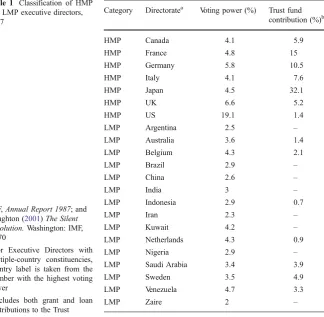
quantitative analysis was then supplemented with a qualitative analysis of the type of argument deployed by Directors in support of their positions. In order to test the links between financial power and outcomes, I categorized Directors as holding high material power (HMP) or low material power (LMP) (see Table1). The former group consists of Directors with a total voting power of five percent or over in the Fund, and/or whose represented state(s) contributed five percent or over of the total contributions to the ESAF Trust Fund. The HMP/LMP typology provides a rough‘first cut’through which to investigate the relationship between
material power and ideational change in the IMF Boardroom; however, the close correlation found between material power, preferences, and outcomes demon-strates the utility of such a typology, and suggests the need for further investigation into the relationship.15
3 The Power of Money and the Power of Words in the IMF Boardroom
The IMF Board sits at the heart of the organization’s governance structure. Although
formally a plenary Board of Governors (made up of representatives from member-states’Finance Ministries and Central Banks) holds ultimate authority, most powers
have been delegated to the Board.16The Board is composed of Executive Directors, who are either appointed or elected by Governors. The largest quota-holding members appoint an exclusive Director; the majority have to‘club together’into a
constituency grouping to elect a shared representative. Over the years the ratio of Governors to Directors has expanded dramatically,17 although a core group of creditor states—including France, Germany, the UK, and the US—have consistently
retained individual representation.
The formal process according to which Executive Board decisions are taken is codified in the Fund’s Articles of Agreement. Directors carry the voting
power of the state(s) under their representation into the Board, and a quorum is stipulated such that Directors representing 50% of the organization’s total voting
power must be present at any meeting. Furthermore, there is a requirement that the ascent of 50% of the voting power present is needed to carry a decision.18 These stipulations mean that, under the 1987 distribution of voting power, a coalition made up of just the UK and US could theoretically have pushed a decision through the Board. However, in practice votes are rarely taken, and a somewhat opaque consensus-based approach is followed. It was, indeed, the explicit intention of the Fund’s founders that the Board would function in a
15Table1provides a snapshot of quotas in 1987, and does not account for subsequent reforms in 1993 and
1997. In addition, in order to generate comparable longitudinal data, the new members admitted in 1992 are excluded from analysis.
16
See IMF Official Website, athttp://www.imf.org/external/about/govstruct.htm. Accessed 22/09/10.
17The ratio in 1946 was approximately 2:1, but by 2010 had rocketed to almost 10:1. The largest
constituencies in recent years have been the two main Africa groups, in which over 20 states are represented.
18
IMF Articles of Agreement: Article XII, Section 5, Paragraph (c). See IMF Official Website, available at
collegiate manner, with decisions being taken in accordance with the common good of the organization and the wider international financial system rather than narrow national interests (Gold 1983b). Although structural power is clearly
‘locked-in’ to the IMF’s institutional rules, it is unclear who holds the ultimate
key to the door.
As has been a common feature of major developments at the Fund, the G7 played a key role in getting ESAF onto the agenda of the organization (Clegg
2010a; Baker 2006), albeit with a significant prod from the Fund’s Managing
Director. The initial energy to generate momentum behind the enhancement of the IMF’s concessional lending capacity came from the then Managing Director,
Michel Camdessus. Shortly after taking up the position in April 1987, Camdessus embarked upon a search for the financial resources necessary to bulk up the relatively insubstantial Structural Adjustment Facility,19a drive that he would later call his‘first major initiative as Managing Director’.20Through an intensive period
of shuttle diplomacy in late May, Camdessus was able to secure the backing of Category Directoratea Voting power (%) Trust fund
contribution (%)b
HMP Canada 4.1 5.9
HMP France 4.8 15
HMP Germany 5.8 10.5
HMP Italy 4.1 7.6
HMP Japan 4.5 32.1
HMP UK 6.6 5.2
HMP US 19.1 1.4
LMP Argentina 2.5 –
LMP Australia 3.6 1.4
LMP Belgium 4.3 2.1
LMP Brazil 2.9 –
LMP China 2.6 –
LMP India 3 –
LMP Indonesia 2.9 0.7
LMP Iran 2.3 –
LMP Kuwait 4.2 –
LMP Netherlands 4.3 0.9
LMP Nigeria 2.9 –
LMP Saudi Arabia 3.4 3.9
LMP Sweden 3.5 4.9
LMP Venezuela 4.7 3.3
[image:10.439.63.388.54.371.2]LMP Zaire 2 –
Table 1 Classification of HMP and LMP executive directors, 1987
IMF,Annual Report 1987; and
Boughton (2001)The Silent
Revolution.Washington: IMF,
p.670
aFor Executive Directors with
multiple-country constituencies, country label is taken from the member with the highest voting power
b
Includes both grant and loan contributions to the Trust
19
For a detailed commentary on the evolution of the Fund’s concessional lending, see Boughton (2001:
637–704).
20
leaders of the G7 for the facility. As a direct result of his efforts, leaders agreed to include the following text in the Communiqué:
[We] welcome the proposal by the Managing Director of the IMF for a significant increase in the resources of the Structural Adjustment Facility over the 3 years from January 1, 1988. We urge a conclusion of discussions on these proposals within this year (quoted in Boughton2001: 664).
Once this general agreement was in place, the responsibility for setting the guidelines for ESAF was passed to the Executive Board. A series of intensive meetings were held in November and December 1987, in order for key financial and operational issues to be resolved in advance of the launch of the Facility in January 1988. There then followed, as is standard practice in the Fund, 5-year reviews of the performance of the Facility in 1993 and 1997/8, which provided opportunities for the production of updated guidelines. The examination of both the pre- and post-launch Board discussions reveal clear lessons about the politics of Boardroom interactions in the IMF.
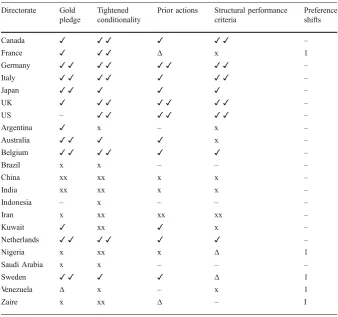
In relation to the theoretical approaches outlined above, the aggregated observations from Board discussions of ESAF presented in Table2 lend support to the rationalist ideal-type. In relation to preferences stated during the course of meetings, there is a high degree of correlation between positions taken and material power. Amongst HMP Directors, there is unanimous or near-unanimous support for the enhanced mechanisms of creditor protection and conditionality under investigation.21 In contrast, there is greater division of opinion amongst LMP Directors. Although over two-thirds of Directors within this grouping opposed both enhanced conditionality in general terms and the use of structural performance criteria, opinions on creditor protection and the use of prior actions were more mixed. It is interesting to note, however, that this division too is overlaid by material power, with the pro-side consisting of Directors representing minor-creditor states, and the anti-side Directors representing non-creditor states. Moreover, preferences remained almost entirely static during both pre-launch discussions and post-launch reviews.
In addition to evidence of materially patterned and stable preferences, the picture revealed when the mechanics of Board discussions are explored also support the rationalist view of the nature of state interactions inside IOs. Within Board discussions, it is common for Directors to simply present rather than fully justify their positions on issues under review. When justifications are provided, the points of reference set out by competing Directors often fail to overlap such that discussions can take the form of a dialogue des sourds, rather than an opportunity to update preferences following the assimilation of information that is mutually regarded as relevant. In ESAF discussions, there was a recurrent point of rupture over whether the Facility should be primarily
21It should be noted that, as Executive Directors change on average every 4 years, these findings on
preference stability relate to the office rather than individuals per se. The existence of stable preferences in the face of changing individuals raises questions over the agency enjoyed by Directors, and broadly these findings reflect Momani’s (2010a) suggestion that Executive Directors commonly enjoy relatively low
directed toward adjustment or to financing needs, with competing Directors evaluating reforms to ESAF around these differing points of reference. It is also common for individual points raised by Directors to not be engaged with during discussion, and to therefore remain unresolved. In terms of outcomes, there is an almost complete lack of preference updating during discussions; rather, the Managing Director’s Summing Up repeatedly serves to codify the
[image:12.439.50.389.72.389.2]preferences displayed by HMP Directors,22against the unresolved opposition of many LMP Directors. Moreover, the existence (in relation to enhanced
Table 2 Overview of findingsa
Directorate Gold pledge
Tightened conditionality
Prior actions Structural performance criteria
Preference shifts
Canada ✓ ✓ ✓ ✓ ✓ ✓ –
France ✓ ✓ ✓ ∆ x 1
Germany ✓ ✓ ✓ ✓ ✓ ✓ ✓ ✓ –
Italy ✓ ✓ ✓ ✓ ✓ ✓ ✓ –
Japan ✓ ✓ ✓ ✓ ✓ –
UK ✓ ✓ ✓ ✓ ✓ ✓ ✓ –
US – ✓ ✓ ✓ ✓ ✓ ✓ –
Argentina ✓ x – x –
Australia ✓ ✓ ✓ ✓ x –
Belgium ✓ ✓ ✓ ✓ ✓ ✓ –
Brazil x x – – –
China xx xx x x –
India xx xx x x –
Indonesia – x – – –
Iran x xx xx xx –
Kuwait ✓ xx ✓ x –
Netherlands ✓ ✓ ✓ ✓ ✓ ✓ –
Nigeria x xx x ∆ 1
Saudi Arabia x x – – –
Sweden ✓ ✓ ✓ ✓ ∆ 1
Venezuela ∆ x – x 1
Zaire x xx ∆ – I
a
One check represents the corresponding Director’s expressed support for the relevant proposition, two
checks represents strong support. Whilst this judgement is partially subjective, in order to classify as
‘strong’I set a minimum criteria of delivering clear support in at least 50% of the meetings at which the
issue was under discussion. The same principles apply to one and two crosses. Triangles denote that the corresponding Director’s stated opinion on the relevant proposition changed during the course of discussions
22The Managing Director’s Summing Up serves to record the‘mood of the meeting’ or‘points of
agreement’reached at the conclusion of the Board’s formal discussions. This statement provides guidance
conditionality) of materially-patterned cleavages through subsequent reviews of ESAF demonstrates that although operational guidance was generated, Board discussions failed to facilitate the resolution of fundamental disagreements. By reviewing the discussions of enhanced creditor protection and enhanced conditionality in more detail, it is possible to both explore points of nuance within these general dynamics, and to situate these discussions within the broader
‘norm lifecycles’to which they contribute.
4 Executive Board Discussions of Enhanced Creditor Protection
Relationships between borrowers and lenders are, it is fair to say, rarely straightforward. Agreements are built upon rules and practices that serve to redistribute costs, benefits, and risk amongst a wide variety of actors. And although much ink is currently being spilt on the unfolding of these processes in relation to the Global Financial Crisis of 2007–08, IMF Board discussions of
the financial arrangements surrounding ESAF show that attempts to establish favorable rules of the game in lending and borrowing are neither new, nor are they confined to private actors. At the Fund, HMP Directors fought to establish a mechanism to ensure that potential losses from ESAF loans turning bad would be borne by Fund members collectively, rather than their treasuries individually. In the face of significant—and unresolved—opposition from LMP
Directors, a pledge permitting the use of Fund resources to absorb losses was delivered. This application of locked-in power served to subtly reform the norm
of pacta sunt servandain international financial agreements—albeit in a manner
that served to protect creditors’interests.23
The root of the disagreement over the protection of creditor resources came ultimately from an institutional idiosyncrasy of the IMF. Whereas many IOs are forced to regularly go ‘cap in hand’ to their state masters and negotiate the
release of financial resources on an ad hoc basis, the IMF has managed through the course of its operations to attain a degree of autonomy. Contributing a quota to the Fund’s General Resource Account is a pre-requisite for
membership, and the practice in the Fund’s early decades of providing 25%
of the quota in the form of gold meant that the organization amassed one of the largest gold reserves on the planet.24In late 1987, it was the role to be played by this stock of gold that came to dominate discussions about the protection of creditors’ contributions to the ESAF Trust. At the crux of the discussions was
the question of who would bear the ultimate cost of default within ESAF: creditors through the non-repayment of resources lent to the ESAF Trust, or the IMF through the sale of gold stocks to meet the repayment of resources lent by creditors. Ultimately, the preferences of HMP Directors, whose authorities had committed the vast majority of the SDR5 billion of loans that
23For an overview of the evolution of this norm in the sovereign debt regime, see Broome (2009) and
Barry and Tomitova (2007).
24
endowed the ESAF Trust, were reflected in the ESAF guidelines produced. And in terms of preferences, process, and outcome, discussions adhered closely to the rationalist ideal-type.
Throughout the Board discussions on the financial arrangements for ESAF, Directors’ preferences were heavily patterned according to material power.
During the three meetings leading up to the Managing Director’s Summing Up,
all but one of the HMP Directors spoke in favor of establishing a ‘gold
pledge’—that is, an explicit guarantee that the Fund’s gold could be used to
offset any potential losses to creditor states in the event of large-scale default by ESAF borrowers. LMP Directors were more evenly divided, with six advocating and seven opposing the establishment of such a mechanism of collective insurance. Moreover, when the LMP grouping is further disaggre-gated, we see an almost complete correlation between material interest and preferences: of the six LMP Directors that spoke in support of the pledge, the authorities of four had provided loans to the ESAF Trust. Overall, then, 10 of the 12 supportive Directors had a clear material incentive in securing the gold pledge, whilst only one contributor—Saudi Arabia, with a SDR200 million
stake—argued against the pledge.
In terms of the dynamics of interaction within these Board meetings, the level of engagement between proponents and opponents of enhanced creditor protection remained low. Several claims presented by opponents were not engaged with, and it was common for Directors on either side to not provide full justifications for their positions.25Advocates of the gold pledge justified their support in terms of its importance for maximizing the lending capacity of ESAF. The first discussion opened with the UK, German, and Belgian Directors repeating the claim that, without the gold backing, resources committed to the Trust would not be sufficiently safe to be included in official reserve figures, but would rather have to be listed as a public expenditure. Such expenditures would, it was suggested, face tighter budgetary constraints, and therefore less money would be released to the ESAF Trust (IMF 1987a: 23–7). The same argument is
subsequently deployed by additional Directors, in this and later meetings (e.g., IMF1987a: 37, IMF1987e: 33).
Directors opposing the gold pledge provided a counter-justification, claiming that existing mechanisms for securing repayment provided sufficient protection (e.g., IMF 1987a: 43). Indeed, the Venezuelan and Nigerian representatives argued that rather than a gold pledge, the best form of security would come through ensuring that ESAF programs were effectively designed and implemented (IMF1987e: 6, 30). In the words of the latter:
While we understand the creditors’concerns that the resources they provide
should be safeguarded to secure their repayment, it is important to stress that the real safeguard is the resumption of growth and the improvement in the payments capacities of users of the facility.
25
A good illustrative example comes from the contribution of the Italian Director, who simply suggests that‘In paragraph 2 of the decision establishing the Trust, reference should be made to the possibility of
In addition to these arguments contesting the necessity of the gold pledge, a series of procedural issues were raised by opponents. Rules dictating the destination of proceeds from gold sales were cited as restricting the ability of the Board to direct resources back to ESAF Trust creditors (IMF1987b: 6),26and a question raised as to the operational basis through which Fund resources could be committed to support the ESAF Trust, which was a formally external entity (IMF1987f: 14). Advocates of the gold pledge however, failed to address these concerns directly in the justifications provided.
Following this limited level of engagement, Directors’ preferences remained
almost entirely static during the discussions of ESAF financing through November and December 1987. In total, just one of the 22 Directors altered their position during the course of these discussions. Rather, the Managing Director’s Summing
Up, which contained an explicit acknowledgement of the gold pledge (IMF 2007: 182), served to incorporate the preferences of materially powerful Directors into the IMF’s ‘instruction manual’, against the unresolved opposition of LMP Directors.
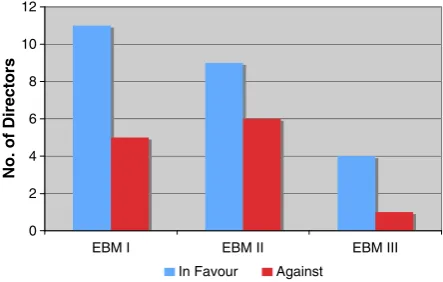
Indeed, in the final meeting, at which the Summing Up was reviewed in detail, a curious silencing of critical voices occurred. Whereas in the earlier discussions multiple voices had spoken in opposition to the pledge, at the final meeting only one dissenting opinion was presented (see Fig. 1). In contrast to previously open discussions, this final meeting was characterized by informal ‘pay to play’ rules,
whereby major creditors dominated discussions.
The Executive Board discussions of the core financial issue of the protection of creditors’ resources followed the broad parameters laid out in the rationalist
ideal-type. There was a clear correlation between Directors’ preferences and
narrow material interests, and, although there was a degree to which positions were justified according to compatible points of reference, outcomes were achieved through the application of locked-in structural power rather than through engaged arguing and preference updating. With its codification and ascent into the instruction sheet of recorded Board decisions, the gold pledge represented a subtle reframing of the norm of pacta sunt servanda. Indeed, this evidence from Board discussions shows that far in advance of the‘final push’on
multilateral debt relief by NGO actors from the late-1990s to the mid-2000s,27 internal contingency planning over non-performing loans was taking place at the behest of creditor states before ESAF had even opened for business. The decisions taken ensured that the institutional rules of the game could be used to protect creditors’ resources, and to collectivize risk.28 Unsurprisingly, when
multilateral debt relief was operationalized, the bulk of the IMF’s contribution
to the 1999 Heavily Indebted Poor Countries Initiative and the 2005 Multilateral Debt
26
According to their interpretation, gold sales would have to flow into the Fund’s general lending
resources, and as such could not be channelled back to individual states on the basis of contributions to the ESAF Trust.
27For detailed overviews of the role of NGOs in the extension of multilateral debt relief, see Broome
(2009) and Busby (2007).
28
As Meltzer (2011) has recently argued, with the Fund’s current burst in lending activity the relationship
Relief Initiative came from the sale of gold (Felgenhauer2000; Gunter et al.2008).29 As such, the codification of the gold pledge represented a crucial moment of managed evolution in the norms surrounding the treatment of sovereign debt at the IMF, and provide a clear case of rationalist mechanisms driving ideational change in global economic governance.
5 Executive Board Discussions of Enhanced Conditionality
Conditionality has always been a controversial aspect of IMF practice. Even before its Articles of Agreement were written, the UK and US delegates to the Bretton Woods Conference clashed swords over whether the Fund’s resources
should be released to members automatically or with strings attached (James
1996: 78). However, by the late 1950s the use of conditionality—attaching
monitored policy targets to the release of resources—had become an
increasingly important mechanism through which the Fund operationalized its influence (Barnett and Finnemore 2004: 56–8). By the mid-1960s all drawings
exceeding 25% of a member’s quota became subject to conditionality. In line
with the organization’s evolving monetary approach to balance of payments
management, clauses concerning the tightening up of credit creation and money supply appeared increasingly regularly in lending agreements (Killick 1995; Haggard1985).
The early lending operations undertaken by the IMF with low-income countries adopted a distinctly ‘light’ approach to conditionality, with both the
1976 Trust Fund and the 1986 Structural Adjustment Facility largely eschewing the use of enforced targets (Boughton 2001: 649–50). In the Executive Board
discussion leading up to the launch of ESAF, however, the question of whether to tighten conditionality was the core operational issue focused on. As was the case in relation to the gold pledge, Directors’ positions on conditionality were
heavily patterned by material power. With justifications presented according to competing points of reference, Board meetings remained a sterile environment
29
Interestingly, Felgenhauer appears to raise the same procedural to the use of gold sales for this purpose as LMP Directors, regarding the operational restrictions placed on the use of gold at the Fund.
0 2 4 6 8 10 12
EBM I EBM II EBM III
No. of Directors
In Favour Against Fig. 1 Board discussion of
enhanced creditor protection. Source: Author’s analysis of
IMF1987a; IMF1987b; IMF
[image:16.439.167.389.54.195.2]for preference updating to take place. Although the Managing Director’s
Summing Up provided an official approval to staff for the use of conditionality mechanisms previously considered off limits, LMP Directors’ opposition to
tighter conditionality was carried through into later reviews of ESAF.
Throughout the pre-launch discussions in late 1987 of outstanding opera-tional issues, divisions on the question of condiopera-tionality were very heavily patterned according to material power. During the November and December meetings there was unanimity amongst the HMP Directors, with each of the seven Directors arguing in favor of tighter conditionality. In sharp contrast, 11 of the 15 LMP Directors registered their fundamental opposition to the establishment of a stricter regime. And, as was the case with the gold pledge, the small number of supportive LMP Directors all represented states that were creditors to the ESAF Trust. Indeed, the lists of LMP Directors who supported the gold pledge and the general prospect of enhanced conditionality are almost identical (see Table 1), which suggests a strong link between material position and preferences.
When discussions focused on particular mechanisms of operationalizing conditionality, these broad patterns of preferences remained in evidence. Before ESAF, the use of performance criteria—policy targets that, if missed, can be
penalized by the interruption or cancellation of a loan—had explicitly been ruled out
from low-income country lending operations (Boughton 2001: 649). However, in pre-launch meetings there was heated discussion over the possible authorization of staffs’use of structural performance criteria. Whereas‘normal’performance criteria
in mainstream lending typically related to easily quantifiable measures such as volumes of official reserves and government spending ceilings, ‘structural’
performance criteria represented the Fund’s shift toward monitoring complex
institutional transformations such as privatizations and the liberalization of trade and exchange rate regimes. In these discussions, all but the French amongst the HMP Directors advocated this policy shift, whereas only two of the 15 LMP Directors voiced consistent support. Similarly, when the potential use of prior actions in ESAF programs was discussed, support from HMP Directors was unanimous, whereas there was a split in opinion amongst LMP Directors. Interestingly, this division followed the same pattern as was evident with the gold pledge and general positions on conditionality.
In addition to the clear correlation between material power and preferences regarding the shape of conditionality under ESAF, further evidence of Board discussions functioning in line with the assumptions of the rationalist model are revealed when the dynamics of interaction are turned to. Very few of the Directors advocating the use of enhanced mechanisms of conditionality provided full justifications of their positions. Rather, statements such as the following from the Canadian Director were common:
[My] Canadian authorities agree that programs should have quarterly bench-marks, some of which could serve as performance criteria…[I] also endorse
As such, positions remained underspecified, framed in very general terms relating to program success.
Amongst Directors opposing tighter conditionality, there was some framing of positions with reference to the impact on program efficiency of enhanced conditionality. For example, potential difficulties were cited for staff and low-income governments in managing the administrative burden accompanying enhanced monitoring (e.g., IMF 1987c: 39). The most common source of justification for opposing tighter conditionality, however, was framed according to alternative points of reference. Rather than viewing programmatic efficiency as the arbiter of success, a recurring line amongst advocates of light conditionality presented the rapid disbursement of resources as the ultimate goal. According to this framing, overly tight conditionality would make ESAF unattractive to potential borrowers, and consequently the Facility would suffer from a low take up of loans; what was needed was an assurance to borrowers that they could confidently predict a stable flow of resources over the lifetime of a program (IMF
1987c: 6, IMF1987c: 10, IMF1987d: 4). In addition, procedural objections were raised. It was argued that the reforms being discussed were in contravention of existing Guidelines on Conditionality, and as such needed to be approved by formally altering these Guidelines rather than fine-tuning them through a Managing Director’s Summing Up (e.g., IMF 1987c: 7).30 There remained,
however, little engagement with these procedural and resource distribution issues by advocates of enhanced conditionality.
Directors’ preferences remained almost entirely static during the pre-launch
discussions of conditionality. There were no shifts from either HMP or LMP Directors in their general views on the desirability of tighter conditionality. In relation to the specific mechanisms at staffs’ disposal, the only shift from
opposition to support came from the Nigerian Director. From an initial view that ESAF conditionality should remain identical to that of its predecessor (IMF
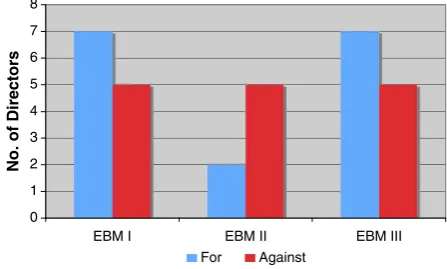
1987e: 4), the Nigerian Director moved to accepting that a limited number of structural performance criteria could be applied on a case-by-case basis, and that prior actions could be used sparingly (IMF 1987g: 23). Notwithstanding this tentative conversion, significant opposition remained amongst LMP Directors to the enhancement of conditionality, and to the incorporation of structural performance criteria into ESAF programs (see Figs. 2 and 3). Indeed, on these two issues stated opposition was as prevalent in the concluding as in the opening meeting. In the case of the use of prior actions a higher degree of consensus emerged (Fig. 4), albeit through a processes of the silencing of critical voices rather than through their active conversion.
The Summing Up of discussions on conditionality delivered by the Managing Director served to enshrine the preferences expressed by HMP Directors. In addition to a generalized tightening up of the monitoring framework under ESAF when compared to its predecessors, the Summing Up
30This was done most forcefully by the Iranian Director, with his injunction that‘I…insist on having any
change in our operations based on a formal decision on changing the guidelines on conditionality—a
made it explicitly clear that both prior actions and structural performance criteria could be used within ESAF programs (IMF 2007: 184). Although mention is made of some Directors’opposition, the Summing Up served to send a
strong signal to staff that, unlike previous concessional lending facilities, ESAF could be seen as substantively equivalent to mainstream lending operations.
Although the 1987 Summing Up served to give the green light for staffs’use of
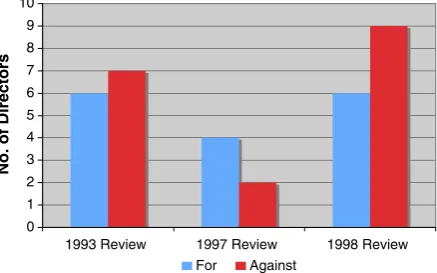
enhanced means of conditionality in ESAF arrangements, familiar patterns of division amongst Executive Directors remained through subsequent operational reviews (see Fig.5). In the 1993 review, five of the HMP Directors spoke in favor of applying program conditionality more rigorously. It was, for the Italian Director, imperative that‘the greatest effort be devoted to ensuring the effective
implemen-tation of the measures envisaged in ESAF programs’(IMF1993a: 29), whilst for the
Japanese Director ‘the establishment of precise timetables and the greater use of
prior actions and benchmarks would be useful in facilitating reforms’(IMF1993a:
10). In contrast, just one LMP Director spoke in support of tighter conditionality. The more common position amongst LMP Directors was to speak in support of the argument, as stated by the Indonesian Director, that ‘excessive conditionalities
reduce a program’s effectiveness’(IMF1993a: 16). Moreover, even after 5 years of
ESAF operations, the points of reference drawn upon by competing Directors commonly failed to overlap. On one side, the crux of arguments rested on the necessity of fostering stronger adjustment as a means to achieving growth and
0 2 4 6 8 10 12
EBM I EBM II EBM III
No. of Directors
For Against Fig. 2 Board discussion of
enhanced conditionality. Source: Author’s analysis of IMF1987c;
IMF1987d; IMF1987e; IMF
1987g
0 1 2 3 4 5 6 7 8
EBM III EBM II
EBM I
No. of Directors
For Against Fig. 3 Board discussion of
enhanced use of structural performance criteria. Source: Author’s analysis of IMF1987c; IMF1987d; IMF1987e; IMF
[image:19.439.167.388.55.194.2] [image:19.439.165.389.477.611.2]external viability (e.g., IMF1993b: 6, IMF1993b: 42); on the other, emphasis was placed on the importance of keeping programs realistic so as to avoid program interruptions, to ensure predictable and sufficient flows of financing (e.g., IMF
1993b: 4, IMF1993b: 13). And these divisions between HMP and LMP Directors continued through the 10-year reviews of ESAF. The US view, that closer monitoring of policies was needed to avoid the danger that ‘things not get done at all’(IMF
1998c: 39), was echoed by a further four HMP Directors. In contrast, nine of the LMP Directors spoke in opposition to a further tightening of conditionality mechanisms.
As was the case with the gold pledge, the Executive Board discussions on the use of prior actions, structural performance criteria, and tighter conditionality in general followed the pattern laid out by the rationalist action theory. Divisions of opinion were clearly patterned according to Directors’material power, with universal support
coming from HMP Directors for tighter conditionality in pre-launch discussions, and near-universal support for a continued ratcheting up in subsequent reviews. The majority of LMP Directors sat on the other side of the fence over this issue, both during the pre-launch discussions and post-launch reviews. With only partially overlapping points of reference deployed when justifying positions, there was almost no evidence of preference shifting during the intensive 1987 discussions. Indeed, materially patterned divisions were carried over through the subsequent reviews of ESAF operations.
0 1 2 3 4 5 6 7 8 9
EBM III EBM II
EBM I
No. of Directors
For Against Fig. 4 Board discussion of
enhanced use of prior actions. Source: Author’s analysis of
IMF1987c; IMF1987d; IMF
1987e; IMF1987g
0 1 2 3 4 5 6 7 8 9 10
1993 Review 1997 Review 1998 Review
No. of Directors
For Against Fig. 5 Board discussion of
tighter conditionality, 1993–98.
Source: Author’s analysis of
IMF1993a; IMF1993b; IMF
[image:20.439.145.384.52.189.2] [image:20.439.170.389.473.609.2]Notwithstanding this continued disagreement among the HMP and LMP camps, the Managing Director’s Summing Up back in 1987 served to give staff
a green light for the use of forms of conditionality previously not used in concessional lending. Indeed, not only was the norm of treating low-income countries relatively lightly eroded, it was turned on its head. In ESAF programs between 1987 and 2000, borrowers faced more monitored performance criteria than their mainstream counterparts did under Standby Arrangements and the Extended Fund Facility (IMF IEO 2002: 45). By drawing on their locked-in power to ensure that their preferences were reflected in the Managing Director’s
guidance, HMP Directors were able to use favorable institutional rules to put in motion a significant—and highly controversial—process of norm change at the
IMF.
6 Conclusion
In 1988, the movement of the International Monetary Fund into the realm of structural adjustment was cemented with the launch of the Enhanced Structural Adjustment Facility. The decades following the opening of this concessional lending window witnessed a proliferation of analyses being directed toward this branch of Fund operations, much of it heavily critical. And whilst many valuable insights were generated into individual cases and more general trends and dynamics, the internal bureaucratic dynamics that helped shape this controversial aspect of the history of the Fund remained largely overlooked. As I have demonstrated in this article, by examining the role of the Executive Board in the establishment and subsequent reform of ESAF we are able to not only shed new light on an intrinsically important series of events, but also to clarify our conceptual understanding of how operational change occurs in key sites of global economic governance.
In relation to the establishment of the gold pledge and tighter conditionality, there was a close relationship between material power and Directors’preferences. There
In analytic terms, the Executive Boardroom of the IMF remains a hidden corner of what in important respects is still a relatively secretive international organization. However, with the routine publication of Board documents to coincide with discussions, and the reduction of the embargo on minutes from meetings reduced from 10 to 5 years, doors are currently in the process of being opened to analysts of this vitally important IO. With contemporary dynamics working to shorten the leash on which Directors are kept by country authorities,31the potential for the Boardroom to move further down the line of political contestation rather than technocratic collegiality is clear. Whilst the Executive Board is very much a part of the IMF, with discussions both being shaped by as well as themselves shaping wider bureaucratic dynamics, its institutional position provides the forum with a privileged role in the process of stabilizing policy ideas. And with its uneasy mix of weighted voting and consensual decision making, by learning more about Boardroom politics we stand also to enhance our understanding of the intersection of material and ideational power in shaping change in global economic governance.
References
Auerbach, C., & Siverstein, L. (2003).Qualitative data: An introduction to coding and analysis. New York: New York University Press.
Baker, A. (2006).The group of seven: Finance ministries, central banks and global financial governance. London: Routledge.
Barnett, M., & Finnemore, M. (2004).Rules for the world: International organizations in global politics. Ithaca: Cornell University Press.
Barro, R., & Lee, J. (2005). IMF Programs: who are chosen and what are the effects?Journal of Monetary
Economics, 52(7), 1245–1269.
Barry, C., & Tomitova, L. (2007). Fairness in sovereign debt.Ethics and International Affairs, 21(1), 41–
79.
Bird, G. (1995).IMF lending to developing countries: Issues and evidence. London: Routledge. Boughton, J. (2001).The silent revolution: Global finance and development in the 1980s. Washington:
IMF.
Brams, S. (1990).Negotiation games: Applying game theory to bargaining and arbitration. New York: Routledge.
Broome, A. (2008). The important of being earnest: the IMF as a reputational intermediary.New Political
Economy, 13(2), 125–151.
Broome, A. (2009). When do NGOs matter? Activist organizations as a source of change in the international debt regime.Global Society, 23(1), 59–78.
Broome, A., & Seabrooke, L. (2007). Seeing like the IMF: institutional change in small open economies.
Review of International Political Economy, 14(4), 576–601.
Busby, J. (2007). Bono made Jesse Helms cry: Jubilee 2000, debt relief, and moral action in international politics.International Studies Quarterly, 51(2), 247–275.
Cabrera, L. (2010).The practice of global citizenship. Cambridge: University Press.
Calvo-Gonzalez, O. (2007). Ownership and conditionality in IMF programs: back to Per Jacobsen’s time.
Review of International Organizations, 2(2), 329–343.
Camerer, C. (2003).behavioral game theory: Experiments in strategic interaction. New Jersey: Princeton University Press.
Checkel, J. (2001). Why comply? Social learning and European identity change. International
Organization, 55(3), 553–588.
31
Checkel, J., & Moravcsik, A. (2001). A constructivist research program in EU studies?European Union
Politics, 2(2), 219–249.
Chelsky, J. (2009). Summarizing the views of the IMF board. In R. Lamdany & D. Martinez-Diaz (Eds.),
Studies of IMF governance: A compendium(pp. 208–228). Washington: IMF.
Chweiroth, J. (2008). Organizational change from within: exploring the World Bank’s early lending
practices.Review of International Political Economy, 15(4), 481–505.
Chweiroth, J. (2010). Capital ideas: The IMF and the rise of financial liberalization. New Jersey: Princeton University Press.
Clegg, L. (2010a). In the loop: multilevel feedback and the politics of change at the World Bank and IMF.
Journal of International Relations and Development, 13(1), 59–84.
Clegg, L. (2010b). Our dream is a world full of poverty indicators: the US, the World Bank, and the power of numbers.New Political Economy, 15(4), 473–492.
Conway, P. (1994). IMF lending programs: participation and impact.Journal of Development Economics, 45(2), 365–391.
Copelovitch, M. (2010).The International Monetary Fund in the global economy: Banks, Bonds, and
Bailouts. Cambridge: University Press.
Dreher, A. (2009). IMF conditionality: theory and evidence.Public Choice, 141(2), 233–267.
Elster, J. (1982). Marxism, functionalism and game theory: the case for methodological individualism.
Theory and Society, 11(4), 453–482.
Elster, J. (1989).Nuts and bolts for the social sciences. New York: Cambridge University Press. Fearon, J. (1998). Bargaining, enforcement, and international cooperation.International Organization, 52
(2), 269–305.
Felgenhauer, G. (2000). IMF off-market gold sales: questions of law and moral hazard.Columbia Journal
of International Law, 39(1), 221–256.
Finnemore, M., & Sikkink, K. (1998). International norm dynamics and political change.International
Organization, 52(4), 887–917.
Frieden, J., & Martin, L. (2003). International political economy: Global and domestic interactions. In I. Katznelson & H. Milner (Eds.), Political science: The state of the discipline (pp. 118–146).
New York: Norton.
Gold, J. (1983a). Political considerations are prohibited by articles of agreement when the fund considers requests for use of resources.IMF Survey, 12(10), 146–148.
Gold, J. (1983b). Strengthening the soft international law of exchange arrangements.American Journal of
International Law, 77(3), 443–489.
Grobe, C. (2010). The power of words: argumentative persuasion in international negotiations.European
Journal of International Relations, 16(1), 5–29.
Gunter, B., Rahman, J., & Wodon, Q. (2008). Robbing Peter to pay Paul? Understanding who pays for debt relief.World Development, 36(1), 1–16.
Gutner, T. (2002).Banking on the environment: Multilateral development banks and their performance in
Eastern Europe. Cambridge: MIT Press.
Haggard, S. (1985). The politics of adjustment: lessons from the IMF’s extended fund facility.
International Organization, 39(3), 505–534.
Hawkins, D., et al. (2006). Delegation under anarchy: States, international organizations, and principal-agent theory. In Hawkins et al. (Eds.),Delegation and agency in international organizations(pp. 3–
38). Cambridge: University Press.
IMF (1987a). Executive Board Meeting Informal Session, November 13th (am). Washington: IMF, Archive Reference EBMIS/87/5.
IMF (1987b). Executive Board Meeting Informal Session, November 13th (pm). Washington: IMF, Archive Reference EBMIS/87/6.
IMF (1987c). Executive Board Meeting Informal Session, November 20th (am). Washington: IMF, Archive Reference EBMIS/87/7.
IMF (1987d). Executive Board Meeting Informal Session, November 20th (pm). Washington: IMF, Archive Reference EBMIS/87/8.
IMF (1987e). Executive Board Meeting, December 11th (am). Washington: IMF, Archive Reference EBM/ 87/168.
IMF (1987f). Executive Board Meeting, December 15th (am). Washington: IMF, Archive Reference EBM/ 87/171.
IMF (1987g). Executive Board Meeting, December 18th (am). Washington: IMF, Archive Reference EBM/ 87/175.