A Tale of Two Data-Intensive Paradigms:
Applications, Abstractions, and Architectures
Shantenu Jha
1, Judy Qiu
2, Andre Luckow
1, Pradeep Mantha
1, Geoffrey C.Fox
2∗ (1) RADICAL, Rutgers University, Piscataway, NJ 08854, USA(2)Indiana University, USA(∗)Contact Author:[email protected]
Abstract—Scientific problems that depend on processing large amounts of data require overcoming challenges in multiple ar-eas: managing large-scale data distribution, co-placement and scheduling of data with compute resources, and storing and trans-ferring large volumes of data. We analyze the ecosystems of the two prominent paradigms for data-intensive applications, here-after referred to as the high-performance computing and the Apache-Hadoop paradigm. We propose a basis, common termi-nology and functional factors upon which to analyze the two ap-proaches of both paradigms. We discuss the concept of “Big Data Ogres” and their facets as means of understanding and charac-terizing the most common application workloads found across the two paradigms. We then discuss the salient features of the two paradigms, and compare and contrast the two approaches. Specifically, we examine common implementation/approaches of these paradigms, shed light upon the reasons for their current “architecture” and discuss some typical workloads that utilize them. In spite of the significant software distinctions, we believe there is architectural similarity. We discuss the potential inte-gration of different implementations, across the different levels and components. Our comparison progresses from a fully qual-itative examination of the two paradigms, to a semi-quantqual-itative methodology. We use a simple and broadly used Ogre (K-means clustering), characterize its performance on a range of repre-sentative platforms, covering several implementations from both paradigms. Our experiments provide an insight into the relative strengths of the two paradigms. We propose that the set of Ogres will serve as a benchmark to evaluate the two paradigms along different dimensions.
I. INTRODUCTION
The growing importance of data-intensive applications is generally recognized and has lead to a wide range of ap-proaches and solutions for data distribution, management and processing. These approaches are characterized by a broad set of tools, software frameworks and implementations. Although seemingly unrelated, the approaches can be better understood by examining their use of common abstractions and simi-lar architectures for data management and processing. Build-ing upon this putative similarly, we examine and organize many existing approaches to Big Data processing into two pri-mary paradigms – the scientific high-performance (HPC) and Apache-Hadoop paradigms, which we believe reflects and cap-tures the dominant historical, technical and social forces that have shaped the landscape of Big Data analytics.
The HPC paradigm has its roots in supercomputing-class computationally intensive scientific problems (e.g. Molecular Dynamics of macromolecular systems, fluid dynamics at scales to capture turbulence) and in managing large-scale distributed problems (e. g. data analysis from the LHC). HPC paradigm
has been characterized by limited implementations, but cus-tomized and tuned for performance along a narrow set of re-quirements. In contrast, the Apache-Hadoop paradigm, here af-ter referred to simply as the Apache Big Data Stack (ABDS) has seen a significant update in industry and recently also in scientific environments. A vibrant, manifold open-source ecosystem consisting of higher-level data stores, data process-ing/analytics and machine learning frameworks has evolved around a stable, non-monolithic kernel: the Hadoop Filesys-tem (HDFS) and YARN. Hadoop integrates compute and data, and introduces application-level scheduling as a means to fa-cilitate heterogeneous application workloads and high cluster utilization.
The success and evolution of ABDS into a widely deployed cluster computing frameworks yields many opportunities for traditional scientific applications; it also raises many impor-tant questions, viz., What features of Hadoop are useful for traditional scientific workloads? What features of the ABDS can be extended and integrated with the HPC implementa-tions? How do typical data-intensive HPC and ABDS work-loads differ? It is currently difficult for most applications to utilize the two paradigms interoperably. The divergence and heterogeneity will likely increase due to the continuing evo-lution of ABDS, thus we believe it is important and timely to answer questions that will support interoperable approaches. However, before such interoperable approaches can be formu-lated, it is important to understand the different abstractions, architectures and applications that each paradigm utilizes and supports. It is the aim of this paper to provide the conceptual framework and terminology, so as to begin addressing ques-tions of interoperability.
II. DATA-INTENSIVEAPPLICATION: BIGDATAOGRES Based upon an analysis of a large set of Big Data applica-tions, including more than 50 use cases [1], we propose the Big Data Ogres in analogy with parallel computing with the Berkeley Dwarfs, NAS benchmarks and linear algebra tem-plates. The purpose of Big Data Ogres is to discern common-alities and patterns across a broad range of seemingly different Big Data applications, propose an initial structure to classify them, and help cluster some commonly found applications us-ing structure. Similar to the Berkeley Dwarfs, the Big Data Ogres are not orthogonal, nor exclusive, and thus do not con-stitute a formal taxonomy. We propose the Ogres as a bench-mark to investigate and evaluate the paradigms for architec-tural principles, capabilities and implementation performance. Also we capture the richness of Big Data by including not just different parallel structures but also important overall pat-terns. Big Data is in its infancy without clear consensus as to important issues and so we propose an inclusive set of Ogres expecting that further discussion will refine them.
The first facet captures different problem architectures. Some representative examples are (i) Pleasingly Parallel – as in Blast (over sequences), Protein docking (over proteins and docking sites), imagery, (ii) Local Machine Learning (ML) – or filtering pleasingly parallel as in bio-imagery, radar (this contrasts with Global Machine Learning seen in LDA, Clus-tering etc. with parallel ML over nodes of system), (iii) Fusion – where knowledge discovery often involves fusion of multi-ple methods (ensemble methods are one approach), (iv) Data points in metric or non-metric spaces, (v) Maximum Likeli-hood, (vi) χ2minimizations, (vii) Expectation Maximization (often Steepest descent), and (viii) Quantitative measures for Big Data applications which can be captured by absolute sizes and relative ratios of flops, IO bytes and communication bytes. The second facet captures applications withimportant data sources with distinctive features, representative examples of the data sources include, (i) SQL based, (ii) NOSQL based, (iii) Other enterprise data systems, (iv) Set of Files (as man-aged in iRODS), (v) Internet of Things, (vi) Streaming, (vii) HPC simulations, and (viii) Temporal features – for in addition to the system issues, there is a temporal element before data gets to compute system, e.g., there is often an initial data gath-ering phase which is characterized by a block size and timing. Block size varies from month (Remote Sensing, Seismic) to day (genomic) to seconds (Real time control, streaming)
The third facet containsOgres themselves classifying core analytics and kernels/mini-applications/skeletons, with rep-resentative examples (i) Recommender Systems (Collabora-tive Filtering) (ii) SVM and Linear Classifiers (Bayes, Ran-dom Forests), (iii) Outlier Detection (iORCA) (iv) Clustering (many methods), (v) PageRank, (vi) LDA (Latent Dirichlet Al-location), (vii) PLSI (Probabilistic Latent Semantic Indexing), (viii) SVD (Singular Value Decomposition), (ix) MDS (Mul-tidimensional Scaling), (x) Graph Algorithms (seen in neural nets, search of RDF Triple stores), (xi) Neural Networks (Deep Learning), (xii) Global Optimization (Variational Bayes), (xiii) Agents, as in epidemiology (swarm approaches) and (xiv) GIS
(Geographical Information Systems).
III. ARCHITECTURE ANDABSTRACTIONS: HPCAND ABDS ECOSYSTEMS
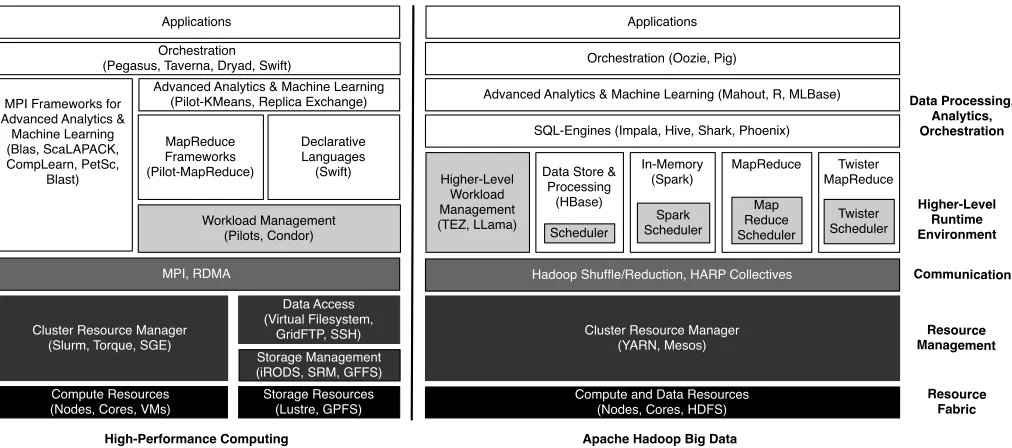
In this section we compare and contrast the ABDS and HPC ecosystems, viz. the underlying architectural assumptions, the primary abstractions (both conceptual and implementation). Figure 1 depicts the different layers and architectural design approaches and highlights some of the primary abstractions. For the purpose of our comparison we identified five layers: resource fabric, resource management, communication, higher-level runtime environment and data processing/analytics. HPC infrastructure were traditionally built for scientific applications aimed toward high-end computing capabilities (small input, large output). Hadoop in contrast was built to process large volumes of data (large input, small output), resulting in dif-ferent software stacks.
A. High Performance Computing
In a typical HPC cluster compute and data infrastruc-tures are separated: A high-end compute environment – typically a shared nothing many-core environment (poten-tially adding GPUs or other accelerators such as the Xeon Phi) – is complemented by a storage cluster running Lus-tre GPFS [2] or another parallel filesystem connected by a high-bandwidth, low-latency network. While this meets the need for compute-intensive applications, for data-intensive applications this means that data needs to be moved across the network, which represents a potential bottleneck. Com-pute resources are typically managed by a local resource management system such as SLURM, Torque or SGE. Gen-erally, these system have a focus on managing compute slots (typically cores).
Compute resources are a typically managed by a local re-source management system such as SLURM, Torque or SGE. Generally, these system have a focus on managing compute slots (typically cores). Storage resources in HPC are shared resources, where a quota is applied on the data size, but not on I/O. Data locality and other scheduling constraints are typ-ically not considered. Lustre and GPFS storage resources are typically exposed as shared filesystem on the compute nodes. In addition several specialized higher-level storage manage-ment services, such as SRM [3], iRODS [4] have emerged. iRODS is a comprehensive distributed data management so-lution designed to operate across geographically distributed, federated storage resources. iRODS combines storage services with services for metadata, replica, transfer management and scheduling. In contrast to ABDS, data-management in HPC is typically done using files and not using higher level abstrac-tions as found in the Hadoop ecosystem.
Compute Resources (Nodes, Cores, VMs)
Workload Management (Pilots, Condor) Orchestration
(Pegasus, Taverna, Dryad, Swift)
Declarative Languages
(Swift) MPI Frameworks for
Advanced Analytics & Machine Learning (Blas, ScaLAPACK, CompLearn, PetSc,
Blast)
Applications
MapReduce Frameworks (Pilot-MapReduce)
Resource Management Cluster Resource Manager
(Slurm, Torque, SGE)
Storage Resources (Lustre, GPFS)
Data Access (Virtual Filesystem,
GridFTP, SSH)
Resource Fabric Higher-Level
Runtime Environment Data Processing,
Analytics, Orchestration
Compute and Data Resources (Nodes, Cores, HDFS) Higher-Level
Workload Management (TEZ, LLama)
Advanced Analytics & Machine Learning (Mahout, R, MLBase) Applications
MapReduce
Cluster Resource Manager (YARN, Mesos)
Map Reduce Scheduler Data Store &
Processing (HBase)
In-Memory (Spark)
Spark Scheduler
Twister MapReduce
Twister Scheduler SQL-Engines (Impala, Hive, Shark, Phoenix)
Scheduler
MPI, RDMA Hadoop Shuffle/Reduction, HARP Collectives Communication
High-Performance Computing Apache Hadoop Big Data Orchestration (Oozie, Pig)
Advanced Analytics & Machine Learning (Pilot-KMeans, Replica Exchange)
[image:3.612.54.560.53.277.2]Storage Management (iRODS, SRM, GFFS)
Fig. 1. HPC and ABDS architecture and abstractions:The HPC approach historically separated data and compute; ABDS co-locates compute and data. The YARN resource manager heavily utilizes multi-level, data-aware scheduling and supports a vibrant Hadoop-based ecosystem of data processing, analytics and machine learning frameworks. Each approach has a rich, but hitherto distinct resource management and communication capabilities.
and non-blocking communications [6]. Further, various non-MPI MapReduce implementations have been proposed: Twister/Salsa [7] to support iterative machine learning workloads, Pilot-MapReduce [8] to support geographically distributed data, etc.
In addition several runtime environments for supporting het-erogeneous, loosely coupled tasks, e. g. Pilot-Jobs [9], many tasks [10] and workflows [11]. Pilot-Jobs generalize the con-cept of a placeholder to provide multi-level and/or application-level scheduling on top of the system-provided schedulers. With the increasing importance of data, Pilot-Jobs are increas-ingly used to process and analyze large amounts of data [12], [9]. In general, one can distinguish two kinds of data manage-ment: (i) the ability to stage-in/stage-out files from another compute node or a storage backend, such as SRM and (ii) the provisioning of integrated data/compute management mecha-nisms. An example for (i) is Condor-G/Glide-in [13], which provides a basic mechanism for file staging and also supports access to SRM storage. DIRAC [14] is an example of a type (ii) system providing more integrated capabilities.
B. ABDS Ecosystem
Hadoop was originally developed in the enterprise space (by Yahoo!) and introducing an integrated compute and data in-frastructure. Hadoop provides an open source implementation of the MapReduce programming model originally proposed by Google [15]. Hadoop is designed for cheap commodity hardware (which potentially can fail), co-places compute and data on the same node and is highly optimized for sequential reads workloads. With the uptake of Hadoop in the commer-cial space, scientific applications and infrastructure providers started to evaluate Hadoop for their purposes. At the same
time, Hadoop evolved with increasing requirements (e. g. the support for very heterogeneous workloads) into a general pur-pose cluster framework borrowing concepts existing in HPC.
application-level scheduler to optimize resource usage for the application. In contrast to HPC, the resource manager, runtime system and application are much more tighter integrated. Typically, an ap-plication uses the abstraction provided by the runtime system (e. g. MapReduce) and does not directly interact with resource management.
Spark is a runtime for iterative processing; it is based on a Scala-based API for expressing parallel dataflow on top of in-memory, distributed datasets. For this purpose, Spark intro-duces resilient distributed datasets (RDD) as higher-level API that enables application to load a dataset into the memory of a set of cluster nodes. The runtime of Spark automatically partitions the data and manages data locality during runtime.
Many analytical applications – in particular in enterprise en-vironments – rely on SQL as data query language. This led to the development of several SQL-based analytic engines in the data processing layer: Google’s Dremel [23], Hive [24], HAWQ [25], Impala [26] and Shark [27] are examples of such engines. While Hive was originally implemented based on the MapReduce model, the latest version relies on TEZ as runtime layer. Similarly, Shark relies on Spark as runtime. Other SQL engines, such as Impala and HAWQ, provide their own run-time environment and do not rely on MapReduce or Spark. In addition, hybrid relational database/HDFS environments have been proposed. HadoopDB [28] e. g. deploys a PostgreSQL database on every node on which it distributes the data us-ing hash partition. Further, it can access data from HDFS via external tables. Several commercial approaches with similar features exist, e. g. Polybase [29].
Advanced Analytics & Machine Learning layer application-s/frameworks typically require multiple iterations on the data. While traditional in-memory, single-node tools, such R [30] or Scikit-Learn[31] provide powerful implementations of many machine learning algorithms, they are mostly constrained to a single machine. To overcome this limitation, several ap-proaches that rely on scalable runtime environments in the Hadoop ecosystem have been proposed, e. g. Apache Ma-hout [32] or RHadoop [33]. There are well-known limita-tions of Hadoop-1 with respect to support for iterative MapRe-duce applications [7]. Thus, increasingly, iterative runtimes are used for advanced analytics. MLBase [34] is a machine learn-ing framework based on Spark as lower-level data processlearn-ing framework. SparkR [35] allows R applications to utilize Spark.
C. Resource Management
Table I summarizes different architectures for resource management: centralized, multi-level and decentralized. HPC schedulers are centralized and designed for rigid applications with constant resource requirements. HPC applications, such as large, monolithic simulations spawning a large number of cores, typically utilize tightly-coupled, often MPI-based par-allelism. MPI applications are tightly-coupled and highly la-tency sensitive. While these applications have fixed resource demands (with respect to number of cores, memory and wall-time), which does not change during the lifetime, they need to be scheduled in a way that they simultaneously execute
Centralized Multi-Level Decentralized
Examples Torque, SLURM YARN, Mesos, Pi-lots
Omega, Sparrow
Workloads large, parallel jobs medium-sized tasks fine-grained tasks
Latency high medium - low low
Application Integration
Submission only Application-Level Scheduling
Application-Level Scheduling
TABLE I
SCHEDULERARCHITECTURES:CENTRALIZED,MONOLITHIC RESOURCE MANAGERS ARE BEING REPLACED WITH MORE SCALABLE ARCHITECTURES EMPHASIZING APPLICATION-LEVEL SCHEDULING.
on a system e. g. using Gang scheduling. Scheduling is done on job-level, i. e. application-level tasks (e. g. the execution of the individual processes on the compute nodes) are not exposed to the resource manager. Thus, scheduling heteroge-neous workload consisting of small, short-running tasks and longer running batch-oriented tasks represents a challenge for traditional monolithic, centralized cluster scheduling systems. Often, Pilot-Jobs are used to overcome the flexibility limita-tions and support dynamic applicalimita-tions comprising of hetero-geneous tasks. Data locality is not a primary concern in HPC: most HPC applications are write heavy, while data-intensive applications are read heavy.
Data-intensive workloads in contrast can be decomposed into fine-grained, loosely-coupled parallel tasks. By schedul-ing on task-level rather than on job-level, the utilization of resources and fairness can be improved [36]. Multi-level schedulers, such as YARN [18] and Mesos [37], efficiently support data-intensive workloads comprised a data-parallel, loosely-coupled tasks and allow the dynamic allocation and usage of resource through application-level scheduling. De-central schedulers aim to address scalability bottlenecks and low latency requirements of interactive workloads. Google’s Omega [38] and Sparrow [36], an application-level scheduler for Spark, are examples of decentral schedulers. In the fol-lowing we focus on investigate the evolution of the Hadoop schedulers focusing on the central and multi-level approaches. Hadoop-1 utilizes a centralized scheduling approach using the Job Tracker as resource manager. Not only represented the Job Tracker a scalability bottleneck, it also tightly coupled the MapReduce framework significantly constraining flexibil-ity. In particular in the early days this was not an issue: Hadoop was often used on top of HPC clusters using Hadoop on Demand [39], SAGA Hadoop [40] or MyHadoop [41] or in clouds (Amazon’s Elastic MapReduce [42] or Microsoft’s HDInsight [43]). A limitation of these approaches is the lack of data locality and thus, the necessity to initially move data to the HDFS filesystem before running the computation.
efficiently support heterogeneous workloads in larger Hadoop environments. Another multi-level scheduler for Hadoop is Mesos [37]; While there are some mostly syntactic differences – Mesos e. g. uses a resource offer model, while YARN uses resource requests – it is very similar to YARN providing multi-level scheduling for heterogeneous workloads.
An increasingly larger ecosystem evolved on top HDFS and YARN. As shown in Figure 1 applications frameworks typi-cally rely on a runtime system that embeds an application-level scheduler that tightly integrates with YARN (e. g. MapReduce, Spark and HBase all provide their application-level scheduler). Increasingly, common requirements are integrated into higher-level, shared runtime systems frameworks, e. g. the support for long-running or interactive applications or multi-stage ap-plications using DAGs (directed acyclic graph). For example, Llama [44] offers a long-running application master for YARN application designed for the Impala SQL engine. TEZ [21] is a DAG processing engine primarily designed to support the Hive SQL engine.
As described, typical data-intensive workloads consist of short-running, data-parallel tasks; By scheduling on task-level instead on job-level, schedulers, such as YARN, are able to improve the overall cluster utilization by dynamically shifting resources between application. The scheduler can e. g. easily remove resources from an application by simply waiting un-til task completion. To enable this form of dynamic resource usage, YARN requires a tighter integration of the application. The application e. g. needs to register an Application Mas-ter process, which subscribes to a set of defined callbacks. The unit of scheduling is referred to as a container. Contain-ers are requested from the Resource Manager. In contrast to HPC schedulers, the Resource Manager does not necessarily return the requested number of resources, i. e. the application is required to elastically utilize resources as they become allo-cated by YARN; Also, YARN can request the de-allocation of containers requiring the application to keep track of currently available resources.
D. High-Performance Big Data Stack: A Convergence of Paradigms?
While HPC and Hadoop were originally designed to sup-port different kinds of workloads: high-end, parallel comput-ing in the HPC case versus cheap data storage and retrieval in the Hadoop case, a convergence at many levels can be ob-served. Increasingly, more compute-demanding workloads are deployed on Hadoop cluster, while more data-parallel tasks and workflows are executed on HPC infrastructures. With the introduction of YARN and Mesos, the Hadoop ecosystem has matured to support a wide range of heterogeneous workloads. At the same time a proliferation of tools (e. g. Pilot-Jobs) to support loosely-coupled, data-intensive workloads on HPC in-frastructures emerged. However, these tools often focus on supporting large number of compute tasks or are constraint to specific domains; thus, they do not reach the scalability and diversity of the Hadoop ecosystem.
The ABDS ecosystem provides a wide-range of higher-level abstractions for data storage, processing and analytics (MapReduce, iterative MapReduce, graph analytics, machine learning etc.) all built on top of extensible kernels: HDFS and YARN. In contrast to HPC schedulers, a first-order design objective of YARN is the support for heterogeneous work-loads using multi-level, data-aware scheduling. For this pur-pose, YARN requires a higher degree of integration between the application/framework and the system-level scheduler than typical HPC schedulers. Instead of a static resource request prior to the run, YARN applications continuously request and return resources in a very fine-grained way, i. e. applications can optimize their resource usage and the overall cluster uti-lization is improved.
While YARN is currently not an option for HPC resource fabrics, trends and demonstrated advantages have lead to pro-posals for integrating Hadoop/YARN and HPC. The following aspects need to be addressed: (i) integration with the local re-source management level system, (ii) integration with HPC storage resources (i. e. the shared, parallel filesystem) and (iii) the usage of high-end network features such as RDMA and ef-ficient abstractions (e. g. collective operations) on top of these. Resource Management Integration: To achieve integration with the native, system-level resource management system, the Hadoop-level scheduler can be deployed on top of the system-level scheduler. Resource managers, such as Condor and SLURM, provide Hadoop support. Further, various third-party systems, such as SAGA-Hadoop [40], JUMMP [45] or MyHadoop [41], exist. A main disadvantage with this ap-proach is the loss of data-locality, which the system-level scheduler is typically not aware of. Also, if HDFS is used, data first needs to be copied into HDFS before it can be pro-cessed, which represents a significant overhead. Further, these systems use Hadoop in a single user mode; thus, cluster re-sources are not used in an optimal way.
Storage Integration: Hadoop provides a pluggable filesys-tem abstraction that interoperates with any Posix compli-ant filesystem. Thus, most parallel filesystems can easily be used in conjunction with Hadoop; however, in these cases the Hadoop layer will not be aware of the data locality maintained on the parallel filesystem level, e. g. Intel supports Hadoop on top of Lustre [46], IBM on GPFS [47]. Another optimization concerns the MapReduce shuffling phase that is carried out via the shared filesystem [48]. Also, the scalability of these filesys-tem is usually constraint compared to HDFS, where much of the data processing is done local to the compute avoiding data movements across the network. Thus, HDFS is less reliant on fast interconnects.
Implementation Execution Unit Data Model Intermediate Data Handling
Resource Man-agement
Language Hardware
(A.1) Hadoop Process Key, Value pairs (Java Object)
Disc/Local (and net-work)
YARN Java HPC Madrid: 16 cores/node, 16 GB memory, GE
(A.2) Mahout Process Mahout Vectors Disc (and network) Hadoop Job Tracker
Java EC2: cc1.4xlarge, 16 cores, 23 GB memory, 10GE
(B) MPI Process (long running)
Primitive Types, Ar-rays
Message Passing (network)
Amazon/ mpiexec
C EC2: cc1.4xlarge, 16 cores/node, 23 GB memory, 10GE
(C.1) Python-Script (Pilot-KMeans)
Process Key/Value (Text) Disk/Lustre Pilots, SLURM Python, Java HPC Stampede: 16 cores/node, 32 GB memory, Infiniband
(C.2) HARP Thread (long running)
Key/Value (Java Ob-ject)
Collectives (net-work)
YARN Java HPC Madrid: 16 cores/node, 16 GB memory, GE
(C.3) Spark Thread Key/Value (RDD) Spark Collectives (network)
YARN Java, Scala EC2: cc1.4xlarge, 16 cores/node, 23 GB memory, 10GE
TABLE II
K-MEANS– COMPARISON OF DIFFERENTIMPLEMENTATIONS ANDINFRASTRUCTURES
IV. EXPERIMENTS
In the following we run different implementations of one of the Ogres of Section II; we choose the K-Means clustering algorithm. Table II summarizes these different implementa-tions. We categorize these into three categories: (A) Hadoop, (B) HPC and (C) hybrid implementations. For (A) we investi-gate (A.1) an Hadoop MapReduce implementation and (A.2) Apache Mahout [32]; for (B) an MPI-based K-Means imple-mentation [51]. We examine the following hybrid approaches: (C.1) Python Scripting implementation using Pilots [8] (Pilot-KMeans), (C.2) a Spark K-Means [52] and (C.3) a HARP plementation [50]. While (C.1) provides an interoperable im-plementation of the MapReduce programming model for HPC environments, (C.2) and (C.3) enhance Hadoop for efficient iterative computations and introduce collective operations to Hadoop environments.
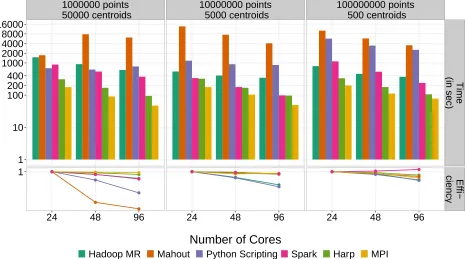
We use Amazon EC2, the Madrid YARN/Hadoop cluster and the Stampede clusters (which is part of XSEDE [53]) as the different resources. On EC2 we utilize the cluster compute instance type, which provides a HPC-style environment. We utilize Elastic MapReduce [54] for managing the Hadoop clus-ter in scenario (A.1) and the spark-ec2 tool for scenario (C.3). Madrid uses YARN as resource manager; SLURM is deployed on Stampede. We run three different K-Means sce-narios: (i) 1,000,000 points and 50,000 clusters, (ii) 10,000,000 points and 5,000 clusters and (iii) 100,000,000 points and 500 clusters. Each K-Means iteration comprises of two phases that naturally map to the MapReduce programming model: in the map phase the closest centroid for each point is computed; in the reduce phase the new centroids are computed as the aver-age of all points assigned to this centroid. While the computa-tional complexity is defined by the number of points×number of clusters (and thereby a constant in the aforementioned sce-narios), the amount of data that needs to be exchanged during the shuffle phase increases gradually from scenario (i) to (iii), in proportion to the number of points.
Figure 2 shows the results of experiments. Both Hadoop im-plementations of K-Means (Hadoop MR (A.1)/Mahout (A.2)) perform significantly worse than the MPI-based implementa-tion. The Map Reduce model – the predominant usage mode of Hadoop-1 – has several disadvantages with respect to support-ing iterative machine learnsupport-ing algorithms: The shuffle phase, i. e. the sorting of the output keys and the movement of the
data to the reduce task, is optimized for use cases, such as data grouping, but introduces a significant overhead where sort-ing is not needed. In the case of larger amounts of shuffle data, data needs to be spilled to disks; sorting is not essen-tial for K-Means. In addition to the inefficiency with each MapReduce, for every iteration a new job needs to be started, which means that in addition to the job launching overhead, data needs to be persistent and re-read to/from HDFS. The MPI implementation in contrast loads all points into memory once. For communication the efficient collective layer from MPI (MPI_Allreduce) is used.
The Python Scripting implementation (C.1) is based on the Pilot-MapReduce framework, which is an interoperable im-plementation of the MapReduce for HPC, cloud and Hadoop environments. The framework utilizes Pilots for resource man-agements. For each map and reduce task, a CU inside the Pilot is spawned. For data-exchange between the tasks the shared filesystem (e.g., Lustre on Stampede) is used. While C.1 out-performs Mahout, it out-performs significantly worse than MPI, or other hybrid approaches. In particular for larger amounts of shuffle traffic (scenario (ii) and (iii)), Hadoop shuffle im-plementation is faster. Also, Spark by default compresses the shuffle data, which improves the performance.
Both Spark and HARP are designed to efficiently sup-port iterative workloads such as K-Means. While these ap-proaches cannot entirely reach the performance of MPI, they introduce a unique way of combining the advantages of MPI with Hadoop/MapReduce. Spark performs slightly worse than HARP. However, it must be noted that Spark operates at a higher-level of abstraction, and does not require to operate on low-level data structures and communication primitives. The RDD abstraction provides a consistent key/value-based pro-gramming model and provides flexible API for manipulating these. However, since RDD are designed as immutable enti-ties, data often needs to be copied in-memory; in each itera-tion our K-Means implementaitera-tion generates two intermediate RDDs. For MPI in contrast only a single copy of the data is stored in memory and manipulated there.
1000000 points 50000 centroids
10000000 points 5000 centroids
100000000 points 500 centroids
●
●
●
● ● ●
● ● ●
●
●
●
●
●
● ●
●
●
●
●
●
● ● ●
● ● ●
● ● ●
●
●
●
● ● ● ● ●
●
● ●
●
● ●
●
● ●
●
●
●
●
● ● ●
1 10 100 200 400 1000 2000 4000 8000 16000
1
Time
(in sec)
Effi−
ciency
24 48 96 24 48 96 24 48 96
Number of Cores
[image:7.612.78.545.35.294.2]Hadoop MR Mahout Python Scripting Spark Harp MPI
Fig. 2. Runtime of different K-Means Implementations: While MPI clearly outperforms the Hadoop-based implementations, the performance of K-Means can significantly be improved by using hybrid approaches, such as Spark and HARP. By introducing efficient collective and iterative operations known from HPC to Hadoop, the runtime can be improved while maintaining a high-level abstraction for the end-user.
between HPC and ABDS ecosystem [55]. Our experiments were designed to expose important distinctions and relevant considerations for integrated ecosystem.
While our micro-benchmark shows that MPI outperforms the Hadoop-based implementation, it must be noted that the second generation Hadoop frameworks, such as Spark, have improved performance significantly by adopting techniques previously only found in HPC, such as effective collective op-erations. Nonetheless important distinctions remain: Hadoop-based frameworks still maintain a very high and accessible level of abstraction, such as data objects, collections etc., and are typically written without a tight coupling to resource specifics, e.g., the user can modify some parameters, such as the HDFS or RDD chunk size, which also controls the par-allelism. In general, frameworks and tools utilize application-level scheduling to manage their workloads and provide pow-erful abstractions for data processing, analytics and machine learning to the end-user while hiding low-level issues, such re-source management, data organization, parallelism, etc. HPC applications operate on low-level, communication operations and application-specific files that often lack a common runtime system for efficiently processing these data objects.
Functionalities available in the ABDS ecosystem (more than 110 implementations) typically exceed those available in the HPC ecosystem, thus reiterating the need for consilience be-tween the two. Several approaches for convergence of the two ecosystems have been proposed. Often, these focus on run-ning Hadoop on top of HPC. However, a lot of the bene-fits of Hadoop are lost in these approaches, such as data lo-cality aware scheduling, higher cluster utilization etc. Thus, we believe that this is not the right path to interoperabil-ity and integration. Furthermore, YARN has been designed
to address the needs of data-intensive applications and sup-port application-level scheduling for heterogeneous workloads, there is some ways to go way before YARN can enable both HPC applications and data-intensive applications on the range of resource fabrics found in HPC ecosystem. A possible and promising approach for interoperability that emerges and will be investigated is the extension of HPC Pilot-Job abstraction to YARN, and the usage of Pilot-Data [12] for data-locality aware scheduling.
Our analysis shows that there are technical reasons that drive the convergence between the HPC and ABDS paradigms, e. g. rich and powerful abstractions like collective communi-cations and direct-memory operations, long the staple of HPC are steadily making their presence felt in the ABDS. We an-ticipate the convergence of conceptual abstractions will soon lead to an integration of tools and technology, e.g., integration of specific capabilities, especially in the form of interoperable libraries built upon a common set of abstractions. In fact, we are working towards such an interoperable library – Scalable Parallel Interoperable Data-Analytics Library (SPIDAL) – that will provide many of the rich data-analytics capabilities of the ABDS ecosystem for use by traditional HPC scientific appli-cations. This will be an incremental but important step towards promoting an integrated approach – the high-performance big-data stack (HPBDS) – that brings the best of both together. Author Contributions– The experiments were designed primarily by AL and JQ, in consultation with and input from SJ and GCF. The experiments were performed by AL, PM and JQ. Data was analyzed by all. SJ and GCF determined the scope, structure and objective of the paper and wrote the introduction, applications and conclusion. AL wrote the bulk of the remainder of the paper.
REFERENCES
[1] NIST BigData Working Group, http://bigdatawg.nist.gov/usecases.php, 2014.
[2] F. Schmuck and R. Haskin, “Gpfs: A shared-disk file system for large computing clusters,” inProceedings of the 1st USENIX Conference on File and Storage Technologies, ser. FAST ’02. Berkeley, CA, USA: USENIX Association, 2002.
[3] A. Sim et al, “GFD.154: The Storage Resource Manager Interface Spec-ification V2.2,” Tech. Rep., 2008, oGF.
[4] A. Rajasekaret al.,iRODS Primer: integrated Rule-Oriented Data Sys-tem. Morgan and Claypool Publishers, 2010.
[5] S. J. Plimpton and K. D. Devine, “Mapreduce in mpi for large-scale graph algorithms,”Parallel Comput., vol. 37, no. 9, pp. 610–632, 2011. [6] T. Hoefler, A. Lumsdaine, and J. Dongarra, “Towards efficient mapre-duce using mpi,” in Proceedings of the 16th European PVM/MPI. Berlin, Heidelberg: Springer-Verlag, 2009, pp. 240–249.
[7] J. Ekanayakeet al., “Twister: A runtime for iterative mapreduce,” in Proceedings of the 19th ACM International Symposium on High Perfor-mance Distributed Computing, ser. HPDC ’10. New York, NY, USA: ACM, 2010, pp. 810–818.
[8] P. K. Mantha, A. Luckow, and S. Jha, “Pilot-MapReduce: An Exten-sible and Flexible MapReduce Implementation for Distributed Data,” inProceedings of third international workshop on MapReduce and its Applications. New York, NY, USA: ACM, 2012, pp. 17–24. [9] A. Luckow, M. Santcroos, A. Merzky, O. Weidner, P.
Man-tha, and S. Jha, “P*: A model of pilot-abstractions,” 2012 IEEE 8th International Conference on E-Science, pp. 1–10, 2012, http://doi.ieeecomputersociety.org/10.1109/eScience.2012.6404423. [10] I. Raicu, I. T. Foster, and Y. Zhao, “Many-task computing for grids and
supercomputers,” inIEEE Workshop on Many-Task Computing on Grids and Supercomputers (MTAGS08) 2008.
[11] E. Deelman, D. Gannon, M. Shields, and I. Taylor, “Workflows and e-science: An overview of workflow system features and capabilities,” Future Gener. Comput. Syst., vol. 25, no. 5, pp. 528–540, May 2009. [12] A. Luckow, M. Santcroos, A. Zebrowski, and S. Jha, “Pilot-Data: An
Abstraction for Distributed Data,”Submitted to: Journal of Parallel and Distributed Computing, Special Issue on Big Data, 2014, http://arxiv. org/abs/1301.6228.
[13] J. Frey, T. Tannenbaum, M. Livny, I. Foster, and S. Tuecke, “Condor-g: A computation management agent for multi-institutional grids,”Cluster Computing, vol. 5, no. 3, pp. 237–246, Jul. 2002.
[14] A. Tsaregorodtsevet al., “DIRAC3: The new generation of the LHCb grid software,”J.Phys.Conf.Ser., vol. 219, p. 062029, 2010.
[15] J. Dean and S. Ghemawat, “MapReduce: Simplified Data Processing on Large Clusters,” inOSDI’04: Proceedings of the 6th conference on Symposium on Opearting Systems Design & Implementation. Berkeley, CA, USA: USENIX Association, 2004, pp. 137–150.
[16] K. Shvachko, H. Kuang, S. Radia, and R. Chansler, “The hadoop dis-tributed file system,” inProceedings of the 2010 IEEE 26th Symposium on Mass Storage Systems and Technologies (MSST), ser. MSST ’10. Washington, DC, USA: IEEE Computer Society, 2010, pp. 1–10. [17] S. Ghemawat, H. Gobioff, and S.-T. Leung, “The google file system,”
inProceedings of the nineteenth ACM symposium on Operating systems principles, New York, NY, USA.
[18] V. K. Vavilapalli, “Apache Hadoop YARN: Yet Another Resource Ne-gotiator,” inProc. SOCC, 2013.
[19] D. Borthakur et al., “Apache hadoop goes realtime at facebook,” in Proceedings of the 2011 ACM SIGMOD International Conference on Management of Data, ser. SIGMOD ’11. New York, NY, USA: ACM, 2011, pp. 1071–1080. [Online]. Available: http: //doi.acm.org/10.1145/1989323.1989438
[20] M. Zaharia et al., “Resilient distributed datasets: A fault-tolerant ab-straction for in-memory cluster computing,” inProceedings of the 9th USENIX Conference on Networked Systems Design and Implementation, ser. NSDI’12. Berkeley, CA, USA: USENIX Association, 2012. [21] “Apache TEZ,” http://hortonworks.com/hadoop/tez/, 2014. [22] “Apache Giraph,” https://giraph.apache.org/, 2014.
[23] S. Melniket al., “Dremel: Interactive analysis of web-scale datasets,” inProc. of the 36th Int’l Conf on Very Large Data Bases, 2010. [24] “Apache Hive,” http://hive.apache.org/, 2011.
[25] I. Szegedi, “Pivotal Hadoop Distribution and HAWQ Re-altime Query Engine,” http://architects.dzone.com/articles/ pivotal-hadoop-distribution, 2014.
[26] M. Kornacker and J. Erickson, “Cloudera impala: Real-time queries in apache hadoop, for real,” http://blog.cloudera.com/blog/2012/10/ cloudera-impala-real-time-queries-in-apache-hadoop-for-real/, 2012. [27] R. S. Xinet al., “Shark: Sql and rich analytics at scale,” inProceedings
of the 2013 ACM SIGMOD Int. Conference on Management of Data, ser. SIGMOD ’13. New York, NY, USA: ACM, 2013, pp. 13–24. [28] A. Abouzeidet al., “Hadoopdb: An architectural hybrid of mapreduce
and dbms technologies for analytical workloads,”Proc. VLDB Endow., vol. 2, no. 1, pp. 922–933, Aug. 2009.
[29] D. J. DeWittet al., “Split query processing in polybase,” inProceedings of the 2013 ACM SIGMOD International Conference on Management of Data, ser. SIGMOD ’13. New York, NY, USA: ACM, 2013, pp. 1255–1266.
[30] R Core Team, R: A Language and Environment for Statistical Computing, R Foundation for Statistical Computing, Vienna, Austria, 2013. [Online]. Available: http://www.R-project.org/
[31] F. Pedregosaet al., “Scikit-learn: Machine learning in Python,”Journal of Machine Learning Research, vol. 12, pp. 2825–2830, 2011. [32] “Apache Mahout,” http://mahout.apache.org/, 2014.
[33] “RHadoop,” https://github.com/RevolutionAnalytics/RHadoop/, 2014. [34] T. Kraskaet al., “Mlbase: A distributed machine-learning system,” in
CIDR. www.cidrdb.org, 2013.
[35] “R on spark,” http://amplab-extras.github.io/SparkR-pkg/, 2014. [36] K. Ousterhout, P. Wendell, M. Zaharia, and I. Stoica, “Sparrow: Scalable
scheduling for sub-second parallel jobs,” EECS Department, University of California, Berkeley, Tech. Rep. UCB/EECS-2013-29, Apr 2013. [37] B. Hindmanet al., “Mesos: a platform for fine-grained resource sharing
in the data center,” inProceedings of the 8th USENIX conference on Networked systems design and implementation, ser. NSDI’11. Berkeley, CA, USA: USENIX, 2011, pp. 22–22.
[38] M. Schwarzkopf, A. Konwinski, M. Abd-El-Malek, and J. Wilkes, “Omega: Flexible, scalable schedulers for large compute clusters,” in Proceedings of the 8th ACM European Conference on Computer Sys-tems, ser. EuroSys ’13. New York, NY, USA: ACM, 2013, pp. 351–364. [39] Apache Hadoop Project, “Hadoop on demand,” http://hadoop.apache.
org/docs/r0.18.3/hod.html, 2008.
[40] SAGA, “SAGA-Hadoop,” https://github.com/drelu/saga-hadoop, 2014. [41] myHadoop, “myhadoop,” https://portal.futuregrid.org/tutorials/
running-hadoop-batch-job-using-myhadoop, 2013.
[42] Amazon Web Services, “Elastic Map Reduce Service,” http://aws. amazon.com/de/elasticmapreduce/, 2013.
[43] Microsoft Azure, “HDInsight Service,” http://www.windowsazure.com/ en-us/services/hdinsight/, 2013.
[44] “Llama,” http://cloudera.github.io/llama/, 2013.
[45] W. C. Moody, L. B. Ngo, E. Duffy, and A. Apon, “Jummp: Job un-interrupted maneuverable mapreduce platform,” in Cluster Computing (CLUSTER), 2013 IEEE International Conference on, 2013, pp. 1–8. [46] O. Kulkarni, “Hadoop mapreduce over lustre – high
perfor-mance data division,” http://www.opensfs.org/wp-content/uploads/2013/ 04/LUG2013 Hadoop-Lustre OmkarKulkarni.pdf, 2013.
[47] P. Zikopouloset al.,Understanding Big Data: Analytics for Enterprise Class Hadoop and Streaming Data. McGraw-Hill Osborne Media. [48] “MapReduce and Lustre: Running Hadoop in a High Performance
Computing Environment,” https://intel.activeevents.com/sf13/connect/ sessionDetail.ww?SESSION ID=1141, 2013.
[49] Y. Wanget al., “Hadoop acceleration through network levitated merge,” inProceedings of 2011 International Conference for High Performance Computing, Networking, Storage and Analysis, ser. SC ’11. New York, NY, USA: ACM, 2011, pp. 57:1–57:10.
[50] B. Zhang and J. Qiu, “High performance clustering of social images in a map-collective programming model,” inProceedings of the 4th Annual Symposium on Cloud Computing, ser. SOCC ’13. New York, NY, USA: ACM, 2013, pp. 44:1–44:2.
[51] W. keng Liao, “Parallel k-means data clustering,” http:// www.ece. northwestern.edu/∼wkliao/ Kmeans/ index.html, 2005.
[52] AMP Tutorial, “Spark kmeans,” http://ampcamp.berkeley.edu/ big-data-mini-course/machine-learning-with-spark.html, 2013. [53] “XSEDE: Extreme Science and Engineering Discovery Environment,”
https://www.xsede.org/, 2012.