STREAM2015 Final Report
Geoffrey Fox, Indiana University
Shantenu Jha, Rutgers University
Lavanya Ramakrishnan, Lawrence Berkeley National Laboratory
http://streamingsystems.org/stream2015.html
. Indianapolis October 2728
2015
See this web site for more information.
Contents
1 Executive Summary
2 Introduction
3 State of Art
3.1 Exemplar applications: Characteristics of Applications, IndustryScience differences.
3.1.1 Application Categories and Exemplars
3.1.2 Application Characteristics
3.2 Current solutions Industry, Apache, DomainSpecific
3.2.1 Particular Solutions
3.2.2 Technology Challenges and Features
3.3 Connections Streaming + HPC convergence. Role of workflow.
4 Next Steps and Research Directions
4.1 New Algorithms
4.2 Programming and Runtime Model; Languages
4.3 Benchmarks and Application Collections and Scenarios
4.4 Streaming Software System and Algorithm Library
4.5 Streaming System Infrastructure and its Characteristics
4.6 Steering and Human in the Loop
5 Build and sustain community
5.1 Community Activities
5.2 Education and Training
6 Summary
7 Acknowledgements
8 Appendices
8.1 Participants
8.2 Workshop Presentations
8.3 Workshop White Papers
8.4 Citations
1
Executive Summary
transportation systems, and urban environments. There has been an explosion of new research and technologies for stream analytics arising from the academic and private sectors, but there has been no corresponding effort in either documenting the critical research opportunities or building a community that can create and foster productive collaborations. To ameliorate this situation, we are organizing two workshops STREAM2015 and STREAM2016. This report describes the discussions, outcomes and conclusions from STREAM2015, the first of these workshops.
We define a stream to be a possibly unbounded sequence of events. Successive events may or may not be correlated and each event may optionally include a timestamp. Exemplars of streams include timeseries data generated by instruments, experiments, simulations, or commercial applications including social media posts. Steering is defined as the ability to dynamically change the progression of a computational process such as a largescale simulation via an external computational process. Steering, which is inevitably realtime, might include changing progress of simulations, or realigning experimental sensors, or control of autonomous vehicles. Streaming and steering often occur together. An example could be for an exascale simulations where it is impractical to store every timestep and the data must be reduced, resulting in streams which may constitute the final results from the simulation in a manner similar to the way we use data from an instrument in a massive physics experiment.
The goal of the STREAM 2015 interdisciplinary workshop was to identify application and technology communities working in the broad areas of streaming, steering and their intersection, and to clarify challenges that they face. We solicited white papers on related topics from the community. The white papers submitted covered a mixture of applications and technologies. The final workshop program included 43 attendees and 29 talks that included 17 accepted papers and other invited talks, four breakout sections and three plenary discussions. We also identified research challenges and future steps for community engagement. The discussions from the workshop are captured as topic areas covered in this report’s sections. The workshop identified four important research directions driven by current and future application requirements.
Programming Models: There is tremendous diversity and churn in stream analytics programming models and systems and no common understanding of application requirements, making them impractical to compare directly. There is a need to research and develop programming models and computational paradigms that can raise the level of abstraction to simplify the programming tasks for endusers.
Algorithms: Challenging stream analytics problems arise from applications where the complexity and scale of these unbounded events are such that they cannot be analyzed at the rate they are produced with traditional batch algorithms. The workshop attendees suggested a variety of compelling research topics including adaptive sampling, online clustering, sketching and approximation that trade space and time complexity for accuracy.
Steering and Human in the Loop: In many cases it is essential that a human guides the automatic responses to event streams. Research ranging over systems, visualization and human computer interaction is needed to integrate human and computing knowledge in decision processes.
The workshop participants felt that the diverse nature of the nascent community was well represented by the diverse group of attendees and the topics presented, but that the topic is in need of further attention because of its growing importance. There is a strong support for establishing and enhancing this community and supporting and expanding the role of http://streamingsystems.org.
2
Introduction
STREAM2015 grew out of NSF ACI’s Dear Colleague Letter (DCL) [DCL15053] to the community to identify the gaps, requirements and challenges of future production cyberinfrastructure beyond traditional HPC. The NSF has a long track record in production cyberinfrastructure to support HPC applications, but arguably a less consistent record in deploying and supporting infrastructure for the rich space of distributed applications. Given the trends in data, instrumentation and scientific computing, an area of particular interest was the investigation of the landscape systems, middleware and applications at the integration point of HPC, dataintensive computing and realtime computing as required by large scientific instruments and projects: streaming and steering lie at the heart of the overlap. Given DOE’s mission, it was not a coincidence that these topics were of interest and relevance to ASCR at DOE. Thus, was born the coordinated NSF and DOE efforts to organize STREAM 2015 and STREAM 2016.
The analysis of data streaming from online instruments, large scale simulations and distributed sensors now enables near realtime steering and control of complex systems such as scientific experiments, transportation systems and urban environments. There has been an explosion of new research and technology for stream analytics coming from the research and private sectors, but many of the activities are disconnected. This report describes the outcomes and conclusions from the first of two workshops, STREAM2015 and STREAM2016, that brings together a wide range of practitioners and stakeholders to cover the full breadth and potential of this topic. Significant effort was made to cover government, industry and academic activities.
We solicited white papers on related topics from the community for STREAM2015. The white papers submitted covered a mixture of applications and technologies. 17 white papers were accepted and are listed in sec. 8.3 with links to posted versions. The white paper authors and several additional participants from academia and industry were invited to the STREAM2015 workshop that covered a rich selection of applications, algorithms and software systems. The final workshop program included 29 talks, four breakout sections and three plenary discussions with 43 attendees.
This report is arranged into three major sections: State of the art; Next steps and research directions; Building and sustaining a streaming system community. These capture the workshop discussions and presentations/white papers and are followed by a summary with appendices listing participants, presentations (labelled [Pnn]), white papers (labelled [WPnn]) and citations (labelled [nn]).
(potentially distributed) state between processing of data sections and there is no possibility of analyzing a previously processed data section.
3
State of Art
Streams can be characterized by concurrent sequences of events, which might be associated with timestamps as in social media posts or time series generated from one or more instruments, experiments, simulations, or commercial applications. Steering might include steering simulations or realigning experimental sensors, or control of autonomous vehicles. Both of these cases were covered in workshop and presentations on current state of the art set the scene for futures discussion; in particular identification of research challenges and future steps for community engagement covered in secs. 4 and 5.
Processing of streaming data is being addressed by many communities including industry, many branches of academic research and national laboratories [Survey16]. The goal of the STREAM 2015 interdisciplinary workshop was to identify application and technology communities working in this area and to clarify challenges that they face. The workshop focused on application features and requirements covered in sec 3.1 as well as hardware and software needed to support them covered in sec. 3.2. Sec 3.3 covers the special topic of HPCBig Data convergence.
3.1
Exemplar applications: Characteristics of Applications,
IndustryScience differences.
3.1.1
Application Categories and Exemplars
Streaming/Steering Application Class Details and Examples Features Talks, WPs
1 Industrial Internet of Things, Cyberphysical Systems, DDDAS, Control
Software Defined Machines, Smart buildings, transportation, Electrical Grid, Environmental and seismic sensors, Robotics, Autonomous vehicles, Drones
Realtime response often needed; data varies from large to small events
WP2,8,10,14 ,17
P2,10,11,14, 16,19,20,27
2 Internet of People: wearables Smart watches, bands, health, glasses, telemedicine
Small independent events
P1
3 Social media, Twitter, cell phones, blogs, ecommerce and financial transactions
Study of information flow, online algorithms, outliers, graph analytics
Sophisticated analytics across many events; text and numerical data
P1,3,12,13, 18
4 Satellite and airborne monitors, National Security: Justice, Military
Surveillance, remote sensing, Missile defense, Antisubmarine, Naval tactical cloud [NavyCloud14]
Often large volumes of data and sophisticated image analysis
WP13 P28,29
5 Astronomy, Light and Neutron Sources, TEM, Instruments like LHC, Sequencers
Scientific Data Analysis in real time or batch from “large”
Realtime or sometimes batch, or
WP1,5,6,9, 12
sources. LSST, DES, SKA in astronomy
even both. large complex events
6 Data Assimilation Integrate typically distributed data into simulations to enhance quality.
Link large scale parallel simulations with time dependent data. Sensitivity to latency.
WP3 P21
7 Analysis of Simulation Results Climate, Fusion, Molecular Dynamics, Materials. Typically local or insitu data. HPC Big Data Convergence
Increasing
bottleneck as simulations scale in size.
WP1,4,7,11 P5,7,9,23,24
8 Steering and Control Avionics. Control of simulations or Experiments. Network monitoring. Data could be local or distributed
Variety of scenarios with similarities to robotics
[image:5.612.73.562.71.298.2]WP7,15 P5,9,17,25
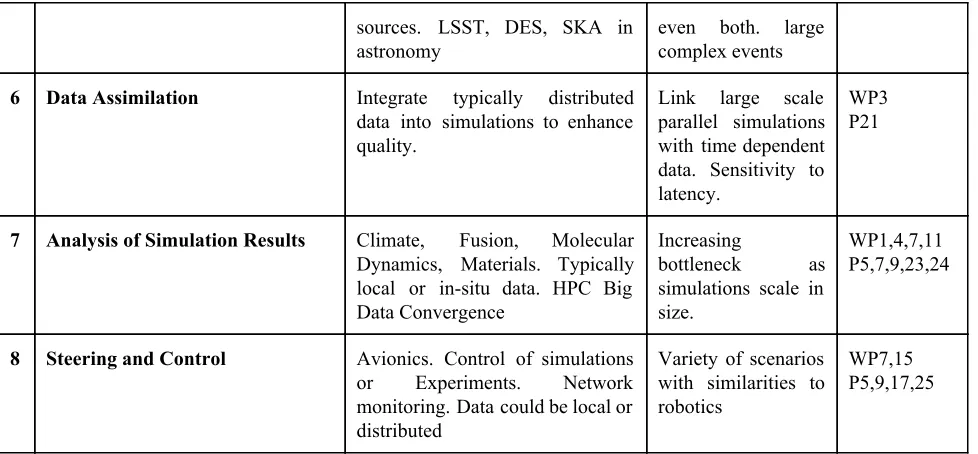
Table 1: Eight Streaming and/or Steering Application Classes
Applications cover a wide range. As one example, for exascale simulations where it is impractical to store every timestep, it may be necessary to do insitu analysis of critical indicators from each step which can then be used to modify simulation parameters or context on the fly. The resulting streams from the insitu analysis may constitute the final results from the simulation in a manner similar to the way we use data from an instrument in a massive physics experiment. As another example, smart city sensors generate streams of data that capture the health and state of an urban environment. Analyses of these data streams can guide city planners and emergency responders.
We surveyed the field and identified application classes including Internet of People, Social media, financial transactions, Industrial Internet of Things, Dynamic Data Driven Applications Systems (DDDAS) [DDDAS15], Cyberphysical Systems, Satellite and airborne monitors, National Security, Astronomy, Data Assimilation, Analysis of Simulation Results, Steering and Control and Instruments like the Large Hadron Collider(LHC), highenergy xray sources, and sequencers. Although, streaming applications differ widely e.g., in the type of science they support (simulations versus experiments), a large fraction of them can be understood using a few common characteristics, e.g, in whether they are distributed or not, size of streamed data unit, whether they have realtime constraints etc. This allows introduction of application classes summarized in table 1 which also lists presentations and white papers discussing each class. Note that these contributions are sometimes technology and sometimes application focussed; the technology contributions often give use cases that are used for listing them in table 1.
There were several applications brought up during the workshop. Some examples include microbiome and metagenomics which were not in any of the formal contributions but likely to grow in need for streaming processing.
● UAV monitoring for oil and gas exploration use case noted the complexity of the analysis of radar images; harder than related optical images seen in surveillance applications. Size is another issue; The size of radar images are several times bigger than optical images because they contain phase and polarization information in addition to intensity value.
Amazon and NERSC available cycles and to avoid the complex replica schemes in data grids. Similarly, photon science experiment workflows are becoming increasingly automated, and are coupling detector data sources to highperformance computers for nearrealtime analysis [P4]. ● The DDDAS Avionics application [P25] in the steering and control category brought up some
important issues including the role of bad data and its recognition detection especially by automated systems used today in aircraft. We often need to support sophisticated application sitting on top of streaming such as simulations to give feedback on how to respond to data. Cyberphysical system applications like the Smart Grid, IIOT (Industrial Internet of Things) or IOB (Internet of Buildings) are growing rapidly interoperability, anonymization, and need to integrate diverse data are important. The tradeoff between anonymization and utility in the Array of Things was highlighted.
● TEM produces streams of connected images with human in the loop with the need to preserve message (image) order. Network monitoring can be viewed as streaming data with network routing becoming a dataflow graph.
● The Square Kilometer Array telescope SKA shifts mechanical engineering (100 square meter mirror) to computing (lots of one square meter mirrors). Here “steering” will be used to update in real time the corrections for atmospheric and mechanical effects on the observed data; and more generalised stream processing will be used because it is too expensive to contemplate keeping all of the observed data and therefore it must be processed into reduced data production.
The discussion noted some differences between industry and research applications. One was event size these are often large in research use cases. Another was approach to getting needed performance; industry might “just” add more nodes to improve performance; this is typically considered too costly for research applications. Finally SQL important in many industry deployments but its broad value in science is not so clear.
3.1.2
Application Characteristics
Several characteristics were highlighted that could be used to develop a more detailed classification than table 1 and in deriving requirement for processing system. These include the size of events; the use of control or steering; the connection between events such as their ordering and stateful event processing; use of human in the loop for feedback; universality of interfaces; adaptive pipelines needed in research today; need to identify the important information “rapidly”; access control; adaptive flow control; the challenge of realtime data assimilation; complexity of data in individual events; need for fault tolerance; provenance especially in adaptive applications where data result of previous workflow; accuracy and use of sampled data; error recovery problematic data will choke when passed through the algorithm again; what are data structures and appropriate storage matching hardware and application needs.
adjustments to datagathering equipment based on analysis of results. Some science applications require highspeed, fully automatic and complex adaptive processing. Here it is often not costeffective to make an automated pipeline for each case.
Within large scale simulations, there are event streaming techniques which will be essential, as every snapshot can’t be saved. This is category 7 in table 1. We also noted that steering (category 8 in table 1) is pervasive; in particular sensors sometimes need to be steered
There is a need to respond to variable rates or load changes such as between peak and nonpeak hours. This requires an elastic system capable of dynamic scalability based on the changing rates. This creates interesting programming paradigms involving unbounded data with sliding windows with the need to detect changes between windows.
In most cases, the data is distributed, which affects synchronization, parallelism and algorithms. One needs to characterize workflows better; for example where are computations done are they close to the source of the data or does data stream to the cloud? This is exemplified by comparison of Akamai edge vs Google server farms. There is a well known discussion of three processing locations: sensor (source), fog (computing near source) or cloud (backend). Does it matter which cloud one chooses as location will affect turnaround? Does the sensor’s connectivity facilitate certain processing modes or does it constrain processing modes the answer could be time dependent. Does the processing (cloud) need to be self distributed? One needs to address the case with no cloud connection (at a particular time). What aspects of processing are sensitive to hierarchical (sensorfogcloud) programming model; does query processing get decomposed at all levels? What parts of system need to talk to all services/nodes? How much can be done at each level of hierarchy?.
Projects such as large telescopes or accelerators with long timelines need to consider timeline of evolving technologies for streaming data as industry is driving rapid change. One can identify needed functions and components and if one programs to this high level model, it should be easier to incorporate underlying technology change.
The availability of test data where security and privacy concerns prevents wider release needs to be addressed as in sec. 4.3. We need better anonymization techniques or privacy policy changes
3.2
Current solutions Industry, Apache, DomainSpecific
3.2.1
Particular Solutions
Three impressive solutions from industry Amazon [P1], Google [P3] and Microsoft [P18] were described. Although operating at large scale their uses like ecommerce and logging transactions have important differences from the research applications discussed in sec. 3.1. Amazon has Kinesis streaming software, Google Cloud Dataflow supporting general Big Data analytics while Microsoft has introduced Trillbased Azure Analytics as a highperformance inmemory incremental analytics engine. This first class (commercial) of streaming software infrastructure can be compared with three others presented at the workshop.
The third set consisted of current domainspecific solutions used today in different observational science areas. As described in sec. 3.1, we heard about technology for Astronomy, Light Sources, LHC, Smart Grid, Array of Things, IIOT, UAV, Avionics and simulations. Early academic work includes Aurora
[Cherniack03]
,
Borealis [Abadi05]
, StreamIt [Thies02] and SPADE [Gedik08]
.As the fourth category we can put research software designed for general streaming applications. These included SEEP [Seep15], StreamMapreduce (
[Streammine15],
[WP2] and [P20]), Workflow ([WP3] and [P21]), cloud video streaming ([WP13] and [P28]), HPC (exascale) technology ([WP11] and [P23]) and an academic approach Neptune [P16] [Neptune16]
with a similar architecture to the Apache solutions. In contrast StreamMapReduce [P20] offers MapReduce with a builtin streaming engine with fault tolerance and elasticity and supporting SQL, CQL and K3. Time Windows permit the definition of a dataset to operate on in StreamMapReduce. SamzaSQL [P22] builds on Apache Kafka [Kafka15], Samza and Calcite with monitoring use cases from Linkedin. IoTCloud [P19] adds parallel processing and low latency to Storm so as to support the use of backend clouds controlling robots. MPI is not designed for streaming and a library to support streaming is added [P23] with special benchmarks and a comparison between MPI I/O and Streaming I/O.
3.2.2
Technology Challenges and Features
Integration of the many technologies to build “endtoend” streaming infrastructure is a basic challenge as is the lack of consensus as to appropriate hardware and software infrastructure. Other issues identified included securing data; dynamic provisioning of cloud resources to reduce cost; connecting different programming models in streaming environment; supporting online algorithms; understanding concept of time and space with respect to streaming data; use of both legacy applications and new online algorithms together in a scaling fashion; use of and identification of reusable components; need for data management to be scalable and dynamic; impact of nonvolatile memory, and GPU’s, which currently are outside streaming frameworks.
We discussed state of the open source software and industry participants noted Storm (and Spark [Spark15] and Flink [Flink15]) was really obsolete and a new hardened version is needed. Amazon Kinesis can drive Apache Storm but latter does not scale well enough to use in large production systems like Amazon Kinesis. Neptune has higher performance than Storm in analysis reported in [P16] [Neptune16]. Apache Flink, building on EU Stratosphere, is a current favorite cloud programming environment and supported in Google Cloud Dataflow. For industry, interoperability is a difficulty for linking many manufacturers and data sources.
The hierarchical sensorfogcloud model is not supported in today’s systems which focus on the backend (cloud) solution.
3.3
Connections Streaming + HPC convergence. Role of workflow.
The issues at the intersection of streaming and HPC were discussed in several white papers [WP1, WP3, WP4, WP5, WP6, WP11, WP12] and associated presentations [ P4, P5, P7, P9, P17, P21, P23, P24]. One reason to explore this intersection is that commercial solutions are not converging with the needs of science big data. Another is that resources available for large scale research applications are typified by NSF resources configured as HPC clusters.
exascale runtime for streaming should be investigated in both these cases. The new exascalemotivated approaches are more dynamic and could be more effective than traditional MPI for streaming. We need to understand the interaction between big and streaming data and the connection between insitu data processing and big machines.
There is a need for a deeper coordination between the HPC and streaming communities. There are similarities between workflow and stream communities with for example Swift from Chicago supporting MapReduce implemented with MPI. We could learn from workflow and in particular from the difficulties in promoting interoperable workflow solutions.
Particular issues discussed included the role of storage and networks in streaming; the impact of RDMA networks on streaming; the impact of SDN on streaming; the I/O performance and architecture needed on HPC machines to support streaming; the need to benchmark HPC vs Cloud solutions with architectural differences and optimization differences; connection with hardware vendors.
There is perhaps a disconnect between HPC and BigData software stacks in the areas of performance and architectural components e.g. HPC might use Slurm and Big Data (streaming) Yarn or Mesos for cluster management/scheduling. We need to engage with XSEDE and XSEDE ECSS to understand better how to do streaming on big NSF resources and look at usability and performance issues.
4
Next Steps and Research Directions
The workshop Identified several important research directions driven by current and future application requirements. These are covered in following subsections.
4.1
New Algorithms
Some of the most challenging stream analytics problems arise from applications where the complexity and scale of unbounded streams are such that they cannot be analyzed at the rate they are produced with traditional batch algorithms. Consequently we need different algorithms that can reduce the complexity of the analysis and there is an active computer science research here but limited practical experience. The workshop attendees suggested a variety of compelling research topics including adaptive sampling, online clustering [Guha13] and sketching.
Sketch algorithms provide approximate results for queries performed over voluminous datasets. This is achieved by using data structures that serve as a surrogate (or a sketch) for the actual dataset, and then using this data structure to evaluate queries. More importantly, the spacecomplexity or memory footprint of this data structure is independent of the underlying voluminous dataset. Examples of such algorithms include the wellknown Bloom Filter that can be used to evaluate set memberships. The Bloom Filter may produce false positives on set memberships, but will never produce a false negative [Bloom70]. The HyperLogLog algorithm is a probabilistic estimator for approximating the cardinality of a dataset [Flajolet07]. The CountMin algorithm effectively approximates the frequencies of elements within a dataset that has repeated elements [Cormode12]. In essence the space complexity (size of sketch) tradeoff becomes a timecomplexity versus accuracy tradeoff. Frequent itemset mining over data streams [Freq04][Freq05][Freq06], stream classification [Classify00] and streaming clustering algorithms [Cluster02][Cluster03] are well known but needs to be applied in massively parallel settings.
In workshop presentations, [WP1] [P5] [P7] described streaming Principal Component algorithms PCA and the identification of “heavy hitters” (mass concentrations) corresponding to galaxy halos in astrophysical simulations. [P13] described parallel online clustering algorithms to find Twitter memes (information concentrations) using Apache Storm environment. [Storm15] [WP10] [P11] described baseline methods for electrical grid data understanding.
The NRC Frontiers in Massive Data Analysis report identifies 7 “computational giants” which are essentially algorithmic challenges. These seven are Basic Statistics; Generalized NBody Problems; GraphTheoretic Computations; Linear Algebraic Computations; Optimizations; Integration and Alignment Problems. They remark that two of the most pervasive strategies for achieving computational efficiency are sampling and parallel/distributed computing. They back this up with a full chapter on “Sampling and Massive Data”. Further they identify 4 common themes.
1) Stateoftheart algorithms exist that can provide accelerations of major practical
importance, by significantly changing the runtime order, for example, from O(N2) to O(N log N).
2) High dimensionality in the number of variables is a persistent challenge to obtaining computational efficiency, and this demands ongoing research effort.
3) The “nondefault” settings (default is sequential in memory algorithms)—streaming, diskbased, distributed, multithreaded—are quite important, yet mostly underexplored in terms of research effort. More broadly they note below that many key ideas have been proven in principle but not yet applied broadly in practice. This includes for example the O(N logN) algorithms mentioned in first theme.
4) Most of the best fast algorithms described in the computational giant section have only been demonstrated in research implementations. More work is required to create robust and reliable software before these algorithms can be used widely in practice.
Sampling was discussed in the meeting including: sampling improving performance; the sketch concept which is a smaller but representative dataset; the general issues of approximation and accuracy and the tradeoff between accuracy and time complexity; socially coupled systems have intrinsic inaccuracy; where, when and what to sample is a challenge; error bounds with sampling; need for users to understand algorithms with approximations and be able to make good choices. Incremental accuracy was discussed with initial sample results being improved as the data increases in size.
Streaming and online algorithms clearly are very promising and in some cases essential to satisfy compute/time complexity constraints. These algorithms are characterized by only using the data once whereas typical iterative batch algorithms go over the data many times. Sampling can go further and only use a subset of the data once (or in a batch sampling many times). The concept of training is not clear in the sampling class of algorithm. Note that streaming algorithms are a distinct idea from realtime algorithms.
In accord with NRC report, the workshop identified need for scalable parallel algorithms covering multicore and parallel computing. Information visualization and dimension reduction (illustrated by PCA presentation [P5]) was also emphasized and covered by NRC. Dimension reduction is linear (e.g. PCA) or nonlinear (e.g. MDS) and comparison of these approaches is needed for streaming data.
the typical performance and accuracy comparisons of streaming versus batch algorithms. Correspondingly is there a batch version of every streaming algorithm? How much processing should be done online and how much offline (batch)?
We need to research steering scenarios involving active learning: for example a set of molecular dynamics simulations that drive towards rare events. Another example is machine learning classification algorithms that can take streams to improve (adaptively) their accuracy.
4.2
Programming and Runtime Model; Languages
White papers discussing this area include [WP2, WP4, WP7, WP11].
Current practice in programming models and runtime (both must be discussed) spans commercial solutions, open source (Apache) and domainspecific solutions. Additionally, there is tremendous diversity and rapid evolution in stream analytics programming models and systems. Furthermore there is no common understanding of application requirements and programming models, making them impractical to compare authoritatively. The workshop exposed the fact that the major science and commercial applications have significant differences. There is a need to identify best practices and computational paradigms that can raise the level of abstraction to simplify the programming tasks for endusers, removing the requirement of expertise in distributed computing, adhoc analytics and integrating diverse software packages. We expect that a few major software and hardware architecture will emerge covering the range of applications and that one will then need to design and build sustainable ecosystems including core middleware and libraries. Note sec. 4.4 discusses producing community systems software and sec. 4.5 the hardware needed to support streaming systems.
We heard about some particular research systems. StreamMapReduce [WP2] [P20] allows event stream processing to work with MapReduce.and extends finegrained event driven execution models for largedata volumes. HighPerformance Implementation of streaming models in MPI was presented in [WP11] [P23]. Neptune [P16] [Neptune16] and Twitter Heron [Heron15] addresses performance problems [WP17] in Apache Storm in particular those associated with Apache Kafka [Kafka15].
We heard from three impressive solutions from Industry Amazon, Google, Microsoft. It was interesting to see the transition in Google from MapReduce to Cloud DataFlow via FlumeJava and MillWheel. It would interesting to evaluate these systems and compare their approaches to workflow and streaming which are integrated.
Some research issues uncovered included:need for programming abstractions and runtime support for adaptive and steered applications in large scalesimulation science; the concept of time is needed in the abstraction/programming model which is addressing time series processing; the performance of two big data languages Python and Java could be significantly improved if their compilers and runtime were approached in a way that is well understood for “simulation” languages C++ and Java; more understanding is needed of the Google concepts of bounded or unbounded and the relationship to batch and streaming programming;
example from the HPC field is the PGAS programming model. A majority of practical programmers tend to think in terms of the von Neumann computing model where a unified memory is updated as the computation proceeds. This model is however very difficult to scale up, leading to the introduction of message passing models in HPC which can be efficient but are in turn difficult to program. The PGAS programming model for HPC makes a minimal change to the von Neumann model by partitioning the memory into an area which is cheap to access (mapped to local memory) and the remainder that is globally shared. This then presents a simple highlevel abstraction to users which is mapped to message passing by the runtime system, introducing some efficiency loss but being much more friendly to the practical or even casual programmer.
Similarly, there are other areas that provide potentially interesting and relevant approaches, e.g., SQL query optimization [WP16] hasn’t been fully exploited for distributed systems although this has been studied in the context of data streams [SQL02] [SQL04]; actor models natural for events should be studied; maybe there are optimized Java virtual machines for streaming?; maybe there are optimized openStack style virtual machines for streaming?
Another reason why processing streams is difficult compared to traditional batch jobs is the scheduling issue. Optimal stream scheduling where you also try to maximize a performance measure such as latency or throughput is NPHard. There are however possible stochastic solutions to the problem and additionally heuristics based on previous runs can be used to efficiently find good approximate solutions [AuroraSched03]. Further research on this could be of benefit to many streaming applications. There is also the tradeoff between latency and throughput in streaming processing settings. Further research is needed to understand this and other stream optimizations [Hirzel14] better.
We discussed the data model required for streaming; issues include efficient parallel data management ; are Spark RDD, AsterixDB and Tachyon important? Can one adapt ideas from adaptive meshing to handle key partitioning and sharding; is MPIIO. and/or lessons from it useful?; do we only ingest into edge elements?
Domain specific Languages are a popular feature in many parallel computing areas. They do not seem to have been explored deeply for streaming systems. In fact industry seems to use API’s (between services) and one should evaluate this approach. One needs more abstractions for streaming systems and good implementations that lower the programming burden.
An interesting abstraction is mapstreaming [Ogre14] which is a high level description of systems like Apache Storm that describes parts of the system but not all; for example it describes the pubsub aspects of Storm but misses its dataflow aspects, and additional need to support full parallel computation in some applications such as SLAM in [WP17]. We also need to add the needed operators or primitives and algorithms. The relation of these abstractions to workflow and its abstractions needs study. Perhaps there is an algebra for distributed streaming systems [Soule10, Soule12]. We do not expect a single solution but rather a family of solutions addressing different application classes such as those given in table 1. Further we emphasis that this is all work in progress much research, benchmarking and experimental systems building will be needed.
The performance cost of using virtual machines especially those managed with systems like OpenStack needs more study. The overheads are going down but are still unnecessarily high partly due to software drivers and partly to the overhead of managing sharing at core level.
Streaming will always give rise to data movement, which needs to be integrated with processing efficiently. We certainly need data movement in parallel and that has often been hard to express and implement when linking parallelism with dataflow. Google’s Dataflow name captures the data movement idea. GridGain (a commercial system built on Apache Ignite) captures the further idea that data doesn’t hit disk unless necessary.
There is no consensus as to data placement and programming models. Traditional science computing models are based on batch executables but that’s not appropriate for alwayson event streams. Event and stream queries need novel data management and computing infrastructure, which needs to match the application requirements.
We need ability to dynamically convert streams into scientific and analytical data types within workflows and make automated processing of such data possible at the rates that the data is being produced.
The workshop asked about the possible use of software designed for exascale runtimes in streaming systems. For example, exascale adds support of dynamic inhomogeneous threads which could be very useful in streaming.
4.3
Benchmarks and Application Collections and Scenarios
We require an understanding of the true complexity and breadth of application requirements to make substantive progress on algorithm, programming models and software systems for stream data analytics and steering. Similar to “grand challenges” in domain sciences, the development of a series of representative streaming and steering examples will be of enormous value. These should include representative data sets at scale. Linear road [Bench04] is an early benchmark developed around Aurora streaming system focusing on one application. There may be a need for benchmark suites like TPC or HPCC that foster collaboration between industry and the research community but we need benchmarks that cover the full complexity of the distributed streaming area. There is a clear need to investigate the performance of streaming applications and software on clouds and HPC systems. This need is covered in this subsection for the applications and in the next subsection for software.
Initial candidate benchmarks were given at the workshop in [WP2] [P20] (taxicab data) , [WP11] [P23] (based on STREAM memory benchmark), [WP16] (LinkedIn monitoring data) and [WP17] [P19] (SLAM robotic planning). Many of the other talks implicitly defined possible benchmarks: [WP1] [P5] [P7] with streaming Principal Component Analysis, [P13] with online clustering algorithms and [WP10] [P11] with smart electrical grid s. Other examples that convey the breadth of challenges associated with streaming include ATLASLHC analysis, Avionics, Drug Discovery and Galaxy Zoo [Galaxy16]. The inspiration for many of the benchmarks mus t come from Industry and must involve interesting unrestricted datasets. Further we need to include benchmarks that present real time data from real time sources. A simple initial task is to agree on a “Hello Streaming World” example.
We need a more comprehensive understanding of and classification of streaming applications (perhaps expanding table 1) to scope a benchmark set. This could build on the Dwarfs [Dwarf06] for parallel computing and the Ogres [Ogre15] for big data applications. Some of the streaming characteristics include the type of events, the size of events, and the lifetime of events.
We need some number N (620?) of exemplar problems that identify use cases clearly and are well described. From this collection, we can work on challenges, abstractions, scaling, theory, stream operators, algorithms, languages and tools. We can look at them implemented with current software on current hardware and see what works and what doesn’t. This process will generate a robust benchmark set. Note some examples can involve actual streaming data and others a repository of data that can be used to generate streams.
4.4
Streaming Software System and Algorithm Library
We need to assemble a general purpose highutility open source scientific streaming software library that can be used by the community. It should be carefully integrated with the Apache Foundation software. It would hold enhancements to Apache software (for example Apache Storm and Mahout) as well as stand alone software. It would contain systems (middleware) and algorithms and would be streaming analog to SPIDAL and MIDAS [Spidal15]. It would have broadly applicable functions, support data reuse, and implement a suite of algorithms exploiting key streaming ideas such data sketches and certainly the challenges highlighted in NRC’s computational giants. It would also have core capabilities such as state of art tools to allow Java and Python to run at high performance.
We need to aim at a toolkit that will support the stringent requirements of the major streaming science applications but is architected so same toolkit can be used across domains including LHC analysis, light sources, astronomy and simulation data. The development of a community toolkit should not be occur before the primary set of requirements and existing system support are understood and have stabilized.
4.5
Streaming System Infrastructure and its Characteristics
Although there is significant progress in developing streaming system software as discussed in sec. 4.2, there is no clear consensus on the type of hardware best suited to host this software. Rather communities use existing systems designed for other applications clouds or HPC to support streaming solutions. Of course if we include the sources of the data, any system must be distributed and must be scalable. Appropriate infrastructure may differ for research and production systems; it may also differ across application classes.
Then we need to understand differences in hardware, systems software and algorithms for the current batch bounded model and the newer unbounded streaming and interactive processing models. Are we at a point where unbounded tasks become a significant part of the workload and justify dedicated hardware?
Note that some communities such as ATLAS at LHC [WP12] [P26] are moving to a streaming model as reduce costs by reducing replica count and data transfer. This only works if streaming systems achieve high performance and are costeffective. Simply good performance achieved by adding more nodes to our cloud is not enough unless cost of streaming model is less than traditional approaches as for example used today by the LHC.
It is not clear if choice of HPC and Cloud infrastructures are intrinsic features of applications (commercial applications are different from scientific ones), software (are systems like Apache Storm biased to clouds) or perhaps both clouds and HPC are efficient and costeffective. We need more comparisons between HPC and cloud implementations for the same application.
One important consideration is the cluster interconnection network performance requirements; one might expect that streaming data would need good network bandwidth but not the same latency seen in MPI (publishsubscribe systems tend to have millisecond and not microsecond latency). We expect it will be important to support interoperability between clouds and HPC clusters and to allow users to easily scale the size of their solution system.
As in sec. 4.5, we expect major challenges like streaming for ATLAS will develop much higher performance science streaming software tools and this would then allow more meaningful evaluations of needed hardware. Current solutions like Apache Storm do not match performance of commercial systems like Amazon Kinesis and will not meet ATLAS requirements. If we build a community as discussed in sec. 5, we can use answers to questions posed above to present community requirements to the hardware vendors.
4.6
Steering and Human in the Loop
White papers discussing this area include [WP3, WP5. WP6, WP7, WP8, WP9, WP15] and see [AIM15].
In many cases it is essential that a human guides the automatic responses to event streams and there is limited software support to enable this in current analytics systems. These cases range from avionics, where a pilot’s decisions may be a matter of life or death, to cases when human expertise might identify regions or candidates of interest that need to be studied in greater detail in computational simulations or the drug discovery process. Another relevant use cases arises from lightsources such as APS/ALS as well as other experimental and observational facilities where a basic requirement is the integration of streaming data into analysissimulation pipelines with humans in the loop. Further large scale simulation science motivates data and humandriven control for steering application/simulations. A final example is the steering of a UAV based upon realtime analysis of data received from the drone. Research ranging over systems, visualization and human computer interaction is needed to integrate human and computing knowledge into decision processes.
The NRC Frontiers in Massive Data Analysis report has a full chapter on “Human Interaction with Data”. This covers Data Visualization and Exploration, as well as crowdsourcing and Hybrid Human/Computer Data Analysis. In this workshop, crowdsourcing was not discussed and visualization was not stressed. In latter, the importance of Python and Pandas was noted and the challenge of visualizing high dimensional time series was posed.
General challenges in this area include: getting a deeper understanding how scientists interact with streams; understanding how Human Computer Interaction HCI principles should be used; achieving scalability for both the algorithms and as well for tightly coupled workflows across different programming languages and models; how the system can maintain message ordering in spite of the high data volumes.; establishing and verifying ground truth; providing reproducibility in a highly adaptive environment with extensive user interaction, input and steering.
Looking at Transmission Electron Microscopy TEM and many related use cases, one can ask: how steering towards very rare events is managed; and secondly how one manages scenarios that depend upon both human and computing awareness.
Steering needs more attention partly because it is not a significant consideration in some major industrial applications where (near) realtime user interaction is not essential. Steering needs to be built in at all levels of system not just added at user level. Steering application types include: Steering the simulations, steering the sensors, steering the coupling/stream. We can pose this an optimization problem. Looking at industry, applications like connected vehicles could involve steering but software like Apache Storm does not directly support steering.
Steering opens up many issues related to resource management. There is a contrast between Dynamic Resources Management for steering and approaches based on Adaptive Workflow.
Steering can be considered as hypothesis based reasoning. A general research question is to understand how, when and where to intercede in automated reasoning. We need to give users just the right amount of information and to have a clear logical model for steering. Note that scientists are often more comfortable steering the instrument, as opposed to relying on a machine learning algorithm. We must understand how to select a division of decision making between system and human. We need to understand the dividing line between human knowledge and computing knowledge in a system that has a broad range of tuning parameters? As in [WP10], we must often have baseline observations to identify normal behavior, and then design a response as a function of violation of accepted tolerance values.
5
Build and sustain community
The workshop was wellreceived and deemed successful by the participants. It was viewed as an interesting start to the development of a community with a good mix of participants and much potential for a community to be expanded. There was a critical recognition that the topic is in need of further attention because of its growing importance. The workshop participants felt that the diverse nature of the nascent community was well represented by the workshop attendees and the topics presented. There was a strong support for establishing and enhancing this community and supporting and encouraging variety of community activities.
5.1
Community Activities
There were several suggestions for community building activities starting with expanding the STREAM2015 workshop website http://streamingsystems.org to a clearinghouse of community information and activities. Additional efforts will be required to organize community activities including application surveys, special issues, workshops, and industry engagement through advisory committees. The community would have as usual multiple subgroups covering topics including those we identified in this meeting and report.
We will organize the STREAM 2016 workshop which will be informed by the results of this workshop and hopefully broaden the community as well as covered applications and technologies. It has a DoE focus and we discussed reaching out to the DOE Light and Neutron sources and trying to cover all relevant DOE applications. It was suggested that we look at other ASCR workshops as some white papers there discuss streaming. The “Data Management, Analysis and Visualization for Experimental and Observational Data (EOD) Workshop” [EOD15] held recently was highlighted.
Several existing conference and meeting venues were discussed to grow the community. A BoF or workshop as SC’16 was seen as promising. Efforts to engage additional key people and activities that could not make it to STREAM 2015 should continue. This includes industry representatives from GE, IBM, FB, Twitter and the financial sector.
The application benchmarks and streaming software libraries discussed in secs. 4.3 and 4.4 are clearly valuable community resources. As a precursor to these collections, we could consider a survey of existing software systems (highlighting those in open source) and a survey of applications existing and potential. These surveys can be analyzed to refine research challenges. We could also consider streaming data challenges following either the successful provenance challenge [Provenance08] or those popularized by Kaggle [Kaggle15]. Work with Apache on software systems such as an improved Storm [Storm15] was supported.
The need for a crisp definition of Streaming systems as an elevator speech was stressed. Our community organization could act as a broker for summer student opportunities. We also discussed journal special Issues and an edited book.
5.2
Education and Training
Streaming data applications are seen as critical to economic growth and development, and they present a tremendous opportunity for workforce development. In addition, a growing number of scientific and engineering disciplines are being inundated with streaming data, either from observational facilities or through simulations. As a result, an understanding of the emerging tools and environments for streaming data will become increasingly important for future skilled workers. Understanding the best practices and developing curriculum support was universally regarded as essential at the workshop. Industrial participants agreed there is tremendous, and growing, demand for the skills that the current community is only now discovering.
Brunner [P8] stressed the relationship between a streaming systems curriculum and the broader area of data science and the discussed an interesting link to a data science incubator at UIUC. Braverman (http://www.cs.jhu.edu/~vova/) has already integrated a discussion on new algorithms needed for streaming data into courses. The workshop participants widely agreed that data science education, and in particular education in streaming data applications, requires realistic datasetsin particular from industry. This point reflects the previous discussion in sec. 4.3.
6
Summary
The design of distributed computing infrastructure that supports streaming data as a first class capability and not an adjunct consideration, is a major interest of both NSF and DoE as they design and deploy National distributed computing infrastructure, to support the analysis of streamed observational data.
The meeting covered existing technology, and divided current approaches to into four areas: commercial, Apache Foundation softwarebased, domain specific, and finally research systems. The current solutions and future research were discussed for two major themes new algorithms and programming model/runtime. There has been significant research into interesting aspects of online (streaming) algorithms; these include efficiency (only touch each datapoint once), sampling (of huge datasets) but there is modest practical use and attention to issues like parallelism. For programming models, highlights included need to move away from traditional batch scheduling, the challenges of performance and faulttolerance plus the identification of application requirements and in particular the differences between commercial and research streaming data.
Although we identified 8 categories of applications, we believe there is a need for more detailed categorization, an analysis of software and hardware infrastructure requirements and development of associated “miniapplications” for use in research and testing.
The importance of the area, the significant number of interesting challenges and enthusiasm of participants motivated discussion of forming a formal “streaming data” community. This could guide and certify application surveys, journal special issues, workshops, industry engagement through advisory committees, and Education and Training. Further it could act as steward of collections of important software as well as benchmarks.
The many open issues will be addressed in the next STREAM2016 workshop.
7
Acknowledgements
The workshops STREAM2015 and STREAM2016 are made possible by support from the National Science Foundation (Division of Advanced Cyberinfrastructure) and Department of Energy (Advanced Scientific Computing Research) and the Air Force Office of Scientific Research (AFOSR). We thank Julie Overfield and Gary Miksik for their efficient support of meeting logistics.
8
Appendices
8.1
Participants
● Yanif Ahmad, Johns Hopkins University ● Ilkay Altintas, UCSD and SDSC
● Amy Apon, National Science Foundation and Clemson University ● Roger Barga, Amazon
● Pete Beckman, Argonne National Laboratory ● Vladimir Braverman, Johns Hopkins
● Robert Brunner, UIUC
● Kaushik De, University of Texas at Arlington ● Dan Fay, Microsoft Research
● Geoffrey Fox, Indiana University ● Dennis Gannon, Indiana University
● Mark Greaves, Pacific Northwest National Laboratory ● Shantenu Jha, Rutgers University
● Supun Kamburugamuve, Indiana University
● Kerstin Kleese Van Dam, Brookhaven National Laboratory ● Xiangbo Li, University of Louisiana Lafayette
● Madhav Marathe, Virginia Tech
● Stefano Markidis, KTH University, Stockholm, Sweden ● Suresh Marru, Indiana University
● André Martin, TU Dresden, Germany ● Bojan Nikolic, University of Cambridge, UK ● Shrideep Pallickara, Colorado State University ● Milinda Pathirage, Indiana University
● Erik Paulson, Johnson Controls Corp ● Jelena PjesivacGrbovic, Google ● Judy Qiu, Indiana University
● Maryam Rahnemoonfar, Texas A&M Corpus Christi
● Lavanya Ramakrishnan, Lawrence Berkeley National Laboratory ● Ben Ring, Johns Hopkins University
● Alex Szalay, Johns Hopkins University
● Joshua Suetterlein, Pacific Northwest National Laboratory ● Martin Swany, Indiana University
● Alex Szalay, Johns Hopkins
● Mathew Thomas, Pacific Northwest National Laboratory ● Carlos Varela, Rensselaer Polytechnic Institute
● Von Welch, Indiana University
● Torre Wenaus, Brookhaven National Laboratory ● Tom Woolf, Johns Hopkins University
● Justin Wozniak, Argonne National Laboratory ● John Wu, Lawrence Berkeley National Laboratory ● TakLon Wu, Indiana University
8.2
Workshop Presentations
P1. Roger Barga, Kinesis: Data Stream Processing Services [pdf] P2. Pete Beckman, Array of Things [video] [pdf]
P3. Jelena PjesivacGrbovic, Google Cloud Dataflow [video] [pdf]
P4. Justin Wozniak, Streaming, Storing, and Sharing Big Data for Light Source Science [video] [pdf]
P5. Alex Szalay, Streaming Problems in Astrophysics [video] [pdf]
P6. Bojan Nikolic, Data Processing for the Square Kilometre Array Telescope [video] [pdf]
P7. Vladimir Braverman, Streaming Algorithms for Cosmological Simulations and Beyond [video] [pdf]