By
Tim J. Edwards, BFA (Hons)
Submitted in partial fulfilment of the Degree of
Doctor of Philosophy.
University of Tasmania
and duly acknowledged in the thesis, and to best of the my knowledge and belief no material previous published or written by another person except where due
acknowledge - is made in the text of the thesis.
Signed: Date:
This thesis is not available for loan or copying for two years following the date this statement was sig ed. Following that time the thesis may be made available for loan and limited copy r g in accordance with the Copyright Act 1968.
Doctor of Philosophy
Implement, drawn.
Abstract.
Through the discipline of sculpture, the project explores the nature and purpose of hand tools as a significant technological extension of humans. The exegesis firstly establishes the utilitarian function of the hand tool in its historical context. It is then argued that the possession and use of tools can be perceived as a form of fetishism. The term fetishism in this context describes a certain satisfaction that arises from the look and the handling and use of hand tools. It also refers to the gratification involved in the process of using tools to create or realise a sculptural form.
The intent of tool use in manufacturing, domestic activities and artistic creation is to make the 'significant object'. These processes always create a marginalised 'leftover' or residue. The value and significance of different forms of residues as signposts or traces of an interaction is investigated in the context of artistic practice and
interpretation, discussed in terms of the work of Long, Cragg and others. In the context of this visual art exploration the residue has come to be seen as the significant result of intentional action.
The outcome of this research is realised in a visual art exhibition. In these artworks the notion and form of tool residue has gained its own distinct identity as a concept. As in the exegesis, the visual art element of this project also interprets the historical and fetishist constructs of the hand tool by specifically focusing on the leftover residue from the process of manufacturing.
Tim J. Edwards, greatly appreciates the help, support and wisdom from following people:
Abstract
Acknowledgements
List of Figures
Introduction Page. 1
Chapter 1. Hand tools. Page. 9
Chapter 2. The hand tool as a fetish object. Page. 19
Chapter 3. The form of residue. Page. 33
Chapter 4. Implements and artworks. Page. 50
Conclusion Page. 64
Bibliography Page. 65
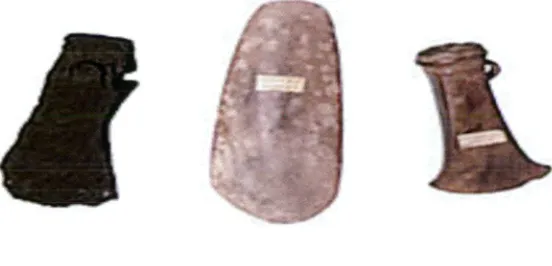
1. Iron Age axe head, Stone Age axe head, Bronze Age axe head, British Museum. Source: British Museum, 2000, Collections On-line
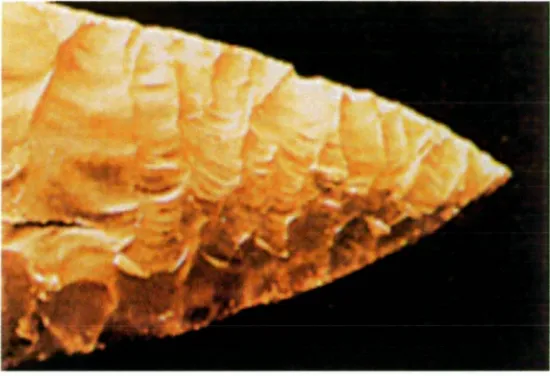
2. Concoidal surface flaking, flint hand tool, approximately 300,000 years old, British Museum. Source: British Museum, Collections On-line, 2000
3. Swan, the spiralled tendril-like residue from a plane
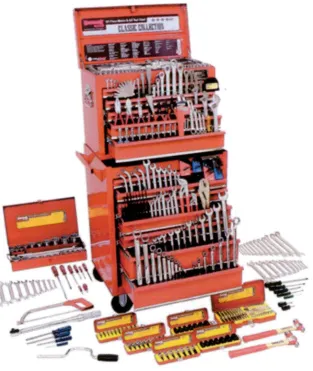
4. Sidchrome 'Classic Collection' tool box. Source: Just Tools, on-line tool catalogue, 2004
5. George Petty, Ridge Tool Company Calendar, 1965, http://www.the pinupfiles.com 6. A typical shed, workshop or studio — with all of the tools hung neatly.
7. Chinese spade money, approximately 5th century BC, Jin state, bronze,
14.2 cm x 6.3 cm, British Museum. Source: British Museum, Collections On-line, 2000
8. Dominic Di Mare, Shaman/Dream/Wands, 1979. Wood, thread, shells, feathers, 46 cm x 36 cm x 10 cm, Daniel and Hilary Goldstein Collection. Source: Craighead Dominic Di Mare, 1998, p.43
9. Tim J. Edwards, Brush, 2003, Huon pine, bronze. 59 cm x 40 cm x 7 cm
10. Tim J. Edwards, Implement 1-6, 2003, Huon pine, silver. 107 cm x 74 cm x 2 cm 11. Martin Puryear, with tools. Source: Esguerra, 'Martin Puryear', 1999
12. David Smith, Sentinel, 1959, stainless steel, 370 cm x 120 cm x 53 cm, Smith Family Collection. Source: Metropolitan Museum of Art, David Smith, 2004 13. Anthony Caro, Sculpture Three 1962, 1962, steel, aluminium, paint,
200 cm x 160 cm x 375 cm. Source: Minneapolis Institute of Arts, Anthony Caro, 2005
14. Anthony Caro, Writing piece, spick, 1978, welded steel, paint, 48 cm x 90 cm x 24 cm. Source: Photograph, Joel Berger, in Hamill, Tools as Art, 1995, p.40
15. Pablo Picasso, Bulls Head (also known as Head of a Bull), 1942, leather and metal (dimensions not known). Source: Picasso Museum De Guernica ala guerre, Bull's Head, 2002
16. Tony Cragg, New Stones, Newton's Tones, 1978, found objects, 366 cm x 244 cm, Arts Council Collection, UK. Source: Nifty, Recent British Sculpture, 1993, p.24 17. Claire Healy and Sean Cordeiro, The Cordial Home Project, 2003, Artspace,
Woolloomooloo, Sydney (dimensions not known). Source: New South Wales Ministry for the Arts, The Cordial Home Project, 2003
18. Richard Long, Red Slate Circle, 1980, 7580 cm. Source: Guggenheim Museum Collection, Richard Long, 2003
19. Richard Long, Hoggar Circle, The Sahara, 1988. 340 cm. Source: Seymour & Fulton, Richard Long, 1991, p.19
20. Tim J. Edwards, Stihl life, 2003, Huon Pine, 200 cm x 32 cm x 2 cm 21. Rummana Hussain, A Space For Healing, 1999, installation comprising
Magdalena Abakanowicz, 2001
23. Arman, School of Fishes, 1982, welded vice grips, 178cm x 90 cm x 8cm. Source: Arman Studio, Arman, 2002; photographer Marc Moreau
24. Richard Serra, Splash, 1968. Lead, 500 cm x 11,500 cm x 495 cm, Castelli Warehouse, New York. Source: Lewis, Art Minimal and Conceptual, 2002
25. Andy Goldsworthy, Breath the Earth, 1994. Source: Goldworthy, Wood, 1996, p.17
26. Richard Serra, 'Splashing', still from Barney, M, 2003 The Order, DVD
27. Bernar Venet, Deux Lignes Indetermines,(Two Indeterminate Lines), 2003, rolled steel, 157 cm x 160 cm x 186 cm, Welle Collection. Source: Art Omni, 2002
28. The visual link between the 'organic line'- grape vine tendrils (left), and the 'industrial line' spiralled residue from the action of a tool: plane (right)
29. Tim J. Edwards, Filament, 2004, welded steel, 98 cm x 145 cm x 90 cm.
30. Clement Meadmore, Curl, 1968, welded and painted cor-ten steel, 400 cm x 740 cm x 330 cm, Columbia University Collection. Source: Gibson, The Sculpture of Clement Meadmore, 1994, p.27
31. Richard Serra, Corner Prop No.7, 1983. 182 cm x 182 cm x 10 cm, Allbright Knox Art Gallery Collection. Source: Schwander, Richard Serra, 1996, p.44
In this exegesis I will put forward the conceptual origins and context of my visual art
project, Implement; drawn, in which the residue from the use of hand tools has
gained its own distinct identity as an object of sculptural form. It is appreciated that
many functional classes of tools exist. However, within this exegesis only edged tools
will be considered. That is, tools that contain one or more of their edges sharpened
for the purpose of deliberately removing material from another object.
This research will focus on the nature and purpose of hand tools in the context of
utilitarian function and also as objects fetishised l by cultures throughout history. The
project will also examine the significance of the residue created from the physical
process of making as both a narrative and an influence in the execution of the
sculptural forms.
In my life, tools and implements hold a significance that transcends mere utilitarian
function. Equally the residue, the by-product or marginalised trace of the tool's action,
also possess significance. This product can be considered a form of wisdom,
possessing contained potential energy.
The rituals of walking, observation and collection began early in life for me. I was
raised on a remote mixed farming property in Victoria. Artefactual relics and the
residue from the processes of past farming endeavors were plentiful.
As a child I kept a series of boxes in which collected residues were stored. These
boxes contained interesting rusted, bent and broken shards of metal from disused
implements and machinery, nomenclature tags, badges, and text from old tractors
and pumps, as well as a seized Winchester rifle. Unusual fragments of wood, stones
and rocks were also collected, chosen for a particular quality of form, texture and
colour. During summer trips to the beach, where the focus was supposed to be on
swimming, instead I walked and collected shells, seedpods, feathers and bones. In
my child's imagination, I was an archaeologist discovering and exploring, collecting,
categorising and storing these artefacts for an imagined special purpose.
Several times a year our family would travel to the city. I looked forward to these excursions because it meant that I could indulge my passion by spending the day in the Melbourne Museum or The National Gallery of Victoria. I spent many hours pondering artefactual curiosities, from the ancient to the contemporary, and from science to art. This context of museum installations, the displaying of objects, the aesthetic and conceptual fragmentation and reduction of culture, art and science into a unified display, is and has been a source of immense contemplation for me and has been extremely influential in the development of my own art practice.
The impetus for this specific research project was born out of a single event in February 1998 when I came across an undiscovered Aboriginal midden' whilst on one of my walking and collecting excursions on the East coast of Tasmania.
Walking along the shoreline, I was drawn into a clear section of bush where four distinct rings of a crusty white substance contrasted against an almost black sandy-loam soil. Investigating closer, I saw that at the centre of one of the white rings there was a series of small flakes of chipped black stone along with one larger stone that was about the size of an adult's palm. The realisation of what this site was became clear. I noted that the larger black stone was a stone hand tool — probably used to crack open shellfish and scrape out the flesh. The white rings of residue were the calcified remains of the smashed shells.
The small flakes of stone were the residues from the making of a stone hand tool and it appeared that up to fifty skilful blows from another tool had created this stone tool. The memory of the action of making this tool (actional technics) was apparent
through the scalloping of the surfaces of the stone. Repeated blows had created one sharpened edge, and the refinement of the form had become shaped as an
ergonomic extension of the human hand.
Upon later reflection, three elements of the site seemed to have special significance. Firstly, the hand tool itself was a symbol of human culture and activity. It could be identified as a utilitarian object, used for processing food for human consumption. Secondly, the stone flakes and chips (the residue) that had fallen from the pre-tool stone, contained significant information about how the tool was made. The stone and
2 A historically and culturally significant site at which shellfish were processed for
shell residues had formed a document of the activities of both the tool making and
the food processing at the site. The size of each stone flake had recorded the brevity
of the impact, the angle of the blow and its point of impact, as the maker with another
pointed tool struck the original stone. The number of flakes indicated how many
blows were needed to create the tool. Thirdly, the flakes also record the geological
properties of the stone and, if analysed, might show the stone's geographical origin.
I surmised that the black stone tool had been collected from elsewhere, as no stone
in the area of the site resembled this material. After experiencing this midden, I was
sufficiently influenced and inspired to create works that made direct reference to tools
and personal memories.
To stumble across an actual lithic site was an extremely significant moment for me.
The ramifications of that find and the shift in my perceptions were not initially
realised. The midden site itself was a snapshot of Aboriginal life and culture. It was
as though the original humans had just left. The site could easily have been missed
or overlooked if not for my curiosity. It looked as if environmental artists Richard Long
or Andy Goldsworthy had created one of their earthworks, as the visual quality of the
contrasting colours and shapes seemed like it was created with artistic intent.
The relationship between humanity and their tools is one of symbiosis and the
significance of the tool from pre-humans to the twenty-first century is an inseparable
part of human culture. Tools are the means by which humans have constructed the
material and cultural worlds from the natural world. 3
The Collins English Dictionary defines a tool or implement as 'anything used as a
means of performing an operation, or achieving an end, a piece of equipment and a
verb pertaining to being put into action'.
3 Tattersall I, The Fossil Trail: How We Know What We Think We Know About Human
other animals by virtue of the fact that he has elaborated what Edward Hall termed
'extensions of his organism'.8 By developing his extensions, man has been able to
improve or specialise various functions. 'Man has elaborated his extensions to such a
degree that we are apt to forget that his humanness is rooted in his animal nature: 8
The computer is an extension of part of the brain, the telephone extends the voice,
and the wheel extends the legs and feet. 'Language extends experience in time and
space while writing extends language'.7
The anthropologist Western LaBarre has pointed out that man has shifted evolution
from body to his extensions of his body and in doing so has tremendously
accelerated the evolutionary process. It may be suggested that man has elaborated
and specialised his extensions to such a degree that they are 'rapidly replacing
nature'.8 Since the earliest history of man, pre-humans or hominids enhanced their
physicality by making tools to sustain their existence.9
Evidence of the earliest tools show that they were constructed using stone. 'From the
most basic, primitive and perhaps fortuitous moment in prehistory when man first
created and used a hand tool as an extension of himself, it activated a parallel growth
in human culture'.1° The development of man as a maker and user of tools has ut
• evolved into a relationship between man and his cultural dimension in which man and
his environment participate in moulding each other. Lz,!
6
Hall, The Hidden Dimension, p.8
7 —
Hall, The Hidden Dimension, p.17
-<,
8
LaBarre W, The Aymara Indians of the Lake Titicaca Plateau: Memoirs of the American
Anthropological Association, Washington: American Anthropological Association, 1984, pp. 18-34
9
De Bono E, Eureka, An Illustrated History of Invention, From the Wheel to the Computer, New York: Holt, Rinehart and Winston, 1974, pp. 2-3
10
Leakey R, The Origin of Human Kind, New York: Basic Books, 1994, p. 46
Within this exegesis 'man' describes a human being regardless of sex or age; considered as a representative of mankind, human beings collectively, and a member of the race Homo
sapiens, because of the traditional language of archeology, anthropology and tool making.
5
The role of tools and technology in shaping our destiny is so dramatically obvious that it may distort our sense of its relative importance. The characteristics of a culture not only condition the appearance of tools but also their use, and spread." The invention of any tool or technology can only be explained in human terms, although this should not imply that technology is a neutral consequence of human activity:12
When we speak of the challenges of a given environment or the needs of a given society, we must be aware of thinking in terms of purely objective, exogenous factors." The challenge counts insofar as to how it is perceived by man. Technology deeply affects the material culture of a society, the size and composition of its
population, the nature of its labour force and the physical environment.
Both technology and invention arise from historical circumstances.14 When we try to explain why a given technological development occurred at a certain place and a certain time it is easy to subscribe to facile determinism. With hindsight many a development may look simply like the natural, almost inevitable product of a specific need. We are frequently told that a given society developed any number of inventions because of perceived need. The type of response to any given need or necessity is largely dependent upon the prevailing culture. Various societies will as a result respond to differing environmental factors in a multitude of ways.
The same might be said of art where the artist may respond to the need and
necessity of his/her environment with imagination and endeavour. Don lhde begins his own enquiry into Technology and the Life World with the broad notion of
technologies as the objects of the material culture that we use in various ways within our environment. I suggest that as a result of man's production and use of tools, material culture is born. Out of material culture, art has been born. It is not my suggestion, however, that art has solely been a consequence of tools and
technology. Ihde suggests that if we were to imagine the New Garden' as a place without technologies. As a consequence humans might well develop their oral and physical expression into song, poetry and dance in both aesthetic and religious senses.15
11 Leakey The Origin of Human Kind, p. 47 12 Hall The Hidden Dimension, p. 10
13 Cipolla C M & Birdsall D, The Technology of Man, New York:
1980, pp. 30-32 14
Cipolla & Birdsall, The Technology of Man, p. 34
15 lhde D, Technology and the Lifeworld: From Garden to Earth,
Holt, Rinehart and Winston,
lhde imagines that within the 'New Garden', none of these activities could involve 'artefacts in actional technics'.16 lhde uses the term 'technics' to suggest the human action of employing artefacts to attain some result within the environment. In my own work I am concerned with results that do involve artefacts as a result of actional technics.
The tool (artefact) itself is an activator and residue of material culture. The Collins English Dictionary describes residue as 'the matter remaining after something has been removed, from the Latin residuus, remaining over, to stay behind, to reside'.
As a consequence of using the tool, residue is created in the material form of
something that has been removed. This is the (in) significant result or by-product that evidences the making process.
As my research developed, Ihde's idea of result within the environment as a
consequence of the tool (artefact) and indeed the physical residue from the making process has become the focus of my sculptural work.
Tools may be classified as cultural residue. Natural residues may be used to make tools. For example, obsidian is a natural glass formed when hot lava flows on to the surface of the Earth and cools quickly. Obsidian is then the result and the residue from the action (eruption) of a volcano. The residue (obsidian) is both a record of the action of the volcano and a documentation of the unique mineral deposits from each volcanic episode. Obsidian was the material of choice for toolmakers from before the Pleistocene epoch throughout Europe and the Americas.17 It was much prized for its unique edge holding capabilities. As a material it was collected and commodified. Obsidian was prized both as a fetishised material and as a product that enabled the multiple productions of specific tools.
University Press, 1990, p. 26
16
ihde, Technology and the Lifeworld, pp. 27-33
17 •
Diamond J, Guns, Germs and Steel, A Short History of Everybody for the Last 13,000
The process of boat building could be perceived as a metaphor for the discussion of the notion of tools and residues. Regardless of technological advances, boat building remains a skilled craft in a continuum reaching back for approximately 100,000 years.18 To begin construction, the boat-builder may select a tree or timber for its specific qualities and begins to use a multitude of tools to shape, mould and
construct the desired boat form. If we were to consider this process in terms of the tool and the residue, we would observe that by using a saw to fell the tree the elements are: saw (the tool); wood chips from the action of the teeth of the saw against the timber (the residue); the felled tree which is re-cut, profiled and joined to become the desired vessel (the tool and the residue). The boat itself could be perceived as a functional tool and from a more abstract position, a form of residue from the application of tools. Hypothetically, if the vessel was left behind as residue or simply sank, archaeologists could find this vessel at a future time and use it as a means of understanding a culture and evaluating the prevailing society at a specific time and place.
The tool becomes the residue of material culture and the fragmented remnants left behind are a vestige or traces from the process of interaction between tool and material. Specifically the wood chips or residues from the making process of our vessel contain the memory and information of the hand tool's action. Through the application of different tools, various physically formed residues are created. Sawing and carving creates flakes and chips and planning or shaving produces a curled spiral of residue. Specifically, this curled spiral is known as swarf, and is also the name given to material removed by various tools in the machining of metal, wood and plastics. This residue contains information of the making process and is more often than not swept up and discarded.
Anthropologists endeavour to determine our ideas about human culture by studying and analysing tools and residue and tools as residue. Within the bounds of my own practice, I liken my role as an artist to that of the anthropologist in that I observe culture and analyse the material or artefactual evidence of our culture to make a realisation in visual form.
A significant part of my art practice is walking and collecting. Collecting natural and man-made objects (residues or the traces of what it once was) has formed a large
18
part of my practice over time. The selection of an appropriate object is both a
conscious and an unconscious process. Usually, these found objects are categorised
when I make assumptions about the origin, history and context of what it is and
where it was found.
These objects may themselves initiate new ideas and provide information about how
sculptural form may be resolved. For example, a weathered stone might present an
aesthetic or tactile quality that may find usefulness as the impetus for future
application.
To this day my penchant for walking, discovering and collecting is a key factor in the
creation of many of my art works. This process manifests itself physically in my works
Quiver, 2001 and About Three Hundred Miles, 2002. These sculptures are constructed entirely out of objects (bones, feathers, stones, found objects and
thread) collected whilst walking the Tasmanian coast.
These two works conceptualise residual memory. They embody, fragmentary
memories of disused hand tools or implements of curious origin and utilitarian
function from my childhood on the farm, and also my memories of the museum
artefact-the tool or implement from a distant culture and time.
The memory of the act of walking and collecting residue becomes a documentation
of the journey taken as part of the process of making new work. In this way, memory
itself can also be perceived as a form of residue, a kind of personal fragmentary trace
of an event or time. Memory and personal perception also play an integral role within
the context of my work.
The creation of a tool as artefact remains a strong influence, although as this
research developed, it occurred to me that the surface finishes that I was seeking for
my implements were becoming more about the processes of making. I reflected at
great length upon the curled residues that recorded my own making processes. Piles
of swarf- the residue, recorded a morning spent carefully shaving a piece of wood,
each curl recording the action of my hand in companion with a hand tool.
Unconsciously and inadvertently I had created material sketches for new forms that
Chapter 1
Hand Tools
The evolution of human material culture is categorised by the material from which the tools of a given culture are constructed. Known as the Three Age System. the Stone Age. the Bronze Age and the Iron Age represent the main paradigm shifts in
[image:17.564.140.416.343.476.2]technology. (Fig.1) It locates an artefact of material culture at a specific place in time. However within remote regions of Australia, the Pacific, Africa and South America certain cultures today continue to utilise stone as the chief tool-making material and therefore may be said to continue existing in the Stone Age.
Figure 1 Axe heads Iron Age. Stone Age. Bronze Age
This chapter explores the significance of the hand tool as a technological extension of humans. It traces the earliest developments and the later growing sophistication of tool technology and its related processes. The main focus is on the evolution of edged hand tool manufacturing. However, it is also the inevitable production of residue. the byproduct of a tool's implementation that is significant to this project.
The removal of material from a work piece is the common denominator and primary function of edged tools from the first humble stone tool to the latest computer guided robotic lathe. This removal of material is achieved through a form of cutting. The presence of a cutting edge is therefore the main and essential characteristic of tools and implements.19 The principle concern of all toolmakers is the pursuit, development and maintenance of a superior cutting edge.2°
The earliest known species of the genus Homo evolved the ability to create
sharpened edged tools and is therefore named Homo habilis — 'handy man'. 'The tool manufacturing process involves the use of memory, prior planning and abstract problem solving; this marks the beginning of culture and environmental adaptation — a uniquely human ability'.21
Tools made from stone that were shaped by basic chipping or flaking have been dated as far back as 2.6 million years.22 Initially the earliest humans were casual tool users, using a convenient stick or stone to meet an immediate need only to then discard the tool. This 'casual' tool use is not solely a human activity as other primates and mammals are known to use sticks to withdraw insects from their mounds or to use stones to crack open seedpods and fruits. Humans however are the only species to use one set of tools to manufacture other tools.
To rise above mere subsistence the earliest humans came to depend on the sharp edge of a tool to cut through the skin of an animal to access the meat. These first intentionally formed stone hand tools represent humans' first technological break through. Conceptually the tool making process had arrived at a point where the maker imagined a desired tool existing within a given piece of stone. The maker's task was to 'uncover' the form from within the stone.
Stone as a tool making material covers a wide variety of types, ranging from the dense and grain-less flint and obsidian, to coarse-grained granite and quartzite. Each type of stone possesses unique properties but all are difficult to manipulate. Flint is a form of silica and is distributed throughout most parts of the world. It is
19 Goodman W L, The History of Woodworking Tools, London: Bell and Hyman Ltd, 1964,
Fid Goodman, 8 The History of Woodworking Tools, p.10 21 •
lk •
isotropic, having equal grain flow in all directions. Its hardness is greater than most steels. When flakes are removed by striking it displays the shell like conchoidal fracture of a brittle glass like material with a sharp edge. (Fig. 2)
[image:19.564.137.412.179.367.2]Other stone materials such as obsidian were also used to make tools. However most edged tools were sculpted using flint.
Figure 2: Concoidal surface flaking, flint hand tool, approximately 300,000 years old.
The earliest stone tools were also the largest They were manufactured from a fist-sized stone (core) with another similar stone (hammer stone) by tapping off flakes on one side to produce a jagged sharp crest. This was a general-purpose implement that would have been used for pounding, hacking and cutting. By a process of development and by acknowledging the efficiency of a more refined blade, thinner, sharper and more versatile core tools were developed.
The traditions of stone tool manufacturing display an evolution and the developments of the technology, leading from one form to another in a seamless transition.
Innovations were made possible through the logic of improvements to the tool's sharpened edge, by developing a new tool based on the old tool for a new specific purpose.
A study of the implements of successive tool making industries displayed the great efforts undertaken to pursue cutting edges in a longitudinal direction. Knifelike
instruments predominate, and thus define the nature of the fundamental need, that of
a cutting tool, which could slit, sever and scrape. 23 The ensuing development of a hunting economy provided food and also made available vast quantities of bone, antler and hide for tools, clothing and housing. 24
The most advanced stone tool making cultural periods begin with the Neolithic Period and coincide with other significant contemporary events. The melting and retreat of the last glaciers, affected the development of a sedentary culture, the invention and development of cropped food production and the domestication of animals. During this time the development and elaboration of stone technology into specialized tools had also brought in the extensive use of materials such as wood, horn and bone. These new materials could not have been manipulated without the aid of specific hand tools, such as serrated blades and gravers or burins — small scrapers with either pointed or narrow chisel like ends. As new technologies grew they exploited the unique properties of these materials which made possible a technological diversification whose specialization and complexity fitted them to fresh tasks. For example bone was a particularly useful material. Its toughness made possible barbed fish hooks, eyed needles and small leather working awls.
As new technologies grew, exploiting the unique properties of these new materials it made possible a technological diversification whose specialisation and complexity fitted them to fresh tasks. For example bone was a particularly useful material, its toughness made feasible barbed fishhooks, eyed needles, and small leather working awls.
The later Neolithic Period also defines that period when ground and polished stone tools incorporated the fitting of a wooden handle to increase their leverage (halfting). The notable developments during this period were simple wood working tools such as chisels, axes and adzes. These made possible precise and intricate designs in timber. The home, cradle and coffin, furniture and utensils were all products of these polished stone tools.
23 Grey M, Man the Tool Maker, London: Priority Press, 1973, pp. 8-9
The use of wood began its broad and successful role in human life during the
Neolithic Period due to the use of ground and polished stone tools. The Neolithic tool kit turned wood into a universal building materia1. 25 Many new possibilities were realised, such as dugout canoes and framing for hide covered vessels. The development of maritime culture — sledges and skis — opened access for further habitation. Substantial habitations were made possible due to the evolution of sophisticated framing techniques, using the polished and halfted stone tools the adze, axe and chisels. This new adaptation (halfting a handle) together with the polishing and refinement of stone tools encapsulates the pinnacle of innovation in the development of the stone tool's edge.
An examination of the evolution and development of stone tool technology gives insight into the growing conceptual sophistication of humankind. Tools, which evolved from the earliest purely functional, roughly formed 'core' stone forms represent a basic utilitarianism where the tool's form and function are inextricably linked. The later 'blade' and 'flake' tools represent a further evolution with the refinement of the tools edge leading to a finer and therefore sharper tool. These blade and flake tools also depict the beginnings of ergonomic and aesthetically considered tools in which the actual appearance of the tool becomes an important consideration.
This pinnacle of stone tool technology, the 'polished' technique, also marks a significant point in the manufacture of non-functional fetishised tool forms. These tools were manufactured for ceremonial, ritualised or aesthetic concerns where the form is the primary objective and the function is not a significant consideration.
The Neolithic or late Stone Age ended with the discovery of metallurgy. The significant point in the paradigm of the Stone Age was the discovery and
acknowledgement that particular stones did not respond to the traditional flaking methods. Instead these stones were soft and remained intact when struck. These stones were composed of naturally occurring copper, which when heated in a very hot fire changed to a liquid state. This discovery led to the production of the first significant metal suitable for tool manufacture. Copper was the first metal to be smelted. At a later, undetermined time, a new alloy was created, by the smelting together of two separate ores, one bearing copper the other tin. The new alloy
25
(bronze) was a far superior material for tool making due to its ability to hold a sharp edge.
The Iron Age began with the first evidence of man-made iron 4.5 thousand years ago in the Middle East. A millennium later the abundance of this ore led to the
displacement of copper and bronze as the chief tool making materials by the Hittite Empire. In the Early Western Iron Age, when the metal was in scarce supply, local armament makers were the primary consumers of this new metal. Later iron tools were developed for clearing forests and for cultivation.
With the advent of the Iron Age came the development of numerous technologies, such as foundry practices. These allowed the exploration of the manipulation of metal. Thus the first approximations to the modern forms of the craftsman's basic tools were established. The main thrust of further tool development was directed at improving the cutting edges of the tool, as well as the methods of attaching 'the edge' to new iron hand tools.
In my sculptural practice the steel hand tools and implements that I use, such as drawknives, spoke shavers, planes, awls and palm carvers, all had their genesis in these early Stone Age and the later iron tools. Chisels and palm carvers are therefore direct descendants of the Paleolithic stone hand tools. The earliest
evidence of the process of chiseling appeared approximately 10 thousand years ago and was created by rectangular chisel shaped flints. The later copper chisels and the slightly more recent bronze chisels were used not only on wood but also soft stone. The Egyptians used chisels and club-like mallets to create monuments and
sculptures of limestone and sandstone. In later centuries, with the development of iron working technologies, chisels and gouges were made in great variety.
Over the following two millennia, the increasing demand for more decoration and luxury in both religious and secular trappings and furniture required the development of new tools. The crude and heavy tools of the early carpenter were refined into more delicate models suited to woodcarvers and joiners who created wall paneling and made stairs, doors and cabinets. 26 In the 18th century a cabinetmakers and woodcarvers kit may have contained 170 or more chisels and gouges.27
26
The drawknife was one of the first wood shaping tools made from iron. It is a two-handled blade that is pulled toward the operator and is the earlier relative to the plane and spoke shave. The drawknife's handles are bent at right angles to the blade's plane. A skilled hand is required to regulate the depth of the cut as a slight change in angle can cause the blade to dig out an incorrect amount of material.
The drawknife has undergone little change since the Viking craftsman, when it was used to level off axed and adzed timbers for boat and housing construction in medieval Scandinavia and Russia. 28 Further development of the tool's edge was centred on methods of fixing the blade to ensure a consistent amount of material was removed with each draw of the too1. 29
When confronted with a particular or unique task, a skilled craftsman develops a special tool to cope with the situation. In the seventeenth century, for example, the taste and fashion in wood carving and joinery for highly ornate woodwork led to a proliferation of creative wood planes made for specific purposes by individual craftsman. 30
The first known users of the plane were the Romans, and the earliest examples come from Pompeii. The Roman scholar Pliny the Elder ascribes its invention to Daedalus, the mythical Greek representative of all handiwork. 31 Excavations of the Ancient Roman settlements in Great Britain and Germany have yielded eleven planes of differing sizes. 32 By the late seventeenth century the plane and its earlier relative the spoke shave had established a significant place in the craftsman's tool kit. 33
Bench planes were used for surfacing and leveling timbers on panels and for creating straight edges on boards so that two or more boards could be joined to form a wide panel. By the early nineteenth century the wood worker possessed numerous planes and specialised tools in their tool kits to shape and form the necessary mouldings and joints used in their craft.
27
Goodman, The History of Woodworking Tools, p. 130
28
Nagyszalanczy S, The Art of Fine Tools, Newtown: Taunton Press, 2000, p. 65
29
Goodman, The History of Woodworking Tools, p. 99
30
Goodman, The History of Woodworking Tools, p. 101
31
Pliny the Elder, Natural History xvi, trans & ed. Gregory Cranc, The Perseus Project, http://www.perseus.tufs.edu , March 2004
32
Nagyszalanczy, The Art of Fine Tools, p. 108
33
The spoke shave may be likened to a short-bodied plane but is constructed in the same manner as the draw knife. The spoke shave has a handle either side of the blade, allowing the tool to be pulled toward the operator but with control over the depth and consistency of cut or shaving.
Although the word spoke shave is recorded as early as 1410, artefactual evidence shows its first appearance approximately 400 years ago. 34 As its name suggests it was originally a specialised tool of a wheelwright and later it was used for various other purposes by craftsmen in many different trades (for example, cabinet making, carpentry). The spoke shave is an example of a tool having been generalised rather than specialised. 35
The unchanging technique of the hand's action in companion with the hand tool throughout history demonstrates an on-going connection between hand and tool. The technology of the tools edge is historically constant. The variables have been the materials of which the tool is made.
A further constant is the ever-present residue, left over from the production of the object. There are two forms of residue produced from the action of tools. Chips, flakes or shards are produced by cutting edges that are hafted or attached to a lever, such as a chisel, adze and axe. The other form of residue is the spiraled form: these shavings are familiar on the floors of any woodworking shop and are sometimes referred to as swarf. These shavings are created by tools with a cutting edge that provide a constant depth of cut and an elongated draw of the tool, such as a spoke shave or plane. Other hand tools such as the drawknife also produce a spiraled residue, when drawn across timber.
35
Goodman, The History of Woodworking Tools, p. 173
34
Figure 3: Swarf, the spiraled tendril-like residue from a plane.
Pliny the Elder noticed this curling effect of tool residue. Pliny describes the resulting residue from the hand tools action and the tools action itself, in a volume of his writings, on natural history: 'The shavings of this wood, when briskly planed, curl up like the tendrils of vine'. 36 As the spiraled form of hand tool residue, swarf is
significant to me and pertinent to this enquiry. (Fig.3)
Hand tools are extremely important to me. They are not only the 'means' or the tools in the most basic utilitarian sense but they also possess significance for me in my own art practice. Through many museum excursions and by viewing exhibitions of relics and artefacts I developed a keen interest in history. The inspiration I gained from these exhibitions was not only from the visual quality of the artefact or the objects themselves, but it was also from the technological methodology that the earlier humans used to create them. This notion of 'what has gone on before', indeed the inspiration of primitive technology has developed into a self imposed ethos of methodology and a construction technique that I use to make sculpture. This approach is centred around working with traditional hand tools on natural materials.
These manual techniques are inherently more time consuming than machining with power tools, yet through the slow and repetitive carving and forming process, small improvements evolve within the piece. Furthermore the process also communicates information and possibilities for the next sculpture. Each new sculpture has been an evolutionary result from a previous sculpture as one form leads to the other. I find the
connections between how our collective contemporary tools have evolved from the
first humble stone tool, similar in form to the stone tool discovered in the midden site
Chapter 2
The Hand Tool as Fetish Object
The term fetish or fetishism (the belief in a fetish) is defined in the Collins English Dictionary as:
1.'Something; an inanimate object that is believed to be the embodiment or habitation of a spirit or magical power. 2. Any object or activity, to which one is excessively devoted. From the Latin facticius, made by art and the Portuguese
feitico, sorcery'.
Within this exegesis fetishism is a term that is used to describe a certain satisfaction that arises from the look and the handling and use of hand tools and also the
pleasure of creating a form that generally, is appropriate to their application.
At different points in our lives we may become attached to objects. This attraction could possibly be through a belief in a hierarchy of an ideal or through the sentiment initiated by a tactile or aesthetic response. These complexions could perceivably be projected onto any object; in my case it has been hand tools. Two tools in particular were the subject of this attachment and fascination. When I was young my father gave me a toolbox of my own, in the manner of a kind of 'right of passage' gesture and now these tools act as mnomic objects. Within the tool box one screwdriver in particular shows the wear and tear markings from his use of the tool. After my father died, these tools are my only physical connection to him. To me the sight and the use of this tool triggers a very precise memory, in that I can remember every detail of certain events, including smells and sounds, much like replaying a home movie.
These hand tools discussed represent an opposite ideology, in the first instance, my fathers' screwdriver is perceived by me to project some kind of essence of a
memory. In the second instance my grandfather's hammer is instead, imbued with the memory of the tools action, and is significant due to the unquantifiable
satisfaction of being put into use. These hand tools are the connection to my own history and relationships to these significant men in my life.
Tools and implements are so intrinsic and ever-present to human collective lives and existence that they have become incidental and perhaps transparent. The notion of a tool as a functioning extension of the hands is an accepted concept. At the same time, a contemporary interpretation of 'tool' is far removed from the traditional concept and the reality of its physical use.
The computer is a tool that extends the hand and the mind. Computers are operated by means of engaging icons to facilitate functions. These icons, also known as tools, and are located on the 'tool bar; use the concept and image of hand tools as a metaphoric signal of the manual tool's operation. The spanner, hammer, and
Tools have also found a place in our language and add colorful metaphors in colloquial dialogue such as: 'an axe to grind', `to have an edge,' to call a spade a spade,' (s/he) is not the sharpest tool in the shed', and `(s/he) is a chip off the old block'. 'To bury the hatchet' provides a metaphor pertaining to a resolution between disputing parties, whereby the act of embedding an implement in the ground is an act of mediation- agreeing to disagree. The original concept of the 'burying the hatchet' came from the Indigenous American culture. The Native Americans possessed implements known as calumets, peace pipes or tomahawks these are highly fetishised and crafted sacred tobacco smoking devices that also have a hatchet blade attached opposite the pipe bowl. The calumet encapsulates war and peace in one ritualised tool and every aspect of their construction and use was and is
considered and symbolic. To refuse to smoke from the peace pipe when invited was considered an extreme insult, and a declaration of war. So to paraphrase thousands of years of ritual and history, you can either smoke for peace or bury the hatchet and make warn This is the opposite meaning to our contemporary use of the term.
In many cultures throughout history certain rituals and beliefs are associated with tools. For example, a tradition of Japanese carpentry from approximately 1700 years ago developed concurrently within a family guild system. The carpenter was the architect, the engineer and joiner. The family of carpenters with its authority and with absolute protection guarded the secrets and specialised techniques of their guild. The guild specialised in specific forms of construction such as those for shrines, temples and domestic constructions.
The two significant features of Japanese carpentry pertinent to this enquiry are the ritualised methods of joinery and the perception of the tools used. Each carpenter's guild developed its own unique method of cutting and slotting timbers together. Their techniques transcend into an almost religious, precisely ritualised process of
placement, measurement and execution. These joints of which approximately four hundred types are still in use today, are not only designed and executed for their utilitarian function but are carefully designed as an aesthetic composition.
Japanese carpenters use a very special, respectful term for their tools, which are not referred to as mere 'tools' instead are instruments named dogu, which has no direct translation in any language, but roughly translated means 'instruments of the way'.
37 •
Due to the special pride associated with being an accomplished professional, ceremonies about the ritual 'of the way' take place as a part of earning the right to use the instruments. 38
Tools are also physical metaphors in our society in ways that signal religious and state or empirical significance in ceremony or ritual. This is witnessed in the 'ribbon-cutting' by a politician signifying an official opening or the 'turning of the first sod' officialising the commencement of work on a civic project. Often the tools used in these ceremonies are especially embellished but fundamentally mimic the production versions. For example a spade for the dignitary to turn the first sod is frequently stylistically crafted with highly polished blades and carved wooden handles.
In the Queen Victoria Museum and Art Gallery, Launceston, there is an apt fetishised version of such an implement. When the Duke of Edinburgh arrived in Launceston on the 15th of January 1868 to turn the first sod of the future site of the Launceston Western Railway, he used a carved wooden spade and an elaborately carved wheelbarrow. The barrow, made from Huon pine and Blackwood was adorned with detailed hooves as handles, legs as Phoenix heads, and the Royal Coat of Arms on the inside face, and is thus being rich in symbology.
These two examples of 'tool fetishism' are conceptually in opposition, yet the vehicle of the ritual, 'the tool', is the common and significant feature. To the Japanese craftsman the object or tool is of primary significance and the meaning is secondary. To the dignitary the meaning is primary, and the object or tool is secondary to the act. This concept of a tool functioning as a utilitarian device, and also having attached specific meanings, beliefs or rituals can be perceived as a fetish object or tool fetishism.
Further evidence of tool fetishism, from a modern consumer's perspective is the way in which hardware manufacturers actively set out to seduce the (generally male) purchaser, by displaying tools in visually, delightful repetitious patterns, or on shadow boards. There is an unstated imperative that to do a job properly, purchase of a complete set will ultimately be necessary. Consumerism and fetishism uniting! (Fig.4)
1992, p.72
Figure 4: Sidchrome 'Classic Collection' tool box
In their advertising, tool companies also have a tradition of overlaying utilitarian function with a suggestion of sexuality. Semi-naked women holding tools have appeared as a metaphor of perceived power and desire to the male consumer since the 1950s. (Fig.5) Paradoxically, more recently the purchase and use of tools can be seen as a form of empowerment for the female consumer as wel1. 39
39
Figure 5. Ridge Tool Company Calendar. 1956
Utilitarianism has given way to high polished lustre, even chromium plating, to emphasise tactility and aesthetics to further woo the would-be user into tool purchase. So specialised have tools become that whole catalogues are devoted to tools based on narrow fields of application.
Television and press advertising exhort self-perceived do-it-yourself tradesmen to purchase a complete range of electric or power tools. The implication being that to own a large range of such tools is the only significant means to actually create something of quality, glossing over the talents and technical skills that are required.
A further example of the notion of 'tools maketh the skill' is displayed in the prolific lifestyle or reality TV shows, for example Scott Cam from Better Homes and Gardens. 4° These programs often show a short segment of a skilled craftsman creating something; by 'simply' using tool 'A' on material 'X', here' is the finished object ready to paint, with no account for the role of trade skills and experience.
Artists and craftsmen are often depicted in their studios. They are shown toiling away at their latest projects with a backdrop of specific tools hung neatly in patterns on the wall. These are in readiness and awaiting use, in a manner that I term tool fetishism.
It is a tradition (shown in various hieroglyphs) that goes back to biblical times,
perhaps even earlier. The craftsman is depicted working with his tools, more tools waiting in the background, carefully mounted on boards. It is all preparatory to the actual point of tool use. This is where the magic happens and the tools are
[image:33.562.83.463.161.325.2]implements that facilitate this magic. (Fig.6)
Figure 6: A typical shed, workshop or studio — with all of the tools hung neatly.
In conversations about tools, discussing as to what makes one tool better than another, one generally ends up trying to consider a subjective X factor. This is part magic, part visual, part tactile, the weight, the fit in the hand and even more abstract, the quality of satisfaction gained through the tool's application. This indefinable 'X factor' can also be considered a fetishism of tools or a tool fetish.
The concept of tool fetish culture is of ancient origin. It dates back approximately one hundred thousand years when the concept of spirits, the afterlife and belief in a non-corporeal existence brought forward rituals centred on burials. The Neanderthals are attributed as being the first culture to bury the dead in this manner. This behaviour suggests a special concern for the departed. They began to bury tools with the deceased, perhaps as a means of preparation for the afterlife.'"
The tradition of fetish belief is continued in most cultures. Fetishism of tool
construction, that is, tools embellished to become utilitarian metaphors began at a similar time. For example, carefully carved morphemic figures were abstracted to conform to the shape of the tool. Carved bone and antler atlatls or spear throwers depict the prey hunted by early humans. This was to perhaps gain something of the spirit of the beast?
Throughout history tools became emblematic of one another. In northeastern China, during the fourth and third centuries BC, the Eastern Zhou Dynasty Chinese created knife money. This rounded edge money was up to 190 mm long and was inspired by the earlier nomadic hunters and fishermen's knives. The inscriptions indicate that they were issued in commemoration of important events. Other markings signify words such as 'fish' or 'sheep' and 'legal currency Qi'. From approximately the fifth century BC, the Zhou Dynasty Chinese further created a currency based on the tool. (Fig.7)
Figure 7: Chinese spade money, c. 5th century BC, Jin state, bronze
Described as hollow-handled scale models of spades, they were up to 150 mm long, detailed in every aspect of the utilitarian version, with inscriptions describing the origin and weight or value. The alloy composition of cast spade money and knife money differs from that of the utilitarian tools, evidencing their differing significance to utilitarianism. 42
Approximately nineteen hundred years ago the Roman philosopher Plotinus enquired into the concept of fetishism asking, 'What is it that attracts the eyes of those who behold a beautiful object, and calls them, lures them towards it, and fills them with joy at the sight?'43
Fetishism has paradoxical meanings. According to Anthony Shelton, in early theories of religion in psychiatry, and in the work of Freud and Lacan, fetishism came to be associated with deficiency, loss and disavowal (the simultaneous belief in the truth and falsity of something). For others, including Marx, Bataille and Baudrillard, it signifies excess." Fetishism informs discussions about power or the projection of power or authority onto supposedly subordinate groups including ethnic minorities. Shelton sees that fetishism is an essential part therefore, of the West's hidden history of sex, mind and commodity. 45
Throughout these philosophers' and writers' discussions there is an assumption that fetishism is an expression that gives rise to deviance, discomfort or displeasure. Yet exactly the opposite can be argued. Derek Clifford in his book, Art and
Understanding: Towards a Humanist Aesthetic, interestingly refers to a tool as a means to discuss a notion of fetishism.
A tool produced by an exaggerated gesture may be deficient in utility, but each time its creator sees it he feels anew the pleasure, which the gesture gave him; and others, unequal to his skill, on beholding it, feel within themselves his vitality and disciplined contro1.46
Clifford further queries, 'Is the step far from the tool that pleases because it works well to the tool that pleases although it will not work at all?' 47 In other words, a tool need not necessarily reflect its intended utilitarian function or purpose to give a certain positive satisfaction.
Another perspective on tool fetishism is the use of a tool that over time has become transformed from its original practical use into a metaphor with no purpose other than as a ritualistic tool for an imagined purpose. Yet it remains a tool with visual links to
43
Plotinus, 1,6,1, The Six Enneads, trans. MacKenna, S. and Page, B S, viewed 16/7/2004, http://www.sacred-texts.com/cla/plotenn, London, 2003
44 Shelton A, ed. Fetishism — Visualising Power and Desire, London: The South Bank Centre & Lund Humphries Publishers, 1995, p.16
45
Shelton Fetishism, p. 18
46
(oi
. 6.s6y) .uo!l!puoo uewnq eqjo sloadse opoqdelaw lualamp ssnosp ;eql slog} leuopunisAp ee Aaql •pueq eq u! j , O apew ee Aain leql pueq eq o aouesse aql aouaialai Ile (£00Z Llloq) 9-1, :spieweidwipue tisnie svom Aw `s,aien !a aNn .vom Aw jo uo!jelsapuew 6u!wnlai e s! ims pue uaaq seq lool aql aogoexl lainidinos Aw o Apoq Ja6Jei eq o pcaluoo aqi u!ql!AA
sJaineal 'snags 'peann `poom
`6L6 'spuemitveakyuewetis 'awn !a omwoa :g ain6u
(2.6!j) -qs!lal JO uoReo!idde peAsqe ue JO asodind leopAqdelaw e Jol ale leql spafqo meg pueq o Klaouoo aq qpoi 6u!6upq ,spuem weal!), se sluawaldw! s!q o4 siajai aien !,0 eJn4InO anewluep! inq Je!!!wei e o swana pue sienip jo sapowaw joj kenlo!lai e `sao!nap opowauw
loe svom snoinogew pruisuoo o4 paAoldwa senlopqoal pue slepaiew s,aien !a
.aJrndinos s!Li Jai ampedap o Twod e se pue pod 901/9.1819J leopols!q ue se qloq
pm eq O uo!lou eq aouaielai swaweldw! s!H •SJ91.14e81 pue buu4s 'sauoq 'poom pameo 6u!sn `spefqo am-10°4 aleopp salewo wen !a oppoo iswe ueopawv
'pen° ss!ms leded eq Aq pasn pJaqieq am-avd ay; si eldwexe uv pueq wawaoeld S831181919J pue lepalew sp q6noni4 qloq `wswepel!!!ln
Figure 9: Tim J. Edwards, Brush, 2003, Huon pine, bronze
Figure 10: Tim J. Edwards, Implement 1-6, 2003, Huon pine, silver
[image:37.562.69.479.340.585.2]1963. He learned valuable techniques and gained a respect for these craftsmen who work without electricity, simply creating with their imagination and hand tools."
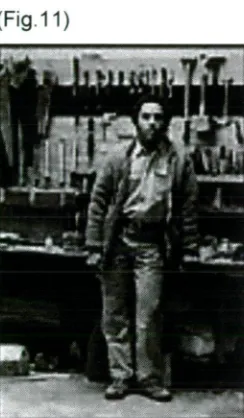
[image:38.562.68.190.234.443.2]Puryear's work was further developed both technically and aesthetically during his time spent living in Stockholm and working with Swiss designers and carpenters. One repeated iconic image of Martin Puryear is depicted in several journals, web pages, books and catalogues. He is shown standing at his bench, with a background of carefully placed and ordered hand tools, reinforcing an obvious passion for hand tools and the 'old school' techniques Puryear applies in creating his sculptures. (Fig 11)
Figure 11: Martin Puryear, with tools.
There is a sensibility and tactility of tools. This notion I have had with me from an early age. My father, who owned many tools for every application, often said, 'There is a tool for every job; always use the right tool and clean it and put it back on the shadow-board', and 'Only I can sharpen the tools'. These tools were housed in a shed that contained any manner of objects without any order, but in contrast, his tools were always shiny and hanging on the wall in precise placement, on the black outlines of the shadow-board. A tool that was not replaced called for an explanation.
This order is not unique to my father. Mechanics of cars or motorcycles, and even builders and tradesmen who rely on tools for their income have the same ideas about this virtual hygiene, and passion for the use and handling of their tools. Their
toolboxes are ordered in the extreme with every tool in its correct position and cleaned to a luster. Such is the nature of tool fetishism.
The concept of a tactile fetish object was introduced to me at Catholic secondary college. During one woodwork class I was visited by a nun who asked me to carve several crucifixes. These were to be given to terminally ill patients. The crosses were used as hand-held objects that were not only imbued with a sense of religious belief, but also as a tactile object that gave a therapeutic solace through the sense of touch. Each cross was unique in its form, carved from wood, with only a vague memory of a true cross. All of the surfaces were smoothed out and rounded, giving an amorphic appearance. During the shaping and carving process I directed attention to the 'feel' of each object, conforming it to the hand, so these fetishes may be a sympathetic object to clasp.
In my art making, the tool is not only the means of construction and the physical connection between the hand and the form but it also possesses a certain fetish significance. Over time and after gaining feedback through the process of making, I gained knowledge about technique and the action of each tool.
When put into use, my tools epitomise a sense of tradition of using the hand in
conjunction with a tool to produce a form. Each tool is a quintessential vestige of form following its function, which also aligns it with a continual history of development from the initial primitive stone tool. Each tool requires a disciplined approach to its care. There is something of a ritual in their maintenance, their sharpening, oiling and storage. A craftsman will always keep a keen edge on his tools, knowing that the return will be the satisfaction that comes from making quick, clean and relatively effortless cuts.
Pablo Picasso once told French author and statesman Andre Malraux 'If we give [the
process] spirits a form [the artefact], we can become independent'. 49 It can be said that to Picasso, art acts as a fetish or tool to fend off evil spirits. I believe the controlling of the demon is in the making process, not the artefact. By making a finished form, one is giving an expression to the Devil, but unlike Picasso, I feel that the process of making is a method of expunging. I believe that the labour and the mental processes during creation are where we meet the demon and seek our independence.
Once the work is complete we are independent from it, yet for me there is
immediately an imperative to get back to the trenches with the devil. The correlation between the repetitious and therapeutic act of carving and constructing, using tools and the realisation of a vision of a form, is my fetish. The parallel consequences of creating forms inevitably produces residue, the trace of hand tool fetishism.
49
Chapter 3
The Form of Residue
Residue is the stuff left behind, the 'insignificant' vestige or trace of an interaction or action and an implementation. According to the Collins English Dictionary residue 'is the matter remaining after something has been removed'. This chapter is an
investigation into notions and possibilities of different forms of residue.
The project, Implement; drawn, specifically focuses on the leftover residue from the process of manufacturing and using hand tools. The process of using tools for manufacturing, domestic activities and artistic creation aims to make a 'significant object'. These practices always create an unwanted 'leftover' or residue. In the context of this visual art exploration the residue becomes a significant outcome.
The theorisation of residue within this exegesis, and more specifically hand tool residue, opens broader categories and notions for other forms of residue. Residue holds certain significance throughout my history. The searching, uncovering and collecting of objects that are various forms of leftovers or residue, remains an integral link with my childhood memories and is a valuable vehicle in my process of art
making. These collected residues serve as both the components for assemblages and also as a base material to carve and form. An example of this process is the timber that I use. It is retrieved from the bush after the loggers have been through. These logs in themselves are the unwanted left overs or residue from the practice of clear felling.
when a piece of any dormant implement can be recycled to build up or sustain another implement.
Farming has always been a fickle industry, subject to environmental conditions that can vary both productivity and income. Through this uncertainty, ingenuity is born. Self-reliance develops special skills for remaking, repairing and sustaining tools that are needed. Necessity breeds' invention and often-new tools are created by their construction, new from old residual tools.
Humans are unique in their ability to create residue. Residue can be perceived as the negative outcome of the positives of applying technological skills to all forms of manufacture and production.
Residue, the leftovers or waste, is also a means to establish categories of taste, aesthetic value and the composition of what may constitute beauty. As noted by theorist Thorsten Veblen in his book, The Theory of the Leisure Class;
Although the requirement of conspicuous wastefulness is not commonly present consciously in our cannons of taste, it is none the less present as a customary norm selectively shaping and sustaining our sense of what is beautiful and guiding our discrimination with respect to what may legitimately be approved as beautiful and what may not.50
It might be said that everything can be perceived as residue, or at least in the state of flux of becoming a residue. In opposition to this idea, the significance of residue can be restated in the idea of 'one person's trash is another person's treasure'. People live in different spaces and times, thus what in one time period is of no value, later becomes imbued with a value at a later time.
The formation of a theory of the value of residue can be found within the discipline of cultural studies. Michael Thompson, in his book Rubbish Theory: The Creation and Destruction of Value, states 'rubbish is a zero-degree of value'.51 For Thompson, residue, or what he calls 'rubbish' is central to a theory of the formation of value; and
as such it's either the visible limit point of social value, or it's something that we
50 Veblen T, The Theory of the Leisure Class: An Economic Study of Institutions, New York:
Macmillan, 1892, pp. 129-130
51
actively conspire not to see. It is thus in an asymmetrical relation to the two major categories of value which Thompson calls the transient (this is the normal state of things: a state of decreasing value) and the durable (an exceptional state in which objects have permanent and increasing value).
Consumer goods are in the paradigm case of the former; works of art in the latter. These processes of value shifts are categorized by their abruptness:
The rubbish to durable transition is an all or nothing transfer. An object cannot gradually slide across from one category to the other, as is the case with the transient to rubbish transfer. The transition involves the transfer across two boundaries that separate the worthless from the valuable and that between the covert and the overt. It involves a loss of the ;polluting qualities of rubbish, and at the same time an increase in aesthetic value.52
This oscillation in the structure of value corresponds to Thompson's proposition that value is a process, a movement, a cycle rather than a quality of things or a structure of contemporal relations.
The nature of Western contemporary material culture is that of a throwaway,
disposable tool society. Disposing of or throwing away is not a new phenomenon, as residual material evidence of humanity has existed for at least 4 million years. Marketing strategies in contemporary technological mass-producing cultures have constructed a perceived need, indeed acceptance that we should constantly update, for the faster, the smaller, the cheaper and the disposable. The result is that our tools become our residue. For example in 2001 over 250 million mobile phones were sold in America. The average mobile phone user upgrades their handset every 18
months, and this is accelerating. Although an initiative of handset recycling has begun the majority of these will reside as landfill.53 The generation rate of electronic scrap in Australia is large and accelerating. There are approximately 9 million computers, 5 million printers and 2 million scanners currently in households and businesses across Australia, and all of these will be replaced, most within the next three years.
In terms of manufacturing, residue is the opposite and a by-product of design. It is the expression of the spontaneous and unpredictable. Residue alone is a broad term.