THE UPPER HYBRID ECHO IN PLASMAS
Thesis by
Luc
Olivier Bauer
In Partial Fulfillment of the
Requirements
For the Degree of
Doctor of Philosophy
California Institute
of
Technology
Pasadena
,
California
1968
-ii-ACKNOv~EDGEMENT
The author wishes to express his deep appreciation to Professor Roy W. Gould for his advice, interest and
encouragement throughout this investigation. It is a pleasure to thank Mr. Fred Blum for his major part in a lively and
fruitful collaboration. The author is also indebted to Profes-sor Robert S. Harp and Dr. Fred Hinton for many stimulating
discussions, to Mr. Reiner Stenzel for his help in some phases of desien of the apparatus, and to Mr. James Downward and Mr. Dick Smith for their corrections of the manuscript. The assistance in the preparation and typine of the manuscript by my wife, Sabine, and Mrs. Ruth Stratton is gratefully
ABSTRACT
The two-pulse stimulated radiation of dense
9 3 11 3
(10 /em < ne ~ 10 /em ) nonuniform neon and argon afterglow plasma columns longitudinally immersed in a magnetic field is studied. The magnetic field is very homogeneous over the plasma volume (~B/B ~ .01%). If the S-band microwave pulses' center frequency is such that they
resonantly excite a narrow band of plasma upper hybrid oscillations close to the maximum upper hybrid frequency of the column, strong two -pulse echoes are observed. This new echo process is called the upper hybrid echo. The echo spectrum, echo power and echo width were studied as a function of the pulse peak power
P
,
pulse separation T , relative density(w
/w)
2
,
and relative cycJotron frequency(w
/w)
po c The complex
but systematic variations of the echo properties as a function of the above-mentioned parameters arc found to be in qualitative agreement with those predicted by a theory of Gould and Blum based upon a simple
nonuniform unidimensional cold plasma slab model. The possible effects of electron neutral and electron ion collisions not retained in the theoretical model are discussed.
I.
II.
III.
IV
.
-i
v-TABLE
OF
CONTENTS
INTRODUCTION
11.1
Background of the
Problem
11
.
2 Objectives
of
the Exper
i
men
t
4
THEORY
8
2
.
1
I
n
troduction
8
2
.
2
Indepe
n
dent
P~rticleTheo
r
ies
8
2
.
3
Collective
Effects
Model
:
Echoes from
a
Cold
24
No
n
uniform
Magnetoplasma
2
.
3
.
1 General Case
24
2
.
3
.
2 Special Cases
:
Low Input
Power Echo
l1
4
Description
,
and Large Input Power
Echo Description
or
Saturation
Phenomena
2
.
3
.
3 Echo
Width
60
INSTRUMENTATION AND
EXPERIMENTAL
TECHNIQUES
63
63
74
3
.
1
Instrumentation
3
.
2 Experimental
Techniques
3
.
2
.1
Measurement of the P
l
asma
Characteristics
7
4
3
.
2
.
2 Measurement of
Echo
Characteristics
80
EXPERIMENTAL
RESULTS
4.
1
Introduction
4
.
2 'I'he Upper Hybrid
Echo
11
.
2
.
1
Echo
Spectra
4.
2
.
2
Echo
PovrerLaw
l,.
2
.
3 Echo \olidth
83
83
84
V
.
4
.
2
.
4
Echo Envelope
4
.
3
Echo near the Cyclotron Resonance
SUMMARY AND CONCLUSIONS
5
.
1
Summary and Evaluation of Resu
lt
s
5
.
2
Suggestions
f
or Further H'ork
APPENDIX A
APPENDIX B
REFERENCES
126
1
35
1
49
1!~9
1
52
155
1
60
-1-r
.
INTRODUCTlON1.1 Background of the Problem
The state of experimental research in plasma physics has tre-mendously improved over the last twenty years. This progress is usually attributed to a remarkable development of microwave devices following the discovery and exp~sion of radar techniques during the
second world •rar. Because of the ncvr instrumentation, old problems
such as the Tonks-Dattner resonances found in a cylindrical plasma
column have been more thoroughly investigated and fimilly understood
(1)
.
It also became possible to verify important theoreticalpredic-tions as to the complicated properties of a plasma in a magnetic field.
For instance, by monitoring the absorption by a plasma column of a
micro1vave continuous wave signal fed into the cavity surrounding it, Buchsbaum and Hasegawa
(?)
showed that fine structure resonances found near the electron cyclotron harmonics could be attributed to interfer-ences of electrostatic waves propagating at right angle with the magnetic fields. Furthermore, they were recognized to be identical with those predicted by Bernstein (3) in the case of an infinite uniform hot plasma in a magnetic field. The continuously advancing technology also produced situations in which the experiment preceded the analysis in the finoing of new phonomena. Recently Hill and Kaplan made an important discovery(4)
also concerning plasmas in a magnetic field which attracted much attention because of the theoretical probRF
PULS
E
TO
P
RODUCE
PLASMA
MIC
ROWA
V
E
PUL
SES
(
Ws
:.:S
We-)
~
CY
CLOTRON
(!
CHO
Fig. 1.1 Sequence of pulses in Hill and Kaplan experiment
(Ta >> T , T >> T ) p
immersed in a slightly inhomogeneous magnetic field (~B/B ~
.
6%
overthe plasma volume), was ionized by a brief, high power 21 MHz pulse.
At a time Ta after the end of the discharge, two short microwave
pulses (~ 10 ns) separated by a time interval T of the order of
100 ns were sent through waveguides to interact •ri th the plasma. Then,
at times t
=
nT (n=
1 ,2,· ·· )after the end of the second microwavepulse, bursts of radiation were emitted by the plasma. They were
called echoes or cyclotron echoes because the pulse center frequency w
was chosen close to the cyclotron frequency
(
2
~
was in the X-bandrange of frequency).
Although first seen in plasmas by Hill and Kaplan, two-pulse
echoes in gyroresonant systems were by no means a new phenomenon. They
-
3-concerning studies of nuclear magnetic resonance in liquids. Since then, numerous observations have been reported
(
6
).
The first experi -ment involved nuclear spin resonances in solids and liquids. Then, the resonant excitation of either noninteracting electron spins, as was the case in sodium-ammonia solution and in donor enriched silicon, or of electron spin waves present, for instance, in a YIG (yttrium iron garnet) disc, were used. Furthermore, since it was shown(7)
that any two-state quantum-mechanical system, spin or otherwise, can be cast in the same theoretical mold, a recent experiment involving chromium elec-tronic states having their degeneracy removed by the crystal inhomogene
-ous strains and which were excited by short intense light pulses from a ruby laser, was tried and brought the discovery of a photon-echo.
The great variety of conditions under which these hro-pulse echoes can be seen indicates the generality of the phenomenon. It c~n be shown that two pulses will produce an echo in any material if, in
this material, the pulses resonantly excit e an ensemble of nondegenerate slightly nonJinear oscillators, the relaxation time of which is not too short compared to the time interval between the exciting pulses. As a result the purpose of echo studies varied depending on each experiment.
The first nuclear spin echo measurements had as an objective to measure the relaxation of nuclear spins in solids and liquids. The experiments using standing spin waves in the YIG disc helped to ascertain through echo spectra measurement the density of modes at any particular fre
experiment, Hill and Kaplan, using a low density plasma (ne < l0
9
/cm3
)
showed that the cyclotron echo comes from the independent electrons gyrating around the magnetic field lines at the cyclotron frequency; the nondegeneracy of the "oscillators" being provided by the magneticfield inhomogeneities and the nonlinearity entering through the energy dependent electron neutral atom collision frequency. Furthermore, they pointed out that the echo could be an interesting diagnostic tool for electron collisions in plasmas.
1.2 Objectives of the Experiment
Because of these interesting implications, an experiment similar to that of Hill and Kaplan was undertaken with the dj fferences that the electron density was higher (l0
9
/cm3 < ne < l011;cm3) and the magnetic field was more homogeneous (~B/B ~ .01% over the plasma volume). The first results displayed some fine but systematic discrepancies with the independent electron theoretical approach. They showed that thesimple theoretical picture which explained the cyclotron echo could not be carried over to this experiment. It became progressively clearer that the "oscillators" were not the free electrons gyrating around the magnetic field lines, but collective oscillations of clusters of elec -trons in the plasma. The echoes in plasmas therefore showed a similar evolution to that of the spin echoes. Indeed, the latter were first discovered and successfully described in terms of independent spins.
-
5-closely spaced hot plasma normal modes extending between the cyclotron
frequency w ~d what is called the maximum upper hybrid frequency c
where 2 w2 + w 2 and where is the plasma frequency
wHo w Ho
=
c po w pocharacteristic of the peak electron density on the axis of plasma
column. If a cold plasma picture is adopted, more appropriate to the
low electron temperature found in the afterglow used for echo
experi-ments, i t c~ be shown that there exists similarly a continuum of
normal modes between the cyclotron ~d the maximum upper hybrid
fre-quency. This b~d of reson~ces in the plasma can be excited with a cold plasma wave propagating across the magnetic field, named the
extraordinary wave. A new experiment was then designed to observe in
better conditions (the pulses' center frequency was lowered from X-b~d
to S-band) the echo arising from these collective modes of the plasma.
It resulted in the discovery (21) of an echo peaking not at the cyclo
-tron frequency but near the maximum upper hybrid frequency, hence the
name upper hybrid echo (see Fig. 1.2) . Simult~eously with the
experiment, Gould ~d Blum (18,20) developed a new collective effect
echo theory in terms of a simple nonuniform unidimensional cold plasma
slab. The objectives of the experiment were then to verifY the
complex dependences of that new echo on the parameters of interest as
predicted by the new theory.
Chapter II is devoted to the plasma echo theories. The inde
-pendent particle theories are described because of their value for low
m1crowaves
pulses
I
st echo
3 rd ech
o
2nd ech
o
Fig. 1.2 Photograph of upper hybrid echoes and their triggering pulses for a
5
micron neon afterglow plasma. The firstecho reaches a maximum power when the ratio
(w
/w)=
.915 with the maximum upper hybrid frequency definea by(w
/w)
= .91. The microwave pulses' peak power= 5W~ ctheir center frequency =
3
GHz. (Horizontal scale:50 nsec per division).
Blum is developed in some detail. The general case is treated first,
followed by the tYro special cases of the loYT pulse peak power regime and high pulse peak poYTer regime or saturation regime. This regime is
studied carefully because of the remarkable complexity of the echo
functional relations to the parameters of interest predicted in that
case. It YTill offer the best possible test of the theory by comparison
YTith the experiment. In Chapter III some details on the instrumentation
-7-electronics and microwave devices, on the magnetic field generation
and measurement, and on the receiver system. Some characteristics of the afterglow plasma are presented as well as some techniques used to
measure echo properties.
Chapter IV is devoted to the experimental results. They will
be compared with those of the theory for each property of the echo.
Furthermore, when important, the effects of electron-neutral and ion
collisions, not included in the theory, are discussed. In that
chapter the last section describes a secondary peak of the echo spec -t rum at the cyclotron frequency not predicted by the cold plasma theory
but believed to be also caused by collective effects and therefore to
be different from the Hill and Kaplan cyclotron echo.
The results and conclusions are swnrnarized in Chapter V and
II. THEORY
2.1 Introduction
The theory of the plasma echo has been a moving field over the
last three years. And a few different points of view have emerged as
a consequence of the sometiwes ~ontradictory experimental results.
Rather than try to find logical reasons for their order of exposition
in this chapter, we have developed them in a chronological sequence.
Section 2.2 will be concentrated on the independent particle theories
and some early experimental results will be injected to illustrate the
difficulties encountered in the understanding of that superficially
simple phenomenon. In Section 2.3 the new collective-effects model
of Blum and Gould will be exposed jn some detail. Influence on the
echo power and echo width of the power of the excitinr, pulses will be
described and some experimental predictions will be made.
2.2 Independent Particle Theories
The discovery of Hill and Kaplan attracted a great deal of
atten-tion because of its phenomenological similarity with the spin echo in
solids. It was of particular interest to plasma physjcists to know
how different the physical mechanisms hiding behind the apparent
resemblance of the experiments really were. A number of workers con
-tributed to build a relatively simple picture where these differences
were pointed out and also how non-interactin~ electrons of a plasma
can give rise to an echo. In this paragraph a report of Gould
(8)
onthese theories will be closely followed. As did the other workers,
--
9-interacting electrons so that one could consider the motion of one of
them in a static magnetic field and an oscillating electric field such
as those encountered in an echo experiment, and then come back and
consider the linear superposition of the motions of each of them.
Before entering into any detail~d calculations one can try to describe
what happens to the electron gas in an echo experiment. It is recalled
from the introduction that the plasma is in a relatively homogeneous
magnetic field (in most early experiments of the order of 1% over the
plasma volume). So before the first micro•rave pulse hits the plasma,
the electrons gyrate around the magnetic field lines with a frequency
of rotation called the electron cyclotron frequency w
c
=
qB m ' andwith a Larmor radius characterized by the temperature of the electrons
and the intensity of the magnetic field. The first pulse of microwave
whose center frequency is close to the electron cyclotron frequency and
whose spectrum width is much larger percentage wise than the magnetic
field inhomogeneities will heat up the electrons and synchronize their
phases so that right at the end of the pulses they will all be in
phase, and will reradiate coherently part of the energy absorbed from
the electric field of the microwave pulse. However, because of the
weak inhomogeneity in the magnetic field, the electrons gyrate at
slightly different frequencies. They will then slowly dephase, causing
a rapid drop in the coherent radiation emitted. The observed radiation
rate of decrease should not be interpreted as a corresponding loss of
intensity of radiation produced by N electrons goes as N2 i f they
are in phase, but goes only as N if they are not. So the situation
before the second pulse is as follows. The electrons have kept most
of their energy acquired during the first pulse, but are out of phase.
By the excitation of the second microwave pulse, the electrons will
acquire a new amount of energy (equal to that given by the first pulse,
since the experimental pulses are chosen to be equal) and coherence
again. However, for the same reason the electrons will again lose
that coherence and the radiation coming from the ensemble of electrons
will drop to a very low level. vfuy, then, an echo after the second
pulse? The answer is evidently not given by the discussion above. It
fails because i t was based on linear logic which would predict that i f
there is only an infinitesimal amount of radiation coming from the
plasma at a time t
=
T after the end of the first pulse, only aninfinitesimal amount of radiation can be expected at a time t = T
after the end of the second pulse. So the echo has to come from some
nonlinear process. However, the first analysis tried by Gould was com
-pletely linear. It was hoped that even though such an analysis would
not produce an echo, i t woQld point out some particularities in the
electron trajectories at times t
=
T , 2T, " ' ,nT after the end ofthe second pulse and then i t would be possible to guess at the effects
of possible nonlinearities. The motion of a single electron in a
magnetic and electric field can be written (neglecting the effects of
v
w-c X V
-1
1-£.E
m- w c
qB
m (2.1)
Now i t is convenient to transform to a rotating reference frame of the
velocity space in which one of the rotating components of E is
sta-tionary. In this system the ef~ect of the other rotating component may
be neglected, and the cyclotron frequency appears reduced by the .
frequency
w
of the r .f . electric field. Cyclotron resonancecorres-ponds to a "difference cyclotron frequency" w' of zero and near
c
resonance to small w'
c So one can write:
w' x V'
=
-c £_ m-E' wc '
=
w c - w (2.2)Since we shall be concerned only with the components of velocity
per-pendicular to the static magnetic field (which lies along the axis of
rotation) i t is also convenient to introduce a complex velocity
repre-"
sentation in which the real and imaginary parts of
V
V respectively. So equation 2.2 can be written:
y with \7
V'
1/v
iw' V'
=
c
V'
=
V'
+iV
'
X y
v
e E'
m
~quation
2
.
3
can be solved using Laplace transformiw't t iw' (t-s)
1/
v
f
"
V' (t)
=
V' ( 0) e c + e c (- £.) E' (s)m 0
are V and X
(2.3)
ds ( 2. tl)
perturbed by a short microwave pulse. Since the duration of the pulse
is very short and the homogeneity of the magnetic :field high, the
con-dition w't << l is
c p certainly satisfied so that the velocity o:f one
electron at a time t
=
t (end of one pulse) is:p
v
V' (t )
p
=
v'
V' (0) ~
E
v
'
t
m
P
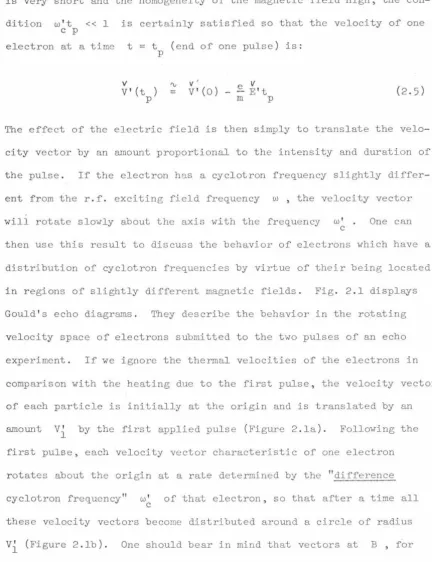
(2.5)The effect o:f the electric :field is then simply to translate the velo
-city vector by an amount proportional to the intensity and duration of
the pulse. I:f the electron has a cyclotron frequency slightly differ
-ent :from the r.:f. exciting :field :frequency w , the velocity vector
will rotate slowly about the axis with the :frequency w' •
c One can
then usc this result to discuss the behavior o:f electrons which have a
distribution o:f cyclotron frequencies by virtue of their being located
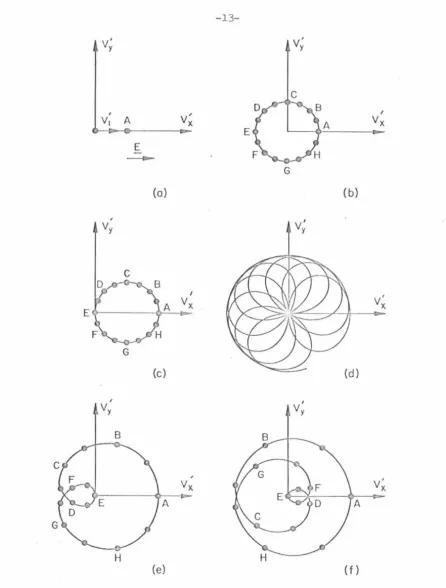
in regions o:f slightly different magnetic fields. Fig. 2.1 displays
Gould's echo diagrams. They describe the behavior in the rotating
velocity space of electrons submitted to the two pulses of an echo
experiment. If we ignore the thermal velocities of the electrons in
comparison with the heating due to the first pulse, the velocity vector
o:f each particle is initially at the origin and is translated by an
amount V]_ by the first applied pulse (Figure 2.la). Following the
:first pulse, each velocity vector characteristic of one electron
rotates about the origin at a rate determined by the "difference
cyclotron :frequency" w' of that electron, so that after a time all
c
these velocity vectors become distributed around a circle of radius
[image:17.573.76.509.126.689.2]vi
yI
v,
,
Vy
B
H
-1
3-v~
c
v/
,
A X
A Vx
E
E
-
G(a) (b)
I Vy
c
v~
G
(c)
v~
A A
(e) (f)
[image:18.579.66.513.52.641.2]cled the origin once, twice, or more, either clockwise or
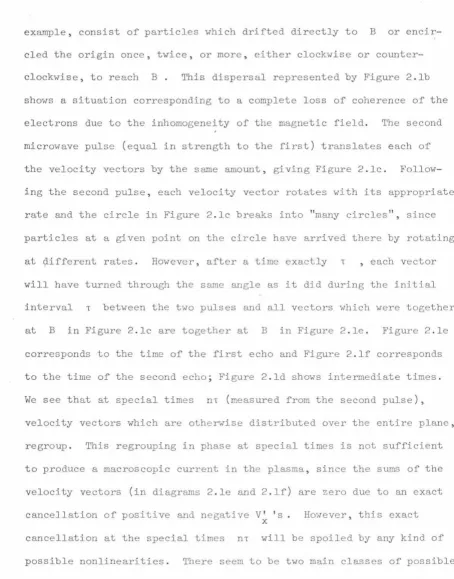
counter-clockwise, to reach B . This dispersal represented by Figure 2.lb
shows a situation corresponding to a complete loss of coherence of the
electrons due to the inhomogeneity of the magnetic field. The second
microwave pulse (equal in strength t o the first) t ranslates each of
the velocity vectors by the same amount, giving Figure 2.1c.
Follow-ing the second pulse, each velocity vector rotates with its appropriate
rate and the circle in Figure 2.lc breaks into "many circles", since
particles at a given point on the circle have arrived there by rotating
at different rates. However, after a time exactly T each vector
will have turned through the same angle as i t did during the injtial
interval T between the two pulses and all vectors which were together
at B in Figure 2.lc are together at B in Figure 2.1e. Figure 2.le
corresponds to the time of the first echo and Figure 2.l f corresponds
to the time of the second echo; Figure 2.ld shows intermediate times.
We see that at special times nT (measured from the second pulse),
velocity vectors which are otherwise distributed over the entire plane,
regroup. This regrouping in phase at special times is not sufficient
to produce a macroscopic current in the plasma, since the sums of the
velocity vectors (in diagrams 2.le and 2.lf) are zero due to an exact
canceJlation of positive and negatjve V' 's . Hmvever, this exact
X
cancellation at the special tjmes nT will be spoiled by any kind of
possible nonlinearities. There seem to be two main classes of possible
[image:19.573.57.512.75.654.2]-15
-cyclotron frequency that Gould and Kegel investigated
(9)
,
and the other the energy-dependent relaxation phenomena first introduced byGordon, Hill and Kaplan ( 10). A typical energy-dependent relaxation phenomenon is the electron-neutral collision frequency which is a
strong function of the electron velocity in most gases (11). What type
of energy-dependent cyclotron frequencies can play a role will be dis
-cussed later. Considering Figures 2.le and 2.l f, an energy-dependent cyclotron frequency will spoil the symmetry of the figures with
respect to the V' axis.
X An energy-dependent relaxation phenomenon
such as the energy-dependent electron-neutral collision frequency will
have the effect of selectively removing electrons (or their
corres-ponding velocity vectors) from Figures 2.le and 2.lf, depending on the magnitude of their velocity. For instance, i f the collision frequency is a growing function of the velocity, many of the eJectrons in Figure
2.le which should have occupied the point A at the time t
=
T willexperience a collision with a neutral before that time and then lose
their phase identification, and so cannot be at A at the time t
=
T .How.ever, among the electrons which should be at point E at t
=
T , very few of them will experience collisions, so that the cancellationof negative and positive V' will again be spoiled.
X A characteristic,
then, of the cyclotron echo is that the nonlinearities are acting at
all times between the beginning of the first pulse and the time the echoes appear. This is a main difference with the spin echo, because
one can show that the nonlinearity associated with this phenomenon comes directly through the pulse excitation. That kind of
echoes, one can use the hints given by Figure 2.1 to derive a
mathemati-cal model. The macroscopic entity we are interested in is the current
present in the plasma. To know the current one needs the density of
electrons and their velocity. The velocity of an electron at a time
t after the second pulse is (using the same notation as in equation
2
.
5)
(2
.
6)
vl is the velocity imparted by the first pulse and is equal to ; e Eltl
v2 is the velocity imparted by the second pulse and is equal to
m
e E2t2¢1 is the rotation between the
'V w' T
first and second pulses
c
¢2 is
'V the rotation after the second p1.1lse = w't
c
Since the electrons have different cyclotron frequencies depend
-ing on their spatial locations, one can define a normalized electron
density G(w') per increment of "difference cyclotron frequency" c
so that the plasma current can be •rri tten
j '
(
t )=
-
N eJ
dw' G ( w' )~
'
( t )c c
w'
c
(2.7)
N is the number of electrons per cubic centimeter if, for example,
one is interested in the plasma current per cubic centimeter. To be
more general and also to introduce energy-dependent relaxation type of
nonlinearities, one can multiply the integrand of equation 2.7 by a
term giving the probability P(t) of no collision between the first
P(t)
=
-
17
-- v(t+T)
e
v
so that equation 2.7 can be written, using the notation J '(t)
=
J to simplif'y:(2
.
8)
The energy-dependent gyrofrequency nonlinearity is present in the
phase. Assuming a weak dependence on
v
2, one has:2
aw
~
=
[ w (V ) - w] t=
[w
'
+ _ c V2] tc c
av
2
and
aw
~1
=
[ w' + _ cv2]
T(
2
.
9)c
av
2
1he energy-dependent relaxation can also be written, assuming again a
weak dependence on
v(t + T)
=
[
v +~
v
2J (
t + T)o
av2
(2.10)
Now in these early theories the effect of the nonlinear terms in the
period of time between the two pulses is neglected, and one considers
their effect only starting from t
=
0, corresponding to the end ofthe second pulse. The approximation is certainly good when one
consi-ders the second or third echo, but seems questionable as far as the
first echo is concerned. However, one can show that the qualitative
aspect of the results is unchanged. Equations 2.9 and 2.10 will then
v(t+ T)
=
V T + 0Now
[v + 0
0
=
w'Tl c
~V2) av2
t
v2
=
v2 + v2 + 2V1v2 cos 01 l 2
and from a·well-known Bessel function identity
e-(a+if3)cos 01
=
with
so that finally:
+oo
NeV 1
L
- 00
with
- 0 0
I (a+if3) n
A (t) g(t -m)
n
-in0 l e
(2.11)
(2.12)
(2.13)
(2.15)
A ( t)
=
I
(In+l (a+if3) +V -(v (t+T)+ (lv
(Vi+V~)t)
_g_
I (a+if3)e 0 av2 nand
g(t )
=
vl n
X
+oo
J
iw't G(w~) e c
-""
dw'
c
(2.16)
(2.17)
A (t) represents an amplitude factor and g(t) represents the nor-n
malized echo shape. One sees that the echo shape is simply the
-
19-should note that, apart from the assumptions mentioned, the plasma
current given by equation 2.15 has been derived in complete generality as far as nonlinearities are concerned. So i t is possible to make
a choice as to which one is preferred and then to dravr some predictions
to be confirmed by the experiment. Kegel (12) showed that a possible
energy-dependent frequency type of nonlinearity could be the relativis -tic mass effect. Other workers (13) , however, pointed out that the
energy-dependent collision frequency type of nonlinearity is much
stronger vrhen the energy of the electrons is of the order of 1 eV,
which is the energy the electrons are likely to acquire in a typical
echo experiment.
For some time the generally accepted picture was an independent particle theory with the energy-dependent collision frequency as the nonlinearity
(10)
.
In the first experiment that we tried, an extremely(liB __
-4)
homogeneous magnetic fiel d B 10 , at least ten times more homo -geneous than was the case in the other experiments, was used. So i t
was a startling surprise to find that the echo width was ten times narrower than expected by equation 2.17. One recalls that G(w' )
c in
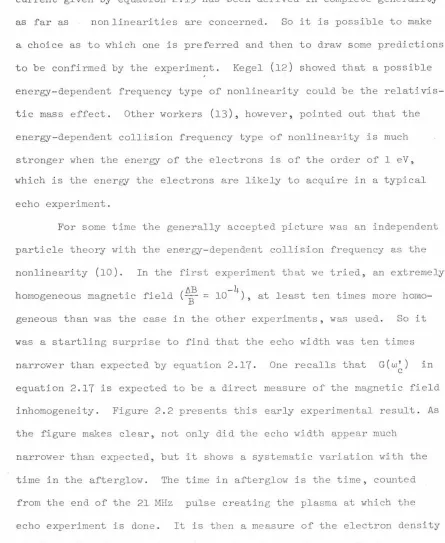
equation 2.17 is expected to be a direct measure of the magnetic field inhomogeneity. Figure 2.2 presents this early experimental result. As the figure makes clear, not only did the echo width appear much
narrower than expected, but i t shows a systematic variation with the time in the afterglow. The time in afterglow is the time, counted from the end of the 21 MHz pulse creating the plasma at which the
[image:24.570.69.514.130.673.2]i
150 nsINDEP. PARTICLES THEORY ('NITH 6 8
8
< i0-4)
20 1--- ~ 15 microns (NEON)
(/') 15
c
I
1-0
~
0 I
u
w
0
30
PULSES SEPARATION =lOOns
EXCITING PULSES WIDTH = 5ns
200 300 400
TIME
IN AFTERGLOW,
To(,us)
Fig
.
2
.
2
Echo width as a function of the time in
the
afterglow
I
1\)
0
-21-the echo gets narrower. As the pressure increases at a fixed time in
the afterglow, the echo gets narrower also. This reflects the fact
that i f the pressure is increased at a fixed time in the afterglow the
electron density increases. The same behavior of the echo width was
observed in a cesium plasma by Wong et al (14). A systematic dependence
of the echo width on density was found, a fact not at all predicted by
the model using an energy-dependent collision frequency. Gould and
Kegel
(15)
then proceeded to resuscitate the energy-dependent cyclotronfrequency model with a new idea. As shown by the calculation of Parker
(1
6)
the radial density profile of a plasma contained in a cylindricalglass column falls approximately as the Bessel function of order zero
from the axis of the column to a distance of about one Debye length
e: kT l/2
(AD = (~) away from the wall and then drops rapidly to zero.
ne
The zone of plasma situated at one Debye length of the wall is called a
sheath. Large static electric fields are present there as a result of
a steady state diffusion situation. Parker solved the problem for a
plasma not in a magnetic field, but i t can be shown that qualitatively
the same type of static electric field exists. It will also be weak in
the center and large in the sheath region. One can take a
one-dimensional model to write the equation of motion of an electron in
such a configuration of fields. The static electric field will be
written E
=
E(y); the equation of motion of one electron will then be:o; ( y ) + w 2 oy ( y ) +
g_
E < y + oy )=
o
c m
(2.18)
position y . Now it is possible to expand E(y) around the position
of equilibrium of the electron
E(y+oy)
=
E(y) + E' (y) oy+
~
I
E"(y) oy2+~
!
E"'(y) oy3+(2.19)
Substitution of equation 2.19 into equation 2.18 gives:
oy(y) + (w2 + .9... E' (y)) oy +1..9... E"(y) oy +
1:..
9.. E"'(y)oy3 =-9.. E(y)c m 2m 3m m
(2.20)
Equation 2.20 is the equation of an anharmonic oscillator, meaning that
its frequency of oscillation is energy-dependent. Through the term
.9... E' (y) the electron gyrcfrequencies are seen to depend on the density,
m
since
q
E
~(y) ~
w2p(y) explaining nicely why the echo width is depen-dent on density. So for a while this new model seemed to hold some
serious promise. However, if one investigates the strength of the non
-linearity and compares it with the energy-dependent collision frequency,
it is found that only the electrons in the sheath experience a nonline
-arity equivalent t o that due to the collision frequency. Taking into
account the small quantity of electrons in the sheath, the echo com
-puted was about t\-10 orders of magnitude smaller in the new model than
in the collision-frequency type of nonlinearity. The contradictory
nature of the experimental and theoretical results brought some under
-standable confusion and the realization that something was basically
wrong in the independent particle theories. One must emphasize,
however, that they did serve a useful purpose, shedding some light on
-
23-that matter, from any physical system. In other words , this system
must possess:
a)
An
ensemble of oscillators with a distribution of naturalfrequencies, which interact with external forces;
tion":
b ) Sufficiently lonG relaxation times to permit observation;
c) One of a variety of nonlinear effects to "spoil cancella
-1. Energy-dependent driving force
2. Energy-dependent natural frequency; anharmonic oscilla
-tors
2.3 Collective Effects Model: Echoes from a Cold Nonuniform Magnetoplasma
2.3.1 General Case
The single particle theories considered the independent electrons
to be the oscillators required for an echo. This implied that when the
plasma interacted with an external RF signal, each electron acted
independently. Actually, numerous experiments have shown that a cylindrical nonuniform pJasma column in a magnetic field such as we
used, exhibits a very complex collection of resonances when excited
with a continuous wave signal whose frequency is changed. Among those
most successfully explained are the Buchsbaum-Hasegawa resonances (25) caused by standing electrostatic waves in the dense core of the plasma,
or the corresponding under-dense modes of Schmitt, Meltz and Freyheit
(26) excited in the low density area of the plasma. Both of these
phenomena are described in terms of electrostatic waves caused by coherent density fluctuations which propagate throush the plasma at a
right angle to the magnetic field. In these two cases the collective
oscillations are seen to dominate the plasma reaction to the excitation
of an external signal. As a rule of thwnb, in fact, one can expect
that the collective effects of the plasma will prevail as long as the
plasma frequency
frequency w /2n c
w /2n is not too small compared to the cyclotron p
and sisnal frequency w/2n .
The Buchsbau.'ll-Hasegawa resonances are most easily observed when
an active discharge is used, thus requiring a."hot" plasma theory. Our
-
25
-electrons can then be asswned to be at room temperature so thaL an
easier cold plasma theory is expected to suffice. Indeed, it is known
that a cold plasma can support two types of waves across the magnetic
fi eld; the ordinary wave and the extraordinary wave. Considering for
the sake of simplicity a uniform, unidimensional slab of plasma, one
can show that the latter type of wave will induce an electrostatic
resonance at what is called the upper hybrid resonance,
w
2 +w
2 , wherec p w /2n is the cyclotron frequency c and
is the plasma frequency. The idea, then, that these collective
w /2n p
oscillations in the case of a relatively high electron density should
play a role in the echo formation had been present for some time, but
it was difficult to see how a new theory could be developed. Herrmann
and ~fuittmer (17) were the first to suggest the existence of an echo
associated vTith the upper hybrid resonance. Later Gould and Blum (18),
Wong and Judd (19) developed that idea. The former showed that a slab
of cold, collisionless plasma with a nonuniform density profile had
al l the necessary properties for the formation of an echo. In this
section the theory of Gould and Blum, and new developments of the
theory by Blum (20) will be presented for comparison with the
experi-mental results obtained by the author. For an easier analysis of the
nonuniform plasma slab, see Fig. 2.3, one can approximate it by an
ensemble of thin space charge sheets each carrying a slightly differ
-ent electron density and spaced closely enough to give a "smooth"
variation of density between the center of the slab and its edge. If
j
Eexl
.
.
.
.
.
.
..
.
. .
.
...
.
.
.
...
.
.
.
.
....
.
.
.
. . . .
.
..
...
.
.
.
.
.
.
.
.
. . . .
.
.
.
.
.
.
.
.
.
. . .
.
. . .
.
.
.
.
.
. . .
.
. .
.
. .
.
.
.
. .
.
.
. .
.
.
.
.
.
.
.
.
.
.
.
. . . .
.
.
.
.
. . . .
. .
.
. .
.
.
.
.
.
.
.
.
.
.
...
.
.
.
.
.
. .
.
.
.
.
. . .
.
.
.
.
.
. . .
::::
:-:-7:-:::::::::
:-:--:--:-:....----....
. .
.
.
.
.
...
. .
.
...
.
.
.
. . .
..
.
. .
...
.
.
. .
.
.
.
.
.
.
.
. .
.
.
. . .
.
.
.
. . . .
. .
. .
.
.
. .
. .
. .
. .
. .
.
...
. . .
.
.
.
.
. .
.
.
.
.
.
.
. .
. .
. .
.
.
.
.
.
.
.
. .
.
. . .
.
. .
.
. . .
.
.
.
.
.
.
.
...
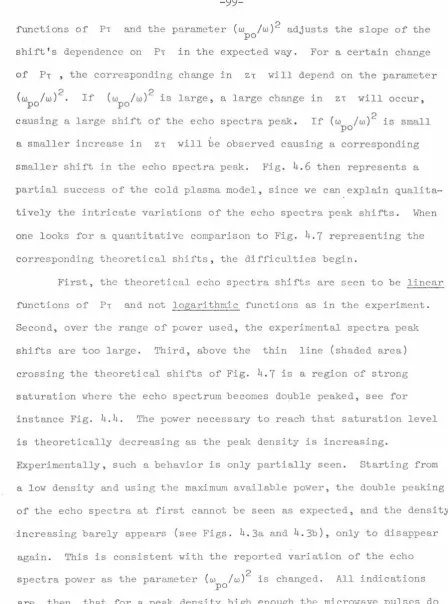
X
+0
-a
Fig. 2.3. The model's nonuniform plasma slab
charge sheets will be excited and will oscillate at their own upper
hybrid frequencies. In other words, each sheet is an oscillator and,
depending on their location in the slab, they can have resonant fre
-quencies ranging from the cyclotron frequency--i f the sheet is
located at the edge of the slab--to the maximum upper hybrid frequency
w
=
wHo=
(w~
+w~
0
)
1/
2 at its center. (wpo corresponds to the maxi-mum plasma frequency in the center of the slab. ) Then even though the
magnetic field is very uniform, the spread of the oscil lator fr
equen-cies could be very wide i f the plasma frequency is high enough; even
comparable to or larger than the exciting pulse's spectrum (see Fig.
2.4). In the independent particle theories the spectrum of the pulse
was always assumed to be much wider than the spectrum of the oscillators.
0
.
8
-
27
-0
.
9
( w /w)
c
1.0
1.0
Fig. 2.4 The solid line represents the density of oscillators vs.
(w /
w
)
withw
2/w
2=
.
36
.
The dashed line representsc po
the spectrum of a typical experimental pulse.
§
!-<
+' u
Q) p. (/)
Q) en
3
p..
<0
<1!
N
•rl
,.; al
E
0
pulse, the sheets will then oscillate and, because of the different
upper hybrid frequencies , slowly dephase in a manner quite similar to
the independent electrons as seen in Section 2.2. It is intuitively
felt, in fact, that when the electron density is small enough the
independent particle theory should be a good approximation. A possible
criterion (21) to fix a density limiting the zones of applicability of
the two theories would be:
w c
=
D.wc w
c
(2.21)
where D.w /w represents the inhomogeneity of the magnetic field and
c c
2
(w
-Ho
w
2
)1/2
/w
represents the spread of upper hybrid frequencies duec c
to the nonuniformity of the electron density. In our experiment this
fixes the density limit to 10
8
e1/cm3. When compared to the usualexperimental values of 10
9
to 1011 el/cm3
,
this criterion reinforcesthe necessity of a collective effect theory. So far the model of Blum
and Gould has the necessary linear property for an echo. To see where
the nonlinearity comes from, a Lagrangian formulation of the equation
of motion of a sheet perturbed by an external field
ox ( x ) + w2 ox ( x) + !:. E ( x + ox)
c m 0
E
ext is used:
(2.22)
where ox(x) is the sheet displacement from the equilibrium position
x . E(x+ox) consists of the external field Eext and the space charge
restoring force of the ions (assumed fixed) which may be expanded in a
-
29-(2.23)
Substituting 2.23 into 2.22:
2' 2" 2
w (x) ox(x) wp (x) OX (x)
J
'2! ( w 2 + w 2 ( x )) + -3L-! -(
w-2~
+-
w-=2~(-x-)
-) + ...c p c p
=
~E m ext (2.24)Equation 2.24 is the equation of an anharmonic oscillator; the nonline
-arity required to have an echo comes then simply from the nonuniform
density profile of the slab. Equation 2.24 is that of the motion of
one sheet only; i t is necessary to link its motion to some physically
measurable macroscopic quantity.
A
sheet displaced from its equilibriumposition x by ox will generate an electric field E(x,t) such that
where
E(x,t)
=
1 e:0
p.(x} is the fixed ion density.
l.
(2.25)
If all the sheets are considered, they will each generate some
electric field which will appear as a voltage V(t) across the slab:
V( t)
+a
J
E(x,t)dx=
-a1
e:
0
+a
J
-a
OX (X, t) p. (X) dX
l.
This quantity V(t) or the square of it will be compared with the
(2.26)
However , before that is done some simplifications in 2. 24 will be
necessary; first some simplification in writing
ox(
X' t)=
OX2u
w
p
!:..E
m ext
=
= F(t) (2.27)
Second, the presence of two nonlinear terms will introduce some unnec -essarily complicated equations. The term in
ox
3
only will be keptthroughout the derivations and the results will be adjusted to take
into account the effect of the term in
ox
2
so that2
.
24
becomes:ox
+w~
ox
[
l + Sox
2 ]=
F ( t )with S « l
(
2
.
28)
Using standard small perturbation techniques (22) the time is redefined
Q
=
wtwhere
w
.
..
(2.29)-31-II
w
2
ox
+w~
ox[l
+Sox
2
]
=
or
=
(
2
.
30)
From equation
2
.
30
one gets different order differential equations by
equating the coefficient of S
0 ,e
1
,
e
2
, ...
II
2 + 2
F(~)
WH
ox
0WH ox
0=
zeroth order:
(
2
.
31)
w
II II
ox
32w
1
oxl
+oxl
-
-
0OX
WH
0first order:
(
2. 32)The zeroth and
first order
differential
equations only
will
be
used
here
.
This will represent a good approxjmation
as long as
e
<<l
.
It
can be shown that the solution of
2
.
31 using
Fourier
transform
is:
OX
0
=
g
J
sin (
g - g 1) F (
~
1
)
d9
1(
2
.
33)
- 00
making a transformation of variable from
gto t
,
equation
2
.
33
becomes
ox
=
0
wt
J
- oo
sin w(t - t
1)
F(t') dt
1 (2.34)If
one
i
s
int
erested
in the value of ox
for times
at
which
F(t)
has
0
ox
0
+<»
J
sin w(t -t ' ) F(t') dt' (2.35)which can be put in t he form
ox
=
w2 (fr (w) sin wt - f . ( w) cos wt)0 ~
WH
where +<»
f(w)
=
J
eiwt l<'( t) dt=
f (w) + i f. (w)r ~ (2.36)
_co
Equation 2.35 or 2.36 would constitute the solution of the problem if
w were kno•rn. To achieve that goal, the ox just obtained will be
0
substituted into equation 2.32. This will produce "secular" terms
from 2.32 unless a condition on
w
is satisfied, givine the value ofw to first order (sufficient in this case). Since ox is expressed
0
as a func Lion of the variable t , equation 2. 32 must be transformed also, giving
2.., 3
W uX
0
2w 1 ..
ox
0
Now usine equation 2.36 one has:
2 w
OX
0
sin wt - f. (w) cos wt) 3
~
(2.37)
-
33-Among the terms of 2. 38 only the terms in cos wt or sin wt will
give rise to solutions growing with time or "secular" terms. So,
gathering all the secular terms from 2.38 and from the other term of
the second member of 2.37, one gets:
Sum of secular terms
=
(2.39)
It can be seen that the disappearance of the cos wt and sin wt
t erms calls for the smne condition on w
=
wH +Sw
1 which is:(2.40)
which means that
w (2.41)
It is then possible to take the value of w and to substitute i t into
equation 2.35:
or since
written:
ox
(t)
=
0
(2.42)
l
c
i(wH++oo
Bwl )t
f
-iwt
'
}
OX (t)
=
- - Im e e H F(t' )dt'0 WH
-oo
or
OX (t)
=
0
1
c
i (''H
+ 6w1)t
f*(wH)}
- - Im e
WH
(2
.
43)
where
+oo
J
e-iwHt
f*(w)
=
F(t )dt-oo
Equation
2
.
43
is the most general equation of the motion of oneplasma sheet in the first approximation analysis used, and subject to
the condition that i t is good only for a time t for which F(t) has
become and stays negligible. Nothine has been said about the exciting
external fie] d represented by F(t) to keep the analysis general. Now
F(t) will be made to represent an echo experiment. So F(t) will be
composed of tvo pulses F
1 and F 2 , one at t
=
- T , the other att
=
0 , so that(2
.
44)
To adapt
2
.
43
to this case:+oo
J
-iw t
f·X· (w ) H ( F l ( t + T) + F
2 ( t) ) dt
= e
H
- oo
+oo
-i~(t'-t)
f2(wH) +
J
F (t' )dL'= e
1
-oo
fiC·(w )
=
H-
35-(2.45)
At this point another simplifying assumption can be made by noting that i f the exciting pulses are symmetrical in the time domain with respect
to their "center line", f
1(wH) and f2(wH) are real; then:
which means that equation 2.45 becomes
f•l< (w )
H
The next thing to calculate is w
1 from equation 2.40:
but
then fr(wH)
=
fl(wH) cos WHT + f2(wH)fi (wH)
-
-
sin WHT fl(wH)which will give
3
( fi + f2 + 2 f
1f2 COS W1)
wl 8wH 2
(2.46)
(2.47)
(2.40)
(2.48)
Using equations 2.43, 2.47, 2.48 the equation of motion of one plasma
where
~w
2
=d
~
(f2 + f2 + 2f1f2 COS WT)
8
WH
1 2(2.49)
Before going on and obtaining a more explici t echo formula, i t is interesting to note that with the method employed here there is a
cor-rection to the frequency from t = 0 to t = T which is ~w
2
andwhich arises from the nonlinearity of the plasma sheet oscillation, but
there seems t o be no corresponding correction between the times t = -T
to t = 0 . Tnis comes about because the solution developed here is
only correct for times after which F( t ) becomes and stays negligible
which is evidently not the case between the two pulses. To correct
that difficulty one can consider what would happen if there >rere only
one pulse: the first pulse at t = -T The plasma sheet motion can
then be obtained from the general equation 2.43:
OX (t)
=
0
(
2
.
50
)
(1 pulse at t=-T)
where
Then equation 2.49 can be corrected to read:
-37-Using a well known
Bessel expansion
,
one
can
show
that
i (
3/ l,)
8
e
w
here
Then
ox (t)
0
ox
(
t) 0w
here
g=
WH
can be
f1
r
2
cos
WT
z
=
written
=
n=
+
""
I
~.
n
J
(
z
)
e
inwT
n
n
=-co
(
2
.
52
)
3 8
) -
flf2
I
W
H
i
(
wH(t-nT)
+
Gt)
}
+
f
2
Jn(zt)]e
(
2
.
53)
As in the
independent parLicle
theories
the sum
over n
means that
ox
0
(t) will
comprise the contribution of the first echo
:
n =
1 ,second
echo
:
n
=
2
and so on
.
(The
negative
values
of n
do not
have
any
physical meaning
;
they correspond to echoes
which
would appear
earlier than
the exciting pulses)
.
Since one
is intere
sted
only in
one
echo at a time, one
can
consider
th
e
equation of
motion
of
the
plasma
sheet
for one
value
of
n
only; the
displacem
ent
of the plasma sheet
created by the nth
echo
will then be:
i (wH( t-nT )
+
Gt
)}
f
2J
n ( zt) ]e
(
2
.
54)
Calculating the im
agina
ry
part of
th
e
bracket
gives a different result
depending
on
the
evenness or oddness of
n
because
of
the
term
So n
even:
ox (t)
=
oneven
bn cos wH(t-n<)+ an sin wH(t- n<) (2.55)
where
and
n odd:
a b n even n even
even even
(-l )n/2
=
_,_
=..:._
__
{[
-
f
1Jn+l (zt)sin(llw1< +Gt)+
r
2Jn(zt)cos GtJ}(2.56)
{[f1Jn+l (zt)cos(llw
1< +Gt)+ f2Jn(zt)sin GtJ}
(2.57)
ox ( t ) =
on odd (2.58)
where n-1
a =
(-
1
~
{[-f1Jn+l(zt) cos(llw1< + Gt)- f2Jn(zt)sin Gt J}
nodd WH
(2.59)
and n-1
b = ( -1) 2 {-f
1Jn+l(zt) sin(llw1< +Gt) + f2Jn(zt)cos Gt]}
nodd WH
(2.60)
Equations 2.55 to 2.60 describe the motion of one plasma sheet trig
-gered by the nth echo. To knovr the voltage across the slab generated
by this echo, one needs equation 2.26
+a +a
v
(t )on
+
f
0
ox (x,t) p. (x)dx
on ~
;
J
w2
(x) ox (x,t )dx p on
-a -a
Substituting the value of ox (x,t ) into equation 2.61 on
v
on(even (t)
or
odd)
+
a
~
I
-a
or
odd)
-39-or
odd)
(
2
.
62)
Equation
2
.
62
would
be
the
most ,general equation
for
the
voltage
gen
-e
r
ated by
the nth
echo
in
the
first
approximation analysis
used
were
it
not for
the fact
that
equation 2
.
24
was
solved only
for
the
ox3
type
of nonlinearity.
It
can
be
easily shown
,
however
,
that the only effect
of the ox
2
type
of
nonlinearity is to
add another
correcting term to
the frequency
wH ,meaning that if one solves
with
ox+
w~
o
x[l +
aox
+
Sox
2]=
F(t)
a
=
1 2instead
of equation 2
.
28
,
thcn
wtakes the
value
:
w
=
w+(
83e
H WH
(2
.
63)
(2
.
64)
(2
.
65)
with the
effect that in equations 2
.
55
to
2
.
62
zin the argument of
the Bessel
functions becomes
:
G
becomes
g = ( ]_
~
- 2_ £.__) ( 2f
:?+ f2 )
28
WH 12 wH l(2.66)
6w
1 becomes:
(2
.
68)
Equation
2
.
62
with the corrections just mentioned represents themicro-wave signal emitted by the nth echo. However, experimentally, using
crystal rectifiers, one just measures the envelope of the microwave
signal so that some of the information given by equation
2
.
62
is super-perfluous and it is clear that any possible resulting simplifications
of that equation will be extremely useful for its later numerical evalu
-ation. An "ideal case" of an equation of type
2
.
62
can be conceived toshow what kind of "theoretical crystal rectification" is possible. Let
us suppose that out of some related theoretical echo calculation comes
the voltage expression:
Wn(t)
=
J
dw n(w)[cn(w) sin w(t-nT)+ dn cos w(t-n<)](2
.
69)
where i t is assumed that:
n(w) c (w)
=
F(w -w )
n o
c and d are not functions of time
n n
n(w) d n (w)
=
G(w -w
o)
((2. 70)and where F(w - w )
0 and G(w - w ) 0 are symmetrical functions of w ,
centered at
Letting w'
=
w - w0
Then one can write:
(2.71)