This is a repository copy of Using the DPSIR framework for transdisciplinary training and knowledge elicitation in the Gulf of Thailand.
White Rose Research Online URL for this paper: http://eprints.whiterose.ac.uk/110706/
Version: Accepted Version
Article:
Baldwin, C, Lewison, RL, Lieske, SN et al. (7 more authors) (2016) Using the DPSIR framework for transdisciplinary training and knowledge elicitation in the Gulf of Thailand. Ocean & Coastal Management, 134. pp. 163-172. ISSN 0964-5691
https://doi.org/10.1016/j.ocecoaman.2016.09.005
© 2016 Elsevier Ltd. This manuscript version is made available under the CC-BY-NC-ND 4.0 license http://creativecommons.org/licenses/by-nc-nd/4.0/
[email protected] https://eprints.whiterose.ac.uk/
Reuse
Unless indicated otherwise, fulltext items are protected by copyright with all rights reserved. The copyright exception in section 29 of the Copyright, Designs and Patents Act 1988 allows the making of a single copy solely for the purpose of non-commercial research or private study within the limits of fair dealing. The publisher or other rights-holder may allow further reproduction and re-use of this version - refer to the White Rose Research Online record for this item. Where records identify the publisher as the copyright holder, users can verify any specific terms of use on the publisher’s website.
Takedown
If you consider content in White Rose Research Online to be in breach of UK law, please notify us by
Using the DPSIR framework for transdisciplinary training and knowledge elicitation in the Gulf of Thailand
Claudia Baldwin *1, Rebecca L. Lewison2, Scott N. Lieske 3, Maria Beger45, Ellen Hines6, Phil Dearden7, Murray A. Rudd8, Christian Jones 1, Suvaluck Satumanatpan9, Chalatip Junchompoo10
Keywords: DPSIR framework, social-ecological systems, integrated coastal zone management
* Corresponding author: Claudia Baldwin, email: [email protected]
1 University of the Sunshine Coast, Maroochydore, Australia 2 San Diego State University, San Diego, USA
3 University of New South Wales, Sydney, Australia 4
Centre for Biodiversity and Conservation Science, University of Queensland, Brisbane, Australia 5 School of Biology, University of Leeds, LS2 9JT, UK
6 Romberg Tiburon Center for Environmental Studies, San Francisco State University, Tiburon, USA 7 University of Victoria, Victoria, Canada
8
Emory University, Atlanta, USA 9 Mahidol University, Salaya, Thailand
Highlights:
Coastal zones cross physical (land-sea) and administrative (between countries) boundaries.
Coastal zone management requires connections across disciplines and areas of expertise. Coastal practitioners need tools and frameworks to support cross-boundary
problem-solving.
DPSIR provides structure for knowledge elicitation and sharing and integrated management.
28 February 2016 Page 1 of 23 1. Introduction
1
Coastal zones are recognized as areas that embody the term cross-boundary: land-sea 2
boundaries, socio-institutional boundaries, focal areas for contrasting human enterprise, and 3
interfaces amongst ecosystem types. Such complex systems create challenges for 4
sustainability because the multitude of interacting biophysical, social, cultural, and economic 5
drivers and processes require simplification to understand and manage. Coastal zones are 6
threatened by a host of stressors that endanger their ability to persist (Adger, 2009), and 7
worldwide, coastal zones are recognized as areas under siege. Pressures on these natural 8
systems are likely to intensify due to climate change (Nicholls et al 2007; Ellison, 2015). 9
10
Tropical coastal systems are some of the most productive, densely populated, and biodiverse 11
areas in the world (Halpern et al., 2009). While coastal areas are vital to the needs and 12
livelihoods of local peoples, human activities are, in many cases, degrading these 13
environmental conditions and systems in these areas. These stressors are well documented 14
and include: overharvesting of fish, seafood, and mangroves; habitat degradation and 15
increased erosion (due to aquaculture, forestry and upland deforestation), and rapid 16
development (tourism, pollution) (e.g., Orchard et al., 2015; Ramesh et al., 2011; Cheevaporn 17
and Menasveta, 2003). 18
19
These threats to coastal zones are evident throughout coastal Southeast Asia. Since World 20
War II, increased exploitation of primary resources has been the foundation of economic 21
development in many Asian countries(Chua and Garces, 1994). Rapid development coupled 22
with an increasing human population in coastal areas has resulted in the degradation of 23
coastal resources (Adger et al., 2001; MacKinnon et al., 2012). Within the coastal zone, there 24
has been a remarkable increase in commercial fishing(Pauly, 2006). Immigration from 25
overcrowded provinces into an open-access artisanal fishery has caused widespread 26
overexploitation of fishery resources, leading to poverty and an atmosphere of desperation 27
(Mathew, 2003; Pomeroy and Viswanathan, 2003, Bennett et al., 2014). Additional threats to 28
coastal and marine areas such as air and water pollution and the loss of wetlands are brought 29
about by increased urbanization, industrial, agricultural and aquaculture development (Yasue 30
and Dearden, 2009, Hines et al., 2012). 31
28 February 2016 Page 2 of 23
To promote effective management of a cross-border coastal zone requires an understanding 33
of the historical, institutional and social-cultural context. Thailand has experienced a period 34
of unprecedented economic growth over the last 30 years. In addition, Thailand is the only 35
country in the region that was not colonized by a western power. There is a long and intact 36
system of government and institutions that persists, despite numerous coups that have seen 37
governments change quite rapidly. In contrast, in Cambodia, traditional governance systems 38
were displaced by French colonial rule, and the country experienced one of the most 39
disruptive civil wars, genocide and dictatorial rule of any country in the recent past (De 40
Walque, 2006). As local governance systems were destroyed, the bonds that hold many 41
communities and families together were broken. In many respects Cambodia is starting anew 42
in building governance systems and appropriate institutions. 43
44
Despite the differences in recent history between Thailand and Cambodia, there are also 45
converging trends. Resource management in coastal zones in both Thailand and Cambodia 46
faces substantial challenges and in both countries there is a growing appreciation of the need 47
to enable a greater element of community-based natural resource management. Public 48
participation and decentralized management has been a central element of recent 49
constitutional rewrites in Thailand, and the Cambodian government is encouraging a wide 50
variety of programs that support a community-based approach (e.g. Dearden et al., 2009). In 51
both countries, coastal resources are intrinsically linked to local economies and community 52
functions, demonstrating the complex interaction between social and ecological systems. 53
54
A framework to understand the complex socio-ecological interactions that can both mitigate 55
threats to sustainable coastal zone development is pivotal. While the resilience of tropical 56
and subtropical coastlines has been extensively studied across discrete fields within the social 57
and natural sciences (Beger et al,. 2010), the lack of truly interdisciplinary research on 58
resilience continues to limit (1) our understanding of the non-linear and complex processes 59
that influence resilience between socio-cultural and natural coastal dynamics across time and 60
space (Ostrom, 2009); and (2) the development of effective integrated management strategies 61
to improve rapidly eroding conditions in tropical and subtropical coastal regions (Talley et al., 62
2003). We applied the Driver Pressure State Impact Response (DPSIR) framework in a 63
28 February 2016 Page 3 of 23
systematic thinking, elicit local expertise on threats, and build capacity among multi-65
disciplinary workshop participants. We aimed for this process to support the development of 66
solutions and management actions to address the complex and coupled social-ecological 67
issues in coastal zones. Transdisciplinary training supports the development of scientists and 68
practitioners who are able to synthesize the theoretical and methodological approaches of 69
different disciplines to better recognise complex problems, building respect through learning 70
the languages and cultures of different disciplines, along with learning how to navigate within 71
and between disciplines (Nash 2008). Here, we explore the utility of the DPSIR framework as 72
a tool for identifying sustainability pathways, through application to a cross-border coastal 73
zone between Thailand and Cambodia during transdisciplinary training. Apart from 74
assessing DPSIR as a tool, such training builds the foundation for development of locally 75
relevant management actions and strategies by addressing issues we could identify at this 76
point. 77
78
2. Background: the Driver Pressure State Impact Response (DPSIR) framework
79 80
The DPSIR framework has been adopted to structure environmental problems and connect 81
conceptual exploration across social and natural science (Ness et al., 2010, Bell, 2012, 82
Gregory et al., 2013, Lewison et al., 2016). The DPSIR framework, which evolved from an 83
earlier Pressure State Response (PSR) structure, was introduced by the European 84
Environment Agency in the 1990s to help policy makers identify cause–effect relationships 85
between environmental and human systems (Smeets & Weterings, 1999). It remains popular 86
for government policy purposes and is used to frame international environmental monitoring 87
and reporting (e.g., UNEP, 2012). 88
89
Traditionally the DPSIR framework includes Drivers which are often defined as global, 90
regional or local social, demographic and economic factors, that act as causal links to exert 91
Pressures on the environment. These pressures can lead to unintentional or intentional 92
changes in the State of the environment, which then lead to changes in the quality and 93
functioning of the environment causing Impacts on the welfare or well-being of natural 94
systems and human communities. Responses are actions taken by groups or individuals in 95
28 February 2016 Page 4 of 23
by changing drivers or pressures through actor driven shifts in behavior, prevention, 97
mitigation or regulation (Figure 1). Refinement of the DPSIR framework continues in more 98
recent applications (e.g. Fletcher et al., 2014; Gentry-Shields and Bartram, 2014; Lewison et 99
al., 2016). 100
101
It is crucial to gain information about how decision-makers, scientists, and citizens perceive 102
and define environmental challenges (Rudd 2011, 2015; Wise et al. 2014). The application of 103
a DPSIR framework involves problem-structuring that effectively simplifies structure and 104
function but maintains enough complexity to enable addressing issues through evidence 105
about social and ecological systems. 106
107
Part of the appeal of the DPSIR framework is that it was developed in response to direct 108
policy and management needs in the context of sustainability. DPSIR takes a complex 109
systems approach while maintaining conceptual simplicity and transparency, focusing on 110
causal relationships among disparate factors. This means that the DPSIR framework has 111
considerable potential for bridging the gap between scientific disciplines as well as linking 112
science to policy and management by engaging stakeholders (Tscherning et al., 2012, Gari et 113
al., 2015, Lewison et al., 2016) because of its ability to integrate knowledge across different 114
disciplines and visualize different decision alternatives. 115
116
117 118
Figure 1 - Schematic outline of the DPSIR framework
119 120
A recent review of the application of DPSIR to coastal socio-ecological systems (SESs) 121
found it has been used successfully to structure environmental problems and serve as a tool 122
for research in coastal zones (Lewison et al., 2016). To date, DPSIR models of coastal 123
systems have been used mainly to support and develop conceptual understanding of complex 124
coastal SESs and to identify drivers and pressures in the coastal realm. Several limitations of 125
the DPSIR framework have also been identified, including lack of explicit hierarchy or scales, 126
inconsistent use of terminology and unidirectional relationships (as originally structured) 127
28 February 2016 Page 5 of 23
129
In spite of these criticisms of DPSIR, a key strength of applying DPSIR to coastal areas lies 130
in bringing together different scientific disciplines with the range of stakeholders to derive 131
sustainable and feasible solutions (Gari et al,. 2015, Lewison et al., 2016). This 132
transdisciplinary cooperation involves development of new language and ways of thinking. 133
Lewison et al. (2016) noted that the DPSIR framework has been applied across numerous 134
boundaries: between disciplines by linking natural and social scientists (e.g., Lowe et al., 135
2014); between the scientific and non-scientific community (e.g., Butler et al., 2014; 136
Espinoza-Tenorio et al., 2010); and among science, management, and policy (e.g., Fletcher et 137
al., 2014). Importantly, recent literature recommends the use of different methods and 138
models to demonstrate synergistic and cumulative cause-effect relationships among coupled 139
elements within coastal systems, and a clear need to include relevant stakeholders to bridge 140
the policy-science gaps and ensure Responses are appropriate (i.e. practical) for a particular 141
coastal system (Cook et al., 2014; Lewison et al., 2016). 142
143
3. Methods
144 145
Here we describe a case study to apply the DPSIR framework as an interactive workshop tool 146
to both define and examine coastal sustainability challenges and train local decision makers 147
and stakeholders who engage with management. This work was conducted in a workshop 148
“Workshop on Integration of Management and Sustainable Usage of Marine and Coastal 149
Resources in the ASEAN Region by using DPSIR Frameworks” convened in the Trat 150
province of Thailand (near the border of Cambodia) from 9 to 14 January 2015. The goal of 151
the workshop was to explore the utility of DPSIR as an instrument for transdisciplinary 152
learning and discussion and investigate its possible application to sustainable coastal 153
management within the Association of Southeast Asian Nations (ASEAN) member countries. 154
The workshop was designed to build capacity in the ASEAN region with a wide range of 155
stakeholders through exposing participants to the DPSIR framework. The framework 156
provided participants with an opportunity to share knowledge and expertise to visualize and 157
organize the connections among human decisions, the pressures that socio-economic factors 158
create on the environment, and the potential consequences for provisioning of ecosystem 159
28 February 2016 Page 6 of 23
and community organizers from Thailand, Cambodia, Vietnam and Malaysia participated. 161
The workshop was facilitated by a group of eight cross-disciplinary experts: marine biologists, 162
social scientists, governance, GIS and digital communication specialists from North America, 163
Thailand, and Australia. 164
165 166
Figure 2 -Workshop Location and Participant ASEAN Countries
167 168
In the first part of the workshop, local NGOs and management agencies introduced and 169
educated participants on the key coastal management challenges for the communities and 170
coastal ecosystems of the Cambodia-Thai border region of Trat Province in Thailand and 171
Pream Krasop Wildlife Sanctuary and Koh Kong Province in Cambodia. These sites share 172
rich ecological and biophysical conditions but have different governance, socio-economic 173
structures, and ongoing research and management activities. While countries varied in their 174
extent of coverage of relevant spatial and scientific data and history of community-based 175
planning and management, there were some common themes. These included coastal habitat 176
degradation (beaches, mangroves, seagrass, coral reefs); overfishing, destructive and illegal 177
fishing; coastal development including tourism; pollution and effects of sedimentation; as 178
well as the influence of market conditions and poverty. The status of and effects of human 179
activities on marine mammals and both the need for, and challenges associated with Marine 180
Protected Areas (MPAs) were highlighted. From the variety of issues covered, participants 181
agreed that studying protected species and designating MPAs was necessary but not sufficient 182
to tackle the range of challenges experienced in this cross-border coastal zone. 183
184
To assist in problem structuring, trainers presented a range of tools that could be used to 185
integrate and synthesize knowledge and engage stakeholders. Because of its ability to 186
integrate knowledge across different disciplines, help structure complex environmental 187
problems and formalize different decision alternatives, the application of the DPSIR 188
framework was identified as having potential to bridge the gap among scientific disciplines, 189
promote translational science by supporting clear communication outside of the scientific 190
community and link science to local policy and management (Svarstad et al., 2008; 191
28 February 2016 Page 7 of 23
193
Following an introduction to the DPSIR framework, and noting the coastal challenges 194
identified by local participants in the first part of the workshop, 33 of the attendees formed 195
into four groups each comprised of representatives of the various countries and the range of 196
roles represented. Groups applied and documented their discussions of the five components 197
of the DSPIR framework to a coastal zone management issue of their choice relevant to the 198
Cambodia-Thai border region. 199
200
Two guiding questions related to the objectives were used to stimulate discussion: 201
1) What are the processes that influence resilience between socio-cultural and natural coastal 202
dynamics across time and space? 203
2) How can the DPSIR framework be used to support the development of effective 204
integrative management strategies to improve rapidly-eroding environmental and social 205
conditions in tropical and subtropical coastal regions? 206
207
Each group addressed issues that were common between the specified Cambodia-Thai border 208
region and could benefit from a trans-boundary approach to management. Group one (G1) 209
focussed on tourism sustainability; group two (G2) on coastal mangroves; group three (G3) 210
on cetaceans, in particular tropical coastal dolphins and porpoises; and group four (G4) on 211
fisheries, in particular crab fisheries management. They also identified research needs and 212
specific actions to address issues and knowledge or data gaps. After completion of the group 213
DPSIR activity, participants were asked to reflect on and document what they learned 214
through the DPSIR development process, what potential they see for DPSIR applications 215
generally, how this could directly help with their everyday job/research, and what they see as 216
most valuable next steps given this experience. 217
218
Output from the break-out groups was analysed and compared thematically according to the 219
components of DPSIR (drivers, pressure, state, impact, response) with particular focus on 220
responses in relation to spatial scale, governance, social-ecological relationships and 221
interactions, information management and information exchange. Common and contrasting 222
28 February 2016 Page 8 of 23
reflecting, comparing, revising and discussing, leading to a corroborated consensus analysis 224
according to accepted qualitative research methods (Denzin and Lincoln, 2011). 225
226
4. Results
227
The results are reported in two tables which are analysed and discussed in more detail in 228
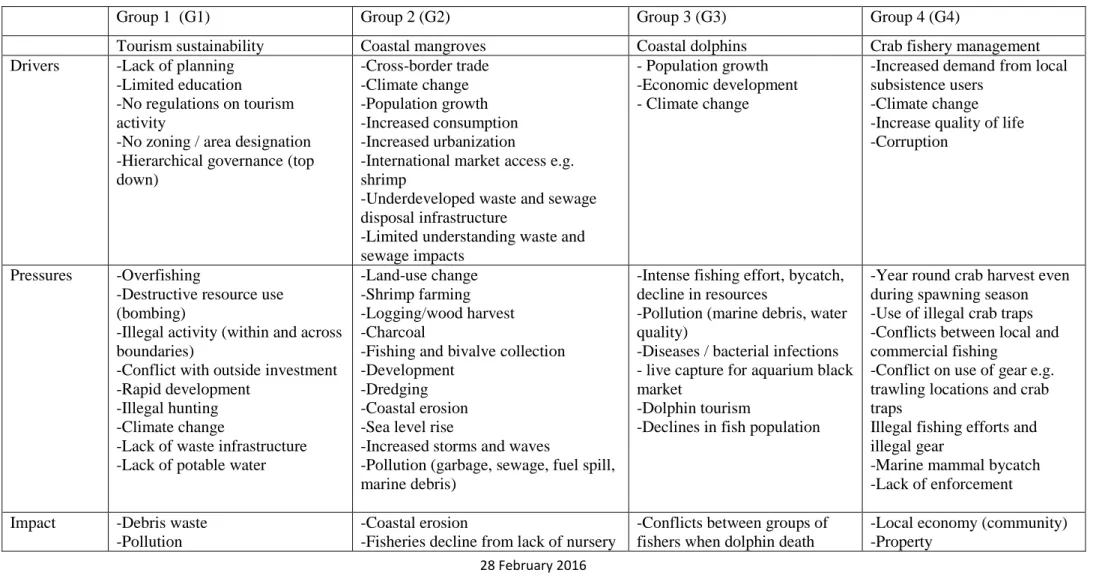
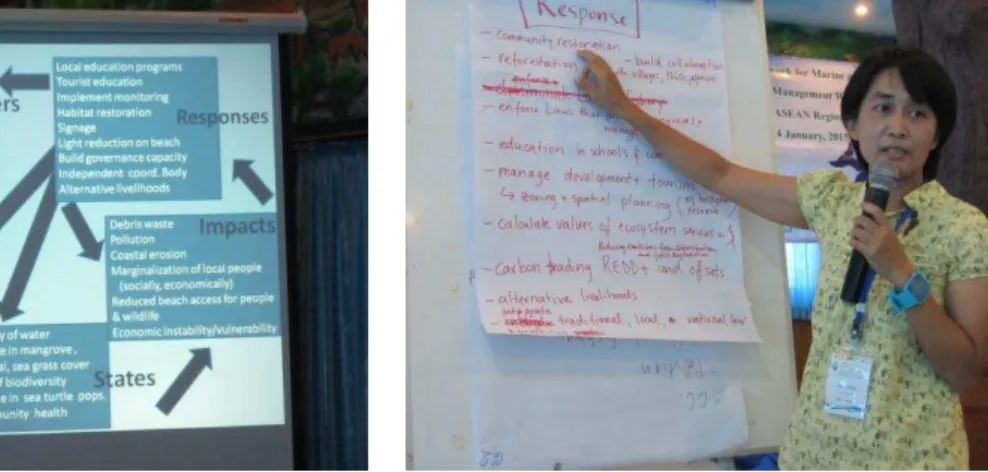
section five. Table 1 illustrates each group's application of the structured DPSIR approach to 229
its particular issue, as reported by the groups (see figures 3-6 for examples of reporting). To 230
succinctly illustrate the complexity of the issues and causal relationships of social-ecological 231
systems characterised by each of the case studies in Table 1, we briefly describe the context 232
of Group Four's (G4) discussion and output focused on the local crab fishery. 233
28 February 2016 Page 9 of 23
Table 1: DPSIR characteristics of four case study issues that challenge sustainability of the Thai-Cambodia coastal zone. The ** symbol 235
represents a section that a group was unable to complete due to time constraints. 236
237
Group 1 (G1) Group 2 (G2) Group 3 (G3) Group 4 (G4)
Tourism sustainability Coastal mangroves Coastal dolphins Crab fishery management
Drivers -Lack of planning -Limited education -No regulations on tourism activity
-No zoning / area designation -Hierarchical governance (top down) -Cross-border trade -Climate change -Population growth -Increased consumption -Increased urbanization
-International market access e.g. shrimp
-Underdeveloped waste and sewage disposal infrastructure
-Limited understanding waste and sewage impacts
- Population growth -Economic development - Climate change
-Increased demand from local subsistence users
-Climate change -Increase quality of life -Corruption
Pressures -Overfishing
-Destructive resource use (bombing)
-Illegal activity (within and across boundaries)
-Conflict with outside investment -Rapid development
-Illegal hunting -Climate change
-Lack of waste infrastructure -Lack of potable water
-Land-use change -Shrimp farming -Logging/wood harvest -Charcoal
-Fishing and bivalve collection -Development
-Dredging -Coastal erosion -Sea level rise
-Increased storms and waves
-Pollution (garbage, sewage, fuel spill, marine debris)
-Intense fishing effort, bycatch, decline in resources
-Pollution (marine debris, water quality)
-Diseases / bacterial infections - live capture for aquarium black market
-Dolphin tourism
-Declines in fish population
-Year round crab harvest even during spawning season -Use of illegal crab traps -Conflicts between local and commercial fishing
-Conflict on use of gear e.g. trawling locations and crab traps
Illegal fishing efforts and illegal gear
-Marine mammal bycatch -Lack of enforcement
Impact -Debris waste
-Pollution
-Coastal erosion
-Fisheries decline from lack of nursery
-Conflicts between groups of fishers when dolphin death
28 February 2016 Page 10 of 23 -Coastal erosion from
development
-Local people marginalized people (economically, culturally / socially)
-Reduced beach access for people and wildlife
-Economic
instability/vulnerability
-Loss of natural waste water treatment functions sediment retention
-Economic loss from decrease in fishing income
-Loss of carbon storage
-Loss of protection from storm and tsunami
-Decrease in biodiversity
-Threatened species e.g. horseshoe crab; river otter
-Seawater intrusion
occurs
-Non-compliance with international regulations -Decline / instability in ecosystem health
-Balance in marine food web -International trade embargo -Religions / culture heritage loss
-Unemployment
-Local fishery community -Local conflicts
State -Water quality
-Change in mangrove, coral, seagrass cover
-Loss of biodiversity
-Decline in marine threatened wildlife (sea turtles, dolphin, dugongs)
-Community health
-Change in area
-Change in diversity (mangrove and animals in mangroves)
-Change in tree density
-Increasing forest fragmentation
-Mortality rate 4% per annum -Thai status: Endangered (official)
-Smaller size caught -Smaller population caught -Degradation of seagrass and mangrove habitat
-
Responses Local education programs -Tourist education (public awareness)
-Implementation of monitoring programs for all states
-Restoration of habitat -Signage / light reduction on beach
-Build governance capacity -Independent coordination body -Alternative livelihoods
-Zero waste system -Climate change resilience programs activities
-Community restoration -Reforestation
-Build collaboration with villages, NGOs, agencies
-Enforce laws that protect mangroves and manage fishery
-Education in schools and communities
-Manage development and tourism through zoning and spatial planning (e.g. biosphere reserve)
-Calculate values of ecosystem services in $
-Reducing emissions from
-Zero waste
-Effective / improved / policies -Effective implementation -Research efforts increase -Public outreach + awareness -Government guidelines (best practice)
-Enforcement
-Transboundary collaborations -Fisheries observer program
-Blue crab bank:
- use trap -6cm mesh size - dynamic population trend - support from FAO -
incentives
- bycatch- other species - stewardship
28 February 2016 Page 11 of 23 deforestation and forest degradation -Carbon trading REDD+ and offsets -Alternative livelihoods
-Integrate traditional, local, national law and practices
-Empowerment of fishery communities
Data gaps
identified
-Need to link past and current monitoring to responses, pressures and drivers framework
- Coastal users behaviour and adaptation. capacity to climate change
- Governance mode assessment -Coastal tourism carrying capacity, coral reef carrying capacity
-At larger scale, strategic
environmental assessment (SEA) needed
- Data on trend in cover, density and fragmentation - field and satellite analysis
-Fishing surveys collecting mudcrab, charcoal and threatened species (horseshoe crab and river otter); - Biodiversity monitoring
- Ecosystem function for wastewater treatment
- Trends in fishing incomes
carbon storage, seawater intrusion -Level of protection from storm and tsunami
- Dolphin population trend - Transboundary movements - Bycatch rates
- Causes of mortality -Environmental toxicology -policy development - Genetics (regional)
- Foraging and dietary studies - Social structure and affiliations -Transboundary outreach - Build transboundary database
28 February 2016 Page 12 of 23
In the crab fishery case study, the Driver was described as overharvesting of fish and shrimp 238
that occurred along this section of the coast due to the rising coastal population and 239
increasing number of large commercial fishing vessels. This in turn put Pressure on the crab 240
fishery as a source of local income and protein, and the State of stocks started to decline, 241
leading to fishermen with unsustainable incomes, moving out of the industry (Impact). Thai 242
regulations that restricted commercial fishing vessels from within three kilometres of the 243
coast were introduced in Response to reduce interference between the commercial trawl 244
fishing and crab fishery. However locals reported that some trawlers (often not from Thailand) 245
used illegal gear and the limit was not enforced, leading to destruction of crab pots in trawl 246
gear. The Impact - Response cycle was repeated as regulations that were introduced to 247
improve crab stocks, restricting crab catch in the spawning season, heavily impacted local 248
fishermen who could not make a living or subsist on seafood during these months. An 249
innovative low technology local response was to continue to harvest out of season, but place 250
female crabs caught with eggs into jetty-side aquaculture tanks (basically buckets with 251
flowing water) until the females released the eggs. Local fishermen then released the larvae 252
into the coastal waters with a resulting increase in the crab stock. With widespread 253
knowledge of improving stocks, some existing fishermen added more pots and new crab 254
fishermen entered the crab fishery, thus increasing the threat to the sustainability of the 255
resource. As a cross-border issue, it was clear that a response solely by Thai government or 256
communities was not a solution in the long term. In addition, the unique local response to 257
building crab stocks and consequent outcomes supported knowledge sharing and transfer 258
among workshop participants. 259
260
Insert Figures 4, 5, 6, 7 here as a group of four 261
262
After constructing a DPSIR framework for each case study, these interdisciplinary cross-263
cultural groups were asked to reflect on their experience of using DPSIR in terms of: 264
what they learned through the DPSIR development process, 265
what potential they see for DPSIR application generally, 266
how this could directly help with their everyday job/research, and 267
28 February 2016 Page 13 of 23
Not all groups responded thoroughly to each reflective question as some groups took longer 269
than others to accomplish the first task. However the reflection is considered to be 270
representative of the cross-section of participants, given the composition of the groups. Table 271
28 February 2016 Page 14 of 23
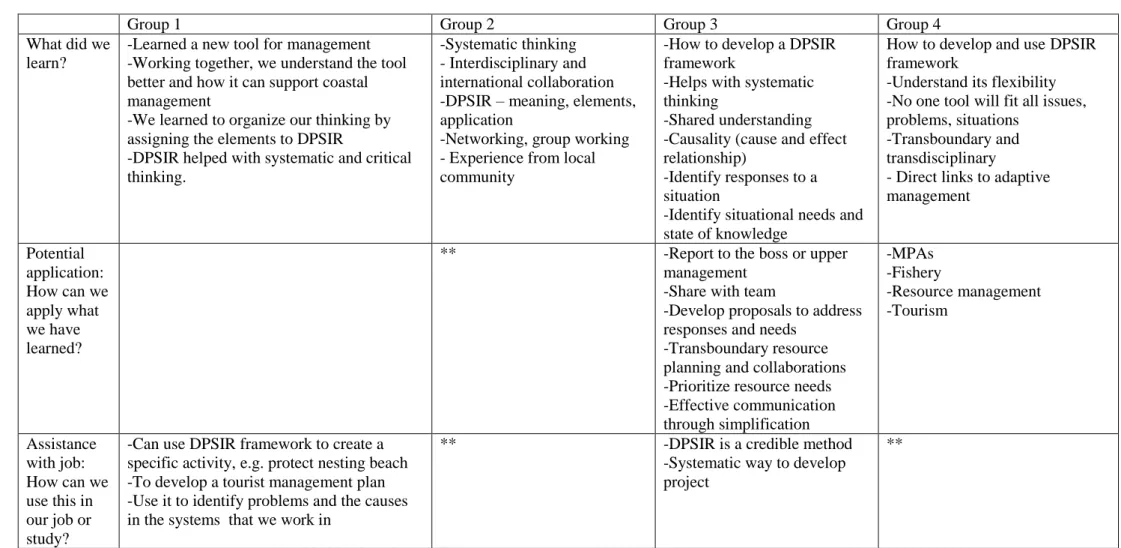
Table 2: Group Reflection on DPSIR training (The ** symbol represents a section that a group was unable to complete due to time constraints) 273
274
Group 1 Group 2 Group 3 Group 4
What did we learn?
-Learned a new tool for management -Working together, we understand the tool better and how it can support coastal management
-We learned to organize our thinking by assigning the elements to DPSIR
-DPSIR helped with systematic and critical thinking.
-Systematic thinking - Interdisciplinary and international collaboration -DPSIR – meaning, elements, application
-Networking, group working - Experience from local community
-How to develop a DPSIR framework
-Helps with systematic thinking
-Shared understanding -Causality (cause and effect relationship)
-Identify responses to a situation
-Identify situational needs and state of knowledge
How to develop and use DPSIR framework
-Understand its flexibility -No one tool will fit all issues, problems, situations
-Transboundary and transdisciplinary
- Direct links to adaptive management
Potential application: How can we apply what we have learned?
** -Report to the boss or upper
management -Share with team
-Develop proposals to address responses and needs
-Transboundary resource planning and collaborations -Prioritize resource needs -Effective communication through simplification
-MPAs -Fishery
-Resource management -Tourism
Assistance with job: How can we use this in our job or study?
-Can use DPSIR framework to create a specific activity, e.g. protect nesting beach -To develop a tourist management plan -Use it to identify problems and the causes in the systems that we work in
** -DPSIR is a credible method
-Systematic way to develop project
28 February 2016 Page 15 of 23 5. Discussion
275 276
This analysis of four coastal zone sustainability issues in Thailand (Table 1) revealed the 277
utility of the DPSIR framework to facilitate and guide systematic and critical thinking in a 278
diverse stakeholder group, multi-disciplinary knowledge exchange, identification of causal 279
relationships, the flexible application at different spatial scales, and the identification of data 280
gaps and actionable strategies. Further, each groups' assessment of their experience of 281
applying the DPSIR framework to a transboundary system (Table 2) provided valuable 282
insight into the learning experience of participants. Below we summarise these findings 283
according to the strengths and limitations of this particular application of DPSIR to a coastal 284
transboundary environment. 285
286
5.1 Strengths of application of DPSIR in this workshop 287
288
We identified five ways in which DPSIR was useful in organizing coastal management 289
problems and identifying potential sustainable solutions. One of the inherent strengths of 290
DPSIR is its ability to simplify and structure complex problems (Gregory et al., 2013, 291
Svarstad et al., 2008). In this regard, the groups identified that DPSIR was a useful tool to 292
help with systematic and critical thinking (Table 2: Groups G1, G2 and G3) about their 293
chosen transboundary coastal management problems (Table 1). While in a traditional DPSIR 294
model, the Drivers can be global, regional or local (Lewison et al., 2016), in all the 295
workshop case studies, Drivers were described as matters that are beyond control of the local 296
area/region scale such as population growth (G2), increased consumerism (G3), lack of 297
regulation (G1), and climate change (G 4). These were seen as causing more specific local 298
and cross-border Pressures such as intensive fishing or overfishing (G1, 3, 4), illegal activity 299
(G1, 4), pollution (G2, 3), and land use change (G2). Resulting changes to the State are 300
typical of most models (Lewison et al., 2016), reporting primarily in terms of the physical 301
environment: habitat decline (G1, 2, 4), water quality (G1), status of endangered species 302
(G1,3), and fisheries resources (G4). Group one was the only group that included a social 303
factor, community health. The Impacts described by each group illustrated the 304
interconnected social-ecological relationships and impact on natural and human well-being. 305
28 February 2016 Page 16 of 23
loss from decreased fishing income (G 1,2, 4) as well as disruption to the social systems 307
described in terms of marginalised locals (G1), and conflicts between groups (G3, 4). 308
309
The use of DPSIR to structure problems and promote critical thinking was well illustrated by 310
Responses, which highlighted actions that could be taken to affect the Drivers and Pressures. 311
These primarily included social-community-governance aspects such as education and 312
awareness programs for local communities, tourists, and schools about the environment, 313
management and regulations (G1, 2, 3, 4); community empowerment and climate change 314
resilience (G1, 2, 4); improved collaboration across borders and among villages, NGOs and 315
agencies, and fishing communities (G2, 3, 4); and building governance capacity including in 316
relation to policy, enforcement, and planning (G 1, 2, 3, 4). Environmental responses 317
included direct action in habitat and fisheries restoration (G1, 2, 4) and research and 318
monitoring (G1, 3). Economic measures were also suggested: carbon trading to reduce 319
emissions from deforestation (G2); valuing ecosystem services (G2); and developing 320
alternative livelihoods (G1, 2, 4). All of the groups agreed on the need for governance 321
capacity building for a more coordinated cross-border enforcement response to improve 322
fisheries management. 323
324
Analysis of the case studies also demonstrates a second strength of DPSIR, as an analytical 325
tool to clarify and understand causal linkages of disparate elements or factors within the 326
coastal system (Lewison et al., 2016). The use of DPSIR in the workshop enabled illustration 327
of social-ecological complexities to more appropriately target practical management 328
Responses. In reflecting about the training (Table 1), G1 and G3 specifically mentioned how 329
DPSIR enhanced their ability to identify cause and effect relationships. Although not 330
mentioned by the other groups, evidence from workshop outputs (Table 1) illustrate that 331
participant groups were able to identify linkages between human activity and environmental 332
issues, such as the link between deforestation and coastal erosion (G2); or overfishing and 333
decreasing stocks and ability to sustain a livelihood (G4). While some of the common 334
Impacts identified across the case studies illustrated the inter-connected social-ecological 335
relationships, a major outcome was the recognition of the importance of social-governance 336
solutions in terms of education, awareness, and capacity building of communities and 337
28 February 2016 Page 17 of 23
339
In terms of this second strength of DPSIR, other authors have found that such cause and 340
effect relationships are often not recognized at the local level. For example Bennett et al. 341
(2015) found that although coastal communities in Thailand identified increasing number and 342
severity of storms, rising sea levels and amplified coastal erosion as major problems, they did 343
not relate these occurrences to global climate change. Lack of ability to make such linkages 344
can inhibit formation and implementation of successful adaptation strategies. 345
346
A third strength of DPSIR demonstrated from this effort was its ability to integrate 347
knowledge across different disciplines (natural and social scientists) and roles (science, 348
policy, and management) (Lewison et al. 2016). Participants reported that working together 349
in groups was considered advantageous in building a shared understanding (G3, Table 2) and 350
improving transboundary knowledge about the common issues, drivers and responses across 351
the ASEAN countries represented (G2, 3, 4, Table 2). The contribution of transdisciplinary 352
expertise (G2, 4, Table 2) was reported as helpful in identifying the causal linkages and 353
determining appropriate Responses. Involving stakeholders from different scientific 354
disciplines meant that Responses, data gaps, and indicators to measure/ monitor included SES 355
systems (Table 1). Involving those with different roles, such as those from local NGOs who 356
work in communities, meant that common issues and relevant strategies were able to be 357
discussed. For example, the solution implemented by the local crab fishing community in 358
conjunction with an NGO in response to depletion of crab stocks represented an innovative 359
integration of scientific and lay knowledge and a lesson to all attendees. Responses captured 360
the need for better policy, community capacity-building as well as research, and placed 361
priorities and feasibility of strategies in context (Table 1). G1, for example, indicated their 362
next step was to train more people in DPSIR and use it to support cooperation among 363
researchers, scientists, managers, and other stakeholders (Table 2). 364
365
The final two benefits of the DPSIR framework that were identified were its ability to foster 366
communication and transparency among stakeholders (Lewison et al., 2016) through 367
simplification of complex problems, and identify knowledge gaps and needs. G1 and G3 368
(Table 2) suggested that DPSIR would enable them to communicate a complex problem 369
28 February 2016 Page 18 of 23
use a tool that would enable them to discover solutions for themselves: groups acknowledged 371
the desire to share it with others in their workplace and community. 372
373
While many countries aim to monitor the State of the environment, DPSIR is often a starting 374
point for development of appropriate indicators to measure the five components of the 375
framework (Lewison et al., 2016). Workshop groups acknowledged a scoping role by 376
suggesting that applying DPSIR would help identify which factors to measure and prioritise 377
resource needs (G1, 3, Table 2). Detailed research gaps or needs were identified separately 378
as well as in the Responses phase of the DPSIR application (Table 1). It was generally 379
acknowledged that there were less environmental data available in Cambodia. While two of 380
the groups (G2, 3) focussed on environmental data gaps, G1 took greater advantage of the 381
DPSIR analysis. G1 indicated that Thailand has good environmental monitoring data of the 382
State but needed to make better linkages with pressures, drivers and responses. This would 383
include understanding coastal users' behaviour and ability to adapt to climate change, and 384
determining which governance modes would enhance sustainability. An interdisciplinary 385
study of coastal tourism carrying capacity was also suggested. There are many examples of 386
these kinds of initiatives in the literature, including this geographical area (e.g. Roman et al., 387
2007). Without the prompting of the DPSIR framework it is unlikely that this research need 388
would be identified or the literature explored. 389
390
Finally, one of the best indicators of workshop impact is the process of change initiated in the 391
host country of Thailand since the workshop. Even though the Thai Department of Marine 392
and Coastal Resources (DMCR) has been monitoring the State of the coast’s biophysical 393
features (coral, mangrove and seagrass health) for more than ten years, there had been little 394
linkage of these States to Drivers, Pressures and Responses. This limited the appropriate 395
targeting of management actions. Applying the DPSIR framework in the workshop 396
highlighted these relationships. After participating in the workshop, DMCR held two DPSIR 397
workshops with all 24 provincial marine and coastal resources committees (MCRC) early in 398
2016. DMCR aims that MCRCs will apply the DPSIR framework to produce marine and 399
coastal status reports for all 24 coastal provinces in Thailand by end of 2016. Once completed, 400
the Responses will be combined in a strategic plan with priority actions for managing marine 401
28 February 2016 Page 19 of 23
403
5.2 Limitations of DPSIR for workshop training 404
405
The previously described (Gari et al., 2015) limitations with DPSIR were not as apparent in 406
this application. While DPSIR has been criticised for lack of explicit hierarchy or scales, this 407
flexibility was appreciated as a benefit in this study. Flexibility enabled a plurality of 408
approaches (e.g. scales) to identify actions that might have the most effect across a range of 409
issues. G4 (Table 2) highlighted the tool's flexibility in application: it was applied 410
successfully to four different coastal issues, characterised by both large spatial scale (e.g. 411
mangrove destruction and introduction of shrimp farming) and local scale (crab fishery) 412
issues, as well as highly mobile species (e.g. dolphins, fish) and sessile ones (e.g. corals, 413
mangroves) (Table 1). It resulted in a range of social, environmental and economic 414
Responses. A possible issue with inconsistent use of terminology was minimised through 415
training, by ensuring a common understanding of terms early in the workshop and trainers 416
being part of each case study group. Otherwise the workshop did not reveal instances of 417
some of the other limitations of the framework that have been identified such as 418
unidirectional relationship and an inability to generate neutral knowledge. In hindsight 419
though, more structured time should be allocated to reflection and evaluation at such 420
workshops. 421
422
The facilitators' observation was that the DPSIR framework was suitable for bringing 423
together the range of stakeholders from different disciplines, roles, and countries, to derive 424
sustainable solutions for the coastal zone. Four days was considered the minimum time for 425
such a workshop, given it was the first time most of the participants had met each other and 426
time was spent sharing information about common issues in each country. Furthermore 427
participants conversed in English, the common regional language, but second or third 428
language of most of the SEAsian participants. Feedback from the groups indicated a desire to 429
take the tool back to their own colleagues, where it is expected that building understanding of 430
DPSIR and exploring the causal relationships could be done quickly among those who 431
already work together and/or understand local issues. In Thailand, it is expected that 432
embedding DPSIR within a formal institutional process for coastal reporting and strategic and 433
28 February 2016 Page 20 of 23
to bring the group together again once more data have been gathered and work through each 435
step in greater detail in relation to specific issues. This need was effectively enunciated by 436
G2 in its identification of existing data and data gaps for each stage of DPSIR (Table 1). 437
438
6. Conclusion
439 440
The inherent strengths of the DPSIR framework make it suitable to engage stakeholders from 441
different disciplines and roles to discuss coastal management sustainability. The utility of the 442
DPSIR framework was identified by participants as a tool that supported systematic and 443
critical thinking, recognition of causality, transdisciplinary knowledge exchange, and the 444
identification of data gaps and other needs, such as capacity building. In this context, we 445
show the suitability of DPSIR as a tool for analysis and communication, and to promote 446
discussion. The application of DPSIR to challenges of cross-border, socio-ecological systems 447
in Thailand and Cambodia demonstrated: the strengths and limitations of the framework; the 448
support for multidisciplinary knowledge sharing; the utility of scientific and stakeholder 449
participation; the individuality and flexibility of approaches (e.g. spatial scales); and its 450
potential use to identify both data-gaps and actionable management strategies. Our results 451
suggest a role for applying the DPSIR framework to a problem iteratively as more data 452
become available, to more finely direct decisions at both cross-border and local levels. 453
Further monitoring of institutional processes in Thailand will reveal whether causal linkages 454
and the range of social-ecological data are well identified through embedding DPSIR within 455
the provincial coastal planning processes. 456
457
Our workshop enabled an international team of researchers and local stakeholders to refine a 458
model of the interactions between primary drivers among coupled ecological, biophysical, 459
social, governmental, economic factors that influence resilience in two geographically 460
adjacent study sites, which typify the challenges faced in tropical coastal zones worldwide. 461
As a critical instrument for strategic decision-support, DPSIR provided the foundation for 462
prioritising data needs and investigating feasibility of site specific actions. 463
464
Acknowledgements 465
Thailand Department of Marine and Coastal Resources, the University of the Sunshine Coast 466
28 February 2016 Page 21 of 23
support for speakers and participants to cover travel costs for the duration of the workshop 468
training. This research was supported by the National Socio-Environmental Synthesis Center, 469
SESYNC (NSF Award # DBI-1052875). 470
471
References 472
Adger, W.N., 2009. Social vulnerability to climate change and extremes in coastal Vietnam. World
473
Development 27, 249-269. 474
Adger, W.N., Hughes, T.P., Folke, C., Carpenter, S.R., Rockstrom J., 2005. Social- Ecological resilience to coastal
475
disasters. Science 309, 1036-1039.
476
Adger, W.N, Kelly, P.M, Ninh N., 2001. Living with environmental change: social vulnerability, adaptation and
477
resilience in Vietnam. edited by W. N. Adger, P.M. Kelly and N. H. Ninh. Routledge, U.K.
478
Beger, M., Grantham, H.S., Pressey, R.L., Wilson, K.A., Peterson, E.L., Dorfman, D., Mumby, P.J., Lourival, R.,
479
Brumbaugh, D.R., Possingham, H.P., 2010. Conservation planning for connectivity across marine,
480
freshwater, and terrestrial realms. Biological Conservation 143, 565 575.
481
doi:10.1016/j.biocon.2009.11.006
482
Bell, S., 2012. DPSIR = a problem structuring method? An exploration from the "Imagine" approach. European
483
Journal of Operational Research 222, 350-360.
484
Bennett, N.J., Dearden, P., Murray, G. & Kadfak, A., 2014. The Capacity to Adapt?: Coastal Communities in a
485
Changing Climate, Environment, and Economy on the Andaman Coast of Thailand, Ecology and Society
486
19 (2): 5.
487
Bennett, N., Dearden, P., Peredo, A.M., 2015. Vulnerability to multiple stressors in coastal communities: A
488
study of the Andaman Coast of Thailand. Climate and Development 7(2): 124-141.
489
Cheevaporn, V., and Menasveta P., 2003, Water pollution and habitat degradation in the Gulf of Thailand,
490
Marine Pollution Bulletin 47, 43-51.
491
Chua, T-E., Garces L.R., 1994. Marine Living Resources Management in the ASEAN Region: Lessons learned and
492
the integrated management approach. In Ecology and Conservation of Southeast Asian Marine and
493
Freshwater Environments Including Wetlands, edited by A. Sasekumar, N. Marshall, and D. J.
494
MacIntosh, 257-270, Belgium: Kluwer Academic Publishers.
495
Cook, G.S., Fletcher, P.J. and Kelble, C.R., 2014. Towards marine ecosystem based management in South
496
Florida: investigating the connections among ecosystem pressures, states, and services in a complex
497
coastal system. Ecological Indicators 44, 26-39.
498
Dearden P., S. Gauntlet, S., Nollen B., 2009. Developing partnerships for conservation in the Cardamom
499
Mountains, Cambodia. In Tropical Forestry in a Changing World: Protected Areas and Sustainable
500
Tourism. Ed by L. Puangchit and S. Diloksumpun. FORTROP II International Conference, Kasetsart
501
University, Bangkok pp 53-68.
502
Denzin, N. K., Lincoln, Y. S., 2011. The SAGE Handbook of qualitative research (4th ed.). Los Angeles: Sage
503
Publications.
504
de Walque, D., 2006. The socio-demographic legacy of the Khmer Rouge period in Cambodia. Population 505
Studies 60, 223-231. 506
Ellison J., 2015. Vulnerability assessment of mangroves to climate change and sea-level rise impacts, Wetlands
507
Ecological Management, 23, 115-137. DOI 10.1007/s11273-014-9397-8
508
Espinoza-Tenorio, A., Montaño-Moctezuma, G., Espejel, I., 2010. Ecosystem-Based Analysis of a Marine
509
Protected Area Where Fisheries and Protected Species Coexist. Environmental Management 45, 739
510
750. doi:10.1007/s00267-010-9451-0
511
Fletcher, P.J., Kelble, C.R., Nuttle, W.K., Kiker, G.A., 2014. Using the integrated ecosystem assessment
512
framework to build consensus and transfer information to managers. Ecological Indicators 44, 11 25.
513
doi:10.1016/j.ecolind.2014.03.024
514
Gari, S.R., Newton, A., Icely, J.D., 2015. A review of the application and evolution of the DPSIR framework with
515
an emphasis on coastal social-ecological systems. Ocean & Coastal Management 103, 63-77.
516
Gentry-Shields, J., Bartram, J., 2014. Human health and the water environment: using the DPSEEA framework
517
to identify the driving forces of disease. Science of The Total Environment 468 469, 306-314.
28 February 2016 Page 22 of 23
Gregory A.J., Atkins J.P., Burdon D., Elliott M., 2013. A problem structuring method for ecosystem-based
519
management: the DPSIR modelling process. European Journal of Operational Research 227, 558-569.
520
Halpern, B.S., Ebert, C.M., Kappel, C.V., Madin, E.M.P, Micheli,F., Perry, M., Selkoe, K.A., Walbridge, S.,.2009.
521
Global priority areas for incorporating land sea connections in marine conservation. Conservation
522
Letters 2,189 196.
523
Hines, E., Reynolds, J., Mignucci-Giannoni, A, Aragones, L.V., Marmontel M., 2012. Sirenian Conservation:
524
Issues and Strategies in Developing Countries. Edited Volume. The University Press of Florida,
525
Gainesville, USA.
526
Hughes, J.W., 2013. Environmental Problem Solving a How-To Guide. University of Vermont Press, Lebanon.
527
Kirkman, H., Kirkman, J., 2000. The management of seagrasses in South East Asia and Australia. Biologica
528
Marina Mediterranea 7, 305-319.
529
Lewison, R.L., Rudd, M.A., Al-Hayek, W., Baldwin, C., Beger, M., Lieske, S.N., Jones, C., Satumanatpan, S.,
530
Junchompoo, C., Hines, E., 2016. How the DPSIR framework can be used for structuring problems and
531
facilitating empirical research in coastal systems. Environmental Science and Policy 56, 110 119.
532
Liu, J., Dietz, T., Carpenter, S.R., Folke, C., Alberti, M., Redman, C.L., Schneider, S.H, Ostrom, E., Pell, A.N.,
533
Lubchenco, J., Taylor, W.W., Ouyang, Z., Deadman, P., Kratz, T. and W. Provencher. 2007a. Coupled
534
Human and Natural Systems. Ambio. 36, 639-649.
535
Lowe, C.D., Gilbert, A.J., Mee, L.D., 2014. Human environment interaction in the Baltic Sea. Marine Policy 43,
536
46 54. doi:10.1016/j.marpol.2013.03.006
537
MacKinnon, J., Verkuil, Y.I. & Murray, N. 2012. IUCN situation analysis on East and Southeast Asian intertidal
538
habitats, with particular reference to the Yellow Sea (including the Bohai Sea). Occasional Paper of the
539
IUCN Species Survival Commission No. 47. IUCN, Gland, Switzerland and Cambridge, UK. ii + 70 pp.
540
Mathew, S., 2003. Small-scale fisheries perspectives on an ecosystem-based approach to fisheries
541
management. In Responsible Fisheries in the Marine Ecosystem, edited by M. Sinclair and G.
542
Valdimarsson, 47 63. Rome, Italy, and Wallingford, UK: FAO and CAB International.
543
Nash, J., 2008. Transdisciplinary training: key components and prerequisites for success. American Journal of
544
Preventative Medicine, 35, 133-140.
545
Ness, B., Anderberg S., Olsson L., 2010. Structuring problems in sustainability science: the multi-level DPSIR
546
framework. Geoforum 41, 479-488.
547
Nicholls, R.J., Wong P.P., Burkett, V.R., Codignotto, J.O., Hay, J.E., McLean, R.F., Ragoonaden, S., and
548
Woodroffe, C.D., 2007. Coastal systems and low-lying areas. Climate Change 2007: Impacts,
549
Adaptation and Vulnerability. Contribution of Working Group II to the Fourth Assessment Report of
550
the Intergovernmental Panel on Climate Change, edited by M.L. Parry, O.F. Canziani, J.P. Palutikof, P.J.
551
van der Linden and C.E. Hanson, Cambridge University Press, Cambridge, UK, 315-356.
552
Orchard, S., Stringer L., Quinn, C., 2016. Impacts of aquaculture on social networks in the mangrove systems of
553
northern Vietnam, Ocean and Coastal Management, 114, 1-10.
554
http://dx.doi.org/10.1016/j.ocecoaman.2015.05.019 .
555
Ostrom, E., 2009. A General Framework for Analyzing Sustainability of Social-Ecological Systems. Science 325,
556
419 422. doi:10.1126/science.1172133
557
Pauly, D. 2006. Major trends in small-scale marine fisheries, with emphasis on developing countries, and some
558
implications for the social sciences. Maritime Studies 4, 7 22.
559
Pomeroy, R.S. Viswanathan, K., 2003. Fisheries co-management developments in South-east Asia and
560
Bangladesh. In The Fisheries Co-management Experience: Accomplishments, Challenges and
561
Prospects, edited by D.G. Wilson, J. Raakjaer-Nielsen, and P. Degnbol, 99 118. Dordrecht, The
562
Netherlands: Kluwer Academic Publishers.
563
Ramesh, R., Lakshmi, A., Purvaja, R., 2011. 11.10 Integrated Coastal and Estuarine Management in South and
564
Southeast Asia, Volume 11: Management of Estuaries and Coasts 227-263.
565
Roman, G., Dearden, P., and Rollins, R., 2007. Application of Zoning and L of Acceptable C to
566
Manage Snorkeling Tourism. Environmental Management 39, 819-830.
567
Rudd, M.A., 2011. How research-prioritization exercises affect conservation policy. Conservation Biology 25,
568
860 866. doi:10.1111/j.1523-1739.2011.01712.x
569
Rudd, M.A., 2015. Scienti policy interface. Global Environmental Change 33,
570
44 60. doi:10.1016/j.gloenvcha.2015.04.006
571
Smeets, E., Weterings, R., 1999. Environmental indicators: typology and overview. European Environment
572
Agency, Copenhagen.
28 February 2016 Page 23 of 23
Svarstad, H., Petersen, L.K., Rothman, D., Siepel, H., Wätzold, F., 2008. Discursive biases of the environmental
574
research framework DPSIR. Land Use Policy 25, 116 125. doi:10.1016/j.landusepol.2007.03.005
575
Talley, D.M., North, E.W., Juhl, A.R., Timothy, D.A., Conde, D., deBrouwer, J.F.., Brown, C.A., Campbell, L.M.,
576
Garstecki, T., Hall, C.J., Meysman, F.J.., Nemerson, D.M., Souza Filho, P.W., Wood, R.J., 2003. Research
577
challenges at the land sea interface. Estuarine, Coastal and Shelf Science 58, 699 702.
578
doi:10.1016/j.ecss.2003.08.010
579
Tscherning K., Helming K., Krippner B., Sieber S., Paloma S.G., 2012. Does research applying the DPSIR
580
framework support decision making? Land Use Policy 29, 102-110.
581
UNEP, 2012. Global Environmental Outlook 5, United Nations Environment Programme, Nairobi.
582
Walker, B., Holling, C. S., Carpenter, S. R., Kinzig, A., 2004. Resilience, adaptability and transformability in
583
social ecological systems. Ecology and Society, 9, 5.
584
Walker, B., Meyers, B., 2004. Thresholds in ecological and social ecological Systems: A developing database.
585
Ecology and Society 9, 3.
586
Wise, R.M., Fazey, I., Stafford Smith, M., Park, S.E., Eakin, H.C., Archer Van Garderen, E.R.M., Campbell, B.,
587
2014. Reconceptualising adaptation to climate change as part of pathways of change and response.
588
Global Environmental Change 28, 325 336. doi:10.1016/j.gloenvcha.2013.12.002
589
Yasue, M., Dearden, P., 2009. The importance of supratidal habitats for wintering shorebirds and the potential
590
impacts of intensive shrimp aquaculture. Environmental Management. 43, 1108-1121.
Figure 4 - Group two reporting on 'Response' to coastal vegetation issues
Figure 5 - Group three reporting on application of DPSIR to cetaceans
Figure 3 - Group one reporting on application of DPSIR to tourism sustainability
Figure 6 - Group four comments on 'Pressures' on the crab fishery