Int. J. Electrochem. Sci., 12 (2017) 2552 – 2562, doi: 10.20964/2017.03.02
International Journal of
ELECTROCHEMICAL
SCIENCE
www.electrochemsci.org
Electrochemical Determination of Caffeine in Oolong Tea Based
on Polyelectrolyte Functionalized Multi-Walled Carbon
Nanotube
Yan Zhang#, Jin Shang#, Bo Jiang, Xianrong Zhou* and Jianhua Wang*
College of Life Science and Technology, Yangtze Normal University, Chongqing, 408100, P. R. China
#
These authors contribute equally
*
E-mail: [email protected]; [email protected]
Received: 1 December 2016 / Accepted: 29 December 2016 / Published: 12 February 2017
In the present work, a voltammetric sensor for detection of caffeine was prepared by modifying a glassy carbon electrode with Nafion and PDDA-MWCNT. This sensor shows high sensitivity for caffeine determination in the range from 0.3 to 80 μM, and the detection limit is 0.05 μM. Moreover, the sensor exhibits good stability, reproducibility and high activity for electrochemical oxidation of caffeine. Thus, it is available for the quantitative analysis of caffeine in Oolong tea.
Keywords: Caffeine; Poly(diallyldimethylammonium chloride); Multi-walled carbon nanotube; Oolong tea; Electrocheimcal sensor
1. INTRODUCTION
4.0% [12, 13]. It is harmful for human health by stimulating heart [14, 15], the central nervous system [16, 17] and respiratory system [18]. Nevertheless, it has delaying fatigue effect and can act as a diuretic [19].
So far, a variety of methods have been utilized for analysis of caffeine in divers beverages including cola, coffee and tea, for instance high performance liquid chromatography (HPLC) [12, 20], capillary chromatography [21], capillary electrophoresis [22], spectroscopy [23, 24] and liquid chromatography–tandem mass spectroscopy (LCMS) [25]. However, analysis of caffeine using those method has many drawbacks, for example high-cost instruments, long analysis time, short column life time, highly skilled technicians, etc. In contrast, electrochemical methods are low-cost, convenient and available to decrease the analysis time [26].
In recent years, utilizing of multiple kinds of polymer to modify electrodes draw much more attention. Those polymer modified electrodes often show not only high activity, good stability and reproducibility, but also have good homogeneity in electrochemical deposition and strong adherence to the electrode surface [27-35]. However, polymer modified electrodes used in electrochemical analysis methods for the detection of caffeine were rarely reported [36-40]. Moreover, one dimensional nano-materials such as CNTs have drawn much attention due to the potential applications in nanoscale sensor devices. CNTs is one of the most popular allotropes of carbon. It is contributed to promote electron transfer of various biomolecules [41, 42]. In addition, it is with high electronic conductivity, chemical stability and extremely high mechanical strength and modulus [43]. Thus, CNTs are widely used for the modification of electrodes and improvement of electrochemical sensors. There are two kinds of CNTs. One is single-walled carbon nanotubes (SWCNTs) which is formed by seamlessly rolling a single graphene sheet in a certain direction with closed ends. The other is multi-walled carbon nanotubes (MWCNTs) which is constructed by several concentric graphene layers [44].
Many kinds of CNTs composite materials were reported to modify electrodes for the analysis of catecholamine and related compounds, for example polymer nanocomposite electrodes, CNT-paste electrodes, CNT/sol–gel nanocomposite electrodes and CNT film electrodes [45]. However, utilizing of poly(diallyldimethylammonium chloride) (PDDA) fictionalized MWCNT (donated as PDDA-MWCNT) to modify GC electrodes for the electrochemical analysis of caffeine is not reported. Hence, in the present work, we develop a polyelectrolyte modified MWCNT which can effectively lower the oxidation potential of caffeine without a significant influence on the background current. 2. EXPERIMENTS
2.1. Chemicals
Multi-walled carbon nanotubes (MWNTs, Shenzhen Nanotech Port Co., Ltd.) were purchased and then fluxed in a solution of 3 M nitric acid for 10 h before use in order to shorten the MWNTs. After this treatment, oxygen-containing moieties were produced at the ends of nanotubes. Poly(diallyldimethylammonium chloride) (Mw: 200 000–350 000), ascorbic acid, and dopamine, were
2.2. Preparation of assembled MWNT films
Glassy carbon electrodes (diameter: 3 mm) donated as GC electrodes were perchased from Bioanalytical Systems Inc., and then were employed as a substrate to grow multilayer MWNT films. Before using, GC electrodes were firstly polished by emery paper, and then were washed by a slurry of alumina fine powders (0.05 and 1 μm) using a polishing cloth. After that polished-electrodes were treated in an ultrasonic bath with doubly distilled water for 10 min. For the preparation of multilayer PDDA/MWNT films, briefly, shortened MWNTs (1.0 mg) were dispersed in borate buffer (1.0 mL, pH=9.18) and then were treated in an ultrasonic bath for 10 min forming a mixture with black colour. A positively charged aqueous solution of 0.2 wt.% PDDA were prepared by mixing with 0.5 M NaCl which is beneficial to the formation of uniform multilayer by increasing amount of polyelectrolyte deposition [46]. GC electrodes were alternately dipped into the PDDA solution and the negatively charged MWNT containing mixture for 30 min for each time. After each dipping step, films were washed with distilled water and dried in nitrogen condition. The PDDA/MWNT films with multiple layers were grown on the surface of GC electrodes. As-prepared electrodes with five layers of PDDA and MWNT each (donated as (PDDA/MWNT)5/GC electrode) was used for the further experiments.
2.3. Characterizations
Scanning electron microscopy (SEM. Hitachi S4300-F microscope, Hitachi Inc., Tokyo, Japan) was employed to characterize the assembled MWNT films. In this work, a silicon wafer, which was processed first with a piranha solution composed of the mixture of 30% H2O2 and concentrated H2SO4
with a volume ratio of 1 to 3 and then washed by the distilled water completely, was used to mimic the surface of GC. Besides, the silicon wafer with pre-treatment was dipped into the solution containing MWNT and PDDA alternatively and then washed with water. After that, it was dried with a nitrogen flow.
2.4. Electrochemical measurement
CHI650A electrochemical workstation (CHI Instrumental, Shanghai, China) was employed to carry out the electrochemical measurements, where a conventional three-electrode system was utilized. Ag/Ag, a platinum and a glassy carbon with a diameter of 3 mm modified with PDDA-MWCNT were used as the reference electrode, auxiliary electrode and working electrode, respectively. The electrochemical impedance spectroscopy (EIS) was performed at current voltage of 5.0 mV with a frequency ranging from 0.1 Hz to 10 kHz, where a mixture of K3Fe(CN)6/K4Fe(CN)6 (1:1) with a
3. RESULTS AND DISCUSSION
The oxidation process was employed to purify the carbon nanotube. It was demonstrated previously that this process could remove primarily the amorphous carbon and metal catalyst. Besides, it also could induce the partial oxidation of the carbon atoms to form the oxygen-based groups including the carboxylic acid groups, especially for the open ends of the nanotubes [47]. Moreover, in the aqueous solution where the pKa was around 2.0, the formed groups at the MWCTNs were negative charge. Consequently, they would interact with polyelectrolyte PDDA which was positive charge. MWCNTs were anchored by such electrostatic interaction between PDDA and the shortened MWCNTs, where a stably and homogeneously assembled composites of MWNTs in nanoscale on the GC electrodes was eventually generated through the layer-by-layer growth of PDDA and MWCNT films. The morphology of the PDDA/MWCNT multilayer characterized by scanning electron microscopy was depicted in Figure 1A, where the SEM of MWCNT/Nafion composite was conducted as reference (Figure 1B). To prepare the composite of MWNT and Nafion, MWCNTs were first dispersed into the Nafion solution in ethanol (0.5 wt. %) and then the formed dispersion was deposited on the substrate and evaporated. According to the SEM images, most part of the substrate was covered with the homogenous MWCNTs after the assembly of five layers of PDDA and MWCNT. The electrostatic interaction inherent between the shortened MWNTs and PDDA and the feature of LBL method used are mainly responsible for the adsorbed form of the MWNT. Consequently, the GCE after the modification with five bilayers of MWCNT and PDDA was employed in the following electrochemical experiments. Additionally, the growth of MWCNTs on the substrate was monitored closely. The MWCNTs with a diameter of 30-80 nm and a length of 0.5-1 mm was found to be dispersed on the surface in low distribution, where most of the immobilized MWCNTs exhibited the morphology of small bundles or single tubes, which was significantly obvious when confining CNTs through the present methods. For example, the distribution of binding with bromoform and mineral oil or entrapping with polymeric matrix were not so good. Besides, the confined CNTs, which were primarily in the form of large bundles, could not be employed in the electrochemical reactions thoroughly and effectively.
[image:4.596.51.544.556.740.2]
Figure 1B illustrated the characteristic instance, which was given by MWNTs combined with Nafion. It was obvious that the distribution of the MWNTs combined with Nafion film was higher than those assembled through the LBL method. In this work, the absorbed form of the MWNTs, which were mostly single tubes and small bundles, were primarily induced by the characteristics of the employed LBL approach as well as the inherent electrostatic interaction between PDDA and the shortened MWNTs. Such small bundles and single nanotubes homogeneously and stably distributed and assembled on GC electrode are believed to be very attractive for various electrochemical applications, in particular for the improvement of the biosensors and electrochemical sensors, as every assembled nanotubes were completely and easily accessible to various analytes. Hence, they could be employed as the electrochemical sensing unit and yield higher signal to noise ratio for the electrochemical determinations, compared to which with large bundles of MWNTs.
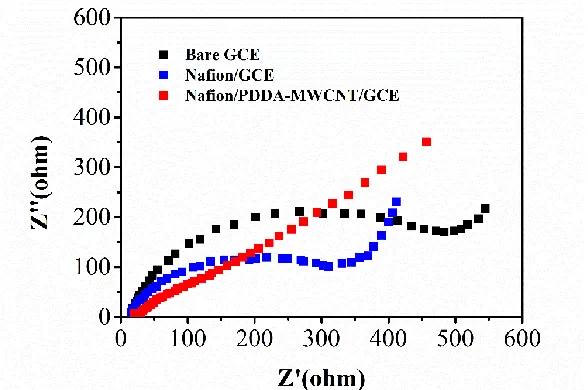
The electrochemical impedance spectroscopy (EIS) was used to characterize the electrode, which provided information of the impedance variations of the surface of the electrode. Figure 2 clarified the Nyquist plots of the impedance spectra in solution of K3/K4Fe(CN)6 (1:1) with a concentration of 5 mM with KCl (0.2 M) at bare GCE, Nafion/GCE as well as Nafion/PDDA-MWCNT/GCE, where the open circuit potentials were 0.251 V, 0.244 V and 0.247 V, respectively. The electron transfer resistance (Rct) was measured to be 91 Ω, 2540 Ω and 980 Ω at the bare GCE, Nafion/GCE and Nafion/PDDA-MWCNT/GCE, respectively, after the optimization of the equivalent and calculation. A significant increase of Rct was observed when depositing Nafion on the GCE surface, whereas a remarkable decrease of Rct was observed when immobilizing PDDA-MWCNT on the surface of the electrode modified with Nafion film. The electron transfer kinetics of the redox probe at the electrode was determined by this resistance, which indicated that the Rct could be decreased by the addition of PDDA-MWCNT owing to its electro-conductibility, where Nafion facilitated the attachment of MWCNT onto the surface of GCE. Moreover, as expected, the composite film of Nafion and PDDA-MWCNT was immobilized on the surface of GCE.
Figure 2. Nyquist plots of EIS obtained at bare GCE, Nafion/GCE and Nafion/PDDA-MWCNT/GCE in the solution of Fe(CN)63−/4− with a concentration of 1.0 mM. EIS parameters: frequency
[image:5.596.152.446.512.707.2]
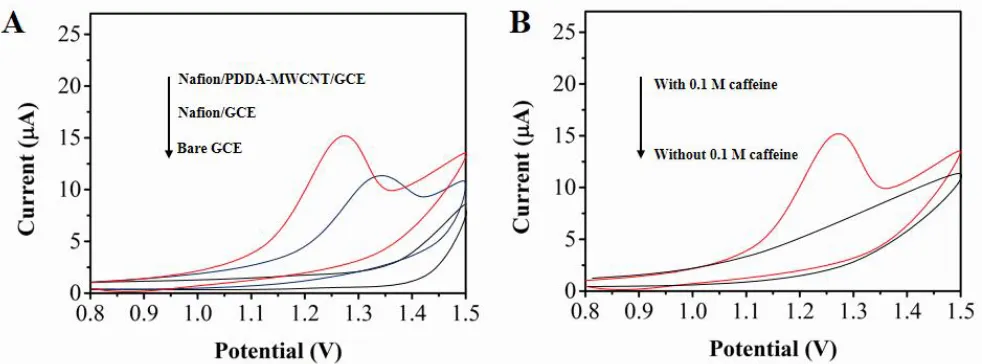
Cyclic voltammetry (CV) was used to analyse the response of caffeine at various electrodes. The Voltammograms of caffeine with a concentration of 0.01 M in H2SO4 with a concentration of 0.1
M at the bare GCE, Nafion/GCE and Nafion/PDDA-MWCNT/GCE was illustrated in Figure 3A, where the scan rate was 100 mV/s. It was obvious that no redox of caffeine was observed at the bare GCE when the potential window was in the range of 0.8 to 1.5 V. However, for both Nafion/GCE and Nafion/PDDA-MWCNT/GCE, an anodic peak of caffeine was found under the same conditions, which might be caused by the pre-concentration action of Nafion towards caffeine at the surface of the film. Moreover, compared to Nafion/GCE, a significant enhancement of the peak current was obtained with Nafion/PDDA-MWCNT/GCE, indicating that Nafion/PDDA-MWCNT/GCE exhibited a remarkable electrochemical behaviour compared with either GCE or Nafion/GCE, at least at this case. The advantages of PDDA-MWCNT, which could serve as an outstanding electrochemical oxidizer for caffeine, was highlighted through the comparison with Nafion/GCE. The PDDA dispersed MWCNT is an idea candidate for the electrochemical application due to the high electro-active surface area with the large surface area. Figure 3B illustrated the comparison of the cyclic voltammograms at Nafion/PDDA-MWCNT/GCE in H2SO4 with a concentration of 0.1 M with and without caffeine in a
concentration of 0.01 M, where the scan rate was 100 mV/s. Indeed, the peak was originated form the oxidation of caffeine, as no redox peak was observed with Nafion/PDDA-MWCNT/GCE in the blank solution. Besides, it was demonstrated that the oxidation process of caffeine at Nafion/GCE or Nafion/PDDA-MWCNT/GCE was non-reversible, which was in accordance with the results reported previously [48].
Figure 3. (A) Cyclic voltammograms collected at the bare GCE, Nafion/GCE and Nafion/PDDA-MWCNT/GCE in H2SO4 (0.1 M) containing caffeine (0.01 M), scan rate 100 mV/s. (B) Cyclic
voltammograms of Nafion/PDDA-MWCNT/GCE in the presence and absence of caffeine (0.01 M).
[image:6.596.55.546.427.609.2]
oxidation of caffeine, which would adhere to the surface of the electrode, may inhibit the access of caffeine, whereas the surface of the electrode was regenerated after being stirred for a certain time. Thus, the equilibrium condition would be obtained when reaching a certain time. Besides, the equilibrium condition could be obtained more quickly when the concentration was higher as expected. However, 400 s was sufficient even through the analysed concentration was the lowest. Consequently, all the reported data were recorded after immersing the Nafion/PDDA-MWCNT/GCE in the analysed solution for 400 s.
The supporting electrolyte was optimized for caffeine, where preliminary experiments were carried out. Diverse kinds of acids (0.1 M) were investigated as the available supporting electrolytes, such as CH3COOH, HCl, HNO3 and H2SO4. The results indicated that H2SO4 with a concentration of
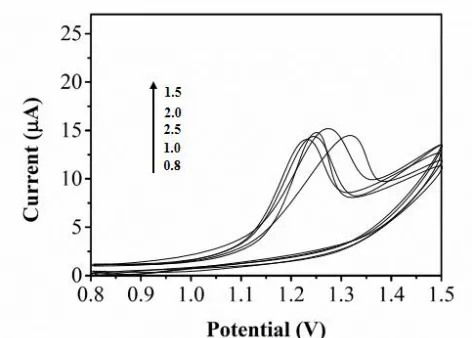
0.1 M was selected as the optimized medium, where the best compromise was obtained between the reproducibility and sensitivity of the signal. The peak potentials as well as the currents of caffeine was affected by the pH of the sulfate solution. In Figure 4, both the peak potentials and currents reduced when the pH of the solution increased in the range of 0.8 to 2.5. Hence, the most proper value was determined to be pH 1.5 because of the outstanding peak response. Moreover, according to the literature, caffeine showed a stable property under the low pH condition [49-51].
Figure 4. The cyclic voltammograms of Nafion/PDDA-MWCNT/GCE in H2SO4 in the presence of
caffeine with a concentration of 0.02 M at diverse pH of 0.8, 1.0, 1.5, 2.0, 2.5, scan rate 100 mV/s.
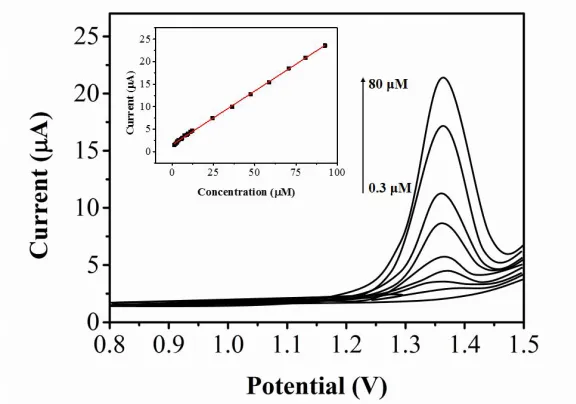
The differential pulse voltammetry (DPV) was carried out to study the relationship between the peak currents and the concentration of caffeine. In Figure 5A, a remarkable sensitivity as well as outstanding separation from the background current was observed. In this work, the optimized parameters of the experiments were determined to be a pulse amplitude of 50 mV, a pulse increment of 6 mV, a pulse width of 20 ms and a pulse period of 60 ms. The standard solution in H2SO4 with a
[image:7.596.180.416.358.527.2]
sensors. Overall, PDDA-MWCNT displayed a comparable or better electroanalytical capacity compared to the carbon nanotubes. The results indicated that the electrode with modification was a significantly promising voltametric sensor for the trace analysis of caffeine.
Figure 5. Differential pulse voltammetry at Nafion/PDDA-MWCNT/GCE in H2SO4 (0.1M)
[image:8.596.154.442.142.344.2]containing caffeine with various concentrations.
Table 1. Comparison of diverse caffeine sensors reported in this work.
Electrode Method Linear range (μM) Detection limit (μM) Reference
Nafion/GCE DPV 0.995-10.0 0.788 [38]
Nafion/BDE DPV 0.6-10 0.23 [52]
Graphite pencil electrode DPV ― 47.4 [53]
Nafion/PDDA-MWCNT/GCE
DPV 0.3–80 0.05 This work
To determine caffeine in tea specimens, this analytical approach was proposed. Thus, the interferential experiments were carried out for some materials generally present in the tea specimens, where these tests were conducted in H2SO4 solution with a pH of 1.0. Based on the relative error of the
determination of caffeine which was less than ±5% [54], the results indicated that the determination of caffeine was not interfered by the common concomitant substances, including 100 times amount of aminoacetice acid, ascorbic acid, citric acid, glucose, theophylline, Mg2+, Cu2+, Fe2+, Zn2+, Ag+ and Pb2+. According to these data, Nafion/PDDA-MWCNT/GCE exhibited remarkable selectivity towards caffeine.
The Nafion/PDDA-MWCNT/GCE was employed to detect caffeine in Oolong tea to assess the practical application of this proposed approach. DPVs were collected under the optimized conditions for the experiments, where the processed sample solution (1 mL) was added into H2SO4 (9 mL) with a
[image:8.596.53.548.435.524.2][image:9.596.35.562.159.233.2]
Table 2 illustrated the results, where the recovery was calculated to be in the range of 98.52 to 101.99%, which indicated that the proposed sensor could be efficient for the practical applications.
Table 2. The results of detecting caffeine in Oolong tea (n = 5).
Sample Found (μM) RSD (%) Added (μM) Total found (μM) Recovery (%)
1 3.77 4.21 5 8.64 98.52
2 4.05 3.65 10 14.33 101.99
3 10.25 7.78 10 20.51 101.28
4 11.22 4.52 20 30.89 98.94
4. CONCLUSIONS
In conclusion, a new caffeine voltammetric sensor based on Nafion/PDDA-MWCNT/GCE was demonstrated to exhibit outstanding sensitivity and selectivity towards detecting caffeine. In comparison with the previous works, Nafion/PDDA-MWCNT/GCE was demonstrated to display remarkable characteristics of broad wide linear range as well as low limit of detecting caffeine. Moreover, an excellent stability and reliability were observed with the modified electrode, which exhibited a remarkable immunity towards some interference. Besides, the electrode could also provide a possibility to apply this method into the routine analysis of caffeine.
ACKNOWLEDGEMENT
The financial support was provided by the Key Laboratory of Protection and Utilization of Wulingshan Region’s Unique Plant Resources of Chongqing(2016); the National Natural Science Foundation of China(31470568)
References
1. J.A. Vinson and Y.A. Dabbagh, Nutrition Research, 18 (1998) 1067.
2. G.-C. Yen and H.-Y. Chen, Journal of Agricultural and Food Chemistry, 43 (1995) 27. 3. Y. Sadzuka, T. Sugiyama and T. Sonobe, Toxicology letters, 114 (2000) 155.
4. M.H. Aliyu and H.M. Salihu, Wiener Klinische Wochenschrift, 115 (2003) 685. 5. V. Crespy and G. Williamson, The Journal of nutrition, 134 (2004) 3431S.
6. M. Sano, M. Suzuki, T. Miyase, K. Yoshino and M. Maeda-Yamamoto, Journal of agricultural and food chemistry, 47 (1999) 1906.
7. C. Greenwalt, R. Ledford and K. Steinkraus, LWT-Food Science and Technology, 31 (1998) 291. 8. M.R. Vaquero, M. Alberto and M.M. de Nadra, Food Control, 18 (2007) 93.
9. J.K. Prasain and S. Barnes, Molecular pharmaceutics, 4 (2007) 846.
10. I.A. Hakim, R.B. Harris, H.S. Chow, M. Dean, S. Brown and I.U. Ali, Cancer Epidemiology Biomarkers & Prevention, 13 (2004) 242.
11. C. Owen, E. Lees, L. Grant, D. Zimmer, N. Mody, K. Bence and M. Delibegović, Diabetologia, 56 (2013) 2286.
13. J.P. Naik and S. Nagalakshmi, Journal of Agricultural and Food Chemistry, 45 (1997) 3973. 14. H. Ammon, Archiv der Pharmazie, 324 (1991) 261.
15. H. Ashihara, H. Sano and A. Crozier, Phytochemistry, 69 (2008) 841.
16. J.M. Davis, Z. Zhao, H.S. Stock, K.A. Mehl, J. Buggy and G.A. Hand, American Journal of Physiology-Regulatory, Integrative and Comparative Physiology, 284 (2003) R399.
17. A. Nehlig, J.-L. Daval and G. Debry, Brain Research Reviews, 17 (1992) 139.
18. M. Doherty and P. Smith, Scandinavian journal of medicine & science in sports, 15 (2005) 69. 19. S. Grandhi, L.E. Donnelly and D.F. Rogers, Expert review of respiratory medicine, 1 (2007) 227. 20. V. Sharma, A. Gulati, S.D. Ravindranath and V. Kumar, Journal of Food Composition and
Analysis, 18 (2005) 583.
21. A. Wang, L. Li, F. Zang and Y. Fang, Anal. Chim. Acta., 419 (2000) 235. 22. F. Regan and Y. Shakalisava, Anal. Chim. Acta., 540 (2005) 103.
23. L. López-Martı́nez, P.L. López-de-Alba, R. Garcı́a-Campos and L.M. De León-Rodrı́guez, Anal. Chim. Acta., 493 (2003) 83.
24. A.R. Khanchi, M.K. Mahani, M. Hajihosseini, M.G. Maragheh, M. Chaloosi and F. Bani, Food Chemistry, 103 (2007) 1062.
25. J. Jones, R. Magri, R. Rios, M. Jones, C. Plate and D. Lewis, Analytical Methods, 3 (2011) 1310. 26. A. Pal, K.Y.-H. Gin, A.Y.-C. Lin and M. Reinhard, Science of the Total Environment, 408 (2010)
6062.
27. S. Horiuchi, T. Fujita, T. Hayakawa and Y. Nakao, Langmuir, 19 (2003) 2963.
28. W. Sun, Q. Jiang, M. Yang and K. Jiao, Bulletin-Korean Chemical Society, 29 (2008) 915. 29. Z. Yang, G. Hu, Y. Liu, J. Zhao and G. Zhao, Can. J. Anal. Sci. Spectr, 52 (2006) 11.
30. M. Taei, H. Hadadzadeh, F. Hasanpour, N. Tavakkoli and M.H. Dolatabadi, Ionics, 21 (2015) 3267. 31. M.M. Radhi and E.A.J. Al-Mulla, Research on Chemical Intermediates, 41 (2015) 1413.
32. K. Rajalakshmi and S.A. John, Sensors & Actuators B Chemical, 215 (2015) 119. 33. H. Abdulla Yusuf, Z. Mohammed Redha, S.J. Baldock, P.R. Fielden and N.J. Goddard,
Microelectronic Engineering, 149 (2016) 31.
34. M. Arai, Y. Nishinaka and N. Miki, Long-term electroencephalogram measurement using polymer-based dry microneedle electrode, Transducers - 2015 International Conference on Solid-State Sensors, Actuators and Microsystems, 2015, pp. 81.
35. T. Töpper, B. Osmani, F.M. Weiss, C. Winterhalter, F. Wohlfender, V.Y.F. Leung and B. Müller, Proceedings of SPIE - The International Society for Optical Engineering, 9430 (2015) 6761. 36. A. Câmpean, M. Tertiş and R. Săndulescu, Central European Journal of Chemistry, 9 (2011) 688. 37. B.J. Sanghavi and A.K. Srivastava, Electrochimica Acta, 55 (2010) 8638.
38. B. Brunetti, E. Desimoni and P. Casati, Electroanalysis, 19 (2007) 385.
39. S. Yang, R. Yang, G. Li, L. Qu, J. Li and L. Yu, Journal of Electroanalytical Chemistry, 639 (2010) 77.
40. J. Zhang, L. Wang, W. Guo, X. Peng, M. Li and Z. Yuan, Int. J. Electrochem. Sc., 6 (2011) 997. 41. M. Valcárcel, S. Cárdenas and B. Simonet, Anal. Chem., 79 (2007) 4788.
42. Y. Lin, S. Taylor, H. Li, K.S. Fernando, L. Qu, W. Wang, L. Gu, B. Zhou and Y.-P. Sun, Journal of Materials Chemistry, 14 (2004) 527.
43. P. Ajayan, Chemical reviews, 99 (1999) 1787.
44. C.N.R. Rao, B. Satishkumar, A. Govindaraj and M. Nath, Chemphyschem : a European journal of chemical physics and physical chemistry, 2 (2001) 78.
45. K. Gong, Y. Yan, M. Zhang, L. SU, S. XIONG and L. MAO, Analytical sciences, 21 (2005) 1383. 46. S.T. Dubas and J.B. Schlenoff, Langmuir, 17 (2001) 7725.
47. A. Kuznetsova, I. Popova, J.T. Yates, M.J. Bronikowski, C.B. Huffman, J. Liu, R.E. Smalley, H.H. Hwu and J.G. Chen, Journal of the American Chemical Society, 123 (2001) 10699.
48. N. Spaƒtarua, B.V. Sarada, D.A. Tryk and A. Fujishima, Electroanalysis, 14 (2002)
70 (2014) 72.
50. G. Baeza, M. Amigo-Benavent, B. Sarriá, L. Goya, R. Mateos and L. Bravo, Food Research International, 62 (2014) 1038.
51. A.H. Rosendahl, C.M. Perks, L. Zeng, A. Markkula, M. Simonsson, C. Rose, C. Ingvar, J.M. Holly and H. Jernström, Clinical Cancer Research An Official Journal of the American Association for Cancer Research, 21 (2015) 1877.
52. C. Martínez-Huitle, N.S. Fernandes, S. Ferro, A. De Battisti and M. Quiroz, Diamond and Related Materials, 19 (2010) 1188.
53. S.Y. Ly, Y.S. Jung, M.H. Kim, I. kwon Han, W.W. Jung and H.S. Kim, Microchim. Acta., 146 (2004) 207.
54. D. He, Z. Zhang, Y. Huang and Y. Hu, Food Chemistry, 101 (2007) 667.