1234567890
8th International Particle Accelerator Conference IOP Publishing
IOP Conf. Series: Journal of Physics: Conf. Series 874 (2017) 012029 doi :10.1088/1742-6596/874/1/012029
Horizon 2020 EuPRAXIA design study
P A Walker1, P D Alesini2, A S Alexandrova3,4, M P Anania2, N E Andreev5,6, I Andriyash7, A Aschikhin1, R W Assmann1, T Audet8, A Bacci9, I F Barna10, A Beaton11, A Beck12, A Beluze13, A Bernhard14, S Bielawski15, F G Bisesto2, J Boedewadt1, F Brandi16, O Bringer17, R Brinkmann1, E Bründermann14, M Büscher18, M Bussmann19, G C Bussolino16, A Chance17, J C Chanteloup13, M Chen20, E Chiadroni2, A Cianchi21, J Clarke3,22, J Cole23, M E Couprie7, M Croia2, B Cros8, J Dale1, G Dattoli24, N Delerue25, O Delferriere17, P Delinikolas11, J Dias26, U Dorda1, K Ertel27, A Ferran Pousa1,28, M Ferrario2, F Filippi2, J Fils17,29, R Fiorito3,4, R A Fonseca26, M Galimberti27, A Gallo2, D Garzella17, P Gastinel17, D Giove9, A Giribono2, L A Gizzi16,30, F J Grüner28,31 , A F Habib1, L C Haefner32, T Heinemann1,11,28, B Hidding3,11, B J Holzer33, S M Hooker34,35, T Hosokai36, A Irman19, D A Jaroszynski11, S Jaster-Merz1,28 , C Joshi37, M C Kaluza38,39, M Kando40, O S Karger28, S Karsch41, E Khazanov42, D Khikhlukha43, A Knetsch28, D Kocon43, P Koester16, O Kononenko1, G Korn43, I Kostyukov42, L Labate16,30, C Lechner1, W P Leemans44, A Lehrach18, F Y Li11, X Li17, V Libov28, A Lifschitz45, V Litvinenko46,47, W Lu48, A R Maier28,31, V Malka45, G G Manahan11, S P D Mangles23, B Marchetti1, A Marocchino49, A Martinez de la Ossa28, J L Martins26, F Massimo45, F Mathieu13, G Maynard8, T J Mehrling1, A Y Molodozhentsev43, A Mosnier17, A Mostacci2,49, A S Mueller14, Z Najmudin23, P A P Nghiem17, F Nguyen24, P Niknejadi1, J Osterhoff1, D Papadopoulos13, B Patrizi50, R Pattathil27, V Petrillo9, M A Pocsai10, K Poder1, R Pompili2, L Pribyl43, D Pugacheva5,6, S Romeo2, A R Rossi9, E Roussel7, A A Sahai23, P Scherkl11, U Schramm19, C B Schroeder44, J Schwindling17, J Scifo2, L Serafini9, Z M Sheng11,20, L O Silva26, T Silva26, C Simon17, U Sinha26, A Specka12, M J V Streeter51, E N Svystun1, D Symes27, C Szwaj15, G Tauscher1, A G R Thomas51, N Thompson3,22, G Toci50, P Tomassini16, C Vaccarezza2, M Vannini50, J M Vieira26, F Villa2,
C-G Wahlström52, R Walczak34,35, M K Weikum1,11, C P Welsch3,4, C Wiemann18, J Wolfenden3,4, G Xia3,53, M Yabashi54, L Yu20, J Zhu1, A Zigler55
1 Deutsches Elektronen-Synchrotron, 22607 Hamburg, Germany 2 INFN, Laboratori Nazionali di Frascati, 00044 Frascati, Rome, Italy
3 Cockcroft Institute, Warrington WA4 4AD, UK 4 University of Liverpool, Liverpool L69 7ZE, UK 5 JIHT, Moscow, 125412, Russia
6 Moscow Institute of Physics and Technology, Dolgoprudny, 141701, Russia 7 Synchrotron SOLEIL, Gif-sur-Yvette 91192, France
8 LPGP, CNRS, Univ. Paris-Sud, Université Paris-Saclay, 91405 Orsay, France 9 INFN, Sezione di Milano, Milan, Italy
10 Wigner Research Centre for Physics, Budapest, Hungary
1234567890
8th International Particle Accelerator Conference IOP Publishing
IOP Conf. Series: Journal of Physics: Conf. Series 874 (2017) 012029 doi :10.1088/1742-6596/874/1/012029
14 Karlsruhe Institute of Technology, 76131 Karlsruhe, Germany 15 PHLAM, UMR-CNRS 8523, Université de Lille, France 16 CNR Istituto Nazionale di Ottica, 56124 Pisa, Italy
17 CEA, IRFU, SACM, Université Paris Saclay, F-91191 Gif-sur-Yvette, France 18 Forschungszentrum Jülich, 52428 Jülich, Germany
19 Helmholtz Institute Dresden-Rossendorf, 01328 Dresden, Germany 20 Shanghai Jiao Tong University, Shanghai 200240, P. R. China 21 University of Rome Tor Vergata, 00173 Rome, Italy
22 STFC Daresbury Laboratory, Sci-Tech Daresbury, Warrington, U.K. 23 John Adams Institute, Blackett Laboratory, Imperial College London, UK 24 ENEA, Centro Ricerche Frascati, 00044 Frascati, Rome, Italy
25 LAL, CNRS/IN2P3 Univ. Paris Sud, Orsay, and Université Paris Saclay, France 26 GoLP/Instituto de Plasmas e Fusão Nuclear, Instituto Superior Técnico,
Universidade de Lisboa, Lisbon, Portugal
27 Central Laser Facility, RAL, Didcot, Oxfordshire OX11 0QX, UK 28 Universität Hamburg, 22761 Hamburg, Germany
29 GSI Helmholtzzentrum für Schwerionenforschung, 64291 Darmstadt, Germany 30 INFN, Sezione di Pisa, Italy
31 Center for Free Electron Laser Science, 22607 Hamburg, Germany
32 Lawrence Livermore National Laboratory, Livermore, CA 94550, United States 33 CERN, 1211 Geneva 23, Switzerland
34 John Adams Institute, Oxford University, UK 35 University of Oxford, Oxford OX1 2JD, UK
36 Osaka University, Osaka Prefecture, 565-0871, Japan
37 University of California Los Angeles, Los Angeles, CA 90095, USA 38 Helmholtz Institute Jena, 07743 Jena, Germany
39 Institut für Optik und Quantenelektronik, 07743 Jena, Germany 40 KPSI- QST, Kyoto 619-0215, Japan
41 Ludwig-Maximilians-Universität München, 80802 Munich, Germany 42 IAP RAS, Nizhnij Novgorod, 603155, Russia
43 ELI-Beamlines, Dolni Brezany, Czech Republic
44 Lawrence Berkeley National Laboratory, Berkeley, CA 94720, USA
45 LOA, ENSTA-CNRS-École Polytechnique UMR 7639, Palaiseau F-91761, France 46 Brookhaven National Laboratory, Upton, NY 11973, USA
47 Stony Brook University, Stony Brook, NY 11794, USA 48 Tsinghua University, Beijing, 100084, P. R. China 49 Sapienza, University of Rome, 00161, Rome, Italy
50 CNR Istituto Nazionale di Ottica, I-50019 Sesto Fiorentino, Italy 51 Lancaster University, Lancaster LA1 4YB, UK
52 Lund University, 223 62 Lund, Sweden
53 University of Manchester, Manchester M13 9PL, UK 54 RIKEN SPring-8 Center, Hyogo, 679-5148, Japan 55 Hebrew University of Jerusalem, Jerusalem, Israel
E-mail: [email protected]
1234567890
8th International Particle Accelerator Conference IOP Publishing
IOP Conf. Series: Journal of Physics: Conf. Series 874 (2017) 012029 doi :10.1088/1742-6596/874/1/012029
detector tests, and other applications such as compact X-ray sources for medical imaging or material processing. EuPRAXIA started in November 2015 and will deliver the design report in October 2019. EuPRAXIA aims to be included on the ESFRI roadmap in 2020.
1. Introduction
The EuPRAXIA collaboration is the first plasma accelerator collaboration on this scale bringing together 16 European partner laboratories and additional 22 associated partners from the EU, Israel, China, Japan, Russia and the USA [1]. EuPRAXIA is structured into 14 working packages each headed by two work package leaders from different institutions. Eight work packages receive EU funding and their topics include: plasma and laser simulations (WP2), plasma accelerator structures (WP3), laser design (WP4), conventional beam physics (WP5), FEL radiation (WP6), and a table-top test beam for HEP and other applications (WP7). Two further EU work packages work on the management of the collaboration (WP1) and the outreach to the public (WP8). In-kind work packages (WP9 - WP14) include additional approaches: beam driven plasma acceleration PWFA (WP9), hybrid acceleration schemes (WP14), alternative radiation generation (WP13) and alternative laser sources such as fiber lasers (WP10). WP11 and WP12 connect to prototyping on plasma-based FEL’s and facility access for experiments until 2019. Industry partners Amplitude Technologies, Thales and TRUMPF Scientific take part in the scientific advisory board and contribute their experience towards a successful completion of the design report.
2. Plasma acceleration
Scientists, medical doctors and engineers have used radio-frequency (RF) based particle accelerator beams for ninety years to probe nature, to produce new particles, to generate light of exquisite quality or to irradiate tumors. The accelerators are of outstanding quality, but have grown in size and cost due to the materials used for construction, which can only sustain accelerating fields of around 100 MV/m before electrical breakdown occurs. Plasma accelerators are not subject to these electrical breakdown limits and the accelerating field reaches 100 GV/m, three orders of magnitude larger than in an RF accelerator. As a consequence, the size of plasma accelerators can potentially be quite small, reducing kilometer scale machines to the meter scale. A new generation of cost-efficient and compact accelerators could open completely new usages of particle accelerators, for example in hospitals and universities. This requires suitable stability and repetition rates.
The great potential of plasma waves for particle acceleration was first recognized by Veksler [2] and Tajima and Dawson [3]. The longitudinal plasma waves can be excited by both electron beams (plasma wakefield acceleration, PWFA) or intense laser pulses (laser wakefield acceleration, LWFA) and are well suited for accelerating charged particles to relativistic energies [4]. Electron beams that are accelerated inside a plasma accelerator structure can originate from the background plasma within the plasma accelerator structure itself (“internal injection”) or from an accelerator that is situated in front of the plasma accelerator structure (“external injection”). Within the last two decades, the beam quality of LWFA accelerators has significantly improved [5-13] and the current peak energy lies at 4.2 GeV [14]. Using these beams, various types of X-ray radiation such as betatron, synchrotron, and undulator radiation down to the water-window wavelengths were produced [15-21]. While several tens of laboratories use laser systems to accelerate electrons, few laboratories have the electron beam needed for beam-driven plasma acceleration [22-28]. FACET at SLAC achieved energy doubling within a single electron beam in 2007 [24] and energy was transferred successfully from a drive beam to a witness bunch in 2014 [25].
1234567890
8th International Particle Accelerator Conference IOP Publishing
IOP Conf. Series: Journal of Physics: Conf. Series 874 (2017) 012029 doi :10.1088/1742-6596/874/1/012029
October 2016 [31] and from these, the initial goal parameters for the 5 GeV electron beam at the entrance of the undulator are shown in Table 1. The agreed possible configurations are:
Configuration 1: LWFA with internal injection;
Configuration 2: LWFA with external injection from an RF accelerator; Configuration 3: LWFA with external injection from a laser plasma injector; Configuration 4: PWFA with an RF electron beam; and
Configuration 5: PWFA with LWFA produced electron beam (hybrid schemes).
In addition to the 5 GeV electron beam, the facility aims to provide a medical imaging X-ray source as well as FEL radiation ultimately concentrating in the range between 1 nm and 0.1 nm. TW laser pulses synchronized to the electron and X-ray radiation will be available in the user areas. Parameter tables for medical imaging and a table-top test beam for HEP and other applications are currently being finalized.
3. Laser and electron beam drivers
The laser used in the LWFA cases is being studied in work package 4 (WP4) with colleagues from Thales and Amplitude industry. WP4 reviewed current laser systems in 2016 [32] and proposed preliminary specifications of the EuPRAXIA laser, the so-called “100 cube” laser challenge (an energy of 100 Joule, a pulse length of 100 fs (FWHM), and a repetition rate of 100 Hz, with a contrast of 1010
at 10 ps). The present work towards this challenging goal disfavors a complete Ti:Sa laser system and is considering a diode-pumped solid-state laser pumping scheme. A second laser system, used for the plasma injector [33], will operate at lower energy and shorter pulse length.
Design work on the drive beam for the PWFA case is being performed in WP5. One option under discussion is that both configuration 2 (LWFA) and 4 (PWFA) use at low energy the same S-band injector and RF linac [34]. The simulated transverse phase space of a possible electron drive beam for a PWFA application is shown in Figure 1. This electron beam has an energy of 548 MeV, a peak beam current of 1 kA, transverse normalized emittances of 1 μrad m and an energy spread of below 0.07%. After acceleration through S-band and X-band structures, the beam is focused by both conventional, electro-magnets, and permanent quadrupole magnets before entering the plasma.
Table 1. Target values for the 5 GeV electron beam parameters at the entrance of the undulators [31].
Quantity Symbol Value
Particle type e Electrons
Energy E 5 GeV
Charge Q 30 pC
Bunch length (FWHM) τ 10 fs
Peak current I 3 kA
Repetition rate f 10 Hz
Number of bunches N 1
Total energy spread (RMS) σE/E 1%
Slice energy spread (RMS) σE,S/E 0.1%
Trans. Norm. emittance εN,x , εN,y 1 μrad m
Alpha function αx, αy 0
Beta function βx, βy 5 m
Trans. beam size (RMS) σx , σy 22 μm
1234567890
8th International Particle Accelerator Conference IOP Publishing
IOP Conf. Series: Journal of Physics: Conf. Series 874 (2017) 012029 doi :10.1088/1742-6596/874/1/012029
[image:5.595.319.515.113.255.2]Figure 1. Preliminary simulation results for the transverse phase space of a possible PWFA drive beam (configuration 4) with an energy of 548 MeV, a peak beam current of 1 kA, transverse normalized emittances of 1 μrad m and an energy spread of below 0.07%.
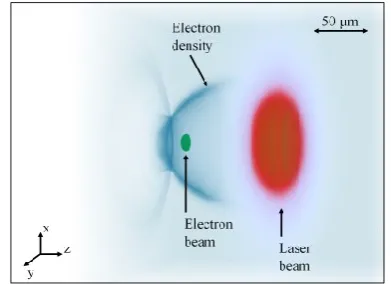
Figure 2. PIC simulation [36] of a LWFA case (configuration 2). The laser pulse (red) propagates the plasma (electron density shown in blue) from left to right and excites a wakefield, which accelerates electrons (shown in green) from 0.1 to 1 GeV in 2.5 cm.
4. Plasma accelerator structure
[image:5.595.82.273.114.265.2]Components necessary for the design of the plasma accelerator structure were reviewed by WP3 in 2017 [35] in which published experimental results were examined and compared not only in terms of achieved electron properties, but also regarding their reliability, stability, or scalability to larger electron energy, or repetition rate. The proposed criteria from [35] for selecting a specific plasma accelerator structure will be used to decide which types of plasma accelerator will ultimately be incorporated into the design report.
Figure 2 shows a particle-in-cell (PIC) simulation [36, 37] performed with the OSIRIS code [38] in which a 1 PW laser traverses a plasma accelerator structure of 1.2 1017cm-3 electron density. The externally injected electron beam (initially: energy E = 100 MeV; relative energy spread σE/E = 0.1%;
transverse emittance εN,x = 1 μrad m) exits the plasma after 2.5 cm with an energy of 1 GeV (σE/E =
1.5%; εN,x = 1 μrad m). While emittance is well preserved, the energy spread is significantly increased
due to the sizable variation of the accelerating field along the injected bunch. Beam loading techniques
[image:5.595.78.523.538.651.2]1234567890
8th International Particle Accelerator Conference IOP Publishing
IOP Conf. Series: Journal of Physics: Conf. Series 874 (2017) 012029 doi :10.1088/1742-6596/874/1/012029
will be used in order to compensate this gradient on the accelerating field and minimize the induced energy spread [39-42]. After completion of 1 GeV simulations with conservation of all beam qualities, simulations of the 5 GeV beam will continue.
5. Layout considerations
The preliminary layout of the EuPRAXIA accelerator tunnel [43] is shown in Figure 3, excluding user areas. Configurations 1, 2, and 4 are visualized. In the current layout, laser and RF infrastructure are situated on the level above the accelerator level floor (not shown). If individual configurations were built separately, the area for the accelerator tunnel for configuration 1, 2, 3, and 4 are 75 m2, 175 m2,
150 m2, and 225 m2, respectively and configuration 1 to 4 can incorporate configuration 5. Hence the
footprint of the accelerator tunnel can be up to 5 times smaller than in conventional accelerator facilities. EuPRAXIA is a site-independent design study. Potential sites will be included in the design report and EuSPARC (Frascati, Italy), SINBAD (Hamburg, Germany), CILEX (Paris, France), CLF (Didcot, UK) and ELI (Prague, Czech Republic) have been discussed as potential sites.
6. Summary
The EuPRAXIA collaboration is preparing a conceptual design report for a multi-GeV plasma-based accelerator with outstanding beam quality. The facility design aims to include FEL radiation in the soft (to hard) X-ray range, a table-top test beam for HEP detectors and industry, and a compact X-ray source for medical imaging. Synchronized TW laser beams will be available in the user areas. Both laser and electron beams are considered as power sources for the plasma accelerator. EuPRAXIA will prepare a proposal to be included on the ESFRI roadmap in 2020 as an innovative European research infrastructure. Ultimately, EuPRAXIA will: use the world-wide leading high power lasers from European industry, drive laser innovation in the connected companies, provide for the first time usable electron beam quality from a plasma accelerator, and serve pilot users from science, engineering, medicine and industry.
References
[1] European Plasma Research Accelerator with eXcellence In Applications http://www.eupraxia-project.eu
[2] Veksler V 1956 Coherent principle of acceleration of charged particles Proc. of the CERN
Symposium on High Energy Accelerators and Pion Physics Geneva Switzerland
[3] Tajima T and Dawson J M 1979 Laser electron-accelerator Phys. Rev. Lett.43(4):267–270 [4] Esarey E et al. 2009 Physics of laser-driven plasma based electron accelerators Rev. Mod. Phys.
81:1229–1285
[5] Modena A et al. 1995 Electron acceleration from the breaking of relativistic plasma waves
Nature377:606 – 608
[6] Umstadter D et al. 1996 Laser injection of ultrashort electron pulses into wakefield plasma waves Phys. Rev. Lett.76(12):2073–2076
[7] Malka V et al. 2002 Electron acceleration by a wake field forced by an intense ultrashort laser pulse Science298(5598):1596–1600
[8] Mangles S P D et al. 2004 Monoenergetic beams of relativistic electrons from intense laser plasma interactions Nature431(7008):535–538
[9] Faure J et al. 2004 A laser-plasma accelerator producing monoenergetic electron beams Nature 431(7008):541–544
[10] Geddes C G R et al. 2004 High-quality electron beams from a laser wakefield accelerator using plasma-channel guiding Nature431(7008):538–541
[11] Leemans W P et al. 2006 GeV electron beams from a centimetrescale accelerator Nat. Phys. 2(10):696–699
1234567890
8th International Particle Accelerator Conference IOP Publishing
IOP Conf. Series: Journal of Physics: Conf. Series 874 (2017) 012029 doi :10.1088/1742-6596/874/1/012029
[13] Assmann R W et al. 2014 Accelerator Physics Challenges towards a Plasma Accelerator with Usable Beam Quality Proc. of 5th International Particle Accelerator Conference Dresden Germany
[14] Leemans W P et al. 2014 Multi-GeV Electron Beams from Capillary-Discharge-Guided Sub petawatt Laser Pulses in the Self-Trapping Regime Phys. Rev. Lett.113 245002
[15] Kneip S et al. 2009 Near-GeV acceleration of electrons by a nonlinear plasma wave driven by a self-guided laser pulse Phys. Rev. Lett.103:035002
[16] Fuchs M et al. 2009 Laser-driven soft-X-ray undulator source Nature Physics5 826 – 829 [17] Maier A R 2012 Stabilized Water-Window X-Ray Pulses from a Laser-Plasma Driven
Undulator PhD thesis Ludwig-Maximilians-Universität München
[18] Lambert G et al. 2012 Progress on the generation of undulator radiation in the UV from a plasma-based electron beam Proc. FEL Conf. Nara Japan
[19] Cipiccia S et al. 2012 A tuneable ultra-compact high-power, ultra-short pulsed, bright gamma-ray source based on bremsstrahlung radiation from laser-plasma accelerated electrons
Journal of Applied Physics111(6):063302
[20] Anania M P et al. 2014 An ultrashort pulse ultra-violet radiation undulator source driven by a laser plasma wakefield accelerator Applied Physics Letters104 264102
[21] Khrennikov K et al. 2015 Tunable all-optical quasimonochromatic Thomson X-ray source in the nonlinear regime Phys. Rev. Lett.114(19):195003
[22] Chen P 1985 Acceleration of Electrons by the Interaction of a Bunched Electron Beam with a Plasma Phys. Rev. Lett.54 693
[23] Wang S et al. 2001 Observation of spontaneous emitted X-ray betatron radiation in beam-plasma interactions Proc. of 19th IEEE PAC Chicago IL USA
[24] Blumenfeld I et al. 2007 Energy doubling of 42 GeV electrons in a metre-scale plasma wakefield accelerator Nature445 741
[25] Litos M et al. 2014 High-efficiency acceleration of an electron beam in a plasma wakefield accelerator Nature515 7525:92-5
[26] Ferrario M et al. 2013 SPARC_LAB present and future Nuclear Instruments and Methods in
Physics ResearchB309 183–188
[27] Aschikhin A et al. 2016 The FLASHForward facility at DESY Nucl. Instrum. Meth. Vol. 806
175-183
[28] Kasilnikov M et al. 2012 Experimentally minimized beam emittance from an L-band photoinjector Phys. Rev. ST Accel. Beams15 100701
[29] Hidding B et al. 2010 Monoenergetic Energy Doubling in a Hybrid Laser-Plasma Wakefield Accelerator Phys. Rev. Lett.104 195002
[30] Martinez de la Ossa A et al. 2013 High-Quality Electron Beams from Beam-Driven Plasma Accelerators by Wakefield-Induced Ionization Injection Phys. Rev. Lett.111 245003
[31] Walker P A et al. 2016 Report defining preliminary study concept EuPRAXIA Deliverable Report 1.2
[32] Gizzi L A et al. 2016 Benchmarking of existing technology and comparison with the
requirements EuPRAXIA Deliverable Report 4.1
[33] Cros B et al. 2017 Electron injector for multi-stage laser-driven plasma accelerators presented
at the 8th Int. Particle Accelerator Conf. Copenhagen Denmark WEPVA001
[34] Chiadroni E et al. 2016 Preliminary RF accelerator specifications EuPRAXIA Milestone Report 5.2
[35] Cros B et al. 2017 Design for an electron injector and a laser plasma stage proposed
EuPRAXIA Milestone Report 3.1
[36] Ferran Pousa A et al. 2017 VisualPIC: A New Data Visualizer and Post-Processor for Particle-in-Cell Codes presented at the 8th Int. Particle Accelerator Conf. Copenhagen Denmark TUPIK007
1234567890
8th International Particle Accelerator Conference IOP Publishing
IOP Conf. Series: Journal of Physics: Conf. Series 874 (2017) 012029 doi :10.1088/1742-6596/874/1/012029
[38] Fonseca R A et al. 2002 OSIRIS: A Three-Dimensional, Fully Relativistic Particle in Cell Code
for Modeling Plasma Based Accelerators Sloot P.M.A., Hoekstra A.G., Tan C.J.K.,
Dongarra J.J. (eds) Computational Science — ICCS 2002. ICCS 2002. Lecture Notes in Computer Science vol 2331 Springer Berlin Heidelberg
[39] Katsouleas T et al. 1987 Beam loading in plasma accelerators Particle Accelerators22:81–99 [40] Tzoufras M et al. 2008 Beam loading in the nonlinear regime of plasma-based acceleration
Phys. Rev. Lett.101:145002
[41] Rechatin C et al. 2009 Observation of Beam Loading in a Laser-Plasma Accelerator Phys. Rev.
Lett.103:194804
[42] Schroeder C B et al. 2013 Beam loading in a laser-plasma accelerator using a near-hollow plasma channel Physics of Plasmas20 123115
[43] Walker P A et al. 2017 Space considerations and possible layouts for future plasma accelerator facilities in the context of EuPRAXIA presented at the 8th Int. Particle Accelerator Conf.
Copenhagen Denmark TUPIK012
Acknowledgments